Once again the summer holidays have arrived and on the morning of a Sunday in August we set off in our car, heading south, but we won't be staying in Italy, because once we reach Puglia we'll board a ferry for Greece... and it's a welcome return after the camper trip five years ago along the entire eastern part of the country and even all the way down to the beautiful Island of Crete. This time we'll stay in the west to see, in sequence from south to north, almost all the Ionian Islands... So it will be a holiday mostly of sea and it won't be easy to match in beauty the Caribbean beaches of Antigua and Barbuda that we still have clearly impressed in our minds: a memory that goes back only a few months.
It's a scorching mid-summer day and, despite the heavy traffic along the A14 motorway, we cover the entire Adriatic coast without any particular hitches, so in the early afternoon hours we reach the port of the city of Brindisi, where we immediately queue up for boarding. The wait, on the burning asphalt, is not the easiest and it's a relief when, around 18:00, the loading operations of the ferry Egypt Express, of the Adriatica shipping company, begin, and once completed, in the evening, we set sail with the bow pointed toward Hellas.
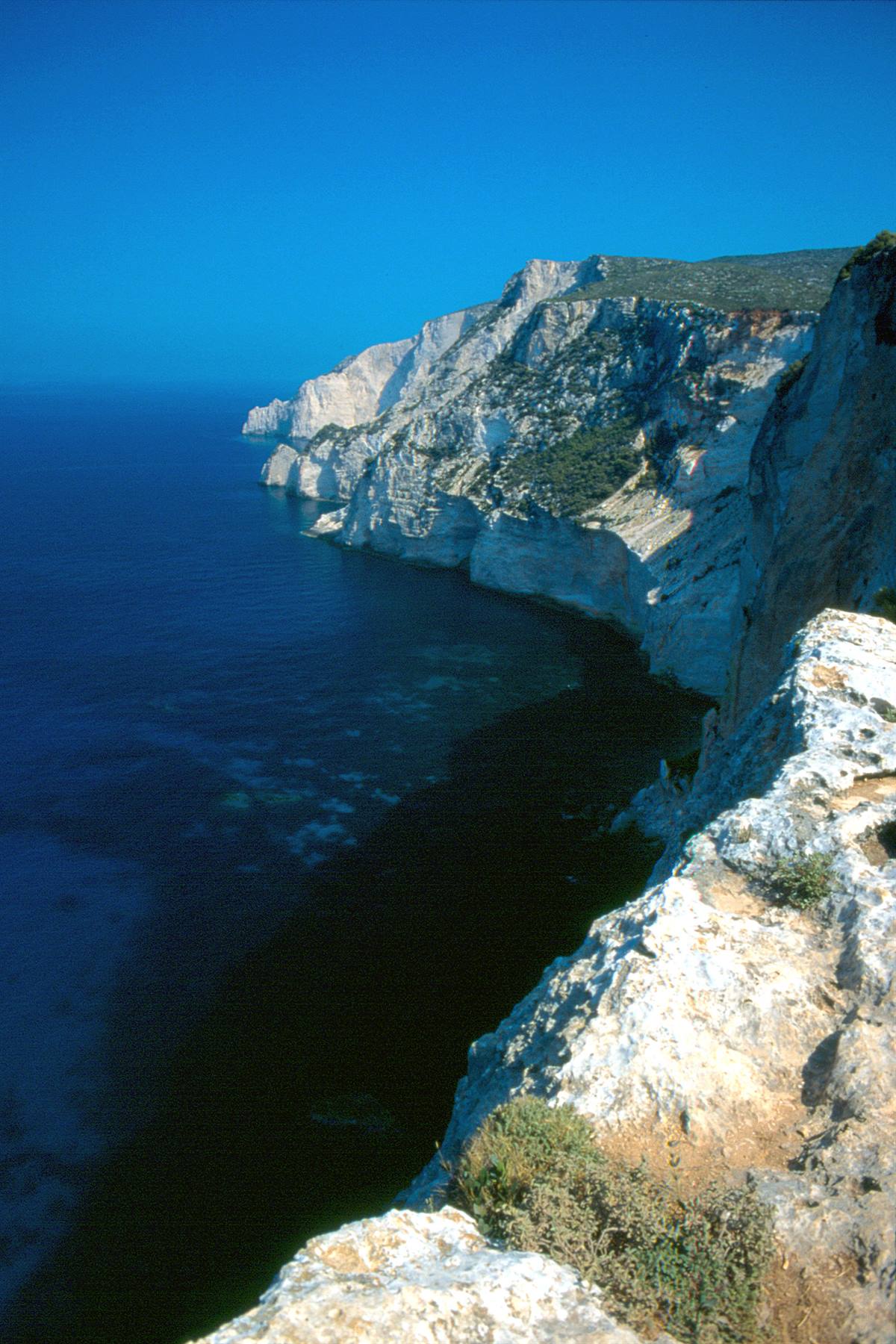
Zakynthos - West coast
Day 27 Aug 1995
After a night spent as best we could on the deck of the ship, dawn begins to break and around 7:00 the first coasts of Greece appear on the left of our route, then, later, also the port of Patras, our first destination, where we dock with the sun now high on the horizon. As soon as we disembark, with our shiny grey Uno, we start following the road that descends toward the south of the Peloponnese, the extreme continental Greek region that stretches toward the Island of Crete, between the Aegean Sea and the Ionian Sea. We thus reach the locality of Kilini, from whose small port we'll board for Zante (or Zakynthos), the first of the Ionian Islands we'll visit. In the torrid climate of this day we then wait for another ferry, which arrives in the early afternoon and which shortly afterward sets sail, allowing us, in about an hour, to reach our destination.
Zante, which has an area of 417 square kilometres and about thirty thousand inhabitants, a third of whom reside in the capital Zakinthos, is the southernmost of the Ionian Islands, if we exclude Kythira which is much further south but which is not geographically part of the group, and according to legend it owes its name precisely to Zakinthos, mythological son of King Dardanus of Troy... Its most famous inhabitant, however, is the poet Ugo Foscolo, who was born there in 1778 and who thus praised his land, just conquered by the Turks, in the famous sonnet "A Zazinto":...
"Nor shall I ever again touch the sacred shores, where my childish body lay, my Zacinto, who mirror yourself in the waters of the Greek sea from which, a virgin, she was born..." Sailing then in the Greek sea we disembark in the port of the capital and immediately set off, along the northern coast, in search of accommodation for the coming days... Accommodation that we find practically on the first try, in the locality of Alikes, thus being able to enjoy the well-deserved rest after the long journey.
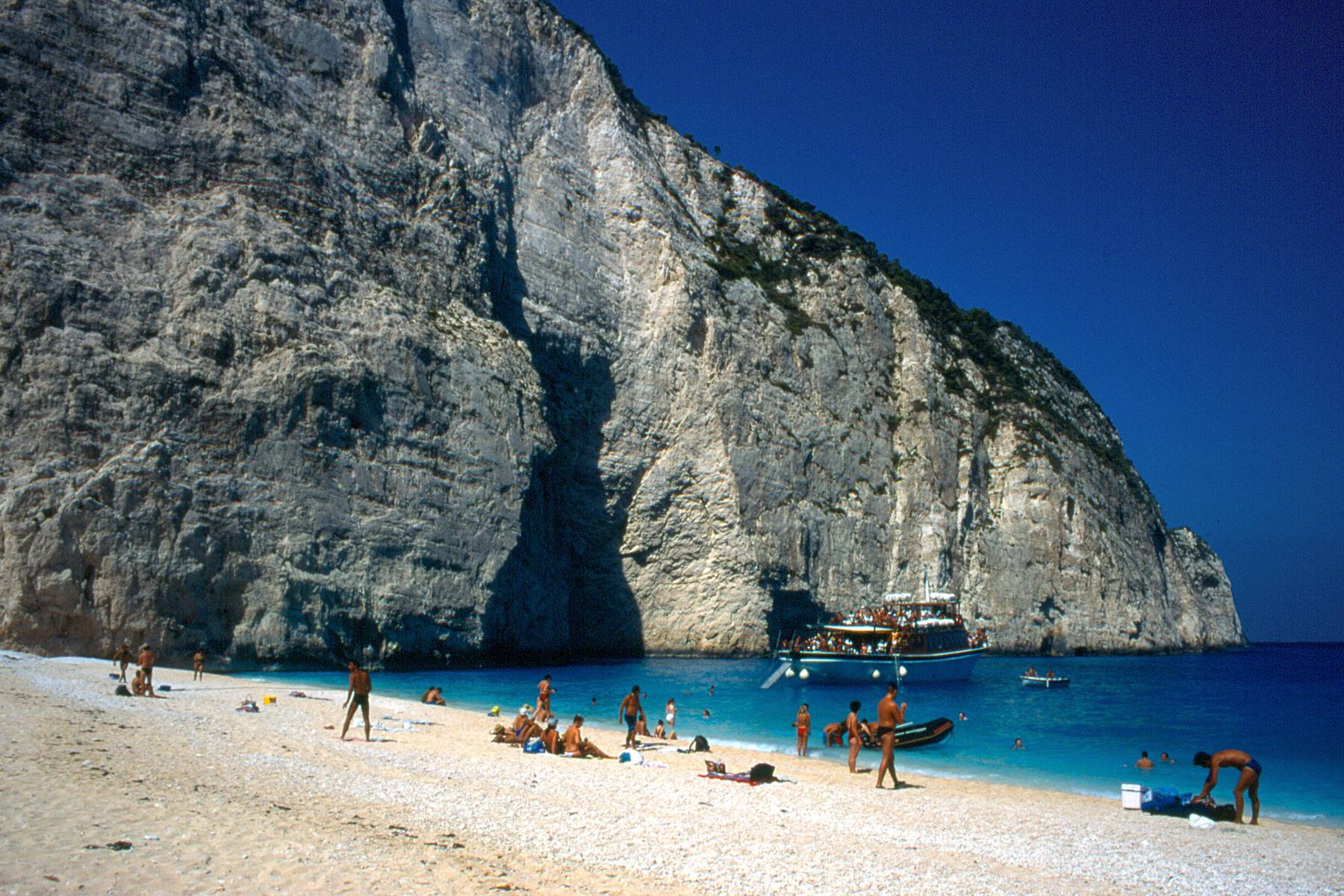
Zante - Navajo Bay
Day 38 Aug 1995
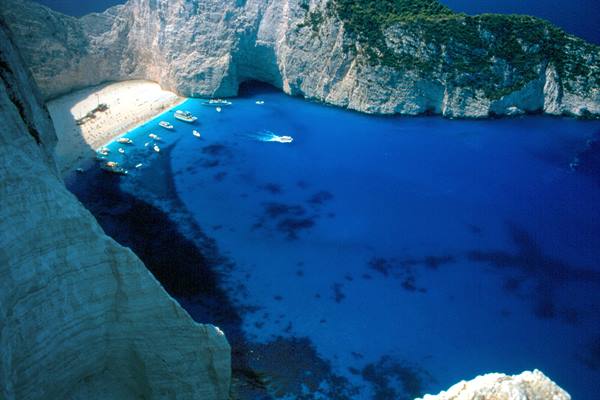
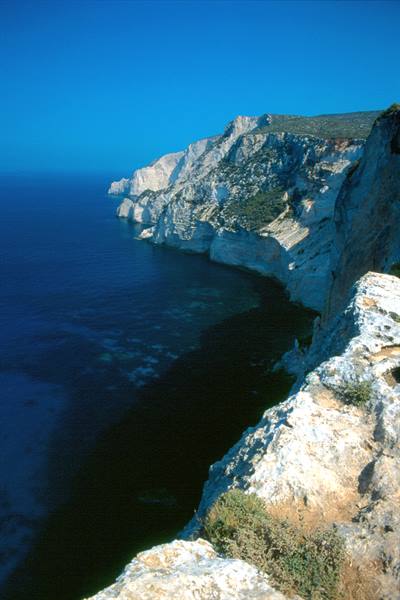
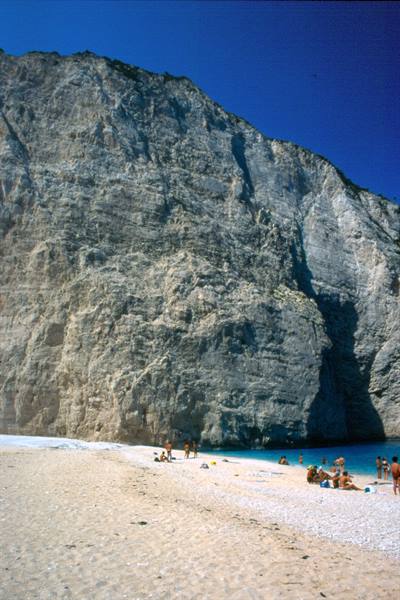
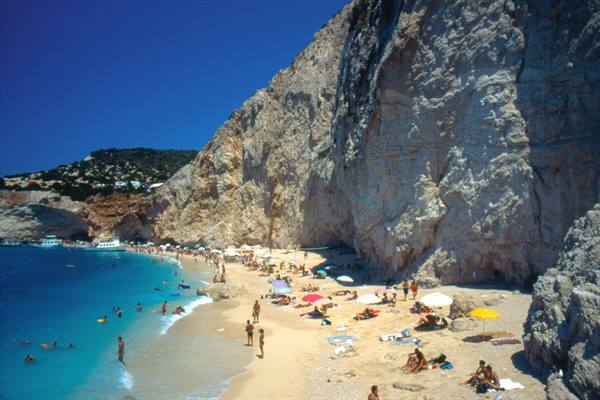
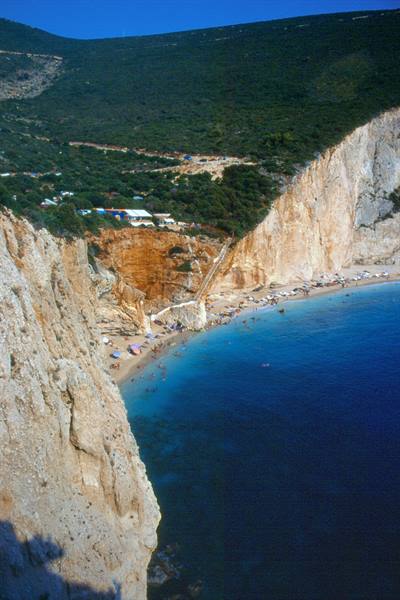
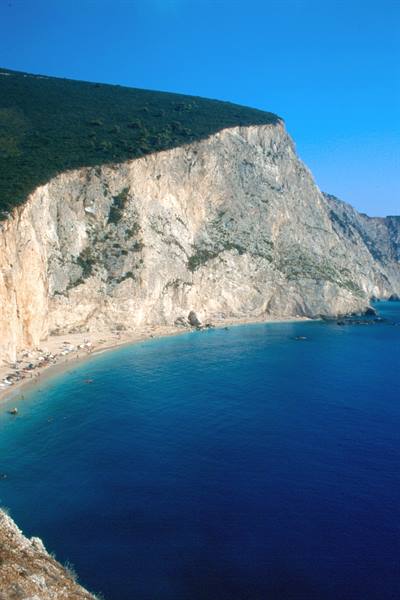
In the morning we set off calmly to discover the Island of Zante and its 123 kilometres of "sacred shores". First of all we climb toward the western part of the island, the highest and with the most rugged coasts, largely inaccessible. Travelling thus along long stretches of dirt road we come to see from above the cliffs that tower over Zante's most famous beach, that of Navajo Bay, several times the cover of the most varied tourist magazines. The stretch of coast in question is truly spectacular, with the white walls sheer above a cobalt sea and the shades of electric blue that characterise the entire, beautiful, Bay of Navajo: a crescent of blinding sand marvellously set among the rocks, so perfect in its features that it seems the fruit of a divine project.
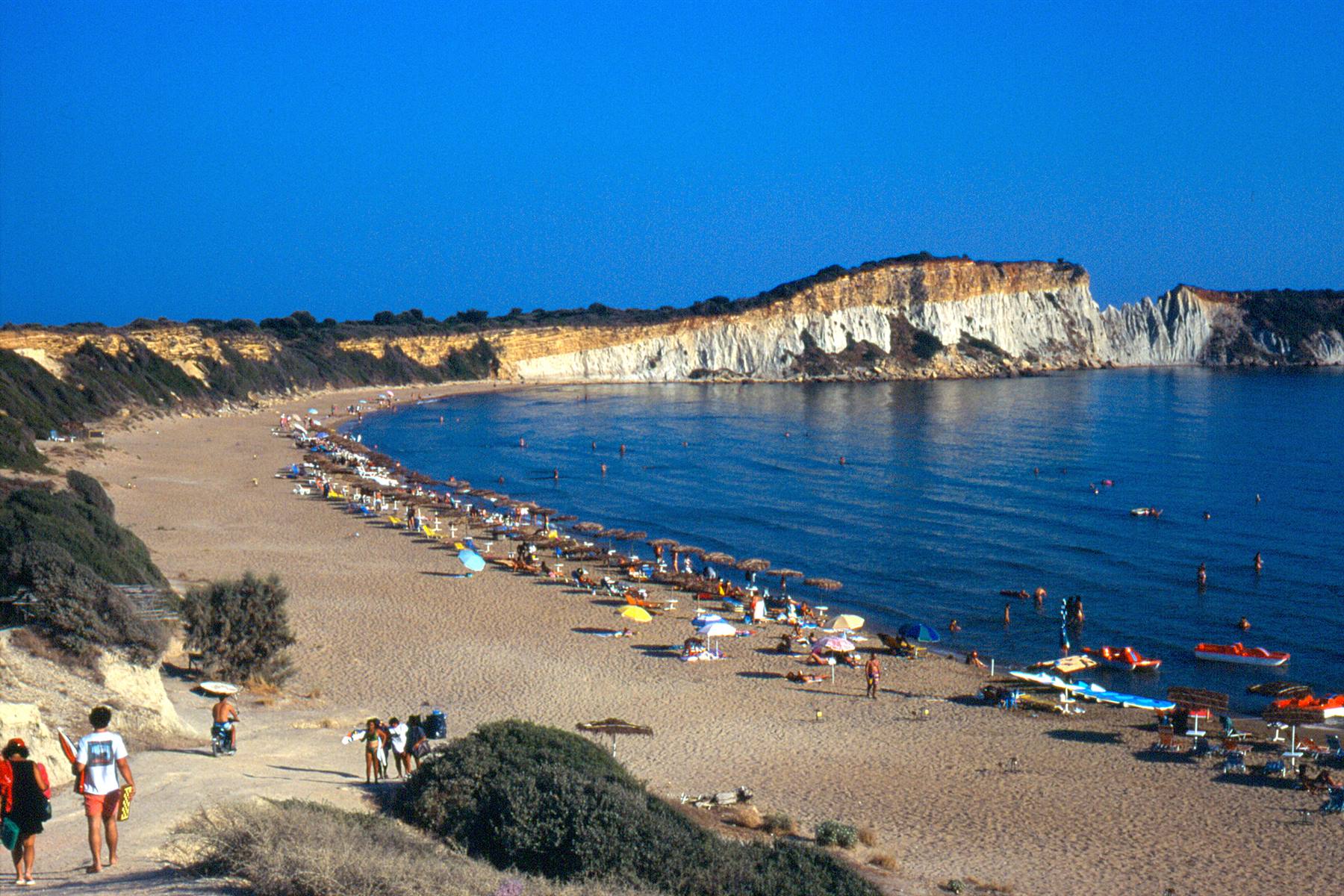
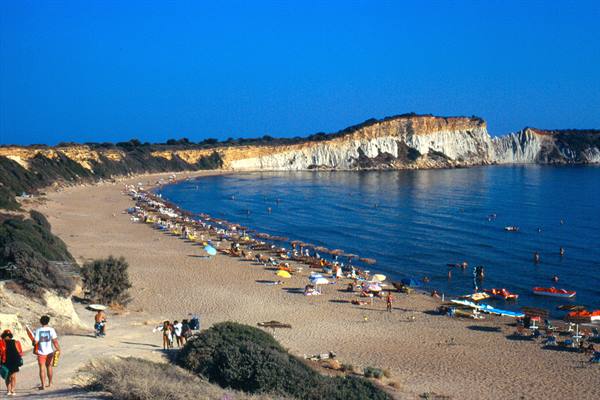
We stay a long time observing the beach from above and we promise ourselves to reach it by sea in the coming days, so then, slowly, we begin to descend toward more accessible shores, where we can spend the rest of the day. We move to the south of the island, looking for a beach to our liking in the wide Gulf of Lagana, but we find nothing that suits us... We thus arrive, on the extreme eastern tip, at Gerakas beach, in what was supposed to be one of the main destinations of the coming days. The bay, in fact, all reddish sand, is enclosed to the south by a scenic two-toned promontory and is famous for being the most important in the Mediterranean for the nesting of the Caretta-Caretta sea turtles. In summer the reptiles come ashore and each lays about 120 eggs, which they meticulously hide in the sand at a depth of 20-45 centimetres...
After about two months the little ones are born, and they as soon as possible clumsily regain their natural environment, for this reason Gerakas Beach is protected by WWF volunteers, who watch over the nests and carefully mark them with small metal cages (currently there are three or four scattered along the entire beach). Of course, it would be nice to see a hatching, but I don't think we'll manage it... Meanwhile, though, we enjoy on the spot a fiery sunset and in this way we positively conclude the day.
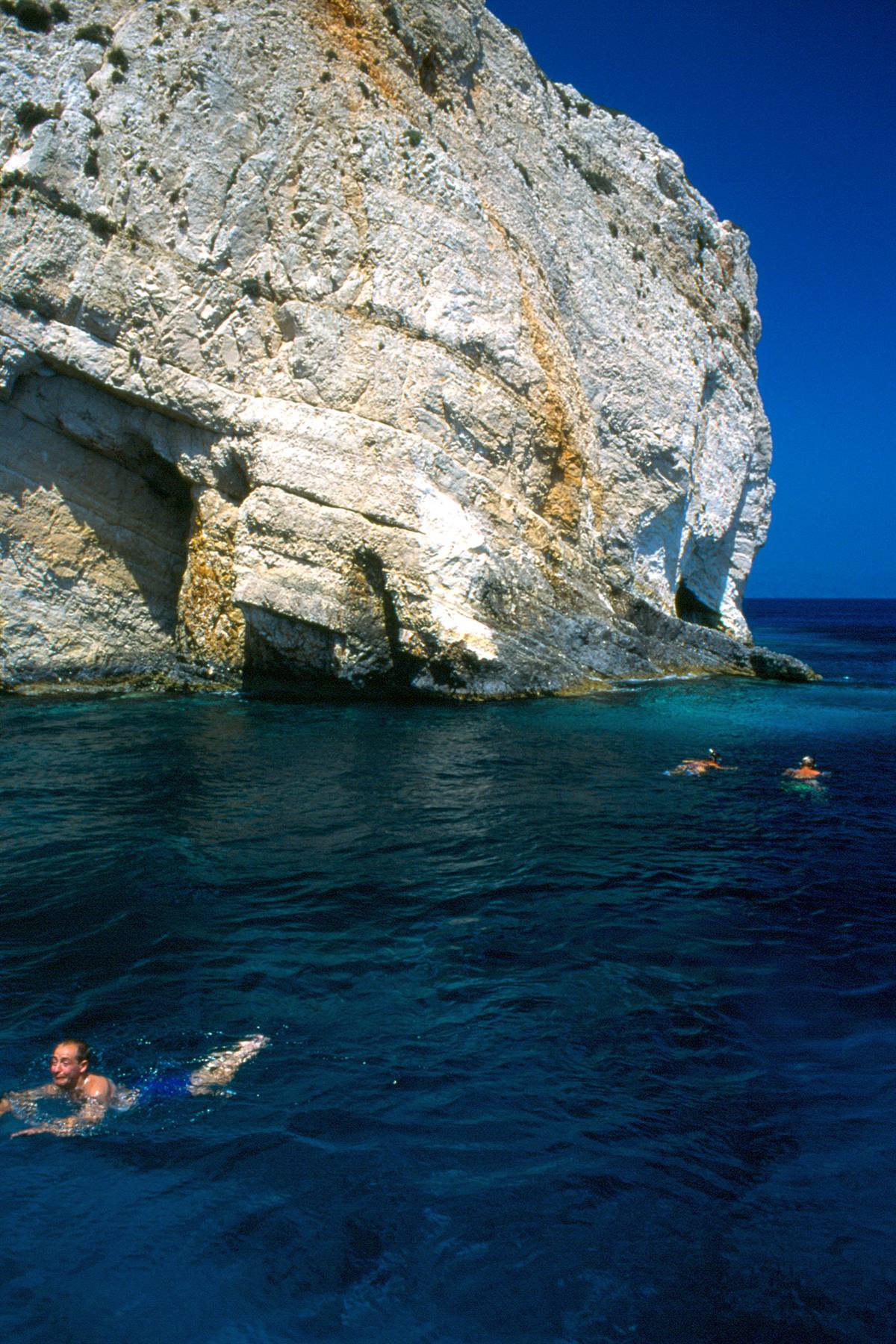
Zakynthos - Cape Skinari
Day 49 Aug 1995
In the morning of the new day, we set off in search of a beach, but none satisfies our needs, so we end up again at Gerakas Beach, which seems to be the only beach of a certain level on the island, if we exclude the inaccessible Navajo Bay. We spend the entire morning on the spot and also part of the afternoon, then we move to visit Zakinthos, the capital of Zante, but we remain in some way disappointed, in fact its appearance is that of a modern city, because in 1953 a devastating earthquake practically razed to the ground all its most important historic buildings and anyway architecturally noteworthy.
Zakynthos - Gerakas Beach
Day 510 Aug 1995
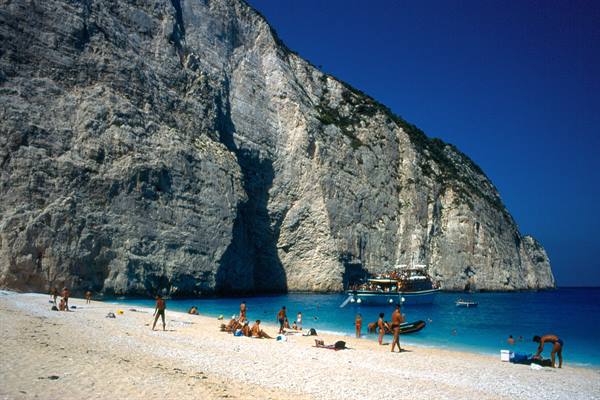
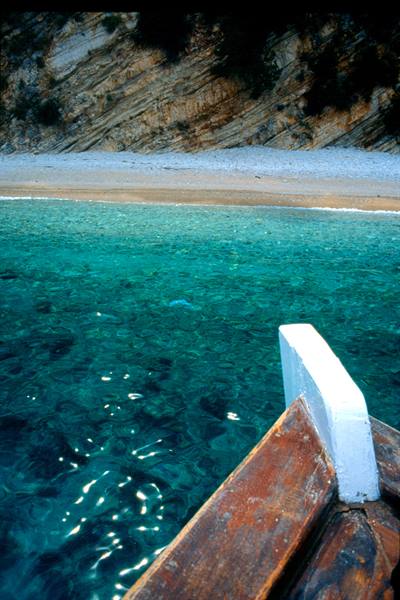
After another night at Alikes, when we wake up we go north toward the port of Korithi, from which we set sail for a boat excursion that will occupy us for the whole day. We round Cape Skinari, the northernmost tip of Zante, and begin to follow the rugged and spectacular coast facing westward, so, around 11:00, we arrive at the famous Navajo Bay... The beach, all light pebbles, is splendid also seen from below, with the suggestive cliffs behind it, which exceed one hundred metres in height, and with the shipwreck in the centre, which only relatively recently gave it its name, now reduced to a shapeless mass of rusty scrap iron. We settle on the shore with our towels, while at midday the landings of tourists are truly numerous, and we enjoy the sea of Navajo Bay, which is an intense blue, but not crystal clear, indeed, rather murky and milky...
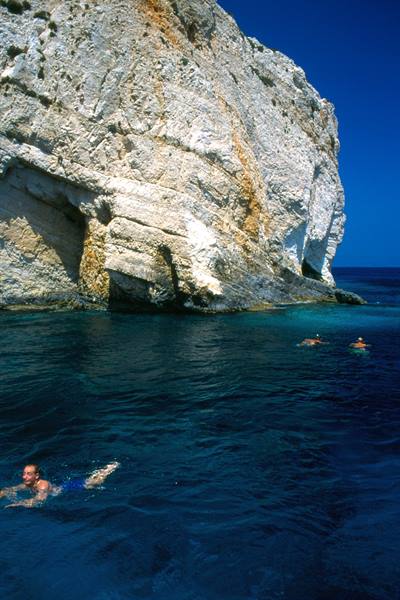
The hours nonetheless pass happily and, after a Spartan lunch, in the afternoon we resume navigation toward the north and toward the port from which we set off... Rounding Cape Skinari again we stop thus to visit, in its vicinity, a series of crevices, among which the inevitable Blue Grotto, characterised all around by a stupendous sea with paradisiacal reflections.
Kefalonia - Megas Lakos Beach
Day 611 Aug 1995
The first Ionian island, with the boat excursion to Navajo Bay, can be said to be conquered and after the last night spent at Zante, in the early hours of the morning, with all the luggage loaded in the car, we return to the port of Kotithi, to board, this time, for the Island of Cephalonia, which can be glimpsed in the haze a little further north. Two hours of sailing separate us from the landing of Pessada, on the south-western coast of what is, with its 688 square kilometres, the largest of the Ionian Islands, which owes its name to Kefalo, mythological local hero, and is sadly famous to us Italians for the tragedy of the Acqui division, here massacred by the Germans at the end of the Second World War.
Half a century after those events we, new Italians of the nineties, will however prefer to remember Cephalonia for other reasons, starting with its natural beauties and the blue sea that surrounds it... Having disembarked from the ferry we stop thus in the immediate vicinity of the beautiful Kaligata Beach, where we spend a few hours in complete relax. In the afternoon we move to the other side of the island, near Sami, the major port of Cephalonia, so as to find accommodation for the period of time we have decided to spend on the spot, but it's the weekend preceding the week of Ferragosto also in Greece and initially we find one, but it seems too expensive to us and after...
we find no others: all sold out apparently! There's nothing left to do then but go to the nearby campsite and pitch the tent that we had brought precisely for cases of extreme necessity, but it's only a temporary surrender, because tomorrow we'll try to do another search, maybe in more outlying areas.
Kefalonia - Ormos Atheras Bay
Day 712 Aug 1995
In the early hours of the morning we take down the tent and leave the Sami campsite. The day is characterised by a dense haze, so we abandon the idea of climbing Mount Enos, which with its 1628 metres is the highest peak of the Ionian Islands, and we prefer to go to the sea in the westernmost part of Cephalonia. Along the coastal road between Sami and Lixouri we find a room-rental owner who has one free for the afternoon: we agree on the price and, without even demanding a deposit, he sets an appointment for the evening, so more relieved we can go in search of a beach that satisfies our bathing needs.
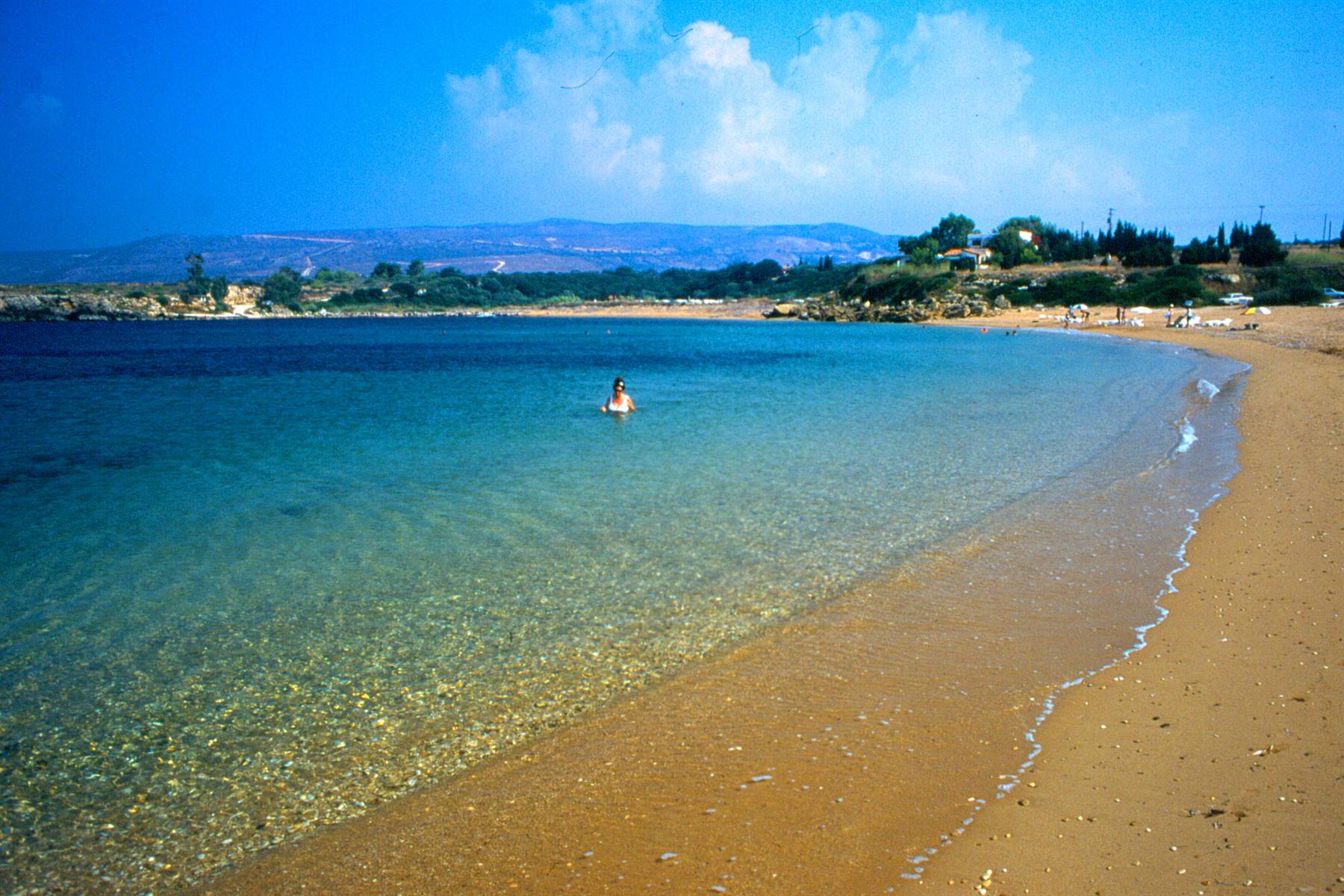
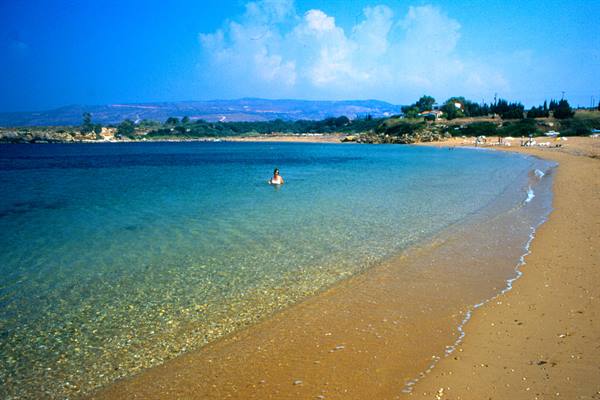
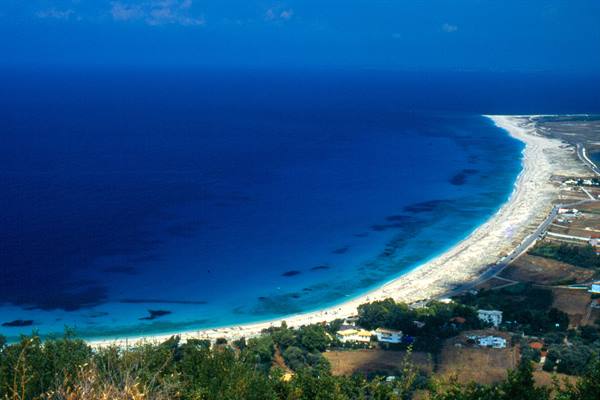
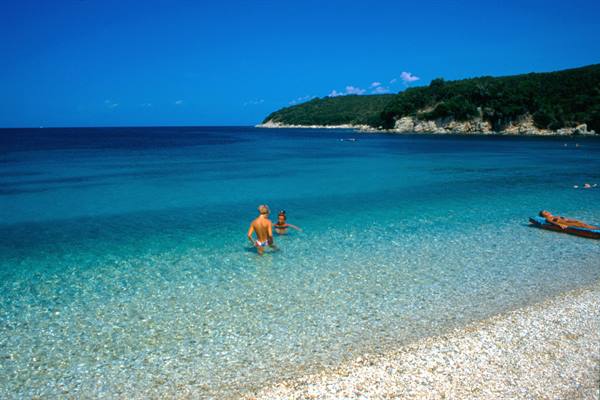
We cross the town of Lixouri and go a little further south to Megas Lakos Beach: the beach, all reddish sand and washed by a splendid crystal-clear sea, pleases us and we spend there the whole morning and the early hours of the afternoon, then we move further north, to the solitary Bay of Ormos Atheras, near Agios Spiridhon. This beach too is extremely interesting and entices us to stay until almost evening, emboldened by the fact that our new and comfortable little room awaits us nearby... However when we show up, around 19:00, we discover that the owner, intimidated by the fact that we might not return, had just rented it to another couple... damn: I had even offered him the deposit! No use crying over spilt milk, so rather downcast we get back in our Uno and in religious silence we return to the Sami campsite where, with darkness now complete, we sadly pitch our tent again.
Kefalonia - Myrtos Bay
Day 813 Aug 1995
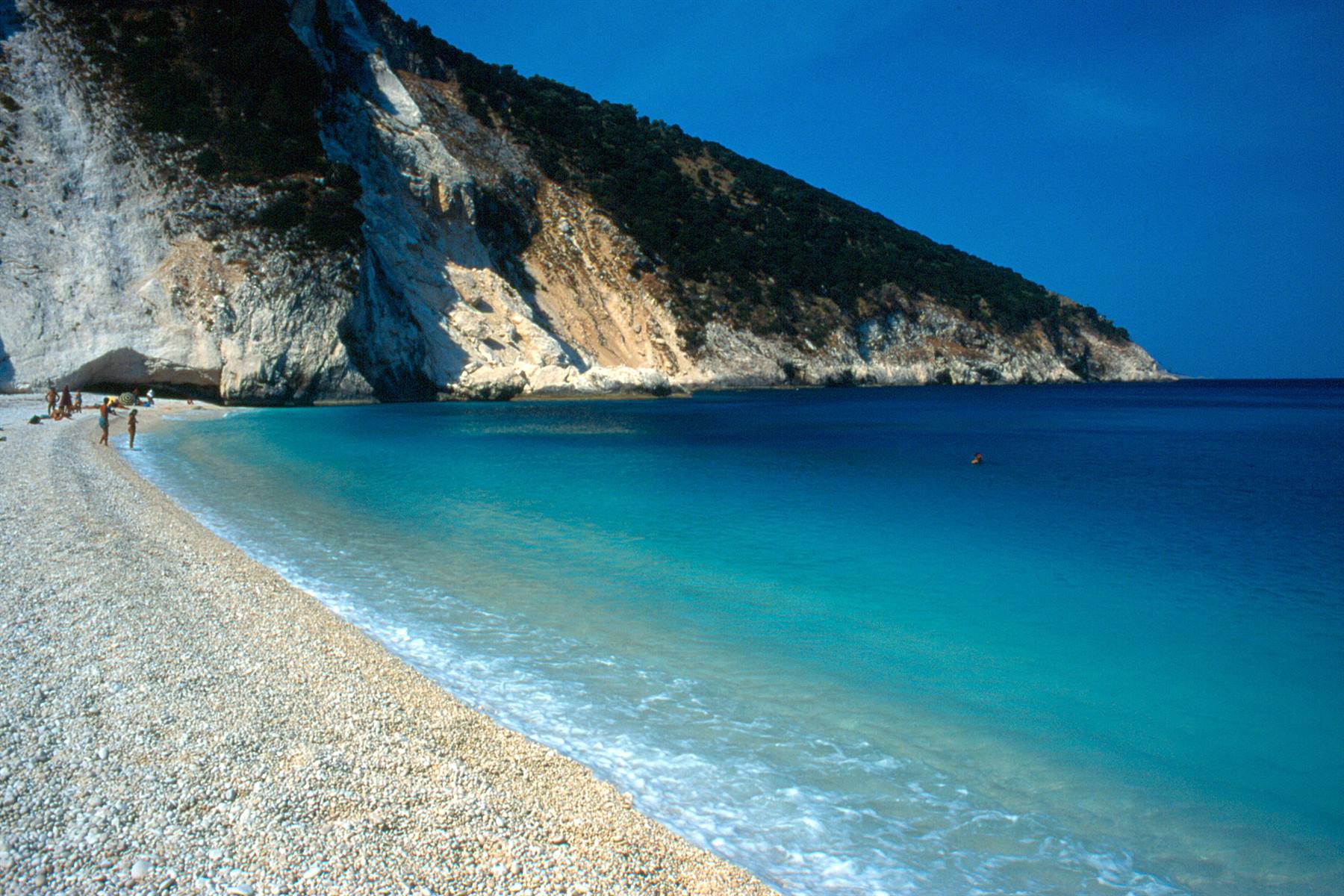
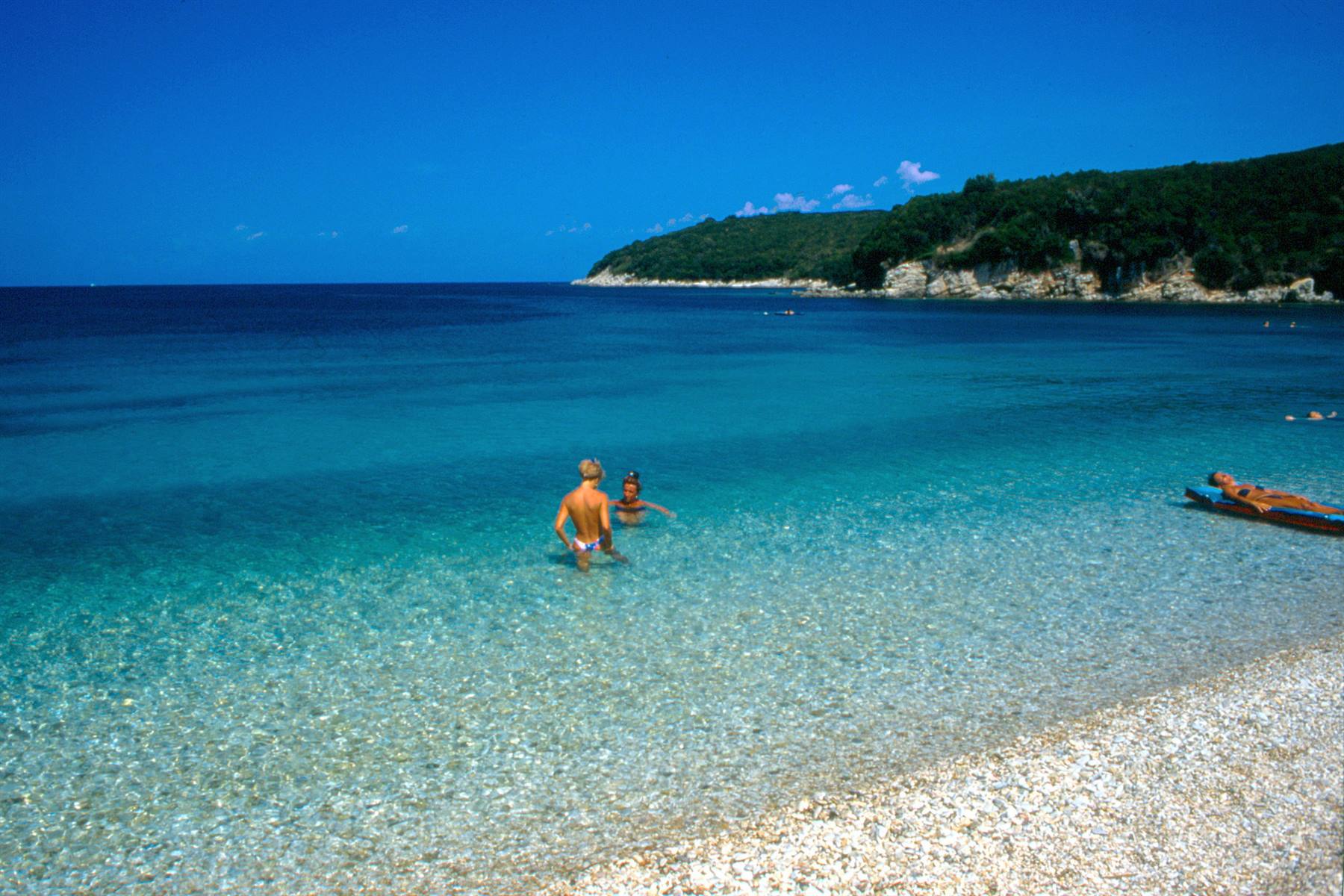
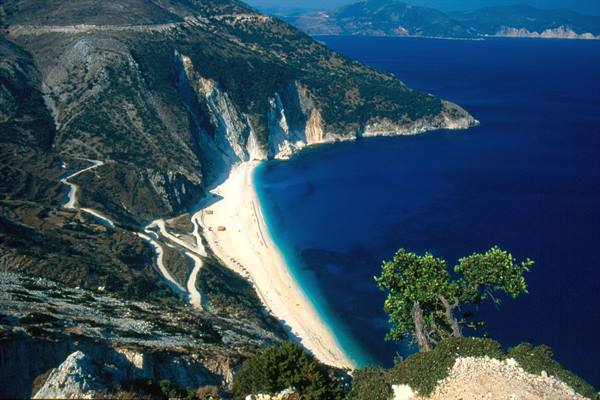
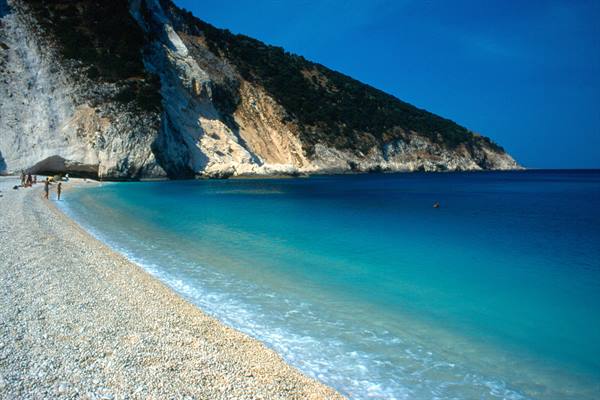
At dawn of the new day, resigned, we leave our ephemeral accommodation pitched on the soil of Cephalonia and drive off along the north-western coast to Assos and its Venetian fortress, perched on a small promontory right in front of the village, then we retrace our steps and go to observe from above the spectacular Myrtos Bay. A dirt road descends in tight hairpin bends to the shores of what is probably the most beautiful inlet on the island, lined with very white pebbles, washed by turquoise waters and framed by a grandiose amphitheatre of light-coloured rock. We go and settle at the foot of the steep cliff that characterises the left part of the beach and spend at Myrtos Bay, in practice, the whole day, alternating wonderful sunbathing and swimming... until almost evening, when we calmly return to our very modest but providential bed.
Having gone out, as in the last two days, for dinner in the centre of Sami, we purchase for tomorrow a boat excursion to the opposite Island of Ithaca, whose outline can be clearly glimpsed beyond the very narrow stretch of sea that separates it from Cephalonia. (Initially we had decided to go there by car and stay there at least two nights, but the difficulties in finding beds made us desist from doing so).
Ithaca - Bay along the coast
Day 914 Aug 1995
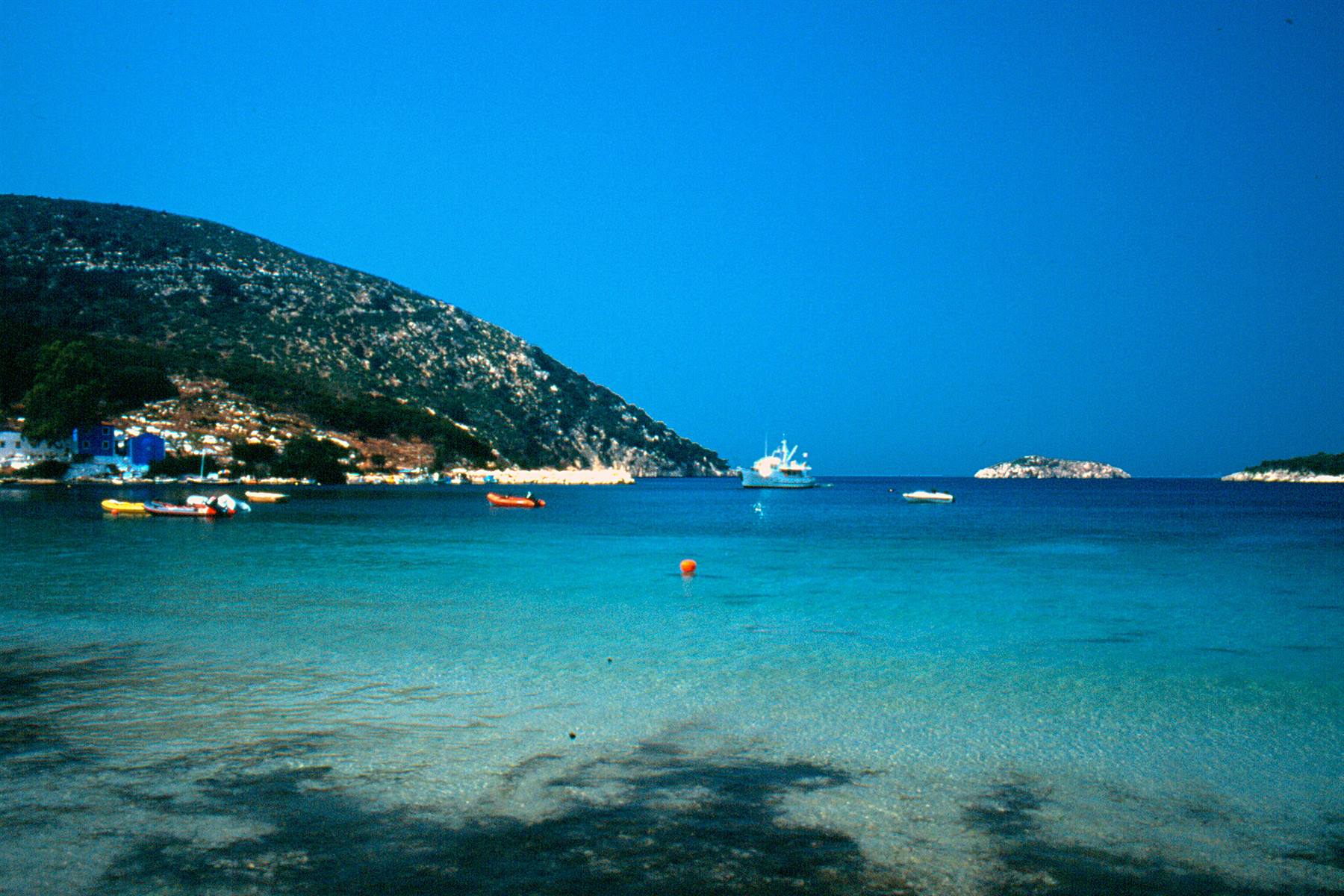
Ithaca, legendary land of Ulysses, told by Homer in the Odyssey, is a very small island, only 24 kilometres long with an area of 96 and with 3600 inhabitants (that's how many to this day are the subjects of the mythical hero of the Trojan War), but it can offer splendid landscapes with a typically Mediterranean flavour. We leave the port of Sami and prepare to follow the coast of Ithaca anticlockwise. We round its southernmost cape and, ascending along the jagged coastline, we stop, at mid-morning, in a wild inlet characterised by crystal-clear waters for a refreshing swim, then, back on board, we sail to Vathi, the tiny capital, all buildings mostly recent, because here too not much has remained after the devastating 1953 earthquake.
Continuing to plough the waves with the bow pointed north we arrive by lunchtime at the characteristic village of Kioni, located at the end of a deep bay and overlooked by mountains that exceed eight hundred metres in height (no small thing considering the size of the island). After a long and relaxing stop we set off on the return journey, we stop to have another swim in the beautiful sea of Ulysses and in the late afternoon we regain the pier of Sami... then we enjoy a fiery sunset and put an end also to this intriguing day lived between mythology and nature.
Kefalonia - Fiskardo
Day 1015 Aug 1995
Ferragosto begins with the taking down of the tent, but we don't leave Cephalonia right away. First of all we go, just outside the town of Sami, to the curious Melissani Cave... The seawater, at a precise point on the western coast of the island, near Argostoli, is swallowed into the underground and after about fourteen days reappears, mineralised, fifteen kilometres away, on the opposite side of Cephalonia, precisely in this crevice. The Melissani Cave is accessed by boat, floating on incredibly clear and fresh water, but its name is in some ways improper, because the ceiling collapsed following an earthquake and the place, located at sixteen metres depth, is scientifically classified as a "chasm lake"... of course, the phenomenon is very strange and the setting extremely original, so the visit proves, on the whole, a beautiful experience.
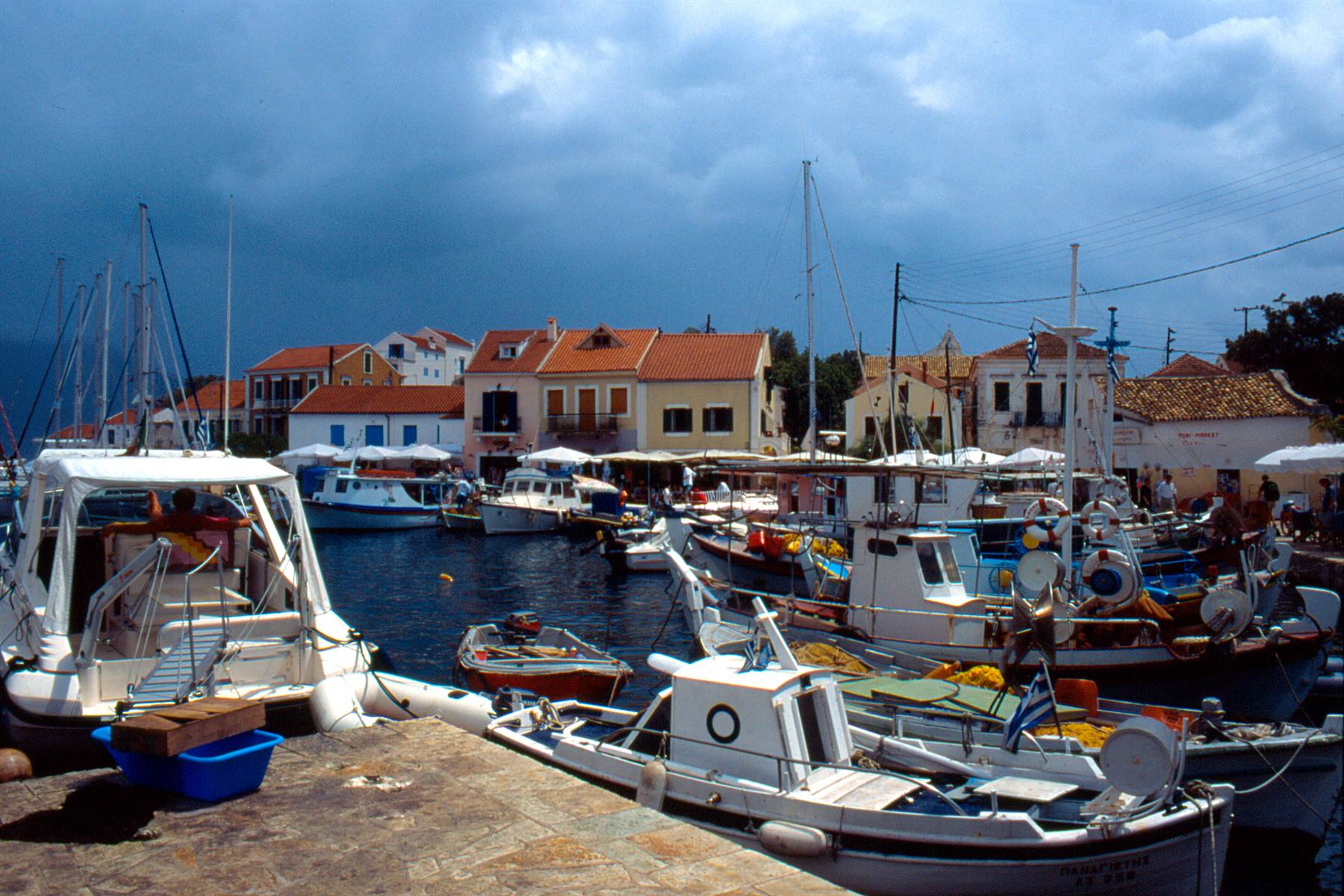
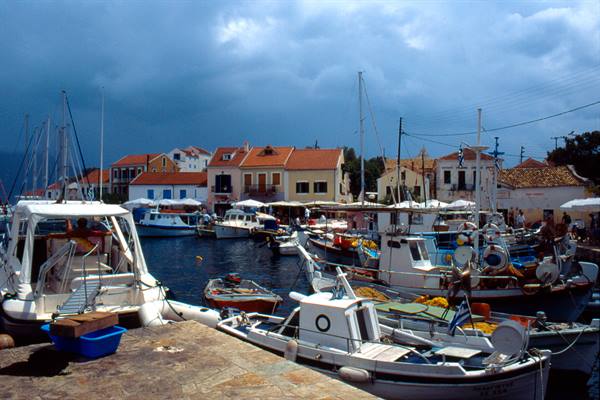
Returned to the full light of the sun, in the early afternoon, we follow the coastal road that arrives at the extreme northern tip of the island at the locality of Fiskardo (from Robert Guiscard, Norman commander, who died here in 1085)... The village, with its very characteristic little port, is the only one that in small part was saved from the devastating earthquake of '53. We wander briefly through the interesting central streets of the village and later, right from Fiskardo, we board for the next island.
We leave Cephalonia behind us and sailing placidly northward we brush past Ithaca, then the tiny archipelago formed by the islets of Kastos, Madouri, Meganissi, Sparti and Skorpios, the latter the private retreat of the very famous Onassis family, and we arrive almost by evening at Lefkada which, extending over 325 square kilometres, can be defined as an island by only twenty metres, that being the width of the narrow channel that separates it from the mainland. We disembark in the locality of Nidri, in the centre of the eastern coast, and there, fortunately, we find accommodation, with an elderly lady who manages a small building all of mini-apartments for tourists, but ours will only be free tomorrow and for tonight she hosts us directly in her own home...
The place is rather spooky, with a creaking wooden staircase and a ceiling of canes plastered over which you can hear rats running... not exactly a pleasant sensation, but the thought of having to pitch the tent again gives us the courage to face the situation... and God willing it also becomes morning.
Lefkada - Porto Katsiki Bay
Day 1116 Aug 1995
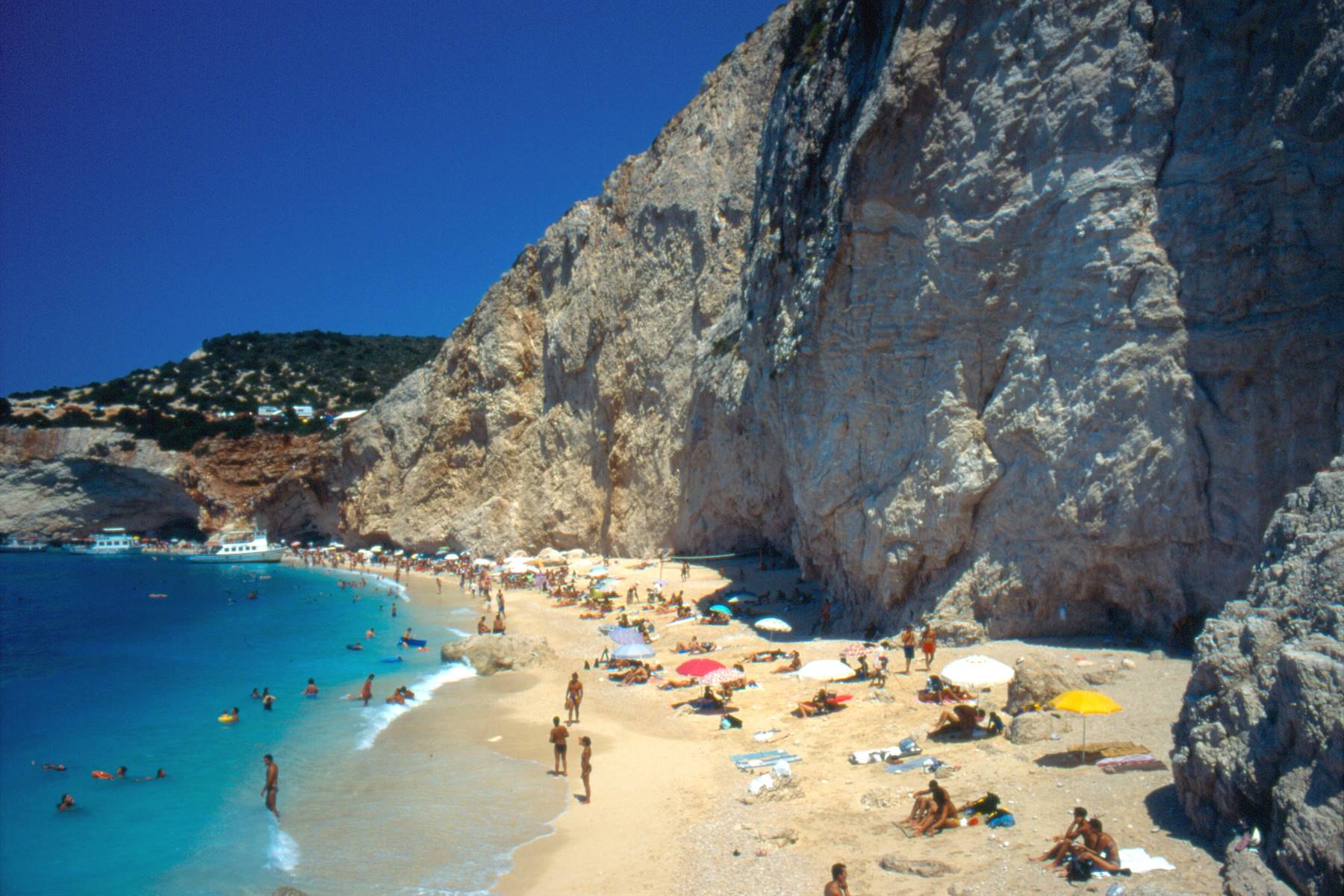
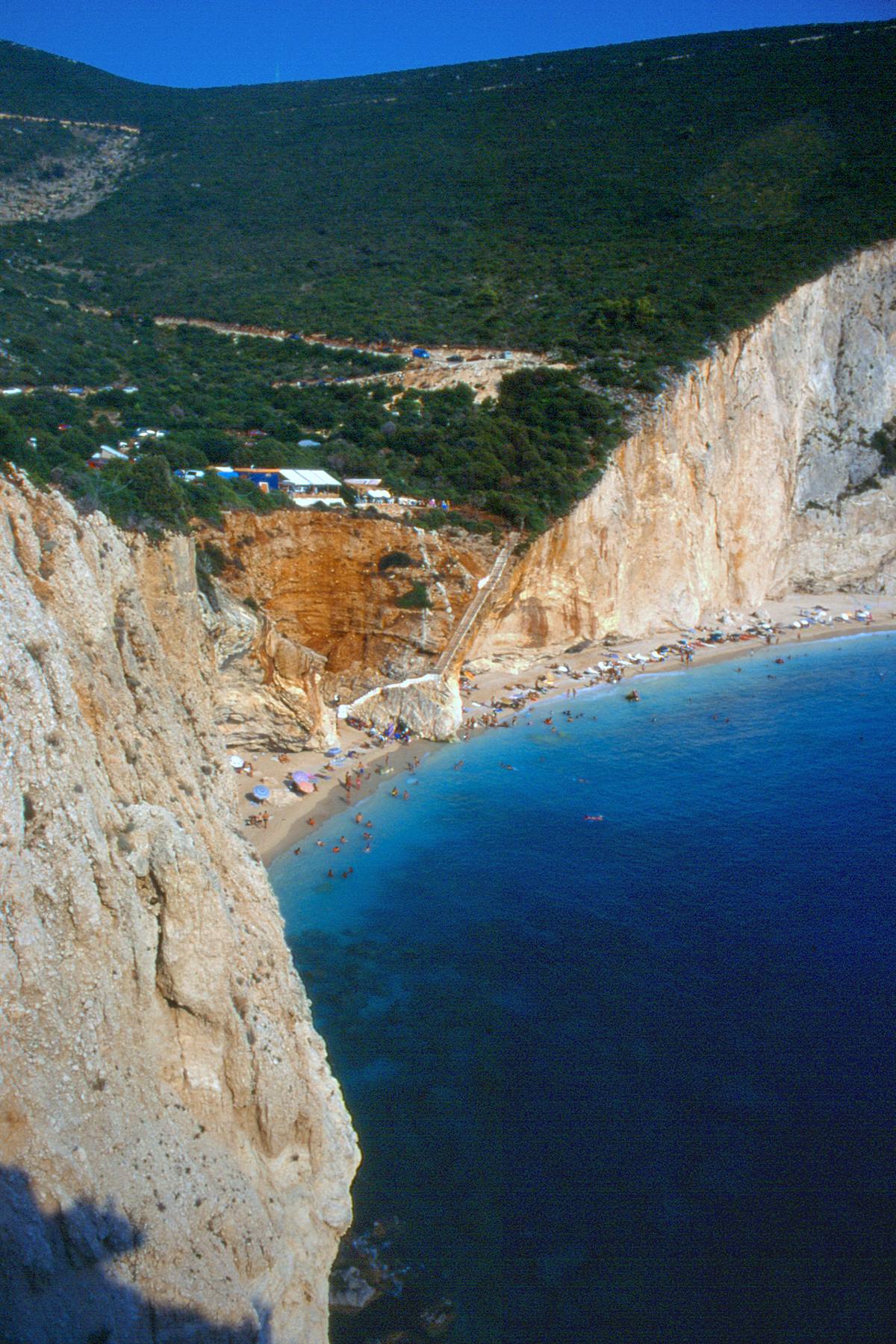
By car we set off for the south of the island, we pass the town of Vassiliki and continue in the direction of the southernmost tip, namely Cape Lefkada, where there is a cliff from which, according to legend, the poet Sappho threw herself, tormented by an unrequited love story, but we don't reach the spot and stop a handful of kilometres before at the Bay of Porto Katsiki. Below a vertiginous cliff there is, perhaps, the most beautiful beach of Lefkada and certainly the most spectacular... You descend by means of a steep staircase carved into the rock and reach the beach, all soft light sand, lapped by a blue sea that invites long and relaxing swims, so we spend at Porto Katsiki in practice the whole day, in the most complete idleness.
In the evening we return to Nidri and finally take possession of a real room, which after the events of the last days appears to us like a small royal palace. We go out for dinner in the centre of the village and on our return we find the elderly lady who in practice waits for us on the doorstep of the house... she bids us goodnight and locks the gate behind us.
Lefkada - Porto Katsiki Bay
Day 1217 Aug 1995
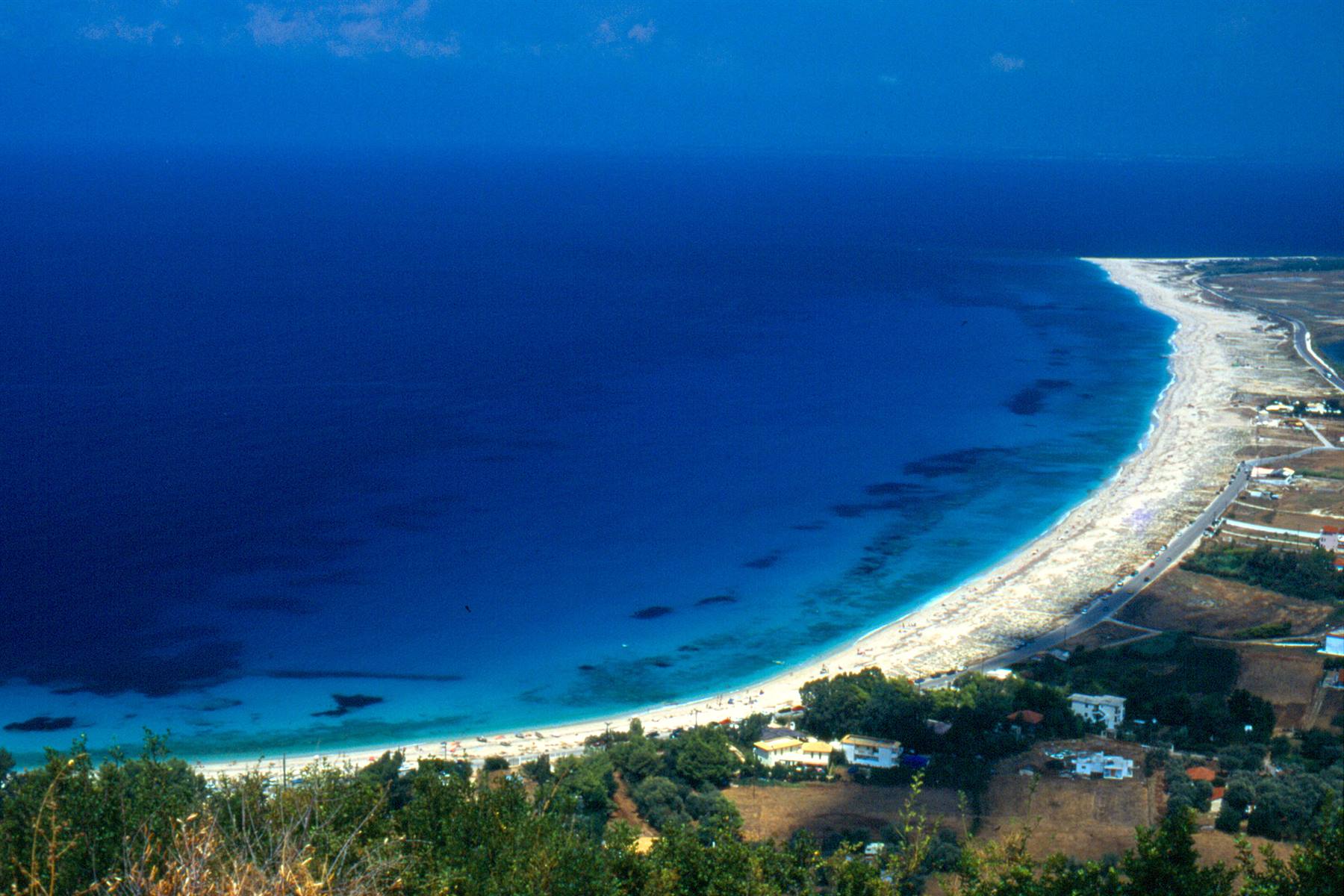
We set off to visit the north-western part of Lefkada, so we arrive at the town of the same name as well as capital of the island, with a not exactly touristy appearance, and from there we go south toward the interior, among bucolic landscapes, to emerge again at the sea near the village of Kalamitsi, at about halfway along the coast that faces west. We then follow the coastal road northward, comforted by beautiful panoramas, and return, in practice, to the vicinity of the capital, closing a small road loop. At this point there's nothing left to do but find a beach where we can spend the rest of the day and we find it on the thin strip of land that juts out toward the mainland...
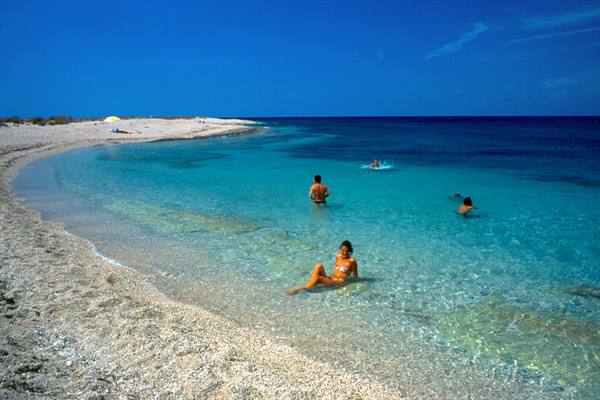
A small paradise, with a vaguely Caribbean flavour, with shallow and crystal-clear waters, an unexpected place of which we didn't even know the geographical name, but which captivates us until evening, when the now too-long shadows advise us to return to Nidri and to our apartment.
Lefkada - The north-eastern coast
Day 1318 Aug 1995
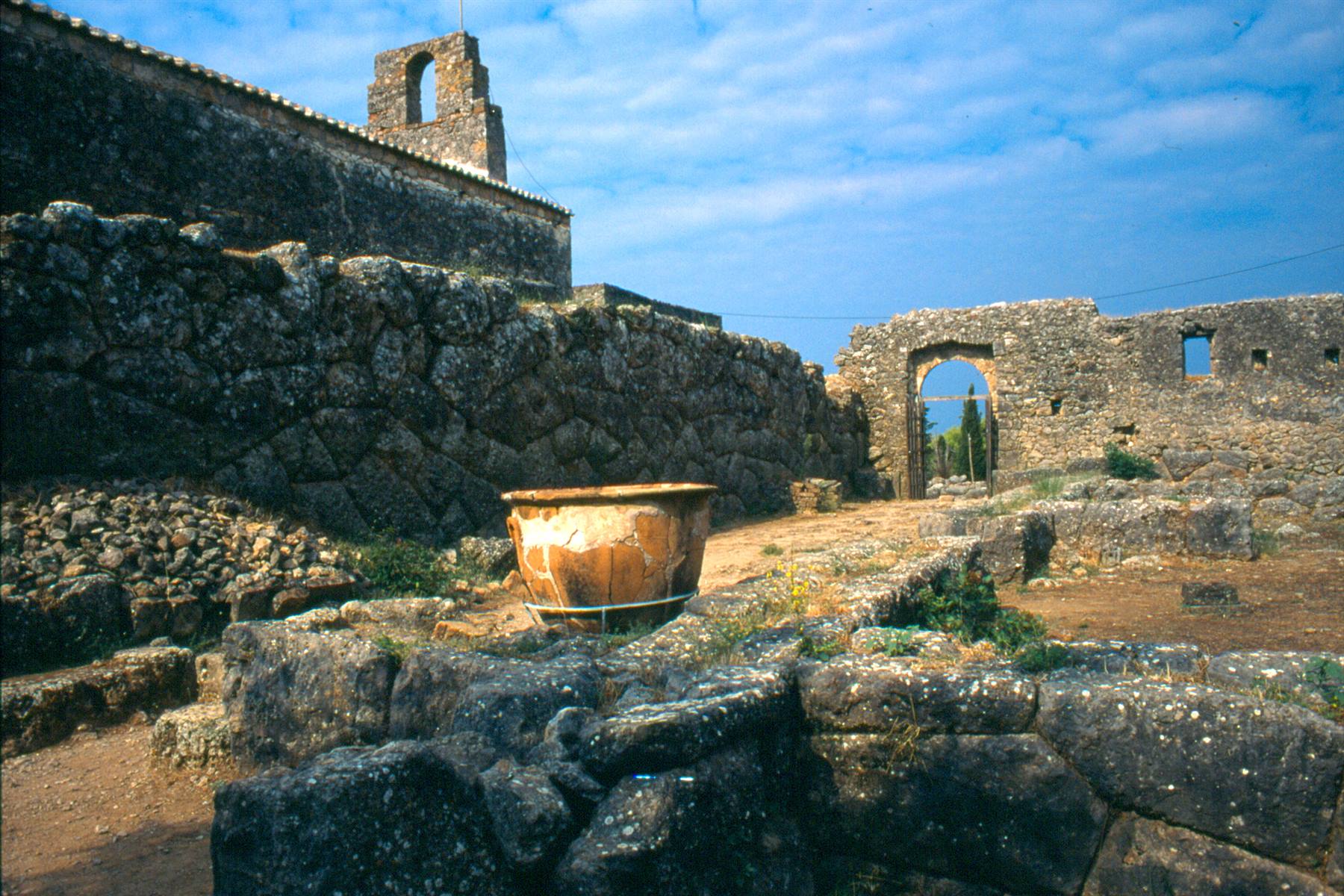
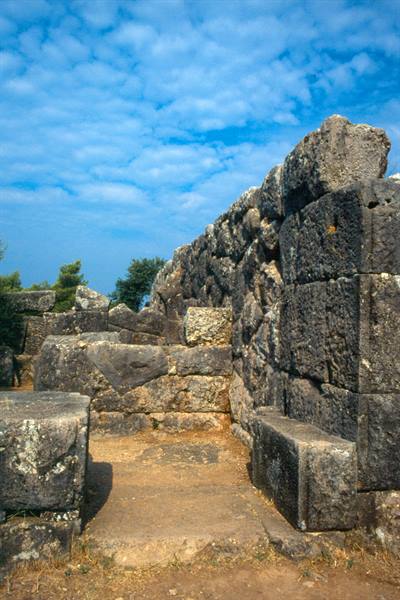
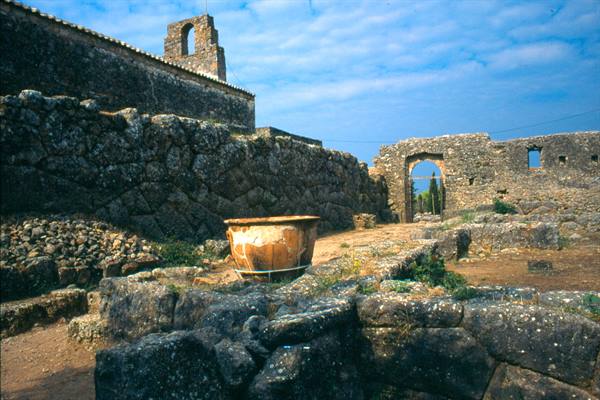
In the early hours of the morning, with all our luggage once again packed into the back of our Uno, we leave the Island of Lefkada too and, after crossing the bridge that separates it from the mainland, we land on continental Greece... From there, following the coastal road north, we pass through the town of Preveza and after a few dozen kilometres we arrive, near Mesopotamo, at a legendary place. The vast plain of the Acheron river was in ancient times a lake in the middle of which lay a small island... that small island today is a low hill on which stand the ruins of the Nekromanteion, the oracle of the dead, from where the mythical Charon ferried souls to the afterlife, into Hades... Not much remains of that place, once so sacred: only a few dry-stone walls and chipped amphorae, but it is still quite an emotion to walk through it.
Before noon we reach the city of Igoumenitsa, the most important port in northwestern Greece, and from there, in the afternoon, we board for the Island of Corfu. After about two hours of sailing we disembark at Kerkyra, the capital of the ancient land of the Phaeacians and the last stop of Ulysses' long pilgrimage (and of ours too)... Corfu, with its 562 square kilometres, is the northernmost of the Ionian Islands, the second largest, as well as the closest to Italy (70 kilometres) and to Albania (less than three!). As soon as we arrive we cross the island from east to west and go looking for accommodation near the village of Pelekas... Ferragosto is now long gone and finding a place to sleep is always easier (and also cheaper!).
Lefkada - The north-eastern coast
Day 1419 Aug 1995
After a quiet night, in the first part of the day we head to Danilia Village and Folklore Museum, the well-made reconstruction of a Venetian village, dating back to the era when the Serenissima ruled the island... and it was no short period, but more than four centuries, from 1386 to 1797, the year the Republic fell. After the brief cultural visit we go to the sea along the central-western coast of Corfu and, having found a sufficiently attractive beach, we spend the rest of the day there, in total relaxation.
Nekromanteion
Day 1520 Aug 1995
With our batteries almost fully recharged, we throw ourselves headlong into visiting the capital and all the sites of historical interest scattered around it. Kerkyra, otherwise more simply called Corfu, is a city of decent size, the seventh in Greece, with its roughly thirty thousand inhabitants, and it has often played a role of primary importance both for the history of its country and, at times, for that of all Europe... as a crucial point of economic exchange in the Mediterranean, but also as a residence of certain sovereigns during the 19th century. In antiquity it also took part in the disputes between Athenians and Spartans, but not much has remained as evidence of those times, in practice only the finds in the local Archaeological Museum, which we are about to see, as the first thing, on our ideal tour today.
Among the halls, full of objects from all over the island, particularly striking are the "Gorgon Pediment", which was part of the ancient Temple of Artemis, and a beautiful Corinthian statue, the so-called "Lion of Menecrates"... but it doesn't take us long to visit the museum, which certainly cannot be called vast, and soon we find ourselves back in the open air. In this way we devote ourselves to exploring the old town, a continuous intertwining of stairways, paved alleys and old buildings, with an urban layout largely Venetian, but also French and English (the Anglo-Saxons ruled the island right before its return to Greece in 1864)...
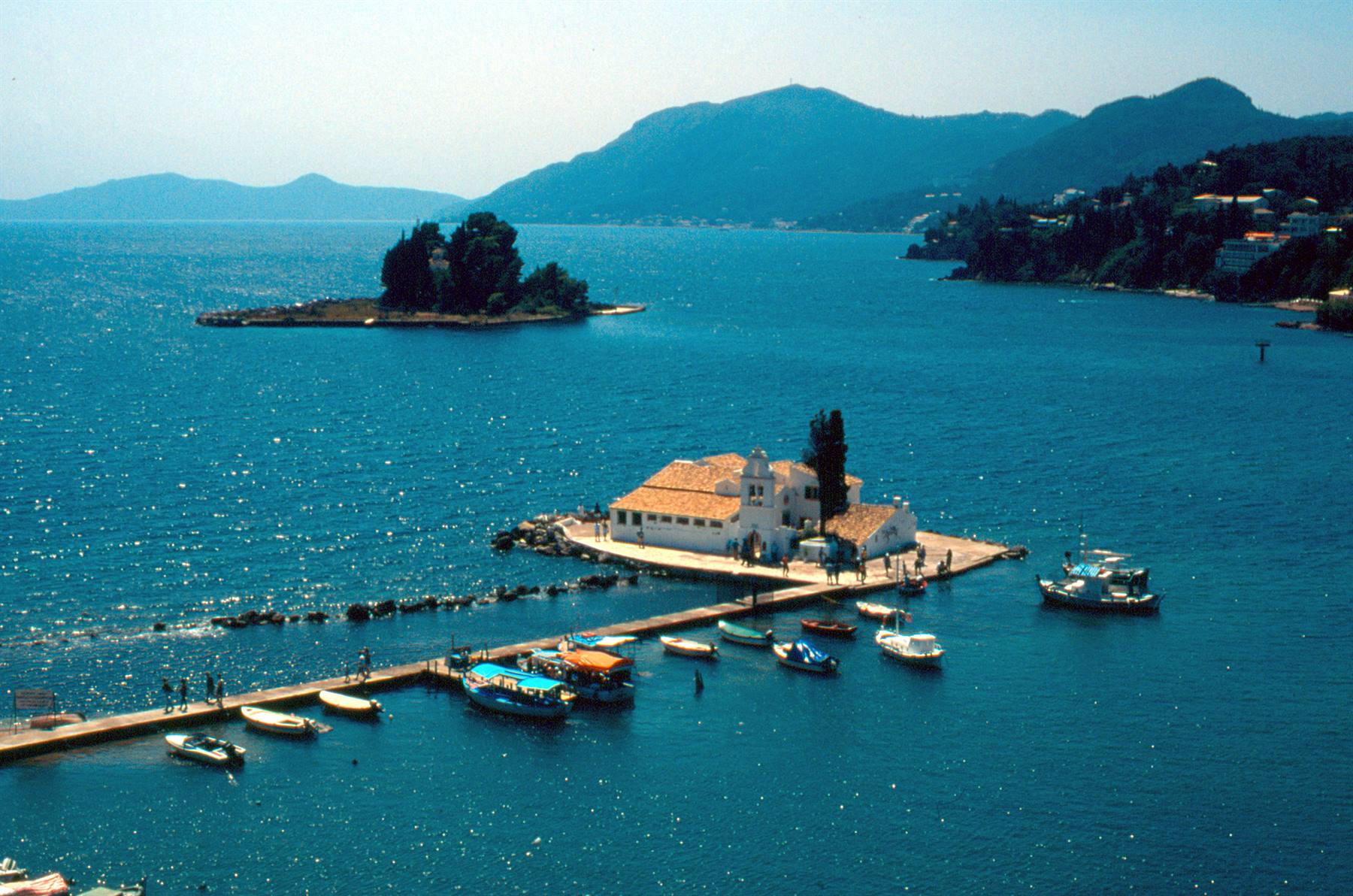
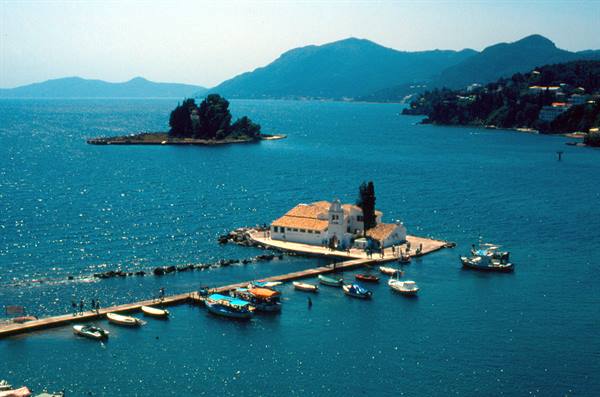
At the end of our short stroll we thus acknowledge that one of the most representative monuments is certainly the Venetian Loggia, but also the Royal Palace, originally the seat of the British High Commission, which closes the great square known as the Spianada to the north. From the historic centre of Kerkyra we later climb up the height of Kanoni, from where there is a beautiful view over the town, and then we go down to the nearby bay, where on a small island connected to the shore by a long pier stands the enchanting Byzantine monastery of Panagia Vlacherna, all painted white, dating back to the 17th century and extremely distinctive, with a delightful sail-shaped bell tower, which in its extreme simplicity can be considered a bit like the symbol of the entire Island of Corfu.
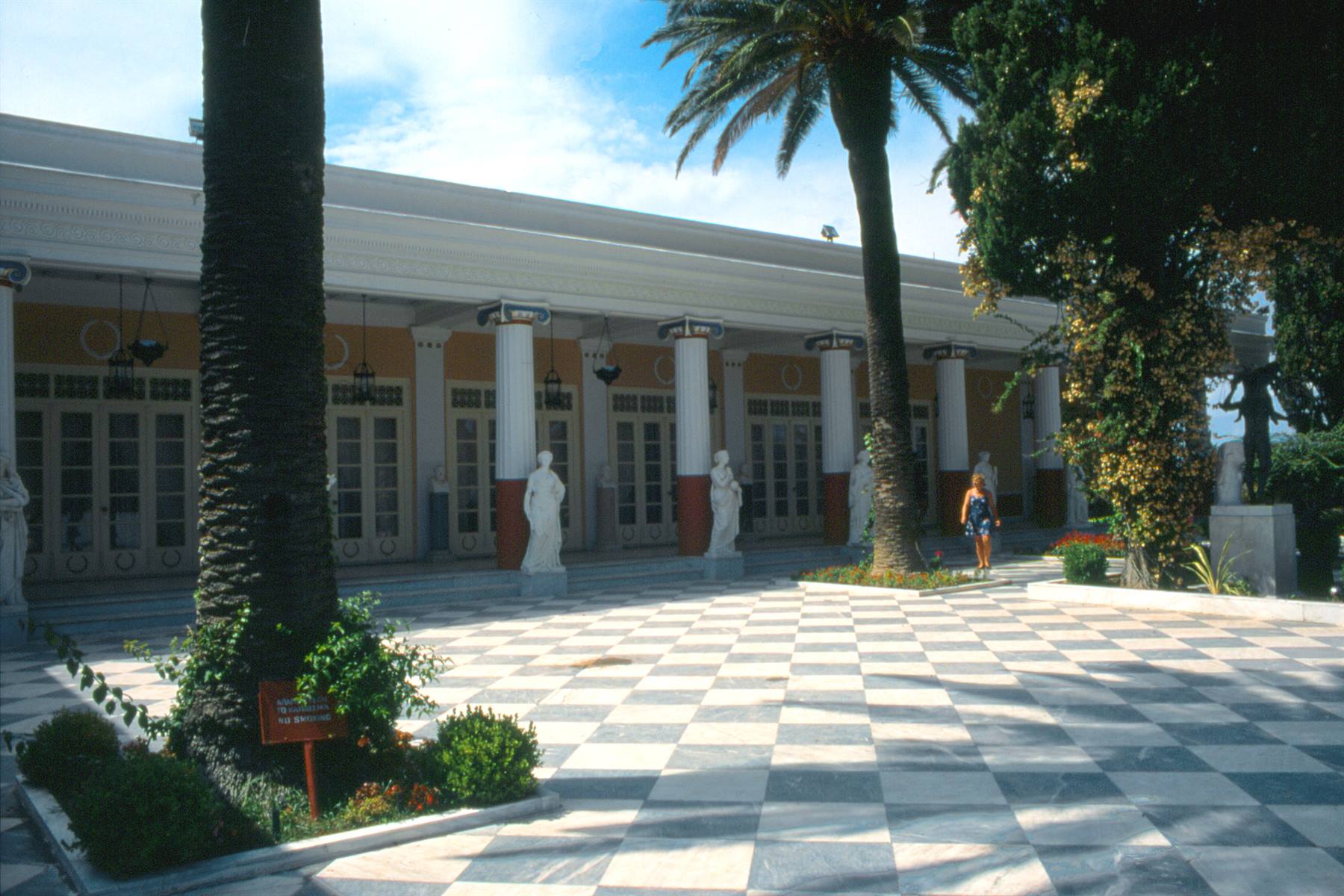
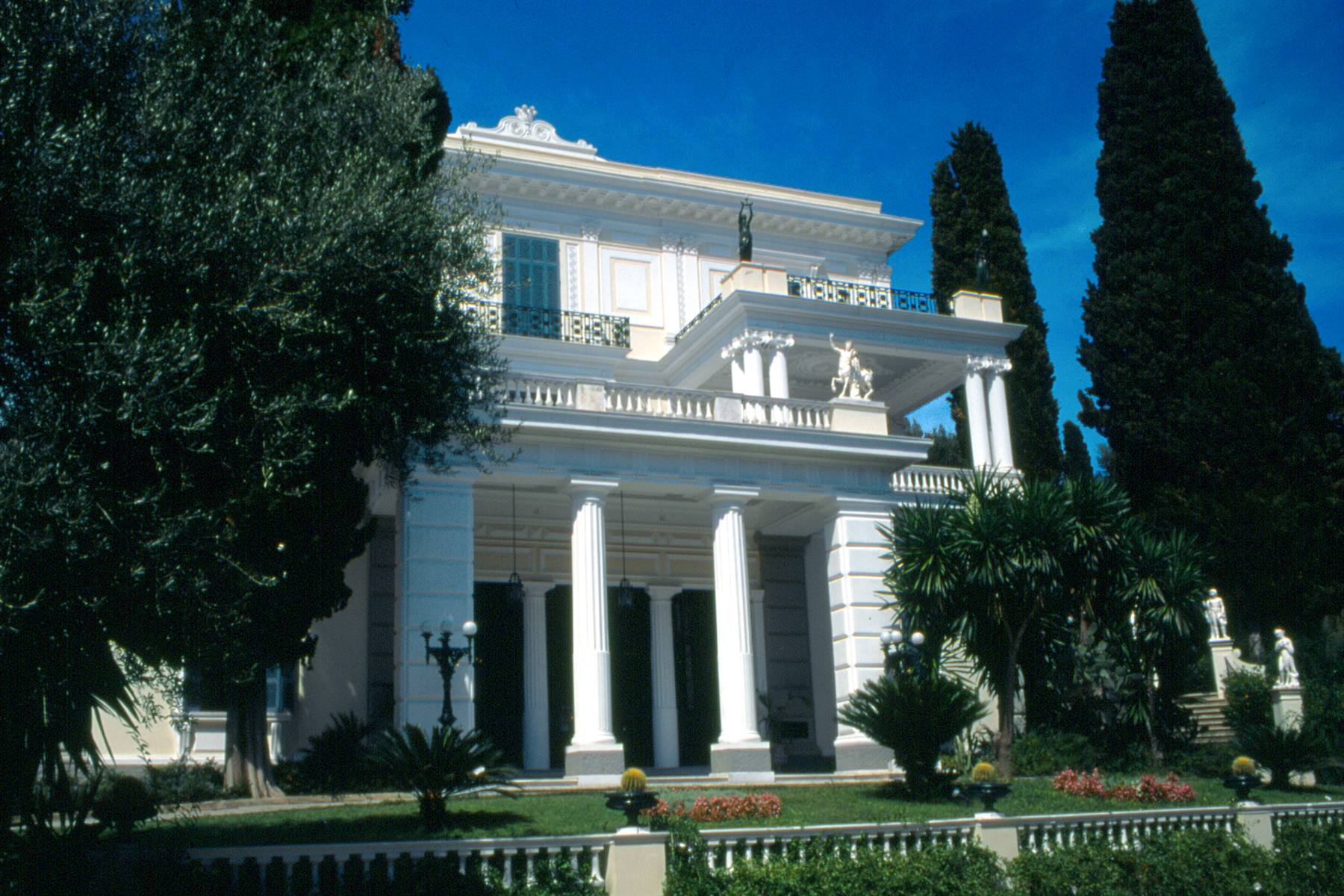
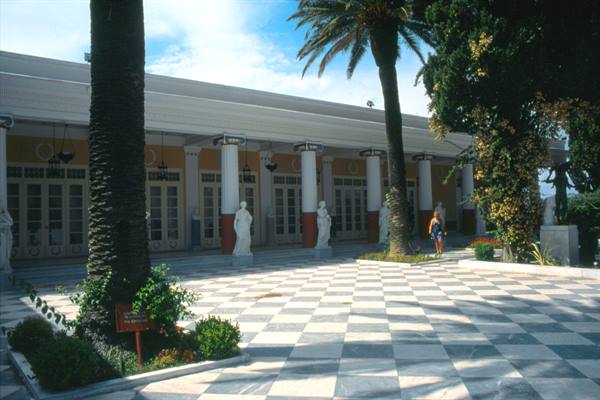
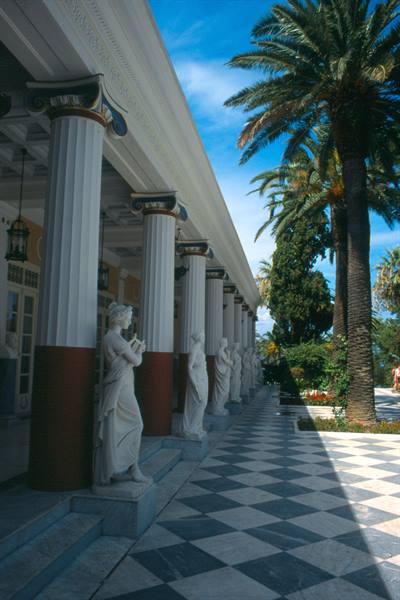
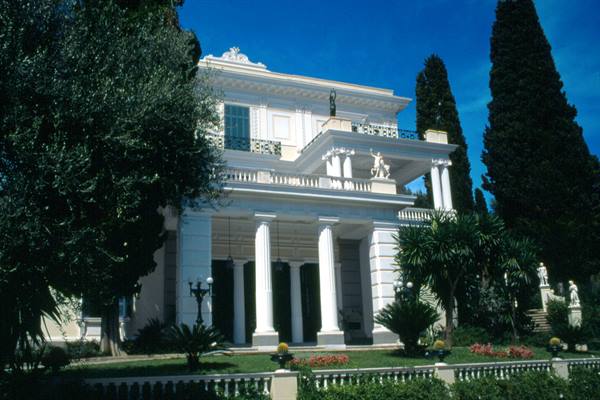
Having given the capital its due attention, to complete the cultural visit, in the early afternoon we move a little further south to the Achilleion Palace. Elisabeth of Austria (better known as Sissi), in love with the tranquillity of the island, had a villa built as a safe refuge for her escapes from the imperial capital and had it built inspired by her favourite epic hero: the invincible Achilles. Today the villa, surrounded by splendid gardens, can be partly visited and we do so starting from the monumental staircase that characterises the ground floor, then moving on to various richly decorated halls and reaching the first floor in the stupendous peristyle all of Ionic columns, busts of ancient philosophers and the statues of the nine muses... The place is highly evocative, no wonder the princess loved to come here alone to wait for the sunrise.
In the gardens stands out the white statue of the Dying Achilles, so dear to Sissi, who stayed in the villa, on several occasions, from 1891 to 1898 (the year of her death). Later the entire complex was purchased by the German emperor William II, who had added on the panoramic terrace that embraces the entire eastern coast of the island the monument to the Victorious Achilles. Now drunk on culture, on this first and last day without the sea, in the late afternoon we slowly make our way back to our accommodation, tired but satisfied with these visits as an alternative to the beach...
Corfu - Panagia Vlacherna
Day 1621 Aug 1995
Today we return to devoting ourselves body and soul to beach life and we go, on the north-western coast of the island, to Paleokastritsa, to what are perhaps the most famous beaches of Corfu. Indeed they are immersed in greenery and lapped by crystal-clear sea, but despite the season being now advanced (we are no longer in Ferragosto) they are too crowded for our tastes... this doesn't mean they don't deserve the day we have decided to devote to them, but frankly, reading in the tourist guide, we expected something more.
Corfu - Achilleion Palace
Day 1722 Aug 1995
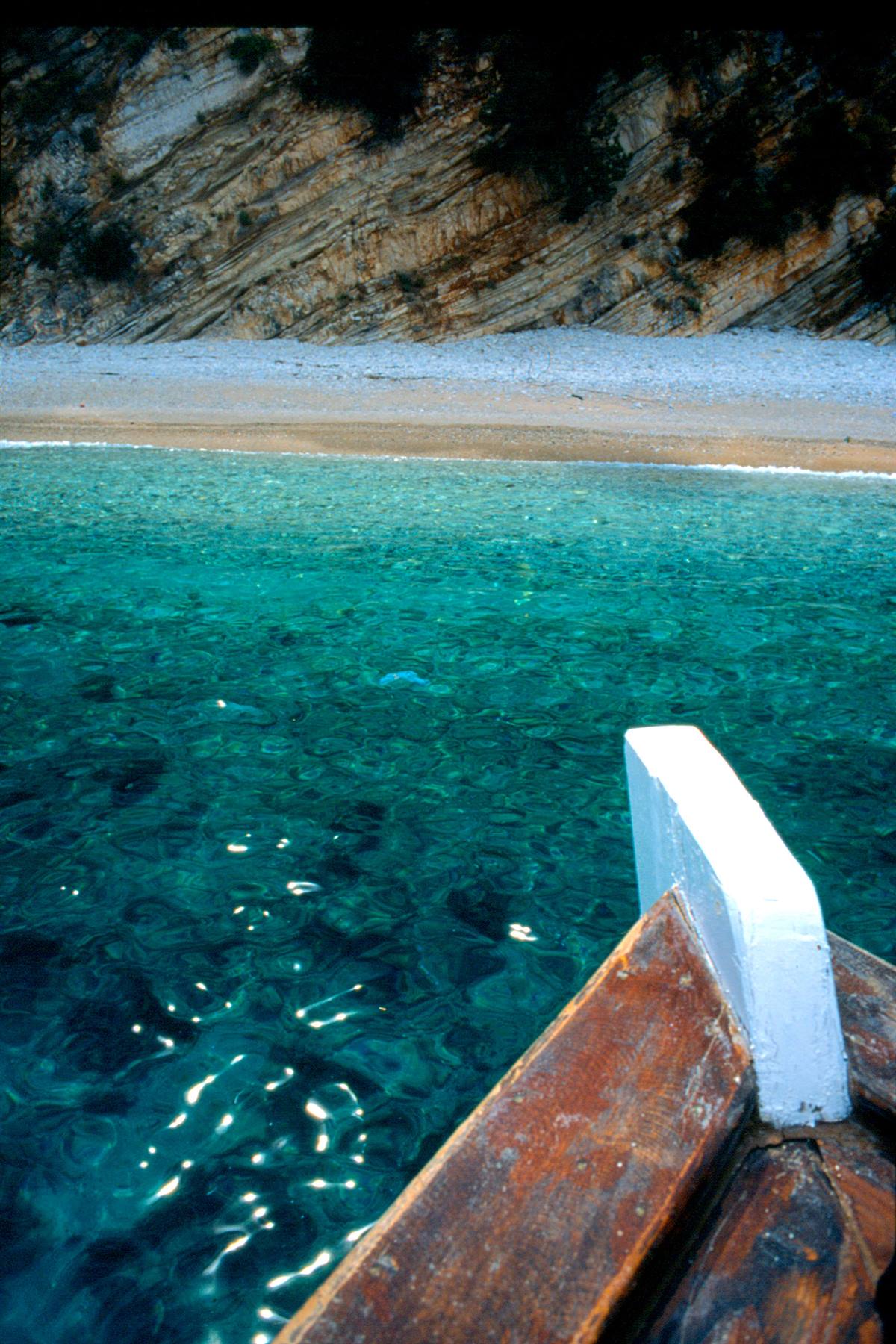
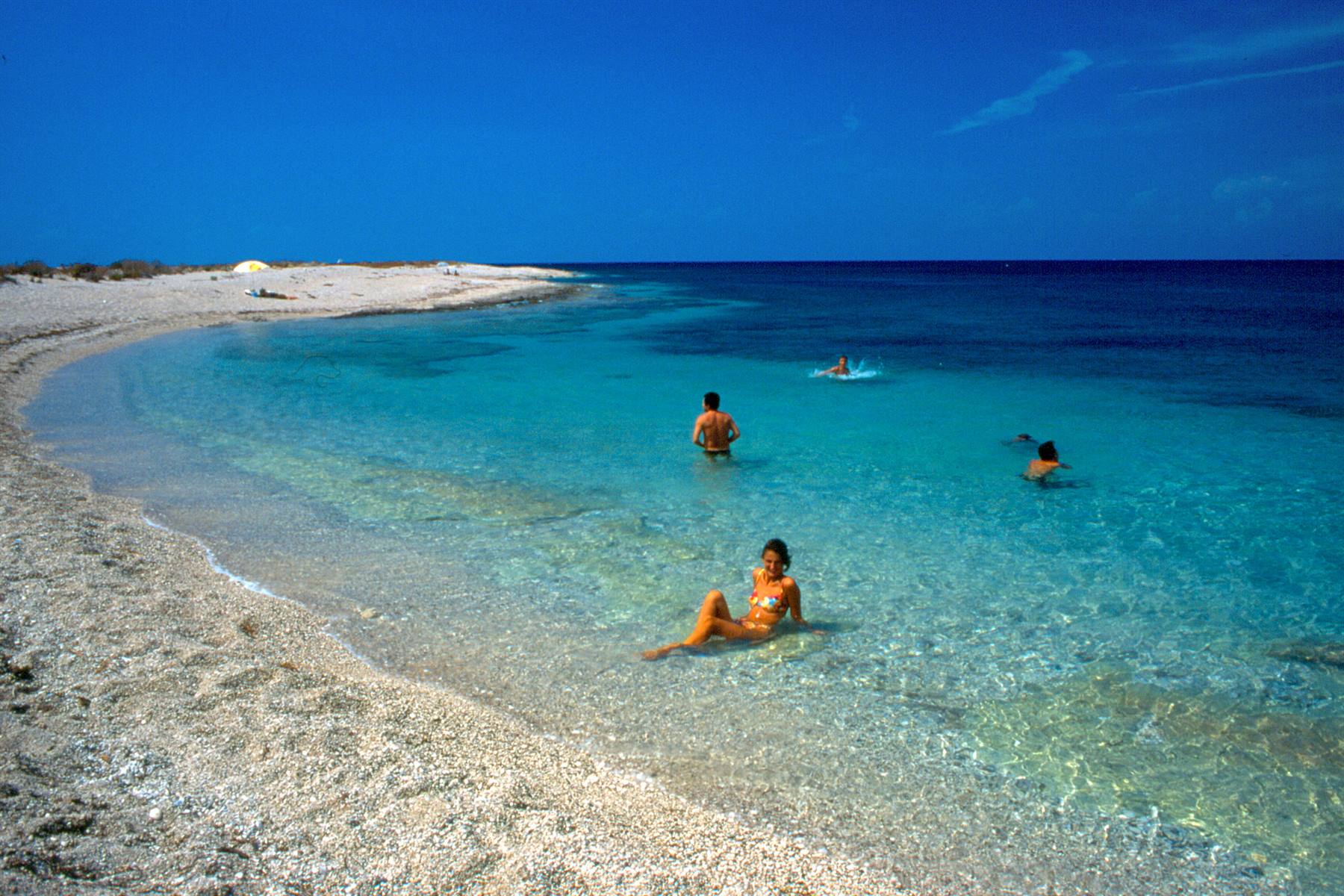
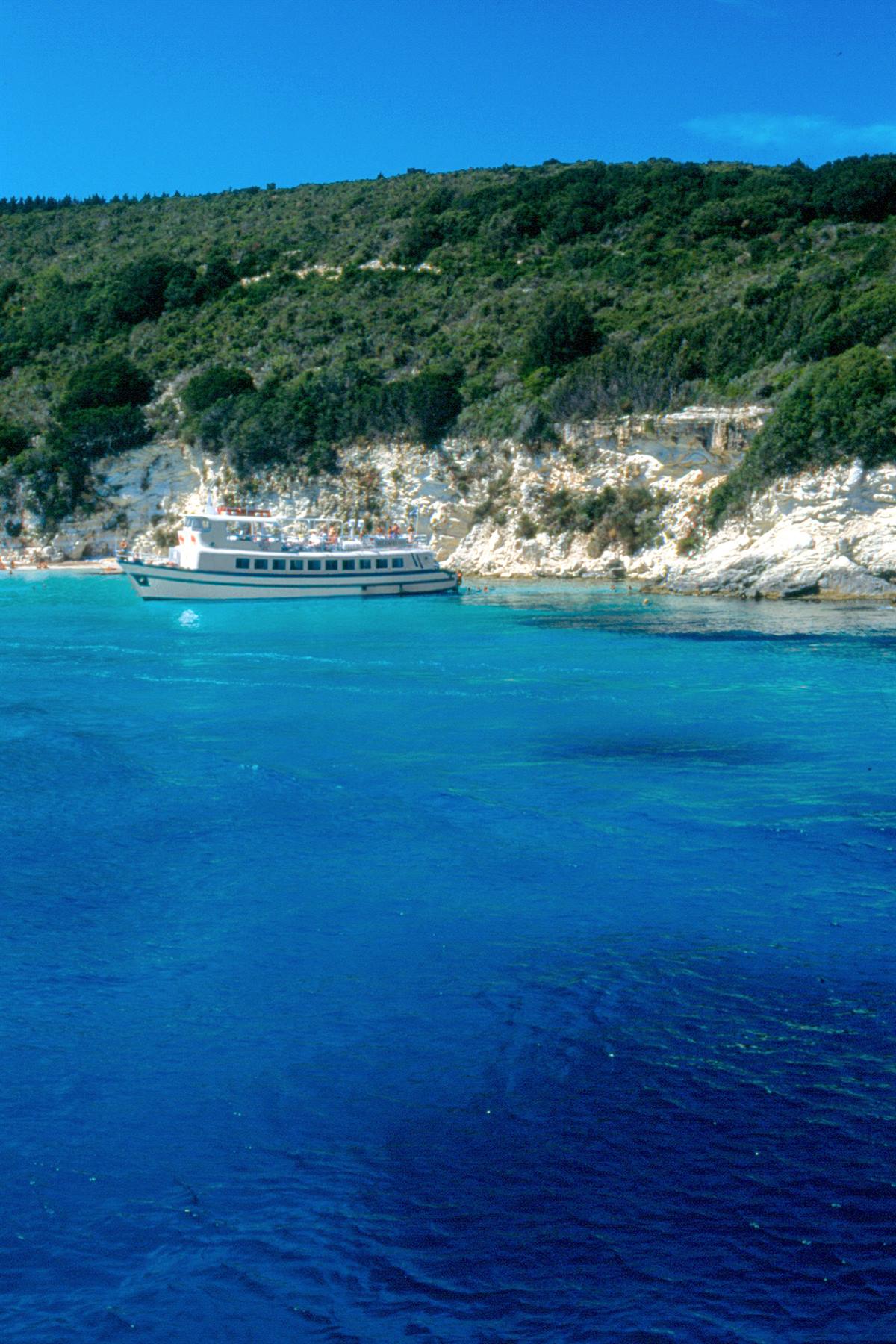
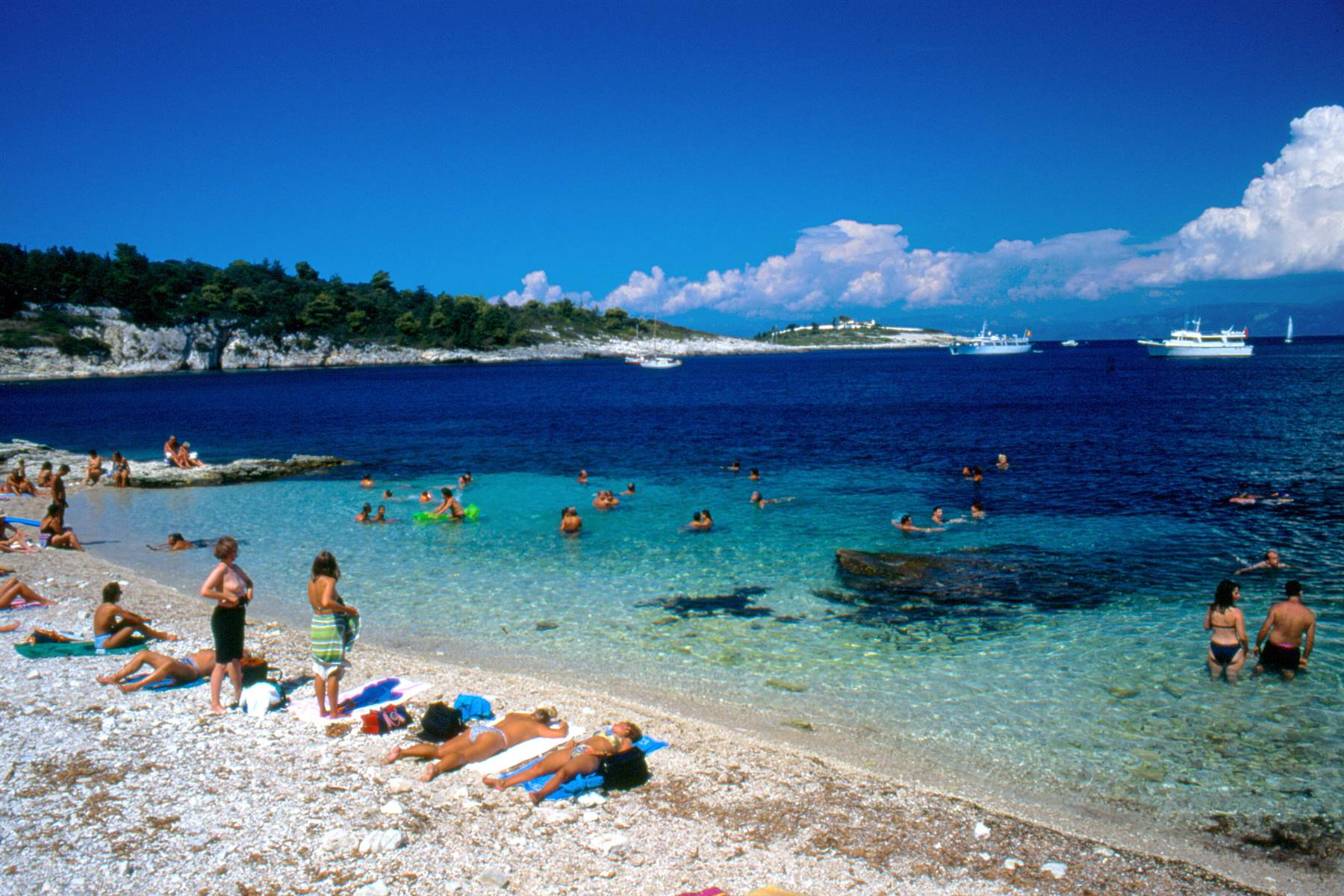
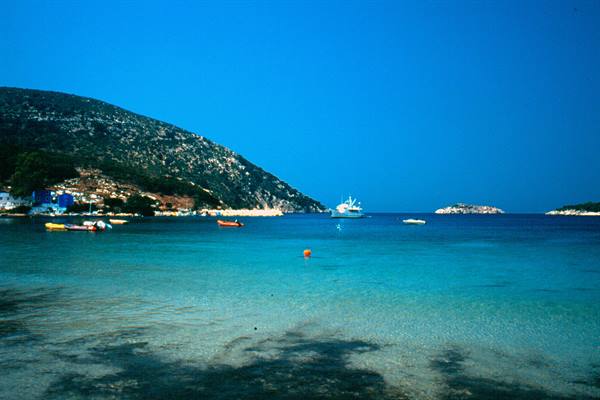
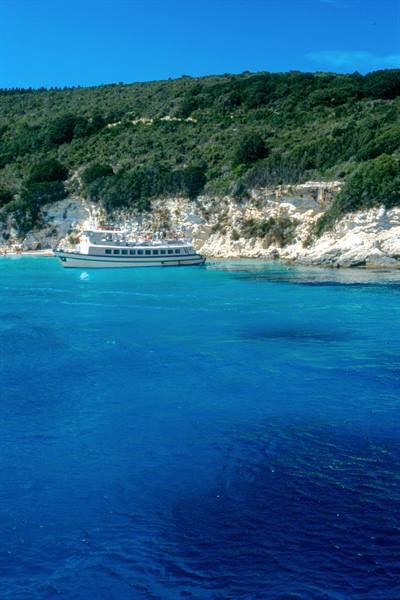
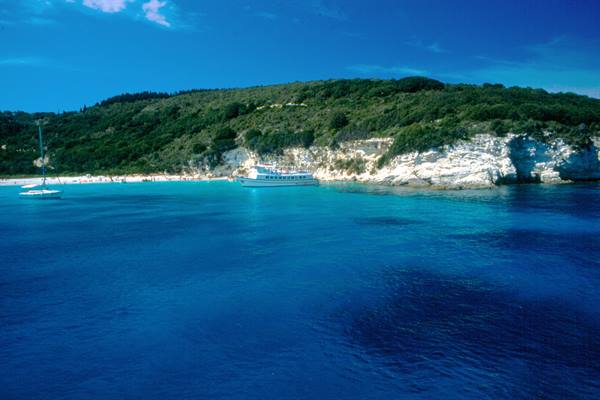
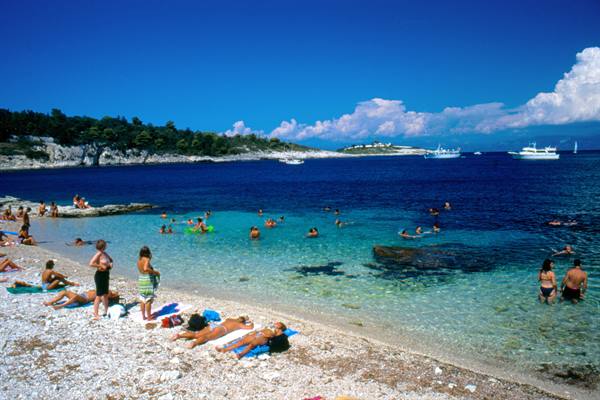
In the early hours of the morning we drive to the port of Kerkyra, from where we will set sail for a boat excursion that will keep us busy all day. We sail south along the entire eastern coast of Corfu and detach from its southernmost point to reach two small islands that are part of the Ionian archipelago. First we disembark at Antipaxos, a sliver of land and rock two kilometres long and eight hundred metres wide, in which however lies one of the most beautiful beaches of western Greece: Vrikes Beach, where we spend some time and take an unforgettable swim! Right after noon we move a little further north, to Paxos, the older sister, if older one can call an island of ten kilometres by four, inhabited by no more than 2500 souls. We disembark at Gaios, the characteristic capital, and then spend a few hours on a nearby lovely little beach with clear blue water...
Of course we would have liked to spend at least a couple of days on Paxos to savour its climate and pace of life, as well as its natural beauties, but it was not possible to do so, for obvious logistical reasons, and we must make do. So when in the late afternoon we leave the island we do so with the feeling of not having completed a job, but at the same time we consider ourselves satisfied with the more than positive outcome of the excursion.
Corfu - Achilleion Palace
Day 1823 Aug 1995
Back on Corfu we devote ourselves to exploring the north-western part of the island, so, in the morning, first of all we go to see the beautiful cliffs of Peroulades and then, descending again southwards, we go to bask in the sun at the interesting Agios Stefanos Beach, where we spend a good part of the day in blessed peace. In the afternoon, returning towards our "base camp", we also stop at the wide and scenic inlet of Agios Georgios, before climbing up to the height of Kaiser's View and enjoying an unforgettable sunset.
Antipaxos - Vrikes Beach Bay
Day 1924 Aug 1995
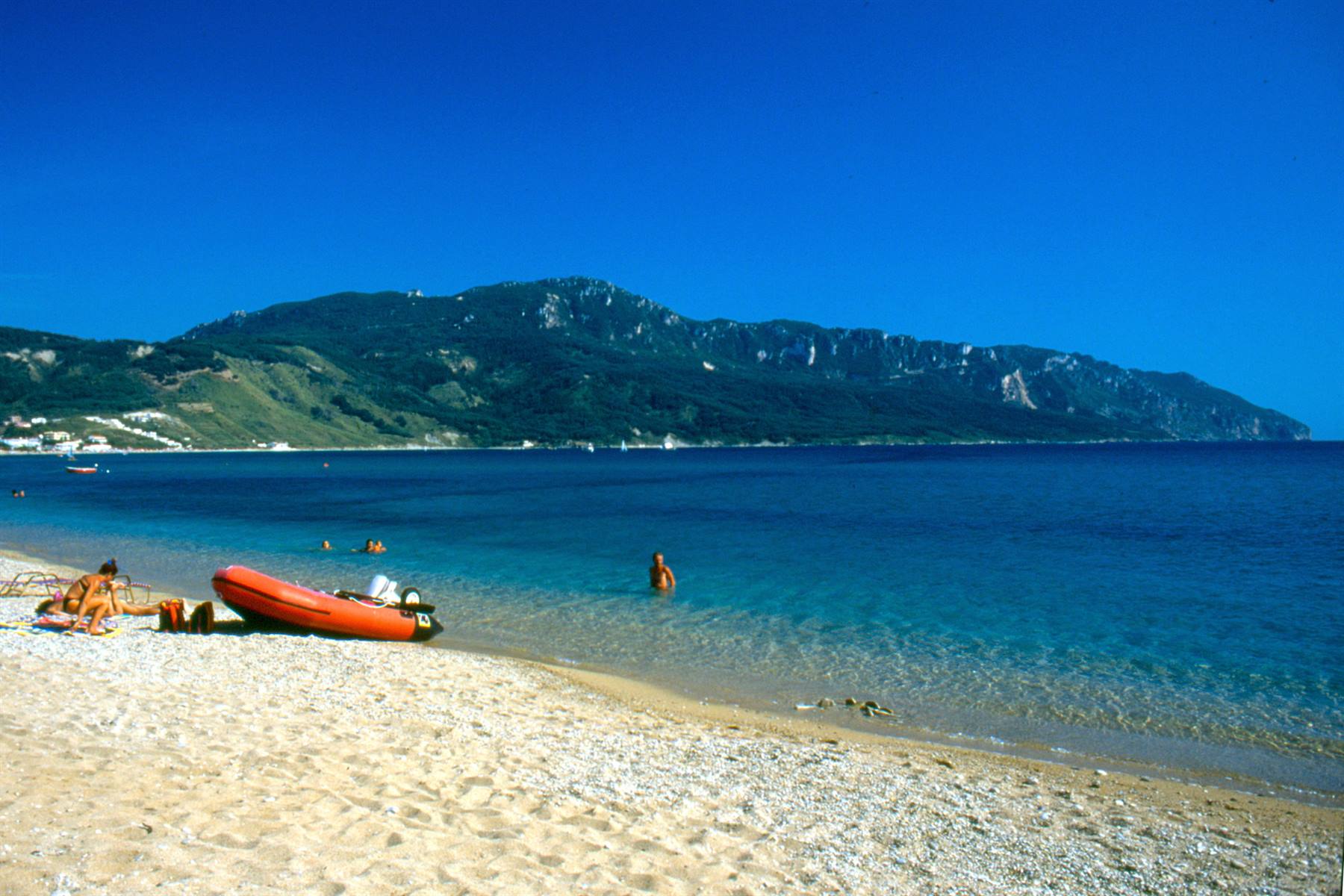
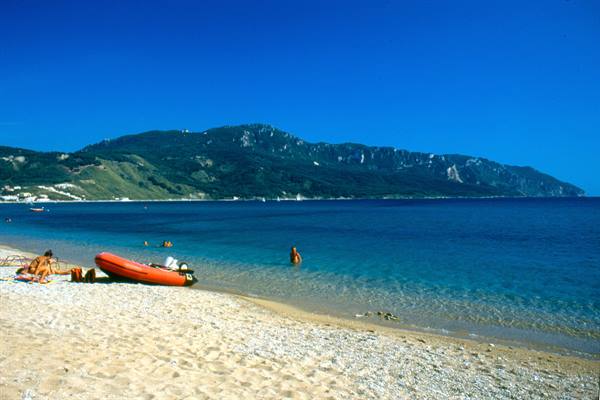
The holiday is now drawing to a close and this is in practice the last full day we will spend on the island of Corfu before facing the journey home. We venture among centuries-old olive trees in the north-eastern part of the island, just a few kilometres from the Albanian coast, which can be clearly distinguished with the naked eye... We thus end up at the wonderful Avlaki Beach, for us the most beautiful of all Corfu, for its endless tranquillity and its stupendous sea. Being able to spend the epilogue of this holiday at Avlaki was a stroke of luck, so much so that the splendid memories of the bay will remain a bit like the symbol of the whole trip... and reluctantly in the evening we make our way back to Pelekas and to our accommodation to start packing in view of the imminent departure towards home and towards everyday life.
Paxos - Bay near Gaios
Day 2025 Aug 1995
Now aware of the fact that the holiday has come to an end, we laze in bed more than usual and get up very slowly, then we leave our room and head in the direction of Kerkyra, from where, in the late afternoon, the ship of the Adriatica company will set sail first for Igoumenitsa and then for Brindisi and Italy. It will be pure chance, or perhaps good fortune, but the end of our journey also coincides with the change in weather conditions, in fact during the night and the crossing of the Ionian a violent storm also breaks out and fortunately, by paying a surcharge, we had allowed ourselves the luxury of a comfortable berth rather than deck passage.
Corfu - Agios Georgios Beach
Day 2126 Aug 1995
In the early hours of the morning we disembark, dry and in fine form, at the port of Brindisi. Having once again set foot on the soil of the Bel Paese we catapult ourselves towards home, but it is a day of heavy traffic and along the Marche stretch of the A14, due to the sudden and continuous slowdowns, we are involved in a small accident... more than anything a big fright, including a rather unpleasant taste of the central crash barrier (the notorious New Jersey)... but all's well that ends well and in the afternoon we conclude, with two tyres flattened by the violent braking, our journey in front of the gate of our home... a journey that was able to offer us excellent sea and fine historical inspiration. All in all a confirmation of how much good Greece had been able to offer us also five years ago, on the occasion of the camper adventure all the way to the Island of Crete.
0 reader comments