The construction work on our new house began a few months ago and we are quite busy... Despite everything, the day after Ferragosto, the queen of summer holidays, we decide to take a short period of travelling holiday, as we like, so as to take our minds off everyday problems. We set off in the camper in the evening with the intention of managing to cover some distance in the cool, avoiding the blazing sun as much as possible. Our goal is Upper Bavaria, the southernmost of the seven administrative districts of Bavaria, the largest of the German Länder by area and the second by population, whose capital is the very famous Munich, which, however, we will not touch on this trip, unlike the neighbouring regions such as the Allgäu in Swabia, or the Salzburg area in nearby Austria.
At Faenza we take the A14 motorway northwards, then at Bologna the A1 in the same direction as far as Modena, where we begin to follow the A21, better known as the Brenner motorway... in this way we cross the whole Po Valley and at the foot of the Alps we stop for the night.
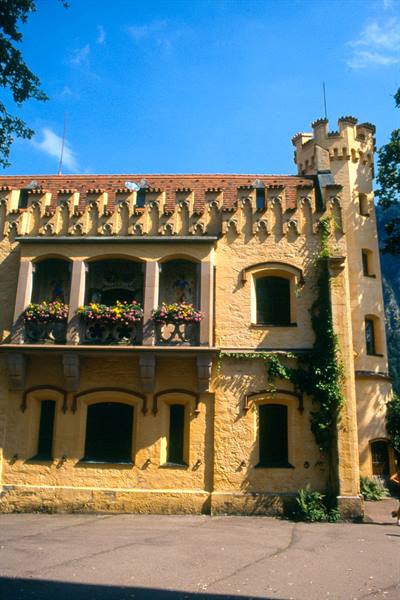
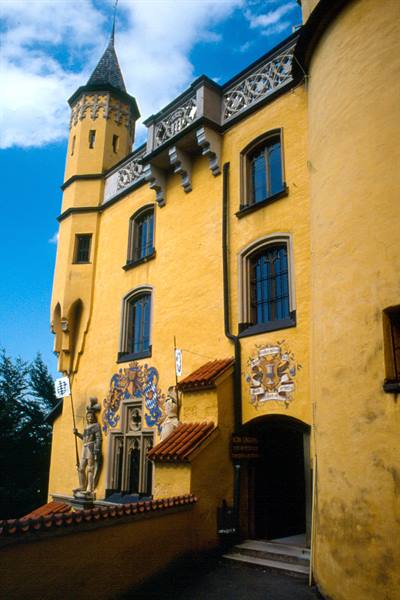
Hohenschwangau
Day 217 Aug 1991
In the morning we cross the Brenner Pass and enter Austrian territory. Having reached the vicinity of the city of Innsbruck (the Tyrolean capital), we head west and then tackle the scenic Fernpass, characterised by some little mountain lakes with incredibly crystal-clear waters. We leave behind us the transparent lake basins of the Fersteinsee and the Blindsee and approach the Austro-German border. Just after entering German soil, we observe the interesting waterfalls of the river Less... a thunderous stream that forms some rocky gorges before crossing the town of Füssen and flowing into the vast Forgeen See. In the afternoon we immediately dedicate ourselves to visiting the nearby Bavarian royal castles. The eccentric Ludwig II, King of Bavaria in the mid-nineteenth century, left an indelible mark on the entire region, scattering it with splendid residences and fairytale buildings.
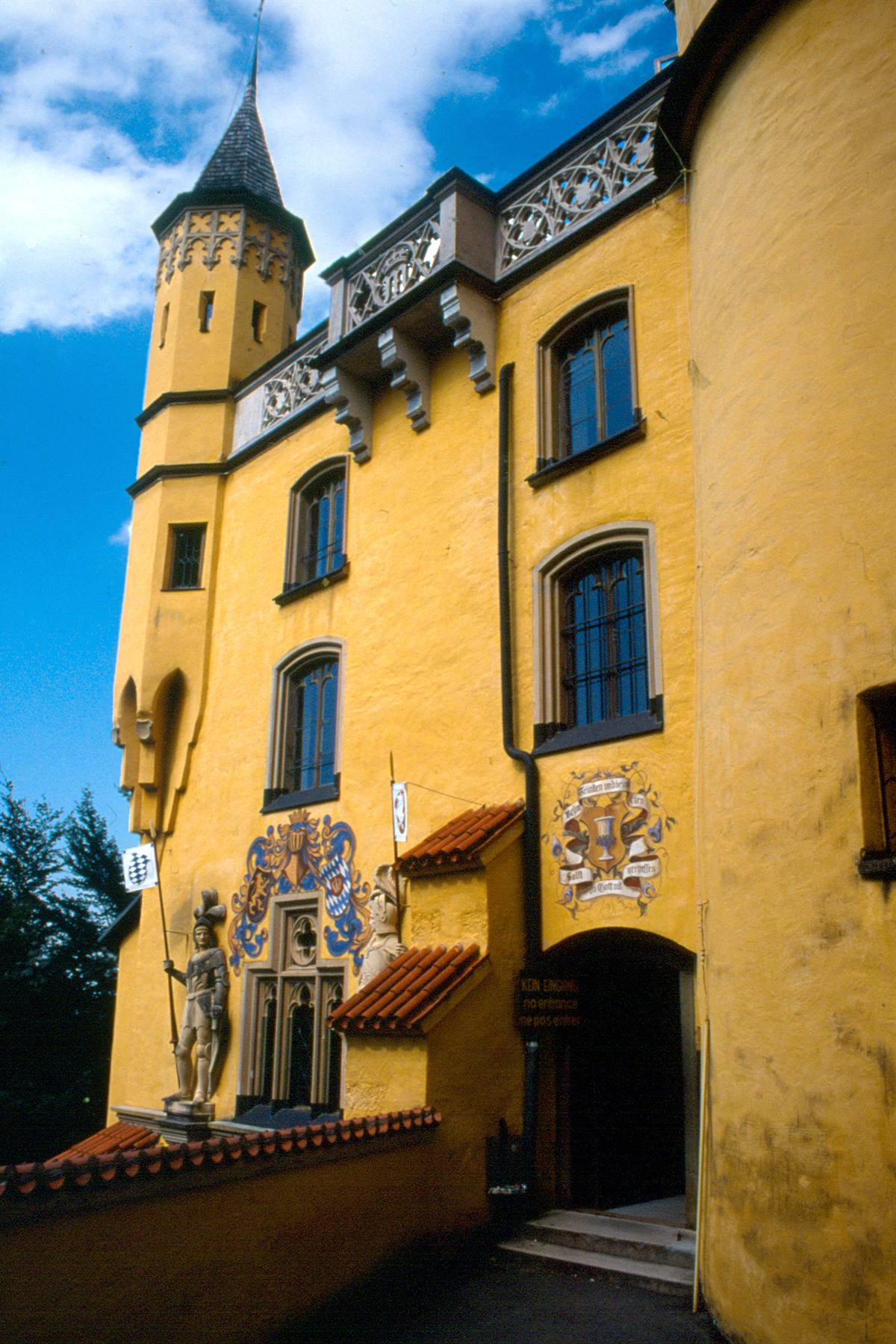
He spent his childhood a few kilometres from Füssen, in Hohenschwangau castle, purchased in his time by his father Maximilian II, who turned it into a summer residence... and it is precisely from Hohenschwangau castle that we begin our exciting Bavarian experience. We visit the interiors of what the prince loved to call his "Paradise on earth", but which in reality was only the first page of a fairytale... almost modern... then we observe only from a distance the fantastic Neuschwanstein castle and return for the night to nearby Füssen. In the evening we don't disdain a stroll through the characteristic centre, where a festival is taking place in an undeniably German, but above all Bavarian, style, with people in traditional dress and beer flowing in rivers.
Neuschwanstein
Day 318 Aug 1991
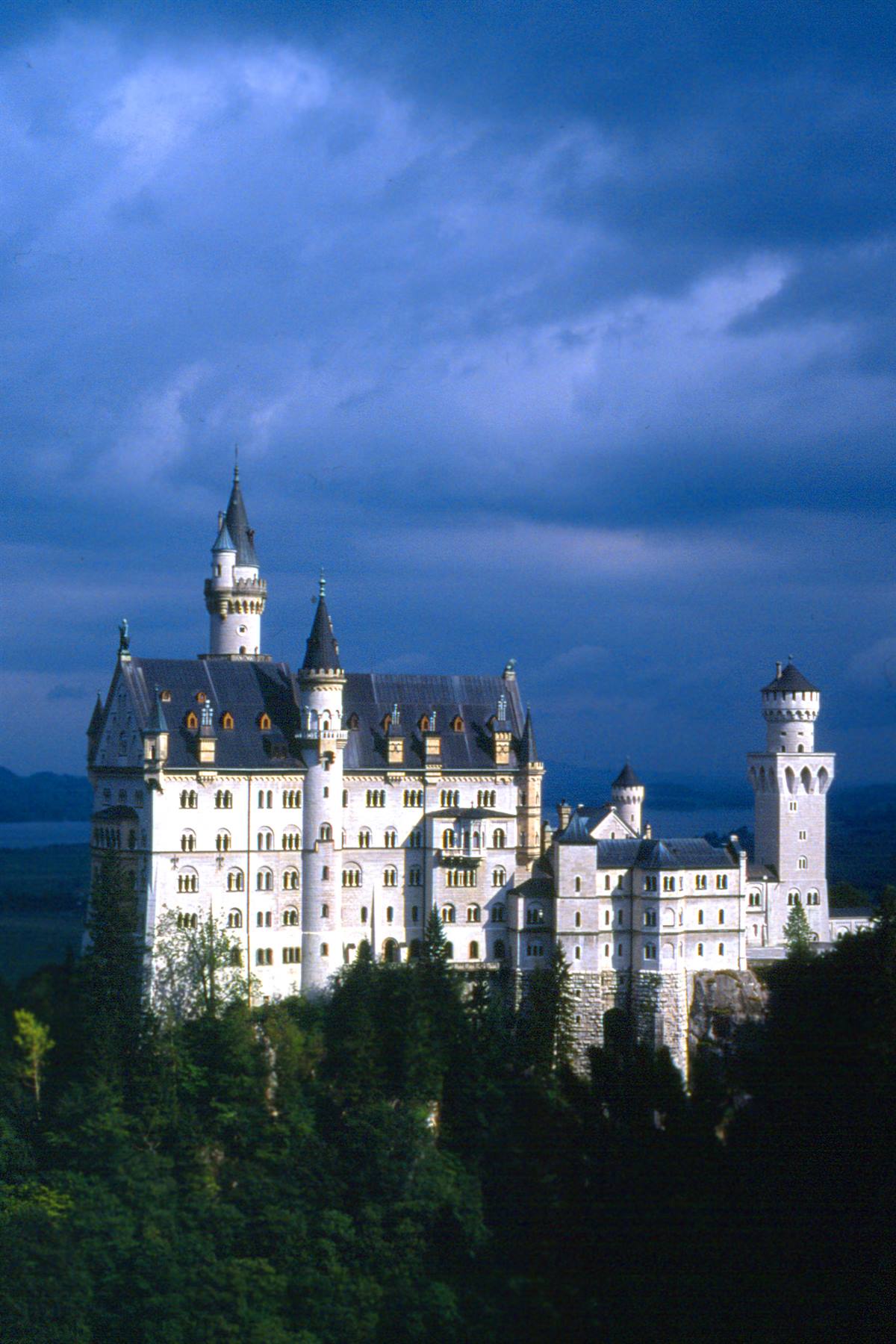
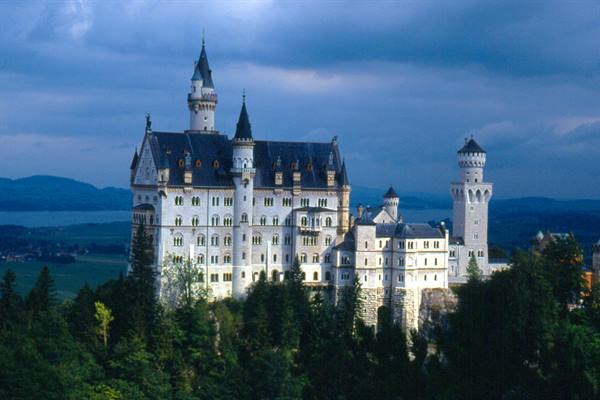
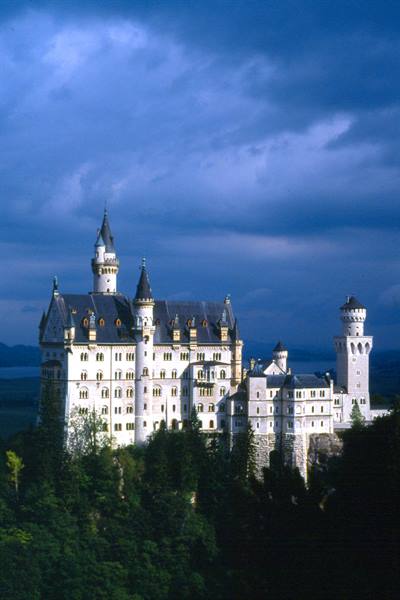
First of all we complete our exploration of Füssen, a city founded by the Romans as a small fort to protect the Via Claudia, which connected the Venetian lagoon with Augsburg, in whose urban fabric the graceful Spitalkirche stands out, a little church from 1748 with a painted façade and interiors decorated, undeniably, in Baroque style. Immediately afterwards we devote ourselves body and soul to visiting the fairytale Neuschwanstein castle. Among the neo-Gothic walls of Hohenschwangau, the idea began to take shape in Ludwig's mind of creating a new sumptuous castle. At first he thought of renovating Hohenschwangau itself, then he convinced himself to build an entirely new one... So a few kilometres away, in an extraordinary natural setting, the king laid the first stone on 5 September 1869. In 1880 the site employed as many as 209 workers and Ludwig's dream was taking concrete form...
the monarch wanted the castle, in fact, to be like a great stage set for the works of his great friend and musician Richard Wagner. In a relatively short time, what can be described, to all intents and purposes, as a fairytale work was thus magically taking shape, which, almost a hundred years later, in 1965, Walt Disney would take as a model for the construction of the Disneyland castle in Los Angeles... And fairytale is also its name: Neuschwanstein, which literally means "The new swan stone".
We explore one after another the sumptuous rooms of the manor, then with a short walk we also reach the little Marienbruke bridge, from which the view of Neushwanstein and the surrounding heights is truly unforgettable! In the afternoon we follow road number 17 northwards and, having reached the village of Stelngaden, we take the short detour that leads us to the beautiful Wieskirche church, nestled among green meadows, in a tranquil hilly landscape. The religious building was constructed between 1746 and 1758 to a design by Dominikus Zimmerman, a famous architect of the time, thanks to whom one of the most admirable examples of Baroque architecture in all of Bavaria came into being... The very rich interior decorations are, in fact, enhanced by the luminosity of the space, and the great organ with 42 stops dominates the wall opposite the high altar.
Just above the organ is the representation of the "Gate of Eternity", placed at the end of the great fresco that embraces the entire vault. This superb painting, at the centre of which stands out the figure of King David, is the work of Johann Baptiste Zimmerman, court painter in Munich. Having scoured the Wieskirche down to the smallest details too, we follow road number 23 and in the evening we arrive at the gates of the town of Oberammergau, where we stop, at the end of an extremely intense as well as splendid day.
Mittenwald
Day 419 Aug 1991
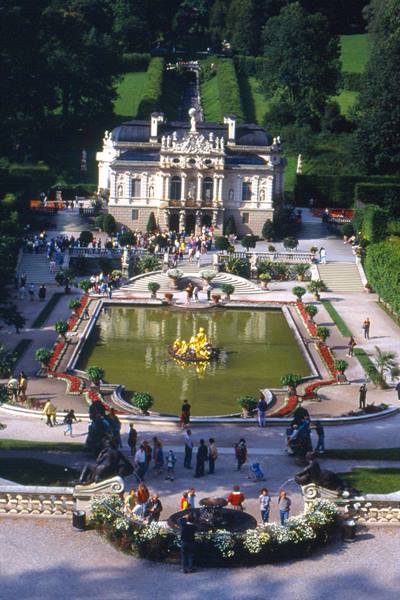
In the early hours of Monday, August 19, from Oberammergau, we cover the short distance that separates us from Linderhof Castle, one of the most electrifying dreams of Louis II of Bavaria, better known as Ludwig. The monarch was only 23 years old at the time of the manor's construction and was experiencing his personal infatuation with the Sun King... If he had been an ordinary person he would have limited himself to simple admiration, if he had been an ordinary sovereign he would have collected a few keepsakes of his most famous French counterpart, but he was Ludwig and he decided to have a castle built in the most sparkling Baroque style of the period, worthy of competing with those of his idol. The gardens too were to be inspired as much as possible by those of Versailles, but the relatively much smaller spaces did not allow this in every respect.
The park was finally enriched with numerous water features, as well as through the creation of a large artificial grotto and the reconstruction of a Moorish pavilion, brought from nearby Bohemia to satisfy yet another whim of the Bavarian king. Having admired Linderhof Castle in all its splendor, we head back toward Oberammergau and from there continue south along road number 23. At Ettal we also briefly observe a Benedictine monastery, founded in 1330, topped by a great dome fully sixty meters high and with interiors sumptuously decorated in Baroque style. Thus we arrive, in the afternoon, at Garmisch Partenkirchen: the largest and most famous German winter resort, which lies nestled in the plain formed by the confluence of the Loisach and Parthnach rivers...
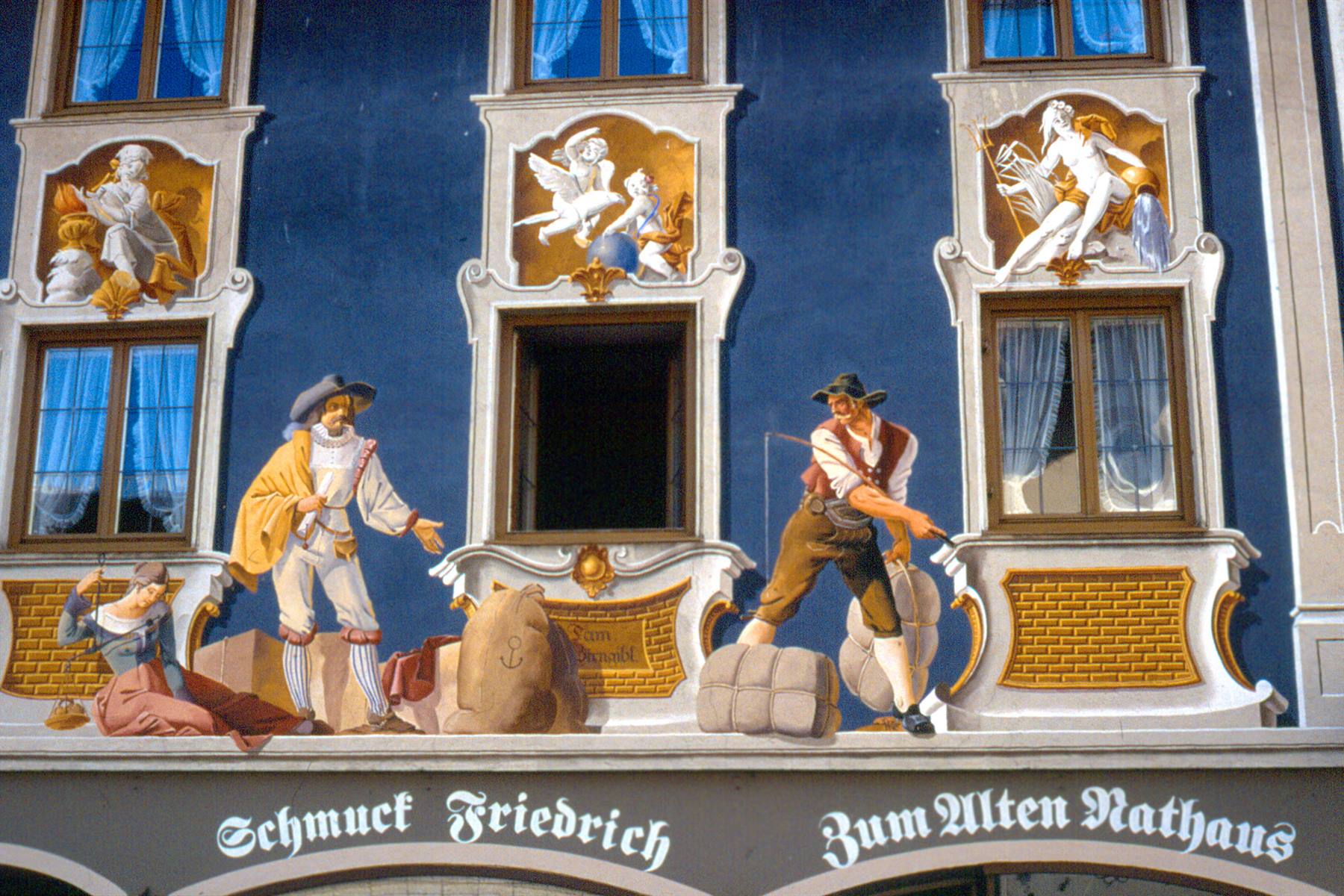
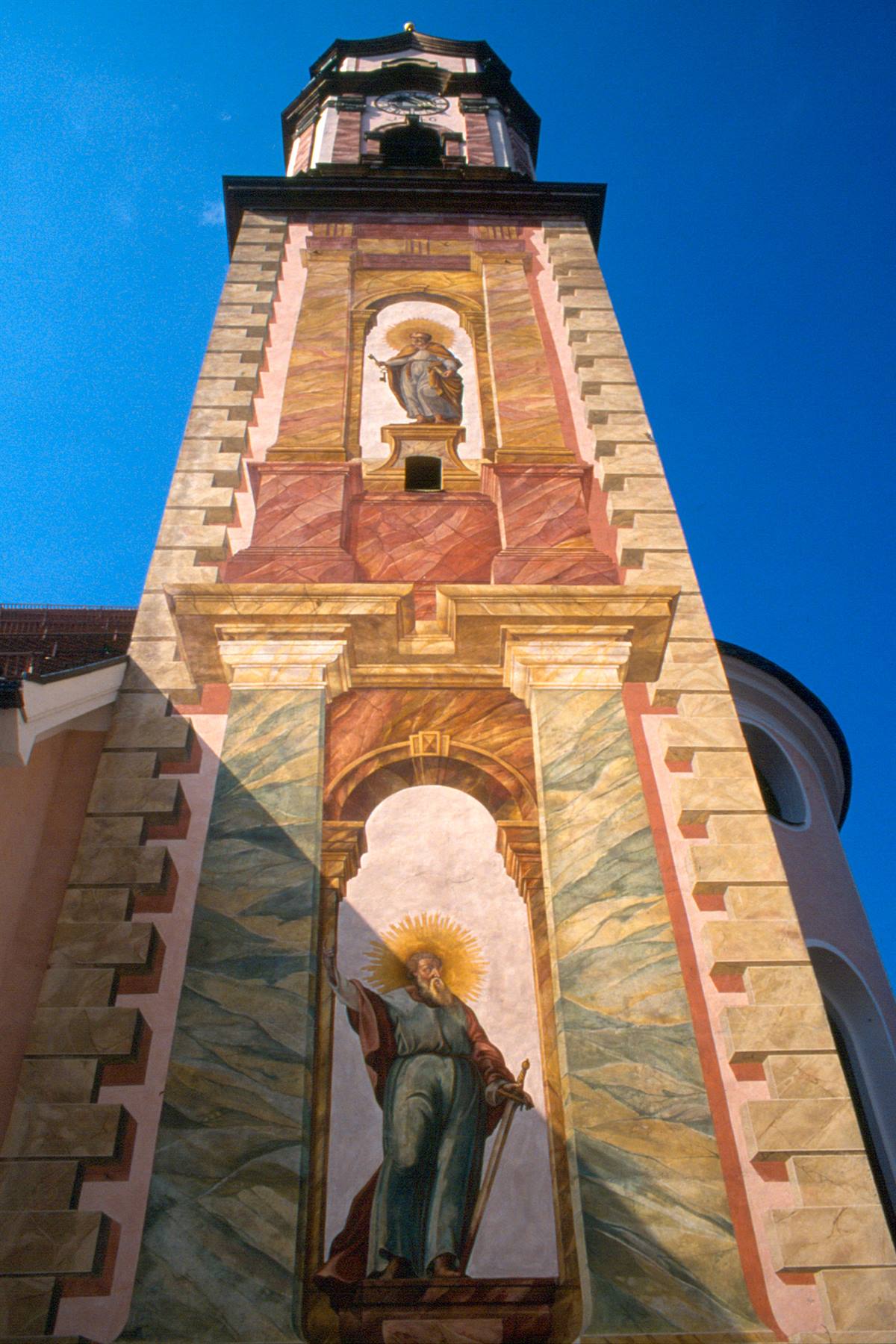
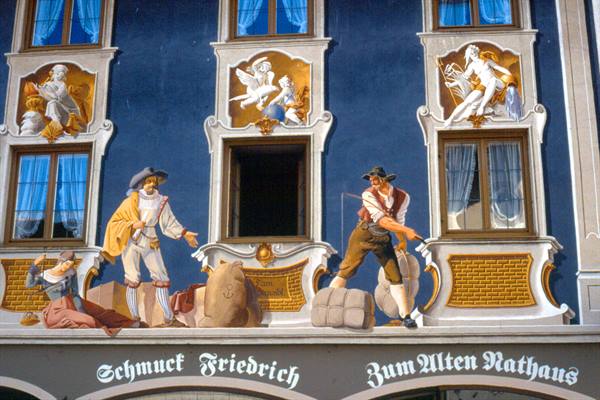
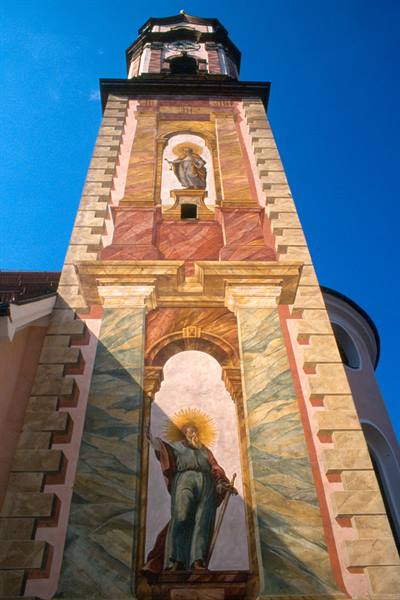
And it is precisely the Parthnach river that, before entering the town, forms an impressive rocky gorge, just over six hundred meters long, the so-called Parthnachklamm, which we visit thanks also to nine suggestive galleries carved between the very high walls of the gorge, at whose bottom the sun's rays practically never reach... an exciting way to end the day!... But it is not yet evening, so we decide to go and see the village of Mittenwald as well, located a few kilometers away, almost at the border with Austria, famous throughout Bavaria for its houses painted with sacred and profane scenes, the work of talented local artists, which offers fairy-tale views against the backdrop of the very high surrounding Alpine peaks, so, before sunset, we return to Garmisch Partenkirchen because from there, tomorrow, we will set off on a high-altitude excursion.
Mittenwald
Day 520 Aug 1991
At 8:00 in the morning here we are at the Zugspitz Bahnhof, the little station of the cog railway that in just over an hour takes us almost to the 2963 meters of the Zugspitze, the highest peak in all of Germany. As soon as we set off we pass near the village of Grainau, with its little church with the characteristic onion dome, then we begin to climb the slopes of the great mountain, enjoying the panorama of the Eibsee below and the very green surrounding valleys. The last stretch of the climb is tackled by means of a cable car that takes us to the summit of the Zugspitze, still abundantly covered in snow, from which the view sweeps over much of the Bavarian Alps.
Back down in the valley we set about grinding out kilometers northward along road number 11 and during the journey we cannot help but notice, at times, some gigantic maypoles, typical of Bavarian tradition (as a symbol of fertility), on which scenes of daily life are depicted. We pass beside the vast Walchensee, cross the Kesselberg pass and descend by switchbacks toward an extensive plain. Having passed the city of Bad Tolz we also cover a short stretch of highway number 8 to arrive, by now in the evening, in the town of Prien, on the shores of the Chiemsee, where we will spend the night.
Fraueninsel
Day 621 Aug 1991
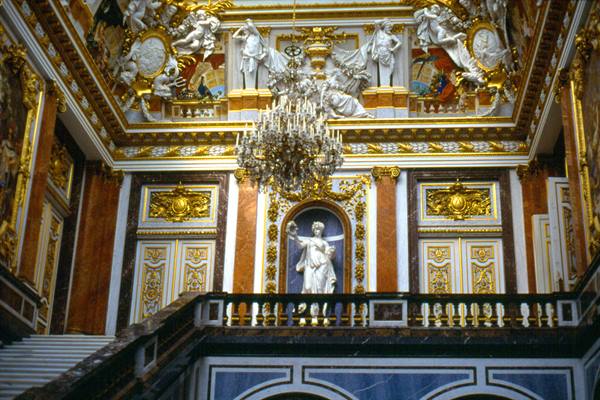
From Prien we set sail by boat on the Chiemsee, the largest of the Bavarian lakes, with its roughly eighty square kilometers of extent, to land, after fifteen minutes of navigation, on the opposite island of Herreninsel... On this patch of land very close to the southwestern shore of the lake there was consummated, in its time, another megalomania of King Ludwig, who had the fantastic Herrenchiemsee Castle built there, taking as a model, once again, the royal palace of Versailles, in France. After the very green gardens we also visit the interiors which, marvelously decorated, involved an enormous outlay of money and the subsequent exhaustion of funds, so much so as to make it necessary to interrupt the works... thus an entire wing of the castle remains, to this day, completely rough, and it makes a very strange impression!...
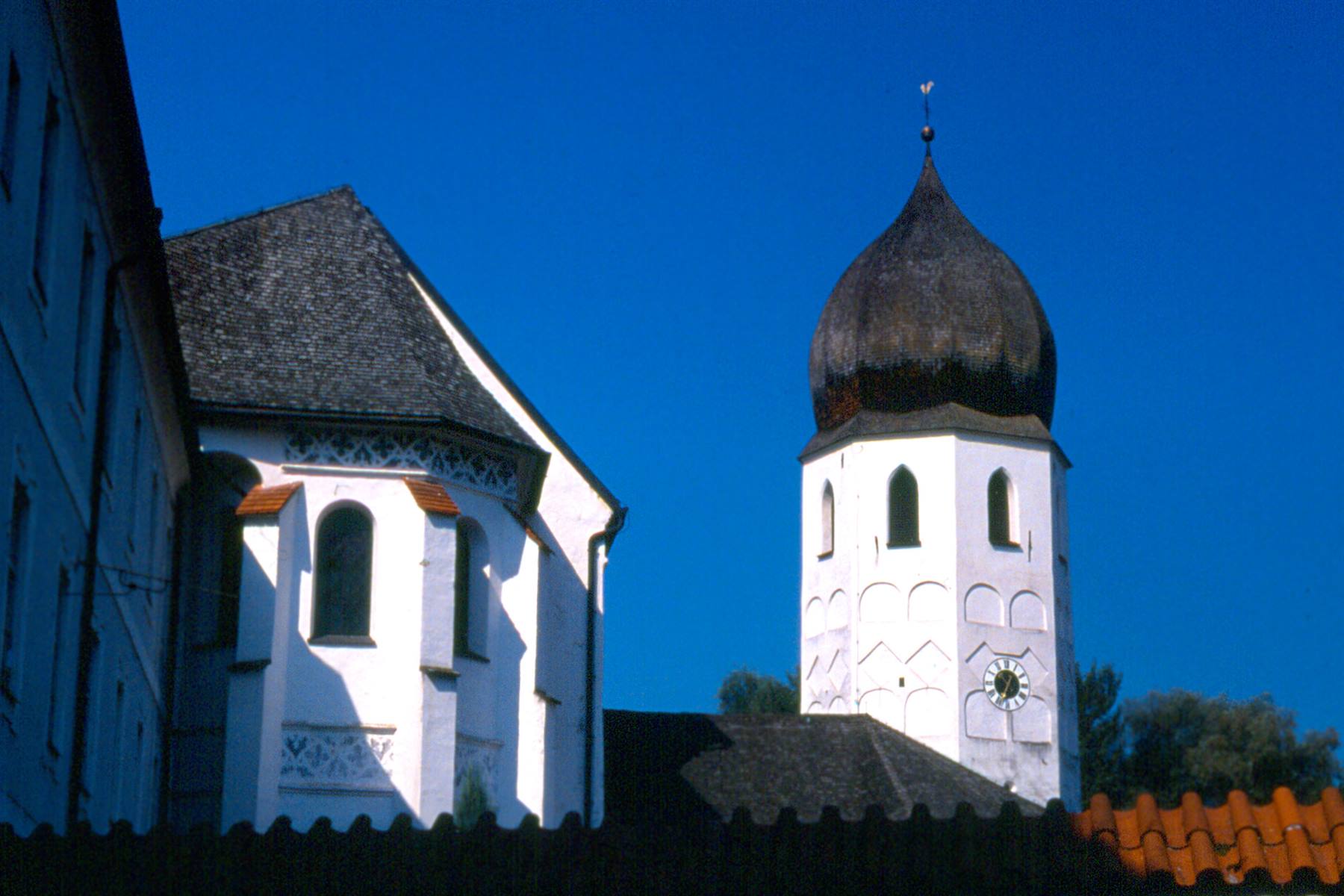
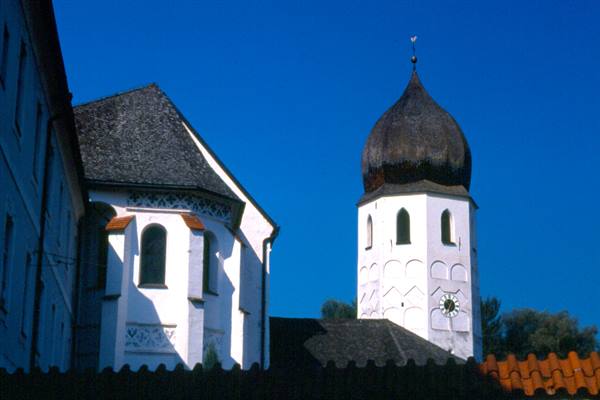
Nevertheless the similarities with the famous castle of the Sun King can be grasped everywhere and become more than evident in the grandiose hall of mirrors. After the island of Herreninsel we disembark on the nearby and smaller Fraueninsel, on which in the 8th century a Benedictine abbey arose, still in operation today, which soon became its nerve center and favored the development of a characteristic fishing village. Back, by now at midday, on the mainland we go by camper eastward along road number 305, which climbs once again among the Bavarian Alps. We pass a small and very green nature park and arrive, by now in the evening, at Berchtesgaden, a well-known tourist resort that today has no more than five thousand inhabitants and is located at the southeastern end of the region, on a strip of land that juts decidedly into Austrian territory.
The small town, which has remained practically intact since the last century, is certainly worth a quick visit, but it is the immediate surroundings that deserve particular attention... and tomorrow morning we will begin exploring them.
Berchtesgaden - Salzbergwerk
Day 722 Aug 1991
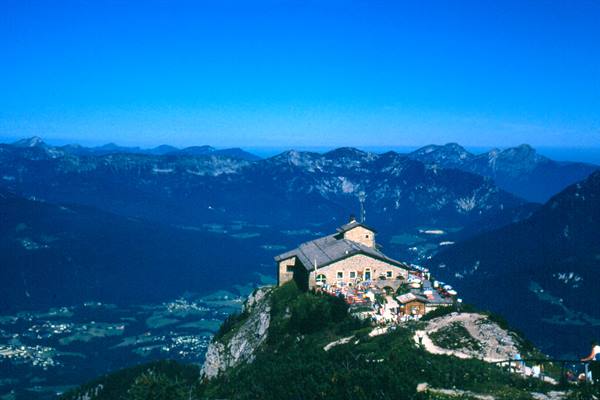
From Berchtesgaden we climb to the nearby locality of OberSalzberg, greatly loved by the German dictator Adolf Hitler, who used to come here on vacation. From OberSalzberg the very daring Kehlsteinstrasse then sets off, overcoming a difference in elevation of seven hundred meters in only seven kilometers, reaching gradients of 25%. Naturally it can only be traveled with special vehicles, and it is only the first stretch of the astounding route that leads to the so-called "Eagle's Nest," a refuge built and donated to Hitler by the party on the occasion of his fiftieth birthday. After the road one walks through a 140-meter tunnel carved into the mountain and reaches an elevator by means of which one covers, in 41 seconds, the last 124 meters of elevation difference that lead inside the Kehlstein Haus, the legendary refuge of the Führer, at 1834 meters of altitude...
But Hitler did not like coming up here, it seems in fact that he suffered from vertigo and the vast panoramas, though very beautiful, evidently frightened him. It was by chance, or by a final and fortunate reconsideration, that the Allies at the end of the war did not blow up the "Eagle's Nest," a fate that instead befell Hitler's mountain residence at OberSalzberg, of which only the bunker remains: an intricate underground labyrinth of cold and gloomy corridors. At this point there is nothing left for us to do but travel the Rossfeldhohenringstrasse, a spectacular panoramic road (toll) that runs along a ridge and on the exact border line between Germany and Austria, with the view sweeping over the wide valley of the Salzach river, in Austrian territory, then we descend again to Berchtesgaden.
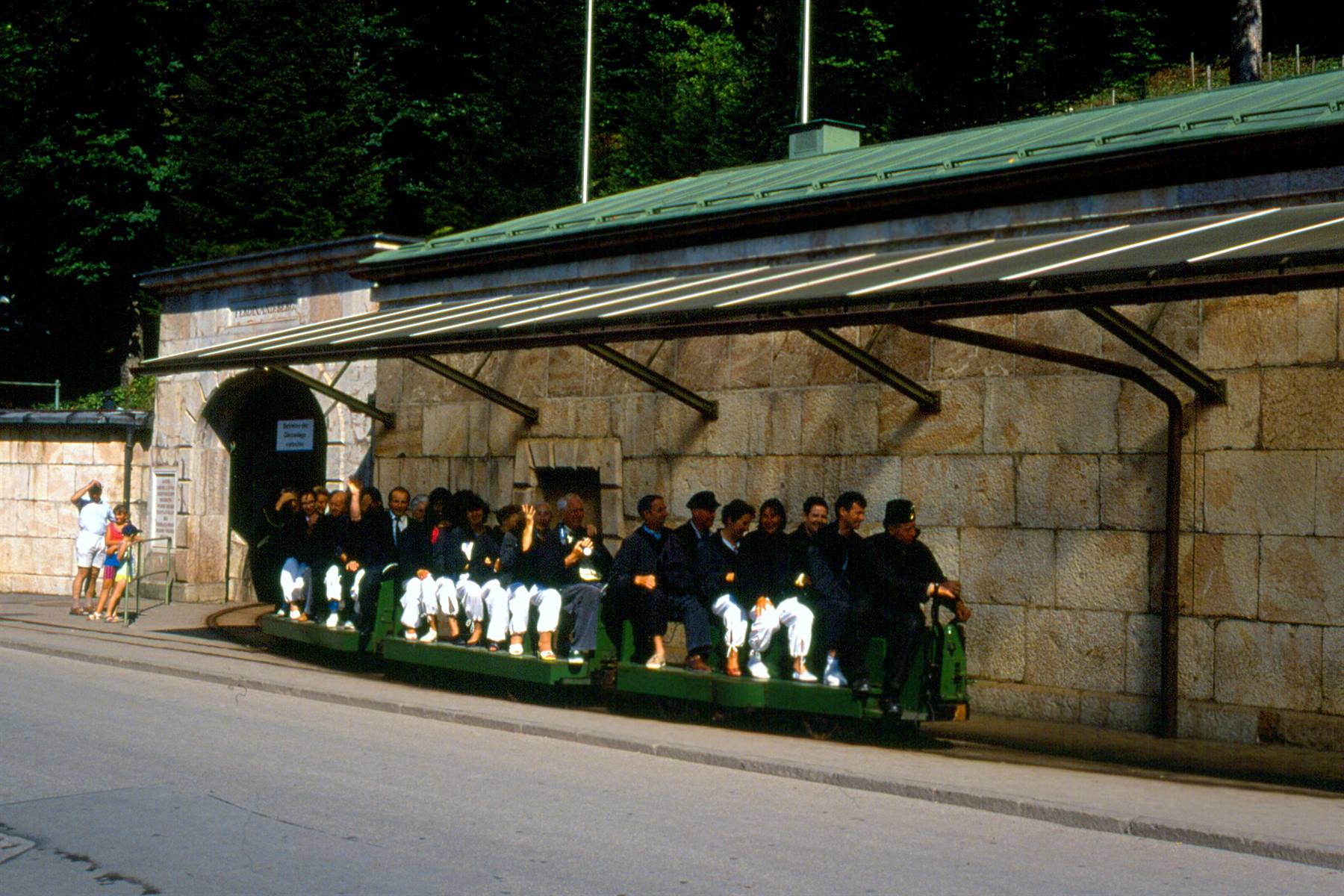
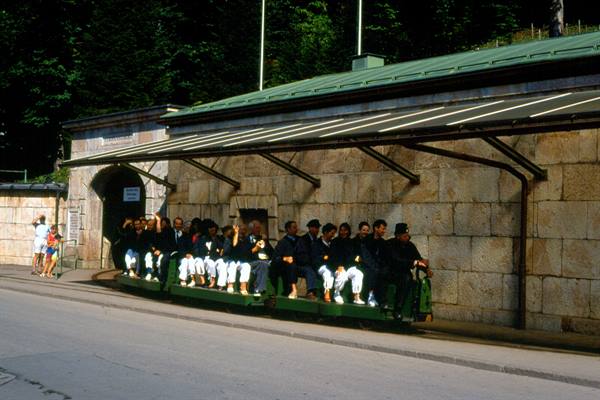
In the afternoon we go to visit, on the outskirts of the town, the very curious Salzbergwerk, that is, the old salt mines... Dressed in funny uniforms and with the aid of little electric trains we venture into the bowels of the earth to discover a very particular world, today softened and also made fun with the introduction of fantastic wooden slides, but once, and for entire generations, anything but hospitable... In the mountains around Berchtesgaden, in fact, salt has been extracted since 1517. After another beautiful day, rich in experiences both strong as well, in the evening we move a few kilometers further south to the shores of the Königsee.
Königsee
Day 823 Aug 1991
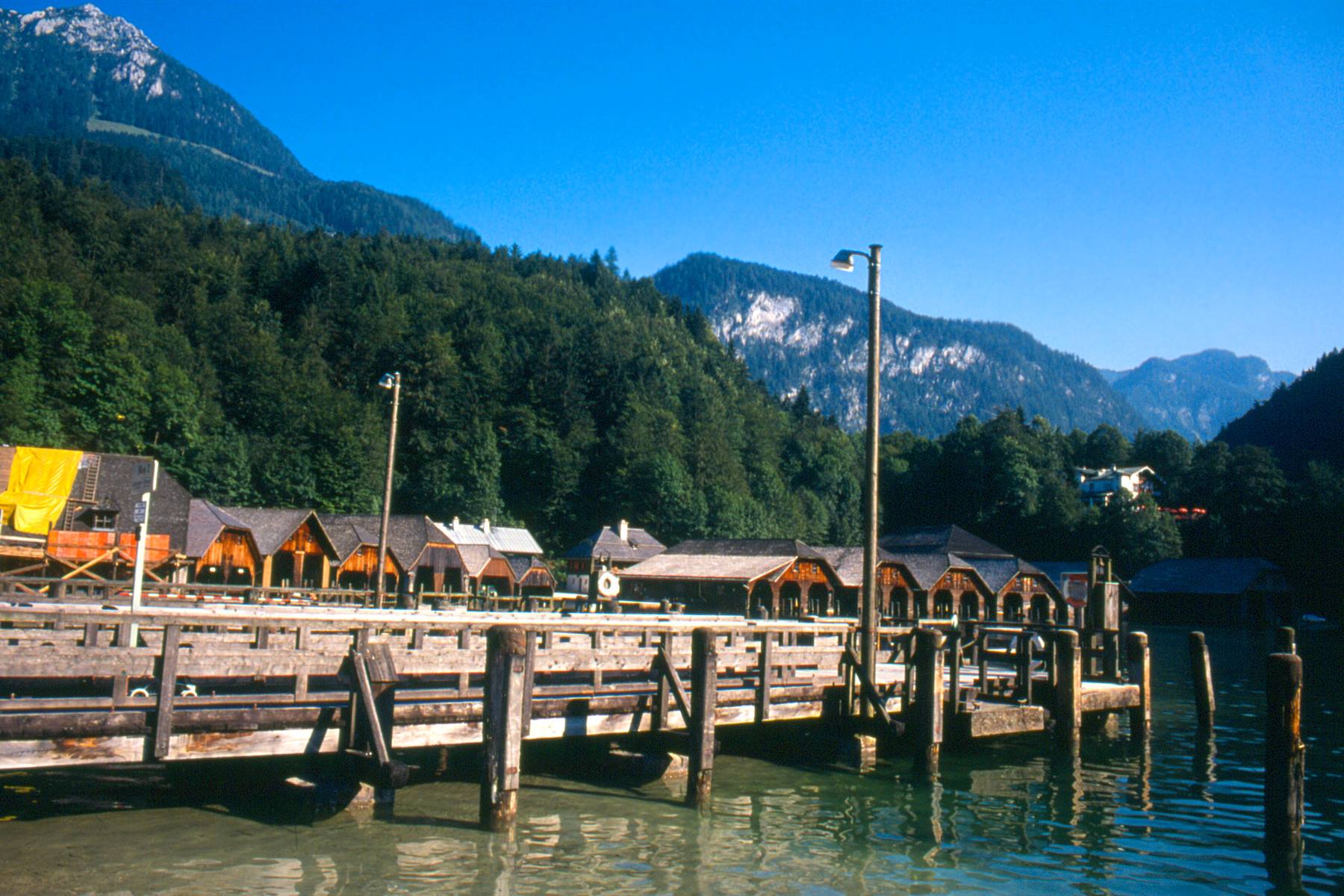
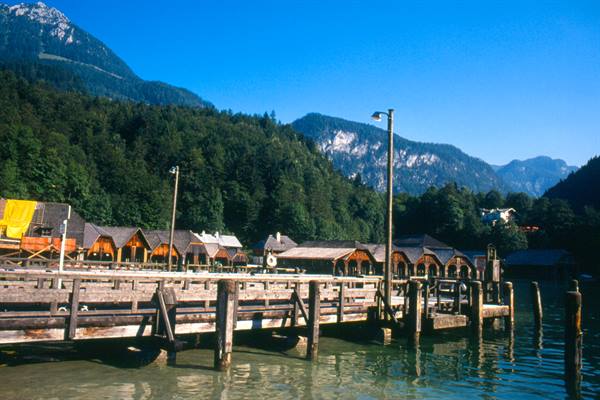
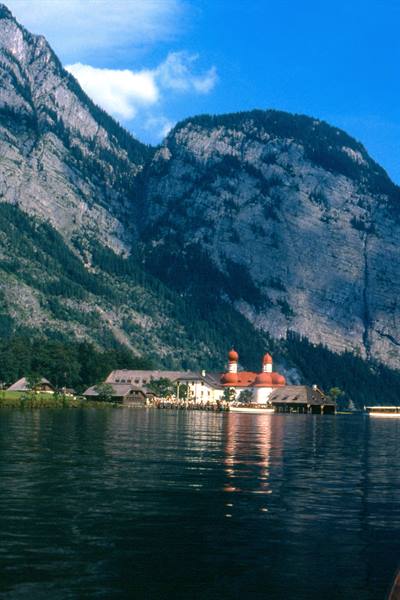
The Königsee is surely the most beautiful German lake and also the cleanest: in fact there are no paved roads along its high shores, so we prepare to cover, with the aid of an electric boat, the eight kilometers of length of the lake basin, which unfold among impressive peaks, soaring to beyond two thousand meters. The setting makes the place resemble a narrow Norwegian fjord, in which the curious phenomenon of the echo also manifests itself, enhanced, at a certain point along the route, by a folkloric trumpet tune. Heading up the lake in a north-south direction we arrive, about halfway, at the graceful Baroque chapel of St. Bartholoma, built at the end of the 17th century, then, leaving behind us the characteristic red domes of the sanctuary, we land shortly thereafter at the southern end of the Königsee, in an ancestral silence and peace, surrounded by beautiful nature...
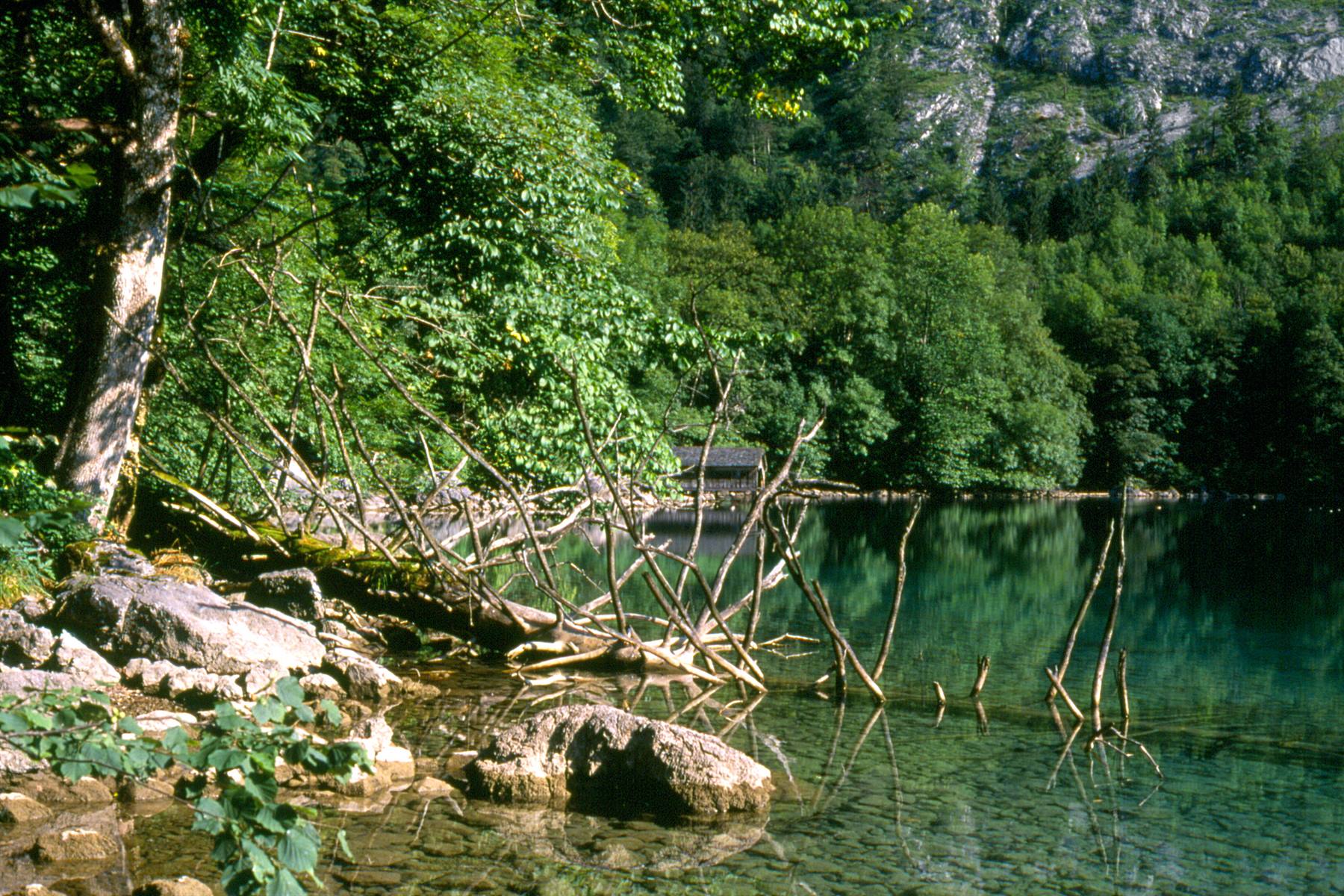
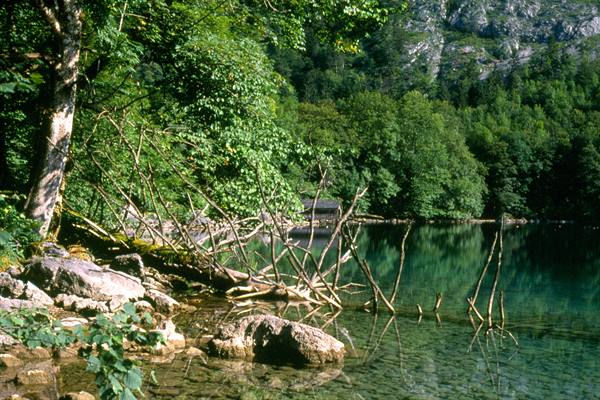
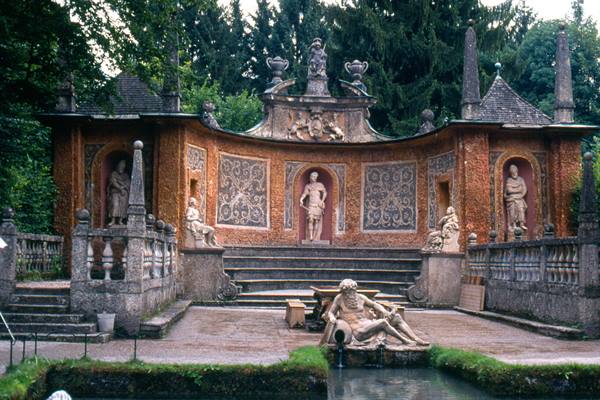
From there, in a few minutes on foot, we then reach the crystal-clear and enchanting Obersee, before retracing the entire extraordinary route in reverse. Around noon we are back in Berchtesgaden, but in a very short time we cross the state border and once we have entered Austria we arrive, on the outskirts of the city of Salzburg, at the sumptuous Hellbrunn Castle, residence, in its time, of Prince-Bishop Marcus Sitticus, who entrusted its execution to the Como-born architect Santino Solari. Very beautiful to us appear the frescoes that decorate the interiors, the work of the Italian Mascagni, but it is the gardens that are particularly interesting, scattered with fountains, grottoes and curious water features.
The prince-bishop loved to invite his guests to walk through his singular park and, being the joker that he was, he amused himself by making them victims of the numerous water pranks, hidden in the most unthinkable places... and still perfectly functioning today!... So we prepare, still wet, to spend the night in the surroundings, not before, however, having also observed an astounding hydraulic theater in which no fewer than 113 figurines move simultaneously, powered solely by the force of water!
Obersee
Day 924 Aug 1991
This day we dedicate entirely to exploring the city of Salzburg. Lying on the banks of the Salzach river, what is surely one of the best-known Austrian tourist destinations owes its urban layout to Vincenzo Scamozzi of Vicenza, today has about 140,000 inhabitants and is characterized by the silhouette of the Mönchsberg hill, on which stands the imposing and mighty Hohensalzburg Fortress, one of the largest military constructions of the Middle Ages. With the aid of a funicular (the Standseilbahn) we begin our visit right from the castle, enjoying a broad panorama of the town below, dotted with domes and palaces, which recall scenes of Italian cities of art, quite different from the traditional images of a pre-Alpine village.
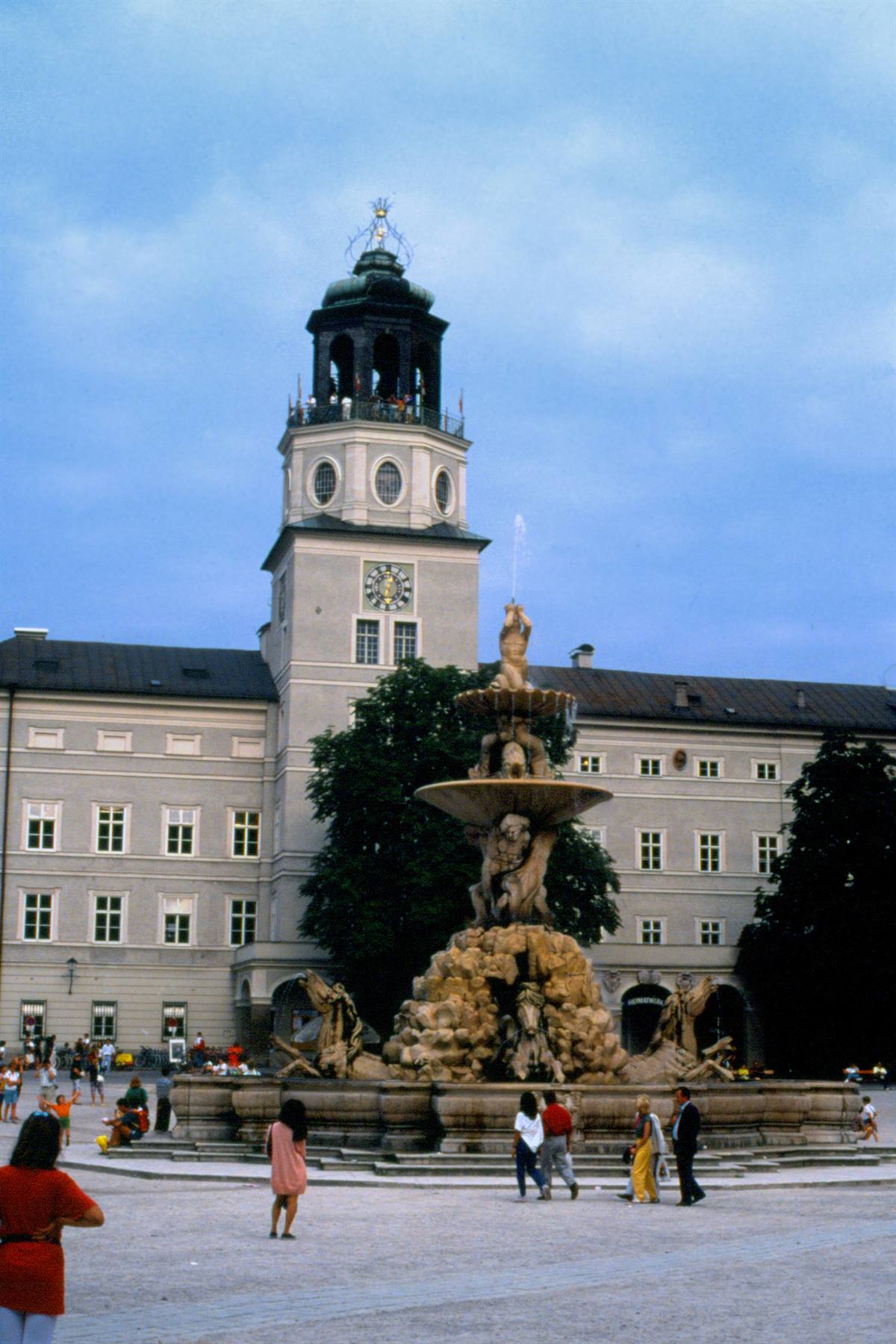
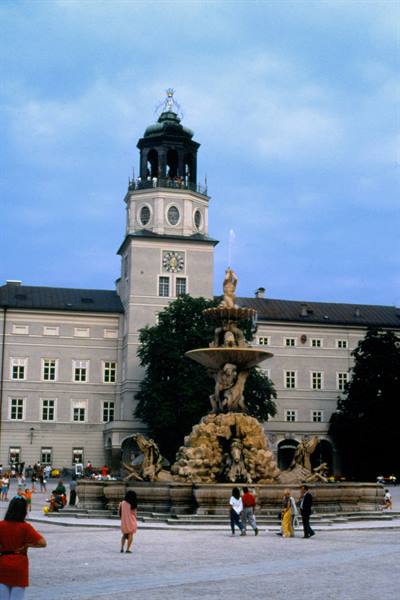
Having descended again to lower elevations we then lose ourselves in the Residenzplaz: the largest and liveliest of Salzburg's squares, adorned at its center by a sumptuous Baroque fountain (the Residenzbrunner) and surrounded by numerous historic buildings, among which stands out the Residenz, which was, in its time, the official residence of the prince-bishops, undisputed rulers of the city. Onto the square also faces the cathedral, erected in its current forms by Santino Solari of Como between 1614 and 1628, who used the Baroque style, exalting its grandiose internal proportions: 101 meters in length by 69 in width! Not far from the cathedral we observe the small but evocative St. Peter's cemetery, where among others the architect Santino Solari and Nannarel Mozart, sister of the famous musician, also rest, with the adjoining St.
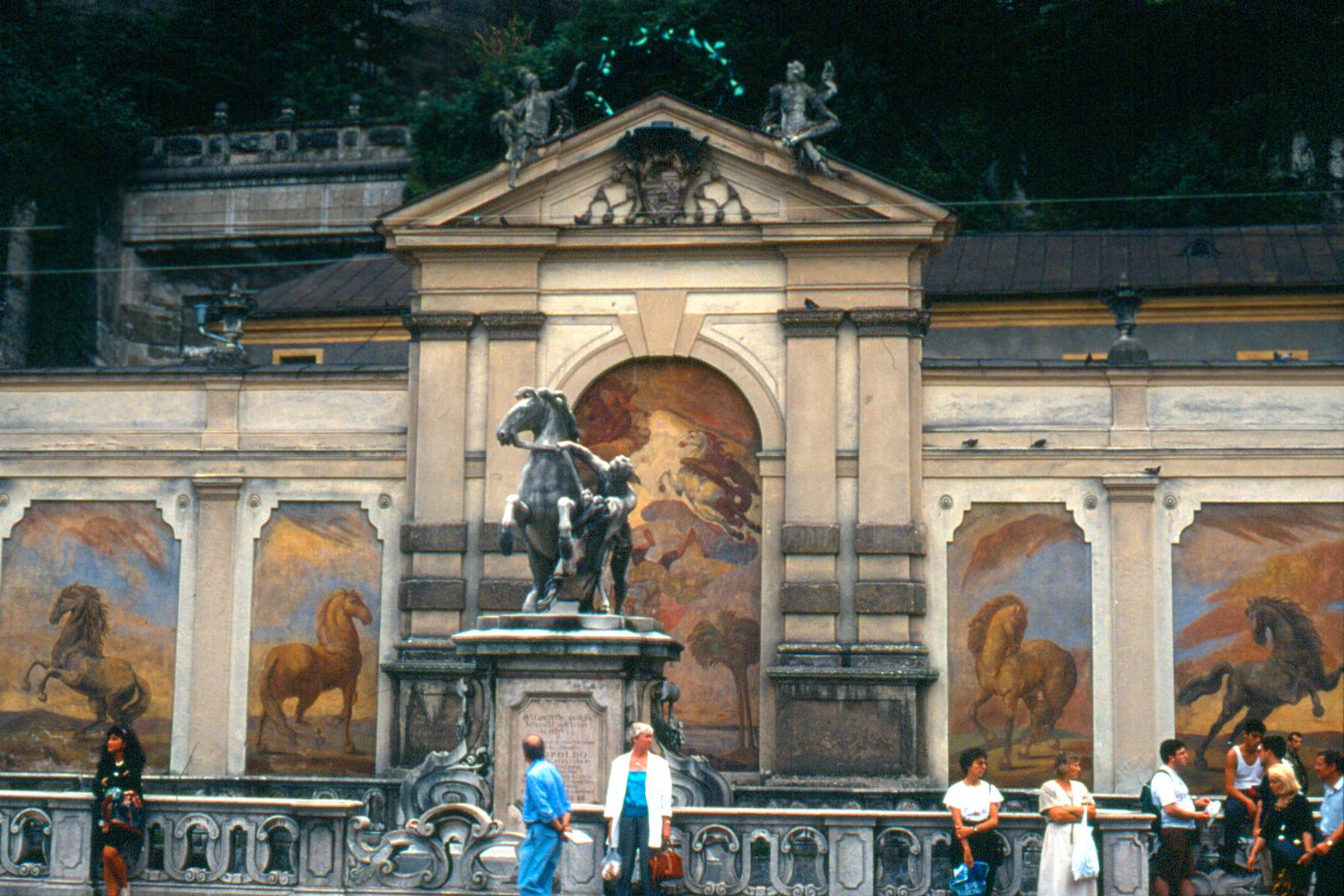
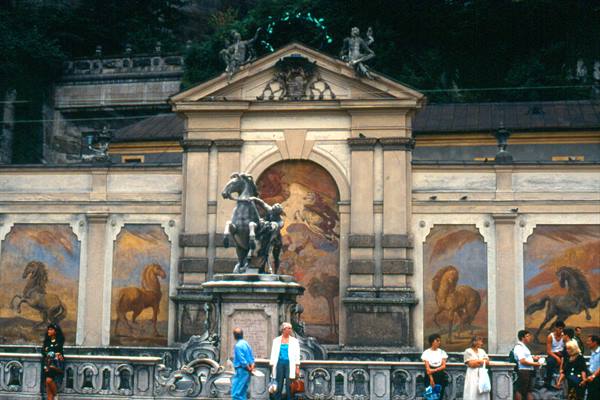
Peter's church, the oldest in the city, erected in 1130 and later remodeled in style... naturally Baroque. Walking we arrive at Sigmund Plaz, characterized by an old horse trough and adorned with large equestrian-themed frescoes, then we walk along the very central Getreidegasse, the most picturesque and lively street in the historic center where, at number 9, is the house in which, on January 27, 1756, a certain Wolfang Amadeus Mozart was born. The bond that unites Salzburg to Mozart is inseparable, and one perceives it everywhere, although it can be described as a one-sided bond... in fact the hatred that the musician harbored toward his birthplace was well known.
A hatred certainly not harbored by the many tourists who invade the central streets of Salzburg, in which one cannot help but also notice the beautiful wrought-iron signs, which in some cases are true works of art! In the afternoon we visit Mirabell Castle, located on the right bank of the Salzach river, erected in 1606 and subsequently modified in Baroque style, which was the summer palace of the prince-bishops. The elegant gardens are adorned with some stone groups, the work of Ottavio Mosto of Padua, and offer splendid views of the unmistakable profile of the Hohensalzburg Fortress.
Salzburg - Residenzplatz
Day 1025 Aug 1991
After spending another night in Salzburg we then prepare to spend the last day of vacation... We leave behind us the wonderful Austrian city and, having taken the A10 highway, after a few dozen kilometers, we encounter the mighty Burg Hohenwerfen Fortress, from which, never tamed, we set off on another excursion, which will take us to the incredible Eisriesenwerfen cave. The particularity of this cavern is due to two very specific natural phenomena: the constant infiltration of water and the low temperature, which give rise to extraordinary icy formations, among which our journey practically concludes. Having regained the highway we return to Italy via the Tarvisio pass and from there, once we have descended from the Alps, we pass through Venice and, having crossed the entire Po Valley, we arrive at Forlì as well. What can we say?...
It was a short trip but extremely rich from a historical-cultural point of view, with also some interesting purely naturalistic insights, but above all it was an opportunity to take a break from the intense construction work on our future home.
1 reader comments
certo che le foto le sapevi fare già nel 91 :-)