St. Remy de Provence, Arles, Carcassonne, Toulouse, Albi, Cahors, Rocamadour, Fontaine de Vaucluse
When
23 Jul 2005 – 6 Aug 2005 15 days · trip of 2005
Who
· @LucaGiramondo ·
How
Travel diary
The story · 16 days
By Luca, Sabrina and Federico
Day 123 Jul 2005
At dawn on a hot midsummer day, waking up, we find the camper, parked in front of the house, already loaded with everything needed to tackle this new journey, which will take place in the south of France. A trip we should have already made two years ago, but a road accident, fortunately without serious consequences, almost completely destroyed our traveling home, and we had no choice but to give it up. We'll go to Occitania, a region historically located west of the Rhône and enclosed between the Pyrenees and the Massif Central, normally a bit overlooked but instead rich in points of notable interest, both natural and artistic. Unfortunately, we'll set off with the anguish caused by the terrible attack carried out, by the hand of vile and despicable Islamic fundamentalists, during the night in Sharm-el-Sheikh, a place we know well.
At 8:46 we leave home, with Federico, a lover of this kind of trip, more chipper than ever, and twenty minutes later we get on the highway at Faenza, as usual. Traffic heading north is heavy, but everything flows smoothly, and at 9:30 we're in Bologna. It's not the same heading south, though, because it's practically at a standstill. The asphalt flows constantly under the wheels of our vehicle; thus at 10:30 we're in Parma and half an hour later in Piacenza. We barely skim the course of the Po and head west along the A21, then south, following the A7 first and the A26 after. We cross the Apennines, noticing the strange name of a tunnel, "dell'asino morto" (which makes a curious pair with the "viadotto del bue morto," located on the A1, just before Florence), and come within sight of the sea, on the Ligurian coast, at 12:30.
We travel along the A10, skirting the Riviera di Ponente, and shortly after, at 12:55, near Savona, we stop at a service area for lunch. The stop lasts less than an hour: we get back on the road as soon as possible and, after a short queue at the Ventimiglia toll booth, at 3:30 PM we enter France, with no checks whatsoever (in fact, not even a trace of customs), in spite of the much-vaunted suspension of the Schengen Treaty by the French after the recent, despicable attacks in London. We follow the very expensive French highway, passing well-known elite seaside resorts like Monaco, St.
Tropez, and Cannes, then, around 5:00 PM, we stop for fuel and notice, for the first time since we started traveling, fuel prices even higher than in Italy! Around 6:00 PM we leave the Marseille exit on our right, and an hour later we arrive at the goal for this first day, at the foot of the village of Les Baux de Provence, which we'll visit tomorrow morning. There was supposed to be a camper parking area in the area, but it's no longer there, so we settle in for the night, rather improvised, along the road, but there's another rig to keep us company and the place seems quiet enough, so, anything but worried, we devote ourselves, after dinner, to some well-deserved rest.
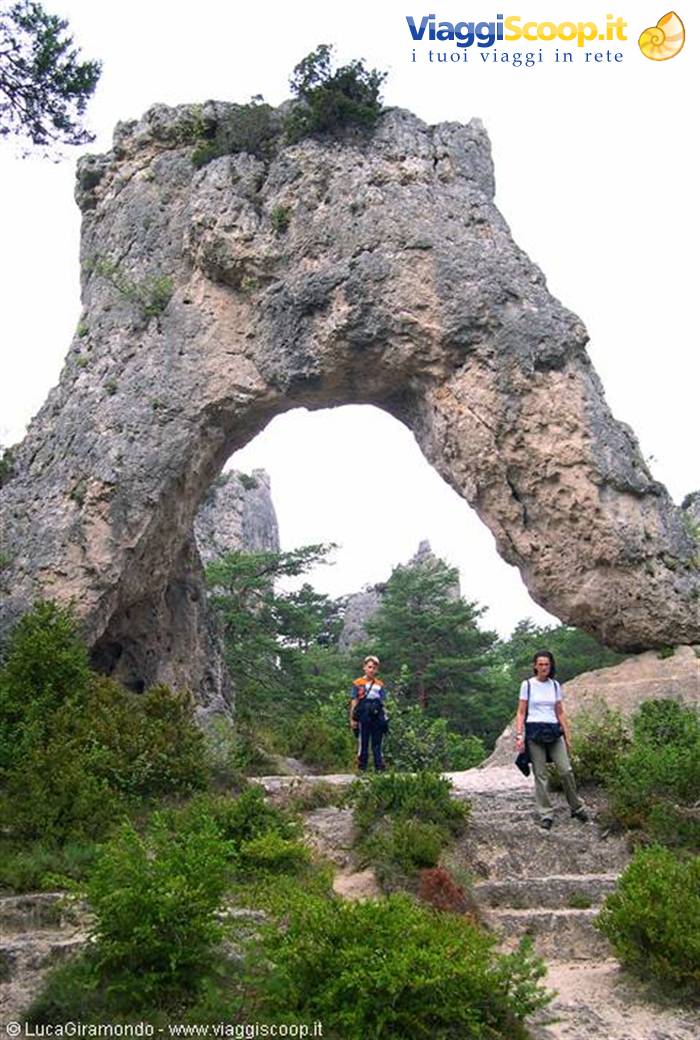
Chaos de Montpellier le Vieux - Porte de Mycènes
Day 224 Jul 2005
When we wake up, there's no sun, but just enough time for breakfast and the sky quickly clears of clouds, so we can set off with better expectations for the visit to the medieval village of Les Baux de Provence, perched on a rocky spur among the modest mountain roughness of the Alpilles. The town, home to a refined court as early as the 16th century, unwisely supported a revolution and was punished with destruction, ordered by Louis XIII, in 1632. In the 19th century, a mineral was discovered nearby and was given, precisely, the name bauxite, and today the village, skillfully restored, can be visited. The characteristic narrow streets have been restored to their former splendor; we walk them in the tranquility of the morning hours up to the panoramic balcony overlooking the Romanesque church of St.
Vincent, and higher up, to the castle, which, however, we decide not to visit: for the three of us it would have cost twenty euros... everything has its right price, and this is decidedly too much, especially since the manor is little more than a ruin. Satisfied nonetheless with the visit, we calmly return to the camper, lingering over the old 17th-century residences and the little shops, which grow livelier as the hours pass. Back aboard our vehicle, we move a few kilometers north, to the outskirts of the town of St. Remy de Provence, where the interesting and evocative Roman remains of Les Antiques are located.
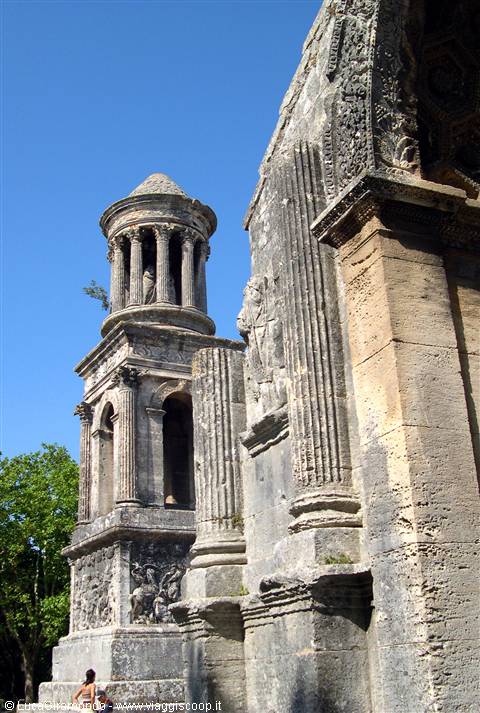
On the ancient road that connected Italy to Spain, the settlement of Glanum once stood here, of Hellenistic foundation, Romanized in the 1st century BC, of which some vestiges remain: foundations of houses, temples, and baths, but above all a marvelous triumphal arch, dating to the early years of the empire, and the mausoleum which, over 19 meters high, was presumably dedicated to two grandsons of Augustus. The pair of monuments, erected side by side, is scenically located on a small clearing among the trees and certainly deserves more than a casual glance. We take a few photos and briefly let ourselves be captivated by the charm of these ancient stones, then set the GPS for today's stage destination and get back to grinding out kilometers.
Taking stock of this first part of the day, we realize, however, due to the missed visit to the castle of Les Baux, that we're well ahead of schedule, so we decide to make an unplanned stop in the city of Arles, which lies exactly on our route. We park north of the town near Porte de la Cavallerie, passing through which, on foot, we reach the historic center, dominated by the imposing bulk of Les Arenes, the largest Roman amphitheater existing in France, which, probably erected in the 2nd century under Hadrian, measures 136 meters by 107 and, developed over two orders of 60 arches, could hold up to 26,000 spectators: a colossal work, fortunately preserved in decent condition down to our day. Under the hot Provençal sun we walk around the arena and, flanking what remains of the theater, also Roman, we arrive in front of the marvelous portal of the church, this time Romanesque, of St.
Trophime, a sculptural jewel dating to the 12th century... Having observed the austere interior, we then devote ourselves to visiting the scenic cloister, through whose slender little columns one can capture the most captivating views of the religious complex. Wandering through a city with a particularly sly look about it, given the holiday, noon passes well by, and, all in all pleased with the unexpected visit, back at the camper, right in Arles, in a shaded parking lot on the banks of the Rhône, we eat our well-deserved lunch. In the afternoon we set off for the most substantial part, in terms of mileage, of the stage: we pass the city of Nimes and venture onto the inland heights along the so-called Corniches de Cevennes.
The road runs for long stretches along the ridge of a mountain system with an unenthusiastic appearance, offering hilly landscape views very similar to those of our Apennines... and the thick haze present certainly doesn't help make them more attractive. Meanwhile, the little arrow indicating the fuel level drops rapidly, approaching the red zone, and the holiday doesn't seem to allow us to do anything about it... Instead, when we were by now thinking we'd have to stop and wait for Monday morning, we find an open gas station near Florac and, after filling up, we can calmly resume our itinerary. We then take the road that follows the valley and the Gorge of the Tarn river, which stretch for several dozen kilometers, offering scenarios sometimes interesting but nothing transcendental (especially if your eyes still hold the stunning canyons of the American West!)...
moreover, we find, in order, the evocative site of Castelbouc in shadow, the vast belvedere of Cirque de St. Chelly backlit, and the remaining part of the gorges flooded by the gloomy light of the valley floor in the late afternoon... in short, a small failure! Around 7:00 PM we reach the end of the narrow valley in the town of Rozier, and from there we climb, along tight hairpin turns, up to the plateau at Montpellier le Vieux, where a camper parking area is supposed to be... We find it, but there are no other vehicles parked, though there is a rustic eatery, the Auberge de Maubert, where we have dinner with an excellent steak at an ridiculously low price (25 euros for three).
Darkness falls in an almost unreal silence: we seem to be at the end of the world, and the setting is beautiful, while quietly, quietly, another little camper arrives to keep us company, and for this night too we won't be alone.
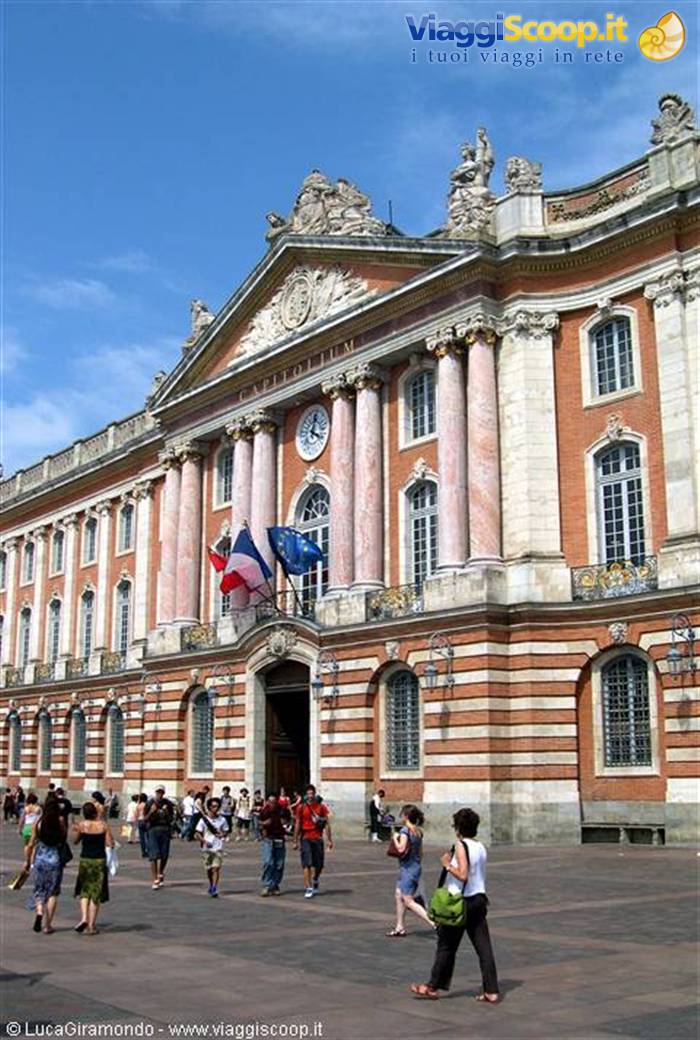
Toulouse - Le Capitole
Day 325 Jul 2005
Unfortunately, it's not a beautiful day from a meteorological point of view: the sky doesn't threaten rain but is completely overcast, and grayness reigns unchallenged. We get up slowly and go to see nearby the so-called Chaos de Montpellier le Vieux: a relatively small area where erosion, caused by weather agents, has over time shaped the dolomitic rocks present into fanciful formations. Having passed the entrance and paid the ticket (combined with the Aven Armand, a cave we'll visit in the afternoon), we park our vehicle and, on foot, venture along the main path that crosses the protected area. We thus tackle the rugged climb leading to the rocky spur of Douminal, surrounded by surprising peaks, and from up there we enjoy the bold panorama...
too bad about the sun, irretrievably absent! Following a downhill stretch, we then approach the so-called Porte de Mycenes: a beautiful natural rock arch that fully deserves its role as the park's symbolic formation. We walk another short stretch of trail and then, with the help of a convenient little train, make our way back to the parking lot, concluding a visit that in better weather conditions, and therefore with more attractive scenery, could certainly have been carried out more extensively and thoroughly... too bad! We resume our itinerary, only to suspend it almost immediately because of my curiosity, but above all Federico's, for an equipped "Adventure Course" among several rocky pinnacles near the Auberge de Maubert.
Armed with protective helmets and carabiners, we thus try our hand, for over an hour, at crossing Tibetan bridges and walkways of the strangest shapes, with Federico, intrepid, letting himself go hanging from some pulleys along dizzying passages, while Sabrina, patiently, waits for us in the camper for lunch... Having finished the adventure, like true tough guys who scorn danger, we present ourselves at the table with an imperious manner... "Bring food, woman!"...we'd like to shout!...Joking aside: we really had fun... and, good as gold, we give a hand in the kitchen without arguing. We have lunch while it's gotten decidedly late and we're still at Montpellier le Vieux, so we promptly get back on the road as soon as possible. We travel the interesting Gorge de la Jonte and after about thirty kilometers we stop to see the Aven Armand.
We descend by funicular along a tunnel and access an immense underground chamber, 45 meters high, which could house within it, in its entirety, the Notre Dame cathedral in Paris. It was discovered in 1897 by a certain Louis Armand and is very beautiful, literally invaded as it is by a forest of over 400 snow-white stalagmites with a very particular shape, due to the height from which the fateful little drop of water falls: they look, in practice, like so many "pancakes" of limestone stacked one on top of another. We thus reemerge into the open air pleased with the visit... and to think we've seen so many caves on our travels! The afternoon is by now well advanced when we go back to devouring the asphalt, but there's still one place we'd like to see before the end of this day. After an endless series of curves, around 6:00 PM, we reach the parking area near the site in question.
We go to the ticket office and immediately after begin descending along a path that in about a kilometer brings us, on the bed of the river below, to the entrance of the Abime de Bramabiau. Literally "The abyss of the bellowing bull" (because of the noise produced by a waterfall in periods of high water), it's a deep crevice in the rock produced by a river that flows for 800 meters underground, then reemerges with a thundering waterfall.
We stay for a long time, in the company of the guide, at a temperature of 8-10 degrees, in the intricate maze of galleries of Bramabiau: we only walk one kilometer of it, but in reality the waters, with the complicity of time, have truly run wild, and the overall speleological development of the caves is a full 11 kilometers! All of it proves to be, if nothing else, very original, and at the end of the excursion into the bowels of the Earth we can, sufficiently satisfied, face the hard climb back up to the parking lot, where our trusty vehicle waits patiently for us.
Also because of the "Adventure Course," it's gotten decidedly late, so we're practically forced to end today's stage in the parking lot of the Abime de Bramabiau: we have dinner and, in the silence of the Cevennes, put an end to an all-in-all positive day, which, however, with the presence of the sun, especially in the morning, could have been decidedly better.
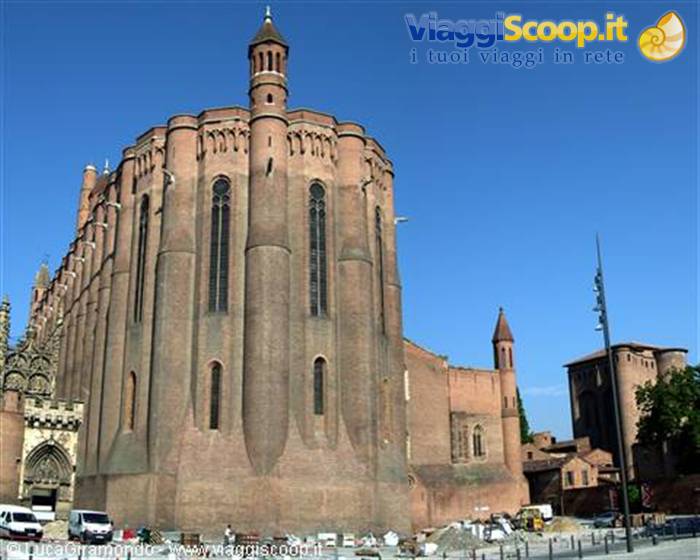
Albi - St. Cécile
Day 426 Jul 2005
Due to the delay accumulated yesterday, we find ourselves forced to skip the visit to the medieval village of La Couvertoirade; on the other hand, today, it seems, we'll be accompanied by a shining sun. With these conditions, we set off after having slept wonderfully well at over a thousand meters of altitude near the Abime de Bramabiau, and after traveling an endless series of curves, we arrive, descending considerably toward sea level, near the village of St. Bauzille de Putois. On the limestone heights dominating the town to the northeast, a road climbs, following which we reach the famous Grotte des Demoiselles.
In the parking lot facing the site it's quite hot, but the feeling is short-lived, and once we've entered, by means of a funicular, into the heart of the mountain, we find waiting for us the constant 14 degrees that characterize the cave, known for centuries but visitable only since the early 20th century. Its dimensions are remarkable, and in particular the great hall, also called "The Cathedral of the Abyss," which reaches 52 meters in height, is striking. Unlike the Aven Armand, however, which is "alive" and dripping, the Grotte des Demoiselles is arid, in practice "dead," and although evocative, it's more gloomy and less fascinating. After another good hour spent in the bowels of the earth, we reemerge, while noon has long since passed and inside the camper it's infernally hot. We have lunch and promptly set off again, following the course of the Herault river. B
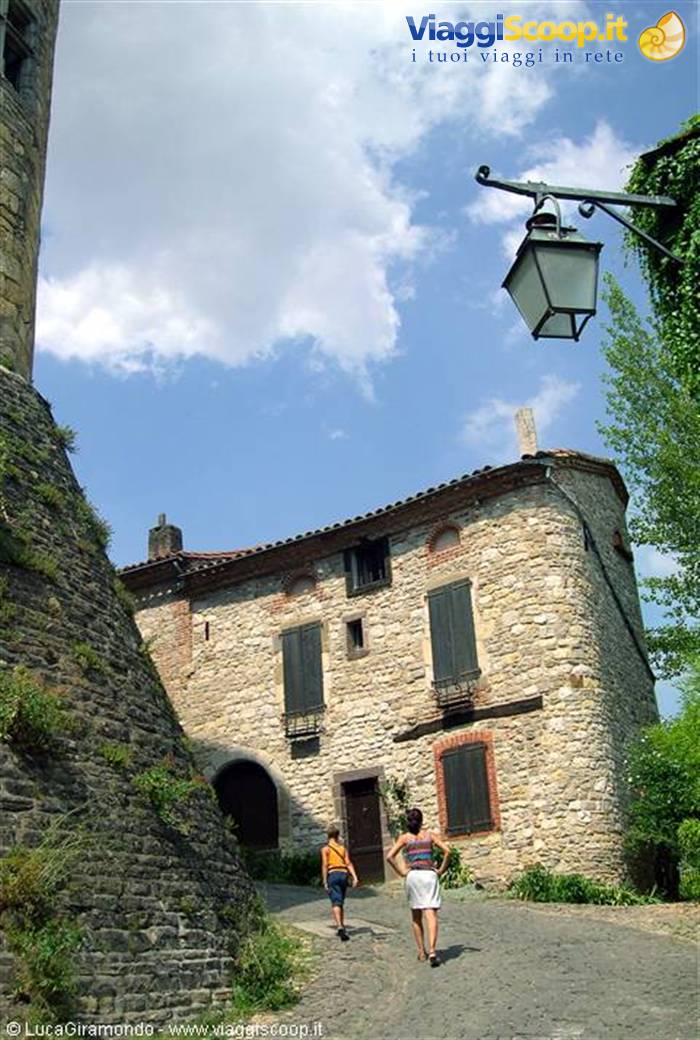
Cordes sur Ciel
Day 527 Jul 2005
The wind blew hard for much of the night and when we wake up the sky is completely cloudy... Damn...!!! Right in Carcassonne, one of the presumably most beautiful places on the whole itinerary! The clouds are traveling very fast above our heads and every now and then you can glimpse a little patch of blue sky, but it's just an illusion. We do every possible and imaginable chore before starting the visit, but the situation doesn't change and, albeit annoyed, we have to accept it. The Cité of Carcassonne, also known as the "Merville du Midì," is one of the most important examples in Europe of a medieval fortified enclosure: its 45 towers are scattered along a double ring, three kilometers long, of ramparts, never breached, built in several stages over the course of about a thousand years (between the 3rd and 13th centuries).
They were providentially saved from demolition and restored by the architect Viollet le Duc in the nineteenth century and have come down to us preserving intact all their extraordinary charm, so much so that they have been used several times as a film set: for example, some scenes of the film "Robin Hood," with Kevin Costner, were shot here. We enter, near the monumental Porte Narbonnaise, into the space between the two rings of walls and walk along it, amid wonderful views, up to the Tour St. Nazaire. From there we enter the old town and immediately come upon the fourteenth-century basilica of St. Nazaire, in which the splendid polychrome stained-glass windows stand out.
We then leave the fortifications again through the scenographic Porte d'Aude to observe the fanciful architectural interplay of the towered walls, which at this point is so beautiful that it stands out even against today's infamous gray sky. We wander for almost two hours among ramparts and medieval alleys (unfortunately overrun by excessive tourist exploitation) and during this time we also observe the fine Chateau Comtal, which rises on the western side of the Cité, preceded by an enormous semicircular barbican and the inevitable moat, but throughout the whole time the sun doesn't deign to grant us its presence in the least! Shortly before noon we finish the visit and set off somewhat annoyed toward Toulouse... doubly annoyed when, having arrived at our destination, the clouds quickly thin out, with the sky turning blue again more than ever.
We park and have lunch near the "Cité de l'Espace": a large interactive exhibition space dedicated to the cosmos and the European aerospace industry, which we would intend to visit, but the high cost of the ticket (20 euros each) and above all, not knowing other languages perfectly besides Italian, the fear of understanding little or nothing make us refrain from doing so. Federico (an ideal and stingy friend of Scrooge McDuck), fortunately takes it well and agrees with the decision, so in the early afternoon we can devote ourselves to exploring the historic center of Toulouse. The ancient capital of Languedoc and current capital of the department of Midi-Pyrénées is an urban agglomeration of considerable size, so, after a futile attempt to find parking on the central streets for our bulky vehicle, we look for an alternative.
We head toward the outskirts and stop, as soon as possible, near a metro stop. To Federico's delight, since he had never tried this kind of transport, we thus reach the historic core of the city of Toulouse by metro (an experience that, among other things, we try to pass off as a substitute for the Cité de l'Espace). We emerge near the very central and large Place du Capitole, dominated by the imposing and elegant neoclassical facade of the building called, precisely, the Capitole, which, erected between the 18th and 19th centuries, today houses the Hôtel de Ville (the city hall). We walk along the narrow Rue du Taur, flanked by ancient buildings, and arrive before the great basilica, entirely in red brick, of St.
Sernin: a distinguished monument of Romanesque art and a stop for pilgrims on the "Way of Compostela," begun in 1080, over which soars the bold 63-meter-high Bell Tower, with six tapered octagonal stories. The use of brick characterizes a bit the whole historic center and also the imposing church of Les Jacobins, a very rare example of a religious building with two naves (usually they are odd in number: one, three or five) erected in the fourteenth century. Closing a sort of itinerary in a ring, we find, unfortunately, the Hôtel de Bernuy closed, an interesting sixteenth-century palace, and we find ourselves in front of the lively facade of the Capitole, certain of having had a brief but pleasant experience among the architectural beauties of this large and perhaps somewhat neglected city.
With the help of the metro we return to the camper and for the evening we move 70 kilometers north to the much quieter town of Albi, dominated by the imposing outline of the Cathedral of St. Cecile. We fuss quite a bit and I also scraped my knee clumsily falling while trying to find the camper area, but in the end we park in a magnificent spot, practically at the foot of the great religious building, and, mindful of what happened in Carcassonne, I rush to photograph it while the sun is out... and in the peace of this provincial town, with the profile of the cathedral illuminated, standing out wonderfully against the night sky, as if wanting to protect us, we conclude a beautiful day rich in history.
Conques
Day 628 Jul 2005
We have our usual breakfast with, in addition, beyond the glass, the grandiose mass of the Cathedral of St. Cecile... and it's precisely from there, naturally, that we start on our visit to the center of Albi: a historic town, a departmental capital, which between the twelfth and thirteenth centuries was the fulcrum of the heretical movement of the Albigensians. The Cathedral of St. Cecile, the symbol of Albi, rises at the top of the hill overlooking the course of the Tarn river, in the center of a vast square, and was built between 1282 and 1390 entirely of red brick. It looks like a medieval fortress, crowned by the walkway and by semicircular turrets, but above all by the majestic tower-bell tower, 78 meters high, that rises above it, reinforced by powerful cylindrical fortifications.
The originality of the construction, which looks more like a military than a religious building, comes not only from the severity of the outer walls, but also from the absence of an entrance on the main facade: one enters instead through a veritable free-standing structure located on one side and made up of a staircase, a turreted portal and a Gothic canopy, rich in pinnacles and pierced decorations. Already impressed by the powerful exterior, we are enraptured before the sumptuous interior: the chapels and vaults are entirely covered with very rich fresco decorations, created in the early sixteenth century by the Italian painter Giovanni Francesco Donnella. We linger a long time inside the cathedral with our noses in the air...
a pity only that, following some maintenance operations, from the great organ come, repeatedly, prolonged and monotonous sounds, which end up disturbing a bit the solemnity of the visit. Emerging from St. Cecile we take a short stroll through the historic center of Albi and arrive at the Gothic Pont Vieux, from which one gets a fine view of the city, inevitably characterized by the cathedral, as well as by the nearby Palais de la Berbie, a scenographic brick building that we stop a little later to see more closely, and which houses the Musée Toulouse-Lautrec. The artist, born in Albi in 1864, is famous above all for having designed numerous advertising posters for the Moulin Rouge and his can-can dancers are universally known: so we buy, in his honor, a fine lithograph and then make our way back to the camper extremely satisfied with the visit we have just concluded...
only Federico is a bit disappointed because he wanted to climb the great tower-bell tower, but it turned out not to be possible, even though some people could be seen at the top. We set off again and, climbing the surrounding heights, we reach the medieval village of Cordes sur Ciel. We park in the camper area below the town and there, given the hour, we have lunch. Without haste, in the early afternoon, we devote ourselves to exploring the village, which, founded in 1222, is perched on a hill at the entrance to the Cerou Valley and is enclosed within four defensive walls, erected over the span of two hundred years.
The route leading to the center, all uphill, in today's heat, turns out to be extremely trying, but in the end, passing through ancient and scenographic gates, we arrive in the main little square of the town, a natural balcony over the valley below, immersed in a centuries-old peace, where we find two improvised musicians further characteristic of the atmosphere... and there, comfortably seated, we enjoy a well-earned and refreshing granita. More calmly (and less out of breath) we descend, savoring the village, dotted with ancient buildings and numerous artists' studios... Cordes sur Ciel is lovely and has certainly deserved the hours of attention we devoted to it. After completing all the routine chores at the equipped area, we set off again toward Albi, skirting cheerful sunflower fields, and thus come once more within sight of the imposing mass of St. Cecile.
Naturally we don't stop and we continue northeast, following the signs for the city of Rodez, where we arrive in the late afternoon. We park near the center and rush to see the Cathedral of Notre Dame, while the sun, after a very hot day, is about to disappear behind big gray clouds that are relentlessly advancing from the west. The religious building, erected in several stages between the thirteenth and sixteenth centuries, is practically the only monument of any interest in the town and stands out, imposing, at the end of the wide Avenue Victor Hugo: given the hour it's now closed, but we manage to take a decent photo, still with the sun's reflection, before returning to the camper for dinner. In the evening it threatens several times to rain, but in the end it doesn't...
we hope it all passes and that tomorrow morning the sun will be back, defying what has been systematically happening since we left: one good day and one bad... today sun and tomorrow... clouds?
Saint-Cirq-Lapopie
Day 729 Jul 2005
In the very early hours of the morning it finally rained, but when we wake up there are far more patches of clear sky and confidently we can kick off this day too. We have to move quickly because, in the car park where we're staying, they're probably getting ready for a village festival and when we poke our heads out of the camper we find ourselves almost completely surrounded by barriers... we have a quick breakfast and right after we leave Rodez behind. We take the road northwest and following the rugged Dourdou Valley we arrive at the ancient village of Conques, while unfortunately the clouds increase dramatically, somehow confirming the alternation of weather conditions. We park and set off on foot to explore the village, accompanied by the shade, which unfortunately reigns supreme...
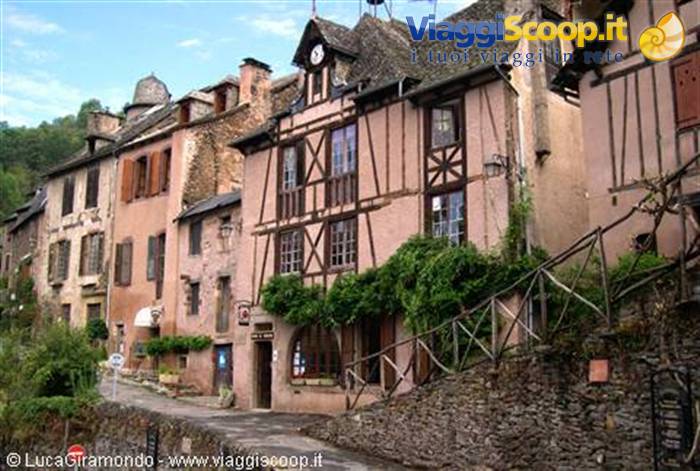
Nevertheless, the silhouette of the Benedictine abbey of S.te Foy stands out marvellously in the centre of the town, a Romanesque building dating back to the 11th century, which was once the hub of city life as a stop for pilgrims on the "Camino de Compostela". Around the abbey complex wind the characteristic alleys paved with round cobblestones and the lanes lined with half-timbered facades, in which we deliberately lose ourselves for a couple of hours, until we are rewarded by a few precious rays of sun. Once we've finished, shortly after 11:00, the visit to the charming village of Conques, which since 1988 has also been part of the Unesco world heritage, we set off again and cover a good stretch of road: we pass through the town of Decazville (I don't want to venture into literal translations as vulgar as they are unlikely) and near the village of Figeac we stop for lunch.
We park on the banks of the river with the sky above us completely overcast and with the only note of colour offered by Federico, who is enjoying himself with his new call whistle, bought in a small shop in Conques. Refuelled, we set off for the second part of the day, while it also starts to rain and the morale of the "troops" drops rapidly to levels inadequate for a holiday mood. In less than an hour we come within sight of the valley of the Lot river, our arrival point for today's leg, and the weather situation obviously doesn't change. Instead of going to see the village of St. Cinque La Popie we then go up, along a side road of the valley, to the Grotte di Pech Merle, visitable only by reservation... We reserved the possibility of doing so, from home via the website, for tomorrow morning, but given the weather conditions we wouldn't mind bringing it forward...
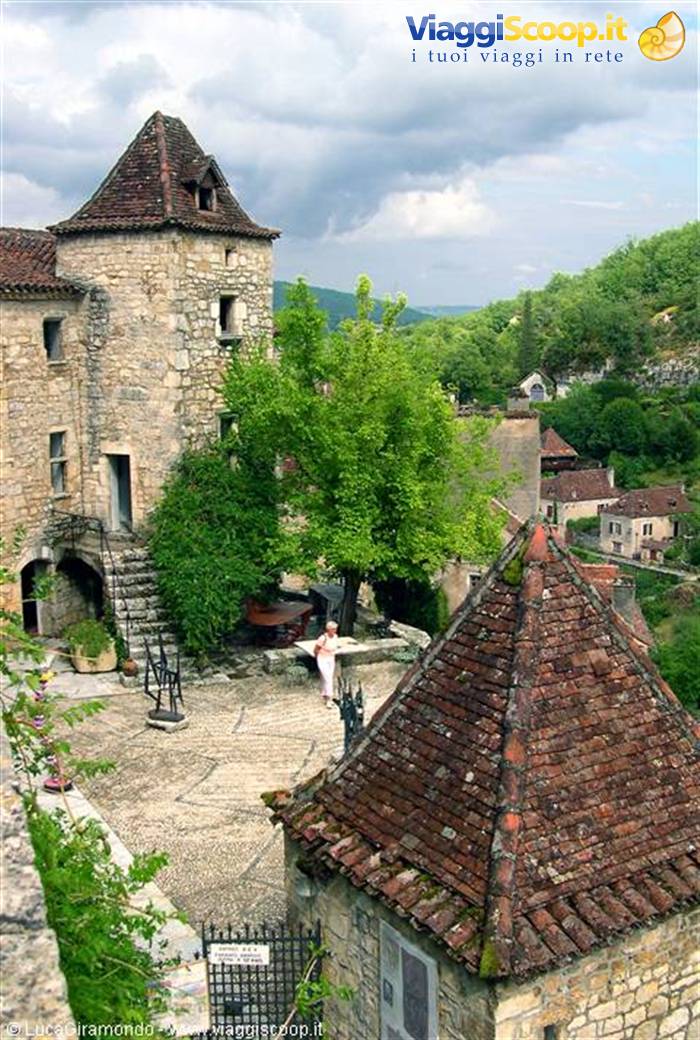
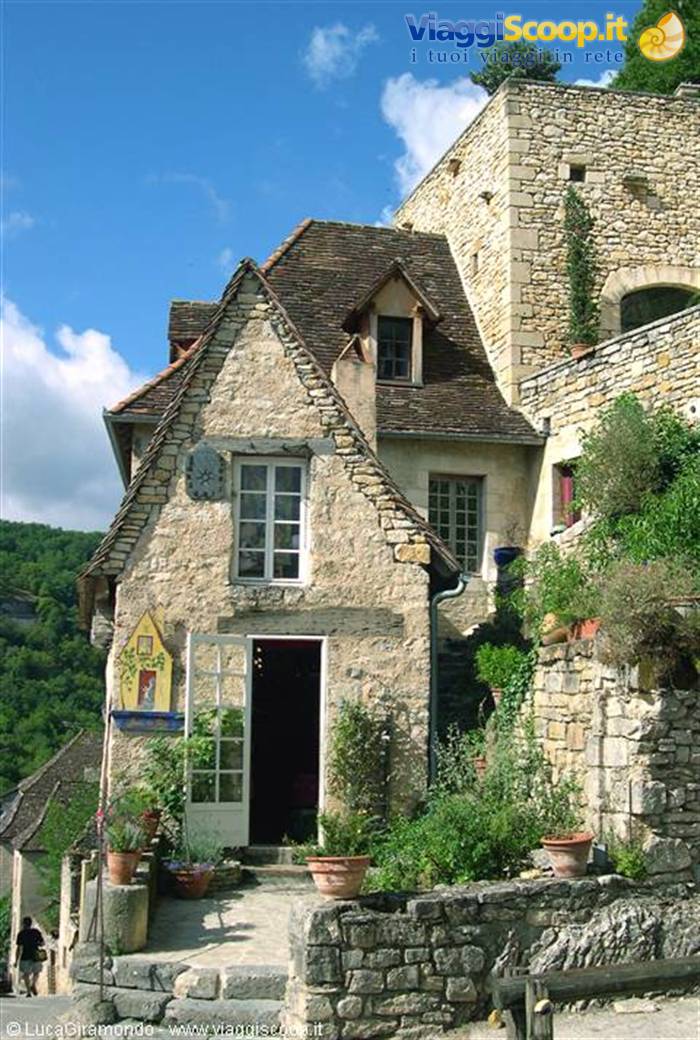
No such luck though: the day's visits are already all full and we have no choice but to go to St. Cinque La Popie, while fortunately it has stopped raining and among the clouds, now sparser, the sun even peeks out. St. Cirque dominates the Lot valley from the top of a cliff and is classified among the most beautiful medieval villages in France. The noble La Popie family, once lords of the place, gave its name to the castle, located at the highest point of the slope, and therefore to the entire settlement. We reach the vestiges of the old manor along a path that starts from the main square and from the top we enjoy the view over the whole village and the old church, perched on the side of the cliff.
We then descend into the heart of the village which, enriched by buildings exclusively from the medieval era, presents a beautiful architectural homogeneity and we enjoy, amid lights and shadows, this little Occitan jewel too. The weather could have been better, but all things considered it was pleasant to stroll almost until evening along the narrow cobbled alleys of St. Cirque La Popie and calmly later we move, for the night, to the very nearby Camping de la Plage, on the banks of the Lot river, so as to properly tidy ourselves up after almost a week of travelling. The little one spends some time in the tiny playground within the area and then we retreat inside the camper, while a few drops of rain fall... but we don't despair: according to the well-tested rules, tomorrow there should be sun.
Cahors - Pont Valentré
Day 830 Jul 2005
PART ONE
The alarm goes off and cautiously I open the skylight above our heads: I look out and find myself in a muffled environment... I'm no champion of diopters but everything around me is excessively blurry and there's a reason, because we're immersed in a thick bank of fog. We don't get discouraged and have breakfast, while the haze slowly thins out and now, looking carefully straight up, a hint of blue can also be glimpsed. We'd like to take one more photo with the right light of St. Cirque La Popie before leaving the place, but the village, at 9:00, is still wrapped in the morning mist and we have to give up, so twenty minutes later we're in front of the entrance to the Grotte di Pech Merle, to visit which the presence of the sun is not necessary.
The cave of the "Hill of the Blackbird" was discovered by chance in 1922 by two teenagers and its main feature is not the limestone formations (though present to a minimal extent), but the prehistoric paintings. This area of France is particularly rich in remains dating back to the Palaeolithic and nearby there are other caves with characteristics similar to this one, but Pech Merle is one of the few open to the public (though limited to 700 visitors a day) and it is essential to book the visit, which we did almost a month ago... and we were extremely provident, since we are first on the list. We collect our tickets and shortly after, accompanied by a guide, we descend into the cave. We thus take in the first paintings, executed in shades of red and black on the white limestone walls of the cave. Some date back as far as 20-25,000 years ago and are marvellous in their crude simplicity...
we are not in the presence of the "Sistine Chapel" but it almost gives you chills to observe those rough yet significant strokes, in front of us, after so much time. We remain almost an hour absorbed in the visit, observing among other things also hand prints on the walls and footprints on the floor, as well as a curious root that crosses the entire cave to sink into the ground at its base, then, considerably satisfied with the experience, we re-emerge into the open air... The fog in the meantime has completely dissolved and now candid little clouds travel in the blue of the sky. We take a quick look at the adjoining museum and then return to travelling along the Lot Valley.
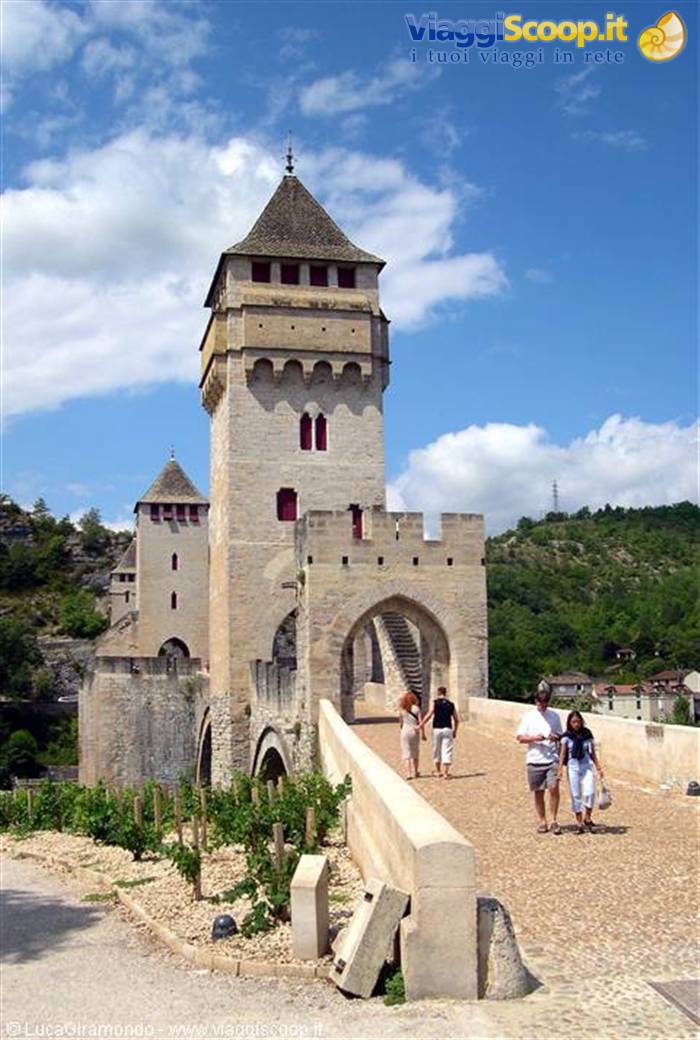
We thus stop to see the curious Defilè des Anglais, a series of narrow galleries topped by strange fortifications, and the little iron bridge opposite that, picturesquely spanning the course of the river, leads to the village of Bouzies. One bend after another we thus arrive in the town of Cahors, embraced by the course of the Lot, which bathes it on three sides, and characterised by the wonderful Pont Valentré, a fortress-bridge considered one of the most beautiful monuments in all of France. We park the camper nearby and on foot we enjoy the impressive medieval construction, the best preserved of its kind in Europe, erected, it seems even with the help of the devil, between 1308 and 1378.
It consists of six Gothic arches on which stand out, at the centre and at the ends, three slender crenellated towers with passages, rising 40 metres above the water's edge, creating a picture of great suggestion... The bridge, symbol of Cahors, has long been rightly included in the Unesco world heritage.
Collonges-la-Rouge
Day 930 Jul 2005
PART TWO
It's almost noon when we leave this surprising little town on the Lot and take the A20 motorway heading north: we cover a good stretch and then stop for lunch in a service area, to set off again right after, as soon as possible, for the second part of the day. We exit shortly before Brive la Gaillard and following some secondary roads eastwards we approach the village of Collonge la Rouge, while the sky, which had darkened, opens as if by magic giving us a more luminous afternoon than ever. We park just outside the village, classified among the most beautiful villages of France, and strolling calmly we devote ourselves to exploring it.
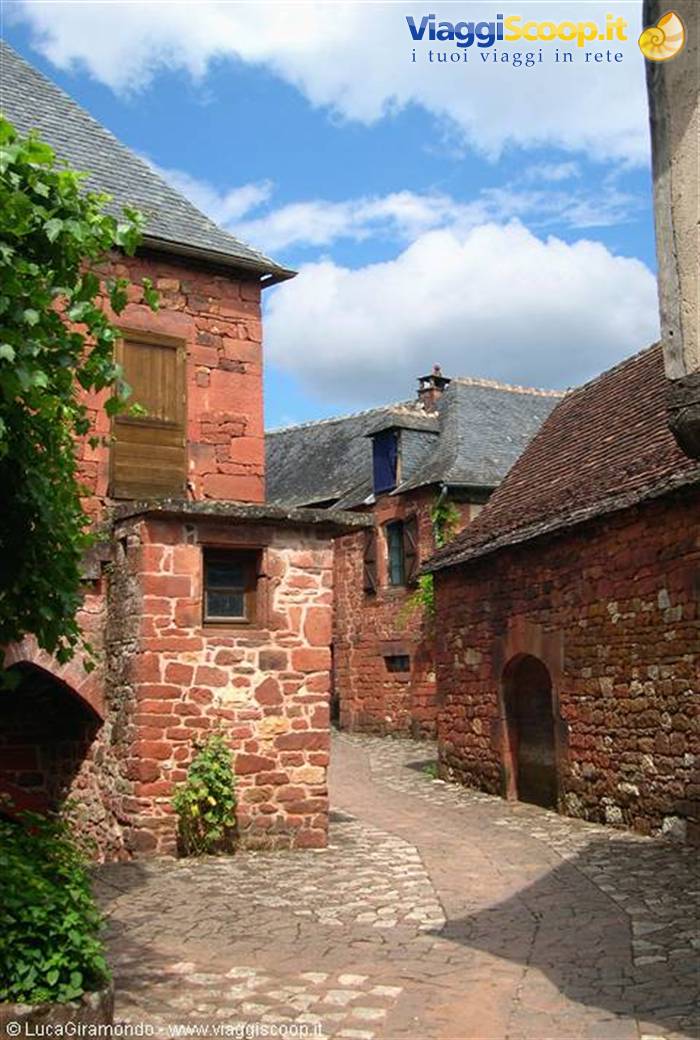
Entirely built using red sandstone, Collonge arose in the year 785 around a priory and from an architectural point of view its most surprising element is the great quantity of noble residences present which, perfectly restored, present a myriad of scenic towers and turrets. The place, in the Middle Ages, was in fact a sort of holiday resort and in a certain sense, after a period of decline, it was once again tourism that saved it from destruction... It's a village of strong chromatic contrasts starting from the bright red of the stones with the white of the lime that binds them and the green of the surrounding bucolic landscape, and then the dark blue, almost black, of the roofs with the intense blue of the sky...
fortunately! We stroll along the Rue de la Barriere, lined with fanciful buildings housing the inevitable little shops, among which one stands out for originality: the "House of the Befana", with everything, truly everything concerning the beloved old lady and her inseparable broom. We walk along the narrow Rue Noir, at the end of which is the tiny Chapelle des Penitents, and we arrive in front of the Eglise de Saint Pierre, a lovely Romanesque church dating back to the 11th century, just as two newlyweds come out of the main door, amid celebrations... There's no denying it: Collonge (the red one) truly delighted us, from every point of view, and satisfied we return to the camper... while the sun disappears again behind the clouds.
It's now late afternoon but our day isn't over: we go south, cross the course of the Dordogne (which we'll meet again later in the trip) and one bend after another we arrive at the so-called Gouffre de Padirac. It's an impressive chasm 35 metres in diameter, which opens suddenly on the limestone terrain of the Causse de Gramat and in extremis we manage to make the visit. With the help of two lifts one descends 103 metres to the bottom of the abyss, but Federico and I prefer to do it on foot, by means of a dizzying metal staircase. At the end of the descent we meet up again with Sabrina and together we walk a short underground path that ends near a bizarre landing stage...
We're in a cave, over a hundred metres from the surface, but we find waiting for us a placid river, the Rivière Plane, which we travel with the help of a boat, driven by an attendant by sheer arm power, for a good 560 metres (it's cool: the air temperature is 13 degrees, the water's is 10). The navigable basin ends in a chamber from whose ceiling hangs the colossal "Grand Pendeloque", a stalactite 60 metres high.
Here we disembark because the final part of the cave is visited on foot and what amazes most is its dimensions: the highest part of the vault rises above our heads to over 90 metres (above it only nine metres of earth's crust remain) and attached to a wall descends, candid, the "Grand Colonne", an enormous limestone formation rising for a good 75 metres! Astonished, we travel back along the Rivière Plane and then the chasm, up to its summit: this wonder of the underground too, discovered in 1889 by the noted scholar and speleologist E.A. Martel, managed to astonish us and right after, accompanied by the first lights of evening, we move for the night to the nearby town of Rocamadour. At the foot of the settlement there's a nice grassy car park, where we settle in the company of other campers.
From there the view of the illuminated village, which we'll visit tomorrow morning, is sublime and in this way we conclude the first week of travelling in Occitania and, at the same time, perhaps, the best day since this interesting adventure began.
Rocamadour
Day 1031 Jul 2005
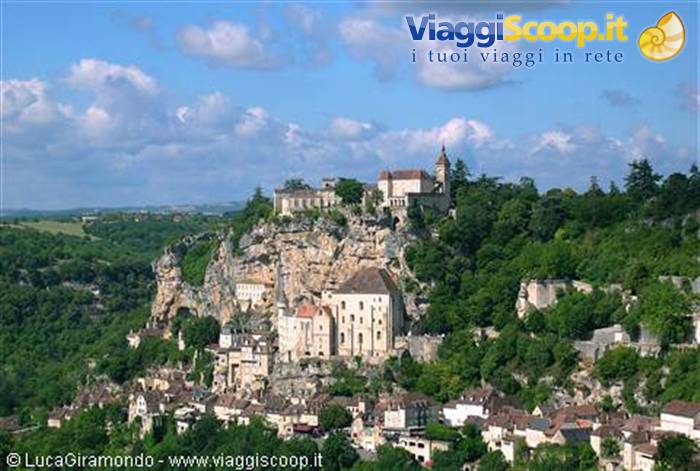
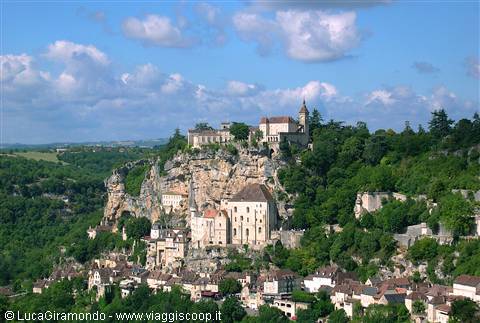
It's pleasant to wake up in the cool when in Italy it seems to be infernally hot, but above all it's nice to open the window and find yourself beneath the spectacular cliff of Rocamadour. The village, perched on the dizzying wall of the Alzou Canyon, with the castle overlapping the churches, the churches overlapping the houses in an incredible vertical universe, which goes from the river straight to the sky, was one of the main pilgrimage destinations of Christendom and already in the 9th century it appeared imbued with a great religious fervour, which continued, ever growing, for almost 500 years. We set off on foot, from the esplanade where we're parked, along the climb that leads to the village...
Rocamadour is in practice laid out on three levels: lower down we encounter the village, made up of two rows of ancient houses arranged along the single street (Rue de la Couronnerie), on which four fortified gates open. On the intermediate level is the so-called "Religious City", formed by the bishops' palace and various sacred chapels, which we reach by climbing the Grand Escalier, a steep staircase of 216 steps that pilgrims once, weighed down by heavy chains, even climbed on their knees. We enjoy excellent views with a medieval flavour and then, climbing along a shaded path used as a Calvary, we reach the top of the cliff, where, in a position that is nothing if not panoramic, is the castle, erected in the 19th century and therefore relatively recently.
Having thus conquered metre by metre the sheer cliff of Rocamadour, we return, more calmly and with less effort, to the camper, completing the pleasant exploration of the village in just over a couple of hours. At 11:00 we're ready to set off again and with our bow turned towards the next destination we take the road: we descend from a rugged plateau, leave the town of Souillac behind and stop for lunch on the banks of the Dordogne. In the afternoon, skipping the village of Domme, we go to visit the village of La Roque Gageac, among the most suggestive in the valley, huddled at the foot of the cliff almost sheer above the river.
The 15th-century ochre-coloured houses compete with the vegetation for the scant space between the riverbed and the dizzying rocky wall of the Pech Vigueyral, leaving barely a gap for the very busy road that runs alongside the course of the Dordogne, and the continuous procession of cars inevitably takes away a lot of the charm of the place, so after a short walk along the secondary cobbled streets we resume our itinerary, in discovery of this pleasant valley. We leave on our left, beyond the river, the silhouette of the castle of Castelnaud, which was English in the Hundred Years' War, to reach that of Beynac, in front of us, which was French in the same war. It sits perched scenically on a high cliff and is reached by means of a winding road at the end of which there is a car park.
We leave the camper and on foot we head towards the manor crossing the narrow and characteristic alleys of the ancient village of Beynac, then we pass through the gate of the castle which, extremely suggestive and in excellent state of preservation, was recently chosen as a set by the director Luc Besson, to shoot some scenes of the film "Joan of Arc". To the delight of Federico, who particularly loves this kind of experience, we visit every tiny nook of the construction, climbing along the spiral staircases up to the battlements, from where there's a magnificent view over the Dordogne Valley and, further in the distance, over the rival fortress of Castelnaud. We linger among the halls of the castle and when we finish the visit it's already evening: we take a few more steps around the medieval village and then return to the camper, where we find an unpleasant surprise waiting for us...
Stuck to the windscreen is a fine!... Ouch!!... It's incredible because we had even paid the 2 euros for parking, but given the size of our vehicle we hadn't placed it in the designated spaces. There's no point dramatising though: it's only 11 euros and anyway I don't think we'll pay it... We fold up our unexpected souvenir and move for the night to the nearby town of Sarlat le Caneda, which we'll visit tomorrow: we're calm and the little mishap certainly hasn't changed the outcome of a more than positive day.
Rocamadour
Day 111 Aug 2005
Not much light filters through the gaps in the blackout blinds... I raise them with a little apprehension and the fears turn into reality: another grey morning is in store, and it's a real shame because the programme included a visit to the historic centre of Sarlat le Caneda, a picturesque town with a medieval appearance. At least it's not raining and, willy-nilly, we set off on foot starting the exploration, so, shortly after, we find ourselves on the straight Rue de la Republique, the main artery of Sarlat, along which numerous shops face. Taking advantage of the situation we enter a tobacco shop and ask for information about the fine... the tobacconist smiles and suggests we let it go: "It's only for the French!", he says, and we decide to follow his carefree advice...
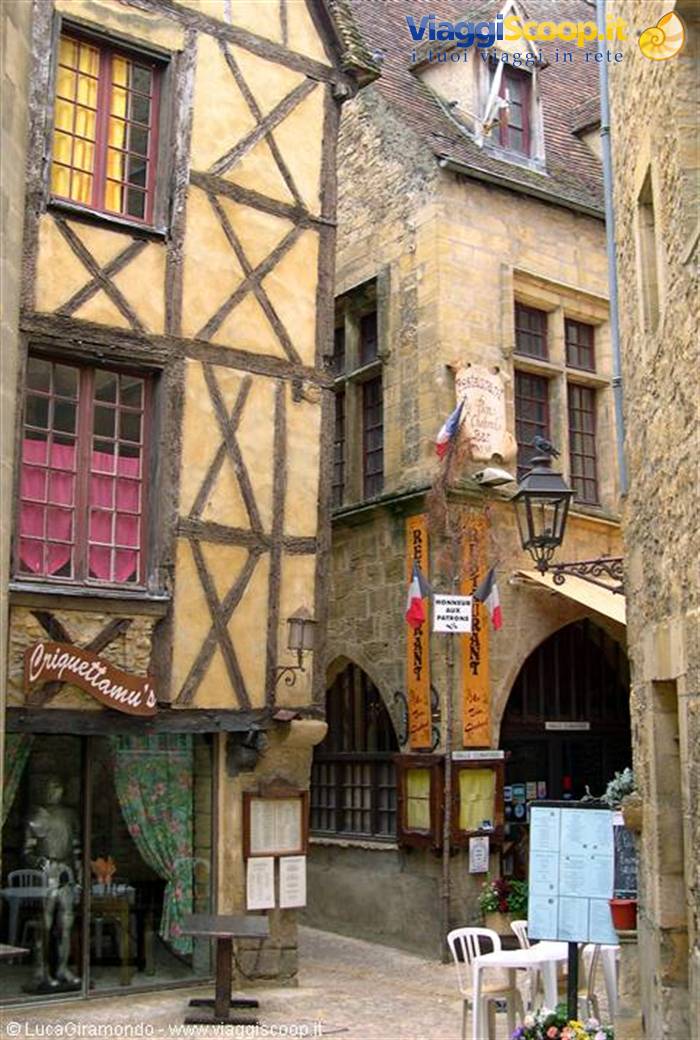
a souvenir it was and a souvenir it remains! We then make our way into the eastern part of the settlement, where the medieval quarter extends and in no time we find ourselves immersed among the characteristic streets of Sarlat, lined with beautiful buildings in yellow stone, skilfully restored, which stand out marvellously despite the inopportune greyness in which they are immersed. What amazes most about this village is the incredible architectural homogeneity and at every step we encounter a view worthy of a photo... imagine how it would have been with the sun out! We leave Sarlat with a bit of a bitter taste, while the clouds slowly thin out, and we head towards the locality of Les Eysez de Tayac, which is a few dozen kilometres away.
Along the way, shortly before reaching what is considered the European capital of prehistory, we stop in the car park of the Roc de Cazelle site and there, given the time, we have lunch. In the early afternoon we go to see the troglodytic settlement of Cazelle, inhabited almost uninterruptedly from prehistory until 1966, when the family, last owners of the place, left it as a legacy to French cultural heritage. Since then a sort of museum has been organised that illustrates, with the help of numerous reconstructions, life in the cliff through the various historical eras. Among nooks and galleries carved into the rock it's above all Federico who has fun, who also enjoys hurling (with fair skill) a perfect copy of the spear used by prehistoric men, and at the end of the route he's almost sorry the visit is over.
To his good fortune, however, there's another similar place left to see, indeed, more important than this one. Skipping the albeit interesting National Prehistoric Museum of Les Eyzes we take the narrow Vezere Valley and arrive at La Roque St. Christophe, a troglodytic settlement which is even part of the Unesco world heritage. The site, which amazes for its vastness, extends for about a kilometre clinging to an 80-metre-high cliff and was inhabited uninterruptedly until the Renaissance, when the town that had by then developed was destroyed by order of the then king of France. While the sun finally comes out we venture onto the impressive rocky ridge: a sort of terrace, partly natural and partly artificial, which for its characteristics and dimensions has earned the name of "Boulevard de l'Humanité".
In this place, among other things, some rudimentary machines used in the Middle Ages for lifting have been meticulously reconstructed and a guide, assisted by an attendant, demonstrates their operation, sparking the curiosity of the little one, fascinated by the fundamental principles of mechanics. Wandering around La Roque St. Christophe the second part of the afternoon also passes pleasantly, so we bring another interesting day of visits to an end, but there are still 150 kilometres to cover to close the leg and it's getting late. We leave the heart of Occitania and speed along the A89 motorway towards the Auvergne region.
We thus arrive, with the first lights of twilight, at the spa and winter resort of Le Mont Dore: we're at over a thousand metres of altitude, it has just rained and it's also rather cold, so we have dinner and then hole up for the evening in the pleasant warmth of the camper.
Sarlat-la-Canéda
Day 122 Aug 2005
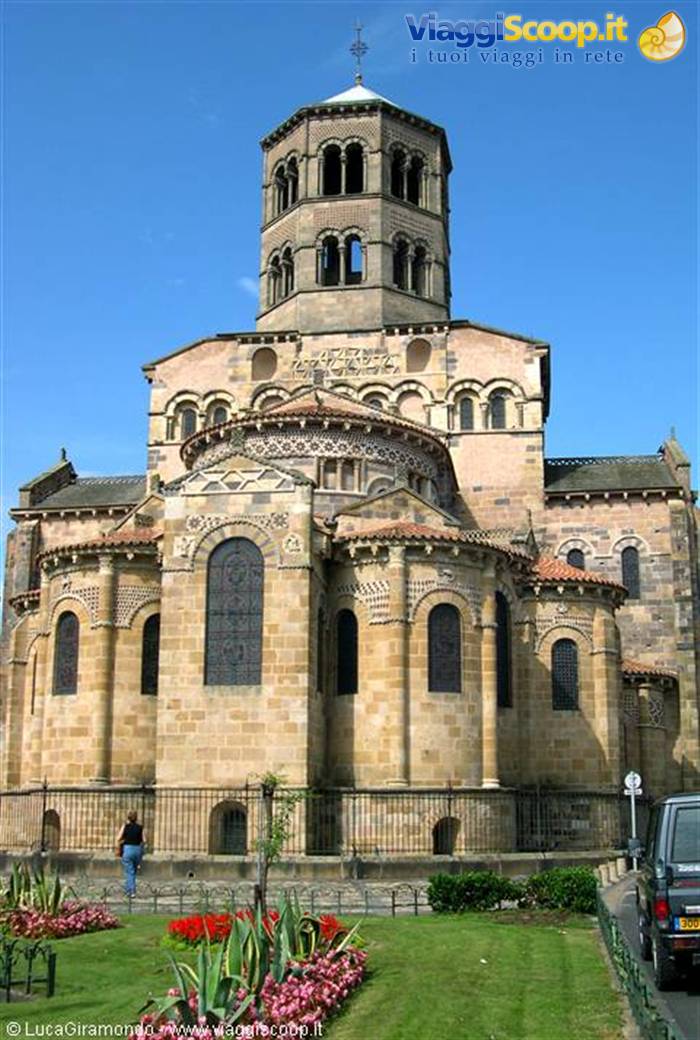
We wake up with the gloomiest sky ever and the thermometer reading 12 degrees! In disbelief we look for a justification that neither the calendar nor the geographical position (despite the thousand metres of altitude) can give us and though disheartened we have to revolutionise the day's programme, which included a visit to the Puy de Sancy first and the Puy de Dome afterwards... all the peaks, of volcanic origin, that characterise this region of France today are, in fact, wrapped in clouds and we have no choice but to give them up. We go east, thus also avoiding the city of Clermont Ferrand, then we cross (at an altitude of 1401) the Col de la Croix Morand, the highest point of the trip, and we arrive after an infinity of bends in the town of Issoire, known more than anything for its Romanesque church of St. Austremoine, dating back to the 12th century.
Thank God good fortune assists us and the sky, as if by magic, opens, so we can enjoy the religious building with the wonderful apse, embellished with polychrome geometric decorations, which stands out against an unexpected patch of blue, then, just the time to admire the interiors, entirely decorated in vivid colours, and when shortly later we resume the road everything is completely grey again. We briefly follow the A75 motorway, then the N102 state road towards the southeast, we stop for lunch and when we set off again, in no time, we reach the city of Le Puy en Velay, while it also starts to rain.
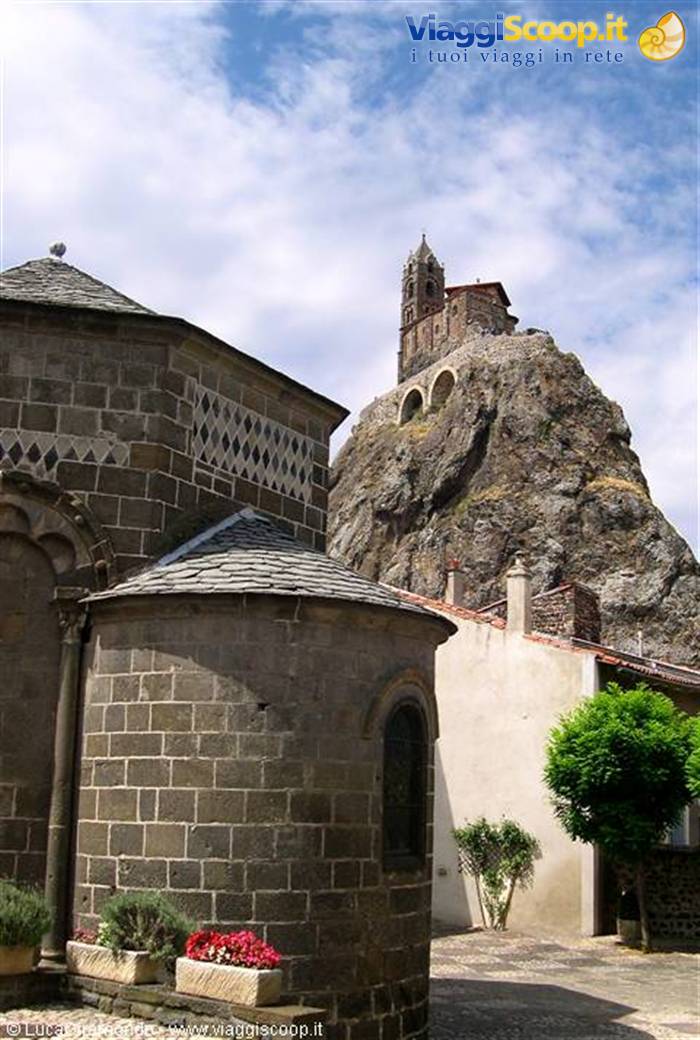
We park near the centre with the rain that first slows and then subsides, so we decide to undertake the visit of what is the current capital of the Velay district, a region in the heart of the Auvergne where the fire and magma of ancient volcanoes played with earth and water, embroidering a truly unusual landscape. Some rocky peaks emerge suddenly here and there in the settlement and the most surprising, the Rocher d'Aiguilhe, 85 metres high, is the gigantic pedestal of the little church of St. Michel, which dominates the scene in the company of the colossal statue of the Virgin, which towers over the Rocher Corneille, and of the cathedral of Notre Dame, built in the 11th century in a dominant position and a site of pilgrimages since the earliest days of Christianity.
We head towards the religious building symbol of the city accompanied by the sun which, as if by miracle, has come out into the open delighting us once again with its presence and we climb the steep staircase that leads to the unusual entrance of Notre Dame, so unusual that the inhabitants of Le Puy loved to describe it thus: "You enter the cathedral from the navel and leave from the ears!"... Meaning that the official entrance is the extension of the portico steps, which end under the church and emerge in front of the choir, right in the centre of the nave (hence the reference to the navel), while you can exit from the side transepts (the ears). This strange architectural solution was adopted to enlarge the building for lack of space and is truly unique.
Delighted by the original views of Le Puy en Velay we calmly return to the camper, while the sky quickly clouds over again and shortly after even threatens rain. It's mid-afternoon and we decide to move further south, in search of better weather conditions and a bit more warmth, which wouldn't hurt! Along the way we make, despite the pouring rain, a detour to see the scenic cliff of Arlempdes and when we're in its presence (incredible but true) a single ray of sun pierces the thick blanket of clouds and as if by magic illuminates the scene. Silently we give thanks and go back to churning out kilometres. In this way we descend from the Massif Central, accompanied by the mercury column which instead, fortunately, rises. We thus stop for the night at Vallon Pont d'Arc, now within sight of the famous Gorges de l'Ardeche and Provence.
The one just ended was certainly the worst day so far, even though the sun has somehow always been faithful to us, but in every trip there must always be a "worst day"... let's hope this was it and from tomorrow the summer sun will once again reign supreme.
Issoire - St. Austremoine
Day 133 Aug 2005
Due to the bad weather we've gained a day on the normal progress of the planned itinerary, this morning however, above our heads, there's a magnificent blue sky: we've come further south and it shows! After carrying out some routine tasks we set off for today's leg and, to begin with, we make our way into the Gorges de l'Ardeche: the river of the same name, before emptying into the Rhone, carves out one of the most impressive and suggestive canyons in Europe, visitable by means of a highly panoramic road that winds clinging to its edge for over 40 kilometres. Sabrina and I had already been to this place, but Federico hadn't, and we don't mind seeing it again...
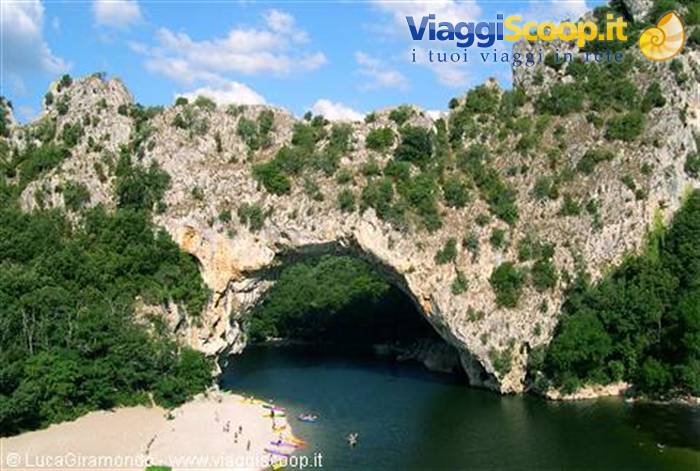
Immediately the most spectacular part awaits us, with the colossal natural arch of Pont d'Arc (60 metres wide and 45 high), through which the river passes and the hundreds of canoeists who every day undertake the descent of the gorges. After Pont d'Arc the road rises and the dizzying viewpoints follow one after another, among which stand out, for their spectacularity, those of Serre de Tourre first and de La Madeleine afterwards. Between one stop and another time flies and it's almost noon when suddenly the landscape loses its ruggedness and we emerge from the canyon onto the Rhone plain, now within sight of Provence. From here we cover another few dozen kilometres southwards and stop in the car park of the Pont du Gard site, where given the time we have lunch.
We had already been to this place too, but a good 18 years ago: back then there were no organised car parks and the strip of asphalt reached right up to the banks of the Gardon. I remember that on that occasion we climbed undisturbed right to the top of the impressive Roman aqueduct, built to carry water to Nimes in 19 BC, by order of Agrippa, son-in-law of Augustus... Today of course it's no longer possible to do so and one must be content to see that extraordinary work of engineering, which consists of three tiers of superimposed arches, for a height of 49 metres and a length of almost 300, from the steep banks of the river and one can only pass alongside it by walking the adjoining pedestrian bridge, built in 1743.
Certainly the site has lost a bit of charm, but it was inevitable given the mass of tourists who access it daily and, despite the prohibitions and regulations, it remains one of the most astounding and astonishing testimonies of the era. With Federico galvanised by archaeology we resume the road and, briefly following the A9 northeast, we arrive in the settlement of Orange, a historic town known since antiquity. We park our camper a short distance from the centre and on foot we head towards it... Suddenly a colossal wall bursts into our view, like a solemn coup de theatre: an impassable barrier that towers over all the houses and stands out, imposing, against the hill of Saint Eutrope, which dominates the urban agglomeration.
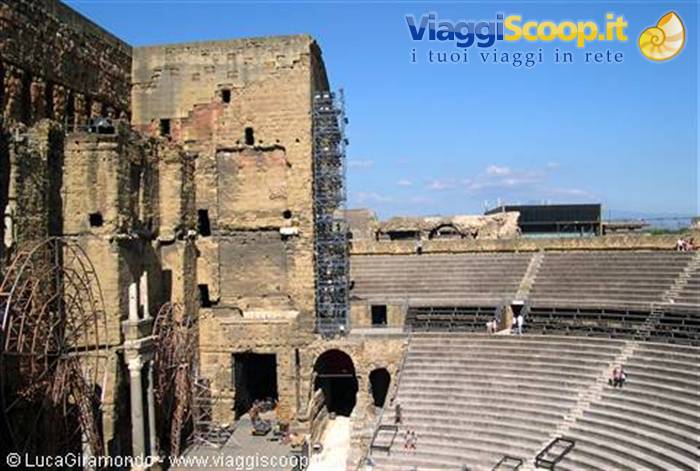
It's the outer part (103 metres long and 36 high) of the ancient theatre, erected in the 1st century AD under Augustus, the only one in Europe that preserves the stage wall intact. We spend almost an hour inside that admirable construction, which in its heyday could accommodate up to nine thousand spectators, and throughout the time we are assisted by an exhaustive audio description (in Italian!) included in the ticket price, then we exit and go to see in the first outskirts of the town the grandiose triumphal arch, also Roman, erected in 49 BC after a victory of Caesar and one of the largest known, with its 18 metres of height and 8 of depth.
Once the visit of Orange is also completed, with full marks, it's now late afternoon and we move for the night to the nearby village of Fontaine de Vaucluse where, along the banks of the placid course of the Sorgue, there's a splendid area equipped for campers... In absolute peace we thus bring to a close a day with a more than positive outcome.
Le Puy-en-Velay
Day 144 Aug 2005
Miracle! Second consecutive day with the sun present!... We wake up immersed in the sublime tranquillity of Fontaine de Vaucluse, beside the transparent waters of the Sorgue, the same "Clear, fresh and sweet waters... " that inspired Francesco Petrarch, who lived here, at intervals, between 1337 and 1353 praising the most beautiful rhymes for his beloved Laura. After breakfast we take a walk along the course of the stream up to the karst spring whence the famous waters gush... or rather, whence they used to gush, because today the spring is completely dry and the little stream appears, suddenly, only a few hundred metres further downstream. Mindful of how the place was about twenty years ago we return dejectedly to the camper, with Federico even more annoyed by the failure of an old mill on the banks of the Sorgue, which was supposed to illustrate the ancient papermaking process.
Despite the small failure at Fontaine de Vaucluse almost the whole morning goes by and we return to travelling the roads of Provence when it's already noon, but the journey is short and we stop shortly after in the village of Gourdes, near which we'd like to visit the strange and archaic Village des Bories. The road that leads there though, almost two kilometres long, sets the maximum width limit at 2.30 metres (just, just our width!)... better not to risk it: we have lunch in a car park nearby and right after we resume the journey. In the early afternoon we thus reach the village of Roussillon, nestled on the hills of the Vaucluse and known more than anything for its ochre-coloured cliffs.
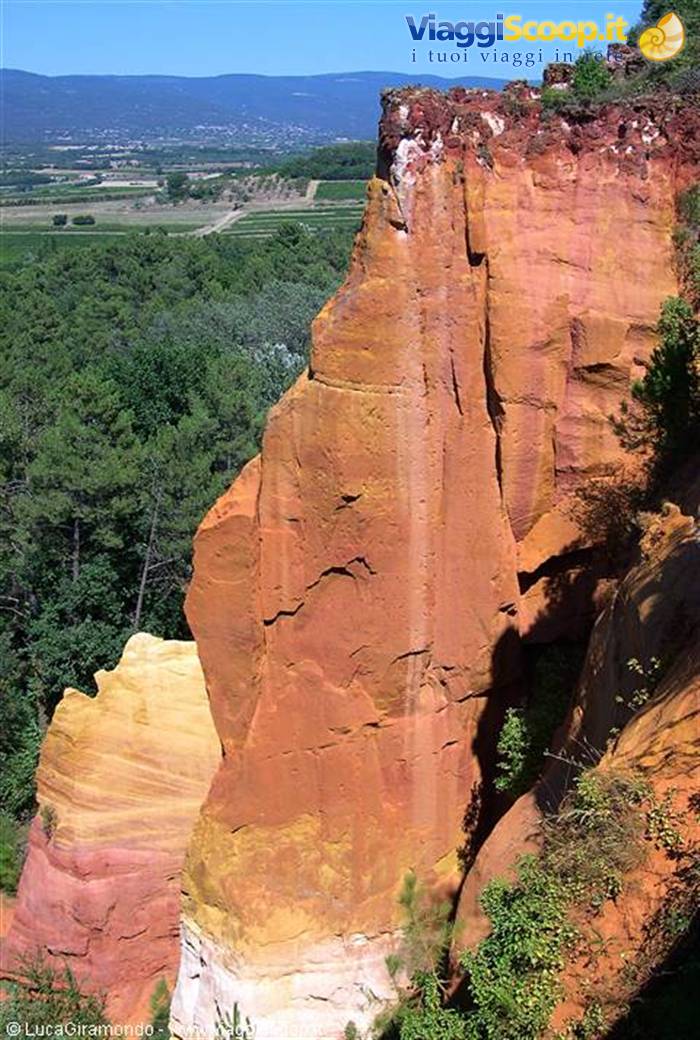
With difficulty we manage to park, then, on foot, we go to walk a stunning path that makes its way into a fantastic environment, made of brightly coloured pinnacles in contrast with the intense green around: it's a charming landscape, a splinter of the American west that has ended up who knows how in the heart of old Europe. In Roman times the hill was called Mons Rutilus and the ochre that made it up was transported by horses all the way to Marseille, to finally reach the banks of the Tiber: it served to colour red the most important togas of the empire and the interiors of patrician houses. Now it serves "only" to attract tourists and in any case it's still a source of wealth for the inhabitants of the place. We enjoy this last visit of the inland regions of France and then turn the bow of our vehicle towards the Mediterranean Sea...
We thus arrive, within a few hours, in sight of the coast near the city of Hyeres... and we immediately get in line: we've arrived, alas, in the classic holiday chaos that characterises all the best-known seaside resorts. It takes us three quarters of an hour to cover the ten kilometres that separate us from La Tour Fondus, from where tomorrow morning we'll embark for the island of Porquerolles, and fortunately we find a car park (albeit expensive) waiting for us where we can spend the night and leave the camper, the next day, for the whole day. For dinner we'd fancy a pizza and nearby there's a pizzeria that looks modest... but it's "a criminal conspiracy!": a simple margherita costs ten euros, and from there it only goes up, plus of course cover charge and drinks!... Everything has its right price and we give up!...
We thus retreat to have dinner in the camper spending a quiet evening, while the holiday is now drawing to a close.
Ardèche Gorges - Pont d'Arc
Day 155 Aug 2005
So we'll spend the last day of this journey in the land of France at the sea... Meanwhile the weather conditions are optimal and this helps us make the finale more positive than ever. We have a quick breakfast and right after we rush to catch the boat that departs at 9:00 sharp from the pier of La Tour Fondus for the island of Porquerolles, the largest of the tiny Hyeres archipelago: a splinter of rock and sand (ten kilometres by two) located just off the Giens peninsula, where we are. Less than twenty minutes after departure we disembark in the little harbour around which the 250 inhabitants of Porquerolles live and there we hire three bicycles, the only means of transport that allows you to move around on the unpaved roads of the island.
After some initial difficulty we get used to the vehicle and pedalling along the coast eastwards, between ups and downs and immense pine forests, we arrive after about half an hour in sight of the Plage de Notre Dame, in practice the only stretch of sand of this small strip of Mediterranean land. Surrounded by the stridulation of a thousand cicadas we chain up the bikes and on foot we cover the last metres to the beach which, completely bordered by thick vegetation and lapped by transparent sea, is certainly beautiful and inviting... We sort out our things and run into the water to have a longed-for swim, disturbed only by the presence of some jellyfish that scare Sabrina and Federico a bit...
I, on the other hand, who have an open account with those damned animals, go big-game hunting and fill a little bucket with them, thus cleaning up as much as possible the stretch of sea in front of us. We have lunch, with our sandwiches, in the shade of the pines and then we pleasantly spend the whole afternoon too at Notre Dame: it's a delightful cove facing the continental coast, which can be clearly seen in the distance, and you're practically surrounded by land when you go into the water, so much so that you have the impression of being in a large lake more than at the sea and only the smell of saltiness helps to settle any doubt on the matter. Quickly it gets to 17:30 and we have to leave the beach, so at 18:00, as agreed, we're returning the bikes and half an hour later we set sail leaving behind the gentle silhouette of the island of Porquerolles.
The last act of the holiday has thus come happily to an end as well and shortly we find ourselves in front of our camper: we have dinner, take a shower and are ready to face a part of the journey home, so as to lighten the day to come. At 20:25 we leave the car park of La Tour Fondus and twenty minutes later we take the A57 motorway at Hyeres. We leave on our right the silhouette of the Massif des Maures and, following the A8 eastwards, around 22:00 we pass near Cannes, while Sabrina and Federico go off to sleep. Afterwards we pass the exits for Nice and Monaco, well-known border localities that announce our re-entry, at 22:45, into Italian territory. We cover another handful of kilometres and then exit the motorway at San Remo: we tackle the very long descent that leads to the settlement and stop for the night, when it's 23:20, in an equipped rest area on the shores of the Ligurian Sea.
Orange - Roman theatre
Day 166 Aug 2005
A day of heavy traffic awaits us due to the mass departure for the holidays... we, on the other hand, have finished ours, but we don't despair and already try to think about the next ones. At 8:40 we set off and, after returning to the motorway, at 9:45 we're at Savona. The strip of asphalt, for the moment, flows smoothly and a quarter of an hour later we take the A26 motorway leaving the sea behind us, while on the radio they begin to talk about long queues of vehicles scattered here and there all over Italy... We face the first at the Piacenza toll barrier, when it's 11:45, then we enter the A1, where we find very heavy traffic, and we stop for lunch, in a car park shortly before Parma, at 12:30.
At 13:15, after a short stop, we set off again and join the long snake of vehicles that, increasingly packed, now proceeds very slowly, so much so that it takes us an hour and a half to cover the few dozen kilometres that separate us from the Modena Sud exit, then in the distance the silhouette of the sanctuary of S. Luca, which towers over Bologna, becomes ever clearer. We pass the Felsineo capital in acceptable times and at 16:10 we're at the motorway toll booth of our city. We carry out some routine tasks and at 16:40 we happily conclude, in front of the gate of our home, this journey too. It was an experience with numerous positive aspects and, in part, only the Cevennes didn't fully satisfy us...
The weather could have been better in the Auvergne, but it was the central part of the itinerary, the heart of Occitania, from Carcassonne to Sarlat le Caneda, passing through Toulouse, Albi, Cahors, Rocamadour and the wonderful minor villages, that enthused us most... What can we say then about the amazing caves and the incredible Palaeolithic traces, the Roman vestiges, the red cliffs of Roussillon and last, but not least, the delightful island of Porquerolles... Dear old Europe never disappoints and this vast area in the south of France, sometimes a bit maligned, is certainly no exception.
viaggio moolto bello!! Unico appunto: innanzi tutto dovevi prendere il traghetto da Porquerolle ed andare all' Ile du Levant nella comunità di Eliopolis...dove si vive tutti nudi...troppo divertente una gita....e poi come si fa a percorrere l'autostrada ed a non fermarsi a nizza??!!! Meritava troppo una sosta!!!
In ogni caso tienila presente per il prossimo viaggio in provenza!!!
Ciao Max
ventoenuvole · 19/02/2012
un viaggio molto interessante, che ho in parte percorso nel 2001, comunque da rifare includendo molti dei luoghi che hai attraversato...
buoni viaggiancora





2 reader comments
viaggio moolto bello!! Unico appunto: innanzi tutto dovevi prendere il traghetto da Porquerolle ed andare all' Ile du Levant nella comunità di Eliopolis...dove si vive tutti nudi...troppo divertente una gita....e poi come si fa a percorrere l'autostrada ed a non fermarsi a nizza??!!! Meritava troppo una sosta!!! In ogni caso tienila presente per il prossimo viaggio in provenza!!! Ciao Max
un viaggio molto interessante, che ho in parte percorso nel 2001, comunque da rifare includendo molti dei luoghi che hai attraversato... buoni viaggiancora