Costa Brava Moustiers Sainte Maire Gorges de Verdon Castellane Barcelonnette Chateau de Queyras Col de Vars and Izoard
Day 121 Aug 2003
From Costa Brava to Moustiers Ste Marie
We set off in the morning from the Platja d'Aro campsite (Costa Brava) to be in Avignon at midday to visit our favourite garden. Unfortunately we find nothing because it's stocktaking time, the dead period at the end of the season. After the usual stop at Carrefour to buy food, we continue towards Cavallon. At Cadenet we took a wrong road and spotted a florist: we bought 2 crape myrtles to put in the garden (lucky we're travelling in a camper!). We arrive at Moustiers Ste Marie in the late afternoon, in the cool and a bit of rain. From the campsite we walk up to the little village perched on a cliff, lying at the bottom of a spectacular gorge. The village is crossed by an alpine river, very cool and very blue. The village, famous for its decorated ceramics, and, after the brioche experience I'd also say for its excellent bakers, originated from a monastery.
Between the two sides of the mountain they stretched a rope with a metal star suspended above the village. It seems that, at that exact point, there was an apparition. The village is perched, full of little craft shops and tastes a bit of Provence, with lavender, scented soaps, cicadas and bright colours and a bit of mountain.
Gorges du Verdon
Day 222 Aug 2003
The Canyon du Verdon, Castellane
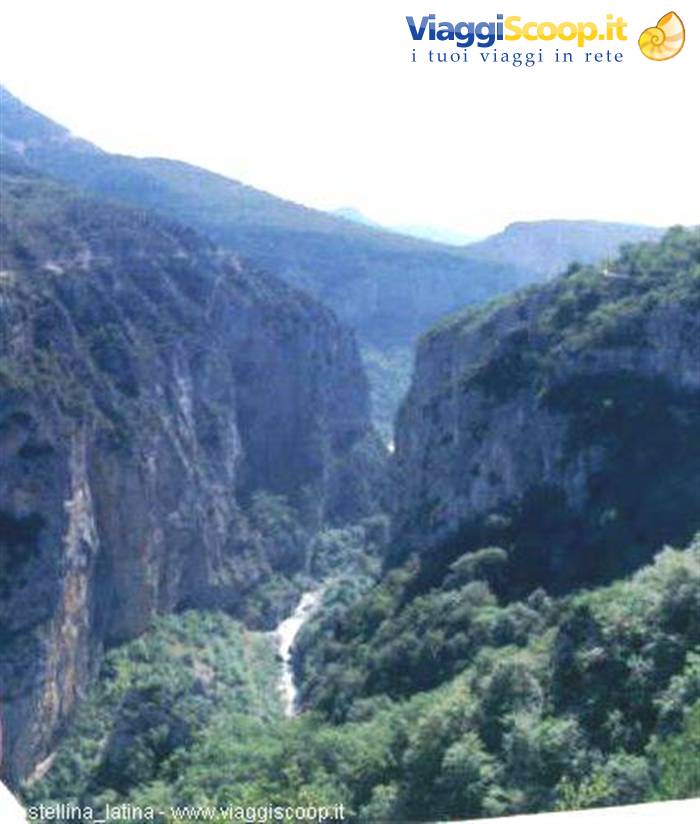
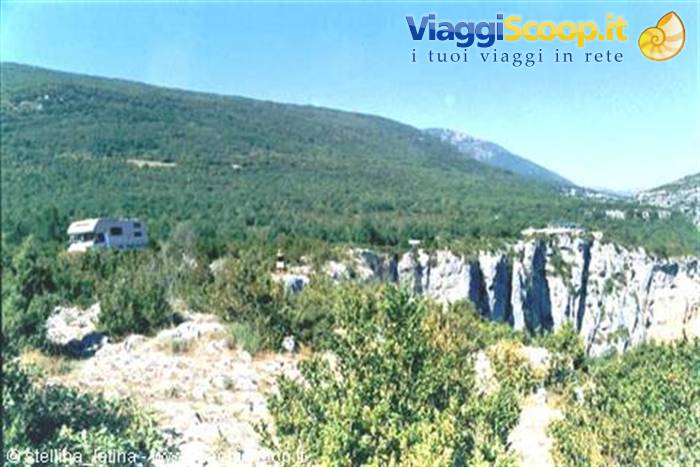
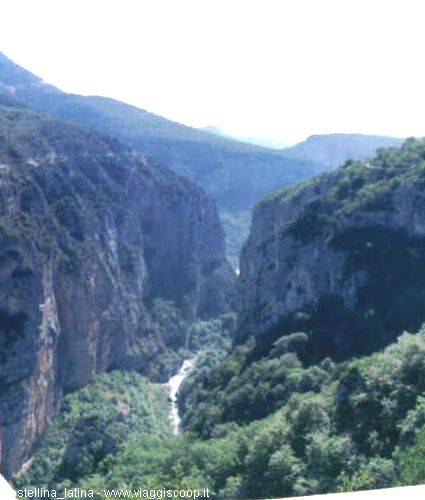
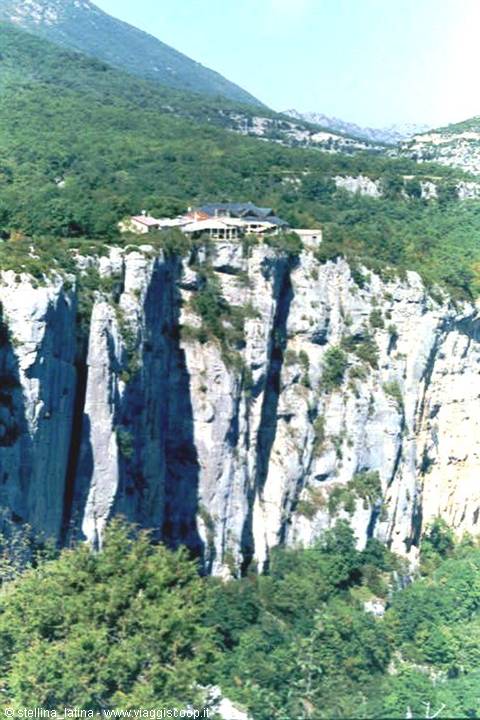
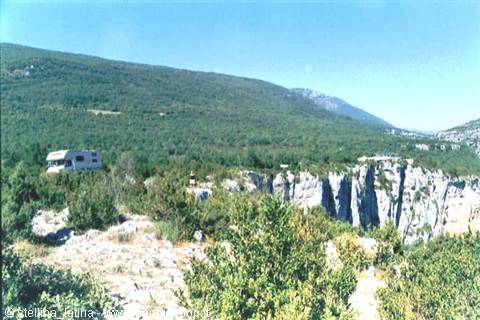
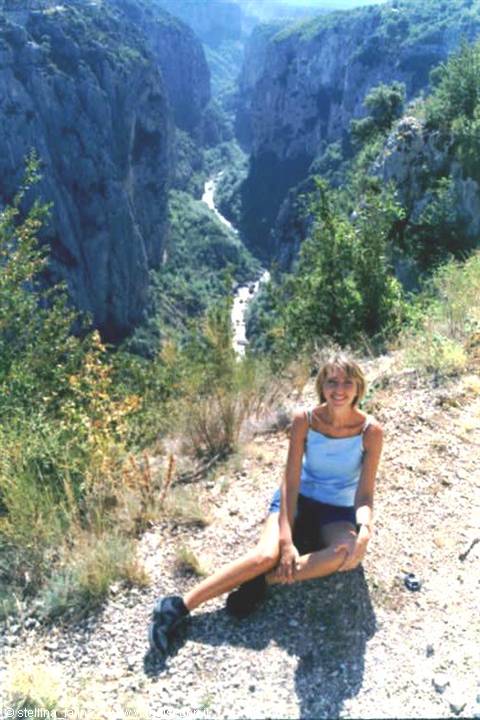
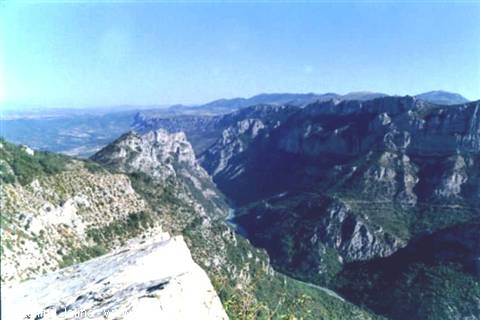
The following day is dedicated to visiting the Verdon canyon. In the morning at the campsite the brioche van arrives for breakfast: spectacular! Shortly after setting off we cross the Verdon where it flows into Lake S.te Croix, we stop for photos right after this bridge, Pont de Galetas. The route done with the camper is heavy due to the tortuousness of the road. The difficulty comes from the road, two lanes without a hard shoulder, with a sheer drop on one side and the rock face on the other. Maybe it's because I suffer from vertigo, but the route is... thrilling! The climate is cool and the route green, with spectacular corners. We make several stops for photos and to admire the landscape at the most beautiful points: Col d'Illoire, Roc du Maillet, Mergès, Les Boucles, Les Cavaliers, Tunnel de Fayet.
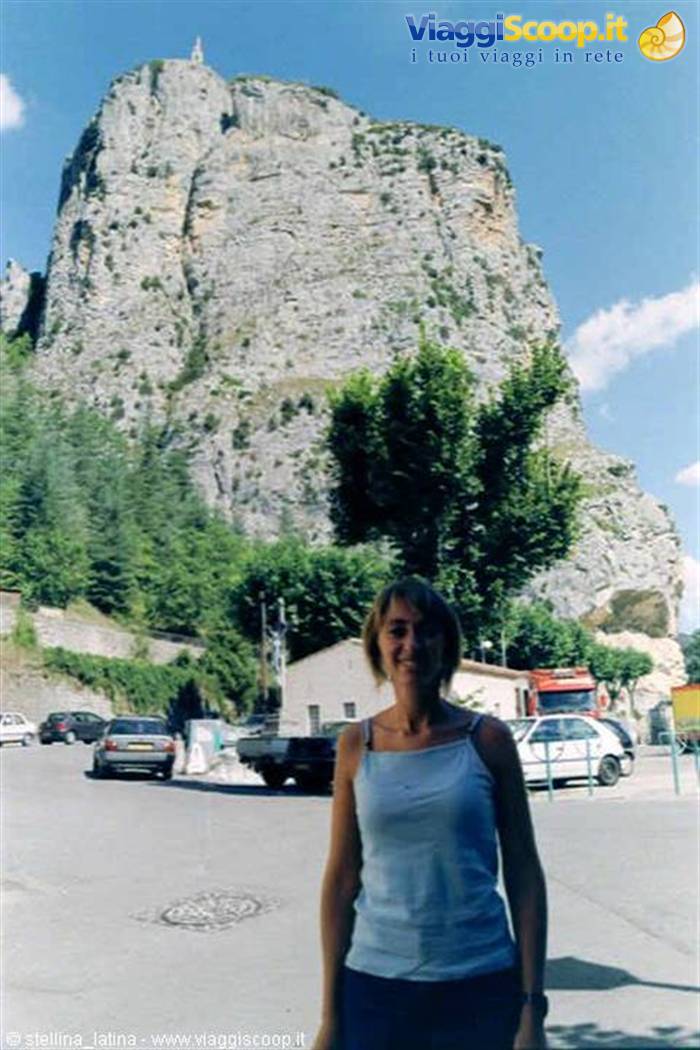
All points on a sheer drop where you can admire, thanks also to the structures created, almost in the void, the bends and bizarre shapes of the canyon. The Pont d'Artuby is also interesting but we couldn't stop because a television shoot was in progress. Les Balcons de la Mescla is perhaps one of the most beautiful points. Along this road you come across lakes, river bends and sheer cliffs and, as in almost all of France, practising sport is greatly facilitated by the highly organised structures. It's therefore possible to go canoeing and do all river sports of varying difficulty, it's possible to climb, to paraglide or, simply, to devote yourself to trekking with equipped and signposted trails. Having finished this route, we head to Castellane, a tourist town situated beneath a large rock that dominates it and on which the fortress city once stood.
We park and visit the shops of the old town, but we don't climb the rock. In the town, though, we see many people setting off to go trekking and pilgrims heading to the ancient church on the rock. After this day of tortuous road, we decide to head to Digne to camp, we follow the road that runs along Lake Castillon and visit the dam that creates the artificial lake, Barrage de Castillon, the lake water is warm and many are swimming. In Digne we don't stop to visit the city as it's very busy, a tourist town, spa town but also industrial, and we're eager to get to the campsite, which we find just outside in the direction of Barcelonnette. The campsite is almost empty.
Fort Queyras
Day 323 Aug 2003
Barcelonnette, Château de Queyras
The next morning we set off for Barcelonnette, after the Verdon my father doesn't feel up to doing the Cayolle or Allos pass, as planned, so we've chosen the lower valley road, which is why we had headed to Digne. The passes we tackle are low: the Col du Labouret (1240 m), the Col du Maure (1345), the Col St Jean (1333) and here the valley opens onto Lake Serre-Ponçon, and then we take the Ubaye valley which leads us to Barcelonnette. Here we find the market (Wednesday) with excellent products: from mountain cheese to cold cuts etc. In Barcelonnette there are the famous Mexican villas, that is, inhabitants who emigrated to Mexico to seek their fortune and then returned wealthy. The villas are rather nice, a bit Art Nouveau, a bit Mexican and a bit French. In practice, especially for us Italians they're 1950s villas but they don't deserve more than a passing stop.
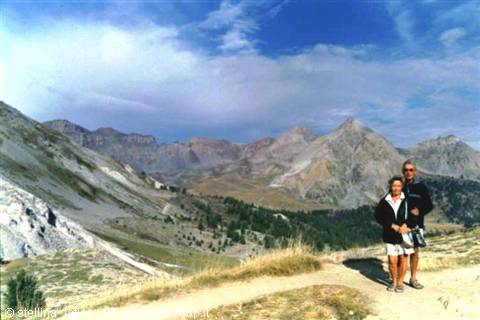
Having left Barcelonnette we start climbing into wide valleys among the mountains up to the Col du Vars (2109), in the final part the road's gradient is very steep, we make several stops to take photos of the valley and the hairpin bends we've already done. On the pass, though, we take a little panoramic walk to stretch our legs on a path full of crickets. The descent is hard on the brakes and on the bends but as far as Guillestre, but for mountain lovers the landscapes are always very charming. Once the road ends we take the Guil valley in the Queyras. The first 5 km are terrible, narrow with overhanging rocks and dark tunnels. Probably done by car or motorbike they can be less atrocious but in a camper it was really narrow, the lanes were 1 and a half without a line in the middle and, obviously, without a hard shoulder.
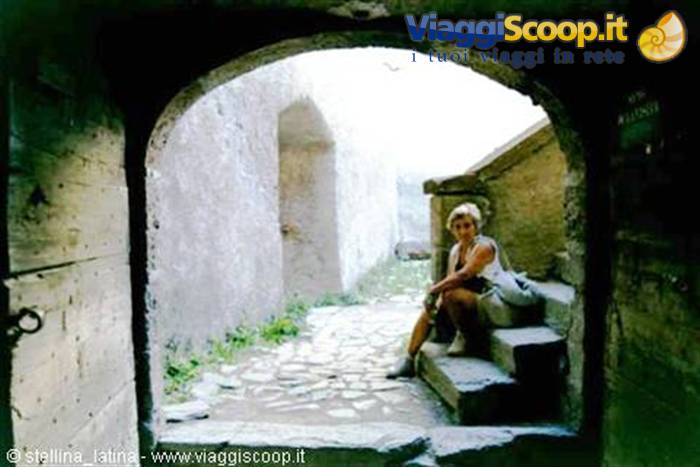
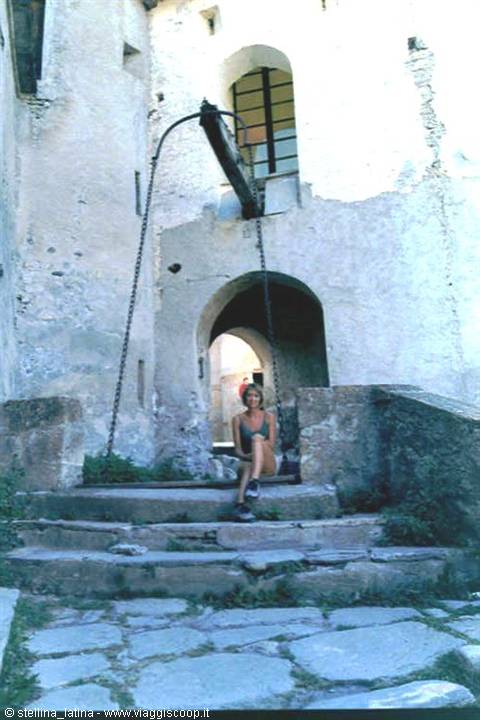
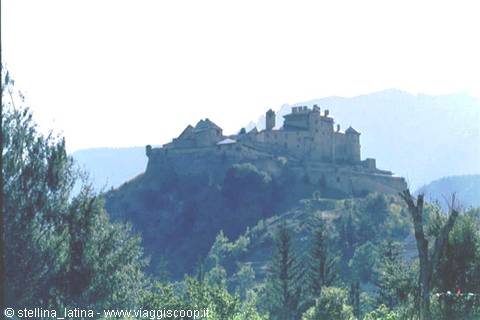
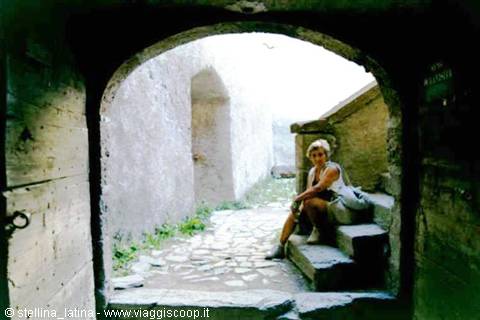
We make a stop at the first lay-by where there's an information point, to decide whether it will be worth continuing: luckily they inform us that the rest of the route is beautiful both in terms of landscape and road. Indeed we quickly reach the bottom of the valley, at Abriés a tourist tour of the pretty little village, we wanted to go to the Monviso viewpoint, but in the end given the time, we decide to give up, we return to Chateau-Ville-Vieille to camp. Having left the camper in a lay-by, while waiting for the reception to open, we walk to visit the Chateau du Queyras fort, pretty in a beautiful position. It's possible, starting from this village, to do difficult high-altitude treks lasting several days. In the village centre, at the tourist office, all possible and imaginable information is available with all the trails and the most interesting points to see.
Gorges du Verdon
Day 424 Aug 2003
Col d’Izoard
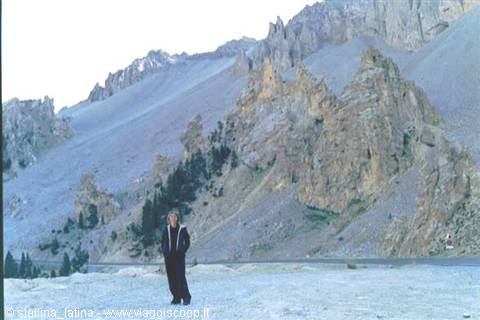
The next morning we set off early, we no longer have to retrace the ugly road at the start of the valley, but the Col d'Izoard awaits us. The road is quite steep but acceptable, even the width of the road surface is more welcoming. We stop at the first pass at 2100 m to photograph the spectacular Casse Déserte. They're sharp rocks in a desert of sand along a mountain ridge (see photo). The final part of the pass begins with a very narrow stretch, single lane, luckily short. The temperature is definitely low, we use our woollen jumpers to be able to go out and take photos. The road is all beautiful, it's full of cyclists: we discover that once a year the road is closed at certain hours to allow the climb by bike. There are obviously serious athletes and some a bit more amateur.
Before reaching the pass you find the monument to two heroes of the Tour de France: Fausto Coppi and Louison Bobet, Having arrived at the Col d'Izoard (2360) they force us to stop, the day of the event was today. After walking some paths and reaching the spectacular viewpoint! (see photo) You can see several valleys and, despite the rain, which then became more insistent, I find it's one of the most beautiful points seen during the climb.. Given the forced stop we take advantage of the break to have lunch. At the highest point the organisation has set up a nice stall with fantastic cakes and homemade foods of every kind for the cyclists.
The situation is a bit comical: there are the real athletes who've done the whole climb, who take photos with the Col d'Izoard sign and there are other decidedly less tired cyclists who "cross the finish line of the pass, with a decidedly less athletic physique… Then we tackle the very beautiful descent to Briançon, and we also understand many things: the cyclists arrived with the whole family by car a few kilometres (1, 2, 3 km) from the finish, took the bike out of the car, dressed up in full kit and pretended to have done the "climb" with the wife then taking the photos… From Briançon, very nice to visit (by now seen too many times by us to devote a stop to it), we decide to return home via the usual Col del Montgenèvre (1854), we find lots of roadworks, with alternating one-way sections regulated by traffic lights.
The descent to Oulx has been improved by the roadworks for the 2006 Turin Olympics. Having taken the motorway we arrive home in the late afternoon.


1 reader comments
Bello il Verdon!! Ci sono stato pure io facendo un'escursione da nizza....troppo bello! La provenza è meravigliosa! Brava bel viaggio!! Ciao Max