We left Milan with Skyeurope and landed in Budapest and then, later, moved at night by bus (Euroline) to Prague.
n.b. the account will be completed in the coming days.
Below is some information for organising a do-it-yourself trip
Sites used: to buy the Prague-Milan FLIGHT and book the HOSTEL
BUS from Budapest to Prague
Expenses per person: 18 Eur bus transfer from Budapest 56 Eur hostel (3 nights double room) 43 Eur museums, buses etc. 47 Eur lunches/dinners/groceries/sweets etc. 30 Eur Prague-Milan flight ===== 194 Eur Total Prague Total Budapest and Prague (7 days) 300 Eur
Day 123 May 2006
arrivo e città vecchia e Mala Strana (Kampa, Palazzo..)
We arrive before 7 in the morning at the bus station. The weather is uncertain and it's very cold (10-12 degrees). It's a working day and a small crowd is rushing to the various bus stops, metros and take-away coffee places. The city seems in full commotion. I think of Milan... after all I also take the metro at 7:15 in the morning! We head toward the old square. The historic center is very small and in an instant we've arrived. We stop on the benches of the central square reflecting on what to do. It's 8:30, it's cold, the wind is blowing and everything is closed, the square is deserted: how different tourists' schedules are! But we had seen an interesting exchange office on the street...we could go back and take a couple of steps to warm up and wait for the 9:00 opening. We exchange the leftover Florins and some euros.
All the street paving is cobblestone and with the suitcase it's hard to move around quietly and smoothly. We decide, therefore, to leave the suitcases at the hostel which is on the other side of the center and, therefore, we take the opportunity to follow the routes indicated by the guide to visit the center all alone in the cold and melancholic Prague. First of all a nice hot cappuccino to warm up! (nice not good, after all we only needed a little shelter from the wind and something hot to drink)
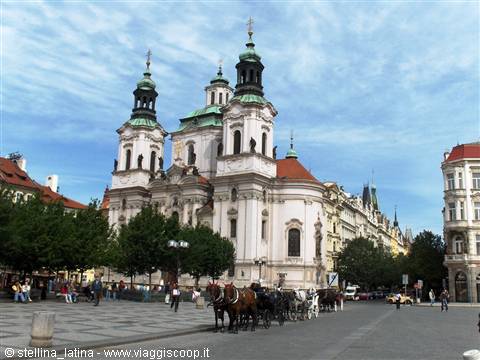
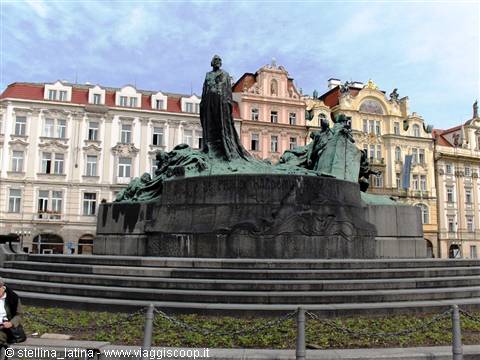
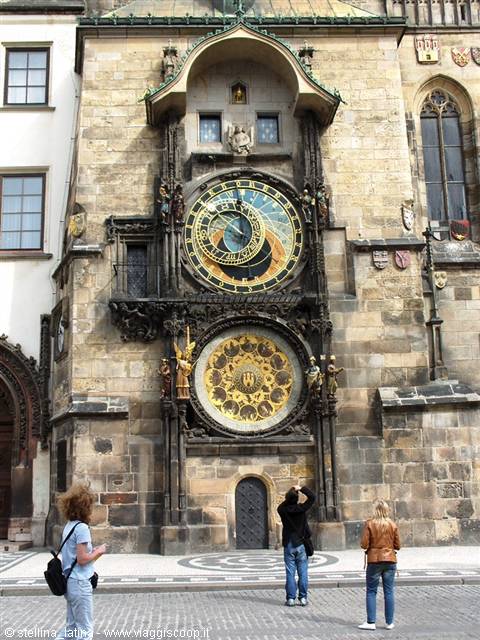
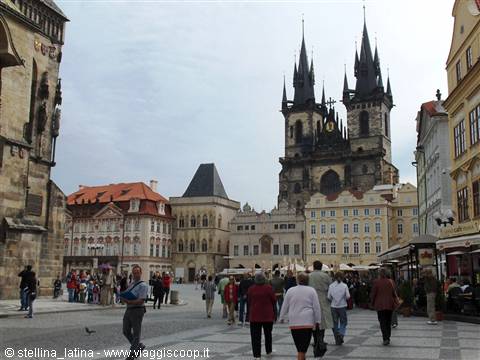
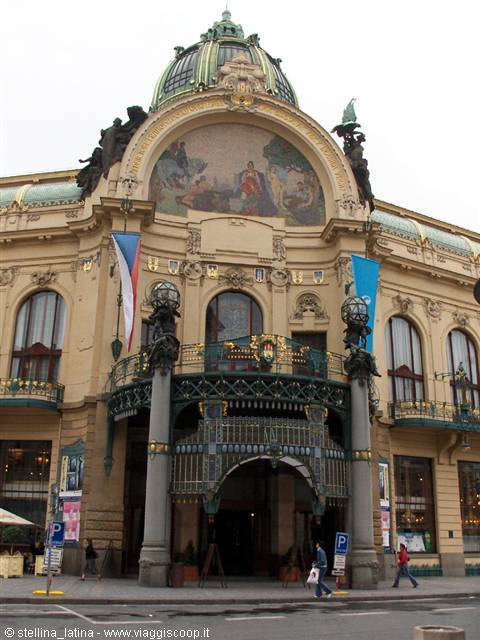
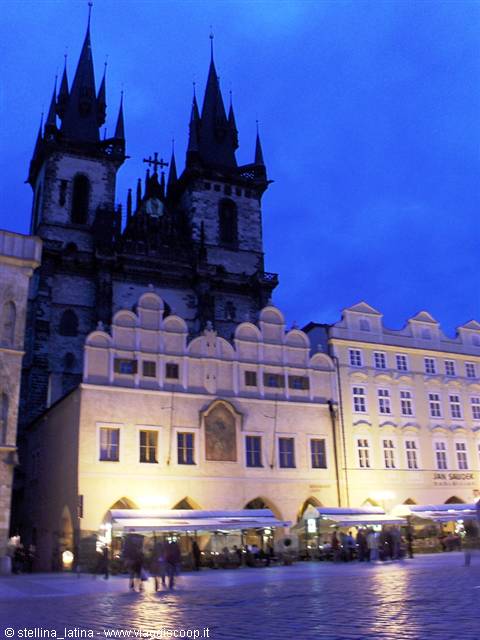
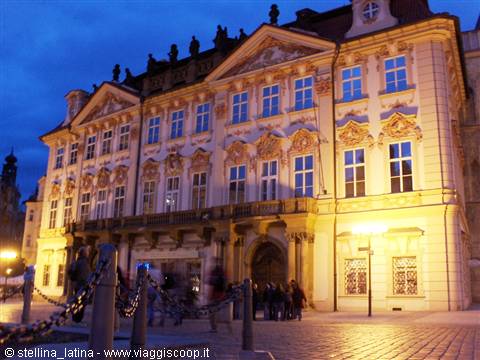
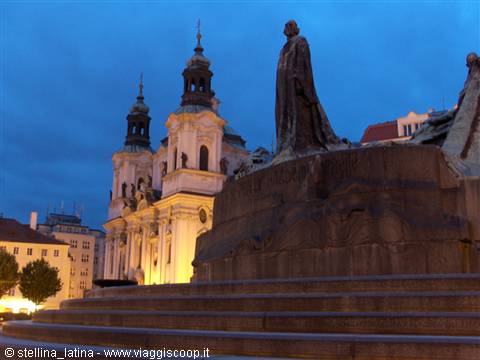
We visit the old part passing in front of the Municipal House decorated by Mucha and enter through the dark Powder Tower. We immediately turn right and then onto Jakubskà passing through the Tyn courtyard, we go around the Gothic church and take Celetnà. We pass under the watchful eyes of the Black Madonna and in Ovocny Trh, where the fruit market once was, we pass among an impromptu display of strange statues to arrive, through the Carolinum and the Estates Theatre, in Zeleznà, in front of the Astronomical Clock (Old Town Hall). The Old Town Square is enclosed by the white and Baroque church of St. Nicholas, by the church of St. Mary of Tyn with its tall and dark Gothic spires, by the Kinsky Palace, an elegant Rococo building, and dominated by the monument to Jus Hus, located almost in the center, religious reformer and symbol of integrity.
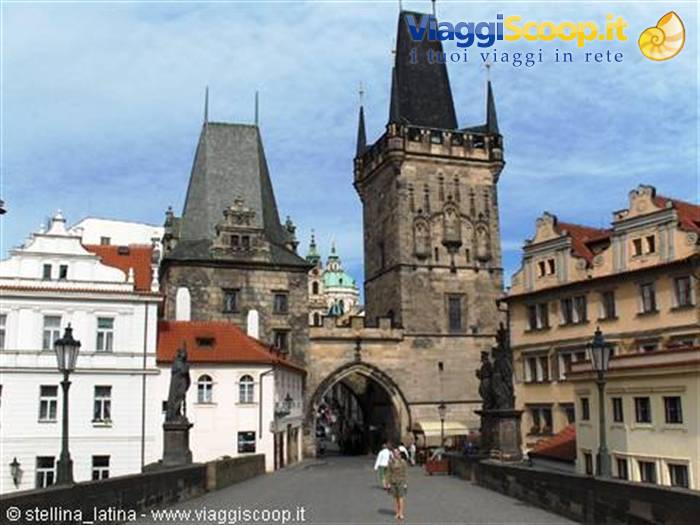
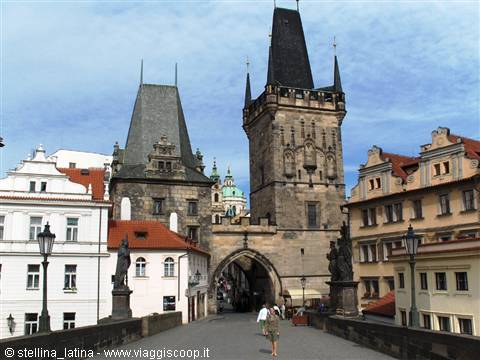
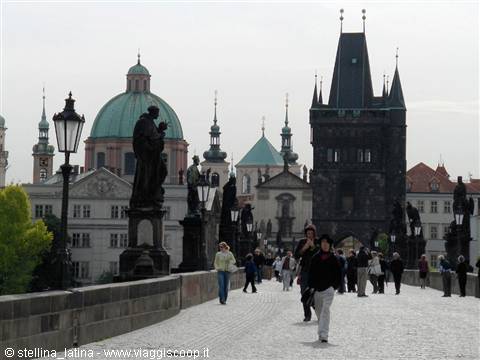
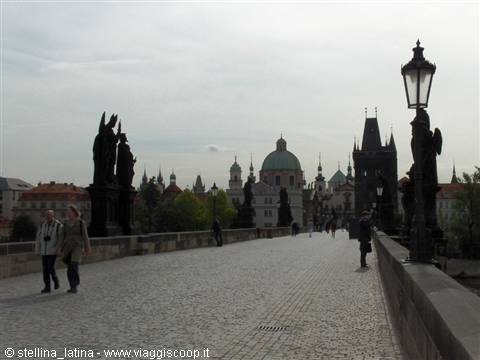
We cross Charles Bridge and then continue to the left. We arrive at the hostel at 12:00. After taking care of the formalities we take our luggage to the room and decide to make the most of the afternoon right away to return to the center, but we're forced to wait for the common room to reopen to retrieve some material. What to do in that hour or so? We decide to go explore the nearby supermarket: it's a large shopping center with lots of shops and a multiplex. We do our shopping, which is always a discovery of strange products. We return to the hostel, put what we bought in the fridge, which is right in the room, and retrieve the material. Walking toward Charles Bridge we pass in front of the modest but very tidy church of St.
Mary Victorious, we decide to go in, more than anything out of curiosity about its eventful history: the first Baroque church in Prague (1611), it belonged to a congregation of German Lutherans, was then assigned to the Catholics and then to the order of the Discalced Carmelites. The main attraction, however, is the WAX STATUETTE of the INFANT JESUS of Prague, offered in 1628 by the Princess of Lobkowicz, daughter of a Spanish aristocrat. Endowed with numerous and very rich garments (displayed in a separate room, among which a dress embroidered in gold offered by Maria Theresa) and with miraculous powers, the statue attracted numerous pilgrims, particularly Spaniards. Further on stands the Romanesque church of St. Mary under the Chain, with two imposing towers, adjacent is the Grand Master's Palace (seat of the Order of Malta).
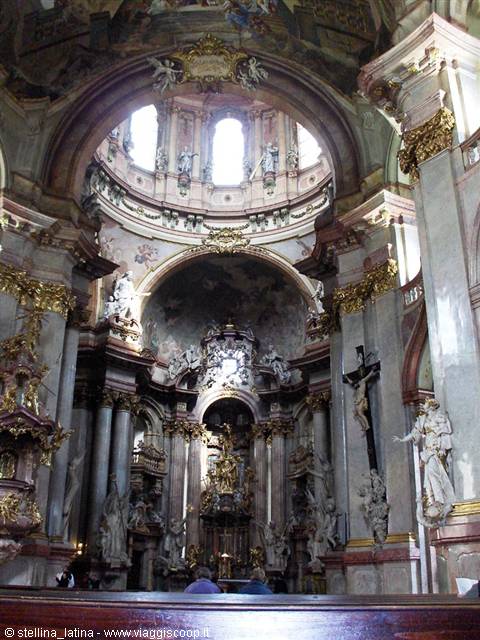
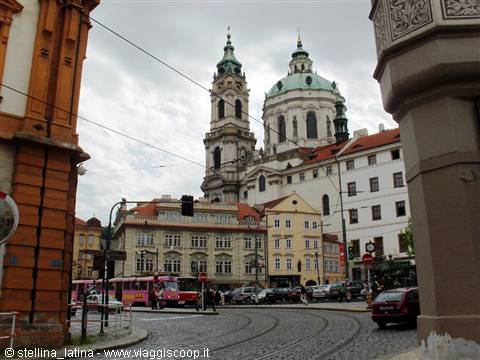
We're a bit tired from the journey and, therefore, decide to stay nearby; between the bend of the Vltava and the Castle, bounded to the south by the tall green hill of Petrin, extends the district of Malá Strana, that is the Small Town, very rich in palaces and churches. The winding narrow alleys suddenly open into squares, thus betraying the Medieval origin of the city disguised by the facades of the palaces, redone from era to era, and dominated by the colorful and rich Baroque dear to the Counter-Reformation. The red and white trams rattle quickly in all directions. We're a bit disoriented because every street is interesting, so we decide to head straight to the Church of St. Nicholas. We enter ST. NICHOLAS (60Kr). The building, located on the Malá Strana square, is defined as "a typical example of Prague Baroque". It was built by a family of architects (father, son and son-in-law!).
It's decidedly full: completely painted, richly decorated with stuccos, statues and pillars. Through a door along the left nave you go up to the balcony from which to better admire the frescoes and the entire church. Seen from above the church is much more beautiful! The paintings on display, although beautiful, are displayed with the wrong light and so are almost invisible. A shame.
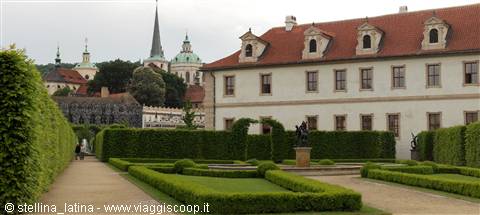
Walking alongside the tall white perimeter wall, we arrive at the entrance gate to the gardens of the WALLESTEIN PALACE (of the Duke of Friedland who razed 24 houses, a factory and a city gate to the ground to build his "little" residence). Today the Senate has its seat there. The public is allowed access to the gardens, we rest, take the last photos of the day wrapped in a restorative silence threatened by big black clouds swelling behind the long outline of the castle that can be seen beyond the very tall white wall. Satisfied with the day we return to the hostel walking alongside the elegant buildings and very well-kept gardens of the embassies, ministries and administrative offices that have their seat in this area. We pass in front of the churches of St. Joseph, St. Thomas and St. Joseph, different interpretations of Baroque forms.
Small note: in the vaulted cellars of the adjacent monastery they still serve the beer produced by the monks since 1358! In the evening we collapse from tiredness (from the night spent on the bus, because we started wandering at 6:30, or from the 20 or so kilometers covered?) and we decide to postpone the evening outing.
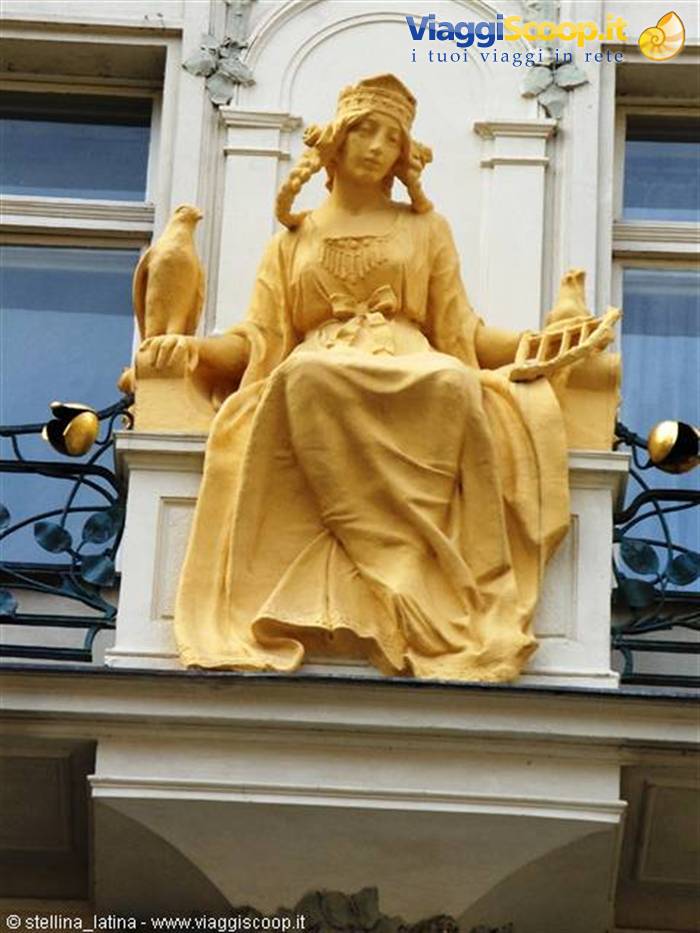
princess Libuse on Charles Street
Day 224 May 2006
quartiere ebraico, museo Mucha, Museo Nazionale, piazza Venceslao
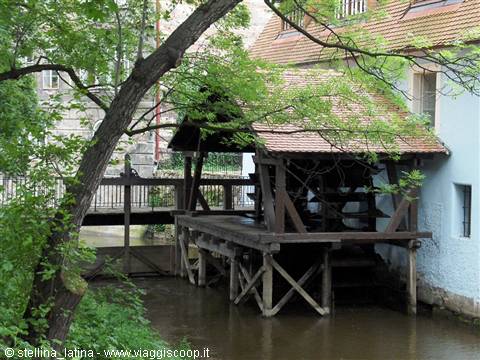
With a hopeful sky we head toward the JEWISH QUARTER. It must be around 8:30...we change route and decide to reach Charles Bridge along the Vltava to see the Palaces on both banks (actually often the other bank isn't visible except through the bridges) Beautiful, as are the interesting gardens in which we discover, thanks to the guide, a beautiful wooden Water Mill immersed in the greenery. We walk the now already lively bridge, pass under the city gate, cross again the old Old Town Square, waiting for the crowing of the Astronomical Clock. <MICHELIN GUIDE: Abandoned at the end of the 19th century, the Prague ghetto, where Jews had settled since the origins of the city, is the subject of a large restoration project.
Witness to this reconstruction is the elegant Paris Avenue, a wide straight artery that joins the Old Town Square to the Cech Bridge (which opens onto the Letná district), flanked by beautiful buildings (in Neo-Renaissance or Secession style) adorned with richly decorated facades, pediments and bay windows. Continuing toward the cemetery you encounter the Maisel Synagogue, a neo-Gothic reconstruction (1905) of the old building destroyed by fire; the Jewish Town Hall, an 18th-century Rococo building rebuilt on an old 16th-century structure, equipped with a clock tower, in which you can see a Hebrew clock face whose hands move counterclockwise (as Apollinaire noted, "they move backwards"); the Great Synagogue.
The Spanish Synagogue, built in 1868 in Neo-Moorish style at the other end of Paris Avenue, has interiors in warm tones, ranging from yellow to dark red.> We go down the few steps that from Paris Avenue lead into the Jewish Quarter and we're immediately next to the Synagogue. Tickets for any visit are purchased in the souvenir shop right next to it. To our disappointment, only three types of tickets can be bought: 1. only Old-New Synagogue (200 kr), 2. all the museums and synagogues including the cemetery (about 15 eur) except the Old-New Synagogue, 3. the sum of the first two. We were only interested in the Old-New Synagogue and the cemetery... We decide to buy only the one for the Old-New Synagogue and to decide later.
OLD-NEW SYNAGOGUE <MICHELIN GUIDE: According to some, its walls were built with stones from the Temple of Jerusalem, others claim that it appeared, already built, from a mound of earth that was being leveled...and there are finally those who say that its Hebrew name (which means "provisional") destines it to be transported to Jerusalem when the Messiah comes. In reality the synagogue, built in Gothic style after 1270, is today at a lower level than the street, probably at the original level of the Old Town before it was raised to protect it from floods.> Historically interesting, it is however a bit disappointing having visited other richly adorned synagogues. The small nave contains original elements. CEMETERY Leaving the Synagogue we head to the Cemetery. It's raised, about a floor higher than the street and, therefore, not visible.
Through the access staircase to a Synagogue-museum you can admire from above the dense tangle of graves that overlap and pile up in a chaotic and evocative cluster of tombstones that constitutes the oldest Jewish cemetery in Europe. <MICHELIN GUIDE: (..)12,000 tombs, but certainly almost 80,000 bodies: since worship forbade the exhumation of buried bodies, the coffins were stacked on about a dozen levels. The oldest tomb, that of rabbi Karo, who escaped the 1389 pogrom, dates back to 1439; the most recent to 1787, the date on which an imperial decree forbade burials inside the city. The ancient tombs are generally simple stone tombstones, but from the 16th century the graves were enriched with inscriptions inspired by the Torah, with engravings or drawings that symbolically illustrate the family names (the Fuchs are represented by a fox, the Maisel by a mouse, etc.).
Within the perimeter of the cemetery there are two synagogues used as museums. > Having left the Quarter early, where even to use the bathroom you have to pay and queue, we look for the Convent of St. Agnes, quite hidden in a winding alley. We stop, then, for a restorative hot tea and here we decide to head toward Wenceslas Square and visit the Mucha Museum which is on the way. MUCHA MUSEUM (120 Kr) The museum includes various works by the artist and a film about his life of about 20 minutes. My passion for Art Nouveau meant that, even before leaving, I tormented Lore with my beloved Mucha, renamed by him "Mucca" (Cow). I'm decidedly biased since, on my part, Mucha justified the trip to Prague, for this reason I prefer to leave the commentary to Lore, reserving a space all my own in "special Mucha".
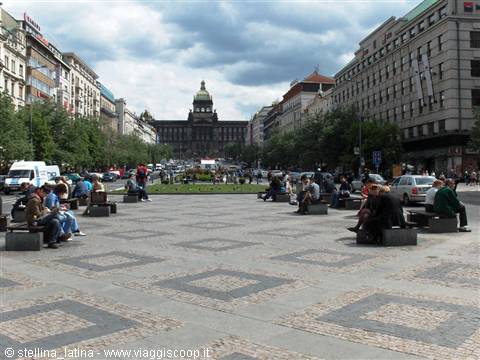
Stop along the way for a snack for Lore at the Thai Take away, very good and a truly nice and clean place! In just a few minutes we arrive at WENCESLAS SQUARE. With elegant buildings, fashionable shops, well-kept greenery and benches, it's a place enlivened by a constant flow of strollers. The square is sloped and the uphill ends with the National Museum. This slope allows a particular perspective and you can admire the square for its entire length. Note many buildings of the Prague Belle Époque; for brevity I'll mention only a few: the Koruna Palace (1914), which shows the transition from Secessionist style to Art Deco, located in front of the Bata building (1913), with functional lines, adjacent to the Adam pharmacy enriched with Cubist elements, then the Peterka Palace (1899), a work prior to the Secession.
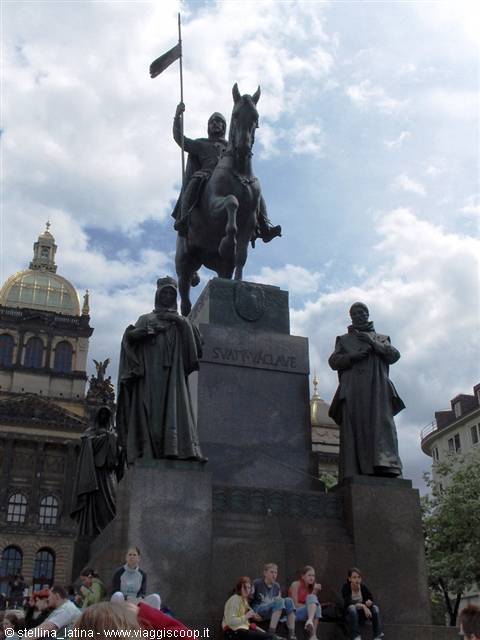
The Wiehl Palace breaks with these expressive canons and revives a Neo-Renaissance approach with pediments, bay windows and turrets. On the opposite sidewalk three grand hotels: the Europa and the Meran, Art Nouveau buildings, and the Jalta, which dates back to the era of socialist realism. STATUE OF ST. WENCESLAS At the end of the Square there's the statue of Wenceslas on horseback, he, yes, Saint Wenceslas seen like this is really a fine big man! He was murdered by his brother Boleslaus at the end of the 10th century, after canonization Wenceslas became the patron saint of Bohemia. The equestrian statue is from 1913 and is completed by the figures of national Saints that adorn the base (Ludmila, Agnes, Procopius and Adalbert), and the inscription of medieval origin engraved in the marble: "May it be granted to us and to our descendants not to perish".
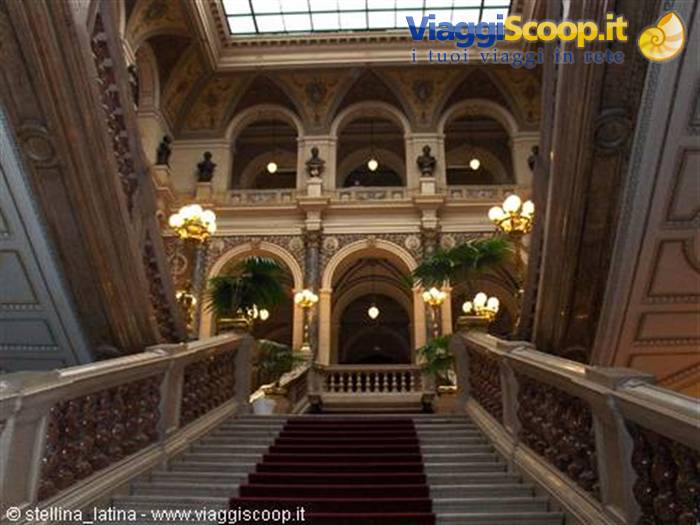
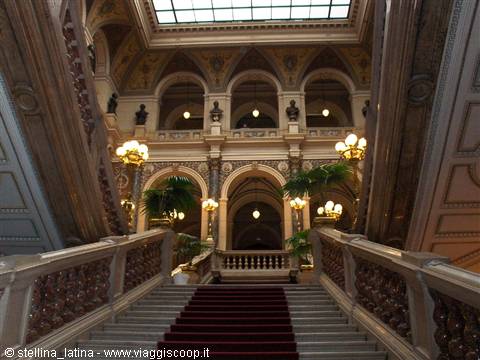
While I imagine that handsome young man in his shining armor (and Lore looks at me a bit disapprovingly) we head to the National Museum, a building that closes and dominates the square-avenue symbol of the history of the last two centuries. NATIONAL MUSEUM: (110Kr) Inside you're welcomed by the stuccos and gildings of the vast vestibule and a beautiful staircase leads to the upper floor. Under the dome is the Pantheon, decorated with numerous statues, paintings and various representations of the glories of Bohemia.) The collections of the National Museum are of mineralogy and zoology. It also contains a section on the prehistory of the Bohemian region. Meanwhile, the fountain in front of the building depicts the Elbe and the Vltava. Under a sky that opens and closes we decide to cross over to the river.
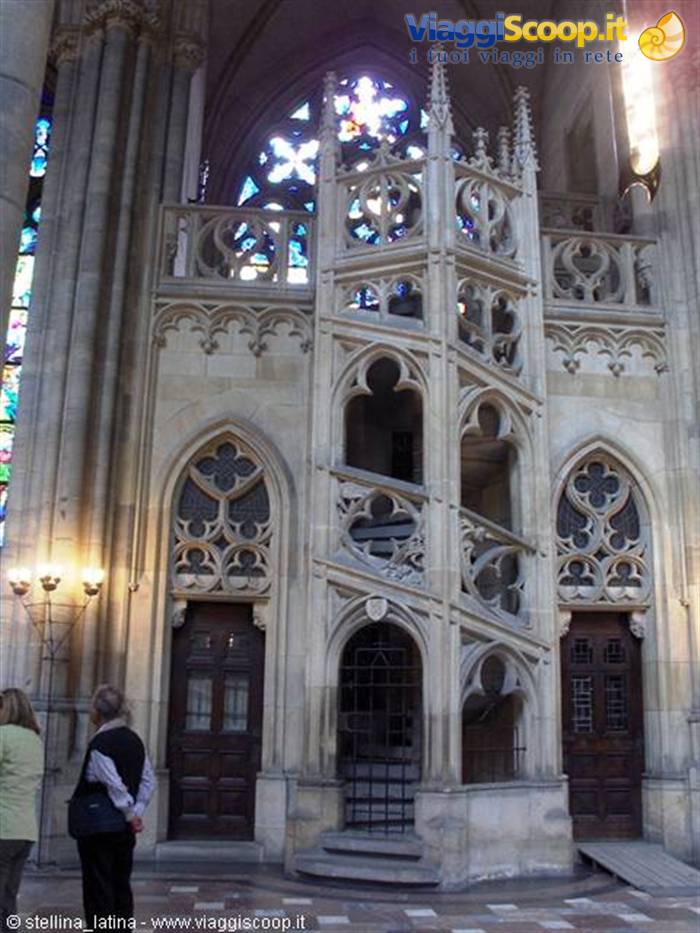
S. Vito, inside the Castle
Day 324 May 2006
speciale Mucha e secessionismo
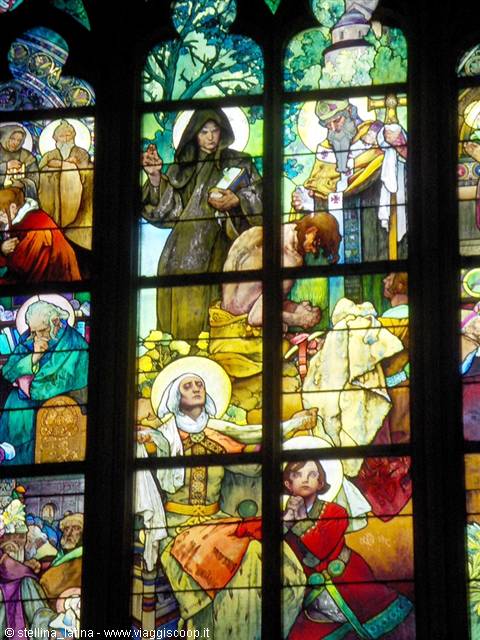
Alfons Mucha (1860-1939) became famous in Paris as Sarah Bernhardt's official poster artist. He worked in the studios of Rodin and Gauguin and became one of the masters of Art Nouveau. On his return to Prague he dedicated himself to more demanding works (cycle of twenty canvases of the Slav Epic, stained glass of St. Vitus, ornamental elements for the Municipal House and banknote engraving). Inside the museum dedicated to him there are several works and a film (in English) in which his life is told.
He was born on July 24, 1860 in Ivancice, a small town in southern Moravia. He tries in vain to enroll in the Prague Academy and in 1877 he moves to Vienna where he will work as a portraitist. In 1885 he begins his studies at the Academy of Fine Arts in Munich. In 1887 he moves to Paris to continue his artistic training, where he will also meet Paul Gauguin. He also continues to work as an illustrator. In 1894 he designs the first poster for Sarah Bernhardt and the success obtained is such that he will sign a six-year contract with the actress. His success is now well known. In 1898, following a trip to the Balkans, he begins working on the Slav Epic.
From 1899 he works for the Austro-Hungarian Empire designing posters and decorating the Bosnia-Herzegovina pavilion at the International Exposition in Paris (he will receive the silver medal) He begins working for jewelers and his decorations are now considered an example of Art Nouveau. He receives several awards for his work. In Paris, also in those years, he meets his future wife, Maria Chytilova.
--> STILL TO BE WRITTEN
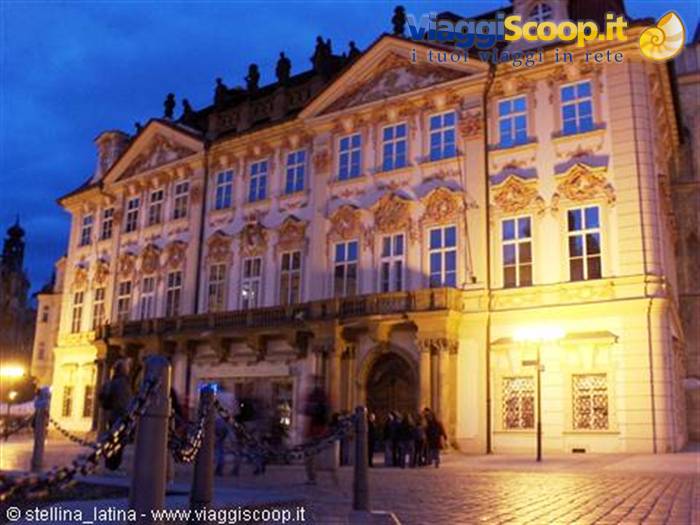
the Old Town at night
Day 425 May 2006
castello, chiesa S. Vito, ristorante
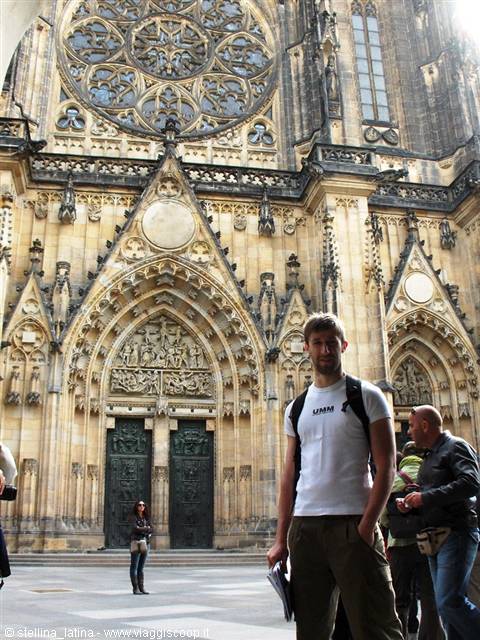
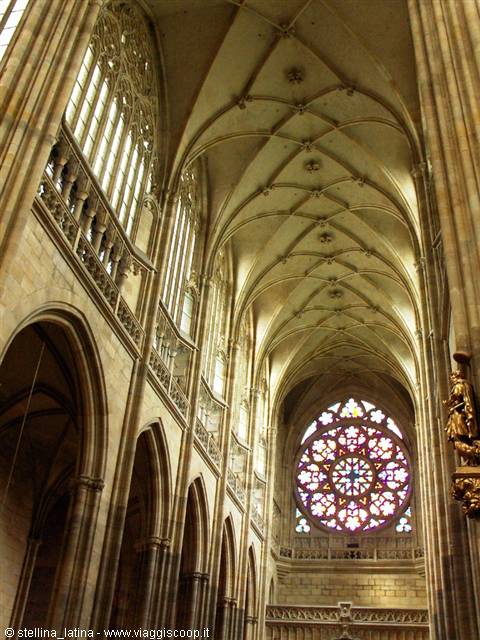
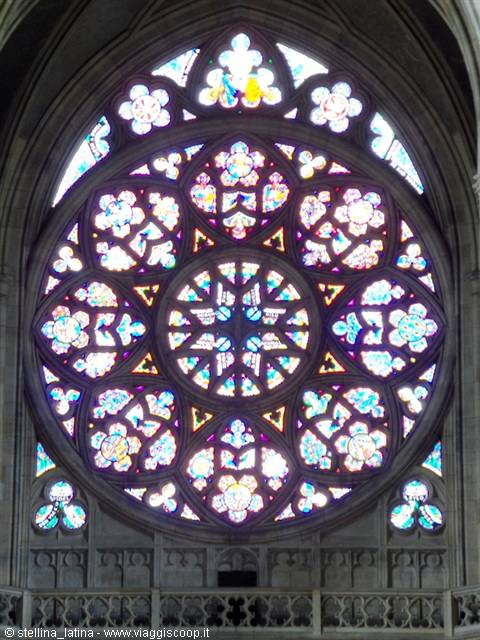
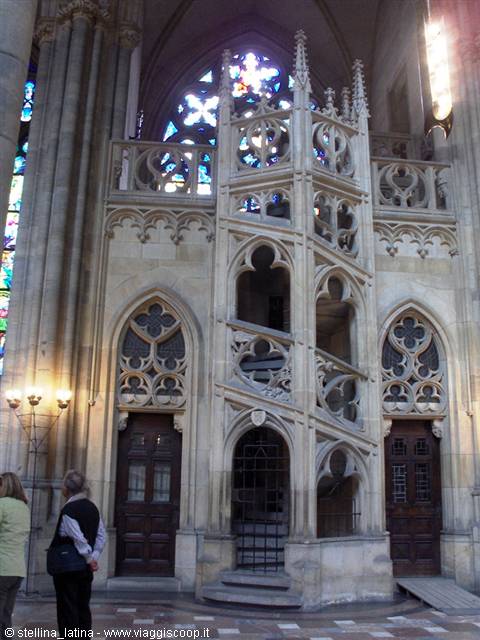
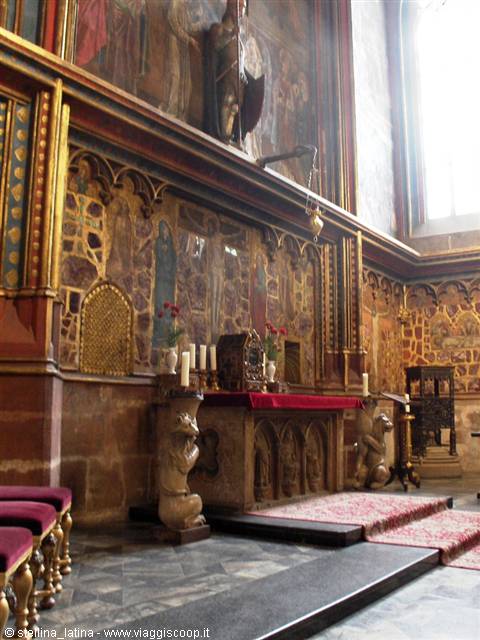
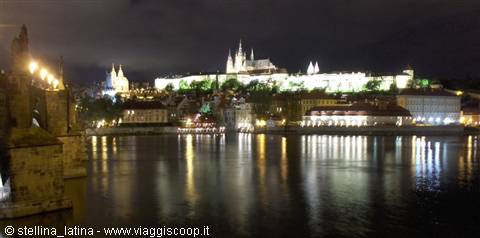
Today visit to the CASTLE! We climb up through the long staircase and thus reach the entrance. You pass the first courtyard and reach the ticket office where you can choose the combinations of visits at different prices... St. Vitus, Royal Palace, etc. We choose the one for 200 Kr + 60 Kr photo permit (do it!). There are hordes of tourists from Tour O. who pass by, unconcerned, in front of the cameras, dawdling back and forth, engulfing everything and everyone, occupying entire halls like flocks pushed and dragged by the shepherd-guides with colored little umbrellas. (sorry for the rant). We start with the Church only because we see a group leaving and we fool ourselves that it's not crowded. St. Vitus is very beautiful and truly deserves a careful visit.
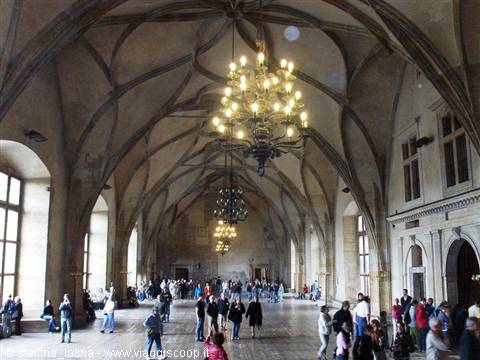
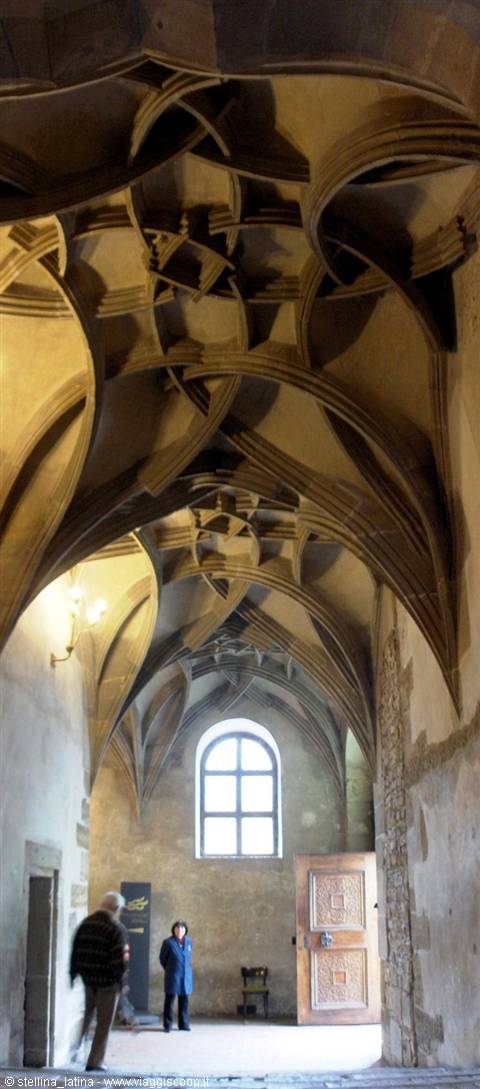
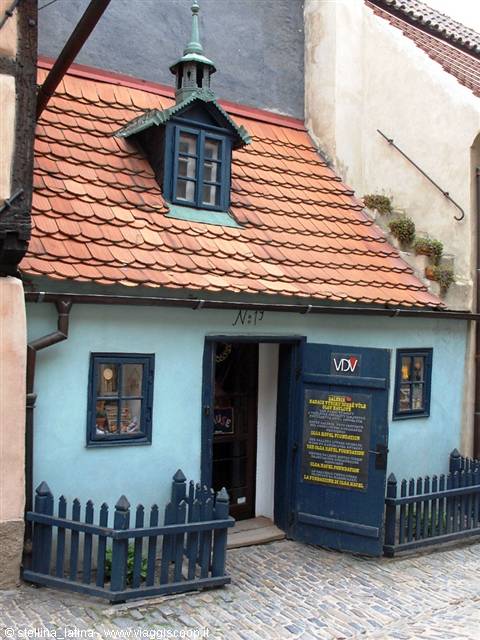
There are 4-5 fundamental elements to visit: you won't have trouble finding them but seeing them, yes, you'll have to squeeze between one group and another to be able to take photos. Having left fascinated we enter the Royal Palace, famous for its beautiful and evocative ribbed ceilings. (every guide provides descriptions of it). We use the "public" bathrooms of the Royal Palace: the queue is truly absurd: in front of me I have a group of Japanese and one of German women...men don't fool yourselves, the herds of valkyries had occupied the men's bathroom too. A bit worn out we visit the Golden Lane. Evocative seen from above (to be able to take a photo over the heads I had myself hoisted onto Lore's shoulders, to the amusement of the Japanese). Cute and also the little shops with weapons, etc. It starts to rain and we're a bit worn out by the "human crowd".
We decide not to linger and we exit.
The previous day we had seen a little restaurant that inspired us and we decide to try the tourist menu. The tourist menu, tried by Lore, includes beer, soup and a main course. I taste the Czech Gulash (180Kr) which is conceptually similar to ours and very different from the Hungarian one. Everything delicious. The service leaves us a bit puzzled: we don't understand why we never see the local people smile, they always seem angry and annoyed (everywhere, in the shops, at the ticket offices, in the venues...). Could they be fed up with tourists? Yet all this multitude of people brings valuable currency and, I believe, is enriching the Praguers at an impressive rate. Theirs isn't racism, in the sense that they behave this way with anyone (also because often, until we open our mouths, they mistake us for locals - maybe because we're fair-skinned...).
a bit tired from the kilometers and the weather and weighed down by an abundant meal we decide to skip the visits planned for the afternoon (Loreto and Strahov Monastery) and to return to the hostel to sleep a little. We let ourselves be tempted by the idea of taking a tram but at every stop we think, come on, the next one. Doing so we arrive at the base of Petrin park. No, and who has the desire to do that climb with the rain, wind and tiredness? But maybe a little piece of the park could be done, just to see the Kinsky Palace, museum of exhibitions (a beautiful very white palace immersed in lush and very well-kept greenery) and the wooden church so interesting for Lore, of St. Michael donated by Ukraine and directly transported from one of its villages, it's beautiful but I'd say almost abandoned. The resemblance to the Kirk of Norway is interesting. In the end evening has come.
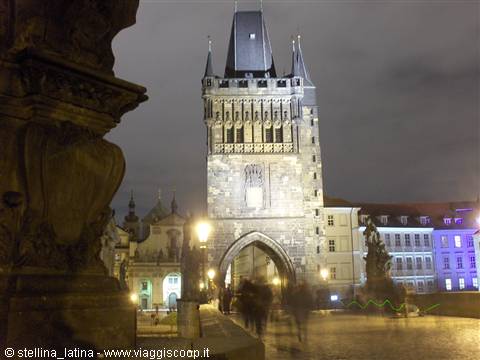
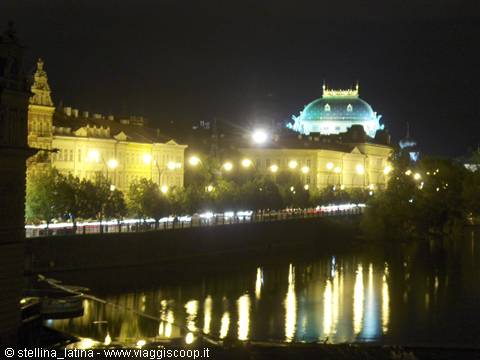
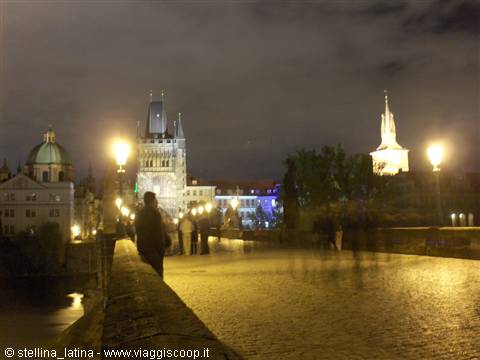
We relax just a moment, have dinner, etc. In the evening, decidedly dressed more heavily and armed with a tripod, we return, through Charles Bridge into the Old Square to see PRAGUE BY NIGHT. And we discover that it's another city! We decide to leave the hostel as soon as darkness falls. At 21:30, then, we start walking toward the center. Charles Bridge is always full, we pass the little alleys and, passing beside the astronomical clock, we arrive in the Square. Uh, we're puzzled: it's dark but...no monument is lit? We wait...in the end we decide to go toward the Town Hall, we take a little stroll but everything is dark. The Powder Tower blackened by time blends with the sky. We try to take a few photos with the tripod but...it's not worth it. We return to the Square and sit on the benches under the large statue of Hus.
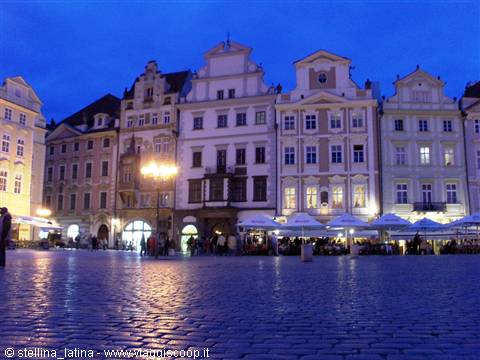
And there it finally happens: they've turned on all the lights! And here's the square transforming. The buildings stand out all the same color (effect of the light) in contrast with the sky and their light is reflected in the paving smoothed by the passage of millions of people. Here come the tripods. of the tourists, including ours, that populate the center of the square. The magic of Prague is finally perceptible! There aren't many tourists (are they all at dinner?) and the silence makes the square seem suspended, as if Prague were that square. We let ourselves be carried away by the atmosphere to the point of almost being moved.
Returning to the hostel we stop at an outdoor bar right near Charles Bridge. The pub, very nice, has an outdoor part and an indoor one with also a disco. We watch life go by while we warm up with a coffee with liqueur, very good - the cocktails were tempting but the idea of drinking something cold.... brrr!). (60 Kr)
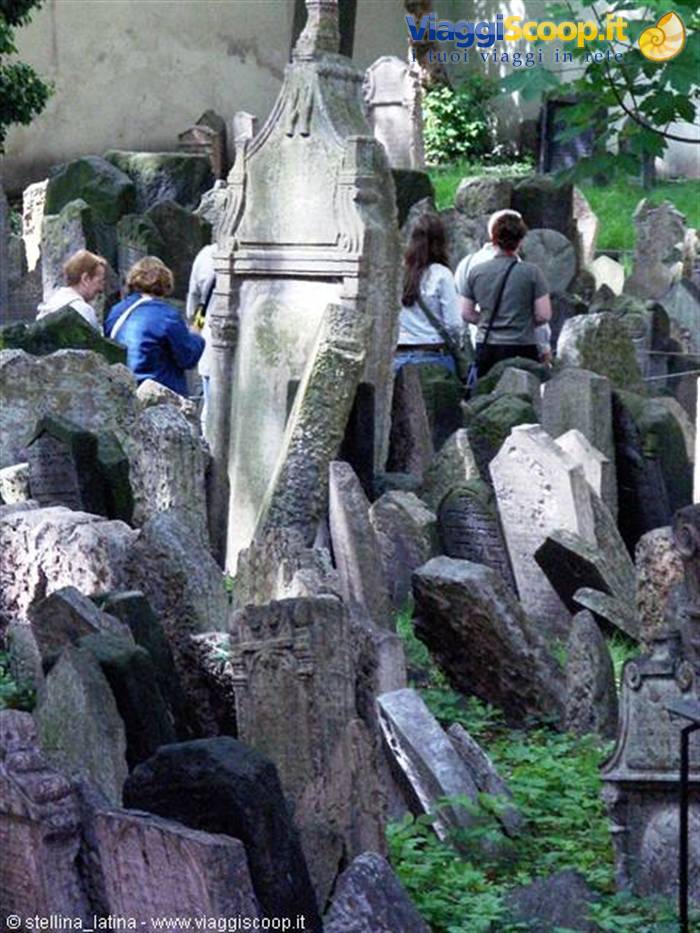
the Jewish Quarter
Day 526 May 2006
Monastero Strahov, Loreto, Città Vecchia
We decide to dedicate the morning to the northern part of Mala Strana. So we start the visit quite early at the Strahov Monastery (begun in 1140, but completed in the 18th century), which has a Baroque church where Mozart is said to have performed, and the Strahov Library, with its incredible collection of volumes and frescoes inspired by themes of education. This monastery was in operation until it was closed by the communist regime (which even had most of the monks imprisoned); in recent years the monks have come back to live there. We visit the Picture Gallery (20 Kr) which we find interesting, in complete solitude (it's off the tour routes) and then we queue up to see the Philosophical and the Theological Hall (80 Kr), taking turns to pass a few seconds in front of the door of both rooms.
Hradcany Námestí is a square born in the Middle Ages, at whose center stands the column of Ferdinand Brokoff (1726) commemorating Prague's struggle against the plague. The Scwartzenburg Palace and other residential buildings in Baroque and Rococo style make this area an ideal destination for architecture enthusiasts. A few steps west of the square opens Loretánskí Námestí, created in the 18th century with the construction of the Cernin Palace (today the seat of the Ministry of Foreign Affairs). The main attraction of the square is the Loreta (1626), a Baroque sanctuary designed to resemble the house of the Virgin Mary. This pilgrimage site preserves the Prague Sun, made of solid gold and encrusted with as many as 6222 diamonds.
We cross the Charles Bridge again to also visit the churches of the old town. Tyn etc. Unfortunately the Tyn church was closed and with no message or hours posted. Moreover the ticket office that sold concert tickets, right next to it, had a nice sign in English "we do not provide information on church hours"! Oh well. You can manage to see through the grates...
STILL TO BE WRITTEN
Charles Bridge
Day 627 May 2006
Rodolfinum, parco Letnà, Cappella di Hus....ed infine si parte!
We decide to rest and get up very calmly so as to be ready with our suitcases by 10:00, the time by which we were supposed to vacate the room. We bring them, on time, to the guy and decide to take one last stroll around the city.
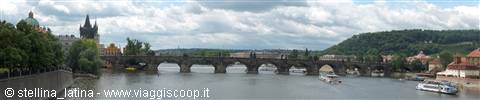
Actually we wander around, more than anything to breathe in the atmosphere. We pass through the center and find ourselves in front of the Rudolfinum. We stop to eat and right in front of us is the bridge to go to Letnà park, where the Belvedere is located. We are, of course, tempted. We cross the bridge, from which you admire the famous Charles Bridge animated by a continuous flow of people topped by soft big clouds reflected in the placid waters of the Moldau. To reach the Belvedere we walk alongside a wealthy and immaculately kept Palace that houses Government Offices. Under the sun (which hadn't shown itself for the whole vacation) we climb the many steps to reach the top of the park. What an effort! The view, however, is worth it. You overlook the whole city and the vista is completely different from the one you admire from the Castle.
If the weather is nice, dedicate yourself to this hike. (maybe there's also the metro but by then we had reached masochism.. or else by then we had built up the muscles.... At the top of the hill there's a Liberty bar with a kitchen, the most expensive in the whole city! but can you beat the panorama?
Still on foot we return to the center and by chance we stop in front of the Hus Chapel. Curious about the building we go in and discover it's a Chapel-museum. Go in! it costs about 40 Kr, it's more than anything a historical place. To be clear, Hus was the religious figure who triggered the secession and all the consequences. In the old square, elegant and severe, his monument stands right in the middle, surrounded by Gothic, Renaissance churches, by the old town hall, by the astronomical clock, by bars and little restaurants. In short, he himself, who became famous for his rigor, towers over political power, religious power, and worldly life. He towers over time past and time present. To live the moment in which everything was born, in that chapel built with private funds and where speeches that changed the history of the nation were fervently held, is moving.
We then return to our hostel, we have the chance to take another shower, etc. We pay for luggage storage and take the metro and then the bus that brings us punctually to our flight.










1 reader comments
SEI MEGLIO DELLA LONLY PLANET!!!! UN BESO MAX