The sun is blazing and the whole of Italy is in the grip of African heat when, finally, we finish the preparations for this new trip... the second we'll take as four. It will be a "soft" trip in some ways, given the presence, precisely, of Leonardo (a little over two and a half), but we'll also try to dare a bit. We'll go by camper (a vehicle universally loved by children) and to avoid the mid-August crowds we won't go to the sea, but rather to the cool, to Austria, in the heart of Mitteleuropa, for the most classic of road trips. The little one can barely contain himself and is uncontrollable when, mid-morning (at 10:53) we leave home heading north... half an hour later, though, we're already in a queue on the A14, but it's no surprise, in fact it's one of those "red-flag" days.
After more than an hour on the road, at 12:00, we're only at Bologna, and from there we start following the A13 highway toward Padua, so at 12:30 sharp we cross the course of the Po River and half an hour later we stop to have lunch at a service area. Parked on the asphalt, among red-hot metal, the heat is almost unbearable, so we stop for the bare minimum and already at 14:00 we're back on the road racking up kilometers, while Leo goes to the back of the camper to take his afternoon nap. On the A4 Milan-Trieste the traffic is really heavy, due to the many vacationers heading to Croatia, and it takes us forever with short queues and sudden slowdowns, then, finally, shortly after 16:00 we take the A23 toward Tarvisio and the pace becomes smoother.
Just under another hour of fast driving and a stop at the last service area to buy the so-called "vignette", needed to drive on the Austrian highway network, and then, after exiting at the town of Tolmezzo, we head straight toward the imposing outline of the Alps, which has by now appeared in front of us for some time. We begin to climb, vertiginously, along the Passo Croce Carsico, up to over 1300 meters of altitude; in this way we leave the Italian heatwave behind us and shortly after 18:00 we enter Austria: a country that has been part of the European Union since 1995, covering about 84,000 square kilometers (a third of Italy), which we will visit fairly thoroughly, excluding its westernmost regions (Vorarlberg and Tyrol) and part of Salzburg (including its famous capital) already seen on a previous trip.
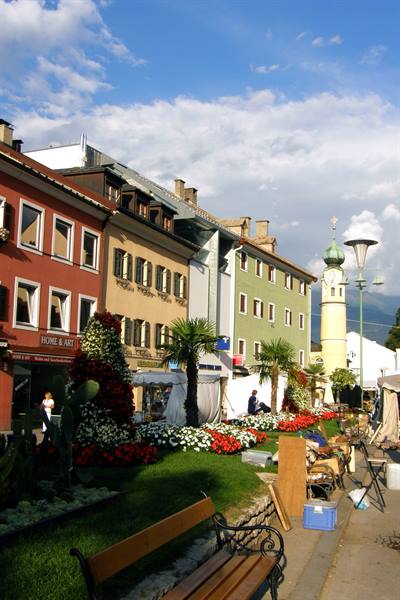
We then descend, surrounded by green landscapes, toward our first stop, namely the town of Lienz, and at 19:30 we arrive at our destination. We stop together with other campers in the station parking lot, from where tomorrow morning we'll leave for the planned excursion, then we have dinner and, after a walk in the historic center, enlivened by the pre-holiday evening, we return to our "mobile home" to rest in anticipation of the new day, with which the visits will officially begin.
Grossglockner
Day 212 Aug 2012
There are a few too many clouds in the sky, but soon they go away and the blue quickly takes over... all the better, also because on the program there's a bike ride, quite well known in Austria: the San Candido-Lienz (already done by Federico, in the company of his grandparents, a few years ago). To do it, though, we have to take the train to San Candido (in Italy), but above all we first have to rent the necessary bicycles. We get up early, with Leonardo galvanized by the idea of riding for the first time in his life on a vehicle that travels on rails. We rent three bicycles plus a child seat from "Papin", buy the tickets at the station and wait at Platform 1. The Austrian railways are extremely punctual and no delay is reported. In fact, we'd only need to be patient for a handful of minutes, but for the little one, eager to leave, they're an eternity...
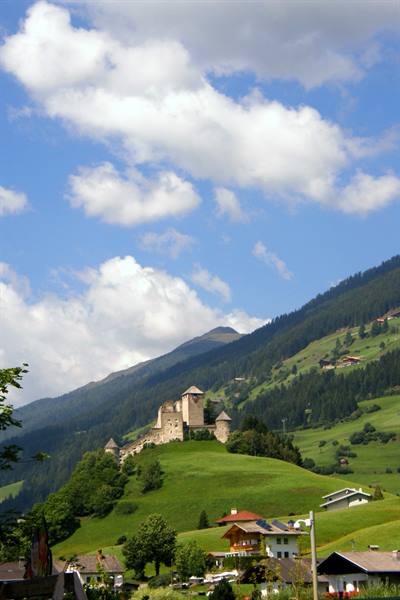
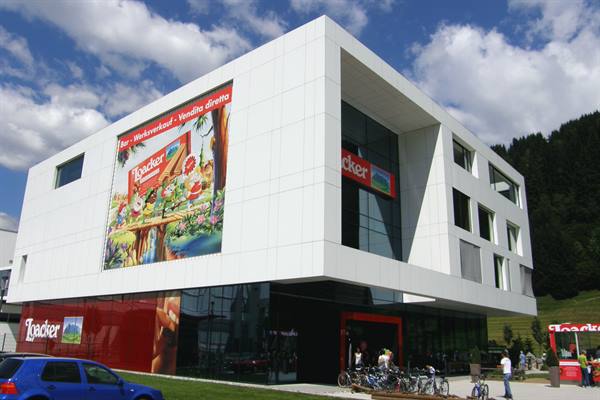
then "finally" the train arrives, so we load the bikes at the back of the train and, once on board, at 9:40, we set off. Together with other hikers we rattle up the valley and at 10:20 we're in San Candido. We retrieve our pedal vehicles from the special car (this too was an experience) and a few moments later, jubilant, we begin to ride the first of the 43 kilometers of bike path that separate us from our return to Lienz. The advantage of doing the route in this direction is that you're almost always going downhill... so, among bucolic landscapes and beautiful surrounding alpine peaks, we proceed quickly along the asphalt ribbon of the bike path. We make a "cow stop" to satisfy the child's curiosity, in the town of Sillian we skip the Wichtelpark playground, where we probably would have stayed till night, but we don't skip a short "sweet stop" at the Loacker facility.
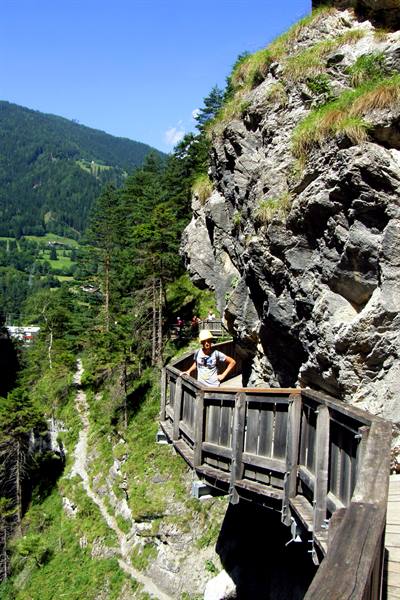
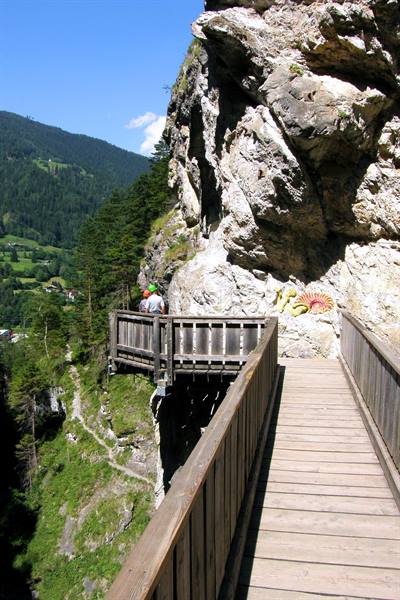
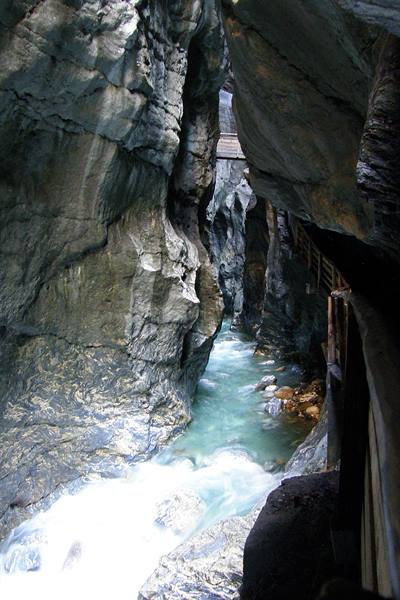
Once the palate is satisfied we get back to pedaling and it's already noon... and so far we've covered barely 15 kilometers: better to speed up, also because Leonardo's enthusiasm seems decidedly to have waned. We rack up kilometer after kilometer, sometimes through very green meadows, sometimes immersed in the woods or on the riverbank, and in any case always surrounded by pleasant landscapes, so we arrive almost at 14:00, now in sight of Lienz, near the Galitzenklamm Gorge. The little one, despite the hour, still seems sprightly enough, so we decide to visit the rocky gorge, already a tourist attraction in the 19th century but then declined and reopened to the public only in 2002, when it was equipped with a new trail that climbs along its steep walls.
At the entrance, more for show than anything else, they provide us with protective helmets and, thus equipped, we set off, child on our shoulders, to conquer the Galitzenklamm Gorge... All it takes is a good half-hour hike and it's absolutely worth it because the bold but very safe wooden walkways of the last stretch of the trail are truly suggestive and, helped also by the beautiful sunny day, offer a spectacular view of the valley below. Satisfied with the brief adventure, we then retrieve our bikes, with which we cover the last kilometers that separate us from Lienz. In this way we reach the camper shortly before 15:00 and immediately have a somewhat late lunch, but more than welcome.
In the afternoon, while Sabrina and Leonardo rest, Federico and I return to the Galitzenklamm Gorge because we noticed some "adventure courses" in the trees in the immediate vicinity, which we intend to try... So we spend a pleasant hour, seasoned with a pinch of adrenaline, and then we definitely return to the camper. We return the rented bicycles, then go for a quiet walk in the small but attractive historic center of Lienz, while the long evening shadows advance. For dinner we give in to the temptation of a convenient pizzeria a few meters from the camper and after the fateful routine four steps we positively conclude our first Austrian day.
Grossglockner - Edelweissspitze
Day 313 Aug 2012
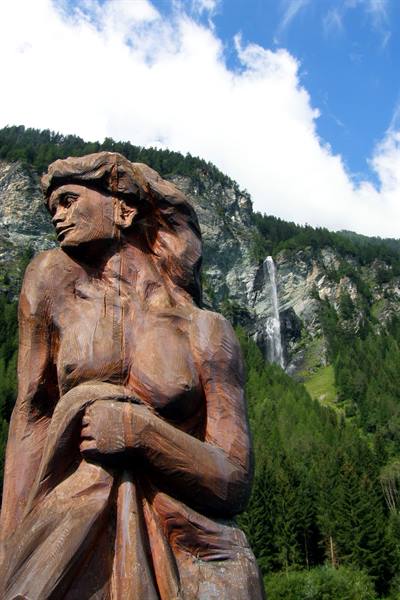
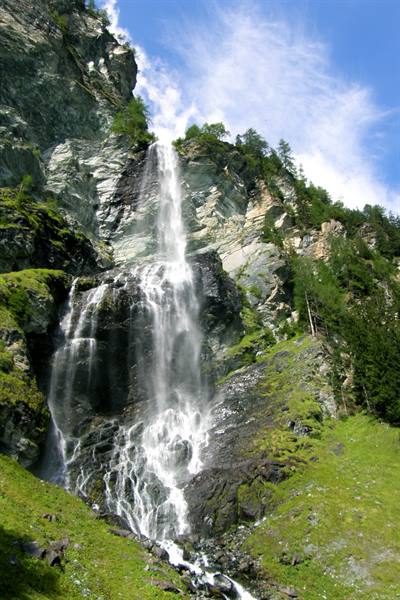
Like yesterday, this morning too the sky is full of clouds, in fact there are many more of them, but rain isn't forecast and a few timid patches of clear sky give us good hope for a quick improvement. We have breakfast and then calmly say goodbye to Lienz, starting to follow the signs for the Grossglockner, the highest Austrian peak at 3,798 meters. We cross a small pass, leaving the Tyrol region behind us to enter Carinthia, and descend toward the Molltal, a very green valley that we calmly start to climb back up. Shortly after the village of Putschall we make the first stop of the day to see the Jungfernsprung waterfall, which already puts on a fine display from the road, on our left. A local legend tells of a virgin chased by the devil who, to escape, threw herself down from the cliff and was saved by an angel who led her safe and sound to the valley floor...
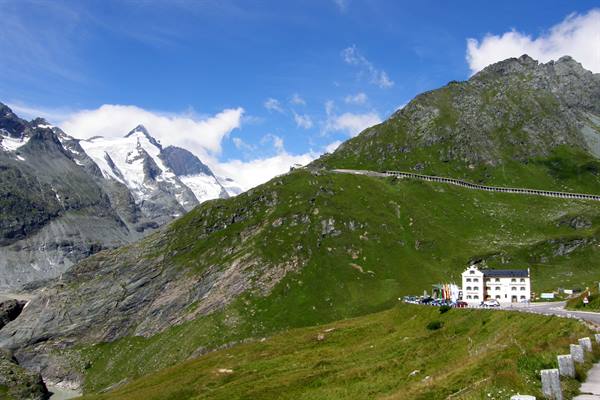
At that exact point the waterfall is said to have sprung up as if by magic, and we intend to reach it by following the trail that goes all the way to its base. Accompanied by the sun which in the meantime, as hoped, has won its battle with the clouds, we set off along a steep and tiring path that goes into the woods, and Leonardo amazes us by reaching the top almost entirely under his own power. Once before the Jungfernsprung (a fine 130-meter drop) we duly immortalize it and then, without hurry, return to the camper... The hike, including the necessary stops, took us about an hour and fully deserved the attention we chose to give it. Back on the road, we soon arrive in the village of Heiligenblut, from which the actual climb begins, while in the distance the snowy Grossglockner massif is already visible.
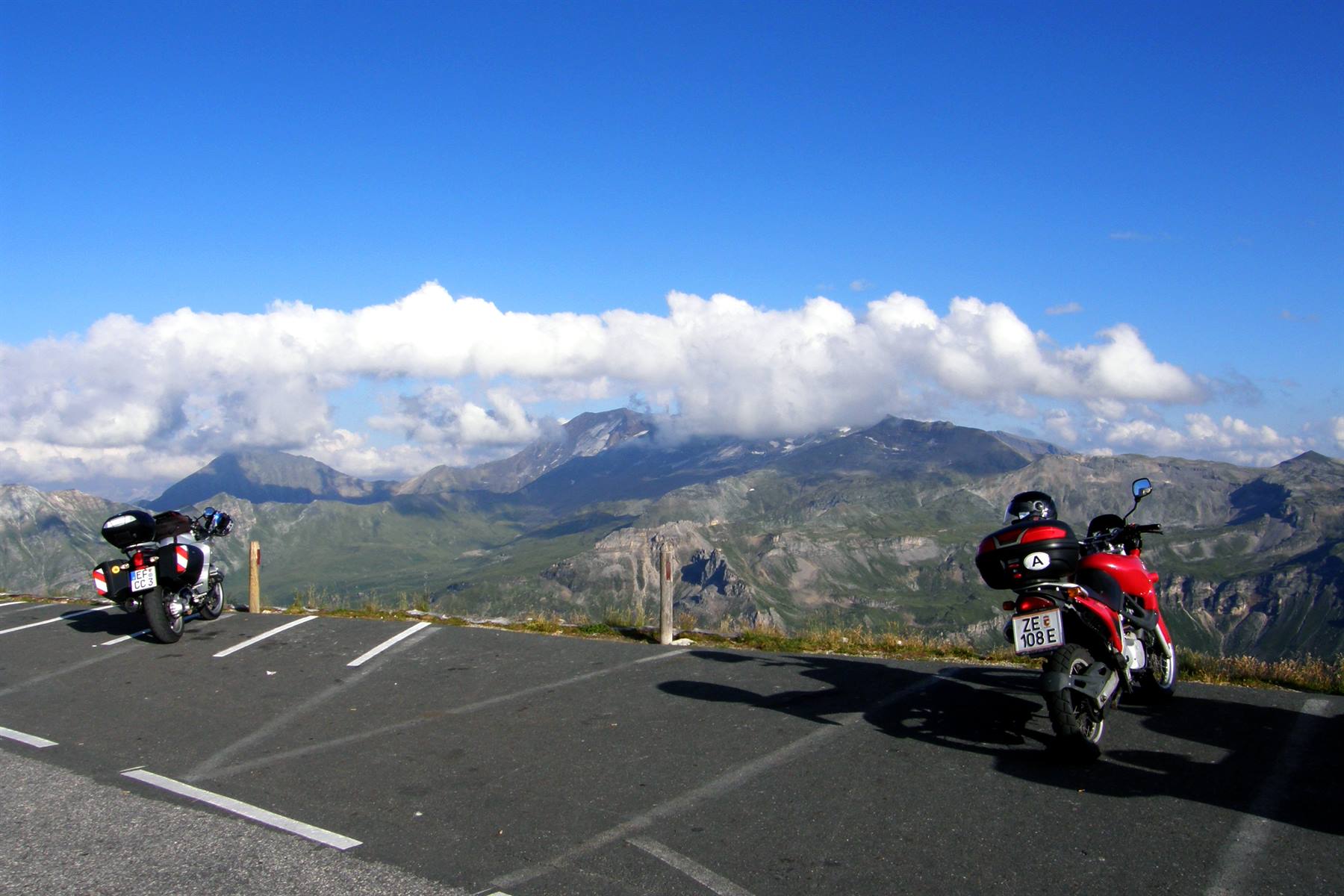
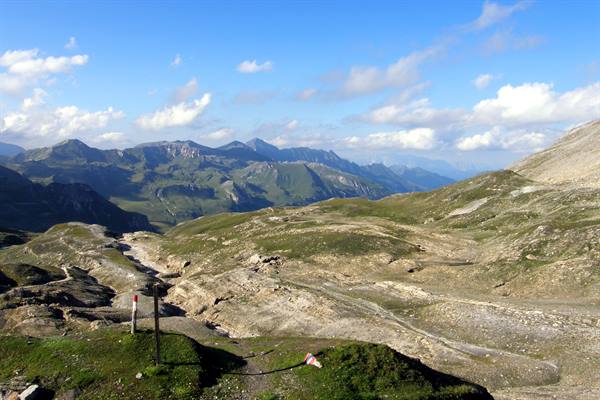
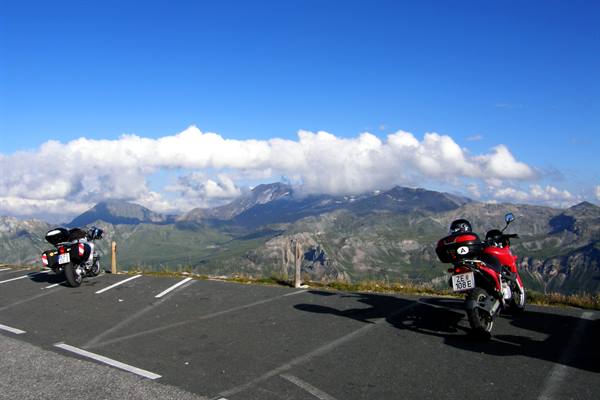
After a few curves we find ourselves in front of a barrier that we pass only after paying the 32 euros required for transit on the Grossglockner Hochalpenstrasse, one of the boldest and most spectacular alpine roads, built in the 1930s and later expanded and modernized, to become nowadays one of the country's main attractions, with almost nine hundred thousand visitors a year. One hairpin after another we rapidly gain altitude and, accompanied by beautiful views that force us now and then to make a stop to savor the details, we reach the roundabout from which the road leading to the Kaiser-Franz-Josefs-Höhe branches off, the best known and most spectacular viewpoint of the Grossglockner Hochalpenstrasse. The scenery becomes ever more majestic, while the sky, thank God, has almost completely cleared, and now a magnificent sun is shining...
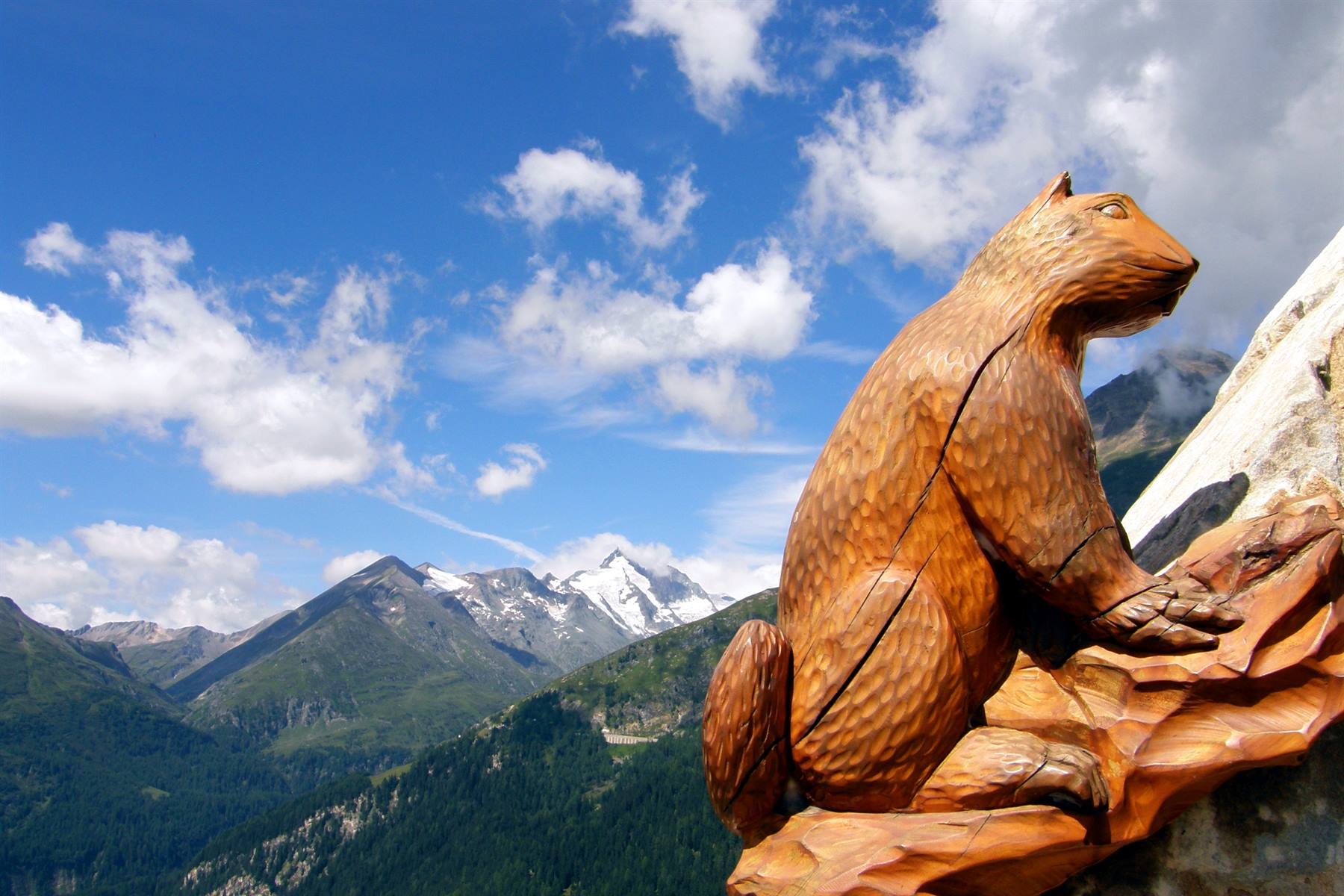
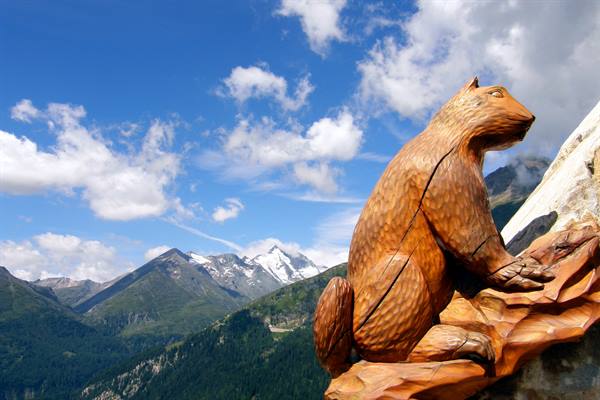
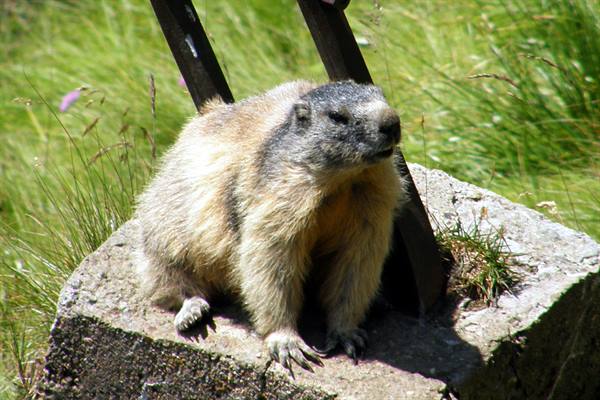
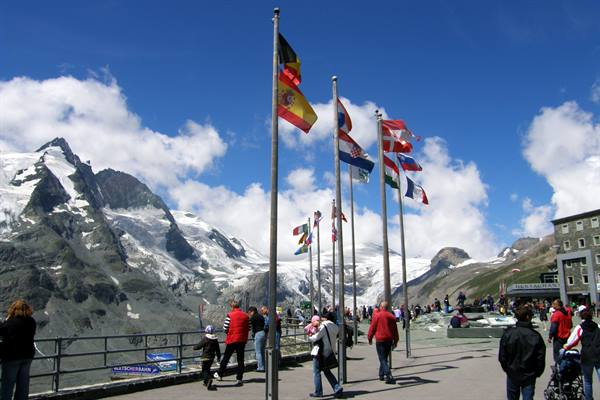
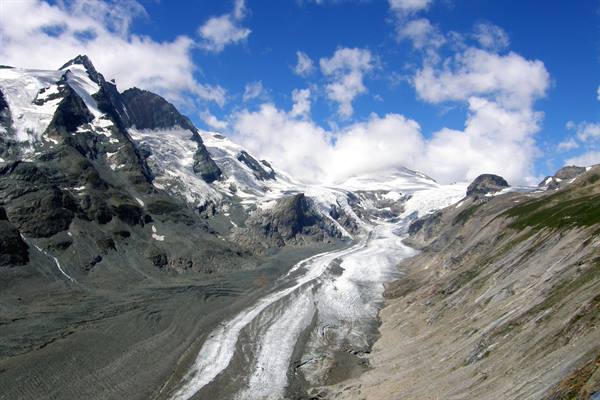
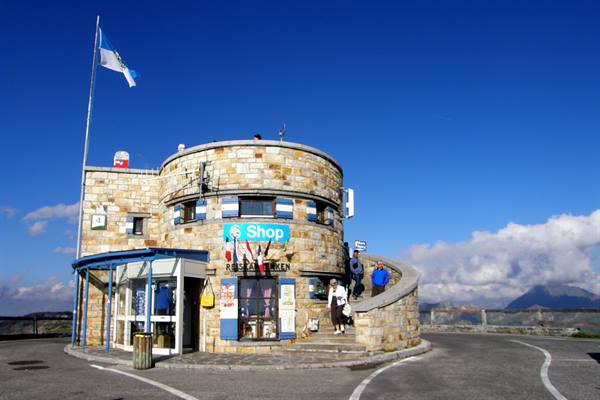
With these few but fundamental premises we thus arrive in the parking lot of the belvedere and the Visitor Center. We're in the heart of the High Tauern National Park, and after leaving our camper we calmly prepare to cover the last stretch of road, with the imposing outline of the Grossglockner on our left and the Pasterze glacier, the largest in the Eastern Alps, sprawling at its feet. Along the way we can also observe, in the cliff opposite, some cute marmots, not at all intimidated by the people noisily pointing at them; then, having reached the main square of the Kaiser-Franz-Josefs-Höhe, we fully enjoy the spectacle of that impressive backdrop of rocks and perpetual snow...
We stay in contemplation for a while, then we also venture into the tunnels that are the first stretch of the Gamsgrubenweg, a panoramic trail that runs along the right side of the glacial valley, after which we retrace our steps. Fully satisfied, for now, with the day on the Grossglockner, we make our way back to the camper to have lunch, given the now late hour, and after a physiological nap we resume our itinerary. We drive back along the Kaiser-Franz-Josefs-Höhe road and, back at the roundabout where it branches off, we start climbing the ramps of the pass that lead to the 2,576 meters of the Hochtor Tunnel (the ceiling of our trip), after which we leave Carinthia for Salzburg. Right after the tunnel we find a patch of snow and Leonardo's enthusiasm goes through the roof because, finally, he can romp around on it.
We only set off again when the chilblains convince the little one to leave his little ice paradise; then, while the afternoon clouds gather over the main peaks, a little later we climb the very tight hairpins that lead to the Edelweissspitze viewpoint (2,571 meters), from which the spectacle is fantastic and vast. It's getting late, so we tackle the very long descent of the Grossglockner Hochalpenstrasse a bit in a hurry to get back below a thousand meters of altitude and leave the High Tauern National Park. To complete the stage, once at the valley floor, we still have a good hour of road ahead of us, so, after climbing back up the Salzach valley, we arrive shortly before 20:00, with darkness looming, in the town of Krimml, from which tomorrow morning we'll begin our visits...
In this way, among curious cows grazing just a few meters from the camper and sparking the child's fantasies, we conclude a beautiful and intense day of high mountains.
Hallstatt
Day 414 Aug 2012
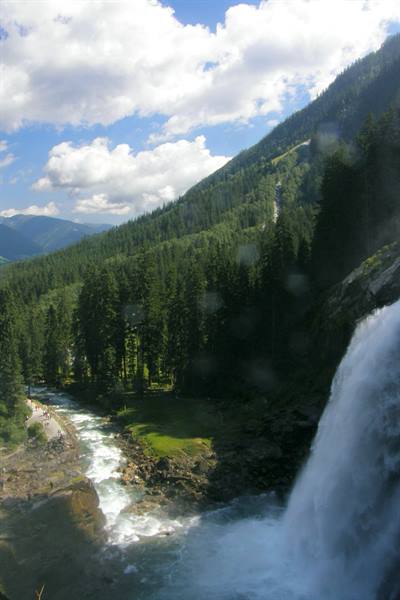
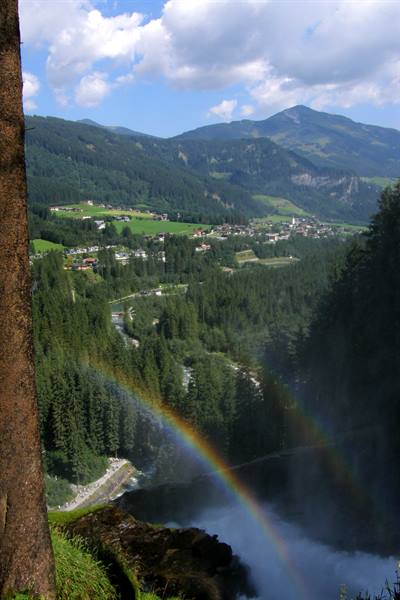
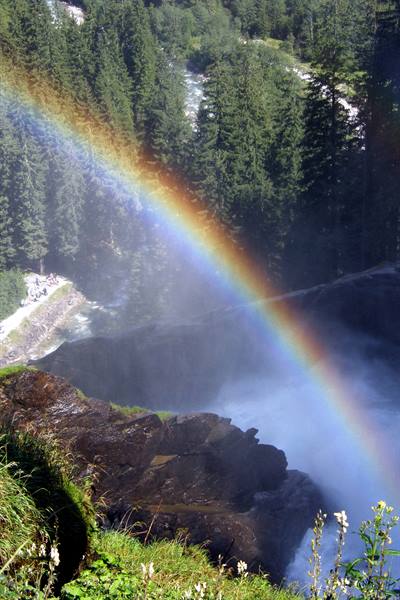
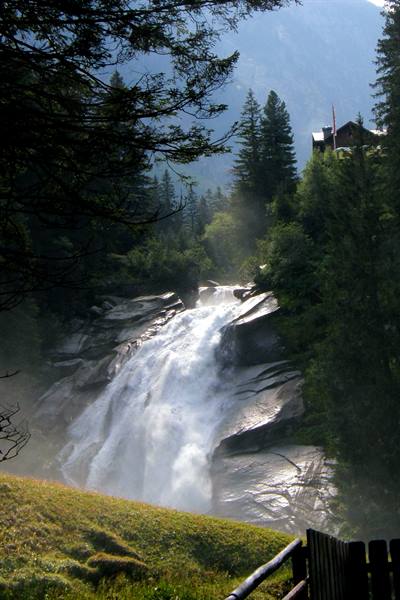
The night was cool—after all, we're in the Alps, and on top of that the wonderfully clear sky helps make the air particularly crisp... The only shame is that the Krimml Waterfalls, among the most spectacular in the alpine region, which we're about to visit, are completely in the shadow of the mountain from which they spring, leaping in three stages down a total drop of 380 meters. A little later we head toward the entrance where the Wasserfälleweg begins, a panoramic trail that climbs alongside the waterfalls... beautiful, yes, but pushing the stroller with Leonardo on board is also quite a workout! In about an hour and a half of walking we reach the base of the highest waterfall: a thunderous 145-meter drop amid the lush and very green surrounding vegetation... then we calmly tackle the descent, exploring the many viewpoints along the trail.
Some terraces overlook the impetuous course of the river and are truly suggestive, with the water, atomizing, giving rise, where the sun hits, to fanciful rainbows. Having thus made our way back to the base of the waterfalls, we also go to see up close the last impressive leap of the Krimmler stream: a 140-meter flight that generates a considerable cloud of water vapor... truly fascinating, just a shame it can't be photographed since it's completely backlit. Waterfalls in the shade or in the wrong light: a small drama for someone like yours truly, who above all loves getting the right shots, but not every donut comes out with a hole... In fact, one should have come to Krimml in the afternoon, but at that time, according to the program, we should already be somewhere else, for a new exciting experience...
We reach the camper and it's already past noon, and after a few routine tasks we resume the itinerary... We don't go far, though, because the little one is tired and near Neukirchen we stop in a parking lot to have lunch; then, while Leo sleeps, we head east along the kilometers remaining to the entrance of the Liechtensteinklamm, a gorge we'll explore in the second part of the day. Already at the end of the 19th century there was an attempt to make the impressive rocky gorge carved by the Grossarler stream accessible to tourists, but during the works the funds ran out and it was only thanks to a donation of six hundred florins by Prince Johann II of Liechtenstein that in 1876 they could be completed... In honor of the benefactor and his origins, the place was then given its name: Liechtensteinklamm, precisely.
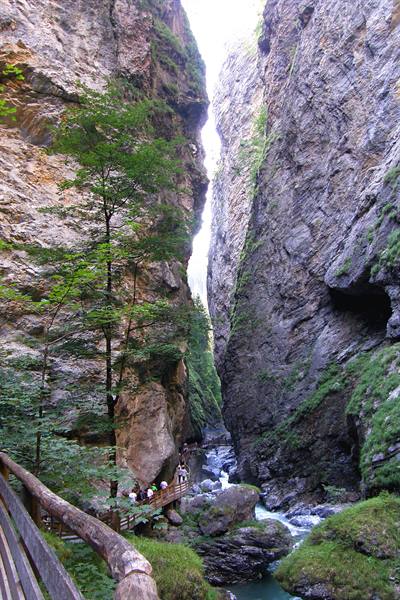
When the little one wakes up we get ready, precautionarily putting on some extra clothing, and after passing the appropriate ticket office we devote ourselves to exploring the gorge. Following a suggestive trail made of very narrow passages, sometimes carved into the bare rock, or bold walkways or vertiginous bridges suspended over the roaring waters of the Grossarler Ache, we venture into the deep and narrow canyon, whose walls rise for over three hundred meters and narrow to just two or three... A tunnel finally leads to a sixty-meter-high waterfall, from which, in practice, the whole thing comes to life. The visit to the Liechtensteinklamm truly is thrilling, but we have no time to waste, so once we've made our way back to our camper we set off to complete today's stage.
We still have about seventy kilometers of winding mountain road to cover, to the town of Hallstatt, on the lake of the same name, where we intend to spend the night. Once we arrive we look for a place to stop, but the campground is full and in the nearby rest areas it doesn't seem we're exactly welcome, so together with two other campers (from Bologna) we move, nearby, to the vast parking lot of the Dachstein Caves, which we had already decided not to visit (as well as the local salt mines), and there we halt our run. In this way we conclude a not exactly lucky day... but if this is the worst, we'll sign the contract right away!
Traunkirchen
Day 515 Aug 2012
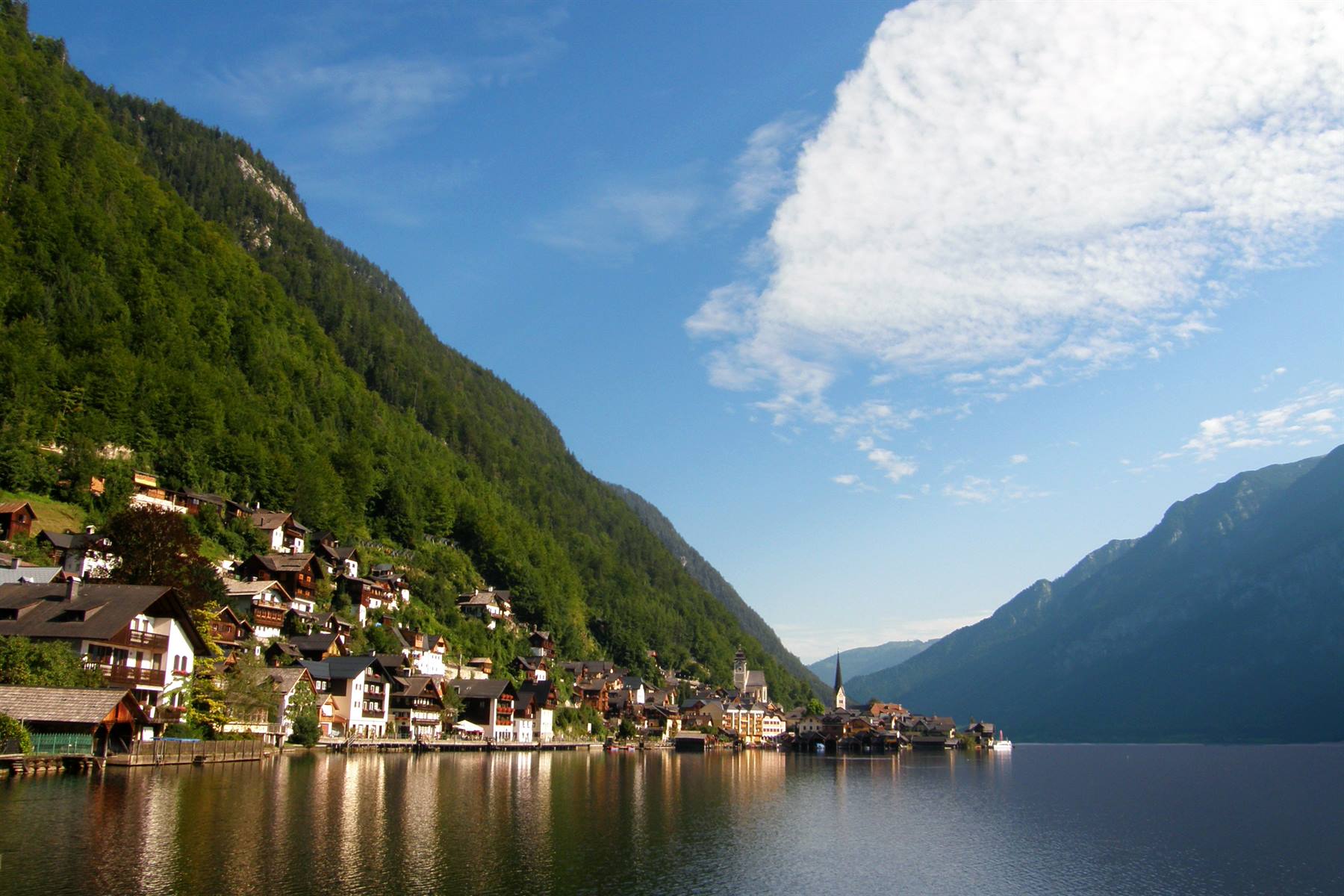
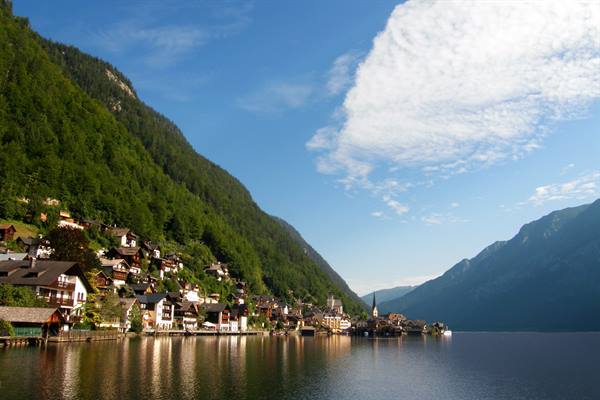
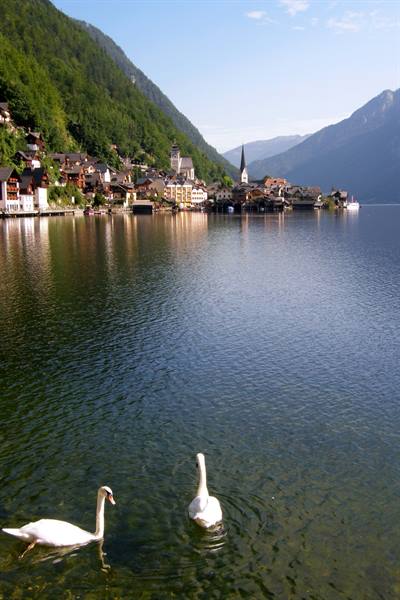
Even though it's Ferragosto, even though the sky is clear, you certainly can't say the morning is muggy, with its 15 degrees. After all, we're in Austria, the quintessential alpine country, along with neighboring Switzerland, and all this I think is normal... The premises for a beautiful day, however, should all be there. We pass back through Hallstatt, a town included since 1997 in the UNESCO World Heritage list, so we can photograph one of the most famous views in all of Austria, with the small center made of old houses clinging to the mountainside, and the little church with its pointed bell tower, leaning out and reflected in the placid waters of the lake in front. We skirt the whole Hallstätter See from south to north, then reach the town of Bad Ischl and from there turn left following the signs for Sankt Wolfgang...
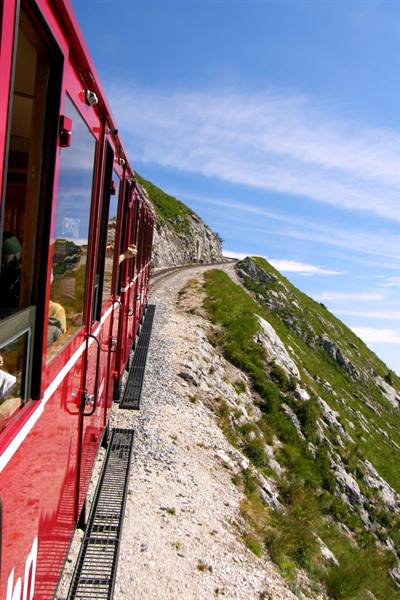
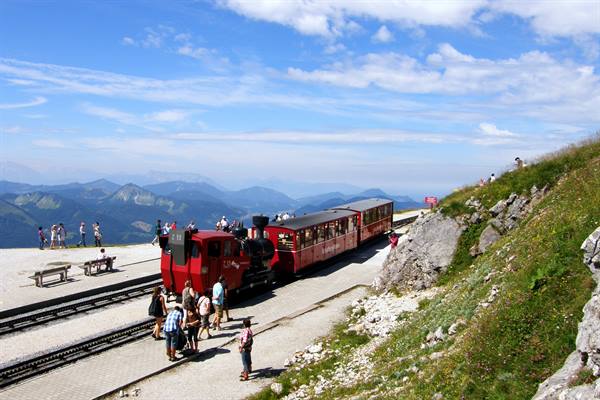
In short we thus reach this beautiful town on the shores of the lake of the same name. The main reason we came to Sankt Wolfgang is that we'd like to ride up the Schafbergbahn: a narrow-gauge railway that leads to the famous Schafberg viewpoint. We find a place for our camper in the parking lot next to the station, then buy tickets (anything but cheap) for the 11:20 train, so we have almost an hour left to take a walk in the historic center of Sankt Wolfgang. Among the typical buildings of this corner of the world stands out the Wallfahrtskirche: a beautiful church built perched above the lake, dominating the entire village.
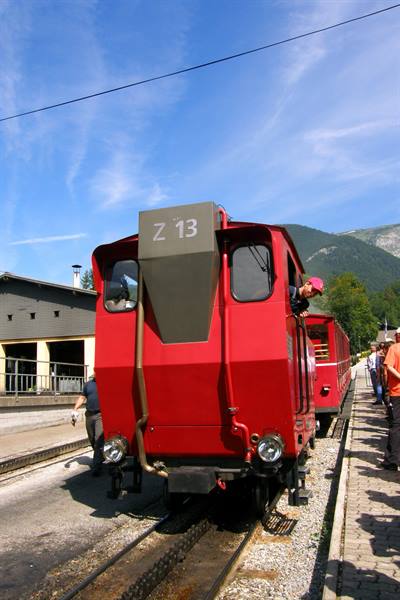
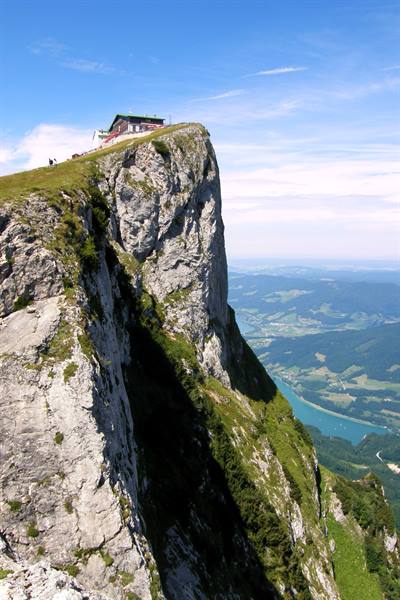
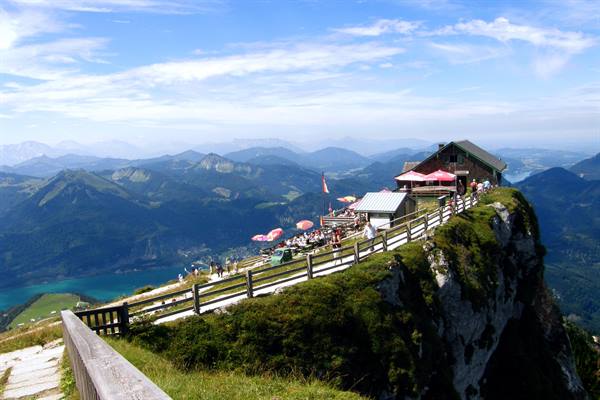
At the appointed time, with Leonardo's enthusiasm through the roof, we prepare to board a steaming, blazing little red train and with it set off along the 5,850 meters of the railway, in operation since 1893, which leads, tackling gradients reaching 26%, to the 1,783 meters of the viewpoint. It takes us about forty minutes, first passing through the woods, then, as we climb, surrounded by ever broader panoramas... In this way we reach the terminus and, once we've booked the return, we can finally enjoy, helped also by the particularly favorable day, the grandiose spectacle offered by the rocky peak of the Schafberg, which stands out wonderfully against mountains stretching as far as the eye can see and several lakes of Salzburg.
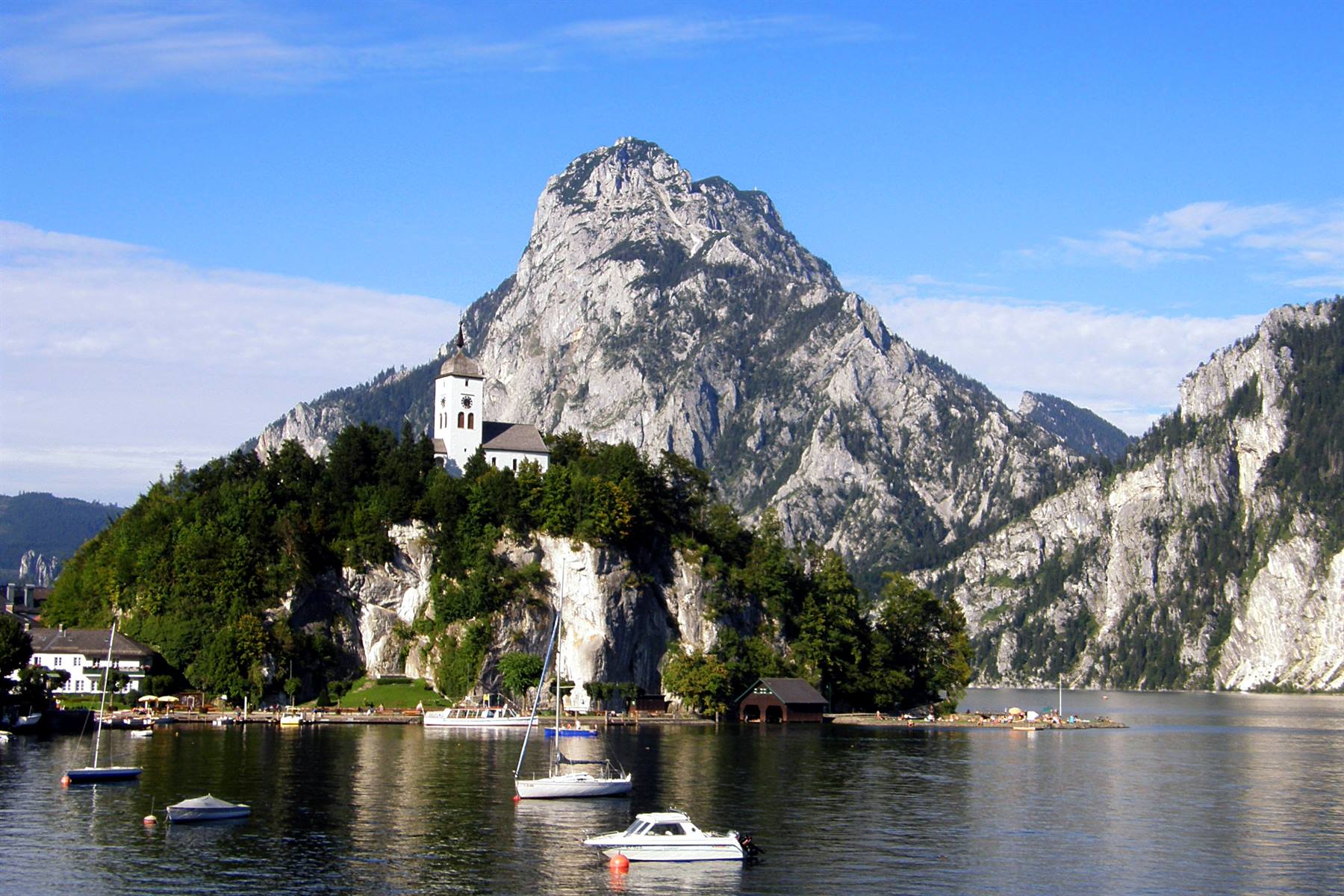
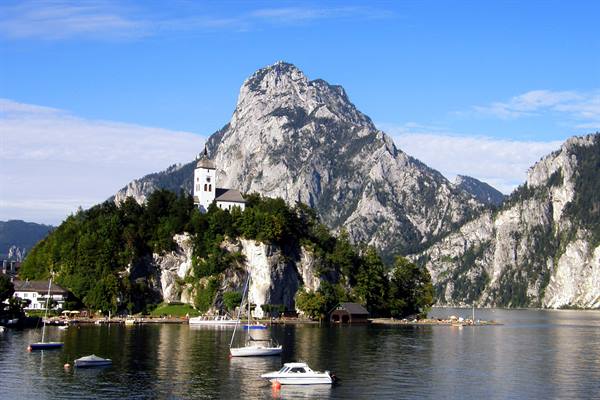
We stay for quite a while strolling around the panoramic terraces and fill our eyes with the stupendous views in front of us; then, fully satisfied with the experience, at 13:15 we catch the train which, rattling, brings us back in less than half an hour to the shores of the St. Wolfgang See. Once back at the camper we finally have lunch, given the late hour, and after a providential nap, especially for the little one, we get back on the road. In short we leave St. Wolfgang behind, pass through Bad Ischl again, and continuing north we come in sight of the Traunsee: another interesting body of water in the region. We drive along the entire western shore of the lake, so we stop to photograph the intriguing profile of Traunkirchen, a characteristic village perched on a small rocky peninsula, and reach the northern end of the Traunsee, in the town of Gmunden.
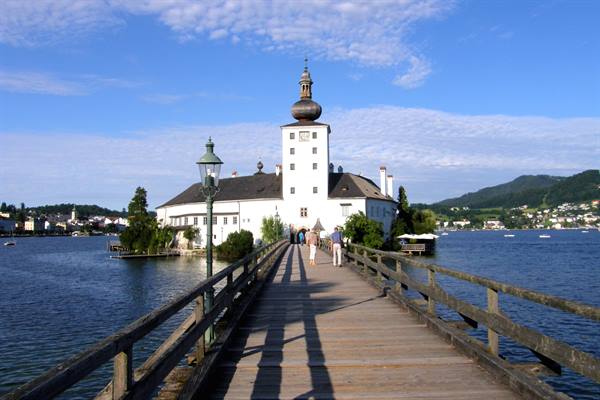
In this touristy lakeside and spa town we stop to visit, in its southern outskirts, the curious Seeschloss: a manor dating back to 1578, built on a small island and connected to the mainland by a 130-meter wooden bridge... Archduke Salvator, nephew of Emperor Franz Joseph, once lived there, and today it puts on a fine display surrounded by the placid waters of the Traunsee. We take a quiet walk along the lakeshore, then move for the night to a nearby campground... We take the opportunity to do a lot of chores, then treat ourselves to a nice dinner in the open air, and finally go to sleep, thus concluding another absolutely positive day.
Steyr
Day 616 Aug 2012
With the most nature-focused part of the trip essentially over, we're getting ready to set off toward the gentle hills that characterize the country's northeastern area and toward its most important cultural and architectural treasures. Early in the morning we leave Lake Traunsee behind and head toward the heart of Upper Austria, while the sky, as forecast, is rapidly clouding over, but we're not making a drama out of it; after all, we've just come from four splendid sunny days and, let's remember, we're in a predominantly alpine region, and besides, it seems to be more of a temporary and passing glitch... After a providential stop at the supermarket, we soon reach the village of Kremsmünster, built on the banks of the river of the same name (the Krems) and overlooked by the massive bulk of the Benedictine abbey, which has always shaped its destiny and its events.
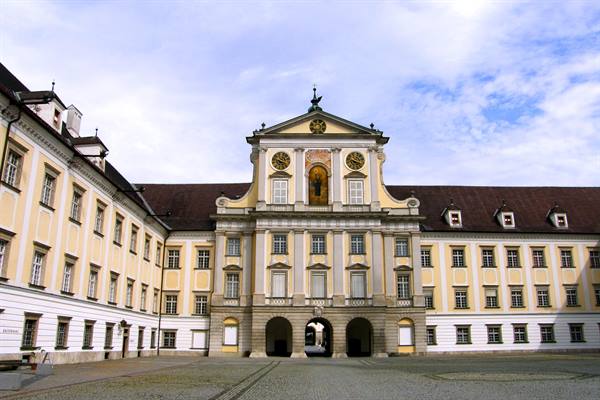
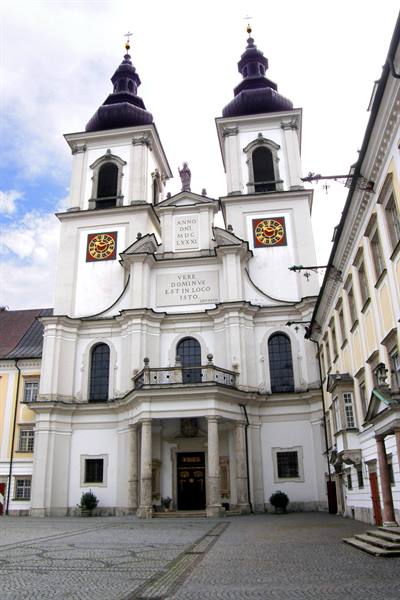
Among the largest buildings of its kind in Austria, the religious complex was founded in the year 777 by Count Tassilo III of Bavaria, who entrusted it, indeed, to the Benedictines, and it enjoyed its moments of greatest splendor in the 11th-12th centuries and during the Baroque period. After parking the camper, we dedicate ourselves to visiting the place, starting from its vast courtyards and arriving at the interesting Stiftkirche, a church with a sober towered facade, transformed into the Baroque style at the beginning of the eighteenth century.
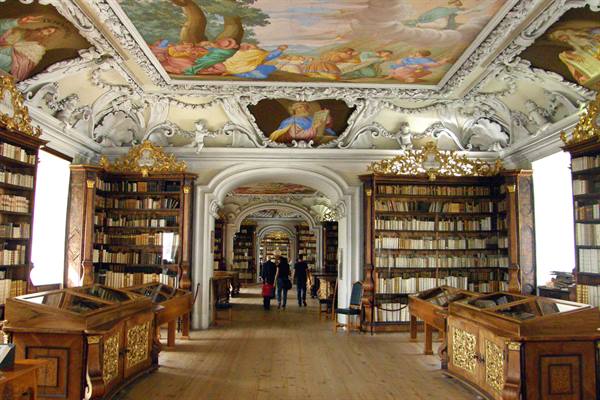
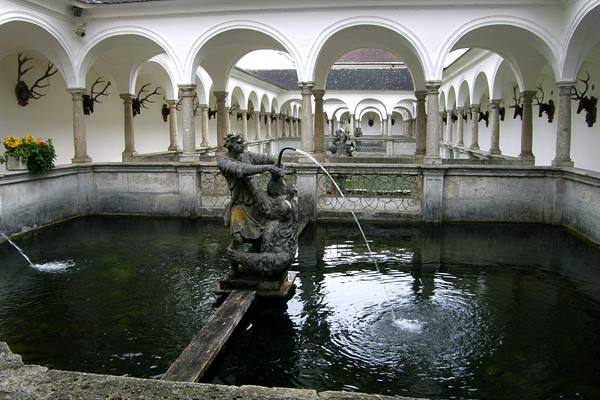
Guided by a religious brother who speaks Italian, we then move on to exploring the abbey buildings, where the Kaisersaal stands out, a fine ceremonial hall, along with some masterpieces of early medieval sacred goldsmithing, such as the wonderful chalice known as the Tassilokelch, and the beautiful library, which unfolds across four rooms filled with 160,000 volumes and over 400 incunabula and manuscripts. We end the visit with the original Fischbehälter, the so-called "fish pond," a fine creation by the Italian architect C.A. Carlone, consisting of five basins with fountains intended for fish farming, still populated by carp, pike, trout and tench, which Leonardo enjoys throwing food to, kindly offered by the guide.
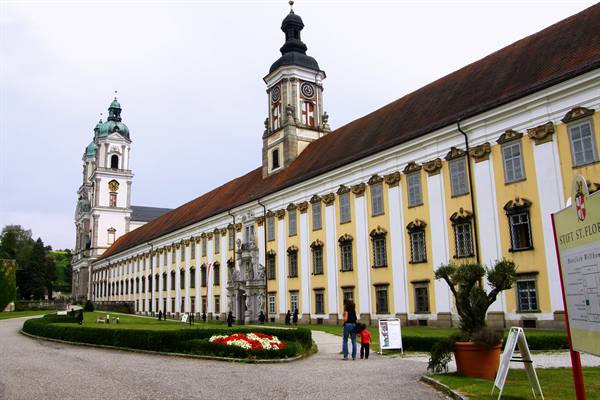
Once back at our vehicle, we move a few dozen kilometers, to the vicinity of Linz, one of Austria's main urban centers, to the town of Sankt Florian, where the silhouette of another abbey stands out, but this time Augustinian. On the supposed site of the martyrdom of St. Florian, which occurred under Diocletian (304 A.D.), the current religious complex was founded in 1071 by the Augustinian canons, remodeled several times and completely rebuilt, based on a design by Carlo Alberto Carlone, at the end of the seventeenth century, to become one of the most significant examples of Baroque architecture beyond the Alps. Even in Sankt Florian we would like to explore the abbey buildings in depth, but the visit is exclusively guided, lasting one hour and only in German... Leonardo would never be able to endure such "torture" and would be unmanageable, better to skip it.
We content ourselves with seeing the exteriors, the vast courtyard and the interior of the beautiful church with its exuberant Baroque decoration, then we retire to the camper to have lunch. The day is still rather gray and at times even threatens rain when, in the early afternoon, we move from Sankt Florian to the nearby town of Steyr. We park near the center, close to the river, and prepare to visit this historic Upper Austrian town as well, founded around the year 1000 around an ancient fortress and developed thanks to its position at the center of an important mining area, while unfortunately a few drops of rain really do start falling.
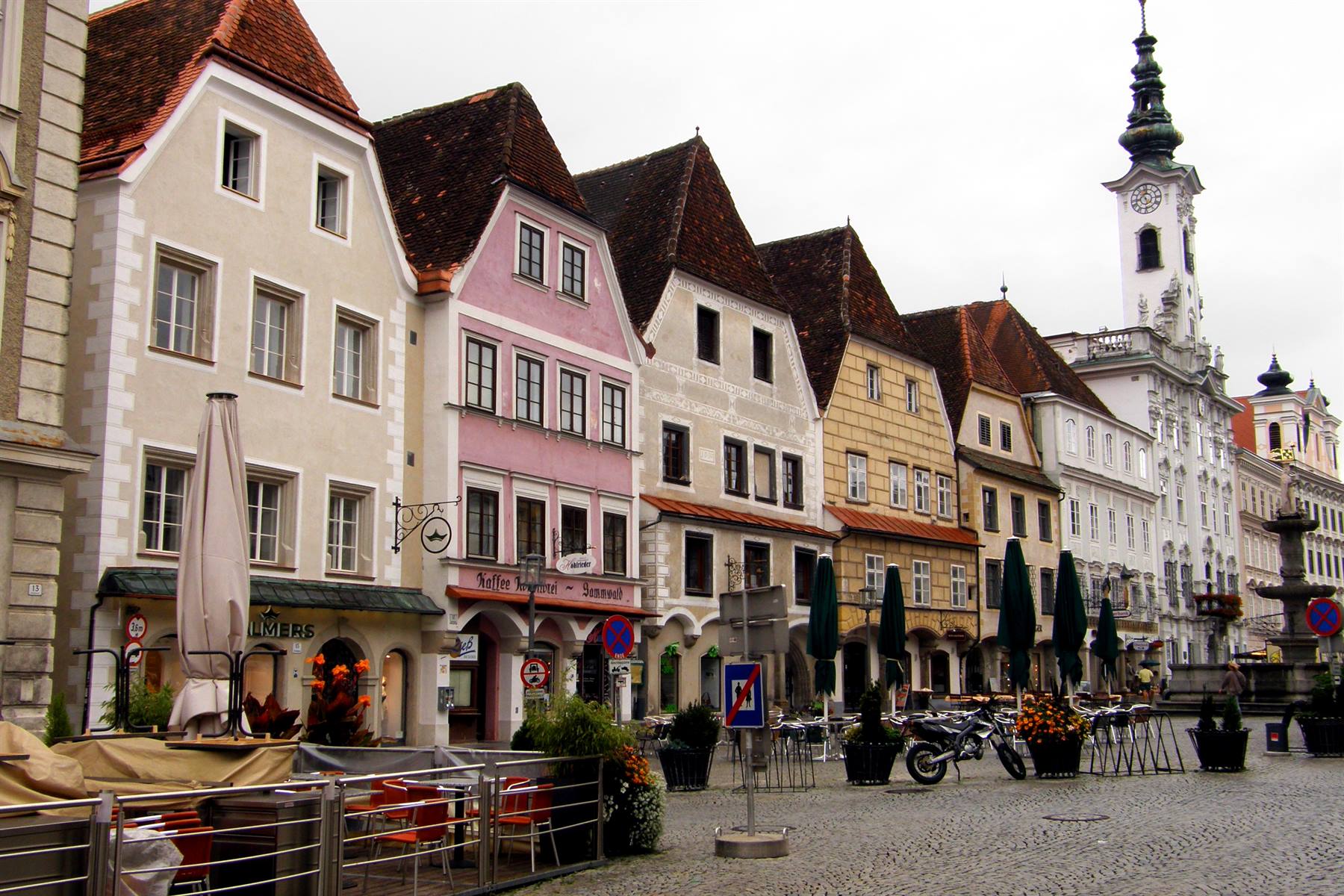
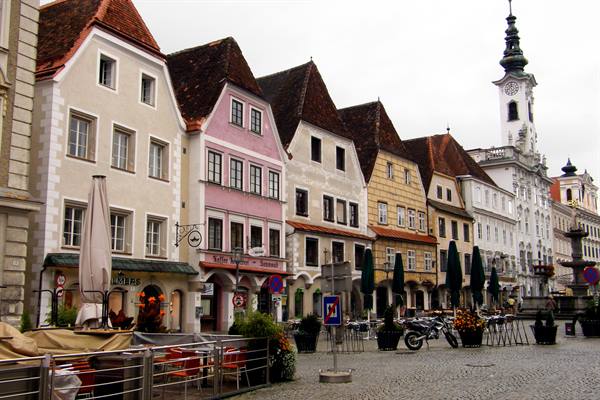
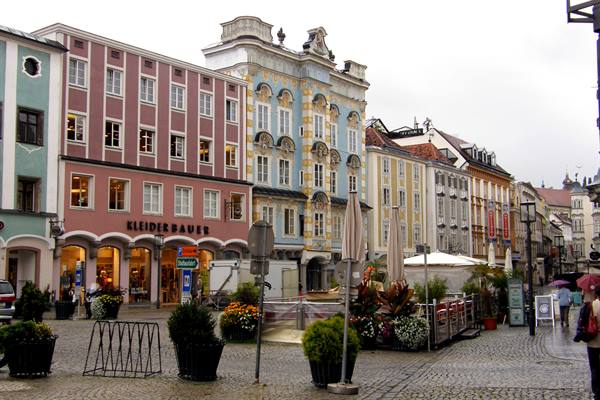
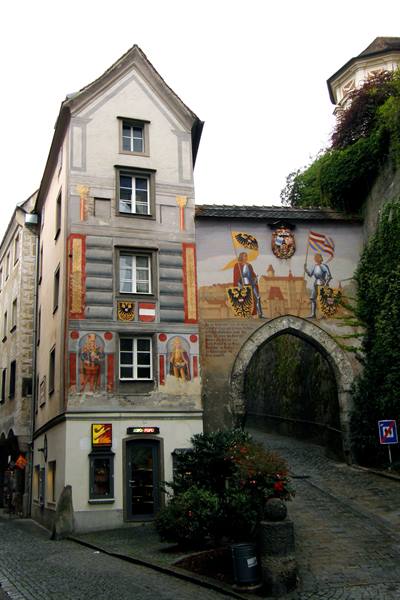
We pass through the massive Neutor, a sixteenth-century gate that gives access to the old town from the south, and thus arrive at the beautiful, elongated Stadt Platz, the true backbone of the medieval city, surrounded by elegant palaces whose facades, built in the most varied styles, from Gothic to Renaissance, from Baroque to Rococo, form an architectural backdrop of considerable merit. While we enjoy the view of one of the most harmonious squares in all of Austria, it begins to rain with some persistence, so we take shelter under an eave and wait for it to stop. Fortunately the wait is, all things considered, short, and a little later we can resume our visit...
We go to see the fine view of the characteristic Michaeler Kirche, which makes a fine show of itself at the confluence of the Enns and Steyr rivers, then we climb up, flanked by historic buildings, to the castle: the Schloss Lamberg. From there we subsequently reach the Stadt Pfarrkirche, a large Gothic parish church that plays the role of the city's most important religious building, but which is closed, so we first return to the Stadt Platz and then to the camper, positively concluding our exploration of Steyr. According to our plans we were supposed to stop there for the night, but it doesn't appeal to us, and given the hour is not late, we decide to cover some road, as far as the place we'll visit tomorrow morning: the sadly famous Mauthausen concentration camp.
However, you can't stay overnight at the entrance to the site, so we stop, in the company of other campers, in a parking lot a short distance away. In this way we conclude a day that was not exactly lucky from a weather standpoint, especially as regards the beautiful town of Steyr, which would have been quite another thing against a blue sky... but let's not despair, because tomorrow the clear weather should already return.
Melk Abbey
Day 717 Aug 2012
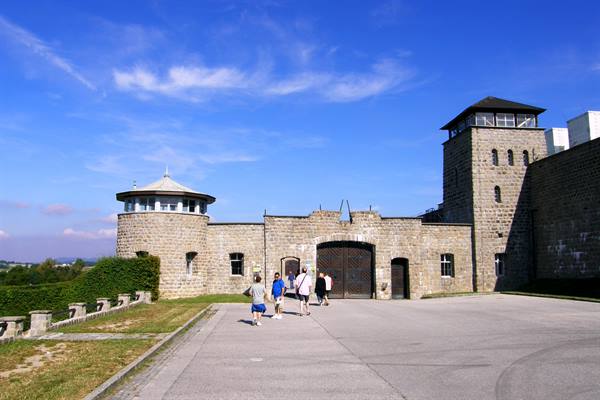
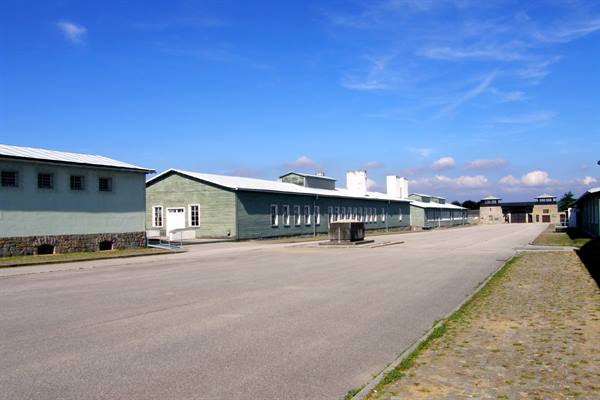
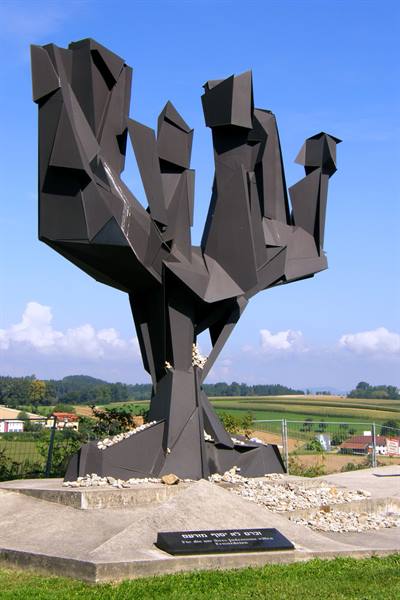
The date wouldn't seem like the most auspicious, yet outside the sun is shining beautifully... and if the morning shows the day!... After breakfast we cover the three kilometers that separate us from the old Mauthausen concentration camp, the most important in all of Austria, where during the Nazi period, from August 8, 1938 to May 5, 1945, the day of its liberation (Mauthausen was the last camp to be liberated), no fewer than two hundred thousand people were deported, of whom at least half ended up horribly killed! A few minutes after 9:00 we are ready to make the visit and first of all we are shown a heartbreaking film about the history of the lager, at the end of which, amid general emotion, little Leo's innocence overflowed, as at the rolling of the credits he stood up and, clapping his hands, exclaimed: "It's over!"...
After passing through the unsettling gray entrance gate, we saw one after another all the horrors of the concentration camp, starting from the miserable barracks where the deportees were crammed like animals, moving on to the chilling gas chambers and the crematorium ovens... it's inconceivable to what level human cruelty can sink! We end the visit among the commemorative monuments erected by the various nations involved in the terrible slaughter, and with such sadness in our hearts we resume our itinerary, convinced that it is already a positive thing that certain testimonies have been preserved, as a warning that this may never happen again! We take the A1 highway east toward Vienna, entering the Lower Austria region, and exit at Melk, an ancient village on the right bank of the Danube, to go visit the famous abbey of the same name.
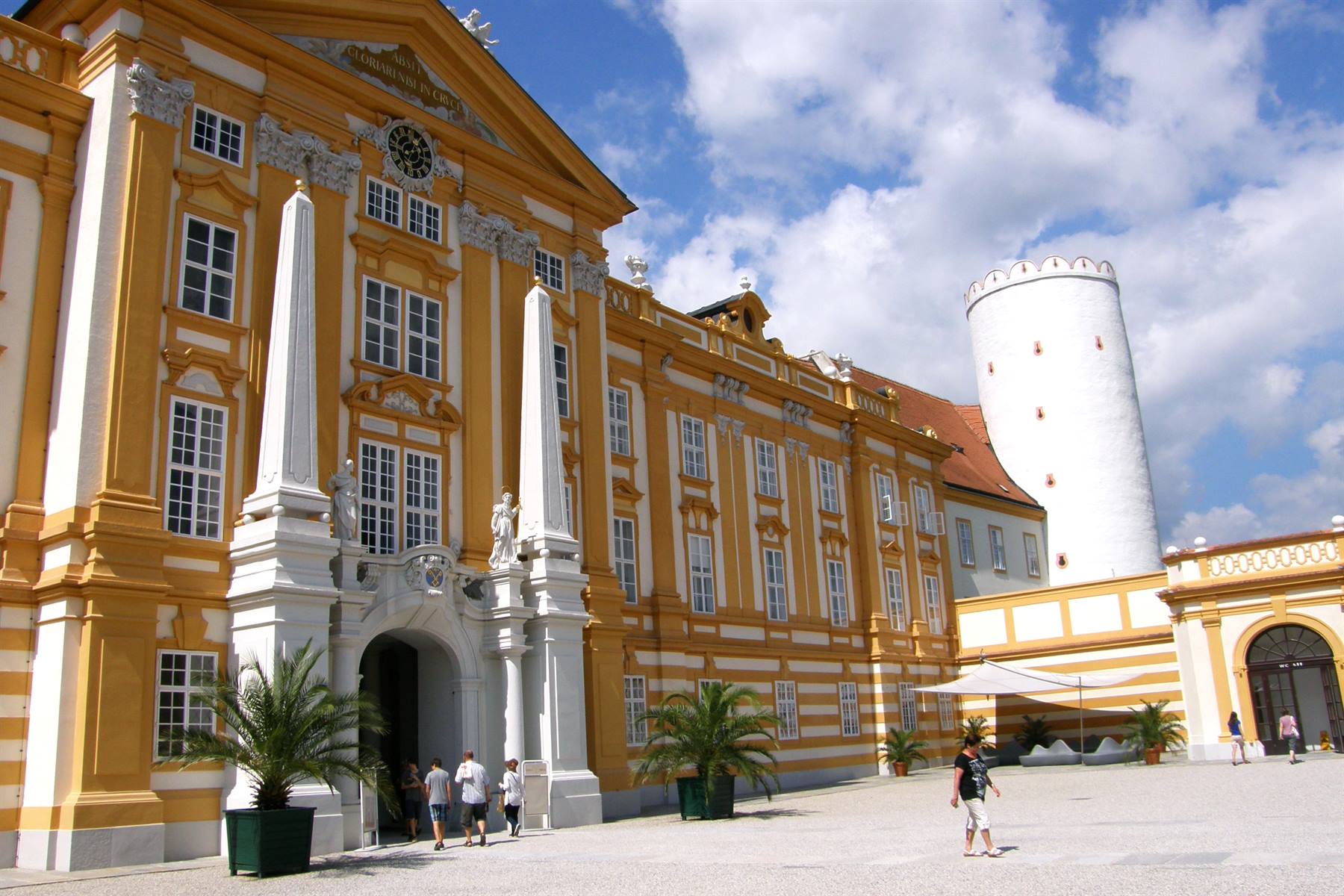
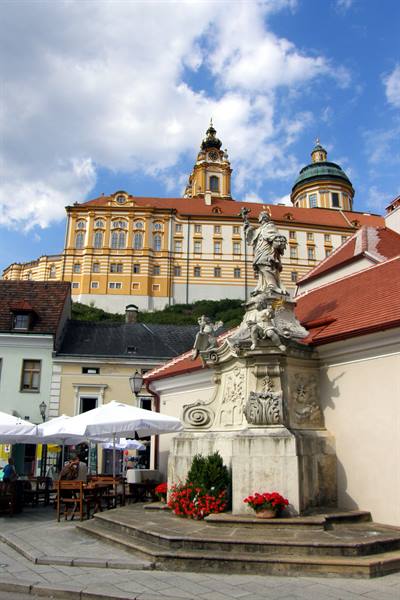
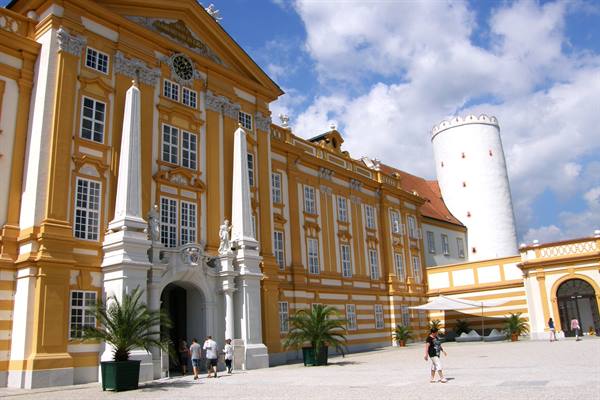
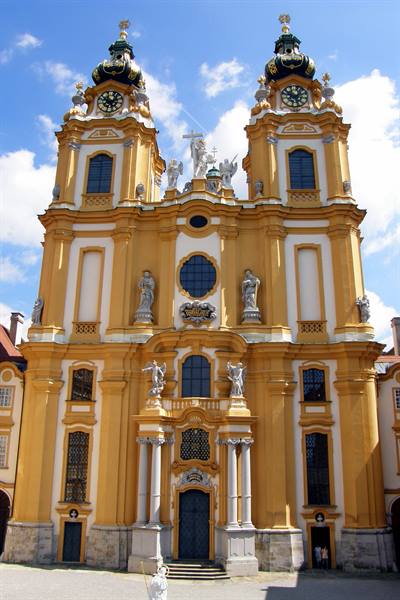
Already arriving from afar one notices the imposing bulk of the religious complex, born as a fortress in the tenth century and transformed into an abbey by the Benedictines in 1089. After alternating fortunes, of splendor and decline, it was rebuilt in its current forms at the beginning of the eighteenth century by the Austrian architect Jakob Prandtauer, and still today it makes a fine show of itself on a rocky spur sixty meters above the course of the river, dominating the town below. We park the camper and immediately dedicate ourselves to exploring the site, passing through its sumptuous main entrance. We cross a few courtyards and, after buying the ticket, begin the actual visit, which fortunately is completely self-guided.
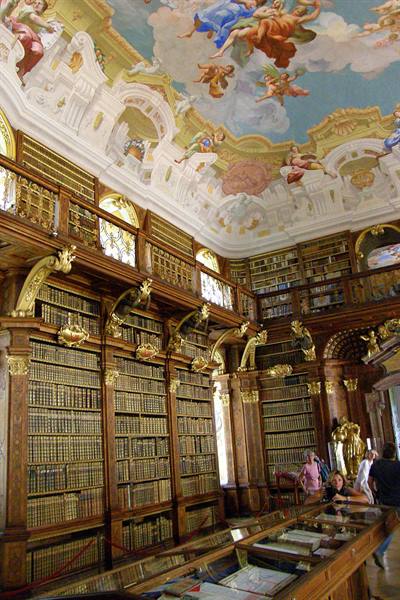
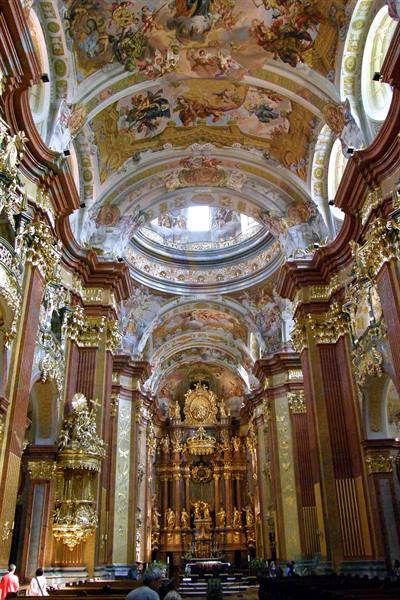
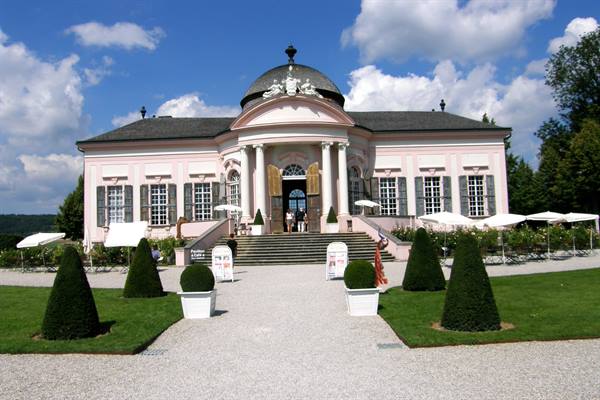
First of all we observe the rich imperial apartments, which culminate in the lavish Marmorsaal, with its fine perspective frescoes, then from there we access a terrace that offers beautiful views of the main facade of the church, the true heart of the abbey, and of the town of Melk, then we go back inside to see the important library, on whose gilded shelves are lined up about 90,000 volumes, among which are several precious manuscripts. By means of a narrow spiral staircase we finally access the interior of the beautiful church, whose architectural design is the fruit of the imagination of the Bolognese artist Antonio Beduzzi, rich in Baroque decorations that culminate in the wonderful high altar. On leaving the abbey we also devote some time to the adjacent park, recently restored, with its beautiful Baroque pavilion dating back to the eighteenth century.
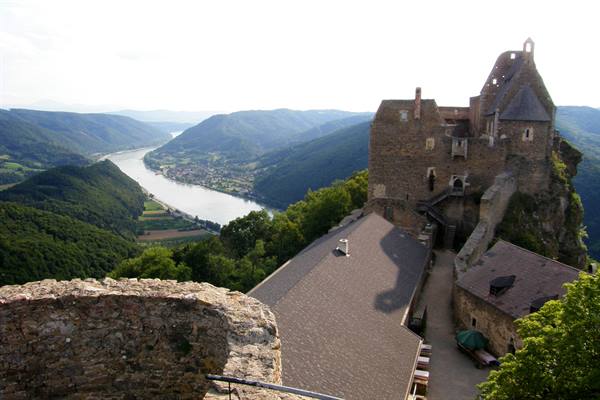
In the afternoon, after lunch and Leo's usual nap, we get a taste of the Wachau, a region corresponding to a stretch of the Danube, which here flows between gentle hills, included, for its landscape and cultural qualities, in the UNESCO World Heritage list since the year 2000. We follow the right bank of the great river for about ten kilometers and then climb up into the hills until we reach the ruins of Aggstein castle. The manor, dating back to the thirteenth century, rises in a romantic position, on a rocky spur, three hundred meters above the course of the Danube, and offers spectacular views over the entire valley below... A shame only about the too many clouds that have accumulated in the afternoon and the not exactly favorable light.
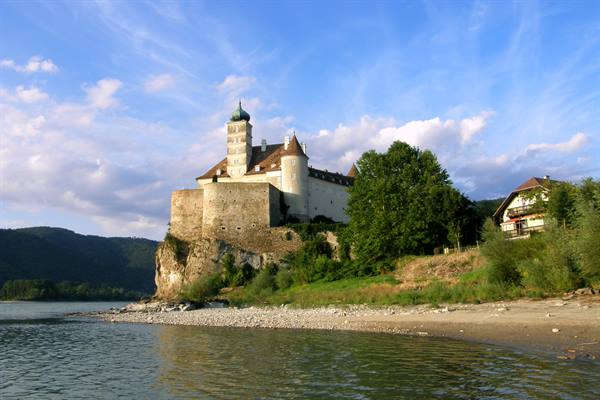
We spend some time scampering among the ancient walls and the dizzying patrol walkways, making the youngest one happy, and then, now in the evening, we return toward Melk in order to find a place to spend the night. So we stop in the village of Schönbühel, at a campsite on the banks of the Danube, right next to the scenic Schloss Schönbühel, stretching its picturesque bulk toward the placid waters that slowly flow at its feet, and there, in divine peace, we enjoy the place and conclude another splendid day.
Dürnstein
Day 818 Aug 2012
Waking up is beautiful, immersed in nature and its muffled silence, on the banks of the great river... the Danube, which with its 2,902 kilometers is the second-longest watercourse in Europe and which, crossing ten states, can boast of touching as many as four capitals! We carry out a few routine tasks and then set off to discover the Wachau, the Danube region par excellence. We cross the river near Melk and begin to follow its left bank, among gentle hills planted with vines. Without haste we pass the town of Spitz and approach, at the end of a great bend, the interesting village of Dürnstein.
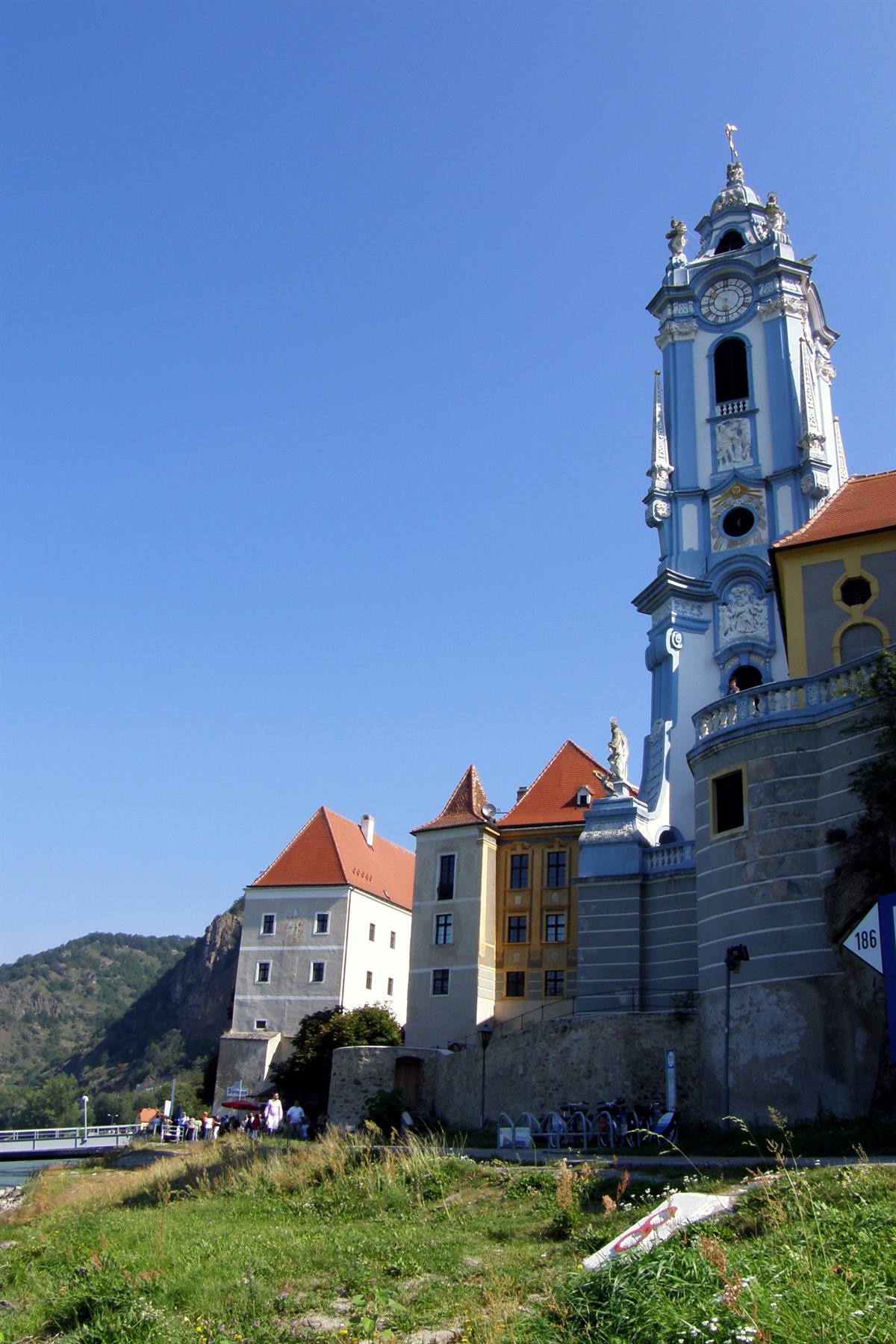
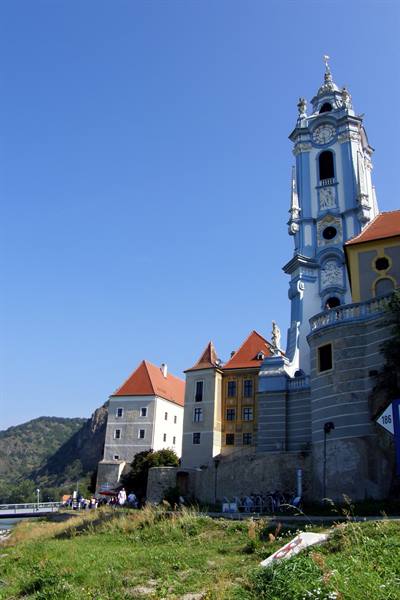
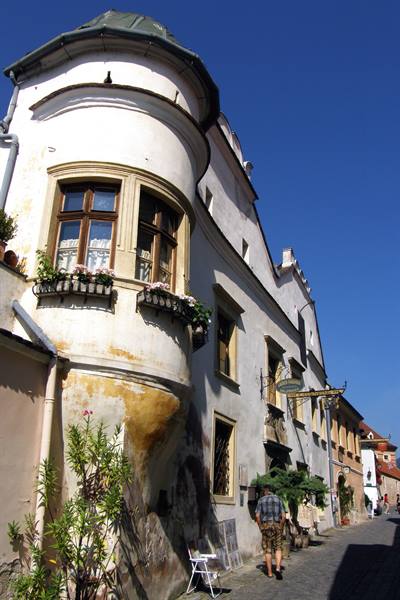
Of medieval origin, the settlement of Dürnstein is overlooked by the ruins of the ancient castle, in which the King of England Richard the Lionheart was also imprisoned, and is characterized by the white-blue bulk of the Stiftkirche Mariae Himmelfahrt, a former Benedictine abbey founded in 1410 and transformed into the Baroque style in the eighteenth century. We park the camper on the banks of the river and treat ourselves to a quick visit of the historic center of Dürnstein, starting right from its main religious building, then take a walk along the Hauptstrasse, a characteristic street flanked by houses dating back to the fifteenth-seventeenth centuries, up to the balcony that offers a fine view of the Danube and its valley. Once back at our vehicle, shortly before noon we reach the town of Krems, the main settlement of the region, at the northeastern edge of the Wachau.
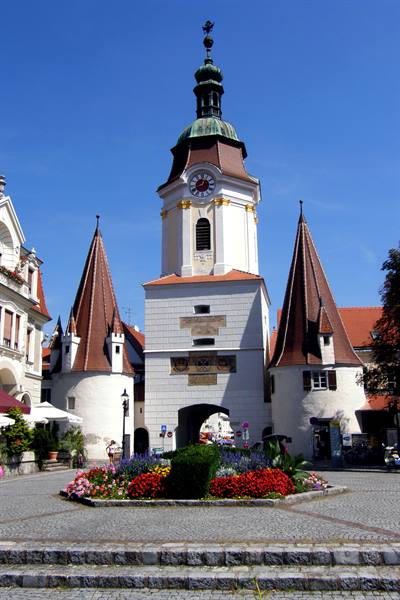
We stop at a supermarket to do a quick grocery run and then, before lunch, we dedicate ourselves to exploring the center, where the beautiful Steiner Tor stands out for its originality, a gate dating back to 1480, flanked by two round towers with conical roofs and topped by a Baroque bell tower. Also interesting is the Hoher Markt square, where the Gozzoburg stands out, a Gothic building constructed in the thirteenth century... but for the rest it's all nice, but nothing thrilling... In fact, in conclusion, in our opinion the whole Wachau is beautiful, but not very beautiful, and perhaps it fell a bit short of expectations. In the afternoon we leave the course of the Danube and, skirting the city of St. Polten, we move, into the region immediately south of Vienna, to the village of Heiligenkreuz, to visit the great Cistercian abbey of the same name.
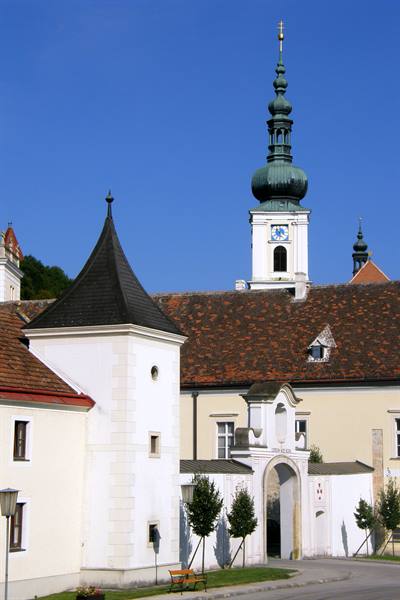
Founded in 1135 by Duke Leopold III of Babenberg, known as the Saint, and transformed into the Baroque style in the eighteenth century, the religious complex stands out for its beautiful courtyard dominated by a large Trinity column and for the severe Romanesque church with its interesting choir, considered a masterpiece of Austrian Gothic. At this point, having left Heiligenkreuz abbey, the visits planned for today would be over, but it's still early, so, also to pass the time, we lengthen the itinerary by passing through the nearby town of Baden Baden, the country's main spa center, founded, would you believe, by the ancient Romans (Aquae Pannonicae), which was a vacation spot for the Habsburg court and which still today attracts the wealthy Austrian bourgeoisie, judging by the numerous villas scattered throughout its urban fabric.
For the evening we move another handful of kilometers, until we reach the village of Laxenburg, from where we'll begin tomorrow morning's visits. Once there, however, we don't encounter other campers, nor do we find the campsite indicated on the road map, so we settle ourselves, all alone, on a quiet street in the center, and console ourselves with a fine sequence of fireworks coming from the nearby Schlosspark... So later we go to sleep, putting an end to a day that probably won't remain in the hit parade of our memories.
Franzensburg
Day 919 Aug 2012
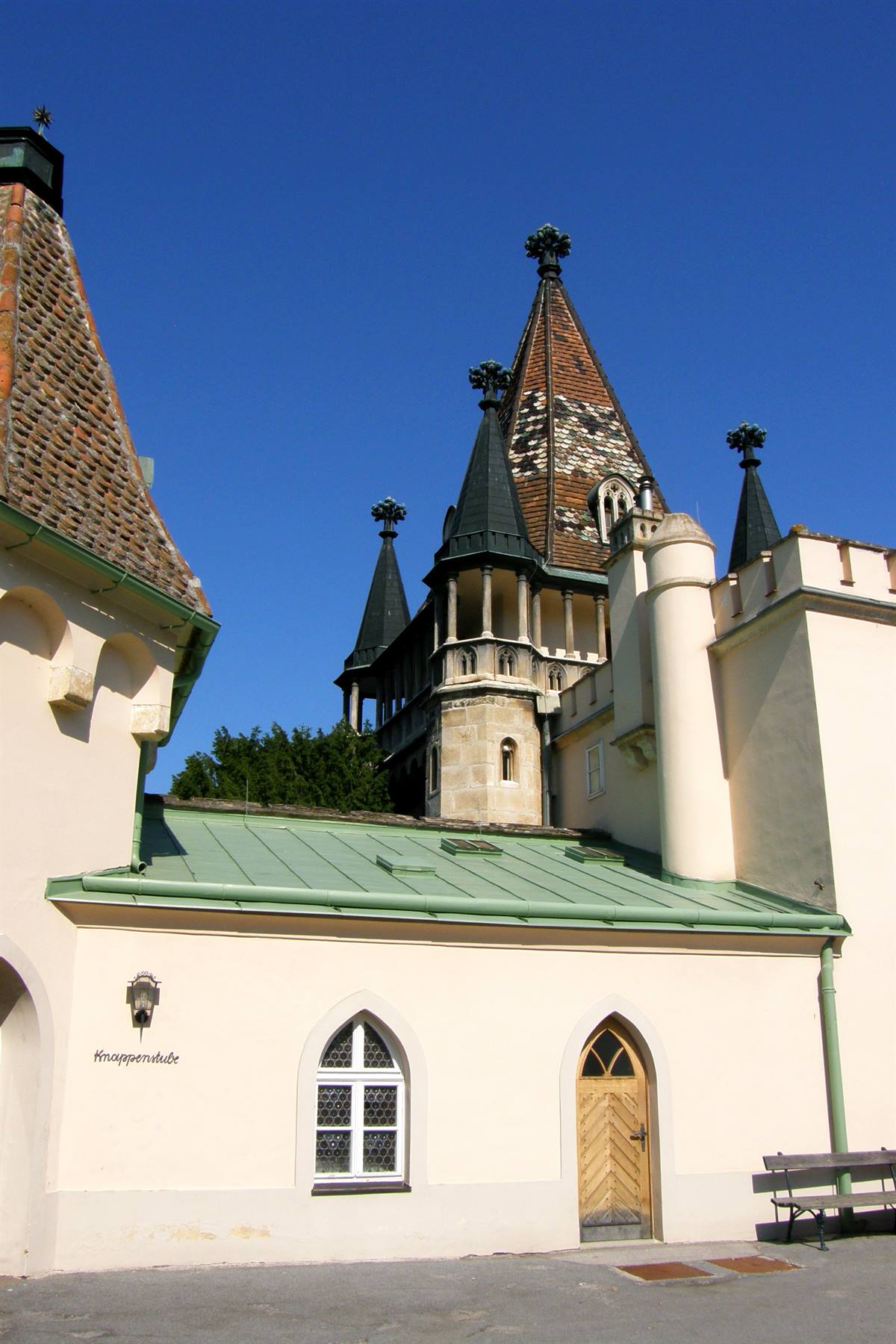
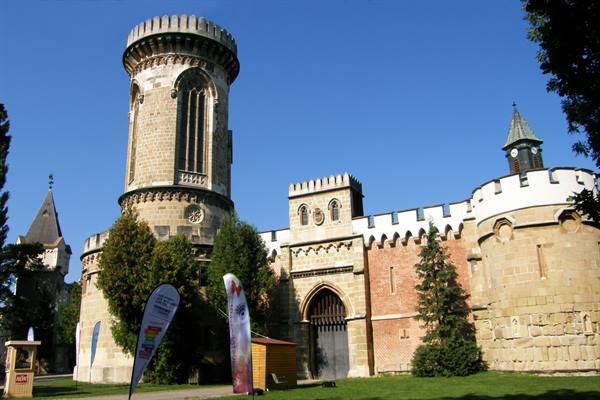
After a quiet night in the center of Laxenburg, shortly after 9:00 we prepare to visit its park (the Schlosspark) and its castle, or rather, its castles, because there are three of them... At the entrance to the site, facing the beautiful parish church, is the Blazer Hof, an architectural complex erected at the beginning of the eighteenth century under Maria Theresa. A little past the gate, on the right, is the sober Altes Schloss, of fourteenth-century origins and redone at the end of the seventeenth century. Then, crossing a good part of the vast estate, among centuries-old trees and neoclassical tempietti, we reach, on the shores of a lake, in view of the Franzensburg, a beautiful manor built in Romantic style, on a small island, at the beginning of the nineteenth century.
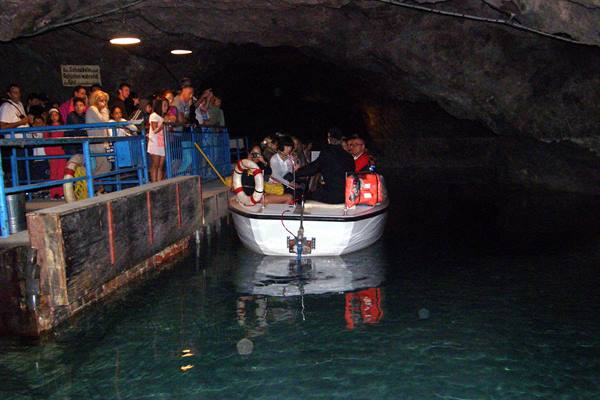
The Schlosspark of Laxenburg is very popular with the Viennese, who often come here to spend their weekends in search of tranquility, and we too spend a pleasant couple of hours, between architecture and nature... an experience that was, all things considered, positive, given and considered that it had been included in the itinerary more than anything as a filler on the approach to the capital. After calmly returning to the camper, we move, just a few kilometers, to the town of Mödling, on whose outskirts, in the locality of Hinterbrühl, we go to see the curious Seegrotte. A former gypsum mine encloses a truly particular tourist attraction: the largest underground lake in Europe (the Baluer See), located at a depth of sixty meters and with an extension of 6,200 square meters. In 1912 an explosion, during the works, poured twenty million liters of water into the tunnels and shafts.
Following this catastrophe the mine had to close and remained abandoned until the thirties, when a group of speleologists decided to make this original spectacle visible to the public. During the Second World War the lake was drained and the underground spaces were used by the Heinkel company for the manufacture of aircraft (about two thousand workers worked there, many of whom came from concentration camps). At the end of the war the facilities were blown up and the water reclaimed the tunnels... Subsequently, thanks to a skillful reconstruction, the Seegrotte was reopened to the public. We enter the old mine through a narrow tunnel and inside we find only nine degrees.
We follow the route that the carts full of ore once traveled, then descend one level until we reach the tunnels invaded by water, in which some scenes from the film "The Three Musketeers," produced by Walt Disney, were also shot. Finally we get on a small boat that takes us on a short tour of the crystal-clear waters of the underground lake, and then we return to the surface and its warm mildness. The original adventure lasted almost two hours, which especially amused the youngest one, but which ultimately fully met our expectations as well. We have lunch in the Seegrotte parking lot and as soon as possible we get back on the road. We approach the Viennese hinterland from the south and, on the highway, cross several peripheral districts, then we cross over the Danube and follow its course, until we reach the northernmost suburbs.
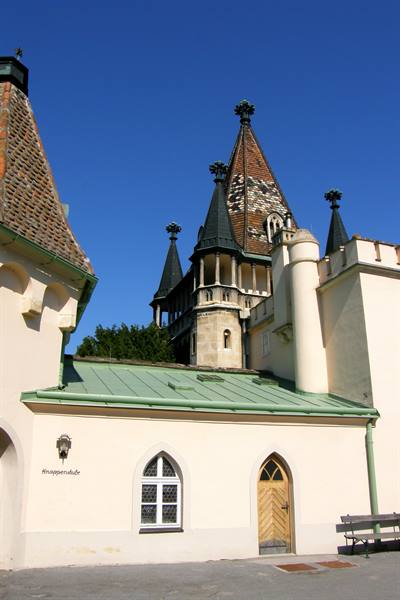
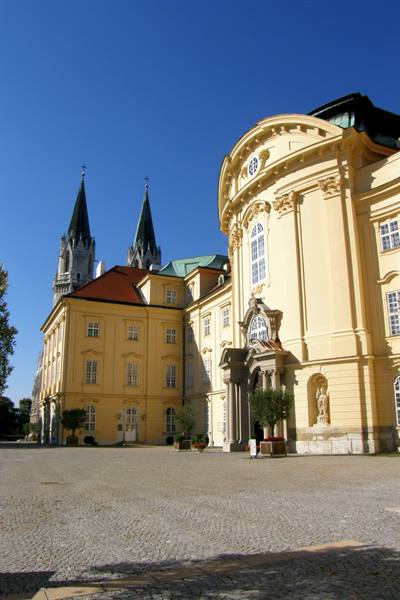
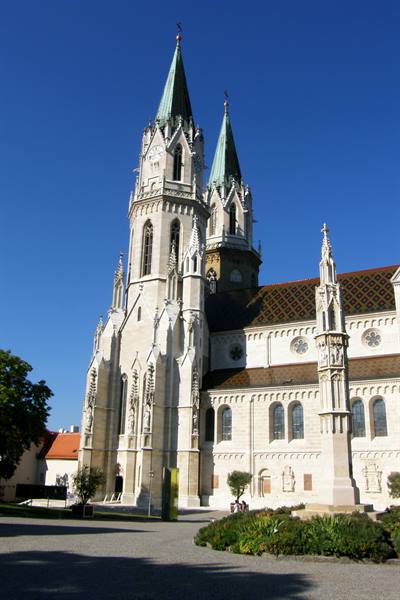
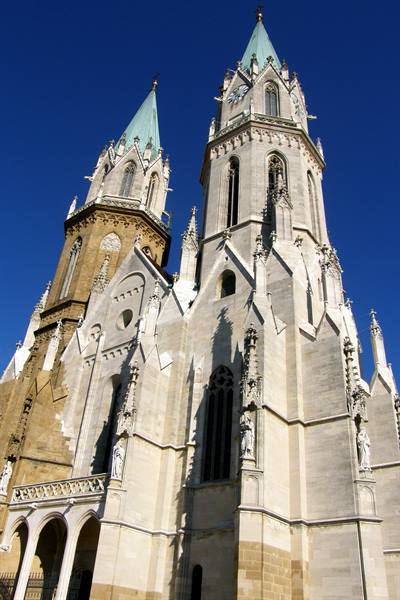
That's how we arrive, in mid-afternoon, in the locality of Klosterneuburg to go see its great Augustinian abbey. Yet another masterpiece of Austrian Baroque, the religious complex was founded by the monastic order of the same name in 1114, at the behest of Leopold III (the same one from Heiligenkreuz) and then renovated in the eighteenth century by Emperor Charles VI, who wanted it to be a new Escorial... but the monarch succeeded only to a minimal extent in his intent. Among the abbey buildings the Stiftkirche Mariae Geburt stands out, a church of Romanesque origins, with a stupendous neo-Gothic facade and interiors rich in Baroque decorations...
We would then like to explore the complex in greater detail, but given the presence of Leo "little pest" and the possibility of doing it exclusively with a guided tour, we desist from the intent, so once back at the camper we set off, nevertheless satisfied, toward the end of today's stage. From Klosterneuburg we don't head toward the center of Vienna, but we venture, with the help of the satellite navigator, into the hills immediately west of the capital, among improbable bucolic landscapes, and arrive in the late afternoon at Camping Wien West, which will host us for the next three nights. The sensation is strange: it doesn't feel at all like being on the outskirts of a metropolis of nearly two million inhabitants, and only tomorrow morning, with the official start of the city visit, will we probably realize it...
for now we content ourselves with getting information about the public transport lines, then we complete the evening with a pleasant outdoor dinner.
Schönbrunn
Day 1020 Aug 2012
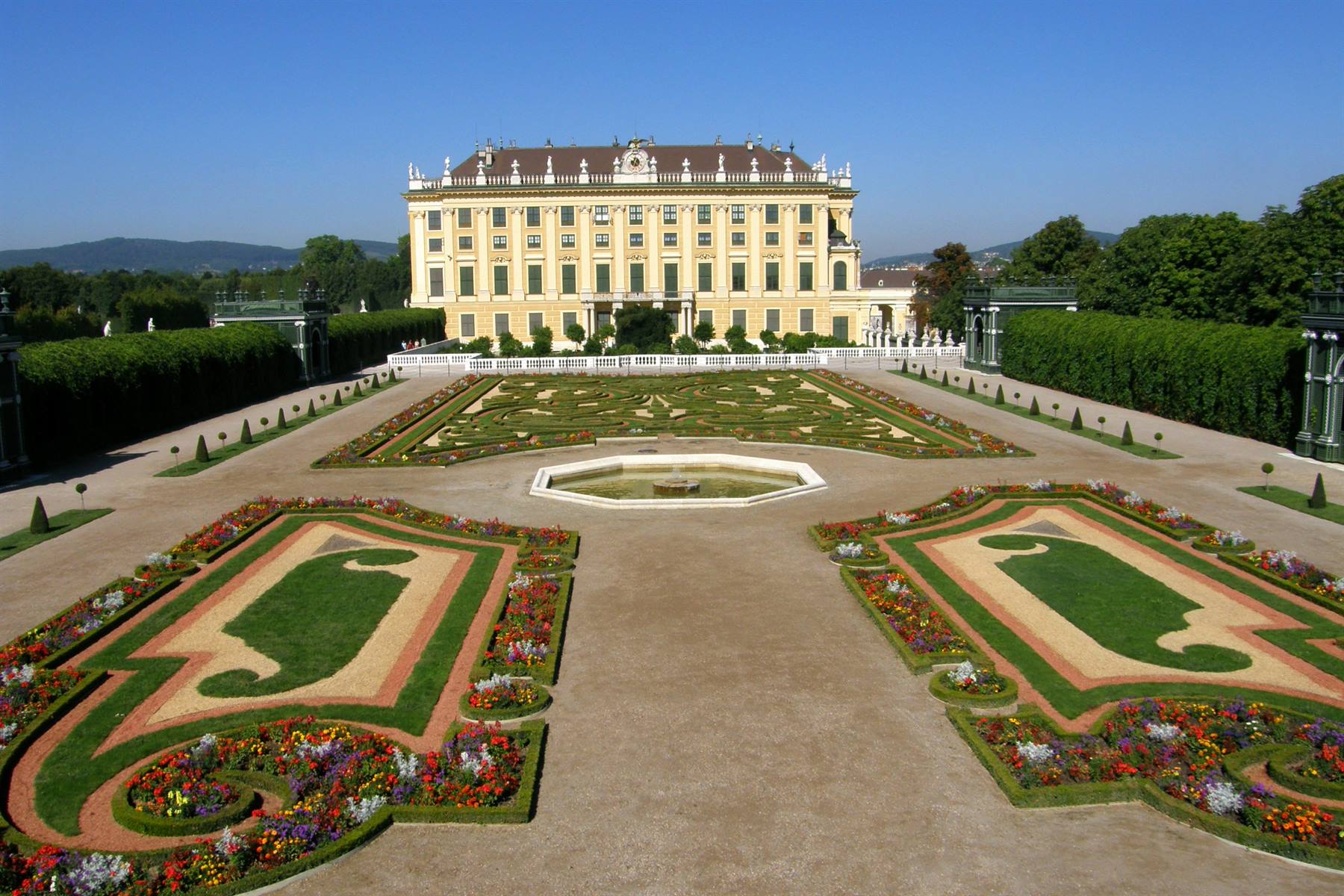
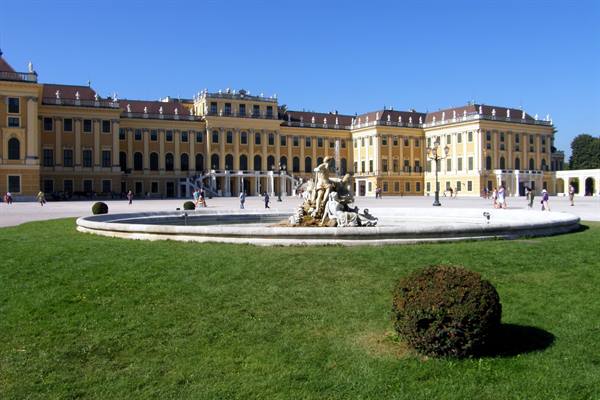
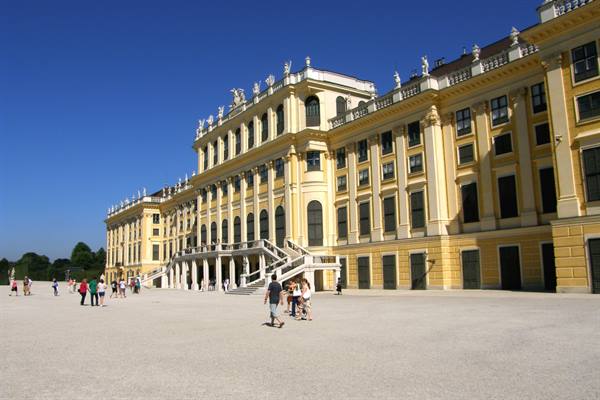
"Mission Vienna" begins... but I miss the sound of the alarm and we leave slightly late. We hurry onto the bus that will take us to the metro terminus, with Leonardo impatient to take this new (for him) means of transport, which evidently particularly tickles his imagination. Indeed, the little one's enthusiasm is sky-high and when we arrive at the Schönbrunn station he wouldn't want to get off, but we can't avoid it because it's precisely from there that we'll begin our visit to the Austrian capital. The most famous of the Habsburg imperial palaces is located, surrounded by a vast park, in a fairly peripheral area, once completely outside the urban boundaries of Vienna.
Born as a simple hunting lodge, it was purchased in 1559 by the future emperor Maximilian II and transformed into a palace between the seventeenth and eighteenth centuries by his successors, taking the palace of Versailles as a model. Its current Rococo appearance and the yellow coloring of the facades date back to the mid-eighteenth century, while the name derives from a spring discovered nearby (the Schönen Brunner), and finally the entire complex has been protected as a UNESCO World Heritage Site since 1996. We pass through the main entrance that leads into the Ehrenhof, the vast courtyard of honor, and there we line up at the ticket office along with hordes of Japanese, eager to get their fill of European culture... but we're no different, because we buy the Golden Pass, which will allow us to see everything possible within the boundaries of the palace.
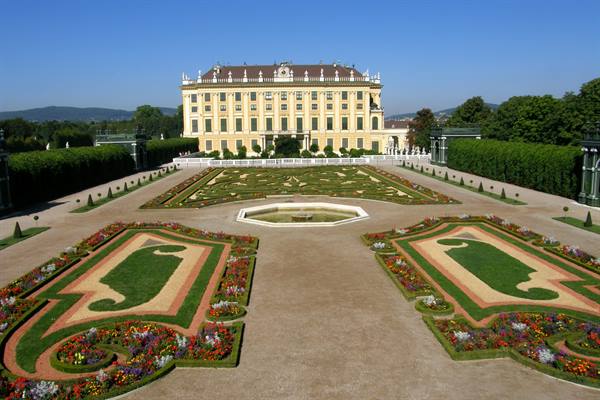
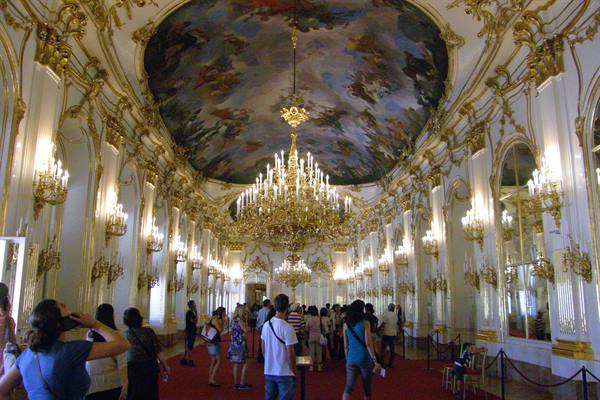
First of all we dedicate ourselves to exploring the imperial apartments of Maria Theresa and Franz Joseph: a beautiful sequence of richly decorated and furnished rooms, among which the Grosse Galerie stands out, a ceremonial hall of imposing dimensions (43 meters long) and with lavish Rococo-style ornaments... but we have to do it all a bit in a hurry and without the audio guide so as not to excessively bore the little one, who, as is only natural, still doesn't understand certain things. The palace interior truly amazed us, but it's especially when we set foot in the vast gardens that we remain stunned by the grandeur of the complex, which extends amid water features and flower beds up to the Gloriette hill (with its neoclassical portico), creating truly fairy-tale vistas.
Included in the ticket price is also the so-called Crown Prince's Garden, a small and graceful flowered park facing the east wing of the palace, so named around 1870 when the apartments of the then Prince Rudolf were set up in the adjacent rooms. We then enter the hall of the former winter riding school, where the interesting Carriage Museum is located, which includes carriages from the eighteenth-nineteenth centuries, belonging for the most part to members of the royal family, among which the imperial coach stands out: a large Rococo carriage from the mid-eighteenth century, weighing more than four tons and pulled by eight horses, used for coronations (here too, as in the apartments, you can't take photographs, not even without a flash... who knows why?).
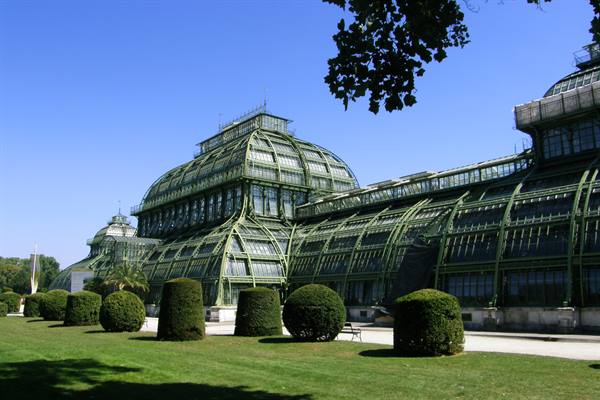
Back in the park, we stroll along the entire Blumenparterre, that is, the part of the garden with geometric flower beds that reaches as far as the Neptune Fountain, at the foot of the Gloriette hill, and nearby we also go to see the curious and vast Maze, rebuilt on the original eighteenth-century model... There beside it we then find a small children's park where Leonardo would (rightly) like to stop, but time is a tyrant and after a while we have to literally tear him away from the games. From the Maze we move toward the western part of the Schönbrunn park, where the intriguing Palmenhaus is located, a grandiose greenhouse in metal carpentry from the late nineteenth century, divided inside into three climatic zones, with beautiful botanical species on display.
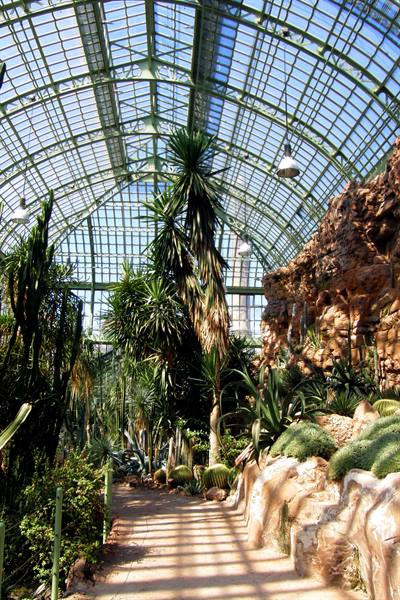
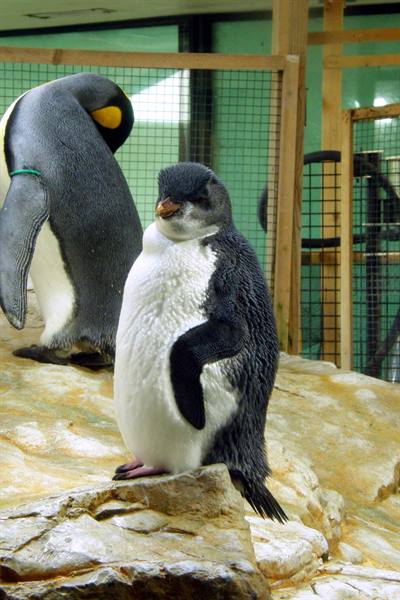
Beside it we also see the Wüstenhaus, another greenhouse inside which an interesting "Desert Garden" has been created, with various kinds of cacti and other plants resistant to arid climates, from all over the world. Almost at noon we finally enter, to Leonardo's immense joy, the great Vienna Zoo (included in the Golden Pass price), the oldest existing in Europe, created in 1752 by Francis of Lorraine, husband of Empress Maria Theresa... Here we see, in practice, all the most important species of the animal kingdom, all while it has become infernally hot, which we would never have expected to have to endure in Austria! To be safe we have the little one eat a gelato and then continue the visit... besides, the adrenaline seems to have made him forget his sleepiness.
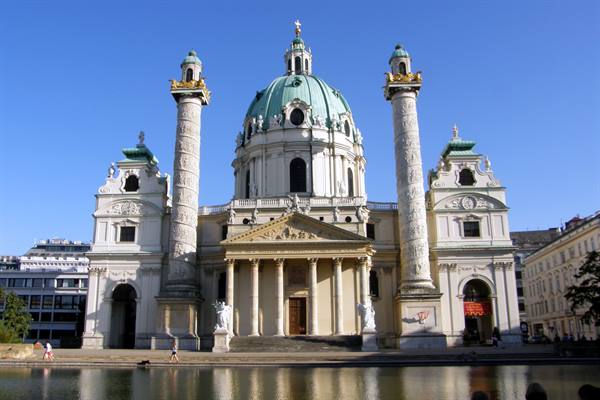
In this way we leave the zoo around 14:00, to head immediately toward the nearest metro station and arrive at Camping Wien West shortly before 15:00. We have lunch and Leonardo heads straight to bed, but it's not over, because shortly after 17:00 we're all back in action. We take the bus again and then the metro to the Karlsplatz station, almost in the center, and once above ground we go to see the nearby, beautiful Karlskirche, a masterpiece of Viennese Baroque, dedicated to Saint Charles Borromeo... The church was designed by J.B. Fischer von Erlach the Elder and commissioned, at the beginning of the eighteenth century, by Emperor Charles VI to fulfill a vow made during a plague.
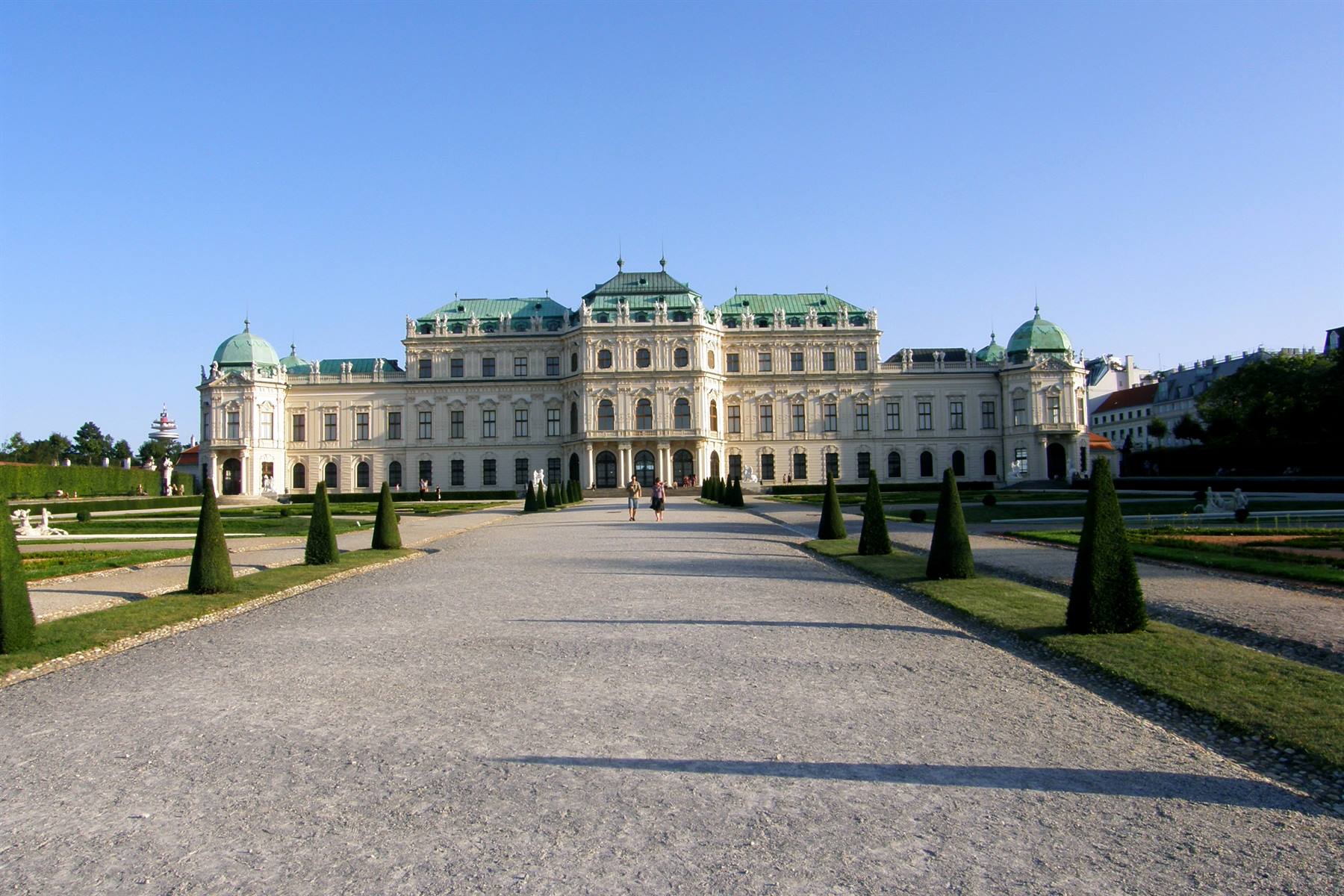
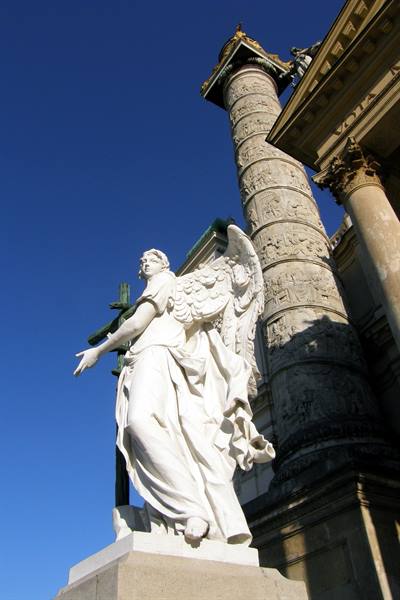
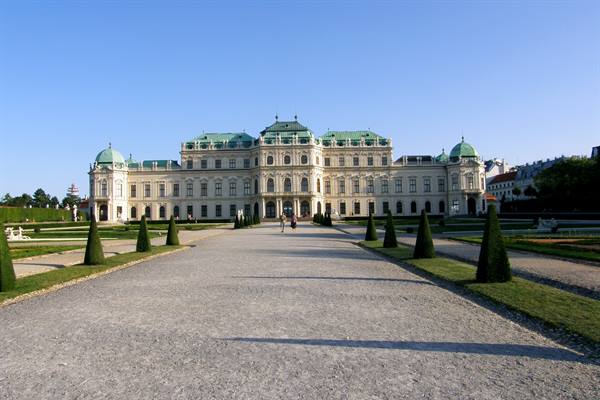
The facade is characterized by two tall columns decorated in a spiral with fine reliefs, while inside, which we visit for free given the late hour, the grandiose dome stands out, making the space particularly luminous. After the Karlskirche, passing through the vast and monumental Schwarzenbergplatz, we reach on foot the famous Belvedere palace. Counted among the most beautiful and elegant princely residences in Europe, it consists of two opposing buildings, interspersed with a large French-style garden sloping down the hill, and was erected at the beginning of the eighteenth century at the behest of Prince Eugene of Savoy, as a summer residence.
We access it from the so-called Lower Belvedere (the palace at the bottom) and, strolling through all the gardens, we come before the Upper Belvedere, the most monumental building, which was also the residence of Archduke Franz Ferdinand, the crown prince assassinated in Sarajevo. After leaving the Belvedere gardens we calmly return to Karlsplatz and stop to let Leonardo have some fun in a small playground, while Federico plays a little game of basketball in an adjacent playground, together with three Austrian boys who recruited him in no time, then we board the public transport that takes us back, now in the evening, to Camping Wien West... We have dinner as darkness falls and conclude very positively the first day of visits to the Austrian capital.
Vienna - Belvedere
Day 1121 Aug 2012
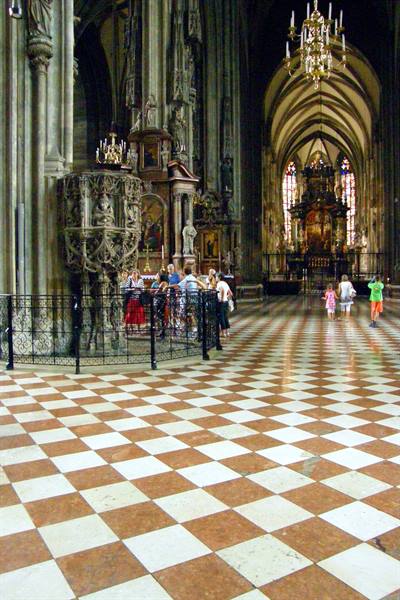
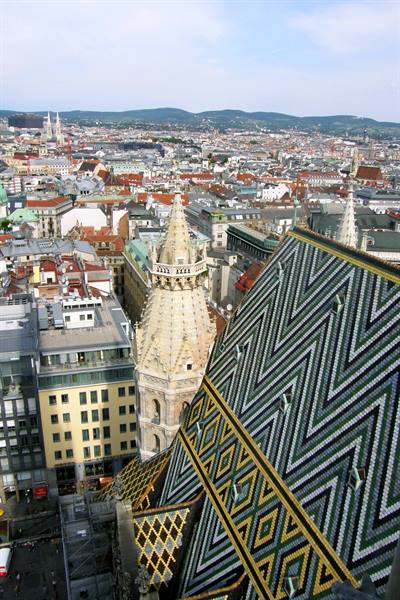
It's the second and last day dedicated to Vienna and unlike yesterday the sky is completely covered with clouds, but let's not despair because it shouldn't get any worse. Bright and early we set off by bus toward the metro terminus and thanks to the latter we then approach the historic center of the capital. We get off at the Karlsplatz station and from there, on foot, we head toward the heart of the city because Line 1 is closed for works. In this way, following the pedestrian Kärntner Strasse, we come before the imposing Stephansdom. St. Stephen's Cathedral, one of the most important examples of Gothic architecture in Europe, is the undisputed symbol of Vienna. Its foundation dates back to the twelfth century, but it was rebuilt over the course of nearly two hundred years starting from 1304, then arriving almost unchanged in its appearance down to our day.
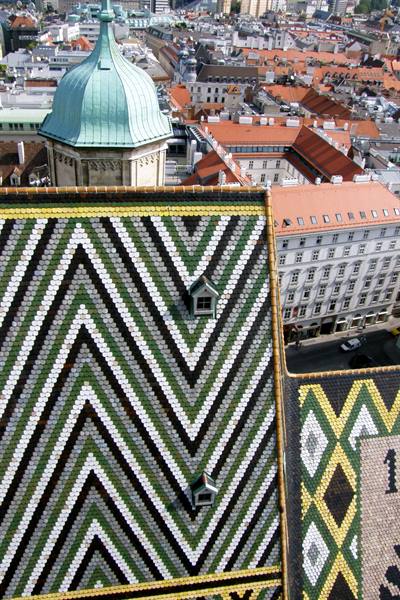
In fact, apart from a few Baroque touches and the restoration due to the damage of the Second World War, everything is still rigorously original from those times. We briefly visit the soaring interiors, on clustered pillars, and then, back outside, we climb (not without effort) the 340 steep steps that lead to the top of the mighty south tower, called by the Viennese Steffl (little Stefan), from whose summit, at 136 meters above the ground, one enjoys a beautiful view of the city and of the original roofing of the cathedral, in polychrome glazed tiles assembled to form fanciful geometric patterns. Having left behind Vienna's most important religious building, we walk along the streets of the historic center for a roundup of the most significant squares and buildings, while the sun, unfortunately, is nowhere to be found.
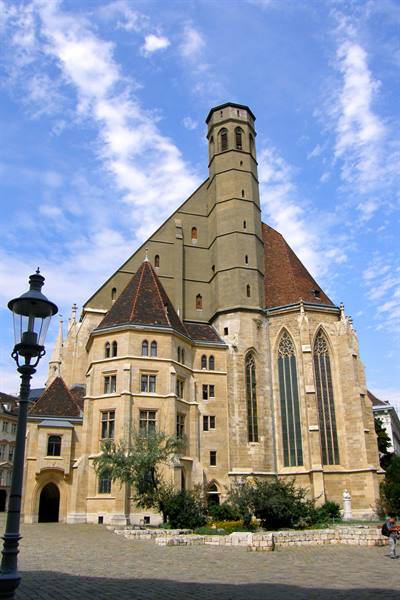
We walk along the Graben, the city's main commercial artery, onto which the Baroque facade of the Peterskirche faces from a side street, then passing through Judenplatz and the severe building of the Böhmische Hofkanzlei, seat of the Constitutional Court, we arrive at the church of Maria am Gestade, a fine Gothic building with a beautiful bell tower and interesting polychrome stained-glass windows. The sky momentarily opens up and a few timid rays of sun come out, while we stroll along the attractive and irregular Freyung square and also a little later before the Gothic Minoritenkirche, the most important religious building in the capital after St. Stephen's Cathedral.
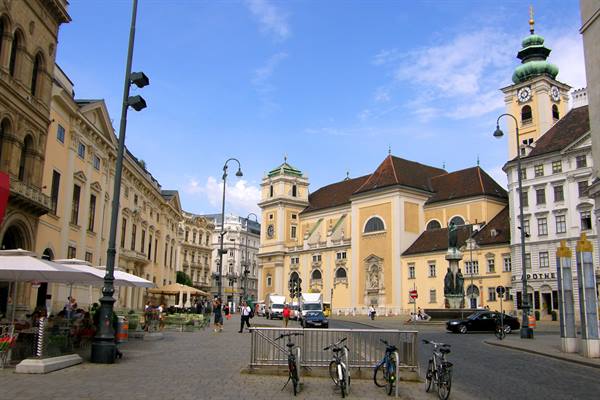
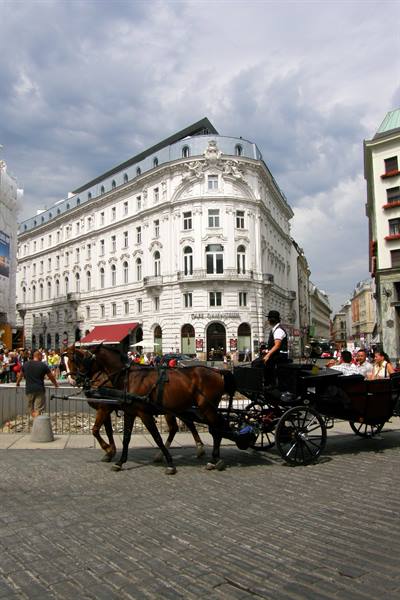
Step by step we thus also arrive at Michaeler Platz, a cozy square where most of the tourist carriages converge and onto which, besides the church of the same name, the imposing facade of the Hofburg faces, the imperial palace that for over six hundred years (from 1283 to 1918) was the official residence of the Habsburgs. From Michaeler Platz we enter the Hofburg, which, having been built over the course of a full six centuries, does not present a perfect architectural uniformity, but which, with its approximately 2,500 rooms, is practically a history book of the nation.
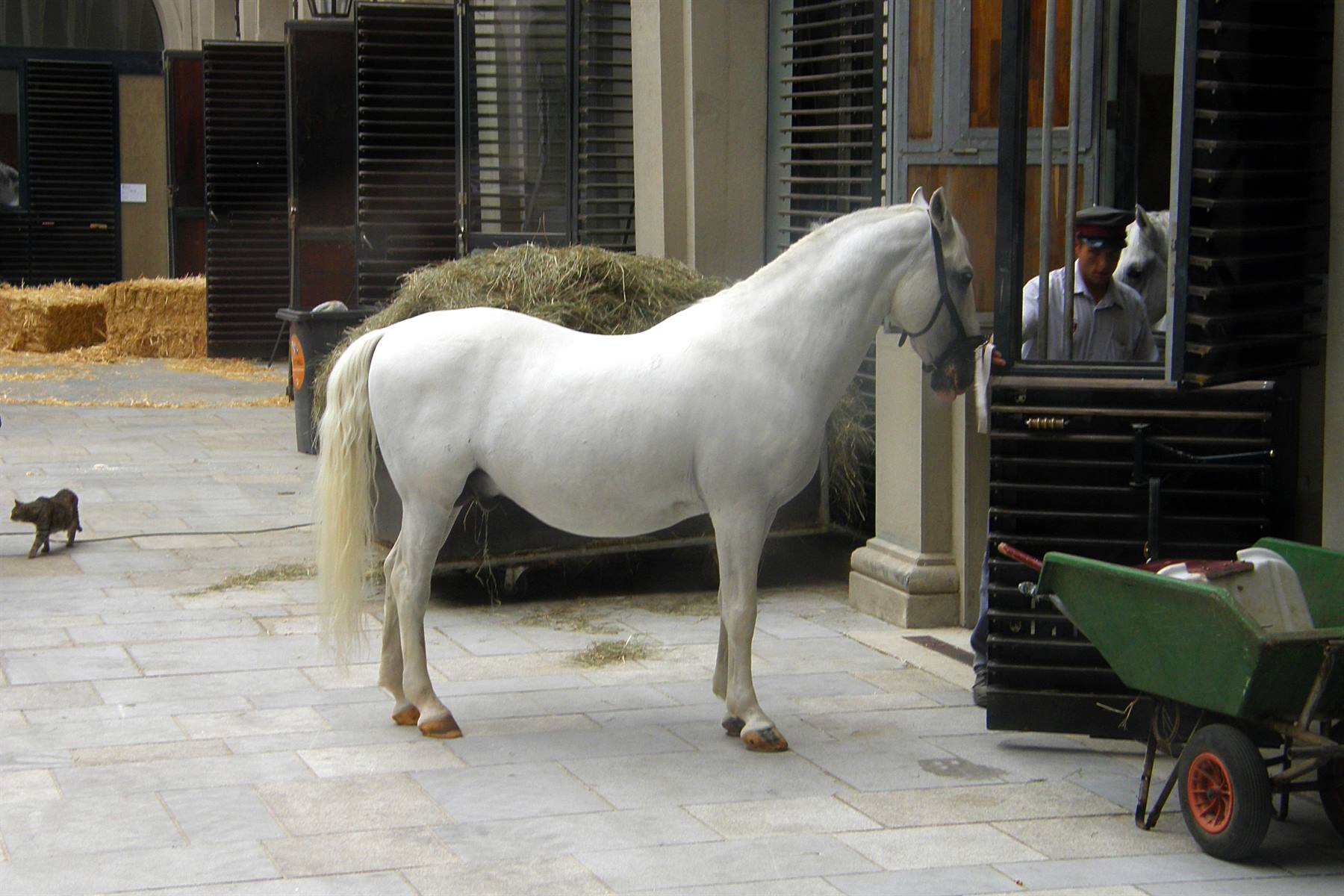
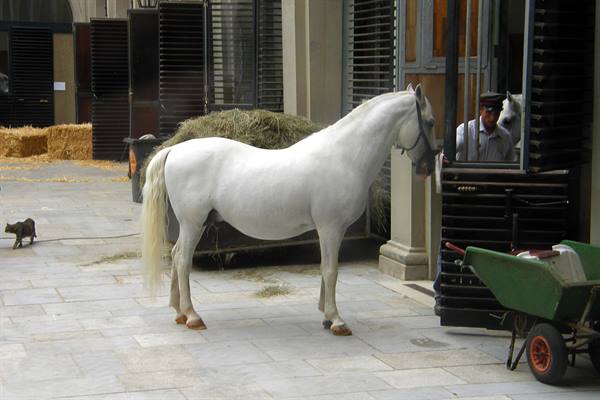
We visit a small part of it, starting from the museum of the court silver and tableware, moving on to some rooms in which the Sisi Museum has been set up, with several relics belonging to the beloved princess, and finally accessing the apartment of Franz Joseph, inhabited by the emperor until 1916, sumptuously decorated and furnished. Once back out on the street we pass in front of the court stables (the Stallburg), which house the famous Lipizzaner horses of the Spanish Riding School, just as they are coming out, in their elegant white livery, to take part in a performance, or more simply in a training session, in the winter riding hall across the way.
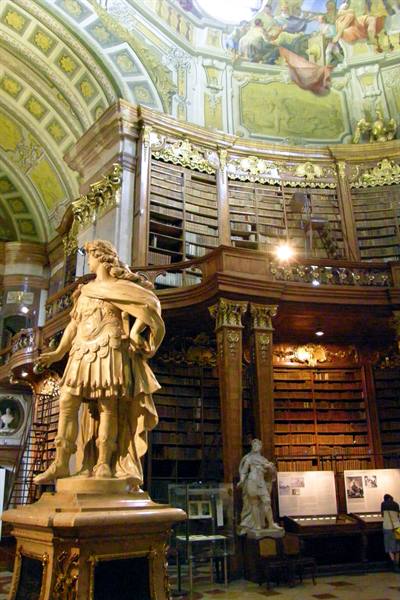
Immediately after we arrive at Josefs Platz, where the building of the Nationalbibliothek (included in the Hofburg) faces, which counts in its archives about two and a half million volumes and which we briefly explore, especially for its grandiose Prunksaal, an enormous space 74 meters by 14, 19 high, wonderfully frescoed, which alone houses about two hundred thousand volumes. At this point of the day, while noon is well past, we cross the courtyards of the Hofburg and arrive in front of its newest wing, that of the Neue Burg, which overlooks a vast square (the Helden Platz) and the Volksgarten park, but meanwhile the sky has grown even darker and the view absolutely does not do it justice.
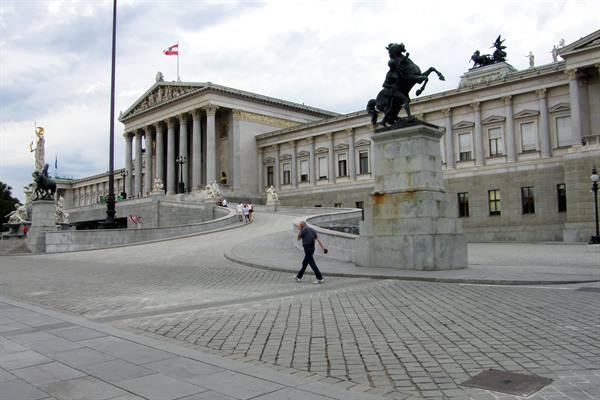
Same story for the nearby Parliament building, a scenic work by the Danish architect Theophil Hansen, who erected it at the end of the nineteenth century inspired by the temples of ancient Greece, but also for the Rathaus, from the same period and with a monumental neo-Gothic facade, the work of Friedrich von Schmidt... the latter even hidden by a giant screen, set up on the occasion of a film festival currently taking place. It's now 14:00 and Leonardo (rightly) is beginning to show the first signs of giving out, so without delay we head for the campsite, followed by a quick lunch and a well-deserved nap... At 17:00, however, we're all ready to resume "hostilities," and with new energy, since in the meantime the sky has completely cleared and, as if by magic, a magnificent sun is now shining.
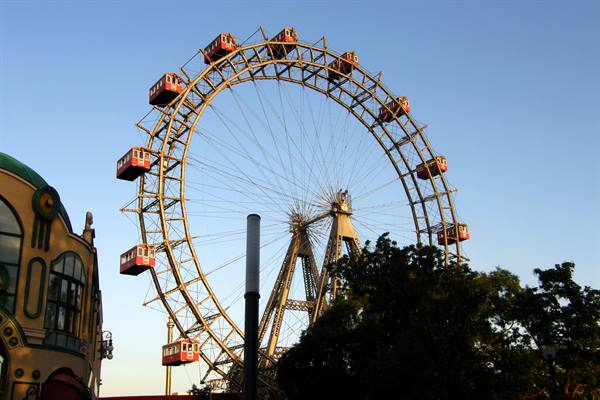
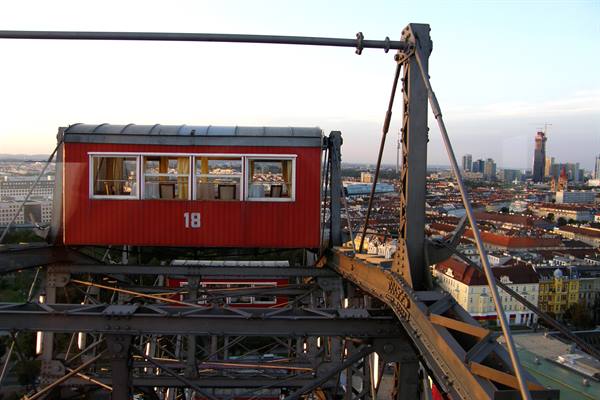
We take advantage of it to stop by the Hofburg to take a few photos, then we head swiftly toward the Prater park, once a royal hunting reserve and later opened to the public in 1766, within which is the Wurstelprater, a historic and large permanent amusement park toward which, primarily, we are headed. Shortly after 19:00 we complete the long line that gives access to the Riesenrad, the great Ferris wheel, 60.96 meters in diameter, built in 1897, which has become one of Vienna's symbols... from up there we thus enjoy a beautiful view of the city skyline, enriched by the warm colors of the sunset. For dinner we have a pizza within the boundaries of the park and then take a turn among the various attractions, trying to please everyone a little, from the youngest to the oldest, excluding Sabrina, allergic to this kind of thing.
Cooked to a turn, at the end of the games, we make our way back to the campsite, where we arrive almost at midnight, exhausted but surely fulfilled by this demanding two days in Vienna.
Vienna - Stallburg
Day 1222 Aug 2012
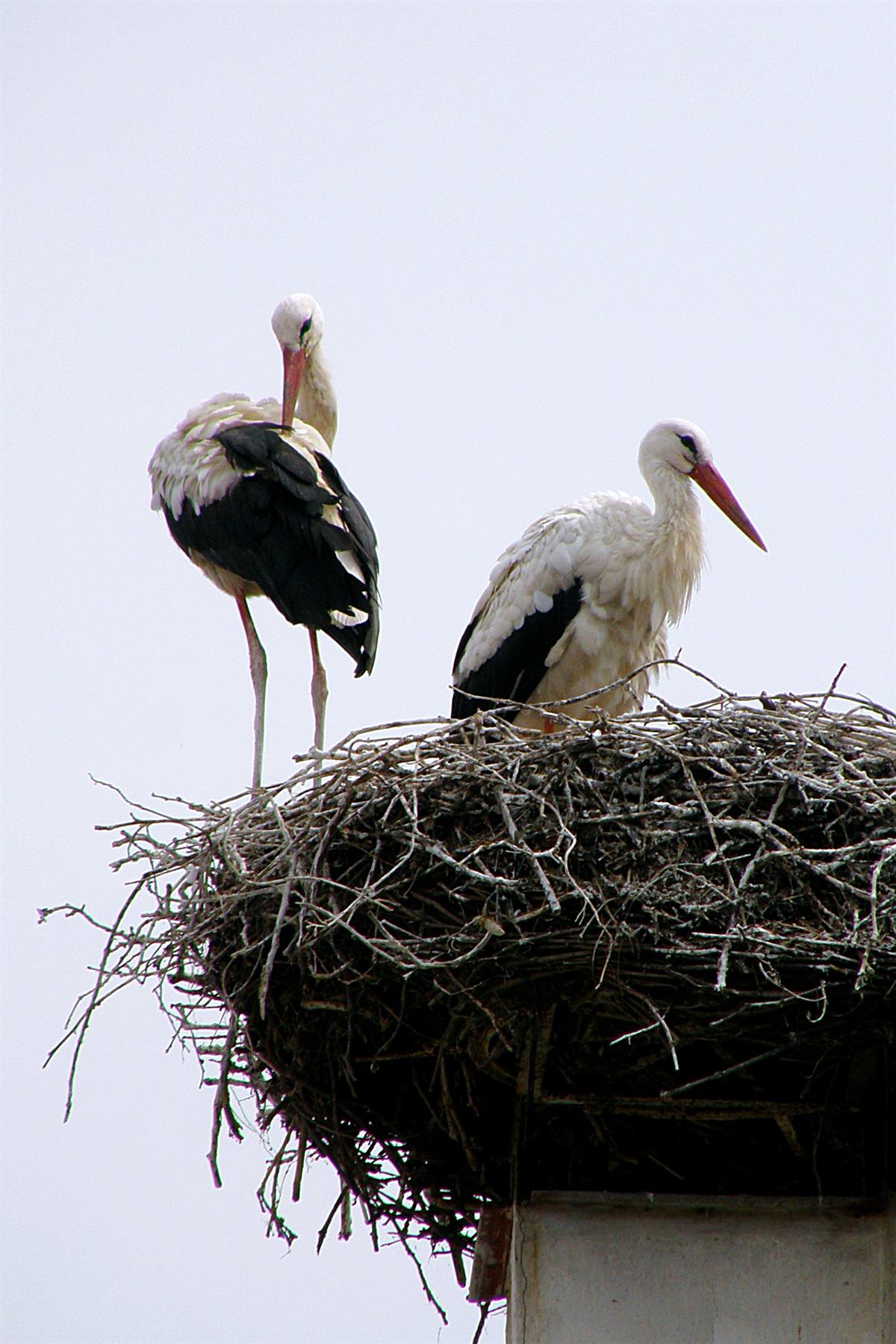
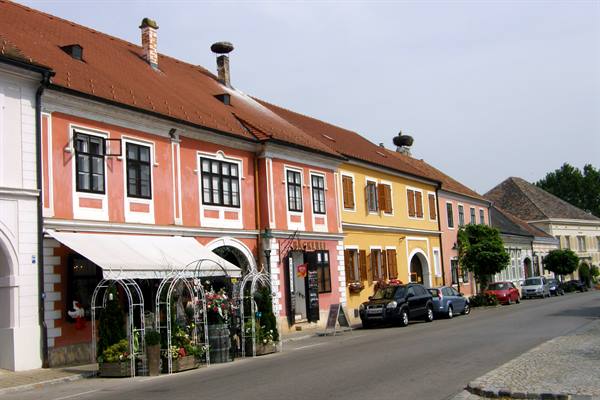
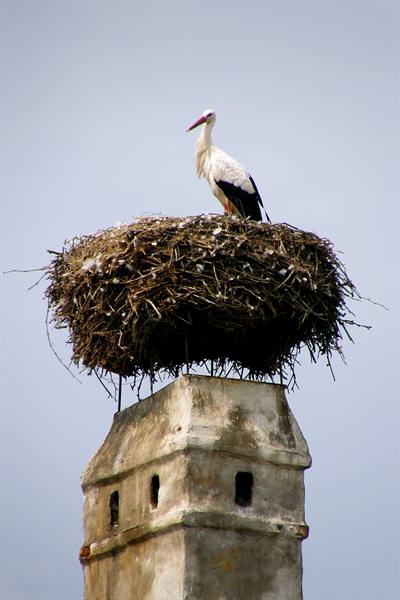
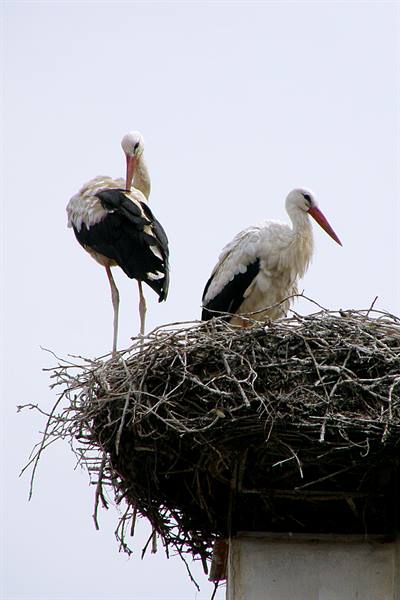
After the intensity of the visits to the capital, today will be, mainly, a transition and transfer day. Once all the service operations are completed, shortly after 9:00 we leave Camping Wien West and, following the navigator's directions, head southeast toward Burgenland, Austria's far eastern region, on the border with Hungary. After about an hour of driving we are, among bucolic landscapes, in the capital, Eisenstadt, for a quick grocery run, and a little later in the village of Rust, almost on the shores of the Neusiedler See, the largest of the Austrian lakes, though the shallowest (about two meters) and with brackish waters. Substantially, however, we have come all the way here not for the lake, but because in Rust, on the chimneys of the houses of the center, with their Magyar architecture, storks are wont to nest in this season...
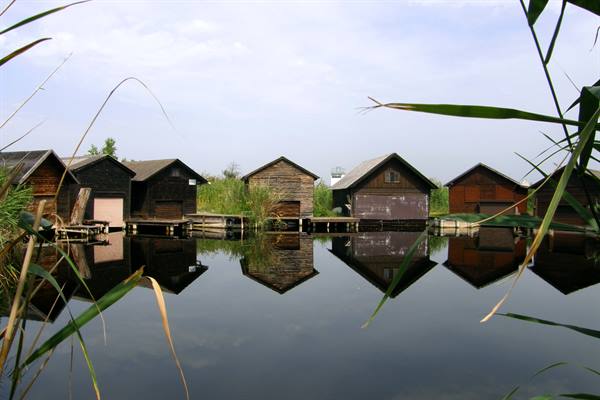
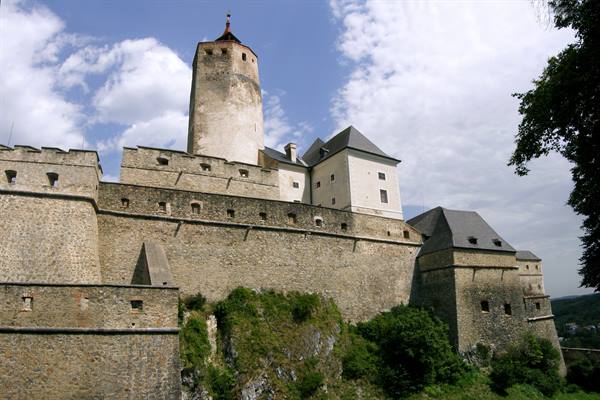
Indeed, several of these birds are present in the nests today as well, artfully prepared by the local authorities or by the inhabitants of the place themselves... after all, they are a tourist attraction and as such are treated, to all effects. We take all the most classic photos of the case and immediately after, by camper, we reach the shores of the Neusiedler See, covered with dense reeds, and finally, for lunch, we move to the first hills at Burg Forchtenstein. At 508 meters above sea level, in a dominant position over the Hungarian plain, stands this imposing manor, the most beautiful of the castles of Burgenland, built in the thirteenth century and never captured by the Turks, during their campaigns of expansion toward the heart of Europe.
We content ourselves with seeing Burg Forchtenstein only from the outside and after lunch, while the little one sleeps, we then set off to cover a substantial stretch of road (about one hundred and fifty kilometers), which will take us into the region of Styria, and more precisely to Graz, its interesting capital. The second city of Austria by population, a UNESCO World Heritage Site since 1999 and European Capital of Culture in 2003, Graz preserves important Central European historical testimonies that we intend to get to know between this afternoon and tomorrow.
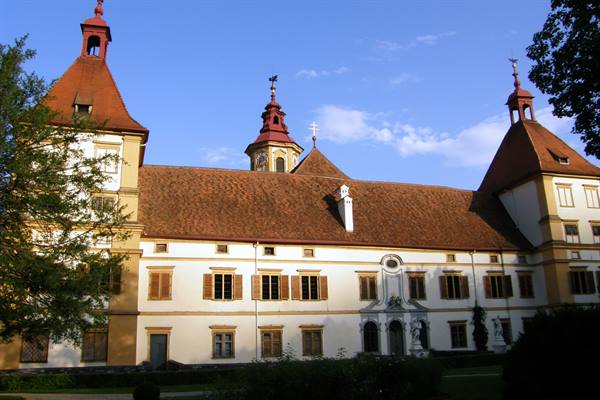
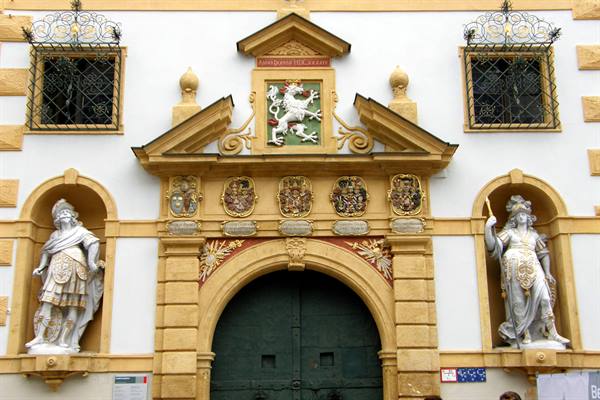
Leonardo wakes up when we are already at our destination, so we head immediately toward the western outskirts of the city, where the Schloss Eggenberg is located, the most famous of the region's Baroque castles, erected at the beginning of the seventeenth century by Prince Hans Ulrich von Eggenberg on the model of the Spanish Escorial and surrounded by a vast English-style park. At this hour of the afternoon, however, the castle is already closed, so we content ourselves with a walk in its gardens, well tended and inhabited by numerous peacocks, observing the elegant manor from the most varied angles, aware of the fact that (returning tomorrow) the interiors too would have deserved some attention, with their lavish state rooms, but the usual exclusively guided visit made us abandon the idea before long.
We wander for over an hour in the park and then, once back at the camper, we move for the night to the nearby Camping Central, from which in the morning we'll set off to conquer the historic center of Graz... Meanwhile after dinner a thunderstorm breaks out that cools the air of another torrid day, rather unusual for the country we are traveling through.
Rust
Day 1323 Aug 2012
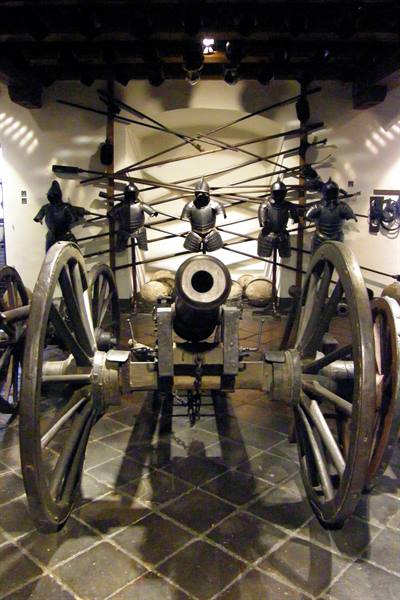
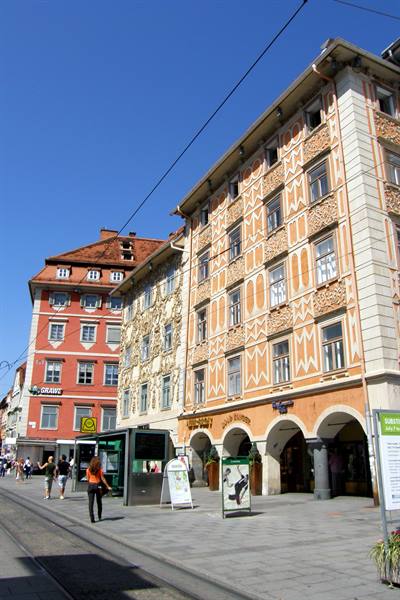
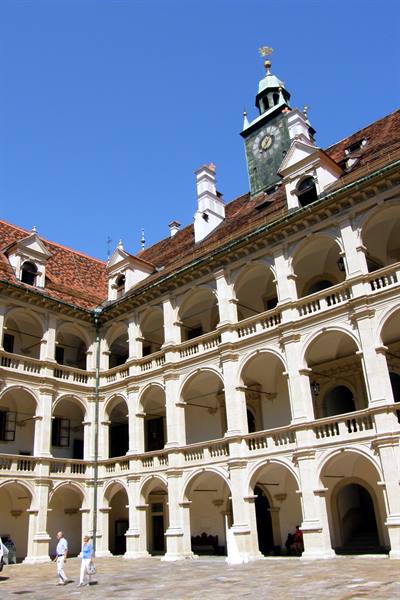
During the night it rained abundantly, at intervals, and when we wake up it no longer does, but the sky is gloomy and completely full of clouds... However, in our plans there is the visit to the city of Graz, which we certainly cannot postpone, so after breakfast we confidently head toward the nearby stop of bus number 32. In this way, after about twenty minutes, we reach the Jakominplatz, a few steps from the center. A few sporadic drops of rain fall while on foot we go up the Herrengasse, one of the main streets of the Styrian capital, flanked by historic buildings, among which is the palace of the Landeszeughaus, the old arsenal, built in 1644, which today houses an interesting weapons museum, in which we momentarily take refuge given the weather conditions.
We thus spend some time among armor, swords, halberds, pikes, shields, rifles and muzzle-loading pistols, arranged on the four floors of the building, in what is, strong of its thirty-two thousand objects, the largest collection of historical weapons in the world. When we go out it's no longer raining, so we also go to see the beautiful Renaissance courtyard of the adjacent Landhaus, a palace erected in the mid-sixteenth century, which was the seat of the regional parliament, then walking we reach the Haupt Platz, the liveliest of the city squares, surrounded by fine palaces, while in the sky some auspicious snatches of clear weather have appeared.
At 11:00 sharp we are in front of the curious Glockenspiel, a carillon from the end of the nineteenth century that three times a day plays some melodies while a pair of statuettes in traditional clothing dance coming out of two little windows placed on the roof of an ancient dwelling. A little later, instead, while we are before the cathedral of Graz, the sun comes out definitively, which even for today will delight us with its presence. Beside the cathedral we explore the Mausoleum, the funeral chapel of Emperor Ferdinand II, whose tomb is found in the underground Gruftkapelle, but here we don't stop, because we climb all the way up to the tower, where there is a large bell at whose ringing Leonardo is scared to death and wants to flee.
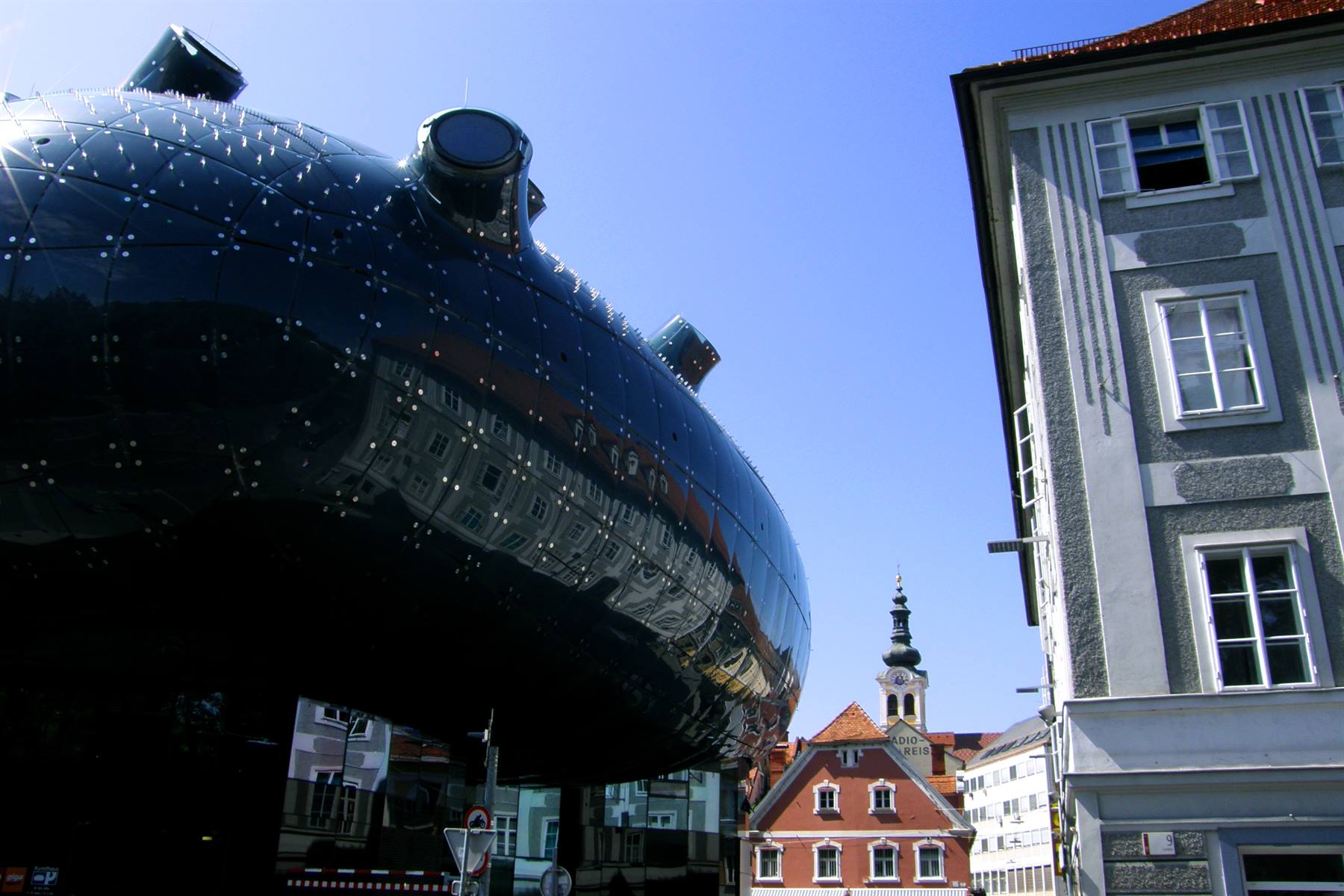
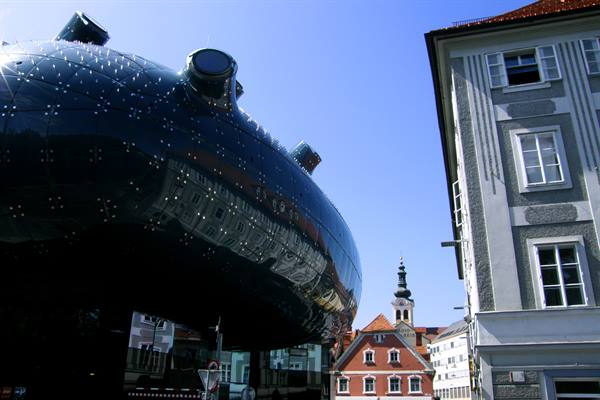
We thus take the opportunity to see, in the Burg across the way, a most original, as well as ingenious, Gothic double-spiral staircase, a small architectural masterpiece dating back to 1500. At this point we return to the Haupt Platz, but the visit to Graz is certainly not over. We cross the Mur river and on the opposite bank we go to admire the ultramodern Kunsthaus, a large building with an irregular and rounded shape, in stark contrast to the classic buildings around it, erected in 2003 on the occasion of Graz's designation as European Capital of Culture, which today hosts contemporary exhibitions... but nearby the Mariahilfkirche is also interesting, with a beautiful towered facade.
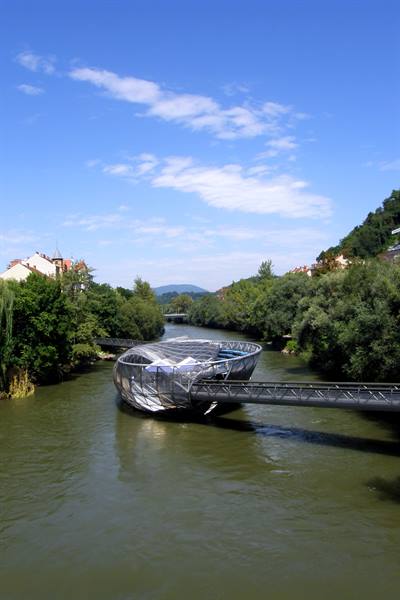
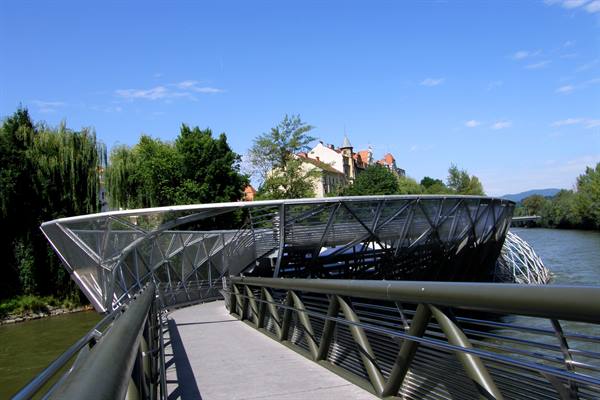
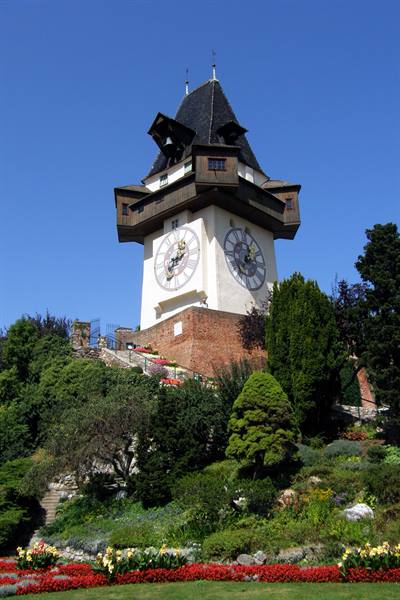
We cross the river again passing through the original Murinsel, a modern structure in steel and glass, from the same period as the Kunsthaus, which forms an artificial island on the Mur, and arrive at the foot of the Schlossberg, the hill that dominates Graz from its 473 meters, once a fortified bulwark. By means of the Schlossbergbahn, a funicular active since 1894, we go up the height, from which we enjoy a beautiful panorama of the city, but above all we can admire up close, surrounded by beautiful gardens
Graz - Kunsthaus
Day 1424 Aug 2012
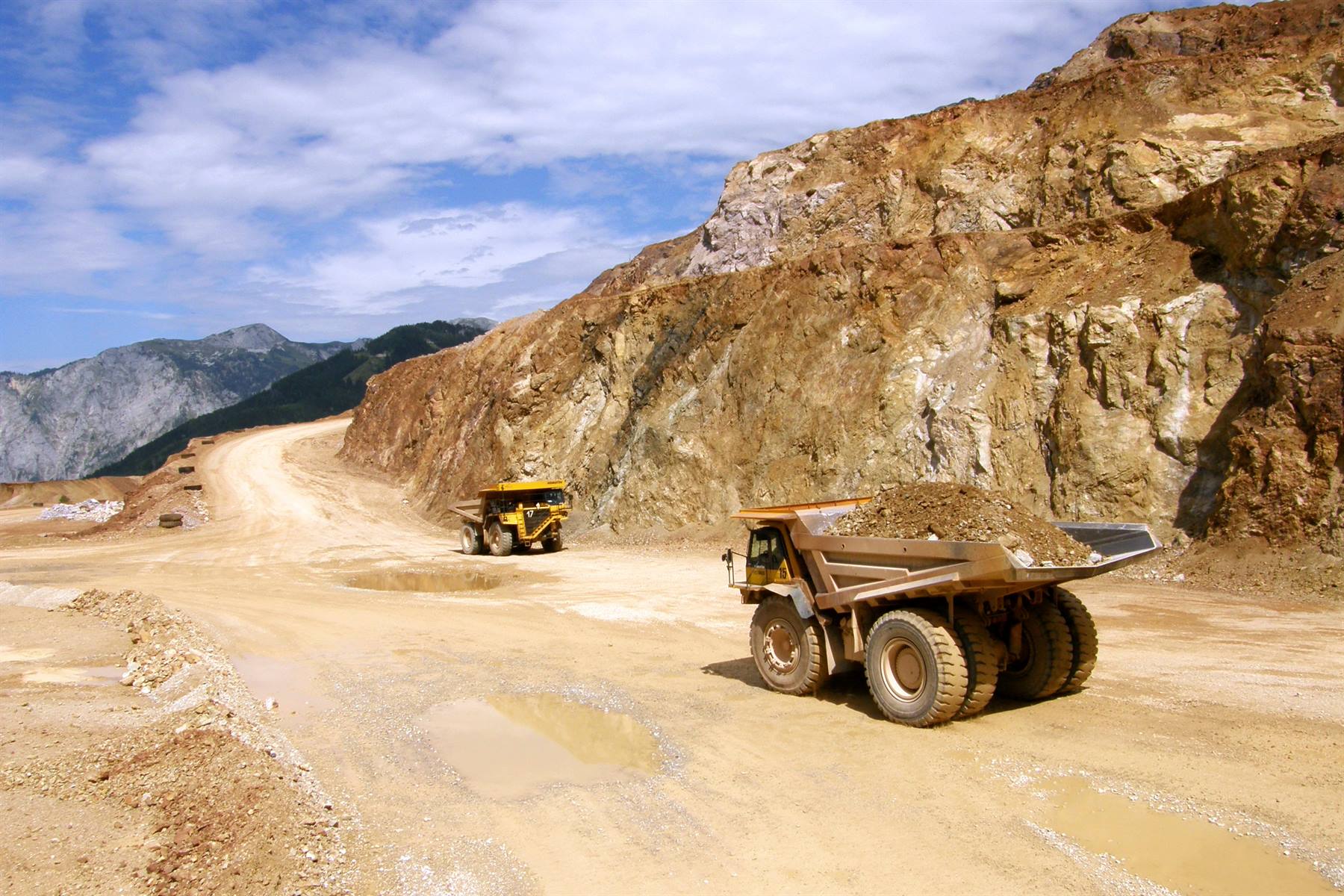
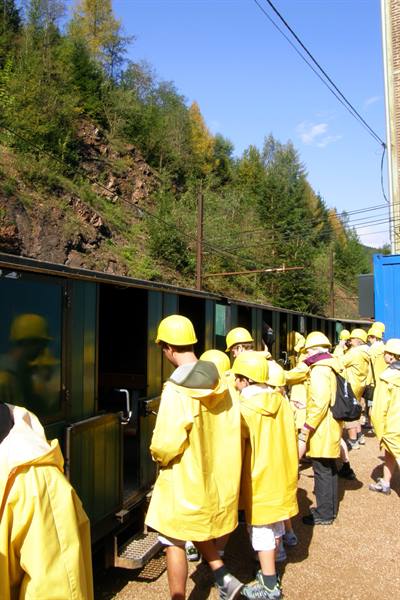
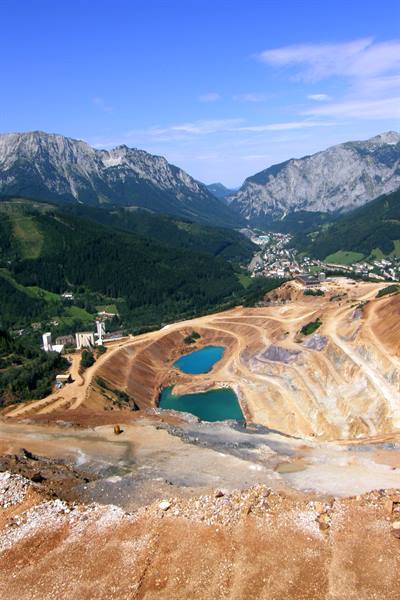
In the morning a magnificent sun is shining again and there is not a cloud in the sky. We enjoyed a good long sleep, because the Erzberg mine, which towers over the little town of Eisenerz, will not open its doors before 10:00. A few minutes after the appointed time we are at the ticket office in order to buy the ticket that will allow us, with a double visit, to understand all the distinctive aspects of this important deposit, exploited for over a thousand years and still in full operation today. In no time at all we find ourselves equipped with a helmet and a yellow waterproof cape, setting off for the bowels of the earth... Our first experience will in fact take place in the old gallery mine, no longer in use today. A bus takes us to the entrance of the tunnel, where what was once (until 1986) the miners' train awaits us.
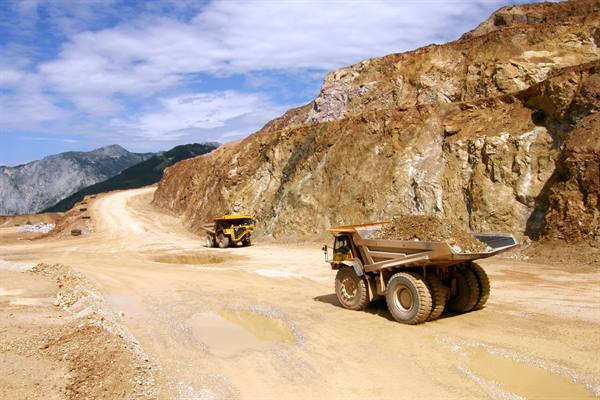
With the rattling vehicle in question we then penetrate for a long stretch into the heart of the mountain and afterwards begin exploring the galleries, in which old machinery is still found, gradually explained to us (a shame only that the explanation is exclusively in German)... The visit turns out, all in all, to be interesting. Several metres underground, though, it is quite cold, and the return to the open air is extremely pleasant. With the same bus as on the way there we return to the ticket office, where a gigantic Hauly awaits us, a quarry truck 5.5 metres wide and 4.5 high (the wheels alone 2.5), modified for transporting people inside its immense dump bed. With that impressive vehicle we thus set off to discover the great open-cast mine.
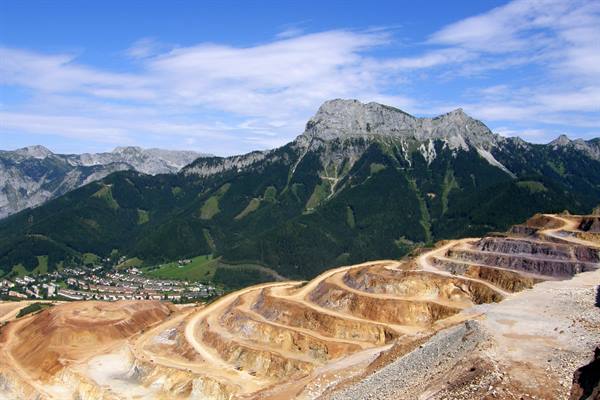
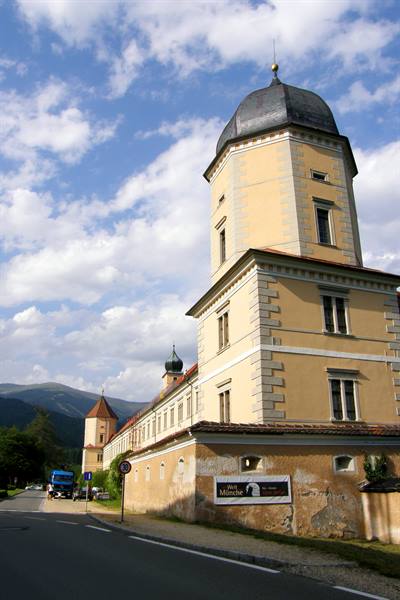
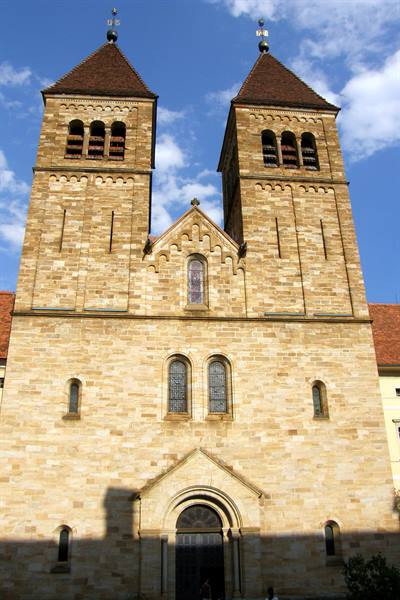
We climb the 42 levels (from 12 to 24 metres high), observing some extraction activity along the way, and reach the summit of the Erzberg, from where there is an extraordinary view over the descending terraces of reddish rock, rich in iron, in contrast with the green mountain landscape around it. At almost 13:00 we conclude the visit, truly interesting from many points of view, and once we have got back to the camper, after lunch, we resume our itinerary. We leave Eisenerz behind heading south and, once back on the motorway, we follow the signs for Klagenfurt, but before long we leave the four-lane road to go to the village of Sekau to see the Benedictine abbey of the same name. The great religious complex was however founded by the Augustinian canons in 1140, and then enlarged over the following centuries.
The beautiful Romanesque cathedral (1164) faces onto the inner courtyard; we also briefly visit its interior, where the beautiful mausoleum of Archduke Charles II stands out at the end of the left nave, executed in baroque forms at the end of the 16th century. Once the exploration of Sekau Abbey was also finished, we go back to grinding out kilometres, because there are still about a hundred left to the end of the stage. We pass through the locality of Zeltweg, known because until a few years ago a Formula 1 Grand Prix was held there, and continue south, still in the direction of Klagenfurt. In this way we leave the region of Styria to enter Carinthia, and after more than an hour of ups and downs, surrounded by bucolic landscapes, we come in sight of the bold Burg Hochosterwitz, a village-fortress that we will visit tomorrow morning.
We settle into the quiet car park at the foot of the stronghold and after dinner we go to sleep, beginning to put in order the memories of a beautiful holiday that is now drawing to a close.
The Erzberg Mine
Day 1525 Aug 2012
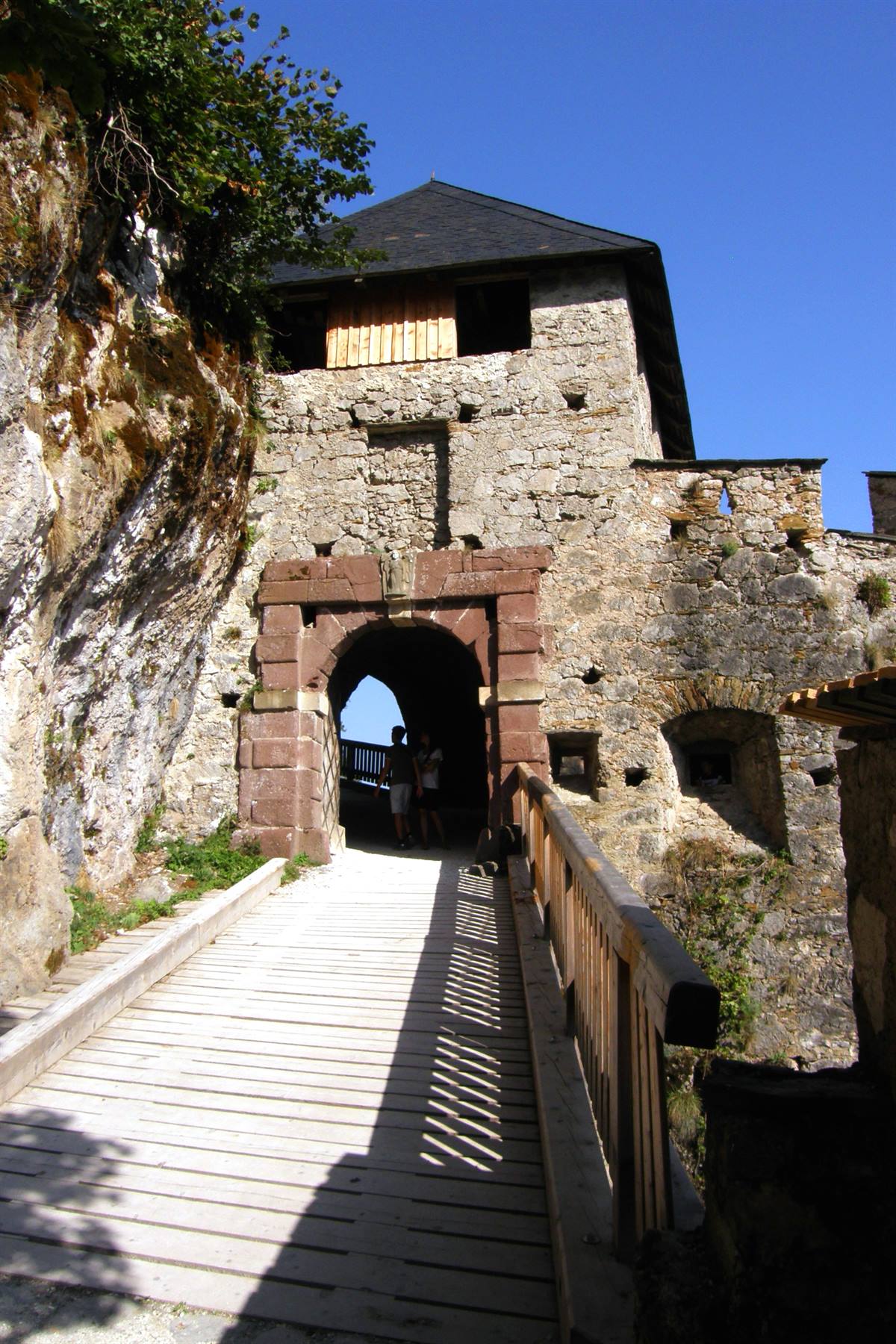
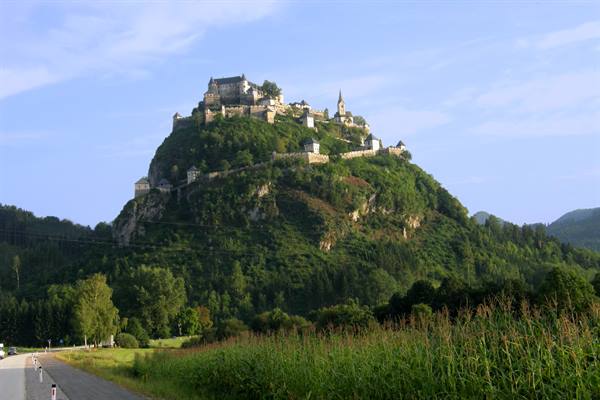
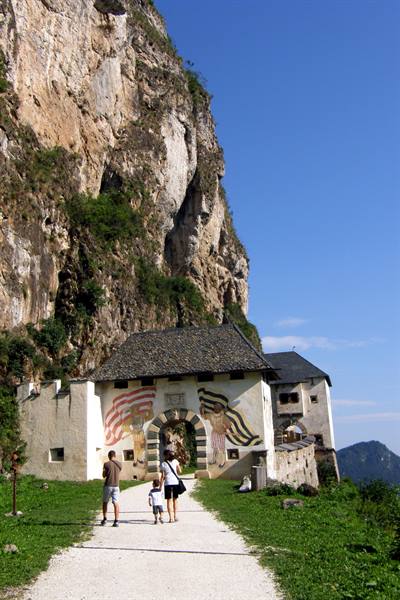
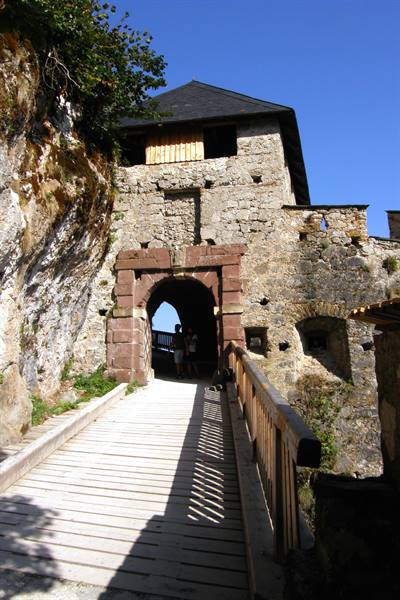
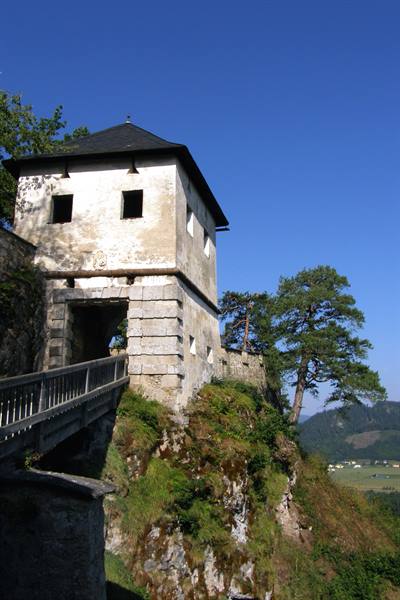
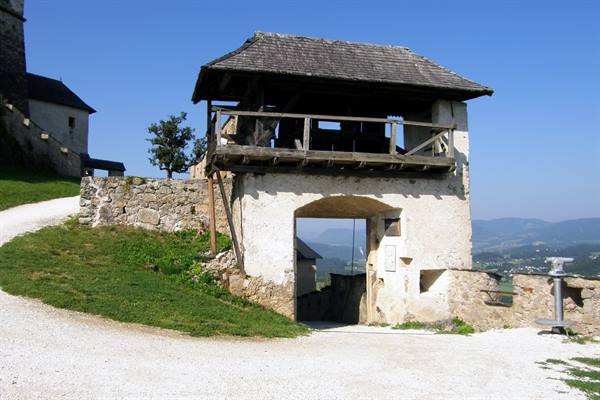
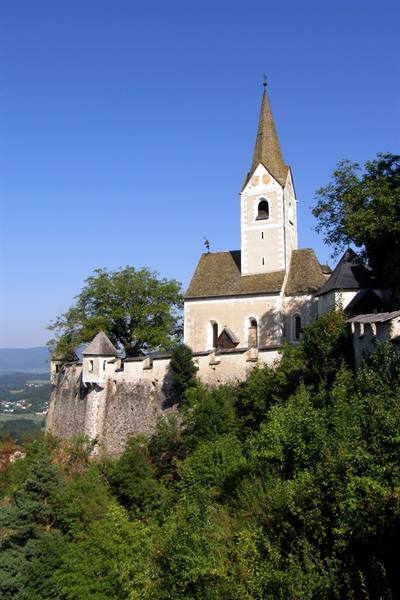
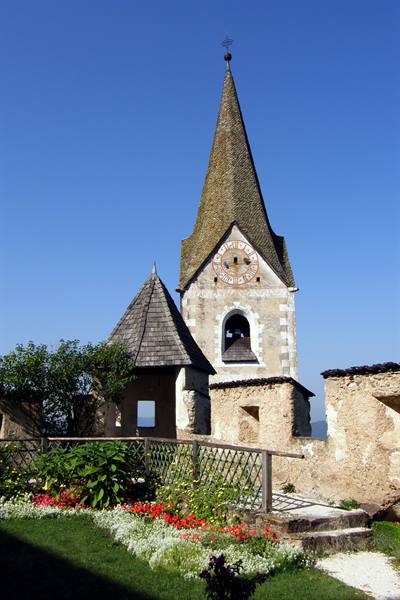
It's the last full day we'll spend in Austria and another sunny day is in store... incredible: two essentially complete weeks of good weather in this country, an event to be remembered in the annals! We're in the parking lot of Burg Hochosterwitz, a small village surrounded by ramparts and perched on a rocky spur dominating the valley below, a true "eagle's nest" built at the end of the sixteenth century as a bulwark against the Turks, which always remained unconquered. Shortly after 9:00 we begin our visit, starting along the path that climbs through no fewer than fourteen towered gates. The first gate, called Fahnrichtor, features two large figures of flag-bearers; indeed they were the first bulwark, having the task of signalling the enemy's movements to the fortress above.
The second gate is the guards' gate (Wachtertor), then through the Nautor we reach the Engelstor, one of the most important from a strategic point of view. Continuing to climb with beautiful views of the fortifications and the valley, which can already be observed from a commanding position, we also pass the fifth gate (the Lowentor) and the sixth (the Manntor), to come within sight of another fundamental bulwark: the Khevenhullertor. Now well past the halfway point we conquer in succession the Landsschaftor, the Reisertor, the Waffentor and the Mauertor... we briskly pass the Bruckentor and also the Kirchentor, the thirteenth gate in the series, then slow our advance and devote some time to the graceful chapel of St. Nicolaus, built right on the edge of the spectacular cliff below.
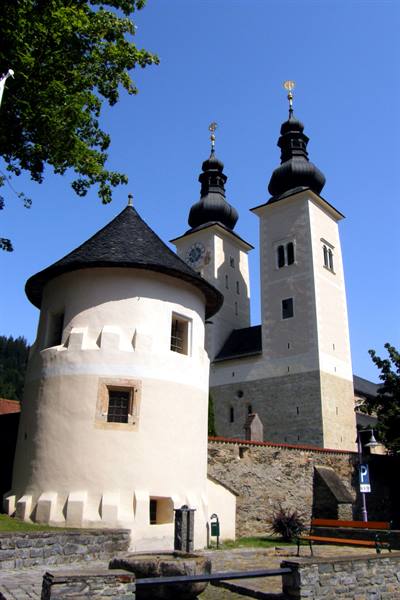
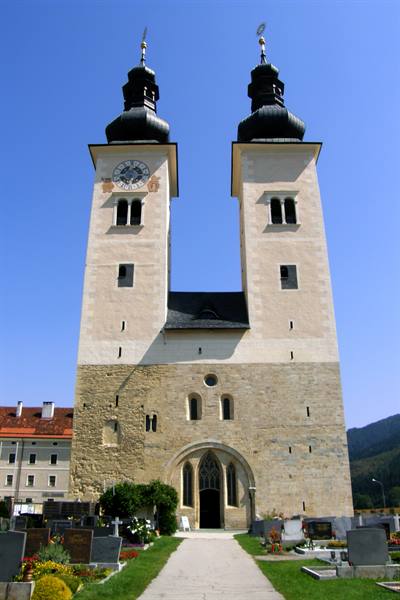
Finally we have only to cross triumphantly the fourteenth and last gate, the Kulmentor, and reach the heart of the fortress of Hochosterwitz, where no enemy has ever set foot. We complete the visit with a quick exploration of a small museum full of testimonies from the era, and then return to the parking lot from which we set out with the help of a convenient but vertiginous lift. In the late morning we set off again to reach the last official destination of this trip. We briefly head north again, then turn left and take the Gurktal: the valley that leads to the town of the same name (Gurk), where there is a cathedral that, built in the twelfth century, is one of the most important examples of Romanesque architecture in Central Europe. After half an hour's drive among the gentle slopes of Carinthia we park beside the Gurk Dom.
First of all we observe its sober but attractive exterior, characterised by two square towers 41 metres high, and then the interior, starting with the fine frescoes of the Äussere Vorhalle (the outer narthex), moving on to that seventeenth-century sculptural masterpiece of wooden art that is the high altar, and finishing with the forest of white columns of the crypt, completed in 1174. Besides this there would also be the Bischofskapelle (episcopal chapel) to see, with a marvellous cycle of frescoes, but it can only be visited in the afternoon and with a guided tour, so we skip it. It's almost 13:00 when we leave the cathedral of Gurk, so back at the camper we set off again and as soon as possible we stop in a shady parking lot to have lunch and then put the little one down for a nap.
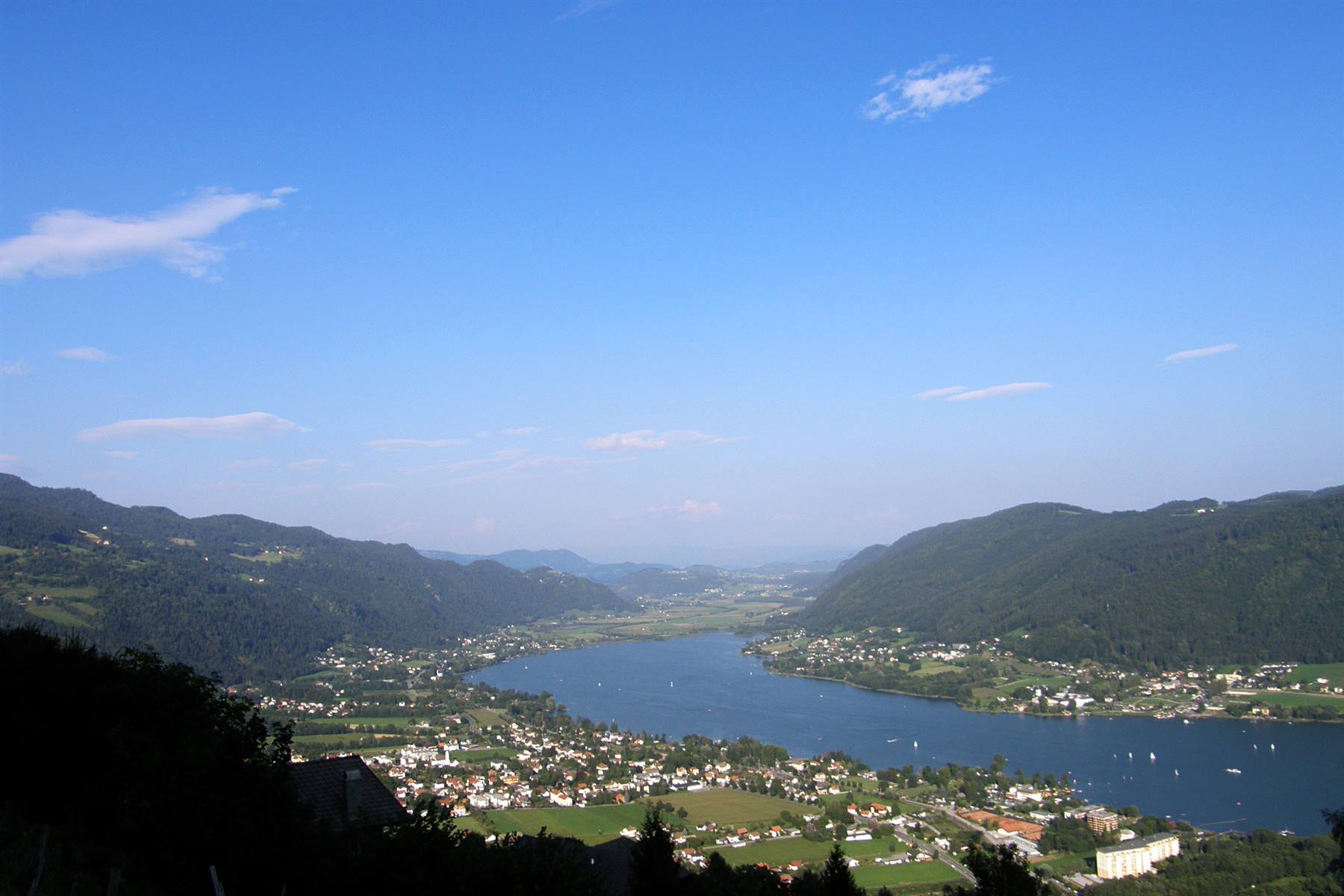
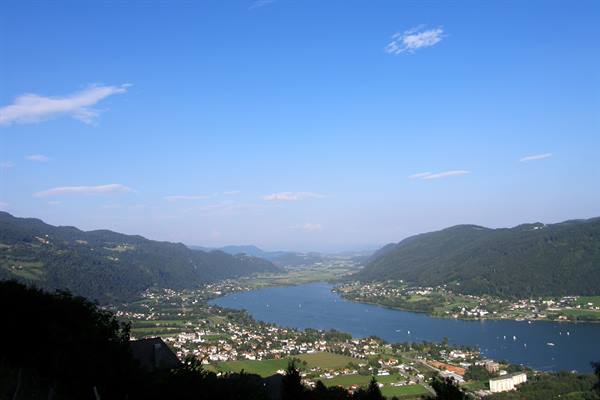
In the mid-afternoon, while Leonardo is still sleeping, we take to the road again and one curve after another we come within sight of the Ossiacher See, one of the best-known lakes in the region. It's early and, to pass the time, at the town of Bodensdorf we take the scenic road that climbs for a full twelve kilometres, almost to the summit of Mount Gerlitzen, at over 1,700 metres above sea level, with fine views over the lake basin... Once at the summit, however, we discover nothing of interest and soon find ourselves heading back down. Back on the shores of the Ossiacher See we drive along the lakeside road to its western end, and once in the city of Villach we stop at Camping Bad Ossiachersee, for the last night of this trip.
We spend some time by the lake, in the company of ducks and swans, then have dinner in the open air, and finally, satisfied with how things have gone, we go to bed in view of tomorrow's return journey.
Burg Hochosterwitz
Day 1626 Aug 2012
We're woken by the patter of rain on the camper's roof... but it hardly matters now, because all that remains is to go home. We leave Camping Bad Ossiachersee in Villach at 9:35. We stop to refuel, because fuel prices are lower than in Italy, and a little later, at 10:10, we cross the border line back into the Bel Paese. Once in Tarvisio we follow the A23 motorway, so by mid-morning, as we leave the exit for Tolmezzo on our right, we ideally close a circle. At 11:10 we're in Udine, then, having taken the A4 Milan-Trieste, we hit some traffic jams that don't prevent us, at 12:30, from being at the exit for Venice... From there we drive on a bit further and shortly after Padua, having just taken the A13, we stop for lunch.
After putting Leonardo to bed, at 14:30, we take to the road again, so that at 15:25 we're in Bologna and subsequently, following the A14 motorway, at 16:00 sharp we arrive at the Forlì exit. After a few service stops, at 17:00, we're in front of our home gate to happily conclude the trip to Austria... a great trip, there's no denying it, with the natural wonders of the Alps and plenty, oh so much culture, which reached its peak with the exploration of the capital, cradle of the Habsburgs and historic crossroads of Europe... But the most positive note is having managed to see all these things with a child of not even three years old on the team, and if a good day is seen from the morning, before evening falls we'd like to have explored the whole world together with him...
0 reader comments