The story
When the mighty KLM MD 11 lands at Tocumen airport in Panama City, the undersigned and his benny find themselves in a comatose, disconnected and larval state from lack of sleep and a very, very long journey. Almost 11 hours earlier we had left behind us work, friends, cold, rain in order to fulfil a dream I'd had since childhood, when, bewitched by the Atlantics, I saw in this strip of green land a sort of new Eden, unknown, a wild land, or yet a distant and mystical place where it was still possible to be truly moved. Over the years, I lost part of that magic that seasoned my adventurous mind, I added wisdom and reality to my soul, rationality and then again curiosity. Panama, if only for the sound of its word, with those "a"s that recall something exotic, exciting, unknown.
Perhaps the great interest I've always had for green places, forests, untouched nature has its origin right here, where I have now arrived. It should be added that my later studies also increased this curiosity: studying the Incas, the Jesuits towards the New World, the role of Spain in the colonisation of the American continent, Panama has always played a leading role, a transit centre for example for that charmer Pizarro in his great enterprise, the conquest and destruction of the Inca civilisation. The first impact is strange: suffocating heat, modernity, music, a bit of green... well...this wasn't the Panama I was looking for, or perhaps what I was looking for, or am looking for, doesn't exist, or no longer exists. Did I get the wrong century, time, world?? No, it won't be like that.
After shaking off the assaults of sleep and tiredness, having slept 13 hours at the Sevilla Suites, we are finally ready to set off to discover this country shaped like a horizontal S, an isthmus country, a thin strip of forests and water, blue and green, the conditioning and dominant colours of the Panama landscape. We climb aboard one of the Diablos Rojos, beautiful and very colourful old American school buses, with high-sounding names, that travel from east to west, sweeping from Via España towards Calle 12, where we'll get off to venture into the Casco Antiguo, the Panama rebuilt after the tumultuous attack by Morgan's pirates in 1671.
The district is being renovated, partly yes and partly no, it keeps intact its colonial charm, the beautiful churches, the beautiful theatre, Bolívar Square (never missing in Latin America) and Independence Square, obtained in 1903 but which is actually a historical contradiction. As the Panamanians like to confirm: Panama gained independence in 1821 from Spain and then separated from Colombia in 1903...that's the truth...dear history books. Panama City was founded in 1519 by the Spaniards, about a decade after a small group of adventurous Iberians led by Vasco Núñez de Balboa discovered for the first time in history the South Seas, that is, the Pacific Ocean.
Once the city was founded, immediately a misfortune: led by its founder Pedro Arias de Ávila, Pedrarias, a horrible and cruel governor of the province, unscrupulous and without qualms about massacring the local indigenous people, The city became extremely important for the gold and silver arriving from Peru, then the pirates came and destroyed it, and then it was also infested with yellow fever, tropical diseases and dying people who arrived from all the colonies to embark for the fantastic Peru. They rebuilt it 8 km further west, towards the Bay of Ancón, today the site of the historic centre. From here you can enjoy a fantastic view of the Panama skyline, truly exciting.
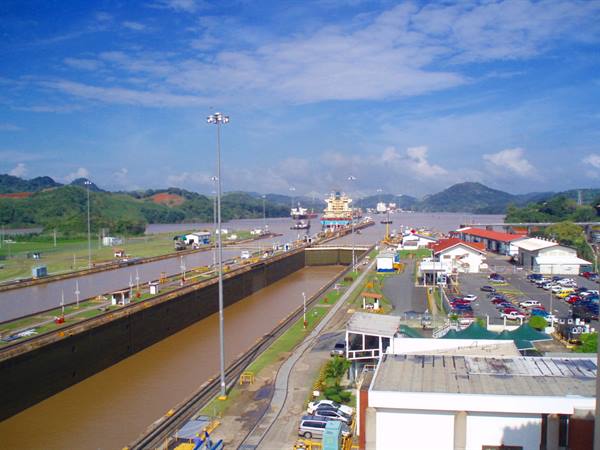
The effects of the Canal and its wealth begin to be glimpsed in the city's urban landscape, in people's clothes, in their cars, in the very American ways of eating, of adding human and physical weight to one's wallet...if you want to visit Panama...go quickly, because soon it will become a luxury for our meagre European wallets. THE CANAL: A MASTERPIECE, a symbol of man's power to modify geography, to change the climatic, geological, sociological, structural and physical conditions of a place, perhaps the greatest engineering work ever devised, a scene of incredible vastness with notable commercial and political effects. Inaugurated in 1914, the canal saw the excavation of 205 million cubic metres of earth, and for the first time the Atlantic and Pacific gave each other that passionate kiss that nature had never granted them, joining them forever through the long jaws of blue water.
But that kiss was not Panamanian, it was American...everything was American: its construction, the territoriality of the canal, its immense fortunes, the impressive related industry, everything was made in USA...and in Panama that oppression at home could not be digested. And as if independence had been only on paper, first from Spain to Colombia, then from Colombia to the USA and then??? nothing.. the Americans obviously left nothing but crumbs to the Panamanians immersed in poverty and enchanted by that marvel that brought no kind of advantage.
Finally in 1977 Carter gave the go-ahead for the US withdrawal, and the canal became PANAMANIAN on 1 January 2000!!! Here begins the story of a new country that, if it knows how to exploit in a right and honest way the enormous fortunes of this bridge between the Americas, will make news and become who knows perhaps the first Central American Tiger!!! But Panama is not only canal and city: we will soon venture into its magical rainforests, in contact with its lush untouched nature, a sense of preservation of nature that I had seen only in Costa Rica, and then a fairy-tale place - Gamboa Rainforest Resort: a sort of five-star eco-lodge, a phantasmagoric resurrection in the midst of the greenery and on the banks of the Chagres river of a hotel enchantingly set in its natural environment, surrounded by free-roaming animals, crocodiles, toucans, capybaras, tarantulas, the largest bird-watchin
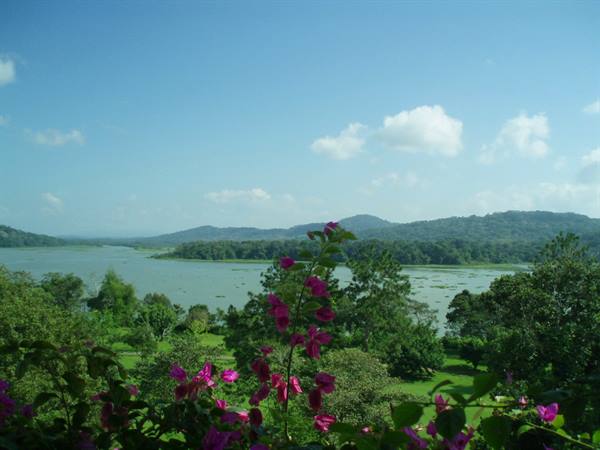
g reserve in the world, a centre for world research on the biosphere, biodiversity and the study of tropical issues. Gamboa, the historic centre of life for the canal workers, today is an open-air museum, its colourful houses of old wood, an insidious nature that envelops everything and everyone, an intense and total green, flowers, colours, the continuous and constant chirping of birds, the flight above our heads of threatening harpy eagles, Panama's national animal. Green, green, blue and more blue: here the Chagres river flows into the canal, the fruit has a different taste, densely complete and authentic, the air is pure and as I swing in my hammock looking at the infinity of green forested hills and a blue sky, I think perhaps I have found what Panama represented for me, a still untouched Eden, a distant, unknown place...even if it wasn't so, I liked imagining it.
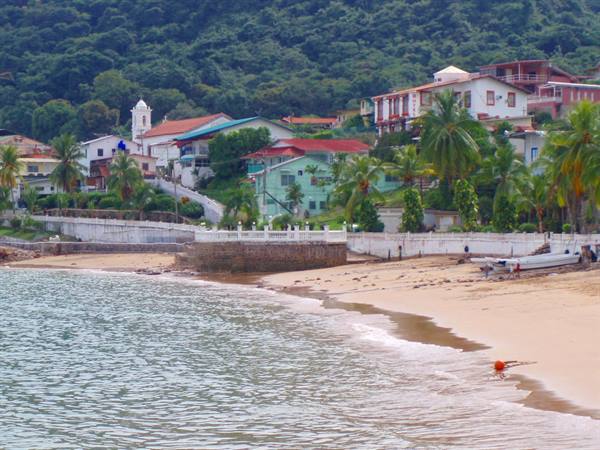
We'll spend the last days on the island of Taboga, postcard scenery, flowers galore, the second oldest church on the entire Pacific coast, green forests, dolphins and very kind Panamanians devoted to the sweet art of doing nothing. You eat from atop a memorable terrace, with a view of the Pacific Ocean, don't forget to take a stroll up there, it's called La Veranda Hotel Terraza...it's a restaurant and hotel, truly special. The rest are the crazy nights of the Panamanians with music, food and lots of nightlife..on the causeway, a fantastic strip of land reclaimed from the canal that now joins three pretty islets, Perico, Flamengo and Amador..pretty beaches, forest, bars, nightclubs, a few hotels, restaurants, and lots and lots of music. All that's left is to say goodbye
The journey's photographs
5 photographs · click to open them full screen

0 reader comments