Mexico had been a dream of mine ever since, in middle school, I had been fascinated by the fortunes of the Maya peoples and the Aztec warriors. By their knowledge of the stars, by their extremely precise calculations, by their architecture and by the contrast with their failure to "discover" the wheel. My plan to set off with a friend travelling without a tour operator and sleeping in family "...." and on local buses came to grief in the face of the glaring slip at the moment of booking the flight. Fortunately my parents too were eager to visit this fantastic country but on different terms: hotels and transport already booked through an agency. I had to give in but I found a truly capable agency that organised a tailor-made trip for me. I studied the map and the guidebook to decide the stops, to organise the transfers etc. and submitted the package to them to get a quote.
On the basis of the estimate we decided to eliminate or add other stops, according to the days and the amount requested. Once the trip was prepared they quoted it; this entailed the possibility that others might join the package, which we would only find out during the trip, in fact my agency relied on local tours. At the end of the account you will find all the references of addresses, costs etc.
Tuesday 16 March 2004. Milan - NY - Mexico City Wednesday 17 March 2004. Mexico City - Villahermosa - Palenque Thursday 18 March 2004. Palenque - Villahermosa Friday 19 March 2004. Villahermosa - Campeche Saturday 20 March 2004. Campeche - Kabah - Uxmal - Merida Sunday 21 March 2004. Merida - Chichen Itza - Playa del Carmen Monday 22 March 2004. Playa del Carmen Tuesday 23 March 2004. Playa del Carmen - Tulum - Playa del Carmen Wednesday 24 March 2004. Playa del Carmen Thursday 25 March 2004. Playa del Carmen - Cancun - Miami - Milan
Here are the expenses incurred for the trip, Note: these expenses were incurred by three people, the per-head calculation is a pure mathematical division hence purely hypothetical. The expenses incurred as three people are proportionally lower, for example in transport and hotel stays.
calculated by dividing what was spent for 3 people: 1,650.00 Euro Tour bought at travel agency "La cucaracha2" 140.00 Euro Hotel Playa del Carmen (Quinto Sol 4-star) 35.00 Euro Travel insurance 6.67 Euro Admin fee 17.33 Euro Malpensa parking with agency agreement 1,849.00 Euro TOTAL TRIP COST
Also consider the following items: 30.99 Euro Passport (annual stamp duty - now more expensive) 153.00 Euro purchases during the trip / miscellaneous expenses, from souvenirs to food bought during the trip
?? Below, the classic USEFUL INFORMATION:
¤ Climate: The climate is variable, it is humid and hot along both coasts and drier and more temperate inland and as you gain altitude. The rainy season, during which high temperatures are also recorded, runs from May to October, while the months from December to February are the coldest of the year.
¤ Time: The time zone in most of the country is 7 hours behind Italy
¤ Language: The official language is Spanish, there are no difficulties if you speak English or simply Italian, especially in tourist places
¤ Festivals and traditions: There are many festivals, just be careful when organising your trip around the following days: Carnaval (late February/early March), Día de los Muertos (2 November).
¤ Visas: A passport valid for at least 6 months and the tourist card are required, while for stays longer than 3 months a visa is issued whose extension costs 205 pesos. Note: if you transit through American airports you will have to comply with the regulations (passport)
¤ Vaccinations: No compulsory vaccination is required. Officially the vaccine against hepatitis A and B is recommended. Risk of cholera, hepatitis, measles and salmonella in rural areas and on the outskirts of the major cities.... In short, nothing is compulsory, but if you plan to go to a remote spot in the jungle to live in a village eating local food, then try to be covered. Get information, perhaps from your Tour, agency etc., for health insurance cover.
¤ Telephone: To call from Italy dial 0052 followed by the district code without the zero and the number to call. To call Italy dial 0039 before the number to call. There are also public phones, some of which work with prepaid cards. Mobile phones work normally but must be tri-band.
¤ Currency and exchange: The official currency is the new Mexican Peso; of course check before leaving or at the rates displayed in the exchange "shops". In Yucatan you can easily pay in US Dollars, less so in Euros. International credit cards are almost always accepted. difficulties may arise in withdrawing from ATMs in outlying locations
¤ Safety: I did not encounter any difficulty, not even by hearsay, but I think it right to report what was officially stated: "Security problems can be caused by the high crime rate and by bandits if you travel by car. In Chiapas, one must pay attention to the presence of guerrillas and army units even though they are generally not dangerous for tourists. The use and trafficking of narcotics is harshly punished".
Day 116 Mar 2004
Milan --> New York --> Mexico City
**MARCH 16: MILAN? New York? MEXICO CITY Departure is at dawn from home to go to Malpensa airport, takeoff for New York on Alitalia flight AZ 604. It is recommended to present yourself at the airport for check-in procedures by no later than 07.15 and to have your luggage tagged to Mexico City: MEX. This is to avoid picking up the luggage in New York and checking it in again. We land in New York at 1 pm in the middle of a snowstorm. In New York, suspicious, we check among the bags that arrived on the belt to see if ours are there too… and of course we find them, and we even have to submit them to customs inspection and then check them in again for the next flight.
The Alitalia staff present in the Immigration Hall will provide assistance in this regard; I didn't see anyone… lucky we checked and know English! After so many flights, I confess I'm very prejudiced against the national carrier.. it's just that I've never been proven wrong by the facts, unfortunately. At immigration, a chubby, smiling officer wishes us a good trip and attempts a "buongiorno" as well as warning me about changing to machine-readable passports, printing me a nice little "warning: from next year, $100 per entry if I don't change it." Thank you, very kind, it will be done. We wait at the airport for about 3-4 hours without being able to see anything except the white snow swirling around, making any kind of view beyond the large windows impossible.
New York airport is nice, orderly, clean, but it's not easy to find something to do: the shops are full of brightly colored gadgets with the American flag, the Statue of Liberty, the White House and the words I love NY…. And everything is extremely expensive. So come on, use a little imagination, will you! Maybe so, but I decide to save space for Mexican purchases. The next leg is with the Mexican airline Aeromexico (AM 403); I must say it's very good. Be careful, if you plan to use the Mille Miglia card, since the Milan-Mexico City flight was purchased with Alitalia, forget about it—they told me no way, it only counts on actual Alitalia flights. We take off a few minutes late after the little men in orange suits have cleaned the snow off the plane, with us on board, and sprayed a fluorescent green liquid. We take off on a completely snow-covered runway, sliding a little.
The snow is falling thickly, the runway has at least a constant 20 cm of snow (even after cleaning, it keeps falling) but no plane takes off more than 30 minutes late. This makes me think: either they use studded wheels here, or it's our airports that don't know how to handle a situation like this. In Milan, where it snows in winter, and has been that way since before the first stone of Mediolanum was laid (so centuries before airports were invented), why does everything grind to a halt if two flakes fall? Can't we learn the secret of the Big Apple to avoid tent camps in reverse at Malpensa, Linate, Orio, etc.?
The arrival in Mexico City at Kennedy airport is calm and, above all, nicely warm despite the local time being 11:00 pm! The meeting with our Representatives just beyond the customs gate is nice; a tiny, round little man with a sign bearing our tour waits for us—he's actually the driver who takes us to the hotel. He's friendly and helpful. The Hotel Marlowe is nothing special; I'd compare it to a three-star rather than four-star (as my parents had chosen). After all those hours on our feet, we collapse at midnight from exhaustion.
Campeche
Day 217 Mar 2004
Mexico City - Villahermosa - Palenque
? 17 MARCH: MEXICO CITY In the morning we had recovered from jet lag quite well and we are ready and excited for the first day. The appointment is quite late, around 9:00, but perhaps because of the jet lag by 7:00 we are already up and about. The American Breakfast at the hotel is abundant but the usual organised groups pounce on the pastries, doughnuts, etc.; luckily fruit is not appreciated as much, take advantage of it, it is always fresh and succulent.
? MEXICO CITY Our guide, a distinguished, tall, thin gentleman, is a history professor at the state university, well-prepared, helpful and likeable. He will accompany us for all the days of our visit to the capital. The historic centre is the "zocalo", all the main squares in Mexico are called this because here, in the main square of the capital, the president had decided to put an immense and majestic statue, so important that he never managed to build it for lack of funds, stopping therefore at the pedestal, precisely called a plinth, that is "zocalo"; from here, partly as a joke, partly as habit, this name remained and was then extended to the whole country.
The square is so immense that you cannot photograph it, and overlooking it are the Palacio Nacional with the very important frescoes by Diego Rivera (unmissable!! With the whole history of Mexico up to the present day) and the Metropolitan Cathedral decorated with Mexican ultra-baroque. This style is extremely rich in decorations, born from the local clergy's desire to show off; it found its ideal ground here because the local population could, amid the "mass" of angels, saints, etc., also put pagan idols without disguises without the priests noticing: that's how to survive colonialism while trying to save a scrap of identity!
By car, a mini-van (driver + guide + we three) we go to the Museum of Anthropology. It is extraordinary, all the finds of Mexico are here. All the finds from Palenque, Chichen-Itzà, the originals, are here to be admired in a well-reconstructed context with a truly excellent historical route. The museum, with El Paraguas at the entrance, is full of priceless treasures: the various rooms of the complex are dedicated to the different pre- and post-Columbian civilisations that made Mexican history great. It deserves an accurate, extensive visit! Following this, a City Tour with a guided visit of the main points of interest in the city: the grand Paseo de la Reforma avenue with the monuments to Columbus, to the last Aztec ruler, the Zona Rosa, the independence monument El Angel and the Chapultepec woods.
Here our visit to the capital already ends; I must admit, at the end of the trip, that it would have been better to dedicate one more day to the city to be able to dedicate a few more hours to the city and, above all, to be able to visit the Aztec site of Tehotihuàcan (to be clear, the one with the temple of the sun and the moon)
? Aztecs – According to myth, the Aztecs or "people of Aztlàn" (from the toponym of the group's original homeland, Aztlàn, but more properly called Mexica, from the name of the tutelary god Mexitl or Huitzilopochtli) arrived in the Valley of Mexico at the end of a long migration from the desert areas of the northwest of the country and in 1325 founded México-Tenochtìtlàn, which became the capital of the powerful empire until 1521, when it fell under the blows of the Spanish "conquistadores".
? Teotiliuacani – It was the inhabitants of Teotihuacàn who, having developed roughly between the 3rd century BC and the middle of the 8th century AD, became in the Classic Period the most important city of Mesoamerica from an economic, political and religious point of view, the cradle of an evolved civilisation whose influence extended to the whole area, leaving deep traces even in very distant places such as the Yucatan thanks to the Toltecs, heirs of the Teotihuacan tradition.
The guide, besides accompanying us to the airport, takes care of the check-in etc. (excess of kindness or doesn't he know that Italian is similar to Spanish?). We then leave for Villahermosa with an Aviacsa flight, new, clean and spacious planes, 6A 313 at 15.46. Arrival at the destination is at 16.56 and transfer by car to Palenque. Arrival and accommodation at the hotel MAYA PALENQUE, truly beautiful, complete with a swimming pool shaded by palms. In the evening (better in daylight) we set about exploring the village, very poor, made up of many little wooden houses with small shops facing onto the main dirt road, all ups and downs. You find everything, from restaurants to take-aways, from shops for locals to those typically for tourists. We had dinner with tacos right in a sort of little restaurant.
Chichen-Itzá: three generations
Day 318 Mar 2004
PALENQUE / VILLAHERMOSA
After an abundant breakfast at the hotel with fruit and various sweets, we are joined by the guide who will accompany us for the remaining part of the trip. With the usual minivan, passing along somewhat rough roads enveloped by lush vegetation. We are in the Tabasco region, which takes its name precisely from the Tabasco "spice," widely cultivated and native to the area. Furthermore, the very fertile soil and abundant rains, besides creating a dense jungle, allow the cultivation of many fruits, above all cocoa. It's possible to follow the "flavor routes," that is, themed itineraries where you visit plantations, farms that process the products with tasting included. As a proper food lover, at the hotel while we were having breakfast I drooled over the brochures. I brought them home, if you need info just ask.) Our route, however, was another one: Palenque, 20 km of archaeological site!
This time we're not alone: our minivan stops at another hotel and we discover that three other Roman gentlemen will flank us for the day with a slightly similar tour. Having arrived at the entrance, our guide entrusts us to another one for contingent reasons. The new guide is fantastic: a professor of history and art, I'd say ideal given the place. At the entrance there are the usual vendors of fresh fruit sold in strips in plastic cups but... then covered with chili pepper! Furthermore you can also find fabrics or other souvenirs.
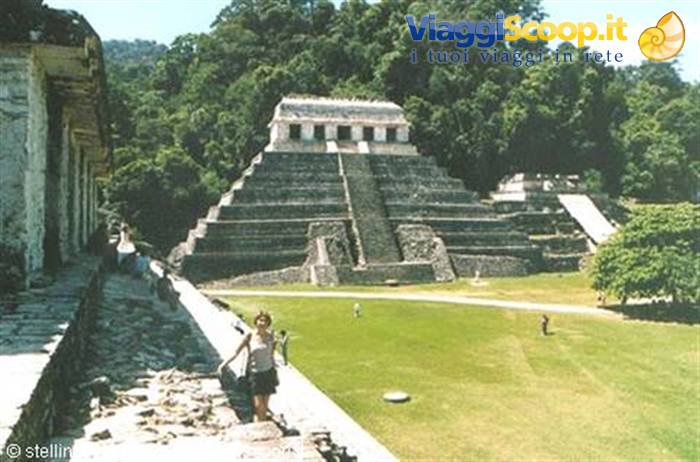
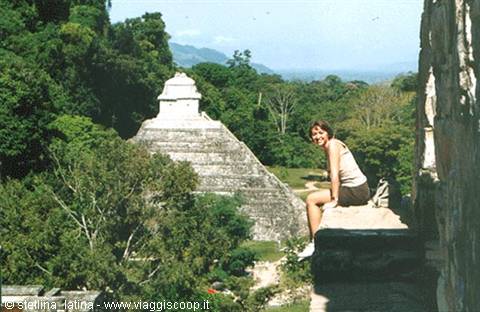
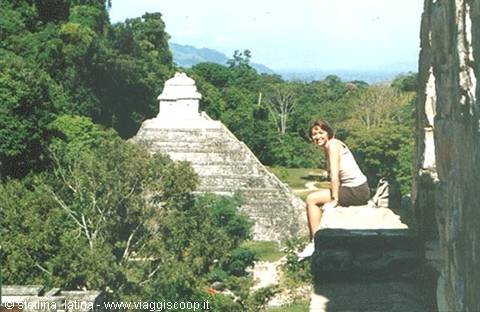
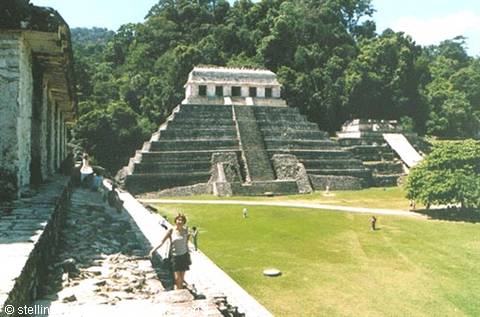
? PALENQUE The site is extremely well-kept: enormous stone constructions (not only steep pyramids) tower over large spaces of manicured English lawn framed by the tropical jungle. Maybe because of the time (early morning) or the period (March) there are almost no tourists. We climb all the pyramids even the outermost ones passing through the tall vegetation and the guide also explains the usefulness of the various plants - from hallucinogenic mushrooms that grow on the trunks, to the very colorful orchids that live on the trees to the scorching chili peppers... try it to believe it!
The site, spectacular, at the end of the trip I confirm: the most beautiful site visited in Mexico! It must have appeared grandiose at the time of its maximum splendor (615-702 AD), with the pyramids painted red wrapped in the dark green of the vegetation, comparable only to Tikal in Guatemala and Copàn in Honduras. The use of stucco, which entirely covers the buildings, allowed local artists to create decorations of high aesthetic level. The visitable part, or rather, discovered part is small compared to the real extension (apparently 20 square km) and archaeologists are continuously working to bring new buildings to light.
The most important buildings, such as the Group of the Cross, the Temple of the Inscriptions and the Palace, are all datable to a period ranging from the beginning of the 7th century to the middle of the 8th century, when Palenque and its rulers dominated a vast territory, interesting are the Tower of the Palacio and the Temple of the Inscriptions with its hidden tomb. The Palacio, residential building of the ruler, is articulated in numerous rooms, corridors and courtyards and is equipped with drainage systems connected to the city's aqueduct, the tall perforated battlements that embellish the buildings make the stocky buildings slender, taking on a formal lightness superior to that granted by the thick wall structures.
It's beautiful to read the history of Palenque on the stone: the world of mortals is represented by the Palacio and the world of the gods by the Temples of the Group of the Cross, while the Temple of the Inscriptions is the place where man becomes god. Palenque is a true masterpiece of pre-Columbian art. Talking with the guide we however discover the first of a long series of bitter realizations. The population is little secularized and they no longer have memory of their past. The guides themselves, to learn and deepen their knowledge of the Maya and other pre-Columbian peoples, study from American or European books. The archaeological excavations are carried out by Nestlé and the weekly payments are promptly converted into beer. Furthermore, the scant consideration of "those stones that interest tourists" turns into "mistreatment" of them.
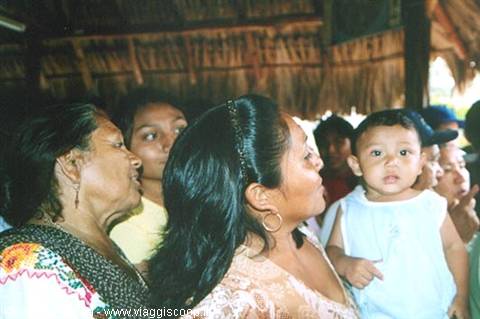
The situation, he states, is not simple and the progressive cultural gap is leading to increasing consequences, such as the exploitation of every type of resource of the forest regardless of endangered species. Unfortunately the cultural uprooting was caused precisely by the Europeans onto which the American dollar culture was grafted. This situation has led to even uglier situations in the Yucatan. During our visit children approached selling simple trinkets, one of these about 10 years old was without ears: the parents, again according to the guide's account, live in the nearby village and are proud of the fact that she is deaf because it's a sign of purity of blood obtained through continuous interbreeding between close relatives. This is a Maya custom that led the Rulers to have physical malformations.
It's peculiar how some traditions have survived however detached from the knowledge of their own past.
For lunch we are transferred to the Romans' hotel, we then continue to Villahermosa where we accompany our temporary travel companions to the airport. We continue to the hotel MAYA TABASCO. The hotel, clean, tidy, is modern and extremely well-kept. We decide to go out immediately to visit the city on foot. It's extremely colorful with "hill" streets in the sense that they are very steep climbs and descents... The little town is beautiful, we can't tell if it's a special holiday but the whole center, pedestrian, is buzzing, people in the street chatting, shopping or simply "strolling." Cheerful music comes out of the shops and everyone seems extremely relaxed and happy. It's often said that this little town despite its name (= beautiful city) is ugly, chaotic and polluted. We must have been lucky but we found it very pleasant, yes it's poor but not as described in the guides.
We eat fruit and sweets bought in the various shops and end up having dinner this way, only my father then decides, once we arrive at the hotel, to have dinner again.
Chichen-Itzá: waiting for the feathered serpent
Day 419 Mar 2004
VILLAHERMOSA / CAMPECHE
The breakfast at the hotel is simply spectacular, the best of the whole vacation and... not only! I'm not used to eating much, to tell the truth usually I don't eat anything at all, at this hotel the breakfast is sensational. The guide had warned us to set aside at least 1 hour to dedicate to it and, wow, I think we used it all! First of all, as soon as we sit down in the elegant room with a buffet displayed behind a beautiful glass with the waiters serving (a sign of hygiene), the waiter comes asking us, tea, coffee or chocolate? Chocolate? Yes, yes fantastic, he fills us a cup full of this sweet chili cream. Oh, "Maya" chocolate, how good it is! It has a different taste from ours, more enveloping, more aromatic and with a spicy touch that makes its flavor more "round," in short to sip with your eyes closed.
Obviously I managed to get a double portion by asking kindly and making puppy eyes at the very likeable waiter, about 60, small and wiry and cordial. A small note: I think Mexicans are a bit tired of being "mistreated" by arrogant and hurried tourists. It's true that the tourist pays but it's also true that they are working and it's not right to consider the people you come into contact with as mere instruments. Just address them politely, with a smile and a few words in the local language and you'll see that all doors will be opened for you! (this obviously applies everywhere, even in our own country...) Returning to the legendary buffet, I recommend you taste everything, from fried plantains (like bananas) to the savory items, strange rolls stuffed with tabasco and spices wrapped in leaves and whatever else inspires you: wonderful.
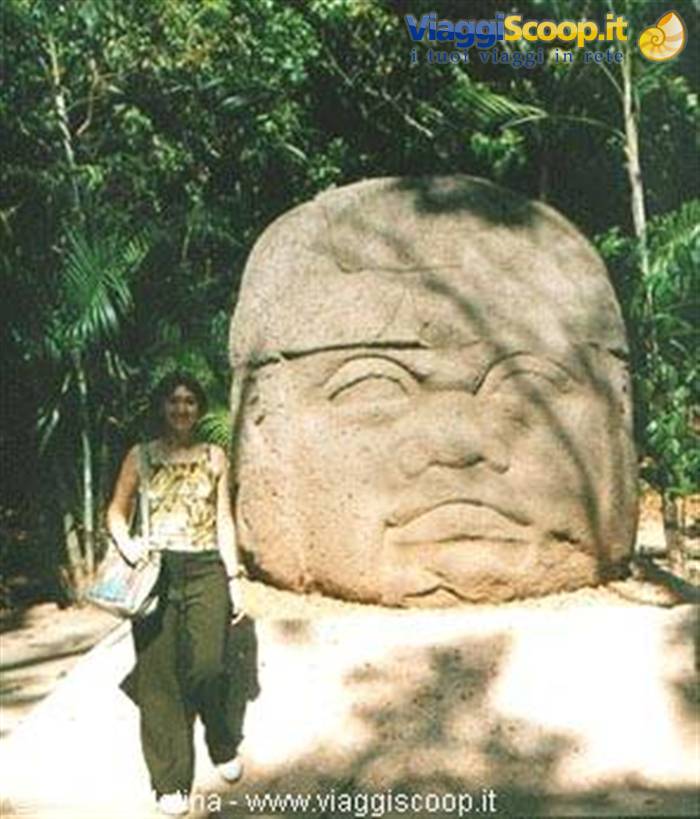
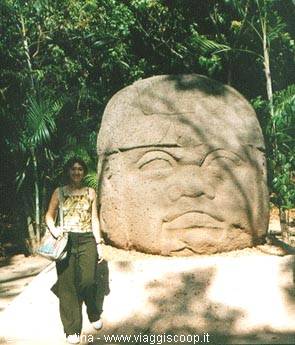
? After the abundant breakfast with the guide we went to the Parque Museo La Venta, where it's possible to admire the gigantic heads carved with negroid features, testimony of the ancient Olmec civilization. In the humid tropical forest among marshes and rivers, in the regions between Tabasco and Veracruz, arose around the 18th century BC the first settlements of the Olmecs, a people of mysterious origins, discovered by archaeologists only at the end of the nineteenth century. Olmec art expressed itself above all through monumental sculpture: allegorical portraits known as "colossal heads," the "altars" or "thrones" of great plasticity, and anthropomorphic statues in which the feline physiognomy prevails.
This population is a bit underestimated by tourists but still preserves the mysteries of its civilization today: its enormous stone heads are still studied with much attention for the features so similar to African ones, because they look at the sky and because they are enormous blocks coming from distant quarries (and they didn't know the wheel).
The park is also a zoo and, therefore, we visit it. The zoo is rich in Mexican animals from felines to the most colorful birds. Advice: bring lots of mosquito repellent, there were many.
? Olmecs – The Olmecs inhabited the coastal plains of the Gulf of Mexico area, a region with lush vegetation and rich in rubber (hence the name of the population, "inhabitants of the land of rubber"). The Olmec culture, which had its apogee in the Middle Preclassic Period (1200-500 BC), is identified as the "mother culture" because considered the oldest of Mesoamerica, the one that laid the foundations for the subsequent development of Mesoamerican civilization by elaborating a system of calendars and giving life to monumental sculpture and the first ceremonial centers, among which the main ones were La Venta, Tres Zapotes and San Lorenzo.
New departure toward Campeche. The journey made always with our brand new minivan is a bit "risky." The drivers have the habit of always eating, especially the usual fruit in strips in plastic cups and, every now and then, they take their eyes off the road. Furthermore the roads have only one lane per direction and the trucks here are immense, not like our tractor-trailers. The fact is that we risk an accident, swerving and ending up zigzagging in the middle of the road. I violently bang my head against the metal pillar of the window (luckily not against the window because I would have smashed it) and we try to explain to the driver that I need ice. He doesn't understand and stops at a pharmacy along the road that therefore doesn't have any. The people who live beside the pharmacy, who are on the porch, take us inside their house and break us a piece of ice from their fridge-block.
They are very kind and we can't repay them, they accept nothing. Obviously driver and guide apologize, I'll have the headache for two days. Man what a blow! Along the way we stop to eat in a restaurant on the sea, (right after Ciudad del Carmen) where we almost swim. Lucky because it lifts my spirits a bit distracting me a little from the pain. We arrive in the afternoon at the Ocean View hotel. Simply beautiful! Imagine: a long house facing the ocean and the beach with immense windows, carved marble floors, ventilated but warm climate. In short, the perfect climate, the feeling of freedom given by the infinite space of the ocean... the low houses and the immense seafront (between the road and the beach they built: 1 pedestrian path, 1 bike path, 1 running path!) that surrounds the whole city.
The visit to Campeche is planned with the guide, unfortunately not so competent in art who learns from reading our guidebook notions unknown to him!
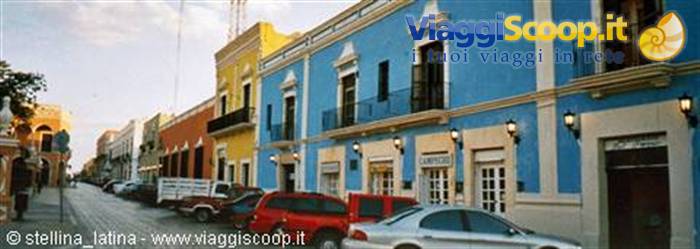
? CAMPECHE Campeche will remain in your heart, visiting it you'll understand why in 1999 it was declared by UNESCO a World Heritage Site. The low and colorful houses combined with the decidedly Spanish stamp give the impression of other times. This is the great secret of Campeche, it managed to modernize without losing that charm of other times. Get lost in the alleys at sunset when the bright colors of the colonial houses flare up and stay even after. I think it gives its best after 5 in the afternoon. Enjoy some Nachos with melted queso in front of the ocean or on a bench in the main square with the illuminated cathedral in the background and the evening life that finds its center here.
The origin of the city is to be sought in the foundation (destroyed, rebuilt several times) in 1540 by Montejo the Younger who encouraged the port development to the point of making it important, even the main port of the Yucatan. On the island in front, however, the pirates settled (French, Dutch and English). For two centuries they built the fortifications complete with cannons, still clearly visible, to defend themselves. In the end, [they] decided to resolve the problem "in
kabah: Chac
Day 520 Mar 2004
CAMPECHE / UXMAL / MERIDA
The awakening was sweet, breakfast a little less so: seated in the elegant lobby we look into the breakfast room to find a free place. There's a tour of French people that has occupied everything. At reception they advise us to wait, they should all leave together in a few minutes anyway. We wait... and finally some places free up, indeed all of them. The problem is that there's nothing left to eat. They've emptied the buffet taking everything away with them (pockets, backpacks, etc.), from fruit to pastries to toast etc. not a piece of bread left, not a glass of fruit juice, not a little jam... we ask the waiter for something to eat or drink, he's left stunned, they have nothing left! In the end he brings us tea and that's it...
So, I wanted to tell all tour participants that it's not necessary to raid everything, that there are also other people in hotels!!! In the end we consoled ourselves by taking a short walk along the ocean. The direction of our trip is Merida but the itinerary includes an interesting stop at Uxmal. We're ahead of schedule and, perhaps because deep down they feel guilty about the car accident the day before, passing by Kabah the guide tells us "if you want, we have time to visit it." We pay the ticket, a few dollars, and go in, we're the only ones, the site is completely deserted.
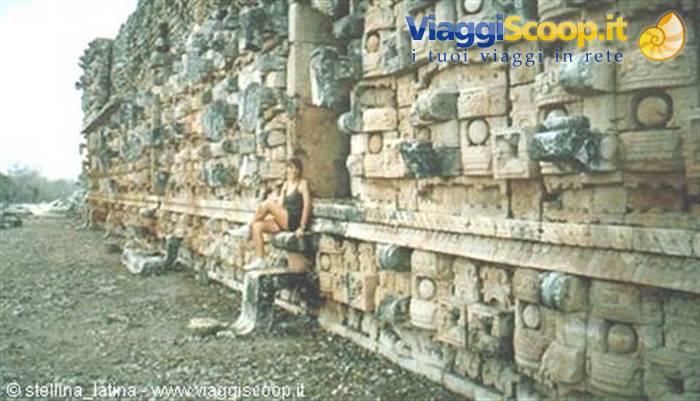
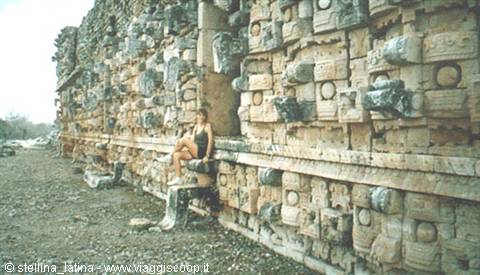
? KABAH Fortunately my paper guide was excellent and thanks to that I decided to go exploring, discovering, at the back, the richly carved wall with the masks of the god "Chaac", the rain god recognizable by his curved nose. Kabah was an important Maya center connected to Uxmal by a large sacbé, a traditional white road that passed through a monumental arch marking the access to the places of worship. The most spectacular architectural complex is certainly the Codz-Poop, a Maya name meaning "rolled mat" and referring to the curved nose of the Rain God, Chaac, on the facade with 250 carved masks. The building in Puuc style appears overloaded with decorations.
On the same platform as the Codz-Poop is the Palace (or Teocalli) built in pure Puuc style - with double columns on the facade and pilasters in the doorways - and equipped with altars and numerous interior rooms distributed over two floors. In the same style was also erected the Temple of the Columns which has in its upper part large panels of columns inserted between projecting cornices. The visit isn't long and we take the mini-van back toward the much more crowded site of Uxmal
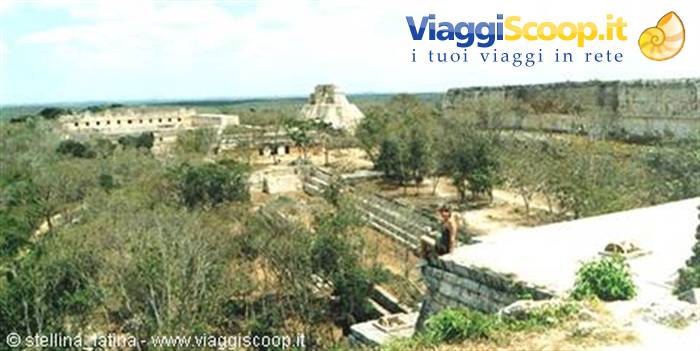
? UXMAL The city, initially founded by the Maya, also underwent occupations by other peoples who added to the god Chaac also the cult of the feathered serpent god Quetzacoatl, of Tlaloc Called "Maya Baroque", the style of Uxmal, known as Puuc, is characterized by abundant decorations that adorn above all the upper part of the buildings. A curiosity is the rope molding, which runs along the buildings and recalls the ropes used to support the walls of the huts..For a long time, Uxmal was among the most populous and flourishing cities of the Yucatán, because water was present there, so scarce in the Yucatan, thanks to the construction of numerous cisterns called chultunes.
The most important and beautiful buildings are:
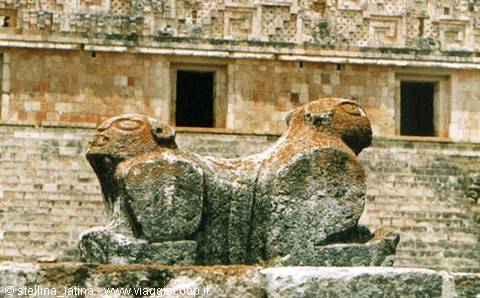
- The Palace of the Governor in which the highest authority of Uxmal lived, is oriented toward the rising of the planet Venus to which the Altar of the Two-Headed Jaguar placed in front of the Palace is also dedicated, and constitutes perhaps one of the most beautiful and perfect architectures of all Mesoamerica. The lower part of the facade is simple and linear, while the upper cornice is densely decorated in Puuc style so much so that on the frieze you can count 260 masks of the god Chaac, as many as the days of the calendar of the sacred year.
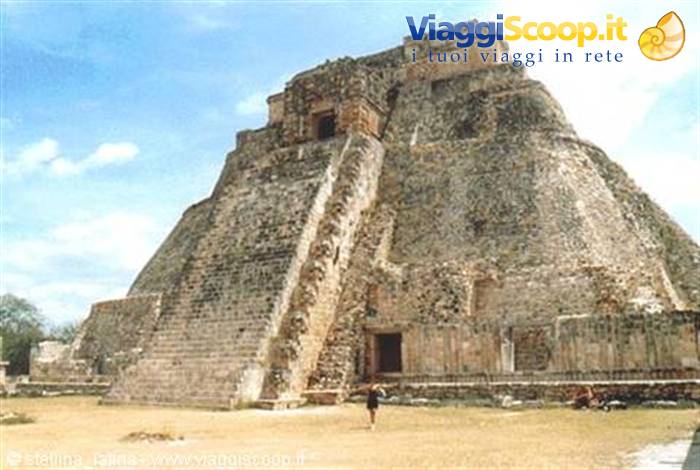
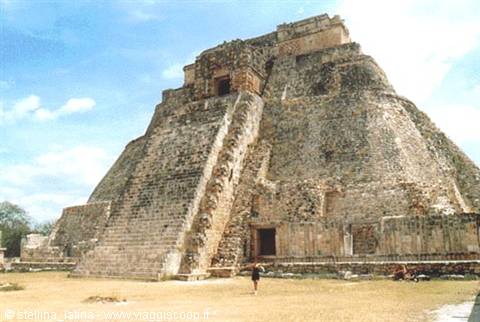
- The Pyramid of the Magician, according to legend was erected in a single night by a dwarf, considered a magical character, with the help of his mother, a woman endowed with supernatural powers. The Pyramid is an imposing building of semi-elliptical shape, 3.5 [sic, actually 35] meters high but unfortunately extremely steep to the point that climbing is now forbidden because too many tourists without the physique have had accidents
- The Quadrangle of the Nuns. The immense courtyard in front of the Pyramid of the Magician is closed on four sides by the splendid buildings of the Quadrangle of the Nuns, called so by the Spaniards due to the presence of numerous cells and the lattice decorations that characterize it. In truth the lattices symbolized mats, reserved for the ruling class whose representatives were also called the lords of the mats. This building is the demonstration of the high technique and refined taste reached by Maya carvers in the art of stone working. The complex was built around the 10th century according to the Maya vision of the universe: the buildings are oriented toward the four cardinal points with at the center a stone column symbolizing the Tree of Life....
- Also very interesting is a well-preserved Ball Game Court in which three stone rings were found bearing engraved the date of the year 649 AD and the house of the Turtles that support the universe.
After this fantastic visit we take the road again heading toward Merida.? MERIDA The city isn't interesting, of Spanish stamp it lived its golden period thanks to the trade of fabrics produced here, strictly white. There are several workshops (I gave in and bought a raw hammock) and for shopping there are several "social houses" that is our cooperatives of small artisans. It's essentially an industrial city. Even the only monument, a Christ saved from the flames several times, is simply a curiosity. Our hotel Del Gobernator, is simple, clean, and we decide to go out in the evening to "visit" the city lightheartedly. We had noticed, in the Localo of the city, which as usual is the hub of all city life, a stage and, curious, we headed there.
In the evening it's a big party: on the stage a famous band plays salsa and I get to know a university volleyball team on an away trip with whom I dance, like everyone else, in the middle of the street. The whole area is transformed into a big party! At night, tired but amused, we collapse in the hotel.
Palenque
Day 621 Mar 2004
MERIDA / CHICHEN-ITZA’ / PLAYA DEL CARMEN
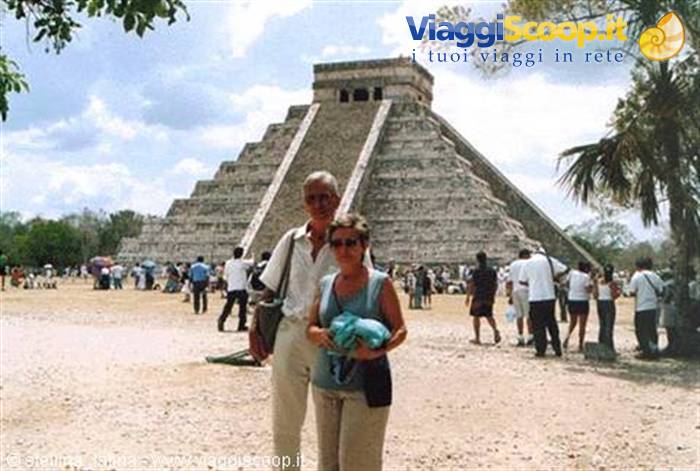
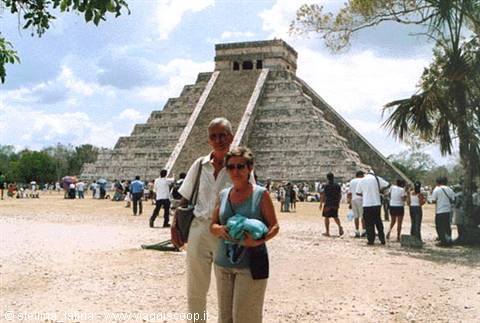
It's March 21st, the day of the Spring Equinox! The trip had been organized so that we would be at Chichen-Itza on this exact day, the day the feathered serpent descends to earth! This time, the 3 Roman gentlemen we had met earlier are with us too. With great excitement we reach this place considered "astrologically magical" by the local population and by various new age religions. We arrive walking along the road from the parking lot, crowded with tourists and locals and enlivened by stalls and musicians who, along the road, paint the scene in bold colors. So we reach the entrance of the site: h e l p!!! But how many people are there?! It seems all of the Yucatan has gathered here. A group of people dressed in white sing and play, others dressed in Maya costumes and others as Aztecs.
Two stages set up for concerts occupy the two opposite sides of the plain that is dominated by the great pyramid. The vegetation is crowded with hammocks and improvised picnics. The festive atmosphere is palpable. To be honest, it feels like being at a real gathering of hippies of various generations (from the '70s ones with guitar and garish shirts, to the new age ones with bells and white tunics). The pyramid, however, is surrounded by a temporary fence put up for the occasion and it is therefore not possible to climb it or even get close. In the front row, the "cameras" of television reporters and newspapers of every kind are aimed.
The event is scheduled for 5:00 PM and, therefore, we take advantage of the waiting time to visit the archaeological site. The site, despite the ocean of a crowd, is very interesting and can be visited well. "The mouth of the well of the Itza", that is its meaning, is the best restored and most famous Maya site, thanks to the majestic Pyramid of Kukulkan, the very one that cannot be visited during the equinox. It has the largest and most imposing ball court in all of Mexico, whose details are very well preserved. Equally imposing is the group of the Thousand Columns, located behind the Pyramid and which includes the Temple of the Warriors and the Temple of Chac Mool, as well as the adjacent Templo de los Grandes Mesas. The sacred "cenote", by now greenish in color, is not as picturesque as one imagines but, it is what it represents that makes it important.
During our tour the sky, a little uncertain, changes and, suddenly, a tropical storm pours down on us. Everyone takes refuge under the "Coca Cola temple" as the bar-hut is nicknamed here and the little streets turn into veritable raging torrents. It's the classic downpour: water by the bucketful for about 15 minutes and then variable again with the sky opening and closing continuously and disrupting the celebrations inside the site with continuous moving of people, instruments, etc.
It is now 2 PM and, having finished the tour, we go to eat in a restaurant near the site. The food is not the best, we are in a full-blown mass tourism area, but it is still acceptable. Sitting at the table with our guide we decide what to do: I push to stay until 5:00 PM to see the famous serpent, the Romans don't want to stay because they prefer to reach the sea earlier. My parents and the guide are hesitant because the weather is very uncertain. In the end I give in and we decide to move on, sigh sigh. In any case, I ADVISE AGAINST VISITING THE SITE DURING THE EQUINOX. In the end I liked Palenque and Uxmal much more. The site is open every day from 08:00 to 18:00, the entrance ticket: 87 pesos.
Having resumed the journey, along the way we leave our travel companions in Cancun while we continue to Playa del Carmen. Our accommodation is in the suite of the Quinto Sol ( ). We settle in and go out right away for a first reconnaissance, in particular along 5th Avenue. The impact is devastating, this isn't Mexico, it's Disney World! Everything is so fake, so constructed. The language isn't Spanish but American, so much so that prices are in US Dollars and not in pesos. From the shops they call out to people to attract attention and sell, considering you "gringos" ugh, just because we're fair-skinned! I arrive at the hotel with my stomach in knots from irritation… but what am I doing here? Where have I ended up? I'd like to catch a plane back so as not to ruin the end of the vacation!
Playa del Carmen
Day 722 Mar 2004
PLAYA DEL CARMEN
Personal reflections: Thank goodness the night is a good counsellor... in the morning I'm more rested, more positive and more willing to understand even this strange world called Gringoland (a nickname given by Mexicans and a very apt one at that). In fact, it feels like being in an American "colony-amusement park." Everything is extremely artificial and it seems as though the Mexicans are part of the setting. Also because they don't seem to be at home: they're not the owners but the employees, and they look with admiration and a sense of inferiority at their employers and at the tourists of, ehm, imposing size—the gringos. It's easy to see scenes of Americans behaving like "superiors" towards submissive Mexicans who try to copy the Americans in their clothing and their eating habits. Mind you, I'm not anti-American, but what I saw, arriving from Chiapas, left me bewildered.
? PLAYA DEL CARMEN The town is actually very charming, all built with respect for the large trees included in the buildings that wrap around them, sprouting out from every side, simulating the jungle. I must say the architects here went wild, showing off their imagination and creating a unique and very beautiful environment. The main street, then, 5th Avenue, is all shops selling typical products, bars with the typical swing seats, and SPAs. The venues (bars, pubs, restaurants, etc.) are truly spectacular themed reconstructions. The atmosphere recreated is warm, welcoming and spectacular.
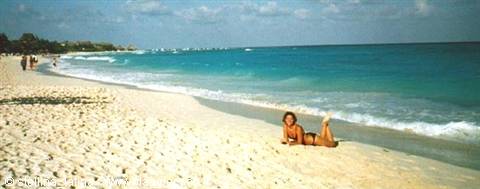
¤ Sea & sun: the sea is beautiful, long white beaches dotted with palm trees are washed by crystal-clear water!!!!
Attention: remember that despite the not excessive temperature, the sun is tropical: USE HIGH PROTECTION! Start with protection no lower than 50/30, only later will you understand your skin's reaction; fine, I'm a mozzarella phototype, but you should know that I never went below 25.
The crystal-clear sea—don't forget it's the ocean, so with a force decidedly different from that of the Mediterranean. Unfortunately it depends on the weather: the week before there was no wind and the sea was dead flat, whereas when I was there the wind had picked up, raising waves—not very high but powerful. Few of us went into the water and, I must say, I even got scared, because the waves were so strong they dragged me to the bottom (I assure you I can swim) but I was "supported" by a "local" guy (an Israeli who had moved there to live and opened a venue) who stayed by my side explaining how to deal with those waves. After 30 minutes I came out exhausted. Ugh, it's not fair, usually the sea here is calm and so transparent you can see the fish.
Also because of the wind we gave up the trip to the island opposite, Isla Mujeres (Island of Women), considered very beautiful. We made up for it, however, by going for the day to Tulum (see further on).
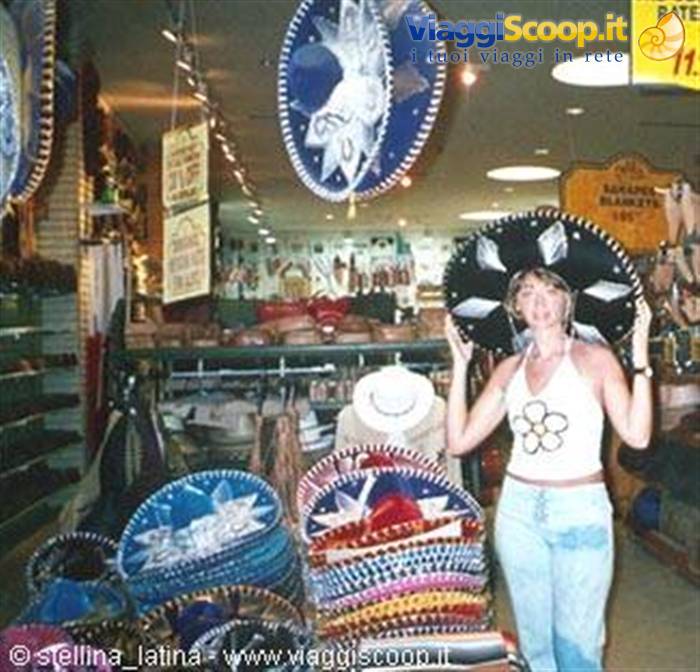
While during the day people devote themselves to sports activities linked to the very white beaches and crystal-clear sea, in the afternoon and evening a multitude of American and European tourists pour along 5th Avenue in search of souvenirs and fill the venues with cheerful chatter. You won't be able to refrain from shopping, also because you'll find ceramics in Mexican colours with the dominant theme of calla lilies, a symbol of the country, very beautiful, as well as a multitude of products including culinary ones (from travel-size hot sauces to liqueurs, above all Tequila).
There are restaurants of every kind: from typical Mexican ones to "natural" ones, for every taste and every pocket. The prices are more similar to American ones than to those encountered in the rest of the country. Everything is dedicated to tourists and, therefore, the prices are appropriate too. If you want to do some shopping, I advise you to do it during a tour and not in the holiday resorts where the tourist is willing to spend more.
? TULUM From Playa del Carmen you just go to the regular bus station and take a scheduled bus (2nd class); I don't recommend 1st class because it costs double and, above all, the air conditioning is on full blast, creating a considerable temperature shock with the outside heat. For a few pesos and a 15-minute ride you comfortably reach the site, the only Maya settlement on the sea. For the return, however, we used a mini-van: a collective taxi that for the same price as the bus took us back to Playa del Carmen. Tulum has three stops: the archaeological site, the pueblo and the tourist town. Tulum in fact is not only an archaeological site, it's a city but divided in two: the inner pueblo, which is poorer, and the tourist town along the coast. Obviously hotel prices are very different!
Tulum is surely the site with the best visual impact: along the high coast on a crystal-clear sea stand the Maya buildings—breathtaking! The position of the monuments sheer above the sea, the very white beach accessible for swimming (bring your swimsuit), the colour of the water an intense azure, the postcard Caribbean palms, the immaculately kept lawn... in short, all of this makes this place unforgettable. In 1518 the troops of Juan de Grijalva landed in this place. Founded in the Maya-Toltec period, it was inhabited until 1544 and then abandoned into Spanish hands. The current name "Tulum" (fortress) derives from the thick walls that surround it on three sides, while the fourth is naturally defended by a steep cliff sheer above the sea; access to the beach is slightly further on.
Unlike many other archaeological sites, Tulum is very ruined and worn away by tourists, so to protect the monuments, nowadays on many of them it's not possible to climb or get too close. The most important building is the Castillo, made up of a terrace and a small temple, reached by a steep staircase. The slit windows facing the open sea suggest that the building was not only used for ceremonial functions but also served as a lighthouse. The Castillo and twenty-two other minor buildings are enclosed in the so-called Inner Enclosure, a sort of inner wall that probably marks the original nucleus of the city. Outside the enclosure, the most interesting construction is the Temple of the Frescoes, adorned with stucco masks. Inside the single room you can see remains of frescoes depicting human figures.
North of the temple, on a platform, stand the remains of a palace consisting of a wing with two parallel galleries, one of which opens onto a portico facing south.? OTHER EXCURSIONS
Exactly halfway down 5th Avenue there's a tourist office, a kind of stall, where they give out free maps of Playa del Carmen, all possible material about the town, all the material for making excursions both by public transport and through packages offered by agencies. Besides parks where you can watch shows such as the re-enactment of the ball game and costume shows, there are also nature reserves where you can immerse yourself among brightly coloured fish. If instead you want to go a little further afield, you can reach suggestive Cenotes where you can even swim (immense round holes in the ground several metres wide where crystal-clear water springs forth; usually you reach them directly from above and the light penetrating to the bottom makes the "cave" atmosphere even more suggestive).
The archaeological sites of Chichen-Itza and also other lesser-known ones are within reach by local bus, but if you're interested there are tours offering a package of 1 or more days with a visit to the sites + a trip to Cenotes + typical restaurants, etc. You can also af
Uxmal
Day 825 Mar 2004
PLAYA DEL CARMEN / CANCUN AND MIAMI
After having breakfast at the hotel we check out and early in the morning we are transferred by taxi sent by the agency to Cancun airport. We then leave for Miami with Mexicana flight MX 311 at 09.50. In Miami the luggage is checked through directly to Milan and we arrive in Miami at 12.20. Boarding in Miami is very critical due to the long personal inspections. The journey then continues towards Milan with Alitalia flight AZ 637 at 17.15. Meals and overnight stay on board.
Uxmal
Day 926 Mar 2004
MILAN
We arrive at Malpensa at 08.15 with Alitalia and get home with the temperature still freezing and with a little tear for the end of the trip....
Villahermosa: the La Venta park dedicated to the Olmecs






0 reader comments