The story
The big day has arrived; we set off on a new adventure towards the mysterious East. Arriving in the great metropolis of Bangkok, as in all Asian places, isn't a very pleasant experience because of the rainy season, which brings a humidity level of a good 90%. I'm lucky, though: the sun rules supreme. Among canyons of concrete skyscrapers and roaring vehicles speeding past with deafening noise, this is the real Bangkok: 12-lane roads and elevated highways. This has been Thailand's capital since 1782, as established by the first king of the Chakri dynasty, Rama I. The name is a contraction of Bang Makok, meaning 'Village of Wild Plums', and the official name in Thai is a kind of tongue-twister. I stay three nights, just enough to see the most important sights. The first visit, and certainly the most beautiful, is to the Temple of the Emerald Buddha, the Wat Phra Kae.
It's an architectural marvel of gleaming golden Chedi (stupas) seemingly suspended in the air, of glossy orange tiles and roofs that pierce the humid sky, of columns clad in mosaics and rich marble pediments. Then I move on to the Royal Palace, used today by the King only for certain official celebrations; without a doubt, looking at such a building leaves you breathless. Fifteen minutes away is Wat Pho, home to the most important Reclining Buddha and Thailand's richest collection of Buddha statues, as well as the national centre for the teaching and preservation of traditional Thai medicine. Crossing to the other side of the river (Thonburi), there's an extraordinary temple, Wat Arun, with an 82-metre Khmer-style tower, built in the first half of the 19th century on the orders of Rama II, highly spectacular.
There's plenty to see around the central area of Siam Square, where the various shopping malls are and where you can find the very latest technology at great prices, and the districts of Chinatown, Phahurat and Banglamphu, where you can shop in all sorts of markets. I think 3 days are more than enough to visit it. After seeing the Thai capital I set off overland for Cambodia; passing through Trat and changing several means of transport I reach the border, I stop at the first little town, Koh Kong, and spend the night waiting for the next morning's coach that takes me to Sihanoukville. It's not the first time I've visited Cambodia; I was there in 2005, when I stopped to visit the Temples of Angkor Wat in Siem Reap. What can I say, a fantastic place: the people, though poor, are helpful and always ready to lend a hand and offer a smile.
Today Cambodians number about 14 million, practically 7 million more than in the period before the genocide perpetrated by the Khmer Rouge, or rather by Pol Pot's organisation, starting in 1975, which according to the parties involved claimed 3 million exterminated victims. To forget the genocide, Cambodians set about having more and more children, at least that's what they told me. Only at the end of July 1997 did the official Khmer radio announce a scoop: the arrest and trial of Pol Pot, whose death came the following year, though it always remains a mystery. After this little historical digression, back to my trip. I arrive at Sihanoukville, a seaside town on the Gulf of Thailand and Cambodia's main port.
Also called Kampong Som, it attracts residents and foreigners alike, who can spend a peaceful weekend resting under the coconut palms on the white beaches, as well as diving enthusiasts who set off to explore the seabeds of the magnificent tropical islets off the coast. On the first day of my visit I take a tuk-tuk and go to explore the various beaches; as an artistic city it doesn't offer much: you can visit two temples and the small port. In the evening, if you're a snake lover, you can dine at The Snake House, a very nice restaurant whose owner is Russian, where you can enjoy typical Cambodian and Russian dishes, naturally without ever being out of sight of these charming reptiles. Ah, I forgot: these are in turn watched over by a crocodile about 1.5 m long. In Sihanoukville I stayed with an Italian friend who owns a guest house.
After three nights I set off for the capital, Phnom Penh, which is a 5-hour journey from the seaside town. The roads are well managed, and as I watch the evocative scenery I snap a few clicks of the camera at the various stilt houses. I haven't mentioned that driving is like in Italy, whereas in Thailand it's the opposite. Phnom Penh owes its name to a certain Madame Penh, who according to legend found 4 bronze statues in a tree trunk floating on the Mekong. To shelter her treasure she built a hill of stones: the Phnom, on which a stupa was built, and the ancient fishing village became the residence of the Khmer kings around the 15th century. I begin my visit to the city at the Royal Palace, which dates back to the early 20th century; its main buildings were commissioned from Khmer and French architects by King Norodom and later by King Sisowath.
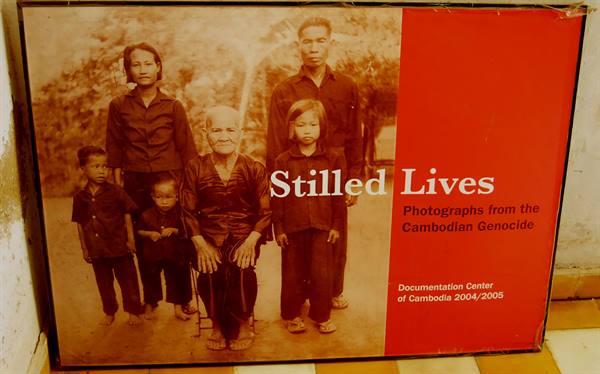
It's extremely charming, with roofs covered in painted tiles, carved lace facades and flowered courtyards with long galleries. Then I move on to a sad reality, the genocide museum or S21, built by the French as a school building and later turned into the most terrible prison in all of Cambodia. Here, from April 1975 to January 1979, nearly 15,000 people were locked up and subjected to the most horrible tortures before being killed by Pol Pot's Khmer Rouge at the Choeung Ek extermination camp. I visit it, but I prefer not to talk about this harsh reality. That doesn't mean pretending nothing happened, though, and anyone who wants can grasp such atrocities by looking at some photos on my website that are worth more than a thousand words. There are also various pagodas and temples to visit; very beautiful is the Silver Pagoda at Wat Phnom, atop a small hill 30 m high.
Not to be missed either are the various markets, from the central one with more than 2,000 stalls to the Russian one, which enjoys tourists' preference as it's better stocked if you want to buy all sorts of souvenirs. Very nice, too, are the boat trips on the Sisowath river. If you're looking for nightlife, though, here, as in most Eastern countries, you're out of luck. You have to make do with the typical 'tourist' venues. After spending a week in such an exciting country, I leave beautiful Cambodia with a heavy heart and return to Thailand with a flight to Chiang Mai. One of the many questions Thais usually ask a visiting foreigner is: 'Have you been to Chiang Mai yet?', as if to stress that it's a must.
The old city is a precise square bounded by canals and remnants of walls, where you can visit many important temples, among them Wat Chiang Man, built in 1296, a typical example of traditional northern architecture with mighty teak columns, and Wat Phra Singh, begun in 1345 by King Pha Yu and completed between 1385 and 1400, which houses the statue of Phra Singh.
The journey's photographs
5 photographs · click to open them full screen

0 reader comments