The story
Here is my first trip outside Europe, apart from the humanitarian mission I did in Somalia in 1992... > Departure is on 28 July from Bologna, with a stopover in Rome, to take Air China flight CA 940, a Boeing 747, arriving in Beijing on 29 July... > I had never taken such a long trip, but I had no problem at all, in fact...I'd do it again right away!!! > You may ask: "Why China???". Simple: because it has always attracted me and, for now, I prefer to visit the East first... > On arrival in the great capital, Beijing, which has 10,000,000 inhabitants and 8,000,000 bicycles, the climate is awful, with 95% humidity and an inexplicable blanket of smog...
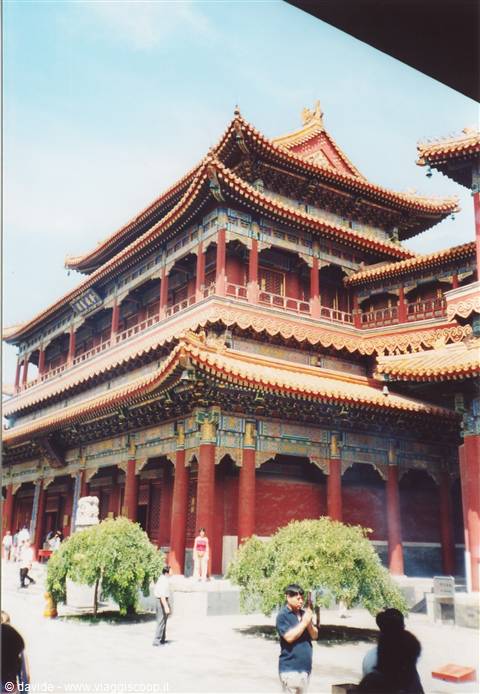
> The first visit is to the Temple of Heaven, unique in the world for its structure and meaning, and today a park where, in the shade of centuries-old pines and cypresses, young and old gather early in the morning to practise traditional gymnastics, "Taijiquan", or to have their usual picnic... The complex was built at the same time as the Imperial City (1406-1420) and was meant to be the place of ritual contact between heaven and earth (heaven was considered round by the ancient Chinese and the earth square: odd numbers were reserved for heaven, the sun and the Emperor). > A recommended itinerary tells me to see, as a priority, the Circular Altar, the Imperial Vault of Heaven and the Temple of Prayer...I'd say it's really worth it... > Then I visit the Temple of the Lamas, literally the Palace of Eternal Harmony: one of the largest and best-preserved temples in the capital.
Originally it was the palace of Yangzheng, fourth son of the Emperor Kangxi (1662-1723). Attached to the temple is a monastery, which houses 300 Lamaist monks (followers of the Dalai Lama) and 200 students, Chinese and Tartar, engaged in the study of the dharma, mathematics, rhetoric and medicine. Going out towards the north there is the Hall of Eternal Protection, with the Buddha of Longevity and, to his left, the Buddha of Medicine... > On 31 July, early in the morning, I go to visit the largest square in the world, which extends 800 metres in length and 500 in width, whose name is "Tiananmen": it houses the portrait of Mao Tse Tung and is much publicised by the TV news. > I then enter the monumental, gigantic, elegant, splendid Forbidden City. This whole complex covers an area of 5 sq km and dates mainly to the 14th century.
The palace is surrounded by a 50-metre-wide moat, still full of water, where today people go boating, and by a 13-metre-high wall... To visit the Forbidden City you need at least 2 hours, but it's worth it, even though it has been partly rebuilt... > One of the most characteristic alleys of Beijing is Dazhalan: in it you can admire 17th-century houses, some of them decorated with multicoloured stuccoes. > I move 20 km north of Beijing to visit the Summer Palace. I then move on to the Ming necropolis, or "Shisanling", which literally means "the 13 tombs", located on the Tiansaeshan hills... > I haven't said something very important: in Beijing restaurants close very early, usually around 20.00... > The next morning I head 64 km from the great city to see the Great Wall at Badaling, which the Chinese call "Wang Li Chang Cheng".
It is the only work made by man and visible to the naked eye from the moon; it is, in fact, a full 6,350 km long, as the crow flies, from its westernmost point (Jiayuguan pass in Gansu province). The Great Wall was indeed a work of defence against the Mongols, but also a fortified road, which allowed rapid movements of goods, for trade, and of defence forces. Words and comments are not enough to describe this work... everything speaks for itself as you look at it... At the main entrance there are several very characteristic little shops, which sell miniatures of the Wall and many other small souvenirs at truly modest prices... Not to mention the improvised kitchens, where for 2 dollars you can have lunch!!! > There are also some rather "peculiar" fishmongers, which leave me very puzzled... You may wonder why...
Simple: inside, on one side they sell fish and on the other...you can choose your own nice little snake, naturally alive, ready to go in the pot!!! > On 2 August I leave, on an Air China flight, for Xian. This city is the capital of Shaanxi province and lies, at 466 metres of altitude, in the Guanzhong plain, south of the Wei river, and has 6.5 million inhabitants. > The first visit I make is to the Ming Walls, which have largely been restored and brought back to their ancient splendour. They have a perimeter of 12 km, are 12 metres high and between 12 and 14 metres wide at the top and between 15 and 18 metres at the base... In my opinion they are worth seeing; the inner city, on the other hand, is not... > Very particular is the Forest of Steles, attached to the Temple of Confucius.
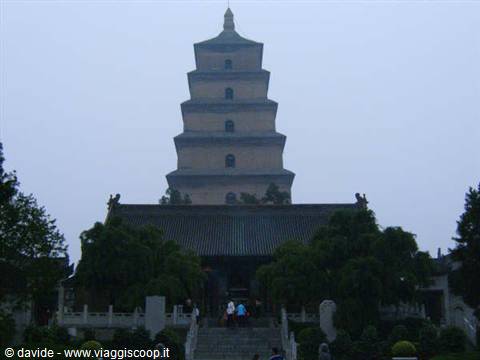
These steles bear Buddhist canonical texts on Kaicheng stone, as well as historical texts, treatises on art and philosophy, criticisms of artists and painters and entire anthologies... > Moving south from the Ming Walls, I visit the Great Wild Goose Pagoda and the Temple of Good Will, which date back to 647 AD, then restored in 1580...but, honestly, I think some retouching has been done recently, because it's all too perfect... > In March 1974 (the year I was born!!!), the peasant Yang Zhifa, trying to dig a well to draw water for irrigating the fields, found the terracotta head of a warrior, 5 metres deep, a kilometre and a half east of the imperial mound of Qin Shihuangdi... So, 2 years later, in 1976, archaeologists began digging inspection wells and the archaeological discovery of the 20th century came to light: the Terracotta Army.
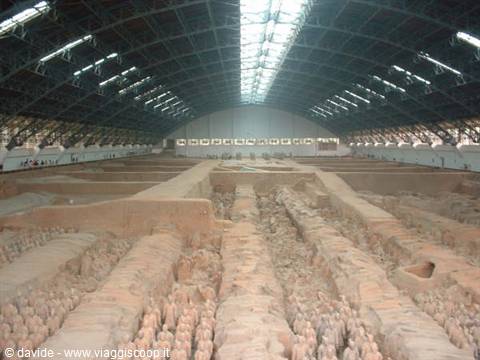
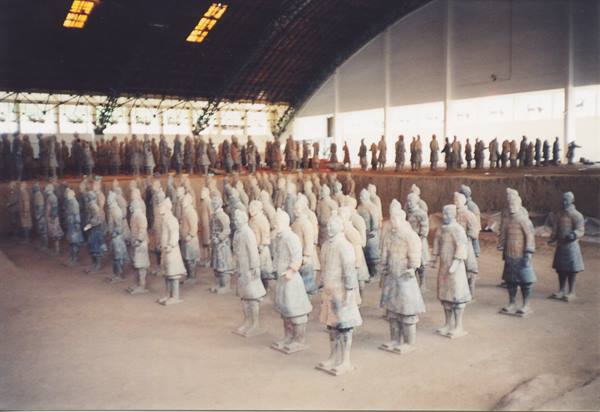
> The complex has been protected with an immense hangar and photography is not allowed. In 1987 UNESCO included the complex on the list of human cultural heritage. > There are three pits, each containing part of the Terracotta Army, at true human height... The first pit is 5 metres deep, 230 x 62 metres wide, for a total area of 14,260 sq m. It contains 6,000 warriors between 1.75 and 1.97 metres tall, who were certainly part of the imperial guard, given the stature decidedly above the Chinese average... Three rows of 70 crossbowmen and archers each open the phalanx on the eastern side and, behind them, arranged in 36 rows of 150 warriors each, are the various squads, each of which is arranged in 4 rows and is assisted by a chariot mounted by a charioteer and an archer and drawn by four horses (2 metres long and 1.5 metres high at the fetlock).
> The second pit is "L"-shaped and is the most interesting. It was opened to the public in November 1994, is 6,000 sq m and contains an army made up of 3 battalions: one of infantry, one of cavalry and the armoured guerrillas, for a total of 900 warriors... The interesting thing is that each warrior is different from the others: the hairstyles seem to have been done in a hurry and the uniforms and the make of the armour vary, underlining that the imperial guard was made up of fighters from the various armies from all over China. > On leaving the third and last pit I pass by the classic little shop selling souvenirs and, as a memento, I buy two terracotta statues representing two warriors, naturally of reduced size, too
The journey's photographs
5 photographs · click to open them full screen

0 reader comments