Day 11 Jan 2006
Sharm
From the coral mountains rising from the seabed to the low reef teeming with fish, from the steep underwater walls dropping to unfathomable depths to the wrecks of ships covered in coral, we arrived in the Red Sea, to be precise at Sharm el Sheikh, after a journey lasting a little over 4 hours. As soon as we arrived we immediately noticed the difference in climate: we had left our 0° behind to find 23°, considering that here it's 10 p.m.... The time difference between Italy and Egypt is one hour ahead and the local currency is the Egyptian pound, the exchange rate being 1 euro = 7 Egyptian pounds. About 20 million years ago, Egypt, Sinai and the Arabian Peninsula were joined in a single block.
Then enormous upheavals of the earth led to the separation of the lands, and the southern part of Sinai remained isolated, giving rise to two great gulfs: to the west the Gulf of Suez, whose maximum depth is just 95 metres, and to the east the Gulf of Aqaba, which instead reaches a depth of 1,800 metres. This latter gulf is part of the great earth fissure, called the Rift, which extends from the Taurus range as far as Kenya. The great seismic activity of the past and the tremendous eruptive phenomena gave southern Sinai its characteristic imprint; its most important peaks are Mount Moses, which reaches 2,285 metres, and Mount Saint Catherine, at 2,642 metres, the highest of the whole peninsula. The shuttle bus from the airport takes us straight to the village, which is located at Sharm el Sheikh, more precisely at Sharm el Maya Bay (the bay of calm water).
The next morning, as soon as we woke up, curious, we went straight to have a look at the sea and to see the sunrise we'd always heard about... The first two days are dedicated exclusively to pure rest and the countless walks along the bay... Everything is so relaxing, especially when you think of the cold back in Italy... Here, around 1 p.m., the temperature is 29°... what a sight!!! Here snorkelling is a must, but as we don't swim very well, we decide to take a boat with a glass bottom... so we enjoy a spectacular underwater view of the coral reef, with its dozens of coral formations populated by lively colourful fish. The sea beneath us is an incredible, endless blue, intense and luminous, with an unspoilt reef animated by thousands of fish... The real excursion definitely begins with the first trip to the monastery of Saint Catherine and Mount Sinai. We set off around 6 a.m.
and, after passing various checkpoints, we take the road, surrounded by desert, from which you can admire breathtaking scenery! To reach the monastery from Sharm takes two and a half hours of travel... Set between the foothills of the protected areas of Nabq and Ras Abu Gallum and the Wadi Fayran, this territory, 4,300 sq km of high mountains, includes the Christian monastery of Saint Catherine, the rocky peak of the holiest Mount Sinai, the highest mountain in Egypt, Mount Saint Catherine, and the Saint Catherine protectorate, opened in 1996. The monastery is a Greek Orthodox convent founded in the 4th century and has a double peculiarity: it is the smallest diocese and the oldest monastery still active.
The Empress Helena, wife of Constantine, ordered, in 337 BC, the construction of a chapel at the point where, according to biblical tradition, the burning bush had appeared to Moses (the tree that miraculously caught fire but was not consumed). In the 7th century, the prophet Muhammad himself is said to have guaranteed the protection of the religious centre. Over time the guards gradually converted to Islam and the monks grew fewer and fewer, until, it is told, in the 8th century the intact body of Saint Catherine of Alexandria, martyred in 395 AD, was discovered; the saint's remains are said to have been placed by angels on the summit of the mountain that today bears her name. The Ottoman Empire too chose to protect the monastery, exactly as Napoleon Bonaparte did.
Having become an autonomous religious structure, today the monastery houses 22 monks under the authority of an archbishop and a council. Built at a height of 1,570 metres, at the centre of a narrow valley dominated by dizzying peaks, this fortress with its imposing walls 10-15 metres high and 2-3 metres thick reveals itself at first glance as mysterious, if not downright anguishing when darkness falls. Given the influx of visitors, today the monks have limited access to the main church, built around the point where the burning bush is said to have appeared, and to Moses' well (in which, miraculously, there is still water today), excluding the treasury, the museum, the library and the refectories from the visit. Inside the walls there is also the ossuary, where the bones and skulls of deceased monks are grimly kept, along with the relic of Saint Stephen, protected by a glass case.
The peculiarity of this monastery, which makes it unique in the world, is seeing a bell tower rise higher than a muezzin's tower. Inside the walls, in fact, besides the Orthodox monastery, there is a mosque, built by the monks to prevent the demolition of the whole monastery, ordered by the emperor Constantine, who wanted the destruction of all Christian places of worship. In this way, in fact, the monastery of Saint Catherine had become a place of worship not only Christian but also Muslim. A holy place for Jews as much as for Christians and Muslims, Mount Sinai is said to have been climbed by the first prophet, Moses, who here received the tablets of the law (the ten commandments). Archaeologists still wonder whether Mount Sinai corresponds to the biblical Mount Horeb. The landscape is very particular, especially if you travel the route on the back of a dromedary...
Leaving the monastery and after lunch, we head toward Dahab, also known as the “Koh Samui” of the Red Sea. Dahab, which in Arabic means “gold”, is located between Sharm el Sheikh and Nuwayba. This delightful little town is the favourite spot of divers and of all those who love to immerse themselves in an atmosphere steeped in Bedouin culture, simple and relaxing. A true hippy refuge, according to the nostalgic. Here the culture of the 1970s met the way of life of the Bedouins. Careful: in Dahab the water is not drinkable and seems to cause new cases of hepatitis every year, so it's advisable to drink water from sealed bottles. We stop for a couple of hours to relax and do a bit of shopping; naturally, prices here are lower than at Na'ama Bay.
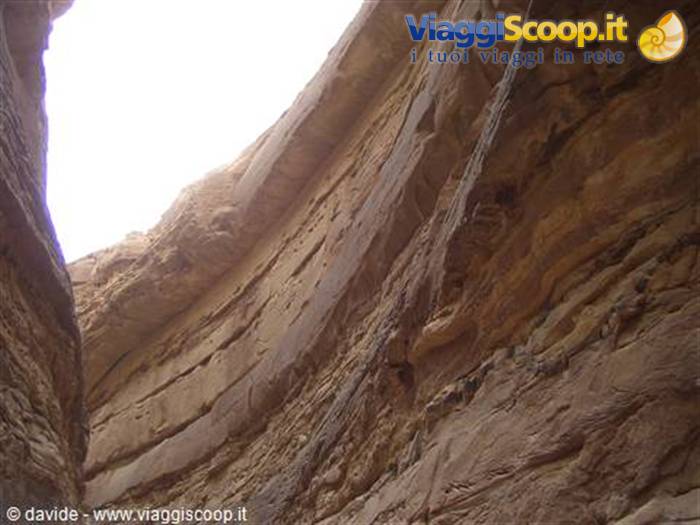
Along the promenade, called Assalah, bedouin-style restaurants, dive centres and beaches follow one another, where anyone tired of lazing in the open-air bars on the beach can enjoy a wide variety of activities, both in the water and on land. After a whole day of excursion, a little tired, we return to our village to rest and prepare, for the next morning, for another exciting visit, not before however having taken a little stroll to the Old Market of old Sharm, which takes only 10 minutes on foot from our village... The following morning we set off at 6 a.m. in a 4x4 for one of the natural wonders of Sinai: the majestic Coloured Canyon. To get there takes 3 hours of travel, of which the last half-hour is off-road in the desert. Among other things, it's a road with a signposted route to follow, because there may be unexploded mines. Once there, the panorama is spectacular and the s
12 photographs · click to open them full screen


0 reader comments