Once again with our most trusted driver, Mejet, whom we met on a previous trip, we set off in search of the Tsaatan people on the border with Siberia, in the northern region of Lake Khovsgol
PRACTICAL INFORMATION READ MY PAGES AT:
Day 120 Jun 2004
MONGOLIA: IN SEARCH OF THE REINDEER PEOPLE
First the immensity strikes you, then the silence, and finally these almond eyes reduced to simple slits to better appreciate the distances in that ocean that changes according to the whims of the weather. We are back in the land of Genghis Khan in search of the reindeer people. But before meeting them we have an important appointment...
The drum rumbles in the small wooden hut where darkness reigns, the ceremony is about to begin, the great shaman of Tsaagan Nur Sun has agreed to practice his art for us. We have come to ask him to implore the gods for the success of our trip to the Tsaatan. Our offerings, vodka, cigarettes, various sweets and a few banknotes are welcome and displayed on the altar. Prayers, magic, spells, litanies, songs, gestures, the shaman drives out evil spirits and implores the gods to join him in his trance dance. At every phase of the rite his wife and sister take part with movements repeated a thousand times. Suddenly the shaman begins to spin, the rhythm accelerates: the shaman is possessed! A few seconds later he is quiet again but his posture and his deeds are no longer the same: by now he is inhabited by a powerful spirit.
The die is cast, three people are chosen from the assembly, among them our driver friend who doesn't know whether to feel honored to accompany the shaman in his delirium. We are glad not to have been chosen, but we didn't imagine that soon our turn would come and we would be flagellated with the long ribbons of his blue cloak, we would receive on our heads the short but sturdy wooden stick he uses to play the drum. We wonder what is about to happen: the shaman seems to have a preference for one of us, he passes his stick over her body several times, striking her stomach hard, asks about the symptoms she feels and finally performs special spells to free her from demons.
I too had the same treatment but in a less violent form, an elderly lady is thrown to the ground from the stool on which she was sitting, our driver as penance will have to abstain from alcohol for seven days, to a child who was doing his homework instead of paying attention to the great master's magical evolutions, the shaman spits in his ears... Finally the drum is heard again insistently, the satisfied spirit is ready to return to its universe and to return the borrowed body to its rightful owner. After a thousand twirls his wife begins to undress him, one by one, of his ceremonial clothes, when suddenly the shaman falls to the ground and only the smoke of an ember sprinkled with beneficial herbs, placed nearby, will bring him back among us.
We share the vodka and biscuits with the assembly, the rest is distributed to the neighboring families, the shaman assures us that we all enjoy excellent health but that our friend must cover up well and consult a modern witch doctor. We set off again with the certainty of having been blessed despite the wrath of the gods because the ceremony in our honor took place during the day and the divinities, as we know, prefer the deep dark to express themselves...
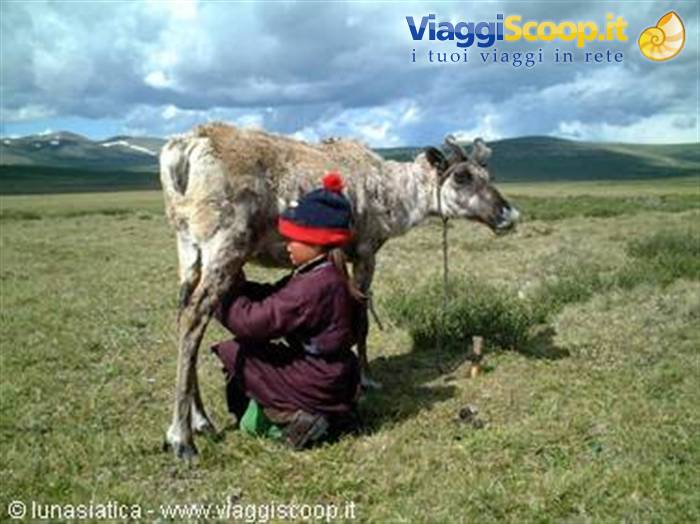
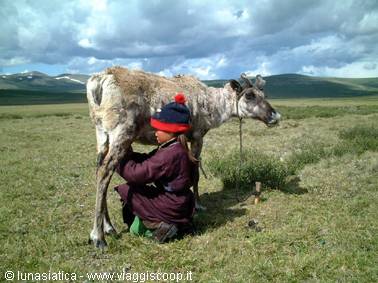
milking the reindeer
Day 220 Jun 2004
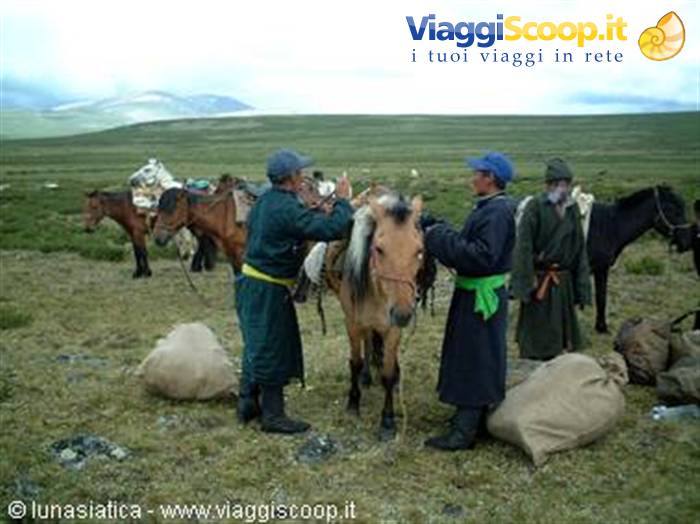
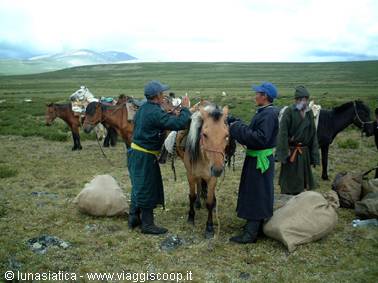
On a morning that struggles to dawn, our caravan made up of about ten horses set off to reach the Tsaatan tribe. I had put flowers in the mane of my horse, called for the occasion Genghis Khan. Our bodies dance following the rhythm of our steeds, the steppe like an endless film, with no horizon you can touch with your finger, passing before our eyes. Only the noise of hooves and the neighing disturbed at intervals the quiet of these magical places, then silence closed behind us to better erase our tracks: the steppe must always remain untouched. Drunk with freedom, intoxicated by pure air carried by the zephyr of the steppe, a song rises from the depths of the earth: it is our guide singing his love for his horses and his homeland. Deep sounds burst from his throat to fly triumphant to the blue of the sky; never had we known such fullness, nor such harmony with nature.
And when the music left its last chords to the light air we remained motionless, thinking we could thus stop the moment, prolong this present to infinity. Here, even music reflects the deep soul of Mongolia, the notes communicate totally with nature. Bare mountains, wooded, flowering, broken, stony, snowfields, torrents, narrow and tortuous passages where our luggage gets caught and our knees get scraped, almost invisible paths where even a Tibetan goat would hesitate to lead its offspring. We must, however, continue in that mineral and vegetable universe toward the climb so steep, the ground so slippery, soaked and muddy that we struggle along with our horses, who sometimes sink up to mid-thigh. Impression of vertigo.
And if time didn't exist? And if this life far from everything but so close to nature were the truth? And if these nomads (and reindeer men) had found the key to living outside of time in the present? White clouds like snow play with the sun, drawing arabesque shapes on this sea of grass or stones; we approach in silence so as not to intimidate the reindeer men and finally, as a reward, behind yet another mountain, here are the first urt, similar to the tents of the Redskins, with their blue smoke, offering themselves to our sight; our senses go on alert: what welcome will the Tsaatan give us? Our fear is soon forgotten; they immediately worry about serving us hot food to warm our aching muscles, they bring us wood and help us pitch our modern tents in which we freeze during the night.
Our climb concludes after ten hours of long effort in the realm of the snow deer; here the reindeer have supplanted man's noblest conquest (the horse) in the heart of this tribe: life is organized around and depends totally on the reindeer. Children of a magnificent but hostile nature, the small Tsaatan people are disappearing and silently ask for help. West of Lake Kövsgöl, there where the steppe gives way to the taiga, in a land furrowed by countless rivers, where winter is extremely harsh, lives a small and very ancient nomadic people. This tribe of about 200 souls in total symbiosis with their animals, so much so that the Mongols have called them reindeer people, from the words tsaa buga, snow deer, and tsang, people.
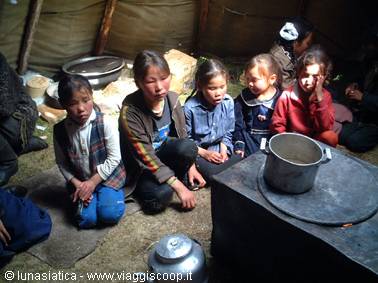
Their survival depends, in fact, entirely on the reindeer: their meat and their milk, four times richer than cow's milk, represent almost the only products they feed on. The skin is used to make footwear and headgear, the antlers cut directly from the live animal, highly prized as an aphrodisiac in Chinese pharmacopoeia, are used as barter goods to obtain essential products such as rice, flour, tea and salt. The Tsaatan have preserved their ancestral traditions and practice shamanism. They venerate and fear the spirits of sky and earth and respect the ancient funeral rites. Children learn everything by imitation, observing adults doing their work; even the youngest know how to tend the herds, and thus prepare themselves to face the hard life of the tribe and the annual migrations.
As for all the peoples of Central Asia, nomadism is not caused by the need to find new pastures—in these boundless lands grass is not lacking—but nomadism has a profound spiritual meaning linked to the cycles of life that allows the relationship between earth and sky, between the visible and the invisible. The Tsaatan have given up a easier life in the village of Tsagan Nur; to comfort they have preferred to live their culture and spirituality unchained, they have chosen freedom. But the struggle is unequal, now that they have been forbidden to graze their herds in neighboring Siberia, brucellosis decimates men and beasts and if nothing is done in a few years this people of distant roots will be only a memory.
And on the way back, setting off again toward new sublime landscapes and unforgettable encounters, we think for a long time about the reindeer men hidden down there in the forests bordering Siberia, who gave us a formidable lesson in humility, they who struggle every day for a precarious survival, tenaciously preserving the value of freedom.
Graziella (angy8@bluewin.ch) NB: the driver can be contacted at: mejet69@yahoo.com or
for Tsatan guides:
practical information on my pages at:
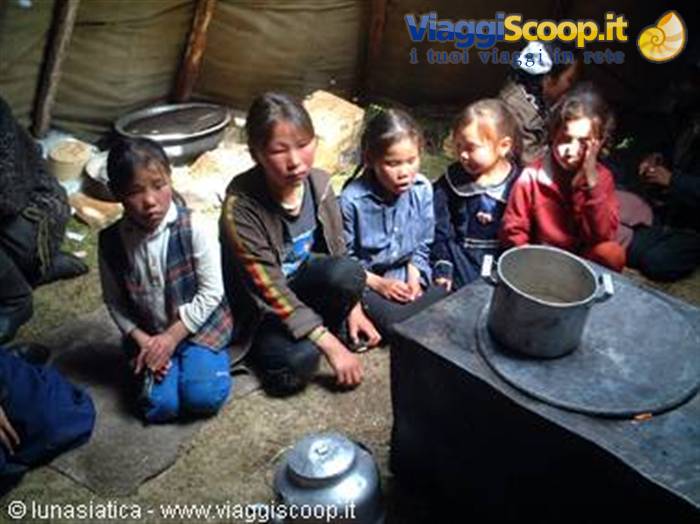
Tsaatan children
Day 320 Jun 2004
TSAATAN:
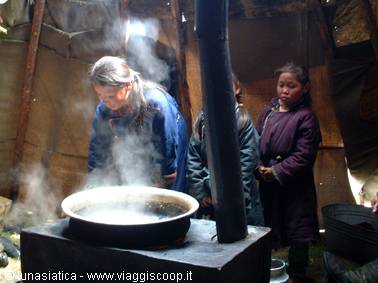
This tribe lives in one of the most remote regions of northern Mongolia, among the mountain forests of the taiga inaccessible to mechanical vehicles: the only way to reach the Tsaatan is by horse. They are nomadic reindeer herders and live in tents (urt) supported by poles and covered with cloths very similar to the tepees of the North American Indians. For the Tsaatan the reindeer is everything: food, clothing and transport. Their diet is based almost exclusively on milk and its derivatives. Their community is made up of about 40 families and 800 reindeer; now thanks to an Italian association the reindeer are doing better; brucellosis has damaged the health of the herds and of the people because they can no longer have contact and go to graze their animals with their brothers in the neighboring republic of Tuva in Siberia.
From mid-June to mid-August the Tsaatan tribe lives 1 or 2 days by horse from Tsaagan Nur Sun. Before and after, the camps are farther away and hidden in the forest. Made up of no more than 40 families, this tribe lives almost exclusively from reindeer herding and lives in huts similar to those of the American Indians. These very poor families struggle every day for their survival and if you decide to meet them it is strongly recommended to bring some foodstuffs in order to improve their lives. You can buy everything in U.B. before departure or complete your purchases in Mörön and Tsaagan Nur Sun. It is advisable to buy an equal amount for the families you intend to visit (from 5 to 10 depending on your stay) Shopping list (ask your driver for advice): v Rice, flour v Tea, salt v Tobacco and cigarette paper v Toiletries: soap, toothpaste, toothbrushes, comb.
v Fabric to make dels, clothes for children. v Candles, lighters, matches, pens, notebooks, playing cards, children's games, T-shirts, thread and sewing needles v Newspapers used to dry dishes, as cigarette paper. v plus all the items mentioned in the chapter: overnight stay under the ger
ATTENTION: have a trustworthy guide because for some time there have been dishonest guides who will make fun of you by taking you into the taiga and after a few hours will tell you that the camp has moved and that by now it's better to return to the valley!!! Do not hesitate to report these practices to the Police of Moron and to your driver upon your return. Ask for the horse guides Bayna and Orcher at the guest house of Tsagan Nur Sun
PREPARATION FOR THE HORSE TRIP TO THE TSAATAN:
1. tent with DOUBLE ROOF (risk of rain, snow or ice) 2. sleeping bag for high mountains (minus 30 recommended) very very cold nights 3. warm clothing because the weather changes rapidly (dress in layers) provide spare clothes in case of rain 4. warm gloves, woolen hat, scarf, cap and raincoat (avoid the cape because if there's wind the horse may be frightened by the movements of the cape) 5. warm socks, tall and sturdy shoes (boots can also be bought on site) 6. riding pants or wear cycling shorts under your pants which will soften the contact with the saddle. Never wear briefs under the cycling shorts or the riding pants to avoid the rubbing and cutting caused by the elastic bands 7. sunglasses with a cord (in case of falling from the horse), sun protection cream 8. repellent against flies and horseflies 9. for the stops: dried fruit, energy food, water 10.
not very fragile luggage, rather small and waterproof so it can be easily loaded onto the horses. Provide sturdy jute or canvas sacks for your luggage as well as rope to tie them 11. provide a minimum of food for your stay with the Tsaatan; you can ask for water and cook at their place but know how to share. 12. anti-chafing ointment, provide painkillers and anti-inflammatories (idea: in the morning before leaving take a painkiller to reduce the feeling of broken bones) 13. knowing how to ride a horse is not indispensable but taking a few lessons before leaving will allow you to enjoy the trip more 14. for your guides: cigarettes and lighters and knives
Other information: angy8@bluewin.ch
Horse guides: in Tsagaan Nur Sum ask for Bayna and Orcher at the Nammun guest house Driver: Mejet: mejet69@yahoo.com or contact in English

0 reader comments