MONGOLIA: IL VOLO DELL'AQUILA
Since the dawn of time the existence of mal d'Afrique has been known, but few know of the nostalgia for the Mongolian steppes. What is this feeling that arises from so far away and veils our gazes with melancholy at its mere invocation? Where does it come from? Perhaps those horsemen who devastated Europe accompanied by the infernal noise of their hooves have left their genes in our veins?
It is physical, this sensation felt from the deepest part of our being before the immensity is so strong, before this infinite green sea, so similar yet so different with every wave that comes to die on the moorland. Here no violent movement, only when Salik* amuses himself by playing with the blades of grass, the source of life for the horses and flocks of the nomads, a slow and graceful movement makes that green carpet sway where the harmonies of the morin khur, the horse-headed violin of the Mongolian people, blend together.
For the third time our steps tread that magical land... that steppe that knows so well how to clothe us in infinite emotions.
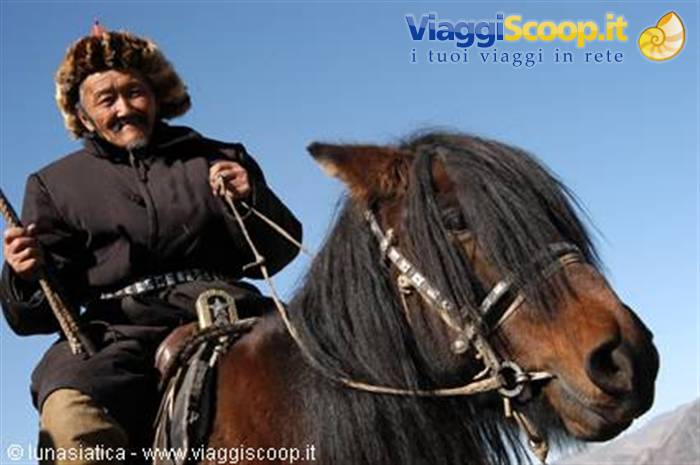
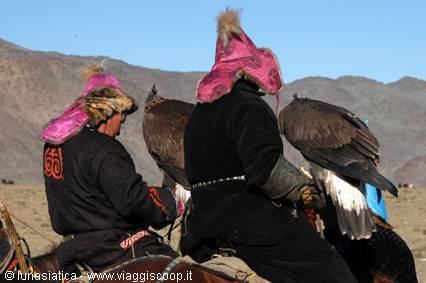
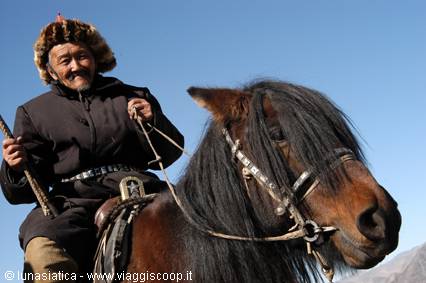
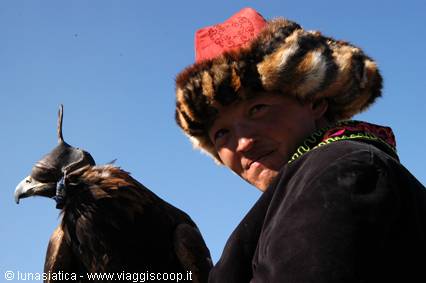
A yurt pops up like a mushroom in the middle of nowhere. Another, very far away, barely visible. No trees. Tufts of gray grass, slender, in a lunar landscape. Down there hills of an ochre color sway towards the snowy mountains of the Altai that tower above three countries: Mongolia, Russia and China. We are at the extreme west of Genghis Khan's territory, in the province of Bayan Olgi. This morning, under the wind that the sun cannot warm, the men leave their round tents, on horseback, by motorbike or on foot. Wrapped in very warm coats, wearing their boots, sporting the traditional Kazakh head covering in silk all lined with fox fur, they have an appointment with the eagles, their eagles. Today the honor and the ancestral know-how of their masters can, with a flap of the wings, fly away or earn the utmost respect from the clan of the falconers.
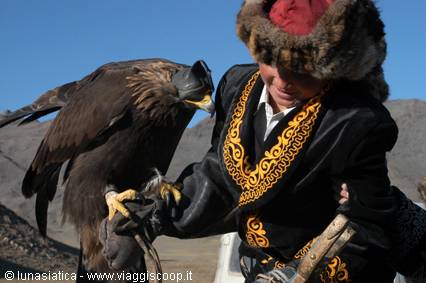
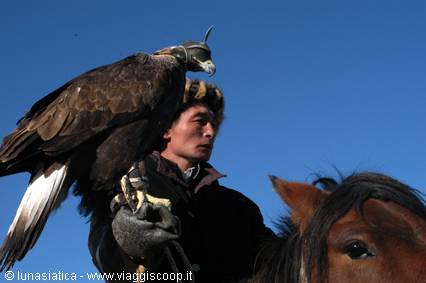
Eyes ready to face the scorching sun and capable of detecting the slightest movement in the immensity, the Kazakhs have been riding across the steppe for several generations. It is in the Altai region where one can meet those who have best preserved the art of falconry. The Kazakhs capture their eagles when young, only one specimen per nest and always a female. The eagle remains with them for about seven years before regaining its freedom to allow it to reproduce. Years during which man and bird depend on each other: the eagle receives food from the Kazakh's hands, in return the Kazakh recovers the eagle's prey, especially foxes and marmots, from which he obtains the fur he wears or sells.
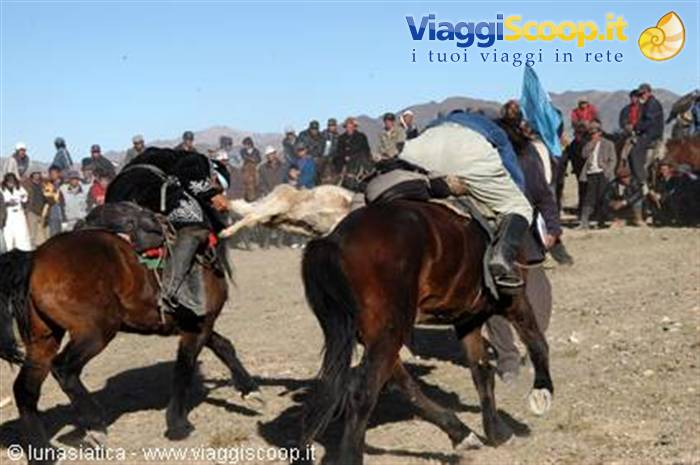
At a charging pace, their eagle towering on their arm, all the decorated falconers begin to circle several times around the makeshift stadium in that remote corner of the steppe and the rhythm of the ride is unleashed following the music. The tournament is open!
Despite their fatigue, without forgetting to make their silver trappings sparkle in the sun's rays, the horses approach one by one; they know very well that victory will also depend on them. For the competition traditional clothing is de rigueur and on its master's right forearm the impassive eagle lets itself be admired, trembling at the thought of making a bad impression on the jury; it has trained so much for this. For him, so proud and real, during the next forty-eight hours there will be no rest and if he wants to hear the echo of his victory in the steppe again he will have to stay on the alert so as not to miss the hour of glory. Concentration is at its maximum among the eagles; from the hill from which they must launch themselves they anxiously await the call of their master to open their wings and show the fastest and most elegant flight of their lives before landing on his arm.
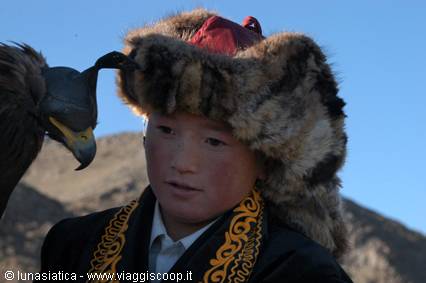
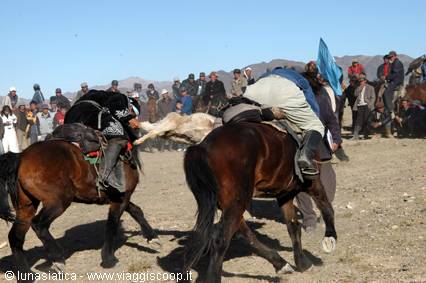
Some will just do their own thing, wandering off to the great despair of their owners in the surrounding mountains. We cheer for our favorite, that of the youngest falconer, 12 years old, present with his father who taught him all the art of falconry, just as his father in turn had done with him so long ago now. Responding instinctively to his shout, with a very fast and majestic flap of the wings, he will go and settle on his young master's gauntlet, securing him an excellent score. After a night spent conferring on everyone's chances, the eagles, watching the various Kazakh equestrian skill games, wait on the top of the mountain to be able to swoop down on the fake fox dragged by its owner behind his horse, thus demonstrating their own ability to hunt prey. Hoarse and wild cries echo across the steppe, crashing against the surrounding mountains.
The Kazakhs urge their eagles to assert their abilities. For the inattentive pupils the hour of the last chance is striking. Some will call their birds in vain with desperate accents in their voices, others, rascals, will at first disdain the fake fox before deciding to catch it, but others, like our favorite, will be luckier and will land on it flapping their wings with pride, not forgetting to demand with shrill cries a bit of rabbit meat, of which they are so fond, before agreeing to abandon their prey.
The distribution of prizes will take place in a joyful disorder while up there a latecomer hovers, playing with the air currents, rising and falling in a pure sky. He takes his time, spreads his wings. He knows he is admired and feared at the same time; this redoubles his feeling of pride and when we least expect it he swoops down fast as lightning on his prey, to which no more than a single breath of life remains when it feels itself lifted off the ground.
But he is out of competition... because he is totally free in that steppe that also sets our emotions traveling, true happiness for our senses.
*Salik: wind in the Mongolian language
Graziella (angy8@bluewin.ch)
PS: or mejet69@yahoo.com to discover Mongolia free as the eagles!
practical information: my pages at:

0 reader comments