A thick fog surrounds the Italian metropolis, it's January and the plains of Lombardy love to dress themselves in this milk-white veil. But how far away you still are, Abyssinia, we even have to transit through the English capital to reach you and walk in the footsteps of your illustrious predecessors. And it's raining in Addis Ababa! But Yemane, our driver, waits for us, faithful, in the heart of the night and he will take the situation in hand, bringing us to a hotel of his choosing where we will fall asleep without even knowing its name! The next day, still a bit tired from that eventful journey, we'll make a quick visit of this capital thrown together any which way, trying to discipline its little houses in working-class neighbourhoods.
People walk calmly along the streets, minding their own business, and only the noise of a few vehicles (it's Sunday) disturbs the quiet of the old Italian quarters. To tell the truth, almost nothing remains of that colonial era that one of us, an Italian, would so love to find again... Drowning in petrol fumes that sting our noses and eyes, an endless line of asthmatic vehicles desperately tries to enter the city, which we cross before the tentacles of the last neighbourhoods give way to the Ethiopian countryside enamelled with huts made of stone or earth with black straw roofs. An incessant all-white-dressed crowd can be glimpsed from the lower city climbing up and down the almost vertical streets of Lalibela, we find it difficult to follow the people hurrying with a steady pace to attend the various ceremonies.
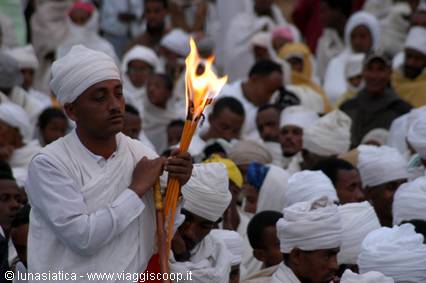
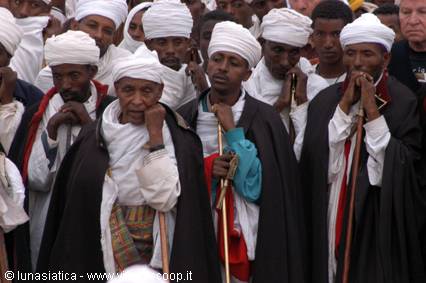
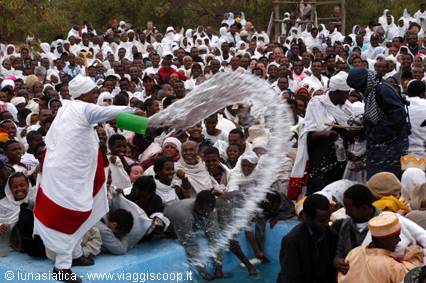
Lalibela, the Coptic one, is celebrating!!! It's Timkat, the Coptic Epiphany, where the birth of the Lord is celebrated with great fervour. The religious songs of the priests have taken possession of the city and every rite is accompanied by a sweet and slow melopoeia that, like a swing, cradles the crowd. Here there are no shouts and no excess, the joy of the Lord's birth is shared by watching the priests sing and dance. On this eve of Timkat, an atmosphere of peace and harmony reigns over the city of King Lalibela.
Wrapped in large white sheets, pilgrims sleep on the ground where the baptism rites will take place, thus guarding all the sacred books of the neighbouring churches gathered for the occasion under one single tent, while in another the priests will sing all night long, accompanying their movements with the piercing music of drums and sistra, and, bathed in light and blessed, we would leave Lalibela with regret. We travelled as best we could on the road created by Mussolini, 1800 kilometres from Addis Ababa to Asmara built by the Italians at the end of the thirties.
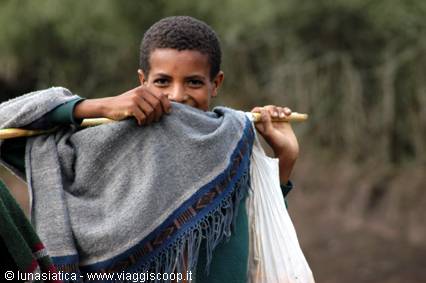
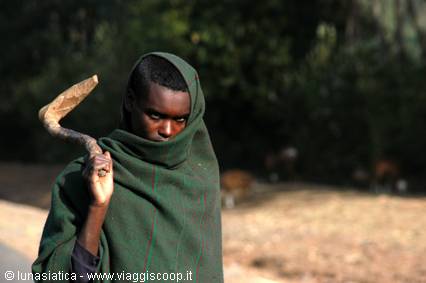
But today what would the Duce think if, instead of his glorious army, he saw this battalion parade by of donkeys that can barely stand on their feet under their extremely heavy load, this uninterrupted flow of peasants and children who, with a rapid and steady pace, hurry towards the markets of the area and the schools? Of the Italian occupation, only this long ribbon of asphalt remains, where millions of Ethiopians walk tirelessly... because the Ethiopian walks as if his life depended on it! But where will he go? He walks with his docile and swaying step, almost always barefoot, sometimes pitiful shoes are attached to his pilgrim's staff, the indispensable and faithful friend of the Abyssinian.
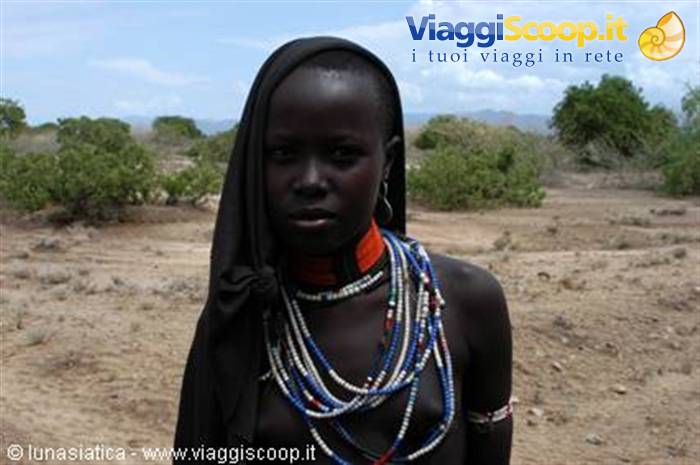
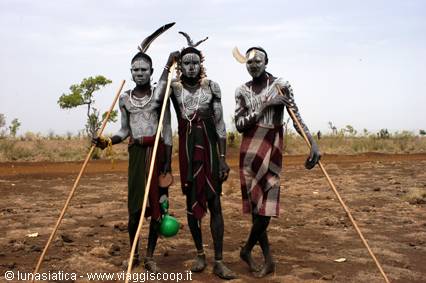
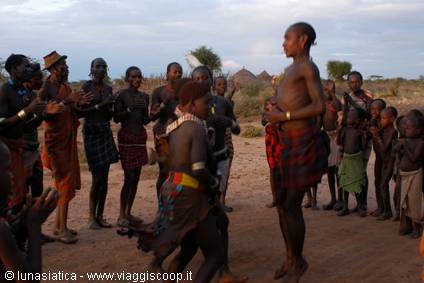
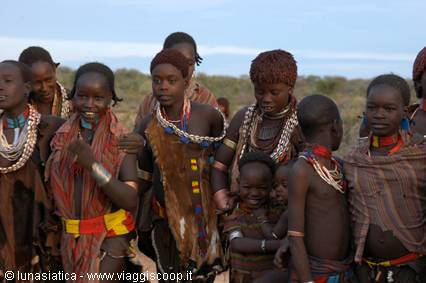
He never goes anywhere without it, they form a single body, so inseparable are they, much more than an aid, it's the staff placed on his shoulders that identifies the various ethnic groups who thus walk towards their destiny. In clouds, clusters, groups, men, women and children make their way, all heading straight ahead, sometimes with very heavy loads, sometimes accompanied by their flock; it looks like a long human parade that, silently, like refugees, seeks its place on this earth. But where do they come from, will they have a destination to reach? The question remains open, seeing them emerge from all sides, from behind trees, stones, mountains. Wherever the eye rests, poor wretches appear. They descend steep slopes to save kilometres, cutting this way, cutting that way, trying to reach their destination as soon as possible.
But where are they going, step by step? To the market? To school? To the fields? No one seems to know or care, yet their long march carries within itself a purpose: that of attaining a better life.
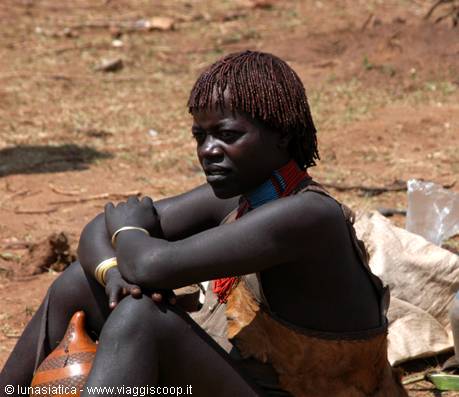
And while waiting, they tread the black earth like the colour of the sweated brows that work it, hoping that their long search for happiness will be short. But in that country so lacking in everything, every step seems to take them further from that aspiration and the Ethiopian will continue, for a long time yet, to walk with his long docile step towards his destiny on the roof of Africa...
FOR INFORMATION: GRAZIELLA: angy8@bluewin.ch and read my pages with practical information: http:xoomer.alice.it/abissinia
THE DRIVER CAN BE CONTACTED AT: sharyemethiopia@gmail.com or: office location is Taitu Hotel, Piassa, Room number 210. Telephone +251-911-402905



1 reader comments
Bellissime le tue foto, mi meraviglio che nessuno si sia fermato a commentarle