The story
Barely an hour's crossing on the Star Ferry takes me to Mui Wo, a village also known as Silvermine Bay, for the many silver mines that once existed nearby, on the island of Lantau, the largest of Hong Kong's islands.
Lantau today is a modern, developed island, but it preserves a rustic and relaxed atmosphere; it is twice the size of Hong Kong, yet is home to only 45,000 people.
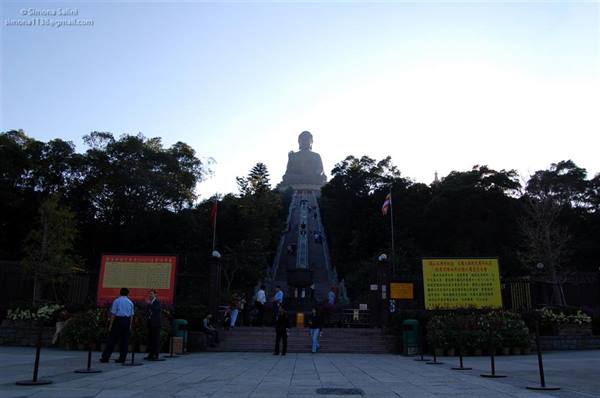
From Mui Wo I take bus no. 2 to Ngong Ping, a plateau in the western part of the island that holds the splendour of the Po Lin Monastery, or Precious Lotus. (Photo 1)
The monastery was once a quiet hermitage, free of curious tourist crowds and hordes of pilgrims; at the end of the 1980s the largest seated Buddha statue in the world was built right here, and since then it has been a strong draw for foreigners and pilgrims.
Initially the number of tourists, I know, was limited by the difficulties of travelling the narrow roads that led up the mountain; then that obstacle too was overcome. Today a bus goes up from Mui Wo to the monastery every half hour.
I too was moved by the curiosity to see the enormous Buddha, and I don't regret it.
Already on the way, on the bus, you can make out the enormous statue dominating the hill, an impressive figure amid the green landscape.
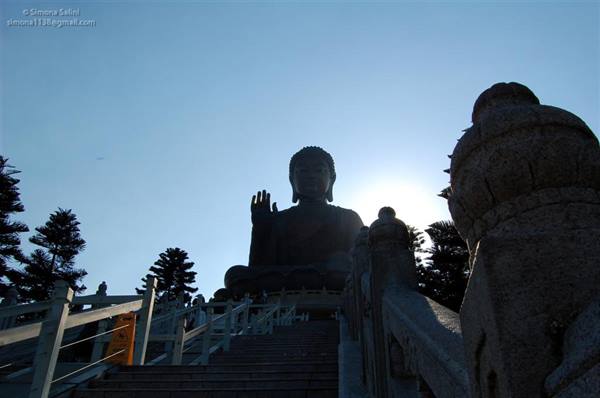
As soon as I arrive I get off, a little annoyed by the crush of people and the air that hangs there; it feels like being in an amusement park, but I'm immediately struck by the place. (Photo 2)
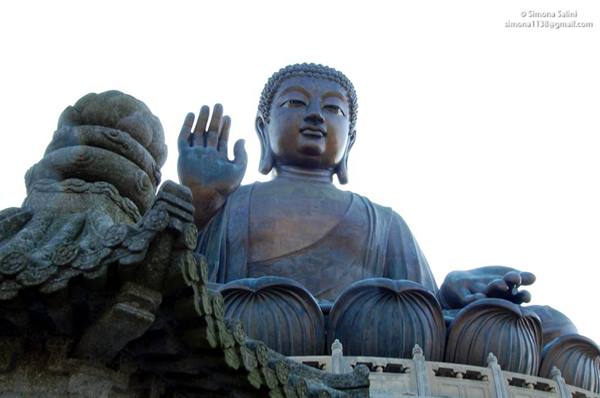
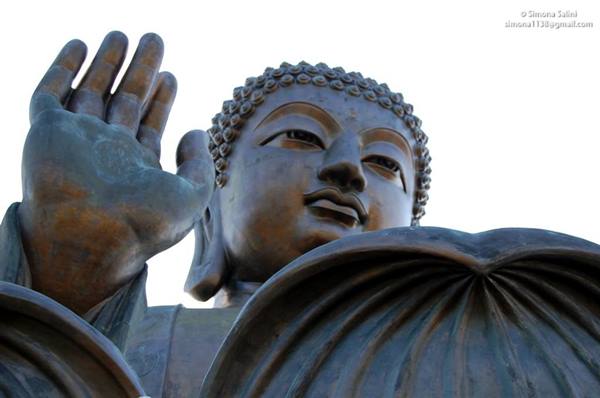
On the hill that dominates the monastery, at the top of a staircase of 260 steps, the figure of the seated Buddha reigns unchallenged, 26 metres tall, seated on a platform; you remain enchanted watching his gentle expression, his solemnity. (Photo 3)
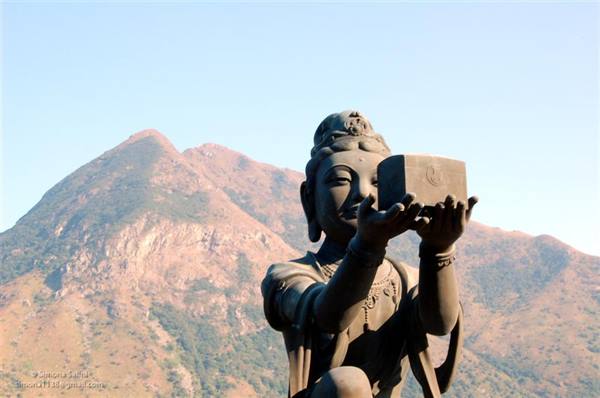
Around the Buddha, six bronze statues present offerings, and they too have expressions that give gentleness and peace; they are beautiful figures. (Photo 4)
I turn to look at the landscape, and it is as evocative as you could possibly imagine; despite the crowd of people, silence reigns.
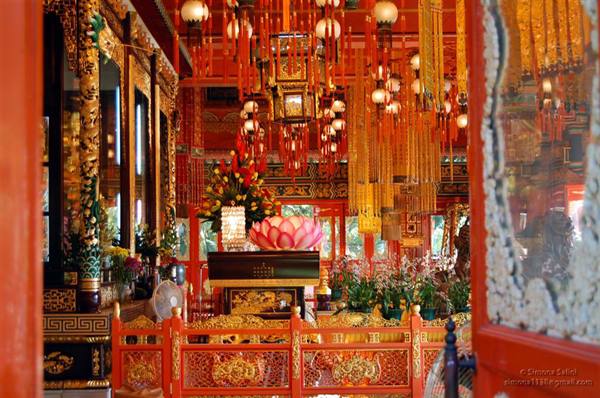
A short distance from the steps leading up to the Buddha is the Po Lin Monastery, with its richly decorated buildings, its carved wooden ornaments, the images covering doors and windows. (Photo 5)
Here too the atmosphere is relaxed and silent.
To the left of the Monastery there are numerous large dining halls; I decide to have my meal here; naturally they serve only vegetarian food (and frankly it isn't up to much); I spend the rest of the afternoon in this garden, reading a book and taking photos, waiting for the day to pass, for the light to soften and for the Buddha to appear to me in a different guise, beautiful in the evening.
The grandeur of the statue, the beauty of the monastery and the quiet of the landscape will make this one of the most beautiful visits I made in Hong Kong.
Simona Salini
INTERESTING FACTS:
* Entry to the Monastery is free and is from 9 in the morning until 18:00; * The meal vouchers to eat at the restaurant near the monastery can be bought at the little shop at the foot of the staircase leading to the Buddha
The journey's photographs
10 photographs · click to open them full screen




0 reader comments