The story
From the centre of Lijiang, around 12, I take a shuttle that takes me to the bus station; there, a couple of hours later, I take the coach to Zhongdian, a city about 200 km to the north.
After eating a plate of rice in one of the numerous restaurants near the station, I set off for the city.
Zhongdian, also known as Shangri-La by foreigners, is a city that undeniably deserves a visit; although it has become a well-known tourist destination, it keeps the simplicity of a lovely Chinese town. The most fascinating aspect of this city is that you can savour and recognise Tibetan culture everywhere, a stroke of luck for those who cannot, or do not feel up to, reaching the more inaccessible region of Tibet. (Photo 1)
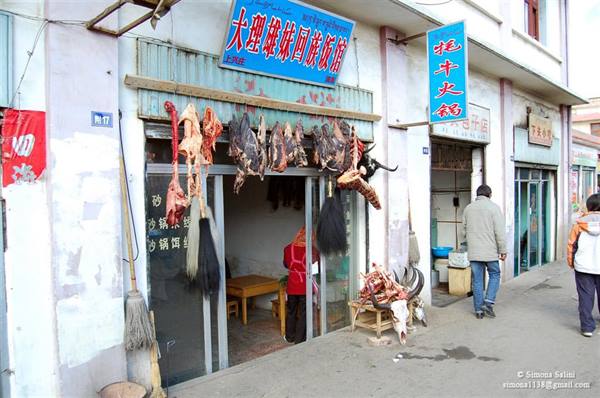
I arrive in the city after 3 hours of travel; the new part presents itself to my eyes as a large Chinese centre crossed by wide, noisy avenues lined with modern buildings. I observe the people, their features are pronounced, their cheeks reddened by the cold, some wear a white headpiece, a sign of the presence of a small Chinese Muslim community, later confirmed by the numerous butcher shops I come across along the street, whose signs are clearly indicative. (Photo 2)
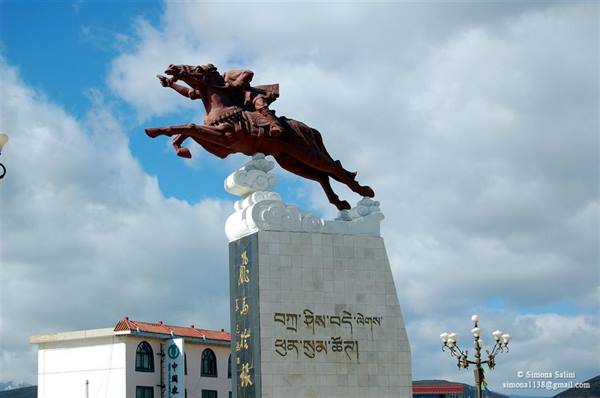
In the centre of the main square there's the statue of a galloping horseman; around it, large colourless and crumbling buildings alternate with shops of various kinds, in truth not very inviting. (Photo 3)
I have a taxi driver take me to the old part of the city, located in the peripheral area compared with the new heart of the centre.
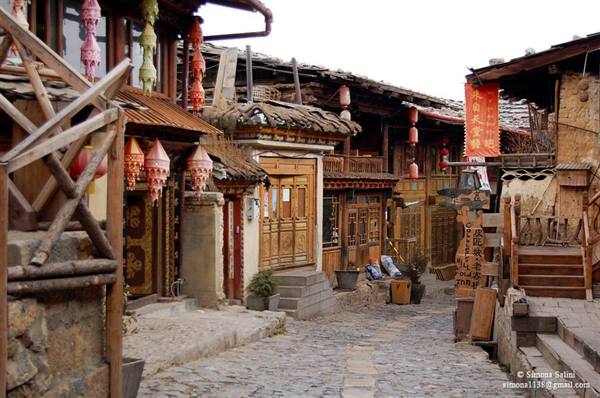
As soon as I arrive I'm struck by the silence and by the completely deserted rocky streets, but also by the numerous establishments offered to us foreigners. (Photo 4)
I walk trying to orient myself and it's an up-and-down of winding stone lanes; everything seems deliberately clean and smooth, and there's no shortage of local craft shops, old wooden dwellings and cafés, many of them closed for the low tourist season.
I seek out and meet with my eyes houses supported by dried-earth walls and whitewashed with lime; the clearly wooden structure is essential, without frills, in keeping with Tibetan tradition.
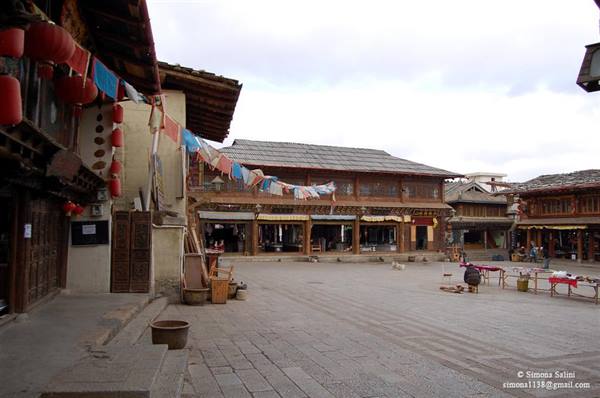
Without realising it I head into what is the main square of the city; the Chinese flag flies high above the wooden buildings, and in the centre there are some stalls selling meat and vegetable skewers. (Photo 5)
I stop at one of the numerous hotels, have a quick dinner in a restaurant and put off to the following day a more thorough visit of the city.
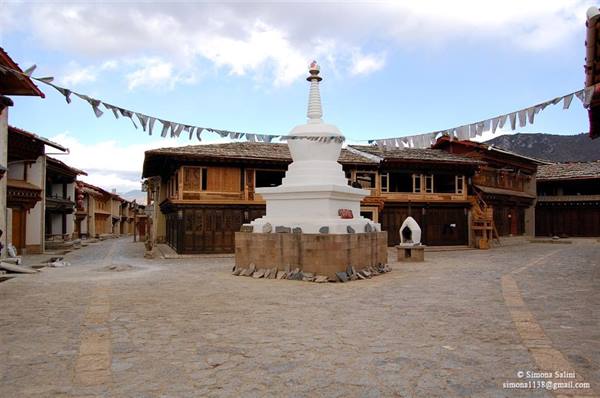
The daylight lets me appreciate Zhongdian even more, enclosed in green highlands; as I walk I come across the first stupa, resting on a cubic brick base; from the white column thin ropes are tied and depart, with small flags in green, red, yellow and blue fixed to them — they are mantras, Buddhist prayers. (Photo 6)
I continue until I reach a temple set on a peak; from here the panorama lets me see the whole city better, the mountains are dusted with snow and the cold is biting. (Photo 7)
I leave the old city and walk along the pavements flanking the big avenues; I take the bus to the Tibetan monastery of Songzanlin, a religious complex dating back 300 years and housing several hundred monks.
The landscape I meet as I move away from the centre changes appearance, the mountains become more imposing, the houses simple, new stretches of cultivated fields fill the landscape and I glimpse the first herds of yak.
I arrive at the monastery and am amazed by its imposing size.
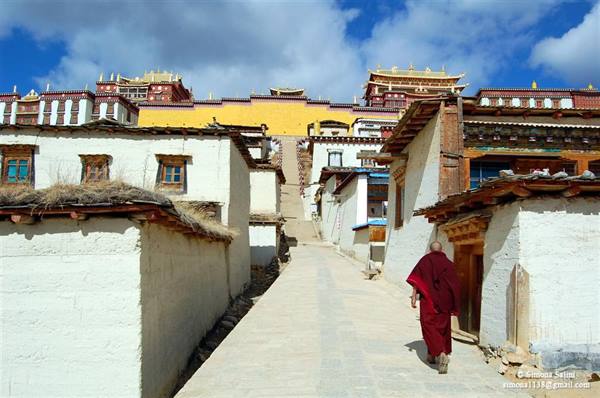
In front of the entrance a group of young women sell cheap trinkets; I start climbing towards the monastery, surrounded by ruined and abandoned houses that give the whole landscape a unique atmosphere. I glimpse the first purple patches moving; they are the monks, silent and reserved, with their shaved heads and worn sandals I see them everywhere, in prayer, sitting reading sacred texts, carrying out humble tasks. (Photo 8)
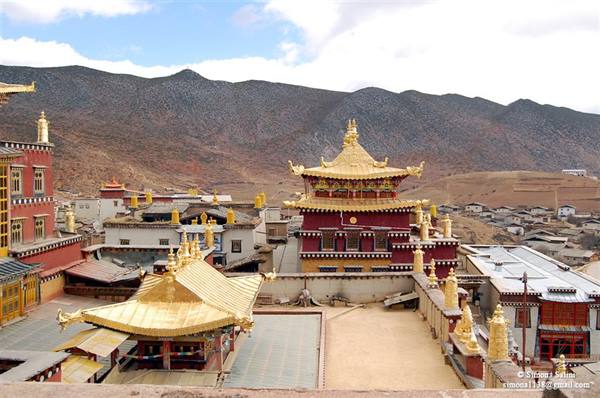
Silence is everywhere; the monastery rises 20 metres, is white and finished with garish colours, surrounded by numerous buildings; the roof is adorned with gilded statues that shine in the sun. (Photo 9)
The prayer hall is large and wrapped in the sweet smoke of incense sticks; yak butter, fruit and money are the offerings I see most often.
When I lean out on the roof of the temple I enjoy a unique panorama; 3200 metres, a height that lets me see fields as far as the eye can see, mountains lush with trees, flocks of sheep and goats, big yaks grazing quietly; the valley seems endless and the sense of peace you breathe is unique. (Photo 10)
I immediately understand why this monastery is one of the most important in southern China: it is majestic, evocative, witness to a difficult history, having gone through the sad vicissitudes linked to the Cultural Revolution, almost abandoned to itself, bombed; for a few years it has been rising from its own ashes… a story lived everywhere in Tibet and in the whole of China in the years of the Red Guards, years in which, with no respect for religions and cultures, monasteries, sanctuaries and everything that symbolised the Nation's ancient history were destroyed.
In the evening I return to the city; in the square of the old heart of Zhongdian an unexpected and welcome spectacle awaits me: the locals dance to popular music spreading through the air from an old megaphone; men and women spin around, twirling their wrists and hands, many move confidently in light steps and smile, warming themselves from the cold of the night that has now fallen.
I watch the dance from a distance, fascinated by this rite that I will discover repeats itself every evening.
Simona Salini
INTERESTING FACTS:
* From Lijiang two coaches leave every day for Zhongdian, one at 8.40 and one at 14.30; the journey lasts three hours and the ticket costs 45 y; * Near Lijiang's coach station there are numerous restaurants where you can taste an excellent rice with meat and vegetables for a few yuan before leaving for Zhongdian; * To visit the Tibetan monastery of Songzanlin you need to take bus no.
3, which passes often along Changzheng Lu; the entrance costs 10 y; * For a meal, a great place is Hellen's Pizza, on Tuanjie Lu; the owners are a likeable Italian, Marco, and his girlfriend, a very kind Chinese girl and an excellent cook; Marco has lived in the city for a long time and can give important information on places to visit; the meat is very good and the homemade walnut biscuits are delicious; * For an overnight stay, if you decide to stay in the old part of the city, a good solution can be the Old Town Bright Hotel, at Bei Men Street 22, where for 80 y it offers clean rooms right in the centre; bear in mind, however, that in this area of the city almost all hotels don't have hot air conditioning and it's always very cold; * If you want to stay in the new part of the city, an excellent hotel is the Shangri-La Hotel, on ChangZheng Road; it has spacious rooms, hot air conditioni
ng, spotlessly clean, but you won't spend less than 200y a night;
The journey's photographs
10 photographs · click to open them full screen


0 reader comments