The backpacking trip, undertaken with my boyfriend, was as beautiful as it was emotionally hard.
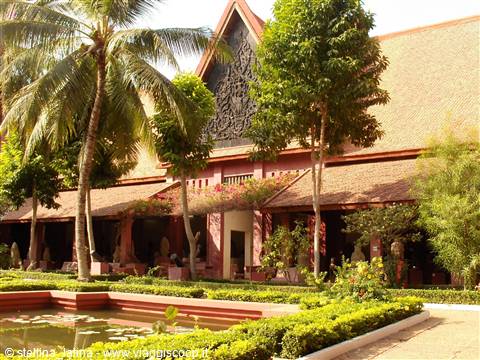
Cambodia is a country that has been through very powerful and difficult experiences (e.g. Pol Pot), which you can read in people's eyes and in a scarred architecture.
All of this contrasts sharply with the splendour of antiquity, namely Angkor, where crowds of distracted tourists gather.
Below you can find (I'll add the days of the diaries as I go) the travel diary with impressions, tips and practical travel information along with the costs incurred.
I recommend a visit that also includes the capital, completely different and, perhaps, more real than the oasis created for the average tourist in Siem Reap.
Day 13 Feb 2007
FINALLY ON VACATION- Siem Reap
The flight to Cambodia from Kuala Lumpur (Malaysia) is very short and extremely calm. We land, in the hot and tiny airport of Siem Reap, which serves the archaeological area of Angkor Wat. The bureaucratic procedures are a bit long. You have to stand in three lines but the problem is that the officials do everything in a rush and I decide to adapt. I take the forms and fill them out while standing in line and not, as many do, stepping out of the line. I reach the official, I have them filled out, I hand them over together with the 20 dollars and the photo, and we move to the other line waiting to be called. The officials act professional but in practice it's just for show and in fact they don't do much. During the last wait they dissolved into laughter because they couldn't pronounce our bizarre Italian names... Another customs check and finally we reach our suitcases.
At the exit, as in all airports, they ask for the receipt so don't lose it in the confusion of documents. Our hotel's taxi awaits us with a sign with our names but, after accompanying us, he asks us for 5 dollars. The price is correct but we hadn't requested such a service... first lesson! As recommended by our friend and expert Teo (whom we will thank or curse in alternating phases several times during the trip, poor Teo!) having arrived at our dream hotel (truly beautiful!) Casa Angkor, settled in and refreshed, we immediately went out hunting for bicycles to rent to visit the Angkor site and get the pass to enter three consecutive days. The sun beats down hard on the dusty and busy road at two in the afternoon. The bicycles are ancient and pedaling is difficult, I don't know why they're so stiff...
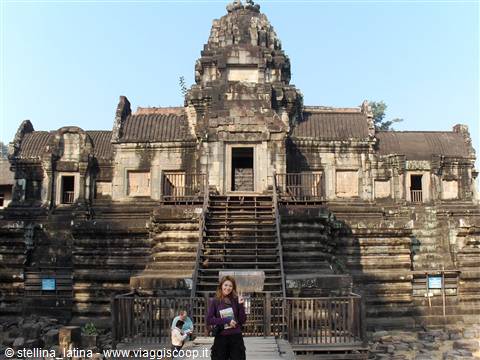
But the traffic amuses me, now mistress of the local road rules I zip through intersections with Lore behind me in a panic for me and for himself. We reach the barrier (marked on the maps) without problems and pay the ticket valid for three days of entry, 40 dollars each. They take a photo of us and in a very few minutes we pass the barrier. The road is straight, fairly paved and shaded by vegetation. There are also several little monkeys hopping here and there in addition to tourists on every means (on foot, by bicycle, on scooters, in horse carriages, in tuk tuks, on elephants). We visited the Bayon with its thousand smiling faces and the beautiful Angkor Wat where we would have wanted to wait for the sunset but, overcome by tiredness and justified by the haze, we decided to return to the hotel.
Exhausted, we returned the bikes, stocked up on water at a pharmacy (yes, yes, and at an excellent price) and, exhausted, we showered, washing off all the dust, the tiredness, the sweat of a very long day. Cooked, while, undecided about what to do, we tried to talk, we fell asleep without even having dinner, waking up only the next morning. (The flight Milan – Rome – Kuala Lumpur was a nightmare and we couldn't rest, I still haven't decided where to publish this part of the trip.)
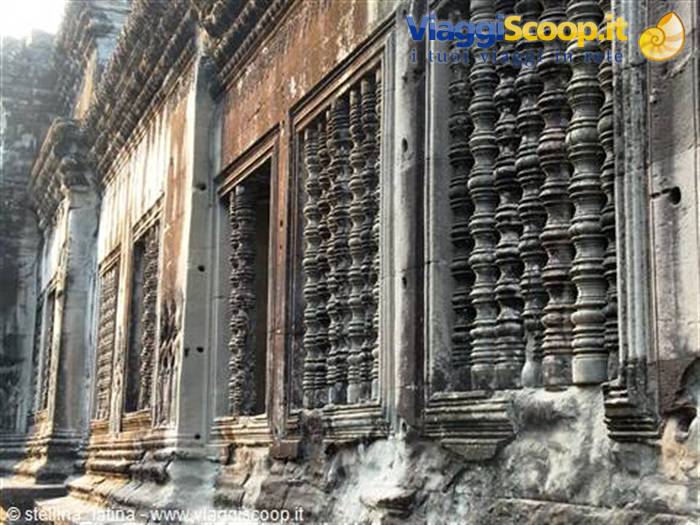
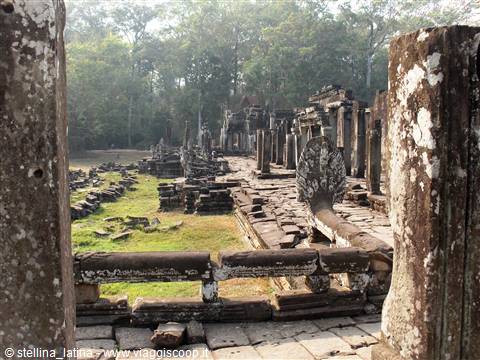
Carved stone windows with balusters at Angkor Wat temple
Day 24 Feb 2007
WHEN NATURE MERGES WITH ART - Siem Reap
Fresh, rested and hungry we woke up early, around 6 in the morning. Ready to face the day, we go to fortify ourselves with the breakfast included at our hotel. Here, if it had 30 it would also get top marks! The breakfast buffet served on the indoor and outdoor tables in the garden with a pergola is sensational! From first courses to second courses to fruit, everything is exquisite, abundant, very fresh. In short, we stuff ourselves a bit with rice, bacon, sweet pancakes, papaya, etc... how worth it was! As soon as we left the hotel, we started bargaining with a tuk tuk driver for the day, fixing a price of 10$ for the big tour, I think the correct price was 6-8 $ but oh well, we'll learn to bargain along the way.
The temple complex is truly majestic and stupendous.
The choice is usually between the small circuit and the big one but it's a shame to choose. If we had had the time it would have been nice to do one day (perhaps the first one when we only had half a day) the small one and the next day the big one. But that's how it went and so we found an agreement to do both. Yes, because in reality, to do the big circuit you pass alongside or nearly so the small one, so... just bargain until you get a fair compromise, sticking to what you absolutely want to see.
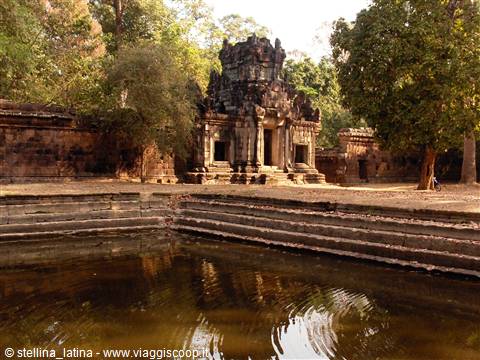
The temples we liked most of all are the classic ones: the Bayon, Angkor Wat, Angkor Thom, walking the road from south to north are interesting the western Baphuon, the Terrace of the Elephants, the Phimeanakas and the royal palace, the Terrace of the Leper King, Tep Pranam and Preah Palilay; to the east, the Prasats Suor Prat, the southern Khleang, the northern Khleang, and Preah Pithu. These temples are the highest architectural expression of the Khmer Empire which over a period of 300 years, between 900 and 1200, built several capitals, moving, from King to King, just a few kilometers apart, giving rise to the current extraordinary concentration called Angkor. Considered masterpieces of world architecture, the spectacularity is also due to the place, immersed in the forest, surrounded by lakes (more or less artificial) and cultivated land.
Angkor has been included among the UNESCO World Heritage sites. The temples of the Angkor area number over a thousand, some reduced to piles of bricks scattered among rice fields; among these temples many have been restored and some are very famous also thanks to films, books and even a Playstation game (one of the settings of Tekken is the place where the player meets his final opponent Heihachi Mishima). One wonders, visiting it, why it was abandoned, the answer comes from history: in fact an attack by the usual eternal enemies, namely the Thai (from Thailand) meant that the capital was moved and the Angkor site was covered by thick vegetation until it was forgotten. It was in fact the French who rediscovered it in the 19th century and restored it (later joined by the Japanese and a UNESCO group), gifting us this magnificent place.
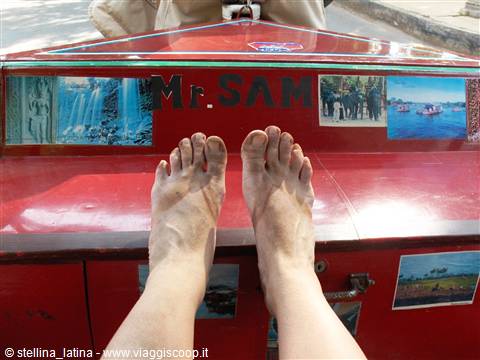
The sun is implacable but fortunately the climate is dry, but the dust and the earth rise even just from a chicken passing by, let alone with a car or a bus. My Kenyan batik has by now become my official "Linus blanket" to defend myself, but despite this you can feel the dust even between your teeth. At the end of the tour I took an exemplary photo of my feet on the tuk tuk that you'll see. The visit to the temples is extraordinary, some are repetitive in architecture but each time you feel a different emotion and when you start to get a bit tired you're surprised by something special. The route is a kind of ring that connects the various temples, once individual capitals of the Khmer Empire. It is therefore easy to visit, especially by tuk tuk, where there is no exertion.
Moreover, at every stopping corner you find spartan bars and restaurants and the inevitable children selling everything, from postcards to books to anything that might interest a tourist. Obviously you bargain; I recommend buying at least one art book on Angkor (they go from 8 to 10 dollars). We stopped to have lunch, since Sam, our driver, hadn't finished eating (we noticed that every time he was either eating or sleeping); Lore had a plate of rice with meat and I had my beloved fresh, cold coconut, to eat with a spoon, unfortunately found only in tropical countries.
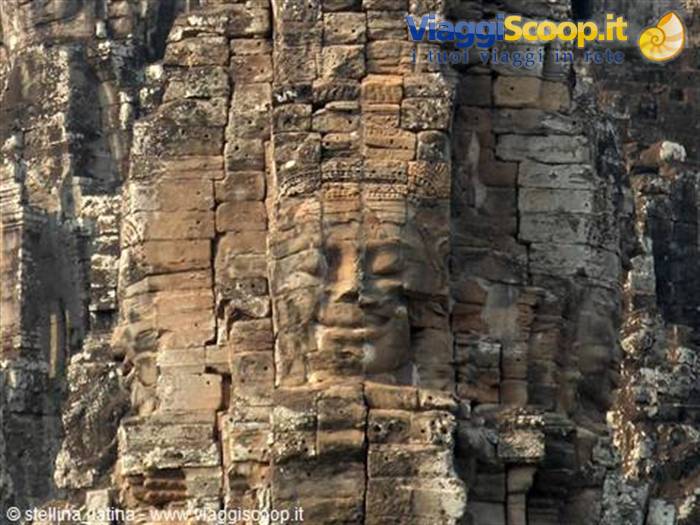
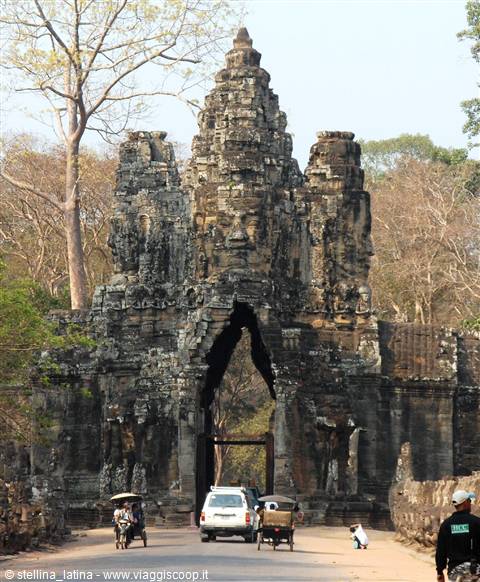
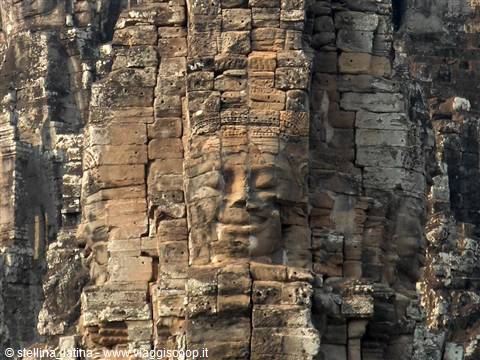
Back to the temples, the magnificent Angkor Wat is considered the largest single religious monument in the world, erected in 1112 it perfectly portrays Hindu cosmology, with the central towers representing Mount Meru (the home of the gods), the outer walls representing the mountains that enclose the world, and the moat representing the ocean beyond the mountains. Subsequent is the construction of Angkor Thom, to be clear where they shot the 2001 film Tomb Raider, coinciding with the change from Hinduism to Buddhism and built after the sack by the Cham in 1177, the cousins and bitter Vietnamese enemies we will meet again in Nha Trang. Very beautiful and evocative is Angkor Thom (12th century), in the Bayon style, therefore built in brick with face-towers dominating every entrance of the city.
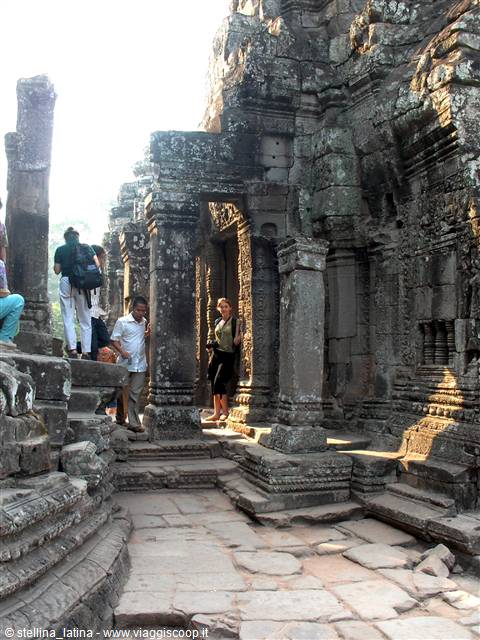
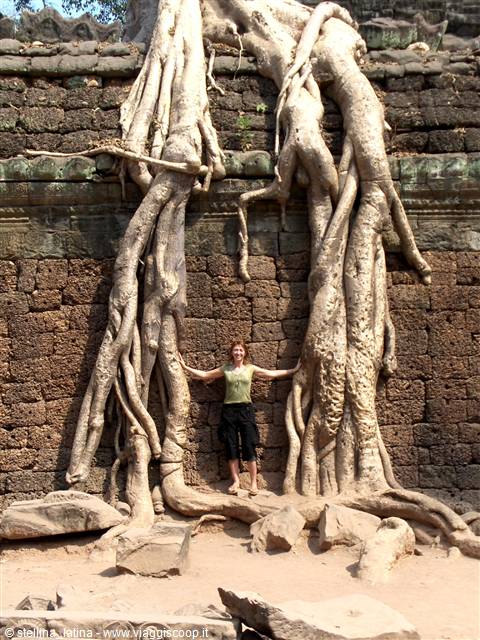
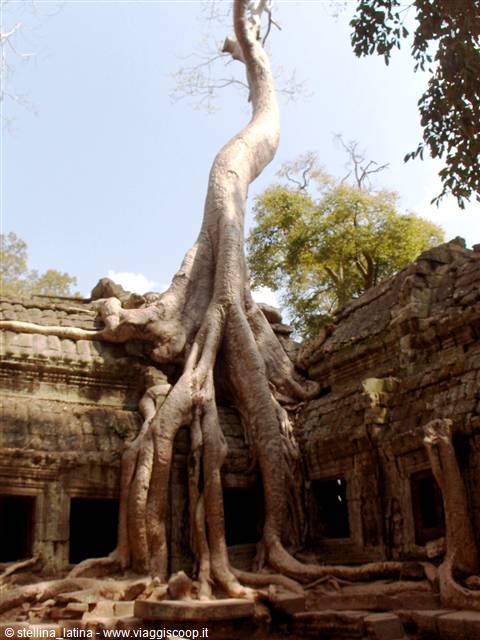
The building must have been of large dimensions, you visit labyrinths of rooms and corridors to slip into, get lost and pick up the path marked by walkways that have been built to safeguard the most delicate structures. The trees, left to grow because they are by now an integral part of the structure, are astonishing. They are gigantic, and, slipping into the embrace of their great and strong roots and the sculpted walls, you feel very very small. You look up and you're no longer able to understand whether the alchemy of this evocative place could exist without the force and arrogance of nature. It is surely the most emotional place of the entire Angkor archaeological site. Try to avoid the organized groups that, like swarms, arrive, occupy all the passages preventing the view and the possibility of taking photos but with the same impetuosity soon leave the ruins.
Instead, dedicate more time to it, together with the Bayon it's the most significant place to visit.
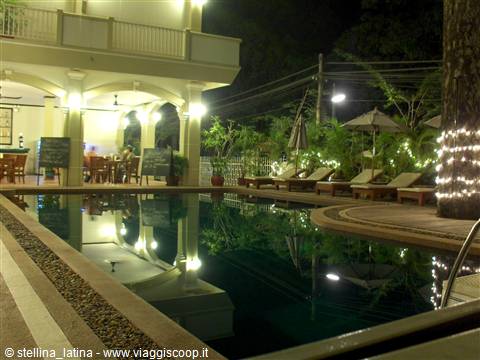
At the end of the visit, by now afternoon, we realize we're red: because covered with the very fine red earth and because of the strong sun for which our mozzarella-style skin is not prepared, despite the sunscreen. Having showered we dived into the cool pool, the only ones in the water, while some Anglo-Saxons, on the deckchairs, protected by umbrellas, continued to read books impassively despite the chaotic Cambodian life beyond the wall. Relaxed, refreshed and perfumed we went out to take a walk "downtown", to look for an internet point, the tickets for Phnom Penh, a little shopping and to have dinner. We inquire at our hotel about the cost of the speedy boat and the bus to the capital and we're quoted crazy prices: for the first 35 $ while for the second 15 $.
Another route, very evocative, is the Battambang - Phnom Penh railway line because the tracks are more often used by the so-called Bamboo Train which is taken apart and reassembled to give way. This tour, however, involves at least a couple of days that we don't have.
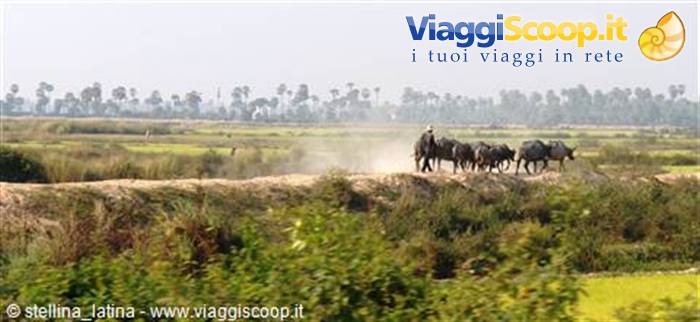
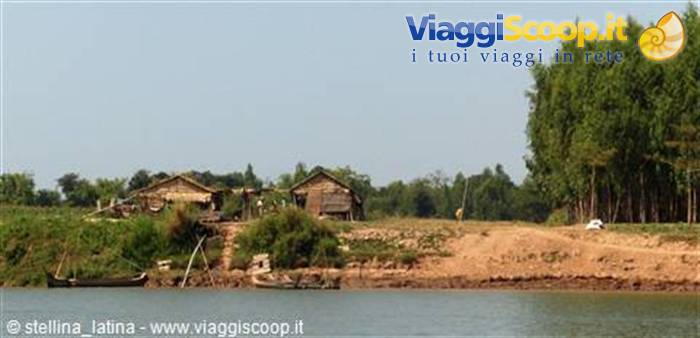
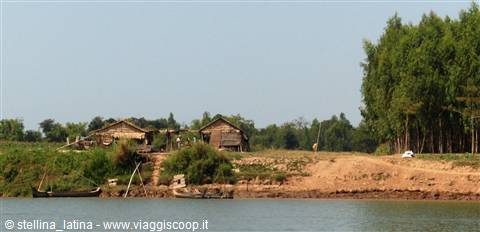
Farmer with buffalo-drawn cart on sandy embankment among green rice fields
Day 34 Feb 2007
.
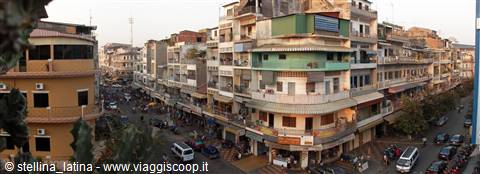
The city looks like a dusty construction site: the sidewalks under construction, new buildings with Western architecture growing among the old houses. Every 100 meters you see agencies offering tourist packages and tickets to reach the capital. As a result, right at the end of our street we buy the bus ticket, departure at 8:00 AM, estimated arrival 1:00 PM, price: 4 $ each! Satisfied with the purchase we continue our little tour, entering our first market where, obviously, we immediately get "ripped off." We have in fact, after long negotiations, bought some silk handbags that are also very cute, lowering the starting price by half.
You should know, however, that it's not worth buying anything in Siem Reap because you'll find the exact same items in the capital as well as in Saigon at significantly lower prices! The market is the classic covered bazaar with lots of little shops where it's easy to find souvenirs, even though at the beginning of a trip one tends to put it off. The center consists of two parallel streets all restaurants, pubs, etc. that could easily compete with our own establishments. Since it was early we wandered a bit reading menus and prices well displayed on the street in front of the respective little tables. I recommend always consulting them before sitting down and ordering to avoid unpleasant surprises. The first day I was granted the choice of restaurant where we tasted Cambodian specialties that I very much appreciated but whose ingredients I couldn't identify...
the prices are higher compared to the rest of Cambodia and Vietnam. For one dinner we spent 3.50 $ each (beer + Amak, a Khmer soup with tagliolini), consider that during the rest of the trip we spent on average per person per meal from 1 to 3 dollars at most! The atmosphere is relaxed, they're almost all independent tourists who, with their Tiger, or rather the Anchor (beers to try!), exchange impressions. The lights, the background music, the summer and informal clothing, the heat all contribute to giving the impression of being at the seaside, a feeling that will follow us for almost the entire trip. Strangely for the country we didn't encounter the classic tours, especially Japanese ones that raged implacably inside the archaeological site.
Carved stone faces on the Bayon temple at Angkor Thom
Day 45 Feb 2007
DAY TRIP – Siem Reap
The next day, after replicating the fantastic breakfast, as agreed, with Sam, our driver, we went to the river of a thousand linga and to the beautiful Banteay Srei for a total of 15 usd (which then became 30 usd because we added other trips, if you can try to keep prices lower because they take advantage of it)
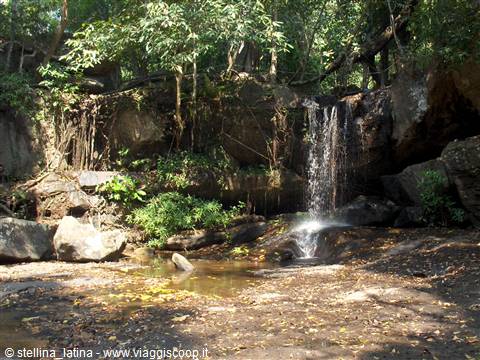
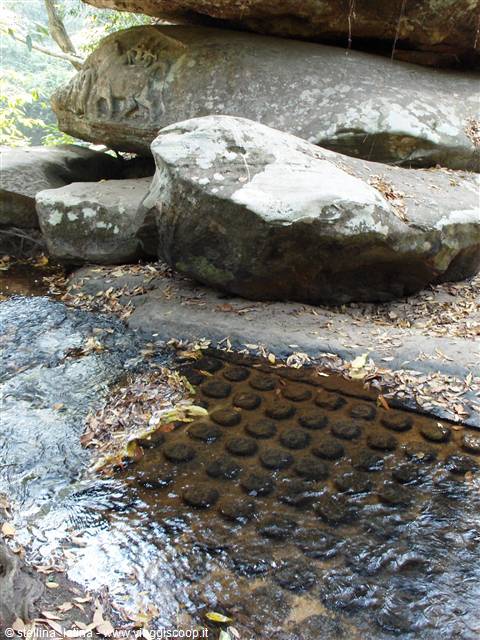
The two sites are fairly close to each other and it's worth visiting both, included in the Angkor ticket. The road is paved even though the dust is always in the air. Arriving at the parking lot of the 1000 linga you walk a stretch on a path in the woods with some rocks, I recommend trekking shoes. The trees are beautiful and with their large aerial roots they form strange designs in the air. You pass through huge rocks, climb a makeshift staircase and arrive in a basin with a waterfall that forms a pond full of multicolored butterflies in eternal motion, it looks like an Eden. Beyond, the route used for ceremonies begins, where the rocks of the river bed have been carved representing the linga (hence the name), a phallic symbol, and various other deities. The visit isn't long and it's worth going all the way to the end of the path.
Moving with the tuk tuk, after waiting for Sam to finish eating, we arrive at the temple of Banteay Srei. Beautiful! At first you're perplexed by the very dark color of the stones but the beauty and finesse of the architecture and the sculpture of the stones leaves you breathless. It's also called the temple of women precisely because of the precision and delicacy of the bas-reliefs. We then stopped to eat at a restaurant in front of the site where we considered adding a little trip to the floating village. The road leading to the embarkation point is very characteristic: you pass neighborhoods dedicated to specific crafts while the houses become more and more sparse and more and more poor.
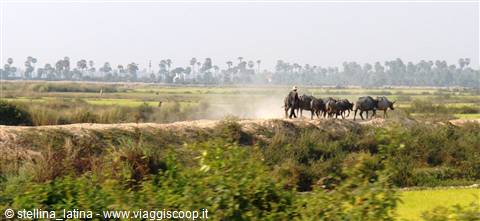
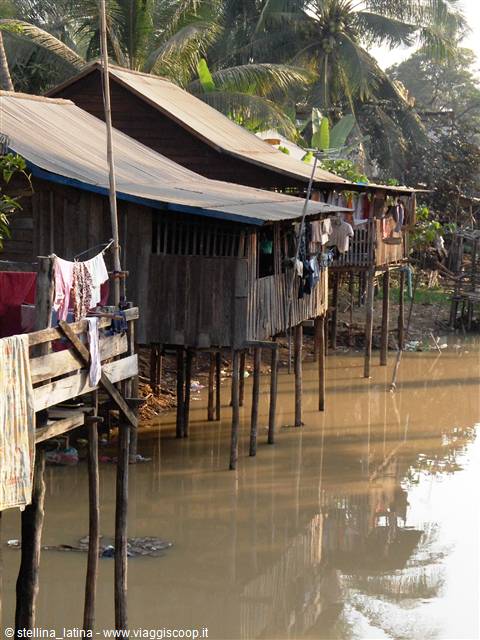
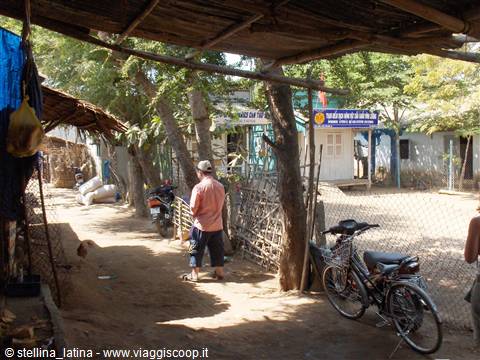
While in Siem Reap the buildings are made of concrete and have several floors, gradually you arrive at little houses of wood and straw and finally only flooded fields and buffalo with curious restaurants with terraces full of hammocks lined up for customers. Always along the road, alongside which the canals run, you'll see in addition to fish also snakes stretched out in the sun drying, standing out for their beautiful vermilion color, so photogenic.
Finished the tour, more and more dusty, we finally immersed ourselves in the pool of our hotel. It was regenerating, relaxing... in short, a cure-all, ready then to
S-21
Day 56 Feb 2007
BY BUS TO THE CAPITAL
After checking out and saying goodbye to the fragrant hotel, we walk to the bus stop. As we will learn, we are picked up by an overcrowded minivan so packed that we have to stand hanging on to piles of suitcases, and taken to the final bus where they "sort" tourists and luggage for the various destinations clearly and quickly. Despite this, we will leave at least 30 minutes late because we waited for a passenger, a local boy who even got a slap on the head for the delay he caused. The journey goes smoothly and the stops are well calculated. We arrive in Phnom Penh about an hour late at most compared to the scheduled time. The bus stops at the Capitol Tour hotel, a few meters past the agency.
We are immediately surrounded by motorbike and tuk tuk drivers trying to grab customers; men in uniform (private guards or police or traffic wardens, it's not clear) try to keep them at least somewhat in check. It's chaos. We grab our backpacks and move into the hotel lobby, waiting for the street to clear and the drivers to calm down a bit. The bus moves away and, calmly, we head to the Capitol Tour office. The office is actually a meeting point for travelers; it is a bar, restaurant, agency, internet point, etc. It is a place from another time, a large room that feels like a station, with people constantly moving with luggage in tow, a murmur in all languages, in short a small but relaxed Babylon, with the cool air blown out by the fan adding that regenerating touch.
We were supposed to buy the trip on the Mekong Delta but we want to go to the hotel first and then come back calmly to see what other tours it can offer us.
We walk towards the hotel we booked by e-mail, under a very hot sun with scorching asphalt, and we immediately notice the closed and somewhat sad character of the inhabitants of this city, so tormented and violated. The hotel is, (darn it, Teo!) small, essential and clean. Our room, on the fourth floor, is an "unauthorized" wooden construction on top of a terrace. The bathroom seems to have been built by a child who had fun making the pipes go in and out of the walls, ending with water on the floor. Its only strong point is a private balcony that allowed us to repeatedly hang out the laundry, which dries in a few hours.
Once rested, we return to the Capitol Tour, where the booking girl speaks fantastic French and I take advantage of it. I verify the tour sent to me by e-mail from the Sinh Café office for the Mekong Delta and we decide to buy the tickets directly (details later). We also look at the tours for the Killing Fields, prices, availability, etc., and what the agency offers. We book for the visit to the Killing Fields at 14:00 the following day.
We can therefore relax and finally dedicate ourselves to visiting this lively city. In 1440 Phnom Penh became the new capital when Angkor, despite its more defensible position, was razed to the ground by the Thais, and in 1863 it was conquered by the French. In 1975 the Khmer Rouge led by Pol Pot forcibly relocated all citizens to labor camps in the countryside. Phnom Penh turned into a ghost city. Only with the defeat of the Khmer Rouge by the Vietnamese did the population return to the city without the possibility of claiming their own homes. There was a rush for the "unauthorized" occupation of buildings, in which as many families as possible settled, defending the new occupation by force. All those, however, who failed to secure a dwelling moved to the outskirts, building a shantytown of wood and cardboard. Unfortunately there were many of them, and it is still partially visible.
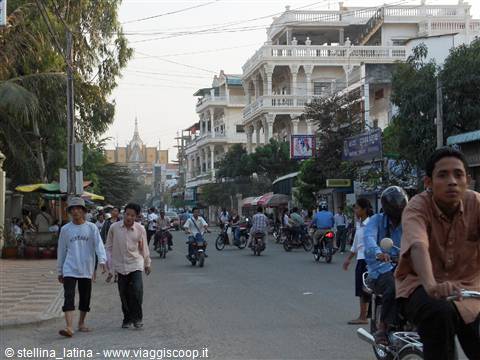
Phnom Penh, therefore, which was known as the "Pearl of Asia" during French rule, today seems to us to be a city characterized by an architecture I would call "random". The trace of the past is clear and readable throughout the city: the buildings are in fact poorly maintained French palaces, readapted for a much larger use by families who, applying the traditional idea of a home, in addition to the unauthorized floors built apparently without any kind of engineering consultation, top the last brick floor with further wooden constructions in the style of rural village huts. The result is a jumble of buildings, colors, wires and humanity that makes it difficult to associate it with the "Pearl of Asia". The main tourist attractions in Phnom Penh are the Royal Palace, the Silver Pagoda, the National Museum, the Tuol Sleng S-21 Genocide Museum-School, Wat Phnom and the Russian Market.
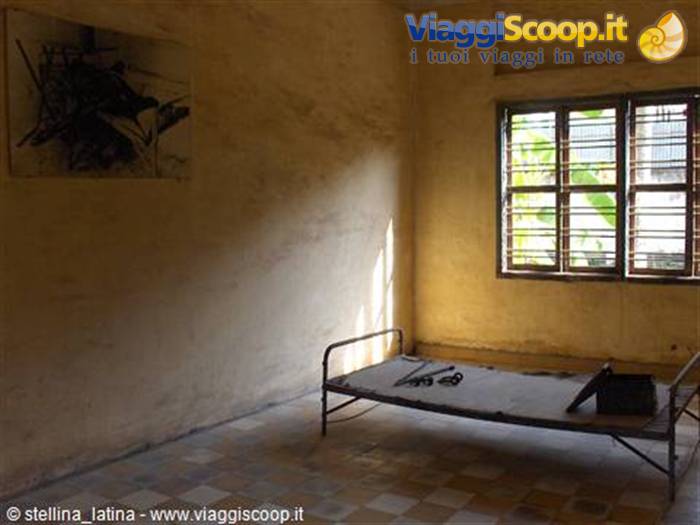
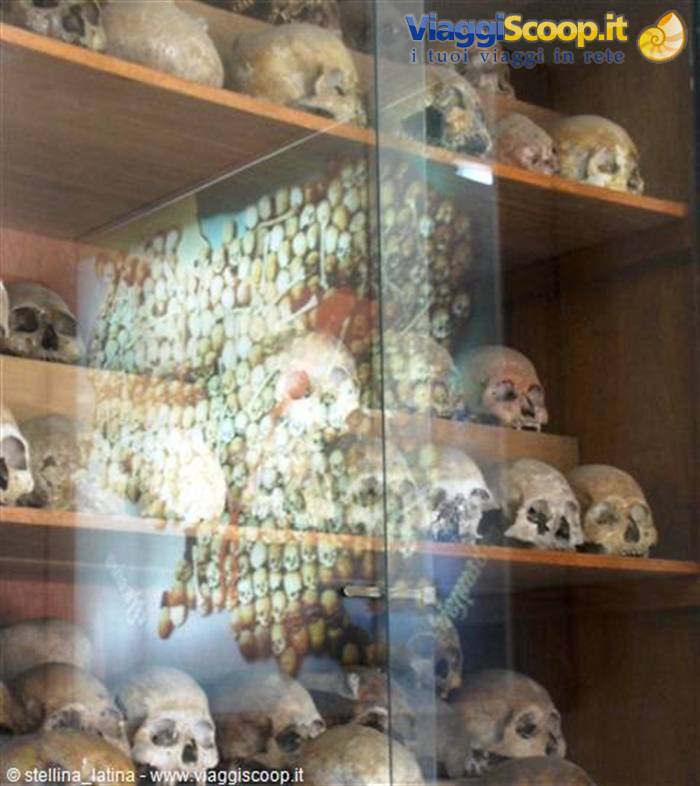
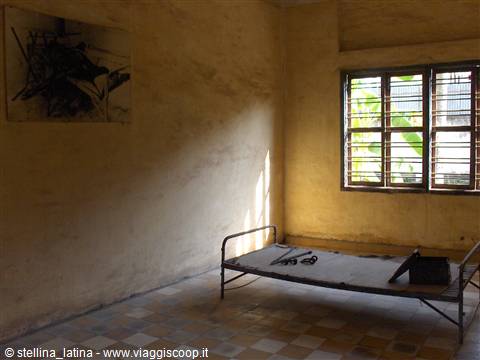
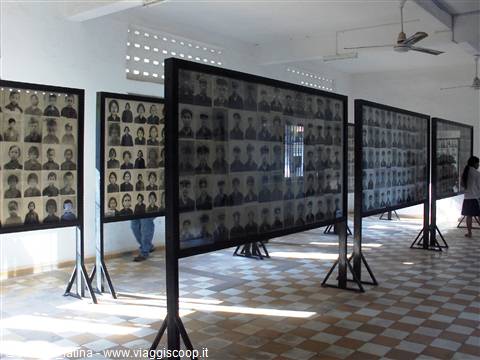
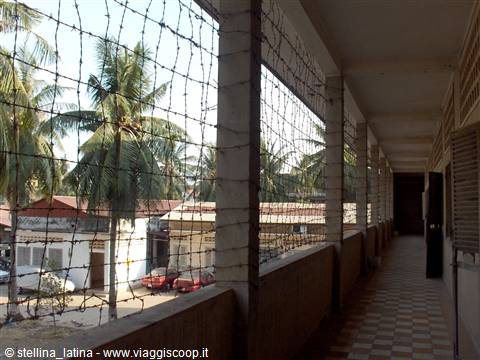
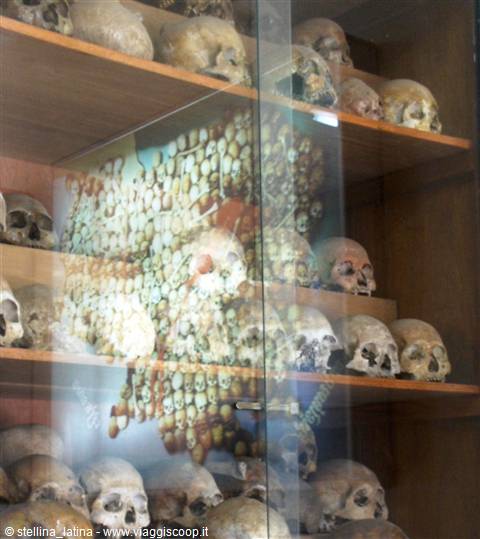
Slightly outside the city is Choeung Ek, that is, the Killing Fields, extermination camps.? We have a tuk tuk take us to the Toul Sleng S-21 School-Museum, the place through which thousands
Rows of skulls on wooden shelves behind glass, memorial to the victims
Day 67 Feb 2007
VISIT TO THE MONUMENTS AND A MINUTE OF SILENCE
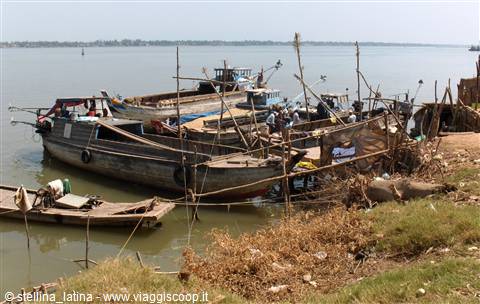
The day includes a visit to all the main monuments, and, in the afternoon, a visit to the killing fields. The sun is shining, the air is clear and we are rested: all the conditions for an excellent visit. We set out early to go and see the • LONG RIVER and, a bridge, historically important but, beyond the long walk, nothing much. There are no important bridges in Phnom Penh, if you read otherwise it's because they're lying! The bridge is a simple "road bridge", nothing much. It was interesting, however, to walk along the river where we saw the start of the day for the fishing boats and the river traders. The second stop is dedicated to the • NATIONAL MUSEUM (3.00 USD) housed in a beautiful building painted brick colour, with an inner garden that is incredibly relaxing.
It's incredible how the chaos of the traffic manages to stay far away, in fact it feels like entering a place outside the city where silence, cleanliness reign and the air is scented with jasmine, lotus and incense. The display cases, some interesting, others a bit too repetitive, are not the only reason to visit this little paradise. Refreshed, we manage, still on foot, given the short distances and after a few hundred > and as many >, to reach the entrance of the • ROYAL PALACE. The entrance is majestic: the long railing hides a place sculpted with precision where not even a blade of grass is out of place. The impact is very strong, the city with its humanity clashes with the perfection and artifice of this royal place.
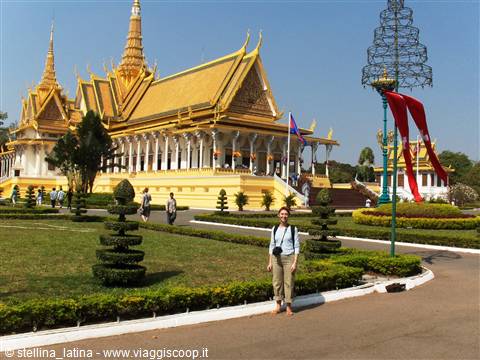
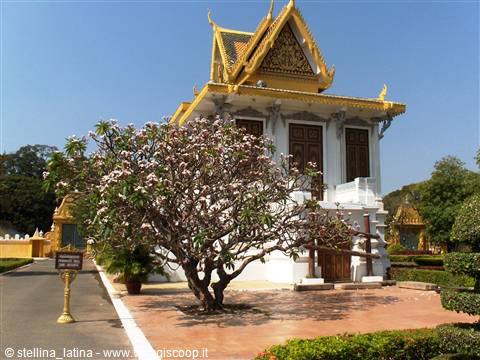
The sun beats down ever harder but to be able to enter you must wear appropriate clothing and they are extremely strict, so, over my little top suitable for 30 degrees, I had to put on another long-sleeved one, without being able to simply wear the batik over my shoulders. As soon as you pass through the gates you pay the ticket. While previously entry to the palace was free and you only paid for the Silver Pagoda, now the ticket is a single one. (3.00 USD). The Palace is exactly as it should be, in the cobalt blue sky the gold-yellow roofs seem drawn with all the different levels and decorations. The lawn, perfectly mown with sculpted plants, gives the impression of stillness, it feels like being in a beautiful model. Only visiting the interiors makes these buildings, interspersed with greenery, real.
You visit the throne room, the small royal museum, the library up to the famous • SILVER PAGODA. In reality the silver of the floor has been covered by carpets to protect it, interesting instead is the setting and the various objects kept inside. It's already midday and, the visit over, we head to Capitol Tour. The perceived temperature is really high and we're gasping, luckily at Capitol there are fans spraying fresh water…we pay for the tour which was due to leave shortly and take the opportunity to have lunch. After talking with a Canadian, married to a Japanese woman, who now lives around the world, the time of departure arrives. On a minibus we entrust ourselves to the driver, who knows his stuff, and to the kind girl who will be our guide. The group is small and, after passing impassable roads, riverbeds and roads being resurfaced, we arrive at the parking area of the site.
A piece of advice: don't go there by tuk tuk because the road is really uncomfortable and long. Entry to the site is paid separately (2.00 USD). You immediately come up against the monument erected to commemorate all the fallen still buried in the extermination fields. The visit is truly touching and, although nothing can be seen in the fields, what you imagine is so strong that it moves you. The atrocities committed too heinous to be understood. Reason would refuse such a thought…with tearful eyes you reach the end of the visit. The guide, a girl I think around 30 with gentle features and manners, has a voice trembling with emotion and can barely keep from crying. It is a visit I recommend for the great human and emotional impact and so as never to forget how far the human being can degenerate into a violence that does not exist in the animal world.
I do not recommend it, however, for families with children, too strong and difficult to explain.
The return is silent. I think back to the incense lit for the thousands of people buried after atrocious violence that I have walked over. I think back to the story of little Peuw… (see review)
We get back to the agency at around 4:30 pm and, given the experience of the previous day, we decide to take a tuk tuk to arrive in time at the market. We negotiate so that he takes us, waits for us, and brings us back to the hotel.
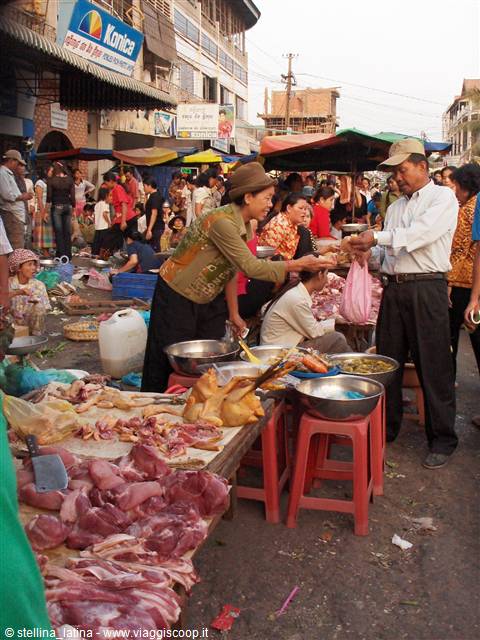
The market is very interesting and we buy t-shirts, silk ties, stamps etc. It is covered and symmetrical: managing to recognise, in the confusion, the meeting point is not easy! In the evening, with head and heart too full from the intense day, we have dinner in the good restaurant next to the hotel.
mekong
Day 78 Feb 2007
THE BORDER
We get up slowly and, after closing the backpacks and having "rolled" down with them from the fourth floor, we wait, as agreed with the Capitol Tour agency, for the minibus that will take us to the border with Vietnam. Out of all the options we chose to cross the border by river, partly for romance, partly for the charm of adventure, partly because it's practically more logical. In fact, it's a sacrilege not to see the Mekong Delta and getting all the way to Saigon only to then come back would have meant wasting days, the only truly scarce resource for us. The tour booked by e-mail from home, perfectly useless since you choose directly at the agency, cost 35 USD each and includes for a 3-day trip, guide, fee, bus, boat, two nights in a hotel in a double room with air conditioning and breakfast.
The price is good and the programme, already compared from home with what was offered by other tours, is interesting. In practice they are all very similar and, unfortunately, what is written on the programme doesn't count for much because the visits inevitably undergo route changes, as we will soon learn, in all the tours purchased.
The tour is summarised as follows:
? Day 1: from Phnom Penh - Chau Doc Pick up with the minibus directly at the hotel and transfer (at Neak Luong) by boat to the Vietnamese border. Stop for customs procedures and lunch, change of boat, arrival at Chau Doc, check in at the hotel.
? Day 2: from Chau Doc to Can Tho (VIETNAM) Pick up at the hotel and transfer by boat for the excursion by pirogue around the floating houses with a visit to a Cham village, a mosque, the fish farm etc. Return to the pier and, by bus we were supposed to climb Mount Sam (from the top of which you can see as far as the Cambodian border), skipped for "military reasons", visit to the temples of Lady Chua Xu and another one in place of Mount Sam. Visit to incense shops and a crocodile farm. Check-in at the Can Tho hotel.
Download 3: from Can Tho to Saigon (VIETNAM) Pick up at the hotel and transfer to the pier where, by boat, we visit the floating market. Visit to a "factory" where rice is processed, to a fruit plantation with tastings (don't kid yourselves, no papaya or mango). Return to the pier and, by bus we continue towards Saigon with a stop at the covered market of Vinh Long and, in theory, a stop at the bonsai gardens of My Tho (not done).
The description of the journey therefore continues in the VIETNAM travel account
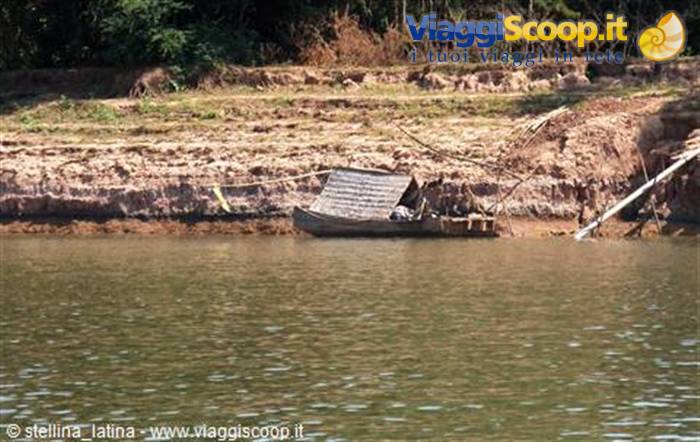
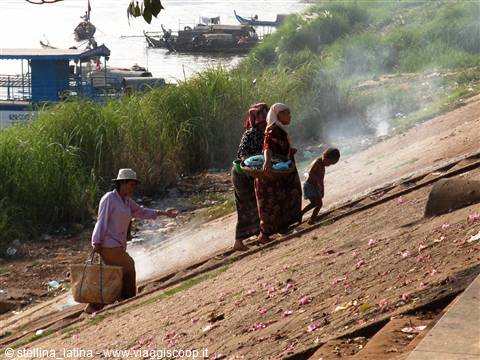
Wooden boat with canopy moored by eroded riverbank, calm green water
finalmente ce l'hai fatta a vedere la cambogia!!!
Bel viaggio! Si capisce dalle facce che è stata dura.....;mi ricorda il mio viaggio in India....;in ogni caso complimenti!!!! Adesso aspettiamo di vedere altre foto!!!!!
Un beso!!
Max









2 reader comments
finalmente ce l'hai fatta a vedere la cambogia!!! Bel viaggio! Si capisce dalle facce che è stata dura.....;mi ricorda il mio viaggio in India....;in ogni caso complimenti!!!! Adesso aspettiamo di vedere altre foto!!!!! Un beso!! Max
cavoli.altro che io.sigh