Finally this day has come on the calendar, which for us is synonymous with departure: strange, but that's exactly how it is… in fact, also this year, without expressly wanting to, we managed to hit the fateful date and for the fifth time, since 2001, on April 21st, we're ready, with our suitcases in hand, to set off on a new trip. This time we're going to do one of the most classic tourist tours there is: ancient Egypt and therefore the unmissable "Nile Cruise"… something we'd had in mind for a while and had prepared scrupulously, with the visit last September to the beautiful Egyptian Museum of Turin, but above all with Federico, our son, now old enough to understand and appreciate the impressive array of artifacts and archaeological sites that awaits us over the next ten days.
At 9:50 we set off, in our car, heading toward Milan and a quarter of an hour later we get on the highway at Faenza, while the fog that characterizes this gray spring morning slowly dissipates. At 10:40, past Bologna, we leave the A14 for the A1 and after an hour we cross the Po, leaving Piacenza behind us too… When noon strikes we're on the western ring road of Milan and right after the Lombard capital we stop at a service area for a quick snack. Back on the road, we soon come in sight of Malpensa airport, so we leave the car at Parking Go (a parking area nearby) and with the shuttle, shortly after 1:00 PM, we're taken to Terminal 1.
Having found the Turisanda desk (our tour operator for this trip), we collect the tickets, check in the luggage and, having passed the metal detector, we wait for our flight at gate B3… So shortly before 4:00 PM the boarding operations begin on the Egyptair Airbus A321 which, slightly delayed, at 4:22 PM, lifts off the ground, identified as flight MS704, immediately turning toward the southeast and then toward Cairo. We climb above today's dense haze and retrace, practically, first the route of the Via Emilia from above and then the Apennine ridge, to reach the Adriatic on the Marche coast and follow it southward so as to fly shortly afterward over the Gargano promontory, with the lakes of Lesina and Varano clearly visible… then a large expanse of clouds and a few glimpses of the Mediterranean. The sun gradually sets and darkness falls as we begin our descent toward the Egyptian capital.
We spot the first lights of the city and after circling over it several times, at 7:55 PM, we finally land (the time, due to the daylight saving time we've adopted, is the same as in Italy). Having got off the plane we meet the Turisanda representative, who helps us complete the customs formalities, then we call home to reassure them, we retrieve our luggage safe and sound and then head by bus toward our hotel. Cairo, the capital of Egypt, with its over sixteen million inhabitants is an enormous city, the largest and most populous in Africa, and alone it houses over 20% of the entire population of the state, so it takes us about an hour to cross it and reach the Le Meridien Pyramid Hotel, which will host us for the first two nights of the trip.
When we arrive at our destination we get off the bus with the spectacular and imposing silhouettes of the Pyramids of Cheops and Chephren before us, standing out illuminated in the Egyptian night, and once at the reception we're immediately handed the keys to room number 507. The hotel is beautiful and very classy: we go up to the room to drop off the luggage and then go down to the street to buy some water and see the Pyramids again… a sweet sight before going to sleep and resting, because tomorrow morning the dancing will begin… and what dancing!
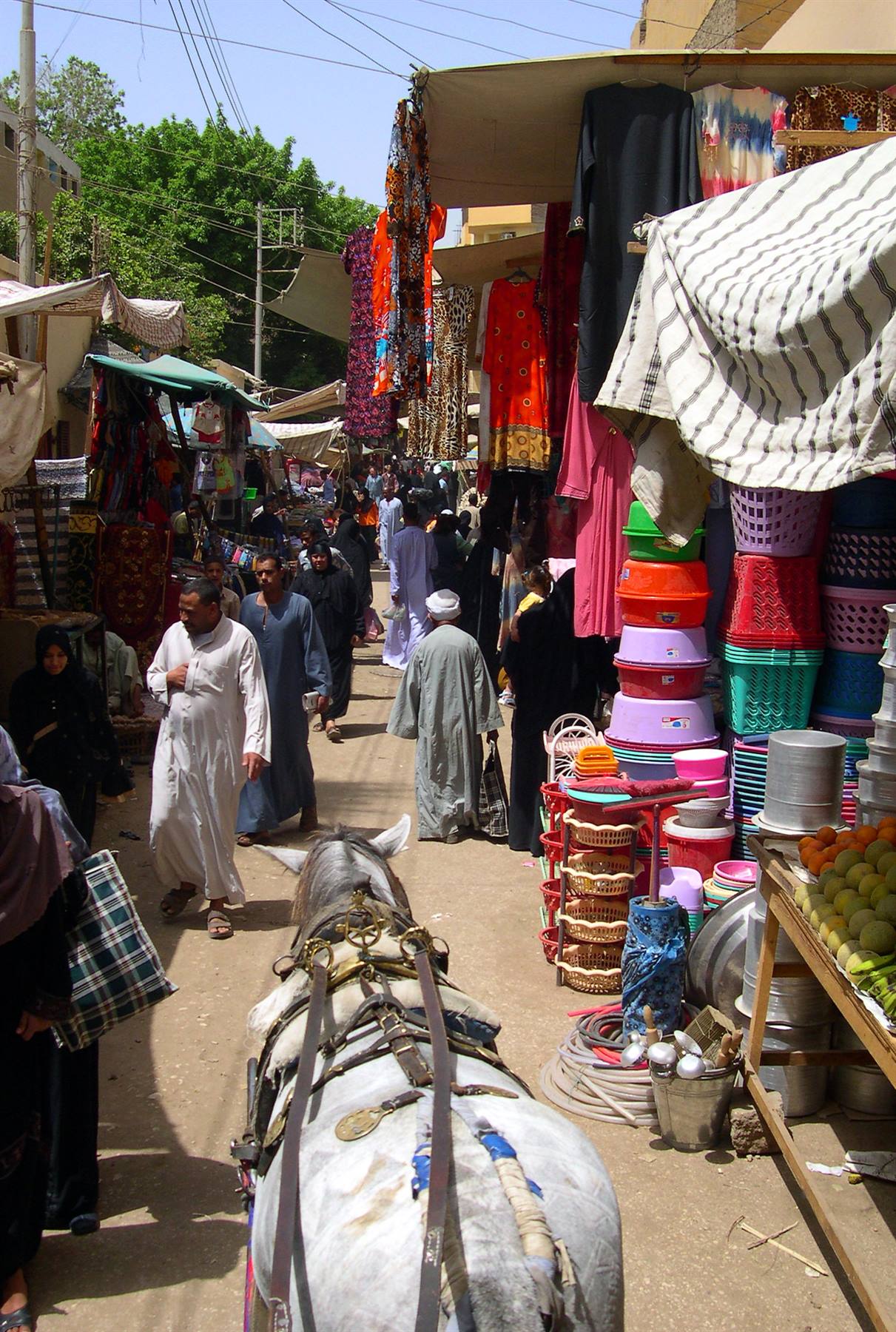
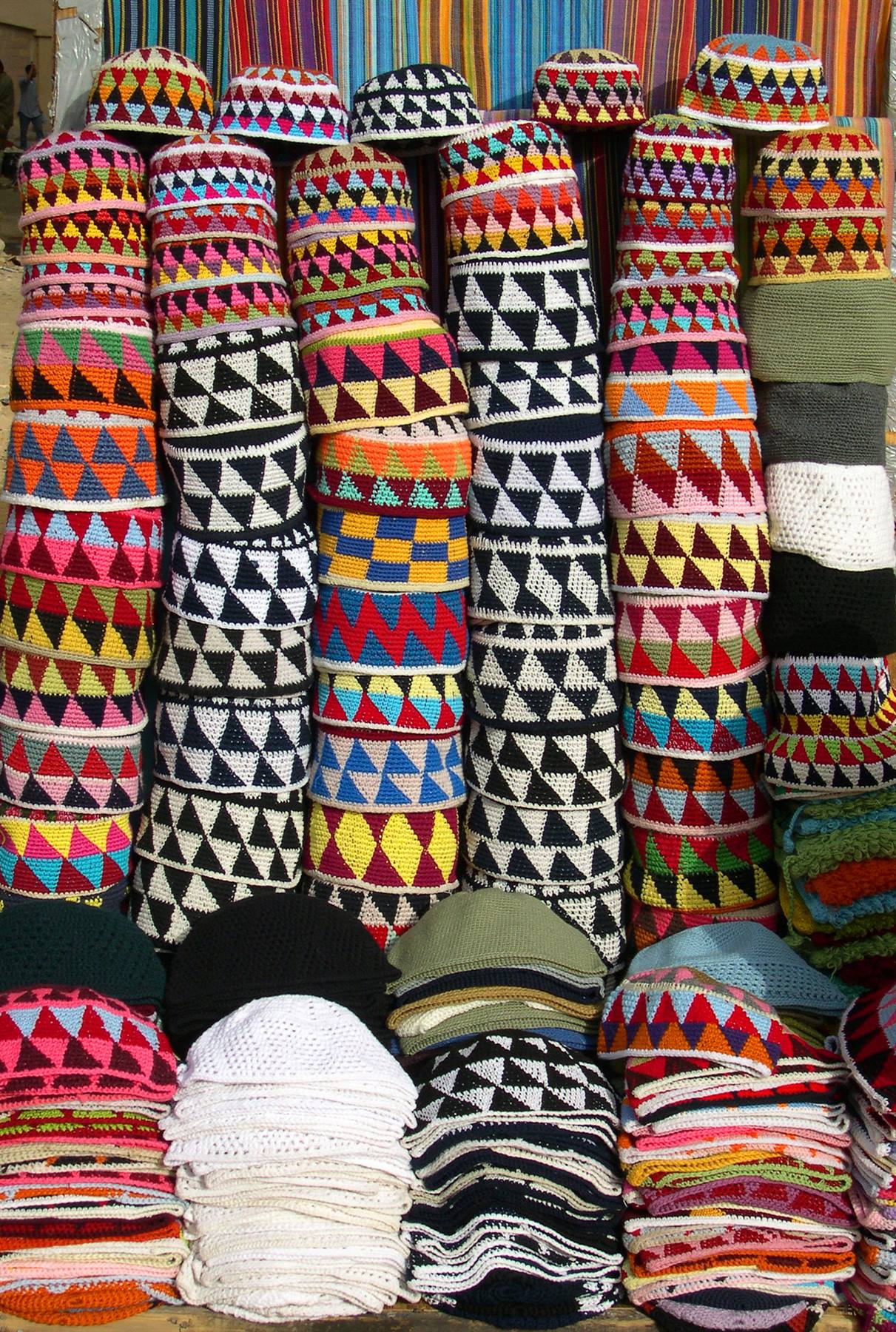
Souk of Luxor
Day 222 Apr 2007
PART ONE
The alarm goes off already before 7:00, but we'll have to get used to getting up early, in fact, in the coming days it'll get much, much worse… Meanwhile below our window the Egyptian car horns are already blaring, while higher up the sky, unfortunately, is instead gloomy and the sun is absent. We have breakfast and right after we get on the bus to kick off this first day of visits: our group isn't large, but among the others there's also a family from Como with a child (Luca) the same age as Federico… and this, perhaps, will make everything a bit easier, in fact they immediately become friends and sit next to each other. In a few minutes we reach the imposing Pyramid of Cheops: no other monument in the world is as universally known and recognizable as the "Great Pyramid", the only one of the seven wonders of the ancient world to have reached our days almost intact.
Erected between 2550 and 2530 BC as a tomb for the pharaoh of the same name, it towers with its 137 meters (originally 146) over the Giza plateau and was for over four thousand years the tallest building in the world… so we feel so small in its presence and the emotion is enormous, only, unfortunately, the day is gray and the whole thing doesn't stand out as it should, plus there's no electricity inside and if it doesn't come back soon we won't even be able to visit it. We set off on foot to go around the Pyramid clockwise, while a few timid rays of sun emerge from the blanket of clouds, and we're immediately assailed by all sorts of vendors and camel drivers… We snap a few photos and then retrace our steps to the ticket office, where fortunately they tell us that the power is back inside the monument.
So we head toward its entrance and prepare to enter one of the most enigmatic constructions ever conceived by the human mind (and also non-human, according to the most extremist scholars). We enter a narrow passage barely one meter sixty high (anyone suffering from claustrophobia would do well to stay outside), which climbs steeply toward the heart of the great mass of stone… Suddenly the passage opens onto a large corridor, eight and a half meters high and forty-seven long, built perfectly, which continues climbing toward the king's chamber, a square space, with the granite sarcophagus at the end, found already empty and looted… or perhaps, as some maintain, Cheops' burial chamber has yet to be found!… It's truly exciting to be in the place that's the subject of a thousand suppositions, in the place where even Napoleon spent a night (and they say that on his way out he was never the same
again), so, full of adrenaline, we return to the open air while, thank heavens, the clouds seem to thin out and at the same time the sun, which comes out into the open, considerably raises the temperature. We walk around the Pyramid of Cheops, this time from the right, and so we can see the nearby and almost equally large Pyramid of Chephren, which, still showing at its summit a good part of the original casing, reaches 136 meters in height… Chephren, the son, did not dare to challenge his father, Cheops, and stopped a few meters lower. Continuing the circuit we arrive, on the southern side of the "Great Pyramid", at the Solar Boat Museum, which houses a boat made of Lebanese cedar wood that presumably was meant, according to the beliefs of those times, to accompany the pharaoh into the afterlife.
The vessel was found, disassembled, in one of the many pits located on site and is of considerable size, with its 43 meters in length… truly extraordinary! We do the visit with strange slippers on our feet, so as not to ruin the museum's wooden floor, and when we return to the sunlight the sky has clouded over again… what a shame! By bus we move to a panoramic height from which all three Pyramids can be seen, including the smallest one, that of Menkaure, Cheops' grandson… a beautiful view, no doubt about it, made even more precious by the fact that Cairo can't be seen and it feels like being in the middle of the desert, but the grayness of the sky blends with that of the sand and the Pyramids don't stand out as they should.
As the morning now draws to a close we also go to see the mythical Sphinx, part of Chephren's funerary complex: it indeed depicts the pharaoh, with the body of a lion, and gives the impression of standing guard over the three Pyramids, which stand out masterfully behind its imposing and universally known silhouette… the only regret is today's dense haze, due in good part also to Cairo's smog, which is terrifying. Almost at noon we get back on our bus and with it we head toward the center of the Egyptian capital. We stop for lunch at a floating restaurant along the course of the Nile… a very quick lunch, because shortly after 1:00 PM we're back on the road.
Temple of Luxor
Day 322 Apr 2007
PART TWO
The day is extremely intense and we dedicate the afternoon to visiting the famous Egyptian Museum of Cairo: of its kind, obviously the most important in the world, even though the archaeological finds of this great civilization are scattered to the four corners of the planet. Founded in 1858 by the French archaeologist Auguste Mariette, the museum over time has progressively expanded to house over 130,000 pieces (and tens of thousands more locked in the storerooms)… Naturally it's not possible to see them all in depth, so we're led on the ground floor in a magnificent parade of the most important statuary, starting with the beautiful three triads of King Menkaure in jet-black basalt, ending, drunk on sculpture, at the foot of the staircase leading to the upper floor.
Having climbed the steps we turn tightly to the right, along a gallery, to visit the eerie room of the royal mummies… In a "tomb-like" silence we scrutinize the incredible faces of sixteen pharaohs, among whom the very famous Seti I and his son Ramesses II. Having emerged from the "world of the dead" we prepare to enter the most important section of all: that wing of the museum which contains the most astounding finds… namely the funerary treasure of Tutankhamun.
One after another we file past all the objects found in 1922 by the archaeologist Howard Carter inside the only royal tomb ever found intact, not looted and overflowing with all its treasures… They're truly extraordinary, headed by the fantastic throne, the solid gold sarcophagus and the astonishing mask: perfect in every single detail, which we can't help but return to see several times… And to think that Tutankhamun died very young and was an almost insignificant pharaoh for Egypt's history… so we don't dare imagine how intact, for example, the tomb of Ramesses II would have been, who reigned for over sixty years. With our eyes now full of wonder we head toward the museum's exit and shortly after 4:00 PM we head by bus toward the Meridien hotel.
The traffic is hellish and we reach our destination at 5:30 PM, just in time to let Luca and Federico take a swim, but the fun is brief because the pool closes at 6:00 PM… So we all go up to the room to take a shower and get ready for dinner. The evening is very short, given the inevitable exhaustion accumulated during the extremely intense day just past, one of those days that will remain forever impressed in our memory, plus tomorrow morning's alarm will go off very early (at 3:00), to allow us to leave Cairo for Luxor and southern Egypt, and in light of all this we soon retreat to the room to seek some providential rest, so as to continue at our best in this fantastic adventure in discovery of Egyptian civilization.
Temple of Karnak
Day 423 Apr 2007
The alarm goes off in complete darkness beyond the window and it's very hard, but we have no alternative, because in a quarter of an hour the porter will come by to collect the suitcases. We go down sleepy-eyed to have an early breakfast and a little later, even before 4:00 AM, we get on the bus that will take us to the airport. We speed at full throttle through the not-even-too-deserted streets of Cairo and soon reach our destination… We're a bit sorry to leave the capital because we're aware that there was more to see besides the Pyramids and the Egyptian Museum, but we must stick to Turisanda's program and perhaps, who knows, one day we'll return to complete the visit.
We do a very quick check-in and in no time at all we find ourselves boarded on flight MS401 (a big Airbus A330) which at 5:40 AM, perfectly on time (as if we were in Switzerland), lifts off the ground headed for Luxor… Just the time to gain altitude, then a quick snack and we begin descending toward our destination, so, at 6:28 AM, not even an hour after departure, we land at Luxor airport, where the Turisanda staff await us. Once the formalities and luggage collection are done we're led to the banks of the Nile, to our ship: the Miss Esadora II, which will accompany us on the navigation along the longest river in the world, in discovery of ancient Egypt.
The large vessel at first sight seems to us elegant, clean and welcoming, as is our cabin, number 309… There we settle the suitcases and, having put on our swimsuits, we immediately go up to the upper deck in search of the pool, so that by 7:30 AM we're already stretched out on the loungers, with the sun burning on our skin, and we're practically the only guests on the ship, since many will arrive with the next flight and others are on an excursion, which we today will only do in the afternoon. Shortly after 9:00 AM finally someone arrives: two young people from Trieste (Susy and Denis) who were with us in Cairo too and together with them we decide to go ashore so as to take a little stroll through Luxor.
As soon as we leave our floating hotel we're assailed by taxi drivers and carriage drivers, who offer us a tour of the little town, so, after a long negotiation we give in to a coachman who for twenty Egyptian pounds (less than three euros) has all five of us get on his carriage… The unplanned tour allows us to flow in a particular way through the colorful local little market: evocative and characteristic… all in all a nice experience, and this way we pleasantly spend the morning. Back on the ship satisfied, we have lunch, while Federico finds his little friend, Luca, and together in the early afternoon they indulge in a very long swim in the pool.
At 5:00 PM sharp, summoned by our guides Moustafa and Ashraf, we finally leave the vessel for the planned excursion… We're thus led, in a short time, to the nearby Temple of Luxor: a monumental construction erected in the 14th century BC by the pharaoh Amenhotep III.
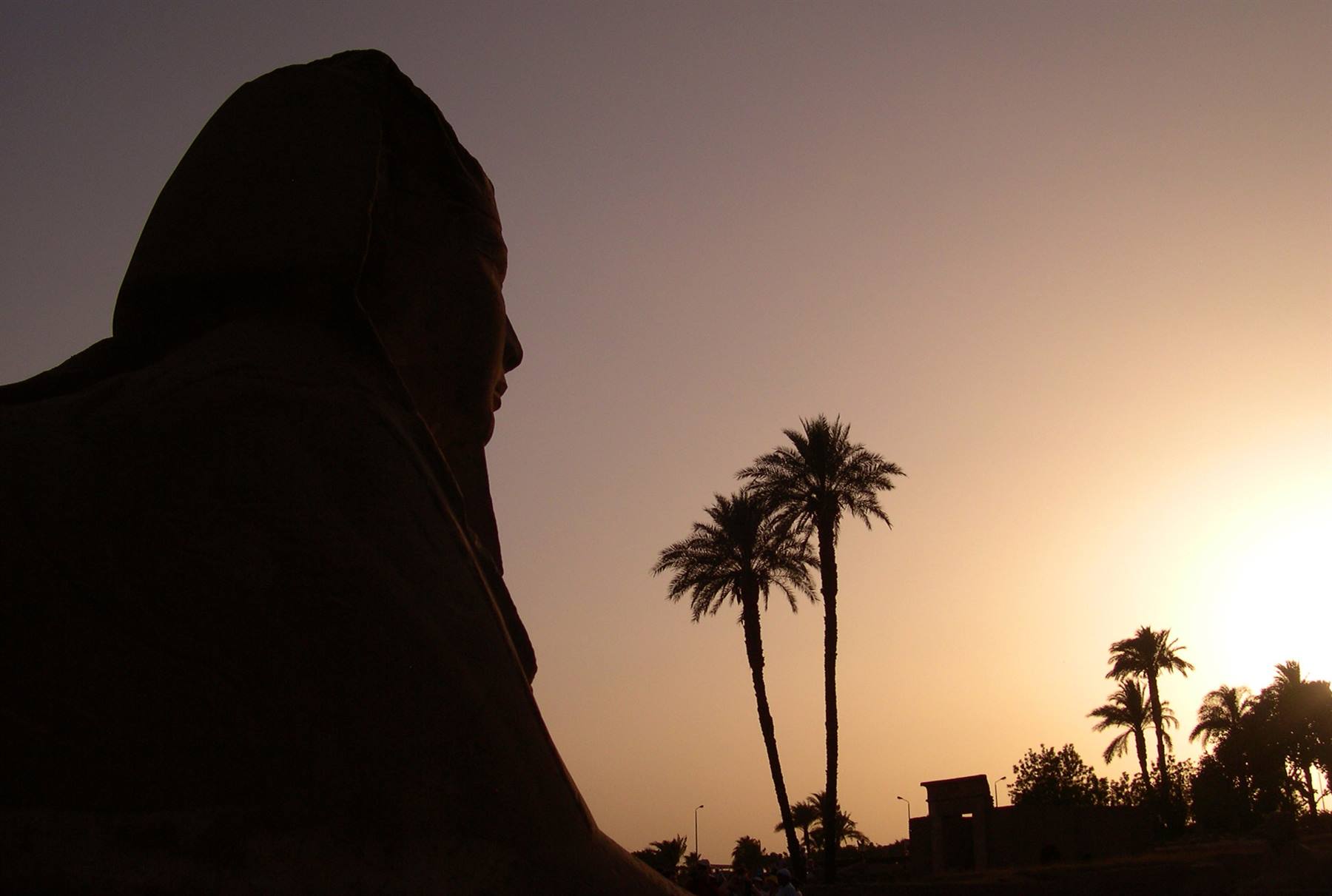
The sun is already near the horizon when we arrive before the ruins and I make a great dash to manage to take some good photos, even at the cost of missing Ashraf's thorough explanations, after which I too try to enjoy the exceptional magnetism of the place: its astounding columns rise impetuously after millennia and it's said, among other things, that in their presence, in 1799, Napoleon's army, amazed, broke into a spontaneous "present arms"… they're truly imposing and create highly evocative views, as evocative as the unbroken parade of sphinxes that precedes the so-called pylon, faced by an enormous and scenic obelisk (bereft of its twin, currently located in the Place de la Concorde in Paris).
With the arrival of darkness the temple is also illuminated with fine light displays and it's a further spectacle that we can enjoy in all tranquillity, before returning for dinner on the Miss Esadora… A little later then, with the wonderful memories of the Temple of Luxor still in our eyes, we go to sleep, because tomorrow morning another pleasant early rise is planned.
Temple of Queen Hatshepsut
Day 524 Apr 2007
The alarm goes off at 4:20 AM… it's a luxury: almost an hour and a half more sleep than yesterday! We leave the ship just as the sun has risen and already around 6:00 AM we're in front of the imposing pylon, faced by the inevitable parade of sphinxes, of the Temple of Karnak, built over the span of 1300 years and considered, after the Pyramids of Giza, the largest, most titanic and magnificent pharaonic monument ever built.
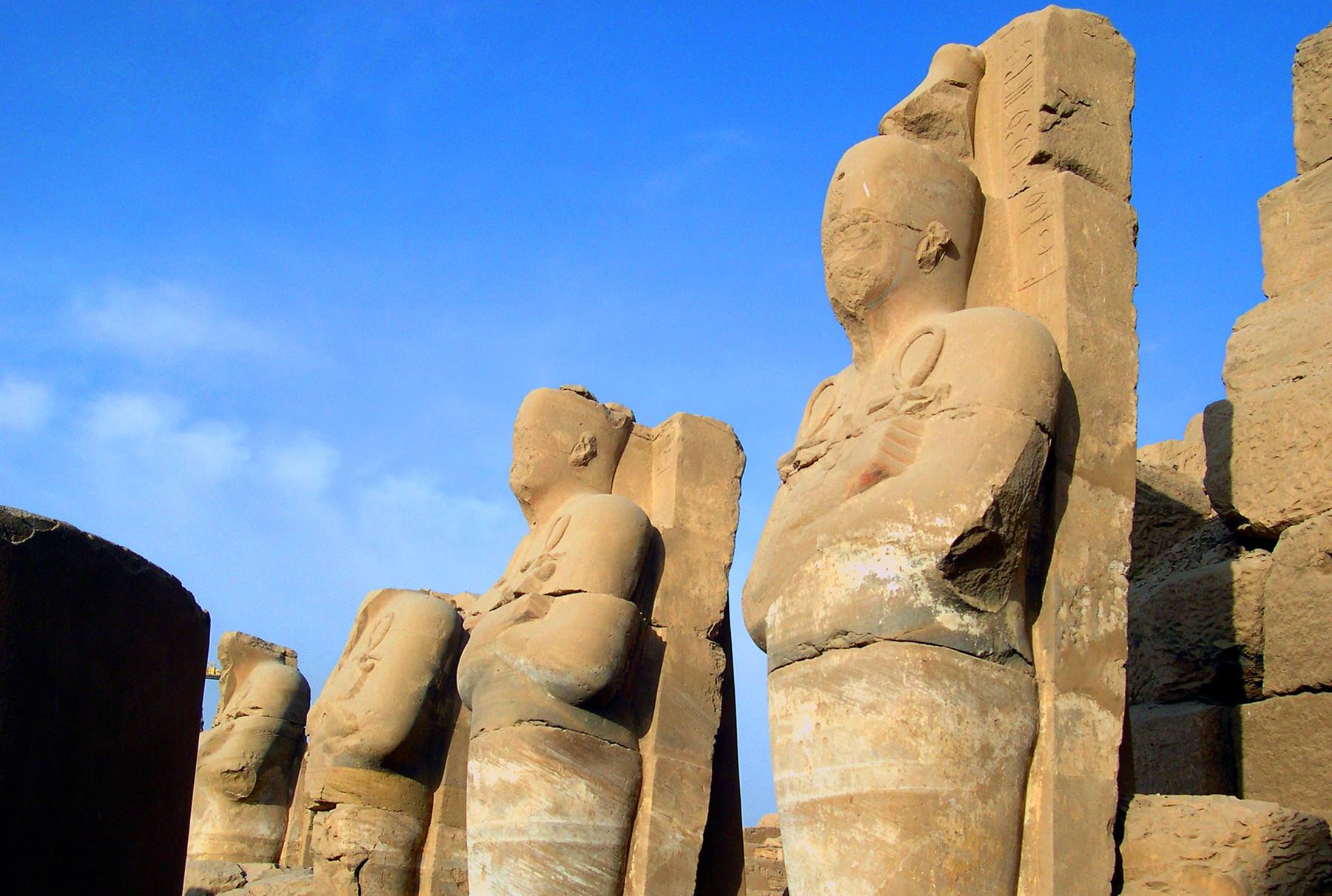
We follow step by step the guide's thorough descriptions and, having passed the second pylon, we remain dumbfounded before the incredible forest of columns of the great hypostyle hall: there are 122 of them 14.40 meters tall and 12 colossal ones, 22.40 meters tall… a true engineering prodigy, considering the times (word of a 21st-century surveyor!)… You really feel small before such works and I confess I've felt that way only before the gigantic sequoias of California… Further on the other ruins are also beautiful, headed by the astonishing obelisks, but also with the mummy-shaped colonnades and the sacred lake, with the Giant Scarab in front, still the object of presumed propitiatory rites… and then more courtyards and more temples… but one can't describe everything the eyes see! At the end of Ashraf's explanations the sun is sufficiently high in the sky to allow us to take a good series
of photos, so we go back over the Temple of Karnak trying to capture its most evocative views and we'd like to stay on site longer than allowed, but we must necessarily make our way slowly toward the exit because today's program is really intense. We get on the bus and, having crossed the Nile by means of a bridge, we head toward Luxor (or Thebes, but also Weset) west… We move away from the riverbed and arrive at the first desert hills, where the major archaeological sites of the region are located. First of all we go to see the so-called Valley of the Queens, located at the base of two tall rocky spurs, where, despite the name, in their time not only queens were buried, but also princes and court dignitaries. Scattered here and there are over eighty tombs, some of which are very interesting, like that of Queen Nefertari, which however, for five years, has been closed for restoration.
So we console ourselves by visiting those of Prince Amunhirkhepshef (son of Ramesses II) and Queen Titi, rich in beautiful paintings. We return to the bus while the heat is definitely rising, despite the still early hour, and passing by the significant ruins of the Ramesseum, the funerary temple of Ramesses II, we reach Deir el-Bahari, that is another funerary temple: that of Queen Hatshepsut. We get off our vehicle while for a moment our thoughts run to the 58 tourists who right here were slaughtered, less than ten years ago, by despicable Islamic terrorists… With a shiver running down my spine we then get on a little train that takes us to the base of the monument.
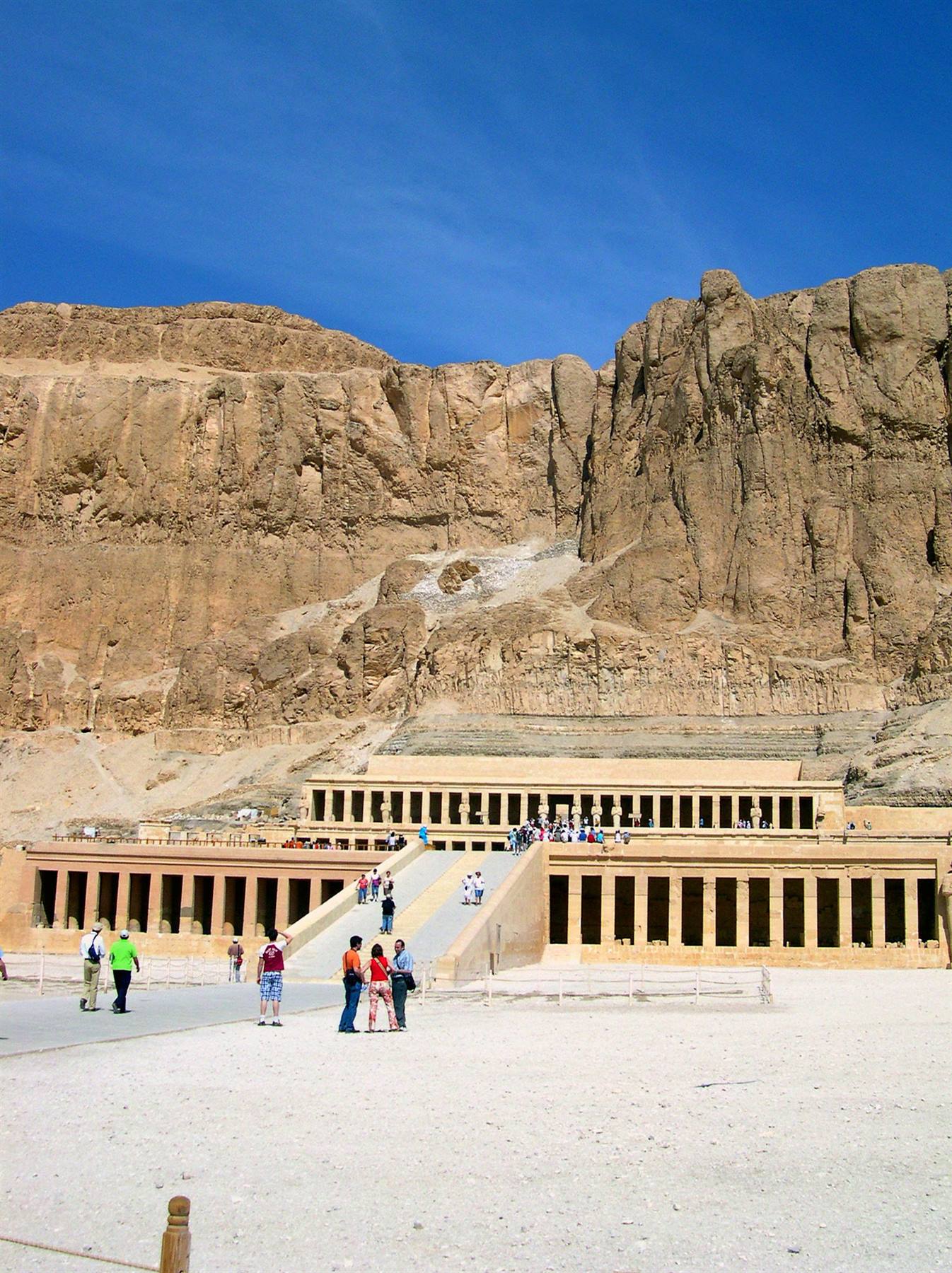
Also the Temple of Queen Hatshepsut, the only woman who ever reigned over Egypt as a pharaoh, in 1500 BC, despite the evident restoration, proves extremely interesting and the highly spectacular views abound thanks to the original terraced architecture and then with the beautiful porticoes and colonnades, against the backdrop of the stern and rocky surrounding landscape. Rich with this new experience we take to the road again, never sated with archaeological wonders, and penetrating even further into the desert we arrive at the entrance of the universally known Valley of the Kings. Among these arid Theban hills were buried almost all the pharaohs of the New Kingdom, starting from around 1500 BC, for over four hundred years.
The tombs found on the site are 63, but not all prove interesting… The most beautiful and precious are permanently closed to the public, like that of Seti I, and only some can be visited in turn, in fact today ten are open, but with our ticket we can only see three… The guide thus chooses for us: first of all that of Ramesses VII, not up to expectations and, indeed, rather disappointing, then that of Ramesses IV, stunning and with extraordinarily vivid colors, finally, passing by the entrance of the small but very famous tomb of Tutankhamun, that of Ramesses III, enigmatic, vast and also very beautiful… As an alternative to this last one one could visit the tomb of Ramesses IX, according to those who have seen it, truly interesting, and in light of all this we can't understand why they had us enter the first one, but we adapt… We come out satisfied from the Valley of the Kings too: certai
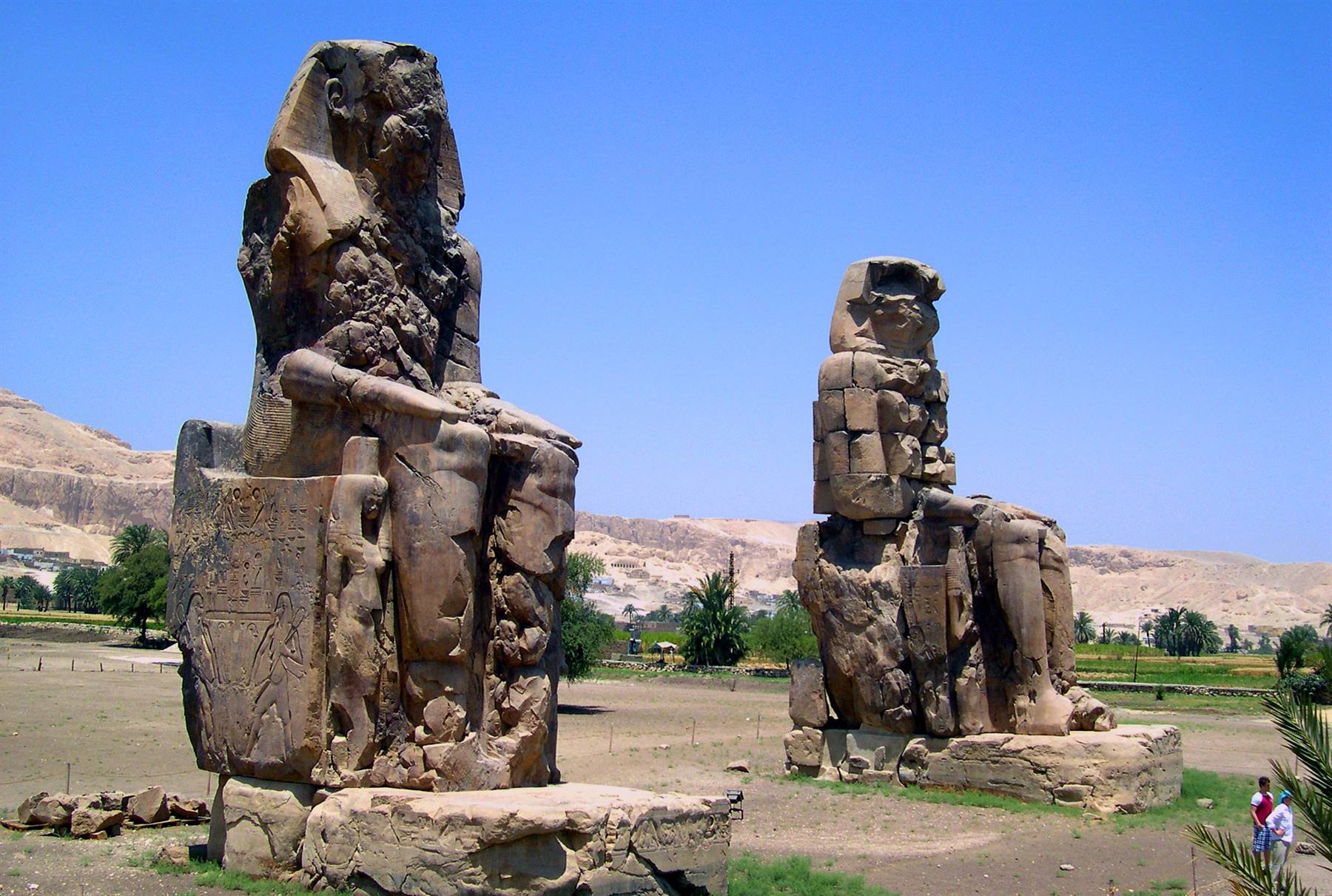
nly, one would like to see everything and more, but one can't and we must make do. The morning is now drawing to a close when we regain our bus and on the way back we stop to immortalize the evocative Colossi of Memnon, two imposing statues, 18 meters tall, that dominate, solitary, the cultivated fields located between the Nile and the Valley of the Kings… Once they were placed in front of the funerary temple of Amenhotep III, completely destroyed, and now they seem like two enigmatic sentinels set to watch over the ancient vestiges of Thebes and they stand out wonderfully against the blue of the Egyptian sky. With the sun almost at its zenith we return to modern Luxor crossing the Nile on a characteristic and colorful vessel, then we go for a walk along the anonymous tourist souk, while we wait for some members of the group to visit the Temple of Luxor, which we did last night.
The meeting point, for everyone, is in front of the bus at 1:00 PM and with relief we get on board seeking some refreshment, before setting off, with the armed escort (an inevitable security measure against despicable Islamic terrorism), for the nearby city of Esna, where the Miss Esadora awaits us, which set sail this morning so as to pass, without wasting time, a lock that bars the course of the great river. Esna is just over 50 kilometers from Luxor, so in less than an hour we reach our destination and, while everyone boards the ship, we're granted fifteen minutes during which, in the company of the two young people from Trieste, we rush to see the Temple of Khnum, from the Roman era and therefore relatively recent.
The building, of which only one hall remains intact, is set nine meters deep, in a chasm in the center of the village and, despite the number of sites seen today, proves very interesting, with the ceiling still intact and beautiful hieroglyphics on the walls and columns… We stay to observe its details, but time passes quickly and we must run back toward the ship, which sets sail as soon as we get on board. It's almost 3:00 PM and we can finally have lunch, then we go up to the upper deck to enjoy the sun and the navigation… In a wonderful quiet we proceed thus between the two banks of the Nile, very green and characterized by an unbroken parade of palms… The sun's rays are warm, but at the same time a pleasant breeze blows and in a marvelous setting we sail until sunset and to the city of Edfu.
When the shadows of evening fall we go down to our cabins, freshen up and go to have the welcome cocktail offered by the Miss Esadora, then we go to dinner… Later we spend some time with the kids and a board game, finally we retire to the room because, in fact, we've been on our feet for an eternity… and what can we say about the stupendous day just concluded: adjectives abound and it's better to lock it jealously in the safe of memories.
Colossi of Memnon
Day 625 Apr 2007
Incredible but true: the alarm is, calmly, at 8:30, in fact a part of the ship's guests has gone ashore to visit the Temple of Edfu, while we, having chosen the longer cruise, will
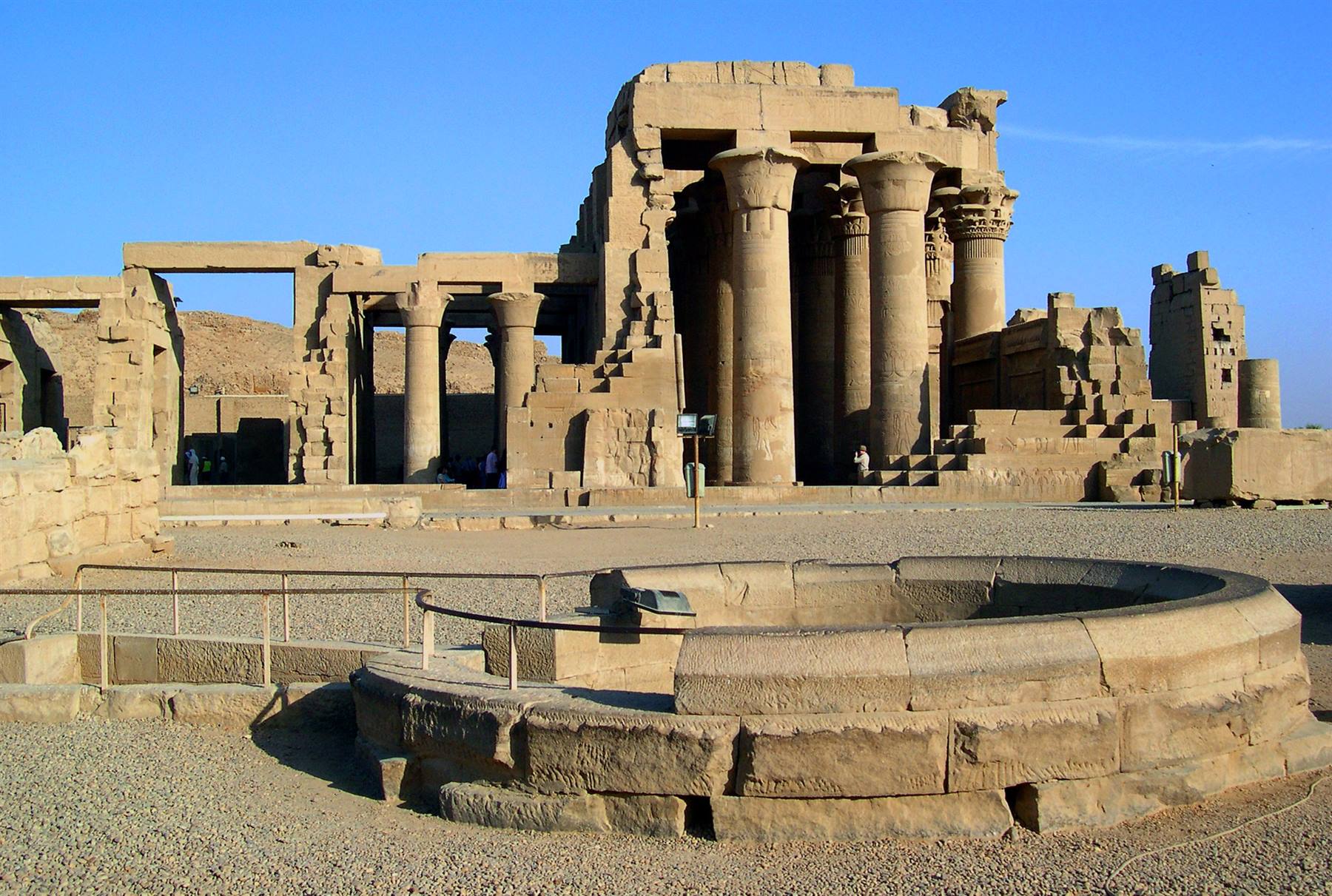
Kom Ombo - Temple of the two deities
Day 726 Apr 2007
This is a real record for the alarm and, they tell us, it won't happen again during the trip: the phone on the bedside table rings at 2:45 am!!!... Needless to say, sleepy, we get ready for the excursion and like a bunch of zombies we present ourselves, one after another, in the ship's lobby... A scene that becomes even funnier when they tell us we can take our pillows to sleep along the way, so at 3:30 am we set off, all clutching our soft fetishes, climb onto the coach and depart southwards, with the armed escort, in the darkness of the African night. While we resume doing what our bodies want to do at this hour, namely sleep, the sun rises, we cross that imaginary line that is the Tropic of Cancer and shortly before 7:00 am we reach Abu Simbel. We get off our vehicle and immediately begin the visit, because the armed escort will leave again for Aswan at 9:00 am.
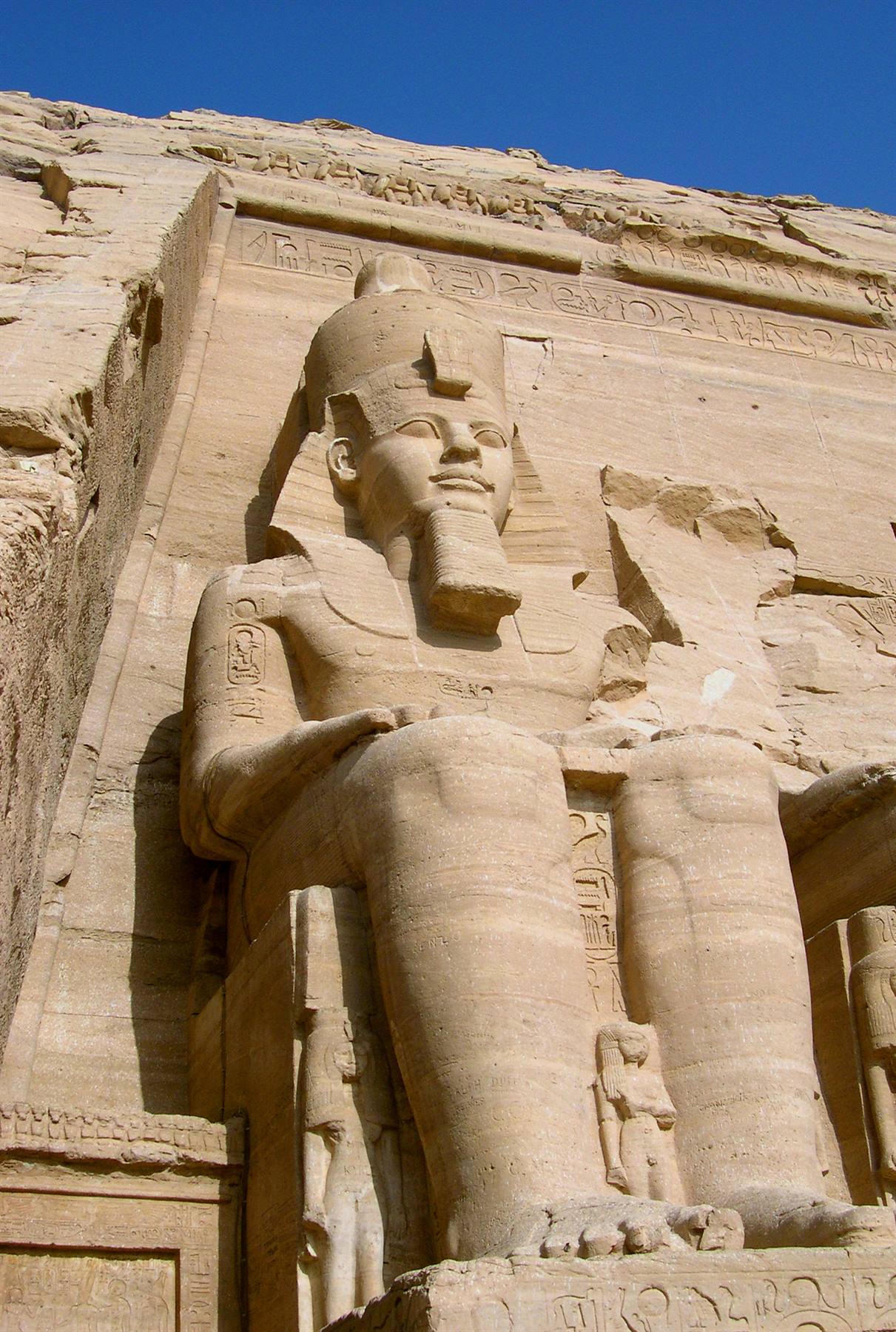
It really is a thrill to walk around an artificial hill and suddenly find yourself before the universally known Temple of the Sun of Ramesses II, built, or rather, carved by order of the pharaoh of the same name almost 3300 years ago, as a symbol of his power and as a warning to the inhabitants of Nubia and to anyone preparing to enter Egypt from the southernmost part of the kingdom. There are no words to describe the beauty of the four seated colossi of Ramesses II, 20 metres tall and with finely carved faces (one unfortunately has no head, lost following an earthquake in 27 BC). The monumental façade is completed by other smaller statues, representing the pharaoh's family members...
There are no words either to describe the beauty of the interiors, rich in bas-reliefs and gigantic pillars in the shape of the ruler, and then, at the far end, the sanctuary, with the statues of the pharaoh among three other deities, which used to be lit by a ray of the rising sun (all except that of the god of darkness, Ptah) on the 21st of February and the 21st of October each year, the dates respectively of the birthday and the coronation of Ramesses II (unbelievable but true!)... Today, unfortunately, it's no longer like that, but the phenomenon still occurs, albeit a day late. That's because the Temple, in the sixties, was cut into over a thousand pieces and moved 210 metres further back and 61 metres higher to save it from the flooding waters of the newly born Lake Nasser...
A titanic undertaking, made possible in large part thanks to Italy and the master marble cutters of Carrara. Having come out of the Temple of the Sun, we also see the nearby and very beautiful Temple of Hathor of Queen Nefertari, the much-loved wife of Ramesses II, much smaller, but still evocative, with the six enormous statues of the royal couple that seem to emerge from the rock, and then the temple proper, which penetrates into the hill for 24 metres. The two hours available pass in the blink of an eye and we move to the right-hand side of the site to savour the simultaneous view of the two temples, before leaving them behind us for good, a little regretfully.
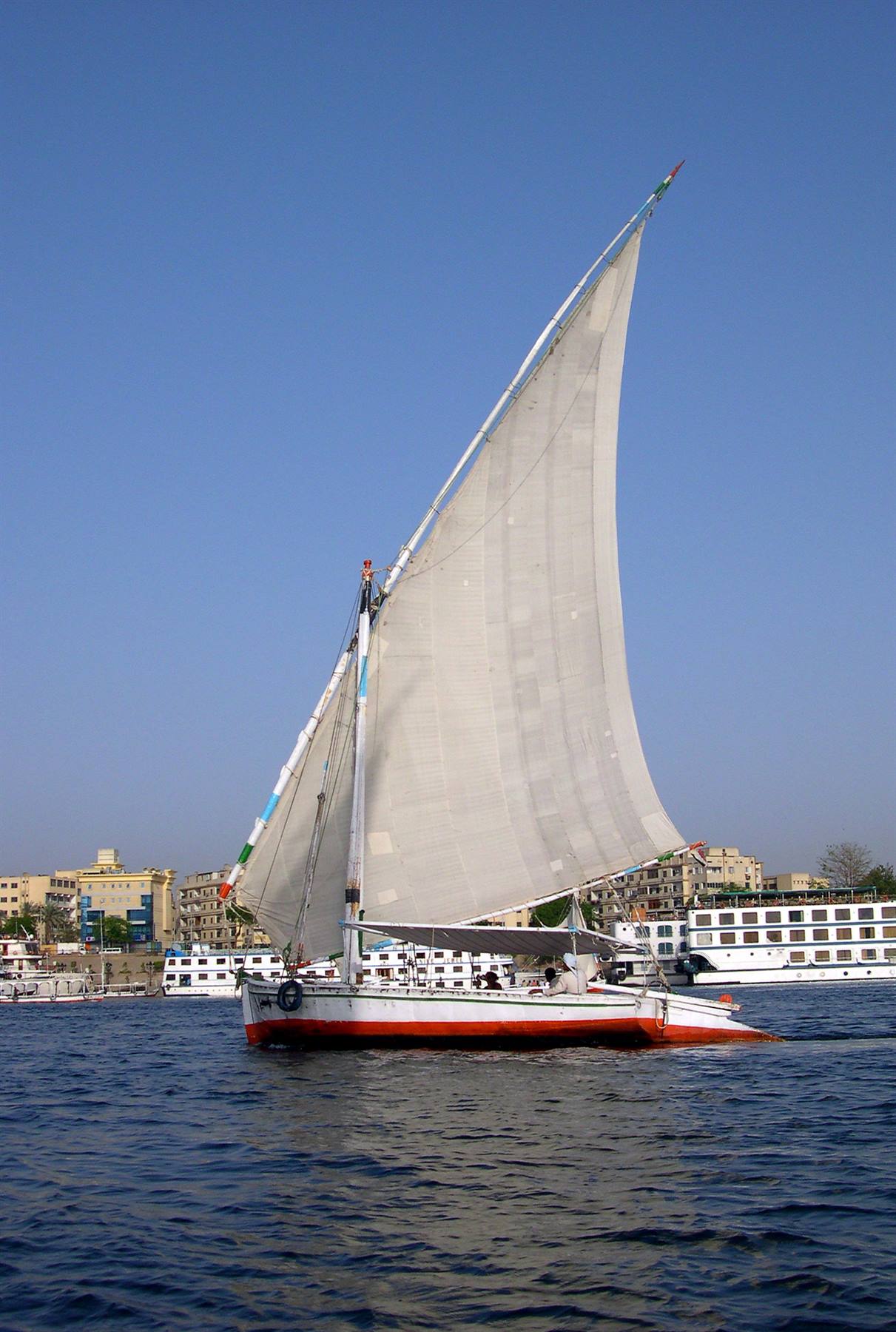
On the way back, in the daylight, we can also observe the immense desert expanses at the sides of the road, including a proper mirage! Shortly after midday we're back in Aswan and, once back on the ship, we have lunch, then go up to the top deck, but stay strictly in the shade, because the sun is beating down mercilessly, and we allow ourselves just one dip in the pool before going to get ready for the afternoon visits. We set off from the pier next to the Miss Esadora around 4:00 pm for a short felucca trip (the typical Egyptian sailing boat) on the great river. We tack placidly as far as the opposite Elephantine Island, a historic strip of land inhabited since antiquity and now disfigured by an enormous hotel and another one under construction...
We notice on the opposite bank of the Nile the great Mausoleum of the Aga Khan, who has been buried here since 1957, but to us Italians it's mainly his son who is known, as the founder of the Costa Smeralda in Sardinia... We sail among the smooth granite boulders characteristic of this stretch of riverbed, which, resembling large pachyderms, gave the island that hosts them its name (but they can also be associated with Gallura, Sardinia and the Aga Khan, who watches over silently from the hill opposite), and then we disembark near the Old Cataract Hotel, a historic hotel that also appeared in Agatha Christie's "Death on the Nile", bringing a lovely river experience to a close.
Near our landing point is the Nubian Museum, which our guide, Moustafa, has the brilliant idea of having us visit this afternoon, even though it's on tomorrow's programme, so as to make the ever-dreaded alarm a little easier... The museum turns out to be quite interesting on the whole, with beautiful statuary and unsettling mummies, but only a very distant relative of the one in Cairo. We get back to the ship when it's almost dark and, after dinner, there would also be a show of Egyptian dance and music to see... but we're too tired after the endless, though magnificent, day, and we soon give in to the temptation to go to bed, even before the show begins.
Abu Simbel - Temple of the sun
Day 827 Apr 2007
It's a real pleasure to sleep until 7:30... even if it's all virtual, in fact tonight daylight saving time came into effect in Egypt and in reality it would be 6:30! On the agenda this morning is a visit to the surroundings of Aswan, so after breakfast we head towards the old dam, the first one, built by the English at the end of the nineteenth century to hold back the impetuous course of the Nile. Once past the barrier we arrive at a landing stage from which we set sail, shortly afterwards, to visit the Temple of Philae. The construction, dating back to Ptolemaic times, is in fact located on an island, but not on the original one, which sank into the waters of the Nile following the construction of the Great Dam, but on another one, practically reshaped on the forms of the previous one... and, as with the Temples of Abu Simbel, this too was an undertaking that was nothing short of...
pharaonic! The arrival on the placid waters of the river makes everything more evocative, and it is only the prelude to what awaits us: the remains of the Temple dedicated to Isis appear extraordinarily intact and are a splendid fusion of Egyptian and Greco-Roman architecture, it's just a shame that the Nile has left the mark of its presence on the walls, in fact for over half a century, at the beginning of the twentieth century, it cyclically flooded the site, but above all it's sad to see the very numerous bas-reliefs defaced at the hands of the Copts, who in Christian times turned the temple into a church. We stay a couple of hours at Philae observing, in addition to the main building, also the nearby and original Kiosk of Trajan, a small temple that we later also see from the river while completing, on the way back, the circumnavigation of the island.
We thus leave the Temple of Isis behind us, but we are not sorry because we will return in the evening to attend the sound and light show. Once back on dry land we are taken to visit the Great Dam of Aswan, a colossal barrier, almost 4 kilometres long, erected in the sixties, which generated Lake Nasser: an enormous water basin extending over 6000 square kilometres, with a length of almost 500!... but from a scenic point of view it is nothing exceptional... Better the Temple of Kalabsha that can be seen in the distance and that I ask to be able to visit, but they tell me that it is practically impossible and that it would be a big problem from a bureaucratic point of view, in fact one can only do it by taking part in a cruise on Lake Nasser (but is that true?).
With the Great Dam the morning excursion is practically over and on our way back to the ship we stop at a shop that sells essences, affiliated with the tour operator (the only stop of this kind during the trip, and it's a good thing, because honestly I was expecting a few more)... We are naturally ensnared by the demonstrations and make a small purchase, then, back on the Miss Esadora, we have lunch before going up to the upper deck, in the open air...
but we stay strictly in the shade because today the temperature has well exceeded forty degrees! On the other bank of the river, right in front of the place where we are moored, you can see the archaeological site of the Tombs of the Nobles, which could be interesting to visit and which tickles my curiosity, but it is not in the programme and although tempted to go there on my own, with a pedestrian ferry that departs from nearby, I am more than anything discouraged by the hallucinatory heat and by the fear of finding it closed, because you can't see a single tourist walking among the remains scattered on the arid hill. Once the hottest hours of the day have passed we nevertheless get off the ship for a "do-it-yourself" tour of the souk of Aswan... where we find some typical situations, but the whole thing is, for the most part, extremely touristy and a bit disappointing...
In the end we make a few purchases, naturally at the end of exhausting negotiations, also amusing, but the motto of many Egyptian sellers is disconcerting: "If you already bought... already cheated!"... and with this phrase echoing in our heads we return to our floating accommodation just in time for dinner. With the arrival of darkness we set off again by coach to go and see the sound and light show at the Temple of Philae... It is already exciting to arrive on the island with the glow of a still waxing moon, but when later the ancient stones are wrapped in enigmatic beams of light, with the narration of the story of Osiris in the background, the setting becomes wonderful and evocative. We thus enjoy the show until late and return tired, but satisfied, to the ship now at midnight...
luckily tomorrow morning the alarm is free and we will only have to get up in time to have breakfast before the restaurant closes.
Aswan - Felucca on the Nile
Day 928 Apr 2007
We wake up while the Miss Esadora, already for several hours, is sailing north, and in the meantime she has also docked at Kom Ombo, so as to allow some new guests who came on board yesterday to visit the Temple of the Two Deities... When we go up to the upper deck to settle in with the sun loungers we are thus already speeding towards Edfu. It is not an optimal day from a meteorological point of view and a thick haze covers everything, with a milky sky and the course of the river wrapped in a somewhat spectral environment... then as the hours pass the mist clears but the sky remains white and, also pushed by the favour of the current, shortly before midday we arrive at Edfu.
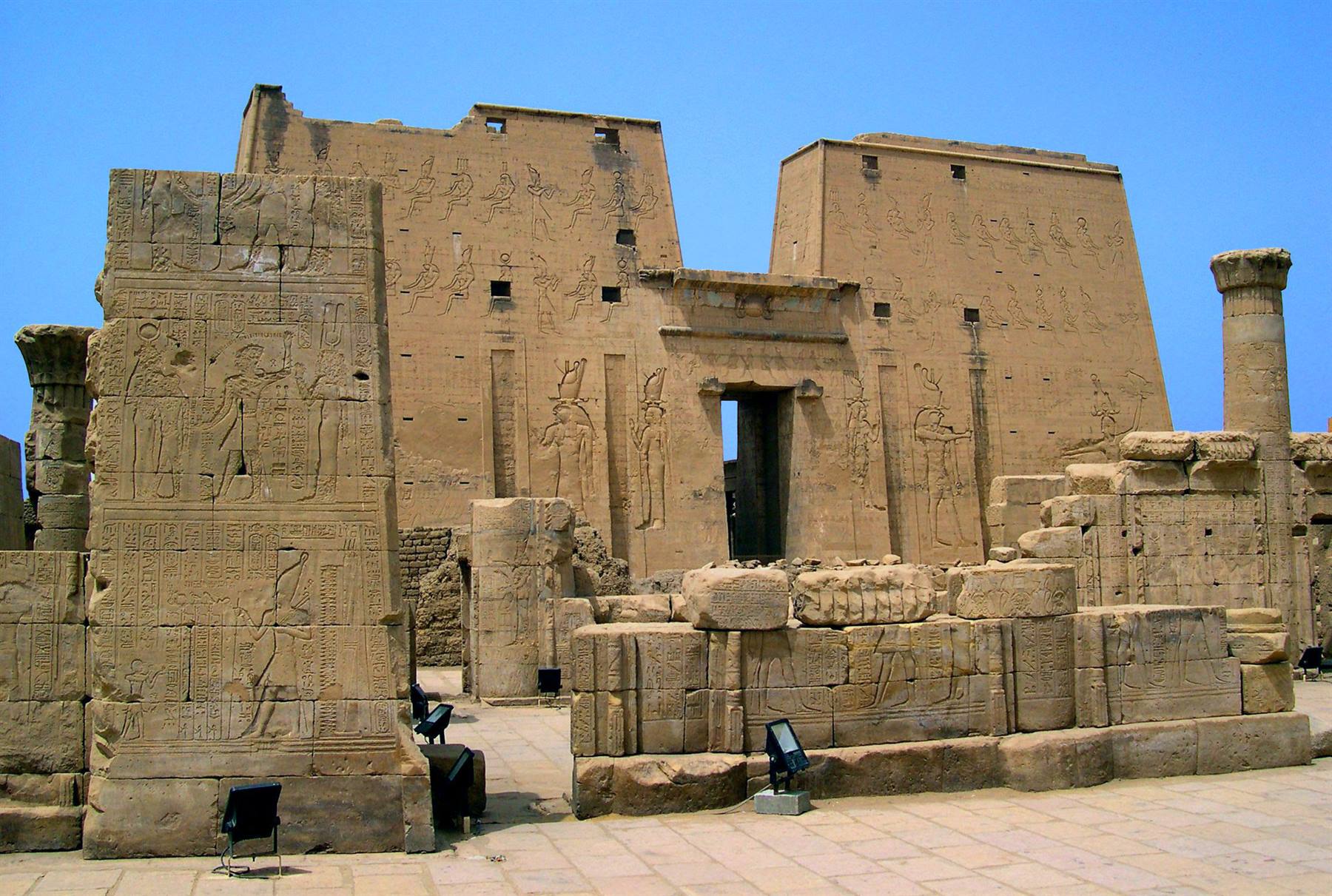
We dock at the pier of the little town and after half an hour of waiting we disembark to get on a coach that in a few minutes takes us before the Temple of Horus (god with the falcon head), dating back to Ptolemaic times and therefore relatively recent, but built with the canons of ancient pharaonic architecture. Thanks to its excellent state of preservation (the best in all of Egypt) it thus allows one to get an idea of what most of the temples must have been like in previous centuries. The enormous pylon, faced by two great granite falcons, leads into the vast court of offerings, colonnaded on three sides, which leads to the entrance of the hypostyle hall, dark but practically intact, with the two side staircases (now closed) that give access to the roof... it's just a shame that, as at Philae, many bas-reliefs were hammered and defaced in Christian times.
We carry out the visit in an oppressive heat (well over forty degrees today too!) and despite everything we make the most of our two hours available, fully enjoying the archaeological wonders that this site too has been able to offer us... In the end, however, rather worn out, we get on the coach in search of some refreshment and with pleasure return to the ship for lunch. In the early afternoon, while we resume sailing, we try to go up to the upper deck, but it is a real oven... so we go back to the cabin for an hour and then try again, but we don't stop on the loungers and go straight to the pool. Proceeding always between two rows of palms, shortly after 17:00, we arrive at Esna and we queue up to pass the lock, but it's no small thing, in fact, at 20:00, when it's dinner time, we are still waiting... and we have all the time to eat, because we only move an hour later...
Finally we can thus witness all the operations of opening and closing the gates that make possible the jump in height of about six metres, imposed on the Nile by the artificial barrier. In the darkness we then continue sailing towards Luxor and after having pleasantly spent the evening chatting under the stars we retire quietly, quietly to our apartments, worthily putting an end also to this day of a character that was, more than anything, one of transfer.
Souk of Aswan
Day 1029 Apr 2007
Just so as not to completely lose the habit of getting up early, on this last full day of the trip that we will spend in the land of Egypt, the alarm goes off at 6:30. We are once again moored at the pier of Luxor and on the agenda is the visit of two temples in the vicinity, which will keep us busy all day... We thus set off by coach, lunch basket in hand and with an armed escort, towards the north, crossing interesting bucolic landscapes and real Egyptian villages, as well as an endless number of check-points, because the government cares in a particular way about tourism, without which the country's economy would collapse. After about three hours of travel we arrive at Abydos, a historic centre dedicated to the cult of Osiris, where every Egyptian hoped to go on pilgrimage at least once in their life... a bit like Mecca for present-day Muslims...
Of the very ancient vestiges, however, not much remains apart from the Temple of Seti I, had built by the pharaoh of the same name (father of Ramses II) around 1300 BC, but this alone is enough to justify the visit and the road taken to get there. The construction is not so interesting for the exteriors, with the pylon practically disappeared and the current façade composed of anonymous squared pillars, as for the interiors, which house magnificent painted hieroglyphs, the best of all in the whole of Egypt. In fact, in the inner hypostyle hall and in the so-called sanctuaries, the bas-reliefs, with their brilliant colours, are a real marvel... and we stay a long time to admire them, not neglecting even the interesting Gallery of the Kings, with almost all the cartouches of Seti I's predecessors engraved on the wall.
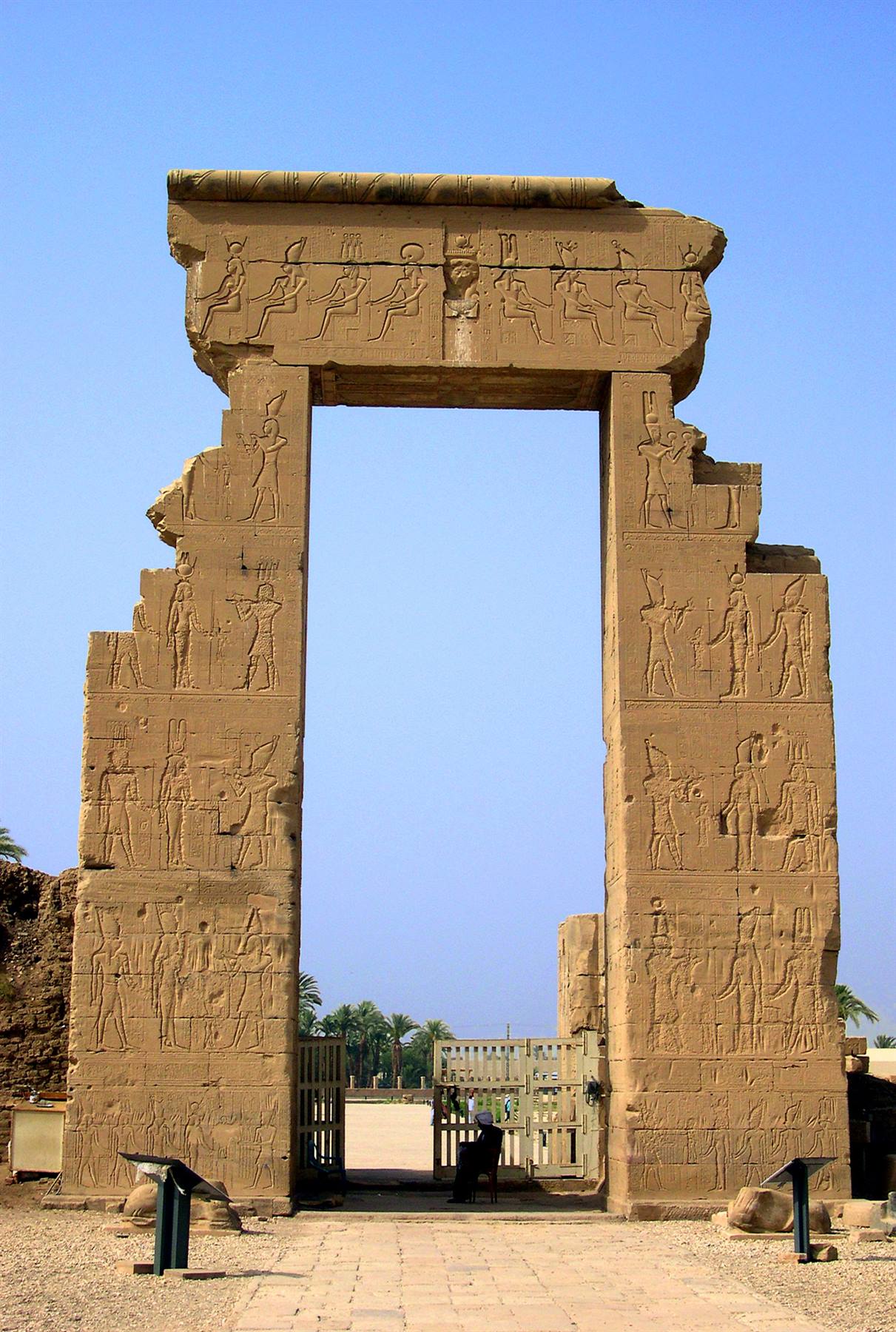
After spending a good hour and a half among the enigmatic stones of the temple we leave satisfied and, given the hour, we stop to have lunch, in the shade, in a nearby park, which seems prepared for the occasion. It is already quite hot and once back on the coach as soon as possible we resume the road. We pass another fine series of check-points and at 15:00 sharp we are in front of the Temple of Hathor of Dendera, dating back to Greco-Roman times and therefore built between 125 BC and 60 AD... It is the last site of those on the programme and this too is beautiful, practically intact, but not painted like that of Abydos. Only one hall, that of Osiris, offers its splendid colours, but the Temple of Dendera is the only one on which you can go up to the roof...
As in the Temple of Horus of Edfu (Hathor, goddess of joy with the cow's head, was considered the companion of Horus) a helical staircase goes up to the roof, following the trajectory that the falcon follows to rise high into the sky, and up there there is a chapel with the celestial vault and the twelve signs of the zodiac depicted on the ceiling, then you come down, as the bird of prey does, swooping along a straight staircase, which has a single ramp, and you return to the monumental hypostyle hall to complete another splendid journey into the enigmatic world of the ancient Egyptians.
Despite the heat, which today too has reached very high levels (and I don't dare think what it could be like in the height of summer), we complete in a magnificent setting also the visit of the Temple of Dendera, which combined with that of Abydos allowed us to worthily conclude the fateful carousel of archaeological sites... and we can consider ourselves lucky, because these last two temples, considered until recently at risk of attacks, are not included in the traditional tourist itineraries, but fully deserve the day that Turisanda wanted to dedicate to them. Once the escort has resumed we head towards the Miss Esadora... The last stretch of the excursion thus takes place through the Egyptian countryside, while the holiday is now irremediably drawing to an end. We reach the ship at almost 18:00 and for Federico there is still time for a swim in the pool...
then we go to the cabin to sort out the suitcases for the imminent departure and to get ready for dinner. In the evening we say goodbye and thank Moustafa and Ashraf, our assistant and guide, who did their job well (apart perhaps from the visit of the tomb of Ramses VII in the Valley of the Kings), then we see a little show of Arabian dances and finally we retire to the cabin, positively concluding also this last day of cruising on the Nile.
Edfu - Temple of Horus
Day 1130 Apr 2007
To close the series of early risings in style today the alarm goes off at 5:00... this time, however, the plane for Cairo awaits us. We have breakfast and then leave the room, or rather, cabin 309, then, at 6:00 sharp, also the Miss Esadora, which satisfied us from every point of view. Half an hour later we are at Luxor airport: we check in our suitcases directly for Milan, we check in and we wait for Egyptair flight MS132, thus, in short, we find ourselves seated on the Airbus A330 that at 8:08 lifts off the ground heading for the Egyptian capital, where it lands less than an hour later, at 8:56. We complete all the laborious boarding formalities and despite having three hours of stopover the time flies... in this way, we go through check-in again, say goodbye to Denis and Susy departing for Rome, and we wait for flight MS705 to Milan at gate number 5...
We don't have to wait long and almost immediately we board another Egyptair Airbus A330 which, practically exactly on time, at 12:25, takes off heading for Italy... We are seated in the central seats and we will not be able to see what flows beneath us, in the meantime, however, I set the hands of the clock back an hour and sync again to Italian time. Everything goes smoothly and we land at Malpensa at 14:55... We collect our luggage, say goodbye to Luca (Federico's little friend) and all his family, and then we waste a bit of time reporting the damage to a suitcase, so we only collect our car, at Parking Go, at 16:20, and with that we set off towards home. At 17:00, once past Milan, we take the A1 while the sky darkens and shortly afterwards it also starts to rain, indeed, to hail, and the temperature drops to 13 degrees (an abyss compared to the over 40 of the past days!)...
and this circumstance also helps us, twenty minutes later, to identify the river we are crossing, which is the Po and not the Nile. The traffic is heavy, given the spring bank holidays, but we proceed without hitches and at 18:40 we are in Bologna. We take the A14, which we follow until Faenza, where we exit at 18:55 and, a little more than a quarter of an hour later, at 19:13, we happily conclude the holiday in front of the gate of our home. An exciting journey has just come to an end, a journey in the footsteps of the mythical pharaohs and of the most astounding civilisation ever to appear on the face of the Earth, an inimitable journey, which will remain forever a milestone of our memories.


0 reader comments