We can consider ourselves decidedly lucky, in fact today, for the third time this calendar year, we are ready to set off on a trip. The day starts very early, or rather extremely early: already at three in the morning the alarm clock makes us jump, and we promptly throw off the covers... there's no time to waste because we have to be at Verona airport by 6:00, from where we'll then take the flight to Egypt, and more precisely to Marsa Alam, on the shores of the Red Sea. Everything was already prepared and it doesn't take us long to get going in our blue Punto (usually the grandparents accompany us, but as a consequence of the accident they had in Sweden, their camper still isn't available). At 3:53 we leave home, and a quarter of an hour later we get on the motorway at Faenza.
We're all enthusiastic about facing this new adventure, but sleepiness clouds our minds a bit and we don't show it openly. Federico in particular seems rather dazed as we speed along, in the darkness, toward northern Italy, accompanied by a mild outside temperature close to twenty degrees Celsius, rather unusual for the season. At 4:30 we're in Bologna and we pass by Marconi Airport, from which this time we couldn't depart due to the lack of available seats on the return flight, so around 5:00 we arrive in Modena, with Sabrina and Federico already sleeping blissfully. It starts to rain (it was forecast)... in fact it's pouring at 5:30 near Mantua, then it stops when, half an hour later, we exit the motorway at Sommacampagna, now in sight of Verona's Valerio Catullo Airport. The sky of a grey day is slowly brightening as we reach the parking lot affiliated with the agency.
We leave the car in the lot and a handful of minutes later we're in the departures hall, where we meet (this is a first) our travel companions: Daniela (my colleague) and Nicola, her son (no longer a child). After the customary greetings we present ourselves at the Alpitour desk, the same as Volando (our tour operator), where we hand over the convocation sheet. In exchange we get the tickets with which to do the check-in. The plane appears to be on time: we go through the metal detector, have a quick breakfast and, right after, pass through door number four, beyond which is the bus that takes us to the stairs that let us board the Neos airline's Boeing 737. So, slightly late, while it's pouring rain, flight No6658, bound for Marsa Alam, takes off and we with it.
In the distance, through the dense haze, we can just make out the shores of Lake Garda, then we bank and settle onto the right course, while the city of Mantua appears below us. Shortly afterwards we enter the clouds and stay there for a long time, through countless bumps. We emerge briefly, spotting the Marche coast with the city of Ancona and all of Monte Conero, then we plunge back into the candid mass of water vapour. When the land reappears later, this time completely free of clouds, I can't figure out which region it is, then I recognize the legendary Meteora, and I understand we're flying over Greece. We skim past Athens and head into the Aegean, pass over the island of Crete and continue over the Mediterranean. A little over an hour from arrival we spot the coasts of the African continent and Egypt.
Soon the bewildering and astonishing vision of the desert unfolds at our feet: an immense desolate wasteland interrupted only by the incredible strip of green that covers the banks of that great and legendary river, the Nile. At this point the aircraft begins to descend until we spot the extraordinary shores of the Red Sea, a basin that cuts like a blade, from north to south, for over two thousand kilometres through the desert landscape that characterizes this part of the globe. Geographically it divides the African continent from the Asian one, and politically its shores belong to seven states: Israel, Jordan, Saudi Arabia, Yemen, Eritrea, Sudan and Egypt indeed, the nation among these, perhaps, currently the most accessible to tourism, given the delicate international situation caused by tensions between the Western world and Islamic extremism.
At 13:16 local time (one hour ahead of Italy) we land at the brand-new Marsa Alam international airport, a tourist destination in the south of the country, about five hundred kilometres from the border with Sudan. Outside the temperature is ideal (32 degrees), accompanied by a light breeze, and it seems like a dream remembering this morning's downpour in Verona. It's a pleasant sensation that serves, if nothing else, to ease the discomforts of the inevitable queues to get through customs and the subsequent wait aboard the coach that will take us to the Amaraya Club (where we'll stay for the entire duration of our trip).
Finally, almost at 14:30, we set off along the road heading toward the hotel, and along the 39 kilometres of the journey we can't help but notice the numerous tourist villages under construction: they shouldn't go overboard granting permits, to avoid irreparably ruining even this place, which, for the most part, is still unspoiled... Then there's the Amaraya Club, incorporated into the large hotel complex of Kahramana, whose main core is on the seafront. Our village, however, as we already knew, is a few hundred metres inland but is still lovely and welcoming. We have lunch (or a snack, given the time) then reach room 1117, put on appropriate attire and head to the pool, while it's just past 16:00 and the sun, already low on the horizon, no longer burns.
Daniela, tired from the journey, has slipped away; we, on the other hand, enjoy a swim in the astonishing pool surrounded by the desert and even play a little game of water polo, which Federico enjoys sitting on my shoulders, having fun and even "scoring" three goals. Soon evening and darkness take over, so we go to the room and almost immediately come back out to attend the customary briefing: in this case very useful because the surroundings can practically only be visited on organized excursions. It seems it's also possible to go to the famous "Dolphin Bay" (recently closed, for unspecified reasons, by the Egyptian authorities) and we put together an enviable weekly programme, tied however to the availability of other people to take part, since the minimum number of participants for an excursion is fixed, non-negotiably, at six.
Highly doubtful of fully succeeding in our aim, we go to dinner (still four of us, because Daniela doesn't seem to be feeling well), then take a walk to the Kahramana hotel and its beach, which is partly "ours" too, and finally, on the way back, having established that there will be no entertainment this evening, we withdraw to our room and, exhausted from the endless day, reach the world of dreams in no time at all.
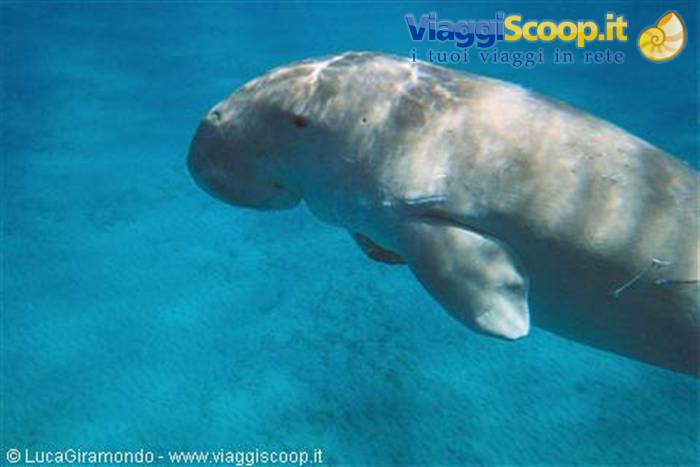
Abu Dabbab - dugong
Day 22 Nov 2003
Already at 7:00 the alarm starts ringing repeatedly: it's not easy to get up at certain times on holiday, but in these places the sun sets early in the evening and to make the most of the day you inevitably have to start just as early in the morning. We go for breakfast and a few minutes before 8:30 we're at the hotel exit, backpack on our shoulders, waiting for the minibus that will take us to the nearby Abu Dabbab beach. Daniela and Nicola haven't emerged from their room yet, so I send them a text message and shortly after, when the coach arrives, we kick off our first real day in Marsa Alam. The Abu Dabbab inlet, located about ten minutes by bus north of the hotel, is owned by the Kahramana and therefore costs us nothing to go there; it's sheltered from the winds, offers good access to the sea and, according to the information we have, should also have a beautiful coral reef.
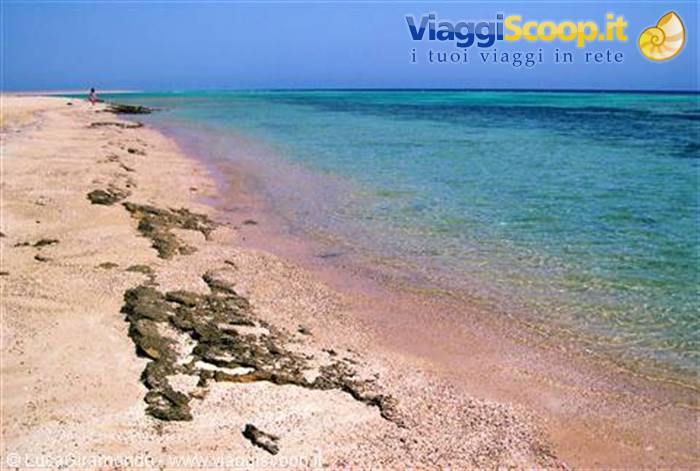
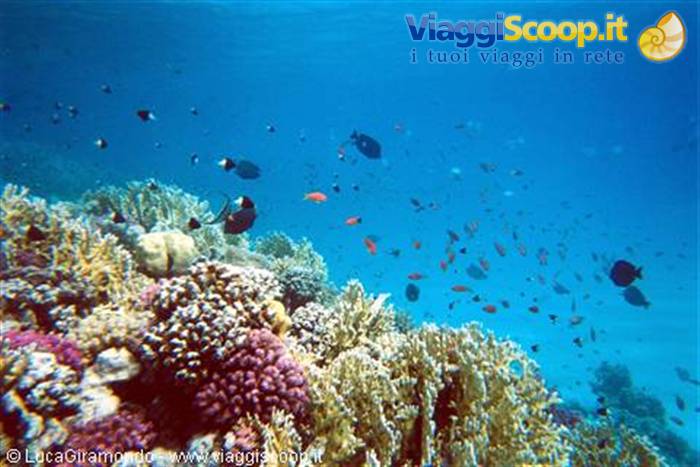
When we arrive the place is still practically deserted, only a few local fishermen are busy spreading their net at the left edge of the bay, so we choose the spot that suits us best and settle in blissfully at the water's edge. I take a few photos: the beach is lovely, but not particularly picturesque; after all, we know that... the wonders of the Red Sea are mainly found underwater. So let's not waste any more time: we put on masks and snorkels and go to discover the Abu Dabbab coral reef. As soon as I dip my gaze among the waves I notice numerous colourful surgeonfish around us, then a curious spotted ray, and the more we follow the wonderful formations that develop toward the open sea, on the left of the inlet, the more the fish increase and the feeling of swimming inside an aquarium becomes incredibly real...
what a spectacle! All enthusiastic, we return to shore and watch the Egyptian fishermen who, meanwhile (in less than an hour), have made their catch and managed to literally fill a small boat with fish, then we settle for a while on the sun loungers: there's beautiful sunshine, a pleasant breeze is blowing and it's divine... We hope our travel companions are doing just as well; meanwhile they've replied to the message letting us know that for today they'll stay within the village. We laze around for a while and then go back to snorkelling, this time though not on the coral reef but on the sandy bottom that stretches out in the centre of the bay in front of us, where apparently there are excellent chances of encountering turtles, but above all the curious dugong.
Also called the "sea cow", the dugong is a large endangered mammal, which can reach three metres in length, belonging to the order Sirenia, like the manatee (which lives in fresh water), and together with the latter is, in practice, the only aquatic animal of its kind with an exclusively herbivorous diet. We swim for a long time but there's no trace of the aforementioned animals, so tired we return to shore to dry off, then with Federico I go along the beach to take some photos, and shortly afterwards Sabrina comes running up to us: apparently they've spotted the dugong and an Egyptian guide, for 3 euros and 50, would even be willing to take us to the exact spot. We go back into the water and almost immediately meet a group of divers: one of them looks upward and gives me an eloquent thumbs-up...
shortly afterwards, in fact, in the intense blue, in the distance, the shape of the dugong appears. With our hearts pounding with emotion we approach as it calmly "grazes" on the bottom, then resurfaces to breathe and lets itself be touched... it's an incredible experience! It doesn't seem real to be able to swim in its company, and we stay for a while watching it: it's funny with that snout bearing big fleshy lips and with those odd fins it uses to move almost on all fours along the sandy bottom. We take a few photos and then leave our new "friend" in peace, but we're not satisfied and ask the guide if she'll take us to see the turtles... She motions for us to follow her and soon there's a big one below us, but too deep to be photographed.
We head back toward shore and so we meet the dugong again as it resurfaces, and it's exactly then that Sabrina and Federico also manage to touch it: we're truly all enthusiastic and I don't think we'll ever forget this day and the Abu Dabbab beach. Time has flown and it's now too late to catch the 13:15 shuttle... no big deal, lunch is served until 15:00 and we'll take the next one. Meanwhile we enjoy the pleasant breeze of the Red Sea a little longer. At 14:15, right on time, the minibus arrives and a quarter of an hour later we're at the Amaraya. We have lunch, then on foot we reach Blondie Beach, the village's beach: we're looking for our friends, but we don't find them, so we retrace our steps and indulge Federico, who was asking to be able to take a swim in the pool.
We finally meet Daniela, but not Nicola, who is in the room resting: we settle onto the sun loungers to chat while the little one is initially claimed by the mini-club and very soon "escapes" it, eager as he is to take the longed-for swim. He stays in the water so long that, meanwhile, I go up to the nearby hill to capture the sunset, and he only comes out when it's now completely dark, with the moon and stars shining high in the sky. The evening passes peacefully, with the introduction show put on by the entertainment team, in which Nicola and I also take part, as performers in a short sketch, then we stop to smoke the hookah and worthily put an end to the first, memorable day in Marsa Alam.
El Quseir
Day 33 Nov 2003
It's already been forty-eight hours since the trip began, but this is the first real day of holiday and we inaugurate it by meeting at the reception, after breakfast and shortly before 8:30, with Daniela and Nicola to board the shuttle that will take us to Abu Dabbab. We liked the place so much that we decided to spend this morning there too, while waiting for the first excursion, which starts today at 14:00. We position ourselves at the same umbrella as yesterday and our companions, impatient, immediately go snorkelling. On their return they're indisputably enthusiastic and show it openly, then it's our turn, with Nicola joining us, and straight away... he's hooked. We observe the same beautiful scenery as the previous day along the colourful reef, which this morning appears particularly "infested" with "tourist fish" (among which, obviously, us too).
I enjoy, as usual, the unconscious spectacle of the mishap happening to me: during a brief dive I feel a sharp pain... it's the meniscus of my right knee, which has surely been injured again (an old story resurfacing). The pain isn't very strong and I continue the visit, but the water supports the weight of my body, which the air doesn't, and once back on shore I realize that walking is decidedly worse... I'm limping noticeably and I'm furious; let's just hope it passes quickly and the holiday isn't irreparably ruined. At 12:30 we leave, while our friends stay: we get on the shuttle and once at the Amaraya we go to lunch. A little over an hour passes quickly and at 14:00 we're back at the reception, waiting to set off to discover El Quseir, a town of respectable size located about a hundred kilometres north along the coast.
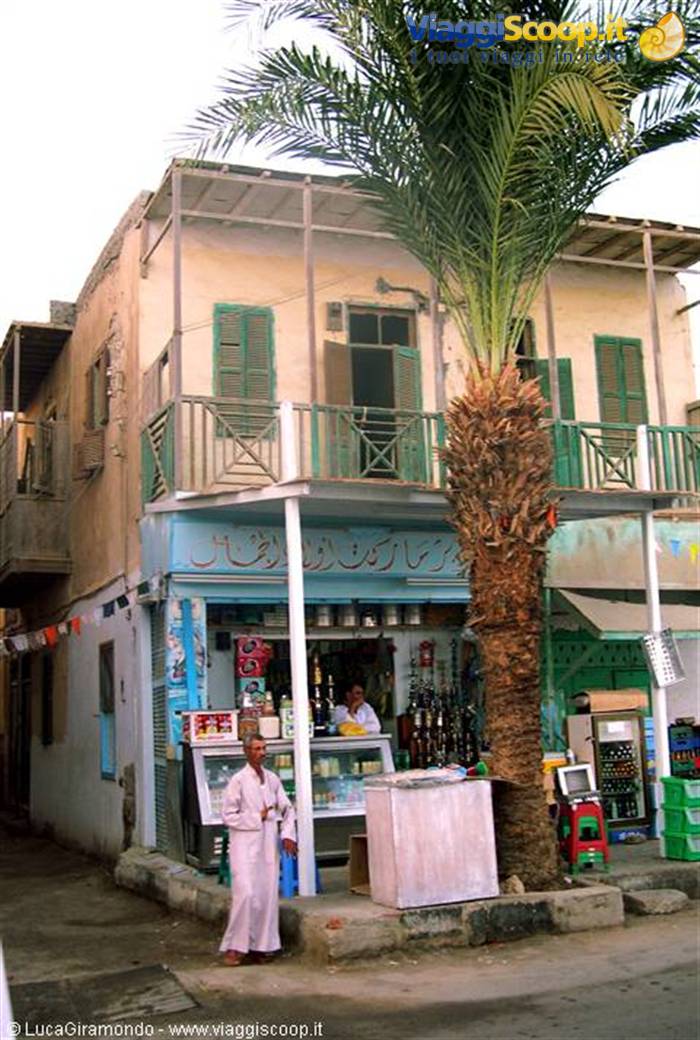
The knee pain is bearable so, hopeful, we set off at the scheduled time. About halfway we stop at the Bravo Club (Alpitour): we join other people, get onto a more spacious vehicle and continue along the road that skirts the Red Sea. A few minutes after 15:00 we arrive at our destination and, travelling along streets lined with dilapidated buildings, we begin the visit of the city starting from a characteristic mosque, flanked by the most classic of minarets. We get off the coach to take some photos and immediately several children come up to us: I give them a ballpoint pen and some sweets, which they end up squabbling over, and it's a shame that happens, but after all it's the price to pay to make them, in some way, happy.
Federico, who still doesn't grasp certain realities, watches his peers' behaviour wide-eyed as we get back on the vehicle that takes us, this time, to the Orthodox church of Saint Barbara, a few blocks away. It's quite striking to see a bell tower among so many minarets, but (few know this) in Egypt over 6% of the population is Christian. The next stop involves a walk through the semi-ruined former Italian quarter: at the beginning of the last century, in fact, there was a phosphate factory in El Quseir set up by our compatriots. The place, among other things, is still today, in part, inhabited by people living in evident conditions of extreme poverty. Step by step I follow the group, lagging slightly...
so we reach the town's seafront, where there are some characteristic buildings and a place where we're offered a drink, while in the air resound the cries of the muezzin, calling the faithful to gather for evening prayer. It's already dark when, by coach, passing near the ancient Ottoman fortress, we reach a central street dotted with little shops where we can do some shopping; so, haggling, we buy a large hookah and leave off the negotiation we'd started to buy some t-shirts... nothing strange, it's all part of the great "game" of commerce, characteristic of Egypt and many other countries in the Maghreb area. At 18:30 we head back to the hotel, which we reach around 20:00, under a magnificent starry sky. We have dinner and, despite my knee continuing to act up, we confirm all the excursions for the coming days, including tomorrow's, the hardest, which requires a 5:00 a.m. wake-up.
We watch a funny cabaret show and immediately withdraw to our room, so as to make up for the missing hours of sleep, but we also think back on the day just ended, which, all things considered, is positive (meniscus aside): the Marsa Alam area, in fact, hasn't yet been completely affected by mass tourism, and today we were able to observe the raw reality of a real Egyptian city.
Shelatin
Day 44 Nov 2003
The alarm rings even before the sun rises: it's just past 5:00 and we're waiting for the departure of the excursion that will take us about two hundred kilometres from the border with Sudan, to the town of Shelatin, where the most important camel market (dromedaries, to be precise) of southern Egypt is held daily. A bit sleepy, we have breakfast and at 6:15 we present ourselves at the reception where, punctually, the coach arrives already loaded with numerous tourists, whom we join. We begin travelling along the coastal road heading south, tackling the first of the three hundred kilometres that separate us from our destination, and soon we find ourselves passing through the centre of Marsa Alam, the tiny town that gives its name to the whole area. Its destiny, however, seems to be to grow enormously in the near future, judging by the tree-lined avenues and multi-lane roads that cross it.
We pass through and proceed quickly, with the view ranging to the left over the shores of the Red Sea, dotted with mangroves, and to the right over the immense Eastern Desert, until we reach, about halfway, a village that seems out of this world. We stop and get off the coach: there's a café and next to it a little shop that sells everything and nothing, but above all dried dates... dried like the wrinkled skin of the old man behind the counter. Then out of nowhere a little girl appears, looking at us timidly: I give her a pen, and in that exact instant she becomes the happiest being in the world—this strange and unfair world in which wealth and fortune certainly can't be said to have been distributed evenly...
Finally I take a photo of her, together with Federico (two human beings at this moment so close, but in reality so far apart), then we get back on the coach, into our air conditioning, and comfortably resume the journey. Around 10:00, after passing numerous checkpoints, we arrive at the outskirts of Shelatin, where the known world seems to end... in reality, from there onward another one begins: the fascinating one of black Africa. First of all we're taken to see a typical Bedouin tent, clearly prepared for tourists because in reality the ancient nomadic desert people today live mostly in dilapidated shacks (with a satellite dish on the roof, but dilapidated).
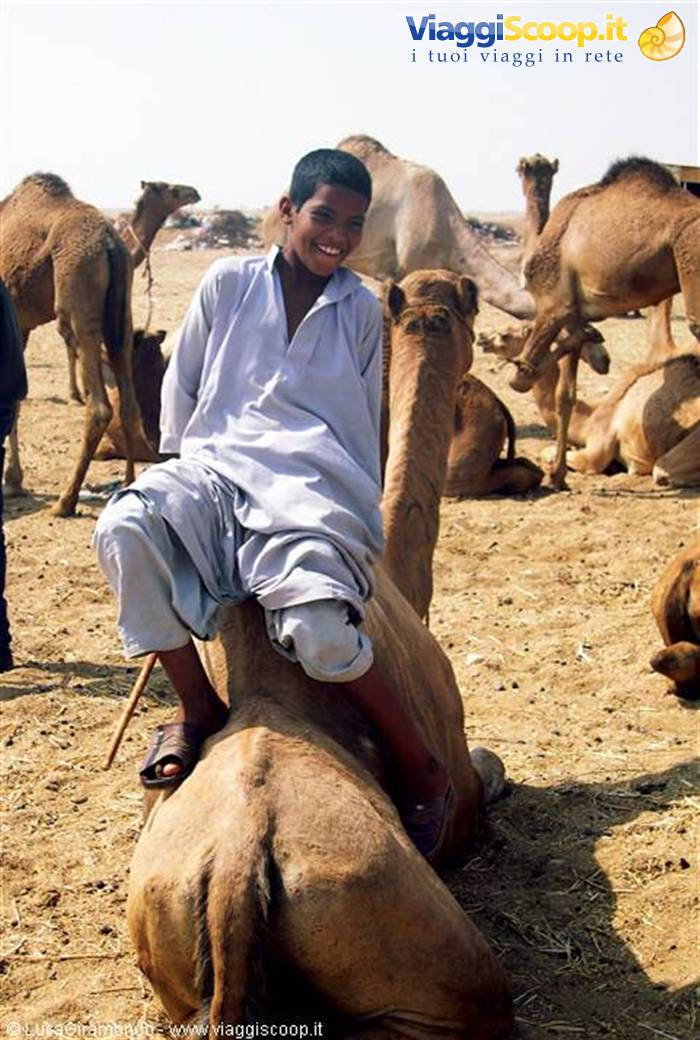
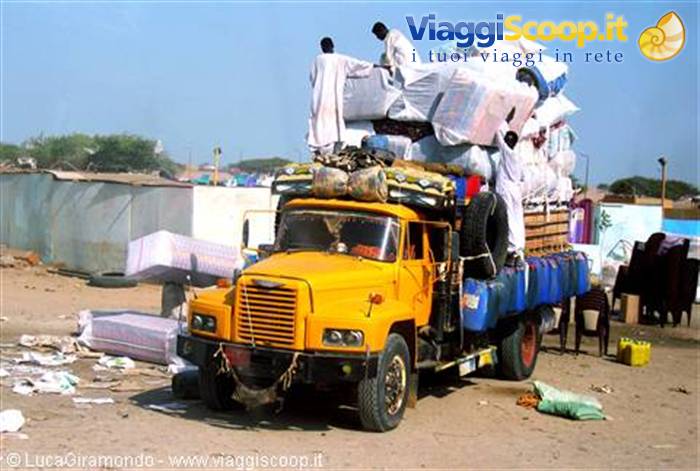
After a brief stop we get back on the coach and, passing through the fishermen's village (which is nothing exceptional), we approach the market area: you can tell from the numerous and colourful Sudanese trucks, loaded to the point of absurdity with the most varied goods, which their drivers come here to barter (Shelatin is, in fact, also a kind of free port). So we arrive at the place where the camels are inspected and branded before being put up for sale, the so-called "Quarantine", a walled enclosure teeming with animals and men who look like anything but veterinarians. The place is very characteristic, but not as much as the actual market we reach afterwards: utterly original and absolutely not a tourist setup.
Groups of humans and groups of camels are scattered in apparent disorder over a vast square of packed earth and animal dung, which is nothing other than the place where this trade has been held since time immemorial. We visit it while the tide of children around us grows enormously and they fight over anything they're offered. One after another we experience everything on this interesting excursion, such as the stop to see the area where, thanks to rudimentary loading ramps, the camels are pushed and, at times, physically hoisted aboard the trucks destined for their transport. After spending almost the entire morning in close contact with the animals of the desert par excellence, we get on the coach and reach what should be the centre of Shelatin.
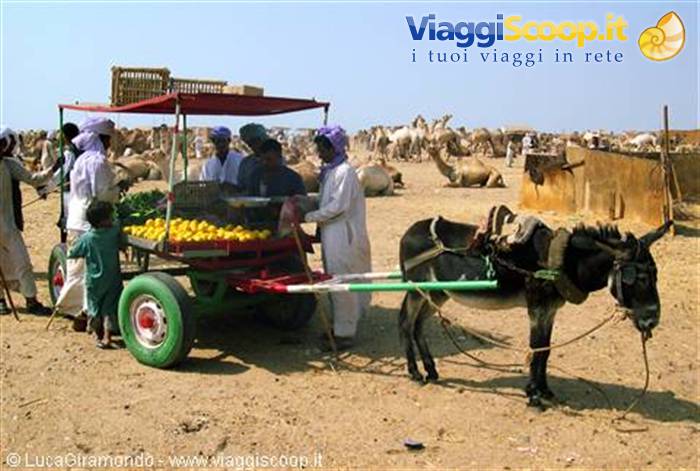
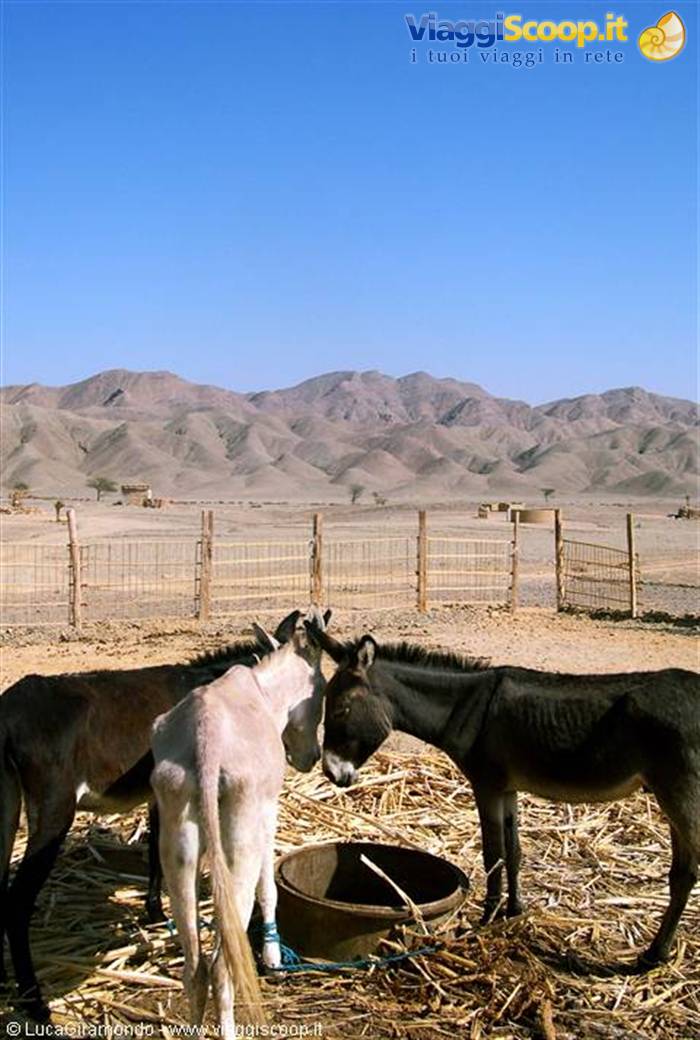
There we visit the traditional market, not beautiful but characteristic and, who knows for how much longer, extremely original, including the intense smells, the carts pulled by donkeys, the heads of slaughtered animals prominently displayed on the counters... and the flies, hundreds per cubic metre of air! Marked by the sight of realities so distant from us, we have lunch in the best restaurant in Shelatin: half a (dwarf) star in the "Michelin Guide"... a decent lunch nonetheless, including a taste of camel meat: good, but which Federico refused to eat. In the end, before getting on the coach and heading back, we find the courage to face the restaurant's bathrooms... a place where even the legendary Mr.
Clean would struggle, but we, undaunted, pass this test too! We begin retracing the road we already tackled this morning, which skirts the shores of the Red Sea, and shortly after the turnoff on the right for Berenice (ancient and legendary port settlement founded in 275 BC, of which only a few ruins remain today), we stop at a Bedouin village, to refresh ourselves in the waters that lap the nearby beach. The inlet, very deep and edged with mangroves, resembles a lagoon more than anything: the bottom is shallow and sandy, the coral reef is completely absent and the water, anything but crystal clear, doesn't invite us to swim, so we limit ourselves to taking a walk and observing the local girls who, upon our arrival, in the blink of an eye, have set up a small costume jewellery market.
The sun sinks pitilessly toward the horizon and it's already dark when, at 17:30, we arrive at the Amaraya; this doesn't stop Federico and me from taking a relaxing swim in the pool. When we get out we chat a bit with Daniela and Nicola and then go up to the room to get ready for dinner, and finally, later, we watch (very few of us, really) the show put on by the entertainment team, after which we go to rest our limbs: tomorrow, naturally, another excursion awaits us and we intend to tackle it in the best possible way. Meanwhile we savour the memory of the one just ended: an interesting experience, which put us in contact with the raw realities of life in this remote corner of the world.
Shelatin
Day 55 Nov 2003
This morning starts off great, with the alarm giving us an extra hour of sleep compared to yesterday, so at 6:00 we get up and, after breakfast, at 7:15 we present ourselves at the hotel exit, where the jeep with which we'll do the planned excursion in the Eastern Desert is waiting for us. Five other guests of the Amaraya get on the vehicle with us and, in the company of a guide and the driver, we set off this time along the coastal road heading north. We pass the airport and, a few dozen kilometres before El Quseir, turn left onto a track that goes into the desert. Ahead of us now is another off-road vehicle driven by another guide, particularly expert in the area. We proceed amid countless jolts, which the little one enjoys a lot, climbing up a sort of gravelly valley, while unfortunately the sky is overcast and a dense haze makes the landscape grey.
Soon we arrive on a small rise and stop to admire what should be a beautiful panoramic view, but it feels like being in the Po Valley and an unusual fog prevents us from seeing anything. I complain about the weather situation to the guide and he tells me that today is a good day to come to the desert, so you avoid suffering from the heat... I reply that today is instead a bad day for taking photographs and that if I really wanted to stay cool... well, then I'd have just stayed comfortably at home! I don't know what strange powers that man has over the clouds... or whether more likely it's just chance, the fact is that shortly afterwards, while the desert flows again beneath the wheels of our vehicle, suddenly the sky opens up and the sun bursts out forcefully.
The blue now forms the backdrop for all the views, while sparse acacia trees contrast magnificently with the tones of the surrounding landscape, which range from black to yellow (the Sinai Desert, which Sabrina and I saw a few years ago, is more colourful but this one too knows how to be fascinating). "Road" doing, we arrive at the end of a gorge that turns into a small canyon and we walk a short stretch of it on foot: the Egyptian Eastern Desert is a rocky desert, which differs quite a bit from the classic idea one has of that kind of environment, namely with tall sand dunes shaped by the action of the wind; moreover, this one also includes within its geographical boundaries mountains that exceed a thousand metres in height. After all, there are several kinds of deserts, whose common denominator is, absolutely, the lack of water at surface level.
It's precisely the presence of water underground, often detected thanks to an incredible sixth sense of the camels, that determines whether or not a Bedouin camp is established, like the one we're heading to. On our arrival, however, to tell the truth, everything appears too nice, excessively clean and tidy to be true, and it's clear, especially after having been to Shelatin, that this is a shameless tourist setup, but the surrounding landscape, full of charm, is authentic and we go along with the situation. Under the traditional tent we're offered tea and coffee, while we listen to the guide, who enlightens us about the customs and habits of this famous nomadic people, and meanwhile, in turns, we experience the thrill of a short ride on a camel's back. At midday we're offered a good lunch, after which, amid a thousand jolts, we head back.
In about forty minutes we regain the paved road and almost immediately stop at Abu Zreib beach to snorkel and spend some time by the sea. It's a wide, sandy, unspoiled inlet, but it won't stay that way for long; in fact, there's already a project to build a five-star tourist village all around it... what a shame! Meanwhile we enjoy its coral reef, which is, however, a notch below the one at Abu Dabbab, and the clarity of the water leaves something to be desired. So we remain a bit disappointed and stop to soak up the last warm rays of the sun, before tackling the remaining stretch of road that separates us from the hotel.
It's practically dark when we arrive at the Amaraya, but Federico still wants to take a swim in the pool, then the usual story: to the room, to dinner and finally to watch the evening show, while Sabrina feels strange and complains of some ominous pains in her lower abdomen. Another twenty-four hours have passed, all things considered, well enough, even though, in several respects, today we didn't take part in one of the best excursions I can remember, and the whole thing could have been done in only half the time, dedicating the rest of the day to the sea and its wonders... but, as they say, not every doughnut comes out with a hole...
Shelatin
Day 66 Nov 2003
Last night's ominous pains foretold the so-called "Tutankhamun's revenge", which inevitably played out at first light and completely spared only Federico. The Bedouins, unconsciously, thus wanted to leave us this little gift. The one hit hardest is Sabrina, who, in evident difficulty, is undecided whether to take part in today's programme of visits or not, but it's a short excursion, a little over half a day, and in the end she leans toward yes, also because we'll be accompanied for the first and last time by Nicola and Daniela. At 8:15 we set off, in front of the reception, aboard an off-road vehicle heading south. We pass Marsa Alam and reach Awlad Barka beach, known for its coral reef.
There we gear up with everything needed to snorkel; Sabrina, however, doesn't feel up to it and decides to wait for our return on the sun loungers on the beach facing the stretch of sea in question, while Federico is overjoyed because he's finally found a pair of fins his size and now feels like a real diver. I, on the other hand, hunched over by the abdominal pains that occasionally assail me and limping because of my bad knee, look more than anything like the Hunchback of Notre Dame on a bonus holiday on the shores of the Red Sea, but I stoically endure. We get on a small inflatable boat that takes us a short distance offshore, near the coral reef, and we dive in while, a short distance from us, a turtle's head pops out of the water, but we soon lose track of it.
So we observe the reef around us: the numerous corals are alive and wonderfully colourful, the fish life, on the other hand, isn't abundant and the clarity of the sea leaves something to be desired... Awlad Barka, in short, is also a notch below Abu Dabbab. Swimming and pushed by the current, we regain the shore and emerge from the water a bit disappointed; not that the place is ugly, quite the opposite, the crystalline reflections of the sea here are splendid, but we expected something more, given that it's the destination of an organized excursion.
So we reach Sabrina, who in the meantime has gotten worse and is holed up in the shade gripped by strong abdominal pains: what a shame, she was looking for the sun so much, and today that she could have enjoyed it freely she's unable to! Shortly after midday we go for lunch at a restaurant in the immediate vicinity, incorporated into a very spartan village, frequented mostly by German tourists, then we head back to the hotel, where we arrive around 14:30. Federico immediately runs to the pool and shortly after I follow him. The rest of the afternoon slips by without praise or blame, with the little one recruited by the mini-club, me playing cards and Sabrina, who's also running a slight fever, sleeping in the shade the whole time, until, in the evening, she moves directly to bed: her temperature has risen further and now even exceeds thirty-eight degrees.
Federico and I go to dinner with our friends and at the end we bring something to Sabrina too, who seems to appreciate it and perhaps this is the first sign of a turnaround in her condition. Later, we survivors go to the Kahramana beach where tonight the Bedouin party is held: paying twelve euros you could take part (dinner included), but we only go to watch and they ask us for five... it's a disgrace; we'd never experienced being guests of a hotel and having to pay to attend a party organized by it! On principle we refuse to pay the fee and go back to the Amaraya, smoke the hookah and then go to bed: let's hope tomorrow is better.
Meanwhile the planned excursion to the "Dolphin House", or "Dolphin Bay" (perhaps, of all, the most important), has been definitively cancelled because the Egyptian authorities have once again banned access to the place, and if on one hand this sends me into a fury, on the other it takes away the embarrassment of choosing whether or not to take part, given Sabrina's condition!
Eastern Desert
Day 77 Nov 2003
The night passed fairly peacefully and at dawn on the last full day in Marsa Alam, Sabrina no longer has either fever or pains, but says she's very tired. Luckily for her, no particular effort is required, given the cancellation of the excursion, and after breakfast we present ourselves at the hotel exit, determined, in any case, to end the holiday on a high note. Because of the impossibility of accessing "Dolphin Bay", quite a few people thought like us and one shuttle isn't enough, but at least two are needed to take us all to Abu Dabbab, which is probably the most beautiful beach in the area. We settle at the water's edge to enjoy the warm embrace of the sun and the pleasant breeze that blows constantly from the north-east, while Federico plays with Martina, his little friend of this holiday, often accompanied by her little brother Raoul (the "microbe", as the two have nicknamed him).
Sabrina finally devotes herself to sunbathing and it's considerable progress thinking back to the condition she was in just last night. I, on the other hand, can't resist lying on the sun lounger and almost immediately go snorkelling: the Abu Dabbab reef is, without a shadow of a doubt, one of the most beautiful in the entire area, and I stay a long time observing the corals teeming with fish, among which a large moray eel stands out, then I head further offshore and encounter two splendid turtles calmly grazing on the sandy bottom. I wait for one to surface to breathe: I photograph it, stroke its shell and swim along with it...
it's an extraordinary sensation! Caught up in the enthusiasm, though, I don't realize I've already been in the water for quite a while, and I'm also alone: at a certain point I feel my head spinning and a small panic attack comes over me, so I abandon my improvised "friend", start swimming quickly toward shore and only become calmer again when, shortly after, I can plant my feet firmly on land... but what an incredible experience! I go back to lie in the sun just long enough to catch my breath and the little one asks me to take him for a swim: I indulge him and, in the company of Daniela, we go over a fine stretch of coral reef, then, once we resurface, we take a walk along the left side of the inlet in search of new views to put in the memory album. Time flies and on our return the hands of the clock, mercilessly, already read 14:00: time to go...
We say goodbye to Abu Dabbab and return to the Amaraya. We spend the rest of the afternoon around the pool, with Federico staying the whole time at the mini-club, having a great time among other things with a big treasure hunt throughout the village, while I'm recruited to do a few sketches: so tonight I'll play the "
Awlad Barka
Day 88 Nov 2003
Five minutes after 7:00 we are already having breakfast, and half an hour later we are walking, backpacks on our shoulders, toward Blondie Beach, the beach of the Kahramana as well as of the Amaraya. The sea today is rougher than usual, so Sabrina, still convalescing, gives up even the last swim. I, not exactly in shape, go anyway (to at least finish the underwater photos), but I don't feel up to bringing Federico too, and only Nicola accompanies me. We go down from the pier a little beyond the reef: the waves are truly big and, even though the spot is beautiful and fish are abundant, it's not pleasant to be at the mercy of the rough sea, so I take the photos and after no more than a quarter of an hour we make it back to land.
To make up for it, we then sneak off to swim in the huge multi-level pool of the Kahramana, but the water, who knows why, is cold, and this explains why the pool is half-empty. It's already almost 9:00 and we decide to return to the Amaraya, so as to allow Federico one last swim before leaving... Indeed, the time available is truly short, and soon we find ourselves in the room packing the suitcases. At 11:00 sharp, we leave the hotel by coach, heading to the airport, and along the way the Volando assistant urges us, to avoid trouble at customs, not to bring sand, shells, or coral. Intimidated by these warnings, before crossing the departures entrance, we remove from our suitcases the two small bags of sand we had brought to add to our collection, and with disappointment we realize, shortly afterward, that they would have gone through without any particular problems...
what didn't go through, instead, for security reasons, was a pair of scissors that Daniela had forgotten to remove from her carry-on luggage. The waiting room is packed with Italians departing for the most varied airports on the peninsula, while the hyper-technological Egyptians, who are not equipped with any kind of sign (either electronic or manual), begin calling, through the single available door, all departing flights simply by voice, but not with the aid of a loudspeaker, rather by shouting at the top of their lungs... the resulting chaos is inevitable, and so is the delay! More than an hour after the scheduled time, we finally board flight No. 6659: a Boeing 737 of the Neos airline, which lifts off at 15:15 Egyptian time, bound for Verona. We soon climb in altitude while below us the desert can be glimpsed, hidden by a dense haze that later turns into a veritable cloud mass.
We thus leave the African continent behind us because, just after sunset, when we sight land again, it is already Europe, and more precisely the Greek island of Zakynthos. A little longer and the coasts of the Bel Paese appear, with a large port city clearly visible, probably Taranto, then, thanks to the satellite navigator, we recognize Foggia and Pescara. We fly over all of central Italy, and right above Forlì some clouds come between us and the earth...
They are a warning sign, because a few moments later we are flying inside an intense weather front and emerge from it only a few hundred meters above the ground: in Verona the weather is terrible, it's pouring rain, so much so that water runs along the side windows, it's windy, and the plane rocks frighteningly, but we land safe and sound at 18:35, right in the middle of the "thrilling" Po Valley autumn! You'd be tempted to turn on your heels and take off again, but we have no alternative, we absolutely must get off, even if the mere thought of doing so makes us feel the humidity penetrating and invading our limbs. We collect our luggage and, after saying goodbye to our friends, by 19:30 we are already comfortably seated in our blue Punto with the bow pointed home.
An hour later, at 20:30, we are in Modena, and at 21:00 in Bologna, while the little one sleeps blissfully on the back seat of the car. The rain doesn't leave us for a moment along almost the entire journey, then it finally stops when, around 21:30, we are about to exit the highway at Faenza. Now the kilometers left to travel are truly few, and a handful of minutes later, at 21:48, this trip too ends in front of the gate of our home... Not one of the luckiest trips I remember, starting from the torn meniscus and ending with the "revenge of Tutankhamun" and the canceled excursion to the "Bay of Dolphins," but Egypt always has a special charm, and Marsa Alam confirms it, because it is another enchanting place where the arid desert meets the blue of the sea...
and what a sea! So, despite everything, this time too we return with a suitcase full of extraordinary memories that help us be optimistic about the future and think that the next trip will certainly be luckier than this one.
Belle foto che ritraggono la realtà e la gente del luogo, qualcuno che finalmente si distacca dal turismo di massa del solo villaggio!!! Anch'io prima o poi andrà a marsa....complimenti!


2 reader comments
accidenti, hai beccato un dugongo....che c......
Belle foto che ritraggono la realtà e la gente del luogo, qualcuno che finalmente si distacca dal turismo di massa del solo villaggio!!! Anch'io prima o poi andrà a marsa....complimenti!