The story
My wife and I made this trip back in 1997, backpacking and completely on an adventure, roughly planning the route to take from home and then deciding on accommodation from town to town. We chose the centre-south of Peru as the destination of our journey, leaving out the Amazon region and the north.
Peru is not an easy trip and the unexpected is the order of the day. The important thing is not to be overcome by anxiety and stress (those you must leave at home), trying instead to enter into the mindset of the Andean people, capable of facing any kind of obstacle without losing their calm.
Among the many trips I've made in Central and South America, this is the one that fascinated me most, whether for the warmth of the people, capable of giving you a smile at any moment, or for the extreme beauty of the landscape, always varied and eternally to be discovered.
The arrival in Lima left us a bit dazed, also because we came from a long flight from Rome with a stopover in New York, and the jet lag made itself felt in a big way.
The capital is not particularly attractive, and a traveller not used to scenes of poverty might even find it hideous, but some glimpses of the historic centre are truly delightful: Plaza de Armas (today called Plaza Mayor), the Cathedral, the Convent of San Francisco, the beautiful cloister of Santo Domingo, the old Government Palace rebuilt several times because of earthquakes and fires, the City Hall with its splendid carved wooden balconies.
A likeable taxi driver, after negotiating the price (as for everything else, after all), took us to the Gold Museum, the largest and most important private collection of pre-Columbian art objects and jewellery.
Poverty lurks around every corner, and getting used to the constant requests for money from beautiful children, often under the effect of glue, is truly difficult. Inland Peru is considerably better in this respect. But Lima is still afflicted today, despite the false proclamations of its Government, by a multitude of social problems.
We leave the capital to head south along the Pan-American Highway by scheduled bus. Outside Lima we witness the degradation of the largest shanty town in South America and, with anger in our bodies, we move away powerless. Our first destination is Pisco.
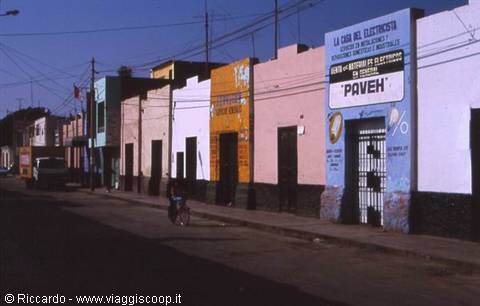
Here we meet quite a few likeable people, among them a Spaniard, owner of the Posada Hispana, who gives us a lot of very useful information for the trip, as well as addresses of houses where we can sleep. The children are uniquely charming. They practically drag us into their neighbourhood market and protect us from potential pickpockets. Pisco is pretty with its colourful facades even though very poor, but a much more dignified poverty than in the Capital. Here they produce the famous high-proof liquor (Pisco), and after a good plate of seviche (fish marinated with lime) it's just what's needed.
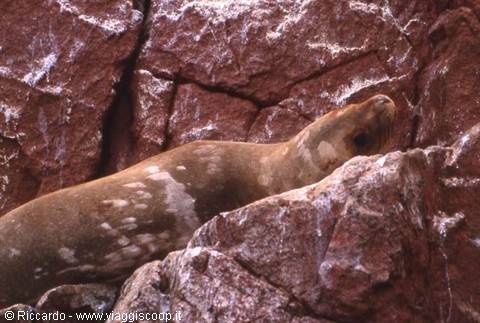
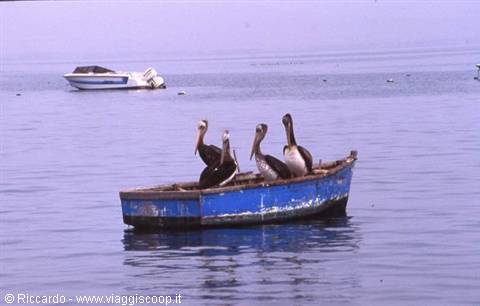
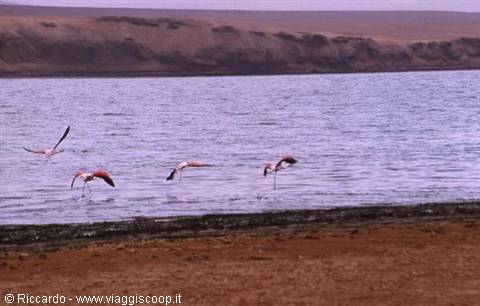
From Pisco we tackled the first of our tours, one we cared about a lot. The Paracas National Reserve with its sand dunes inhabited by splendid pink flamingos (beautiful to see them take flight all together), the Inca cemetery of Chauchilla with its mummified bodies, the beauty of the Ballestas Islands, once used for guano collection, now inhabited only by sea lions, seals, pelicans, penguins and an infinity of other birds.
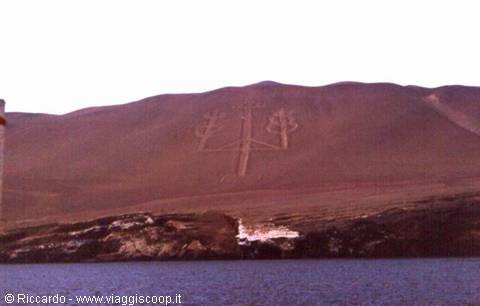
The sight of the Candelabra (drawn on the mountain and visible only from the sea) is something fantastic.
In Ica, reachable from Pisco by bus, we visited the regional museum where the villages of the ancient peoples who inhabited this coast are reconstructed, complete with incredibly well-preserved mummies.
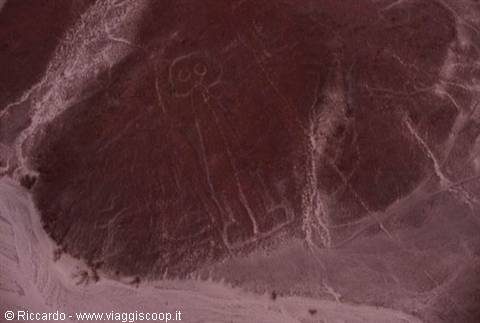
In Nazca, for 50 dollars, we hired a small plane that allowed us to fly over the famous and mysterious lines. The pilot, though a bit crazy, let us take splendid photos. From the ground they are practically invisible, so viewing from above is advisable, even though flight accidents are not so rare.
We also allowed ourselves a quick visit to the workshops of the gold miners, where you can buy charming local artefacts made with the typical stone of the Nazca desert. The prices are truly negligible, and not buying anything would be a real shame.
We travel at night by coach towards Arequipa (10 hours!!!). Going from sea level to 5,000 m and then descending to 2,500 m is something to experience. A mate de coca at that altitude is indispensable to avoid frequent headaches and to warm our bones.
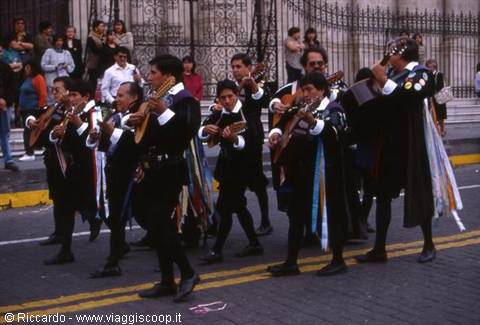
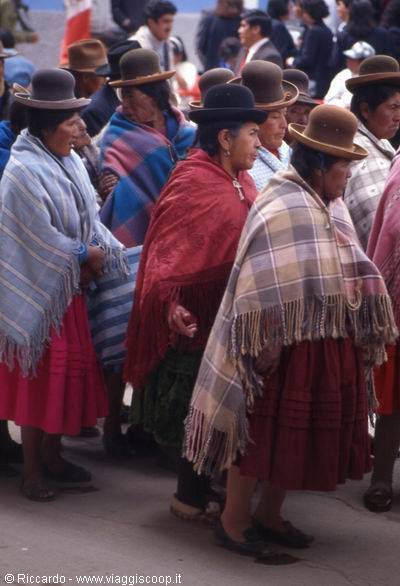
The white city, so nicknamed perhaps for the colour of its buildings, is beautiful, at the foot of the Misti volcano (6,000 m). Unfortunately, because of a ferocious dysentery we enjoyed it little, but between one bout of colic and another we managed to visit Plaza de Armas and the Monastery of Santa Catalina, an ancient monastery of cloistered nuns. We also find ourselves in the middle of a festival, complete with a parade in local costumes and Andean music.
We book through an agency a seat on the bus that will take us to Puno tomorrow, but we discover with great regret that the same seat has been sold several times to other people. These things happen often in Peru, so it's better to show up well in advance at departures.
Despite calm discussions about who has the right to the seat, we all manage to leave with an overcrowding that borders on the absurd, among screaming children and fluttering hens.
The journey up through the Andean landscape is something wonderful, between llamas grazing calmly and us swaying on the uneven road. As was foreseeable, the bus, a few kilometres from Puno, gives up and dies implacably when it's already evening. Here they don't get flustered at all; they load everything onto their backs and set off on foot, leaving us alone in total darkness at a temperature of -15 degrees (El Niño was implacable during this trip; sun but intense cold). Fortunately a car passing that way gives us a lift, and despite a puncture and a wheel change in total darkness, we manage to reach Puno by midnight. Our guesthouse, not seeing us arrive, thought it best to give up our room and, so as not to risk us freezing to death, finds us temporary accommodation for the night.
Hot mate and off to bed...
We're at almost 4,000 m of altitude and you feel every bit of it. Any movement is very tiring until you get used to it. Here mate de coca helps a lot, and for any altitude headaches it's advisable to buy a bag of coca leaves at the local market and chew a few or wet them and place them on your temples. A real cure-all.
Puno is truly pretty, with a beautiful market where you can buy everything for a few soles, as well as fruit, vegetables and grains of every kind and a thousand colours, such as to make it all look as if it came from a painter's hands. The venues are truly welcoming and in the evening there's always some musical group entertaining us with Andean music.
From Puno............to be continued
The journey's photographs
16 photographs · click to open them full screen



0 reader comments