by Massimiliano Baravelli It took 24 hours of flying and three different planes to get to New Zealand, with stopovers in Frankfurt and Singapore before landing in Auckland. To look at it from another angle, though, it took me over fifteen years, because it was since 1988 (thanks, or rather blame, a feature in a newspaper) that I had been dreaming of going all the way down there. I had even given myself a kind of time limit, the year 2000, but I didn't manage to stick to it. For one reason or another - too much money, too far away, the canonical two weeks of holiday being far too few - it seemed like an impossible undertaking. Then, suddenly, we made up our minds (because in the meantime I had infected my girlfriend): first the request for three weeks of holiday, then the booking at the travel agency. After all, you just had to want it, and on 5 February we had arrived at our destination.
maori village in rotorua
Day 25 Feb 2004
5-7 FEBRUARY: AUCKLAND The journey was long, and gruelling. But also an adventure within the adventure, because we Italians, along with other Europeans, are the farthest away of all (12 hours of time difference), and few have any desire to come all the way here. "Down under", down below as the New Zealanders themselves put it, we are rare goods, so rare that in twenty days we didn't meet a single other Italian: honestly, just as well. Having escaped the jaws of the inflexible customs service at around one in the afternoon, after 45 minutes of queueing, under a summer sun that was only barely warm, we go to hire the car: the super-accessorised Toyota Corolla costs 50 dollars a day (less than 30 euros), an excellent price.
Having quickly got used to driving on the wrong side, a custom dating back to the country's Anglo-Saxon origins, we set off towards Coockle Bay, a suburb of Auckland, where our bed and breakfast awaits, booked via the Internet. A bit of a chat with the owners, nice and helpful, a walk on the beach, a fish-based dinner in a restaurant right next door, and then finally off to bed. The next morning we discover why New Zealand is called Aotearoa in the Maori language, which means "land of the long white cloud". Here, in fact, practically without pause, all the cloud masses that form in the Tasman Sea arrive, across those 2,000 km that separate Australia from New Zealand. Finding no obstacles, the clouds become a constant presence: it doesn't rain too often (at least not on us), the sky isn't grey, but the white cloud cover is a constant.
For our first day in Auckland, however, the sky was truly overcast and dark, but at least not a drop fell. Following the Tamaki Drive, which offers a beautiful view of the city skyline, we arrived in the centre, where we visited the port, the America's Cup docks (there were still two New Zealand boats there, I think the training ones), the University and then the inevitable Sky Tower. It is 328 metres tall and near the top has a spectacular panoramic terrace. To go up you use an external glass lift: it's impressive, I assure you. Once you reach the Upper Deck you enjoy a beautiful 360° view of the city and the Hauraki Gulf, dotted with little islands. You can also walk on a glass floor, 80 cm thick, with a void beneath it.
Impressive too, but not as much as seeing the people who jump off the tower (walking down, not like in bungee jumping) among the skyscrapers, and land in the square below. Having left Italy with the idea of throwing myself off too, I gave up immediately after seeing the faces of those flying down below. Having come down from the Tower, after a bit of shopping, we opt for the Museum, which they tell us is beautiful: but it's a long holiday weekend, and the museum area, a park, is hosting an event: there are hundreds if not thousands of young people, and we can't even get close. Seeing all these people together lets us understand how cosmopolitan this city is, where you come across people of every kind: whites, blacks, Asians, Polynesians. Mixed couples are very common, including between Anglo-Saxons and Maori, a rarity in the rest of the country.
As the sun makes its appearance we return to Coockle Bay: dinner and early to bed: jet lag is still making itself felt.
maori village in rotorua
Day 38 Feb 2004
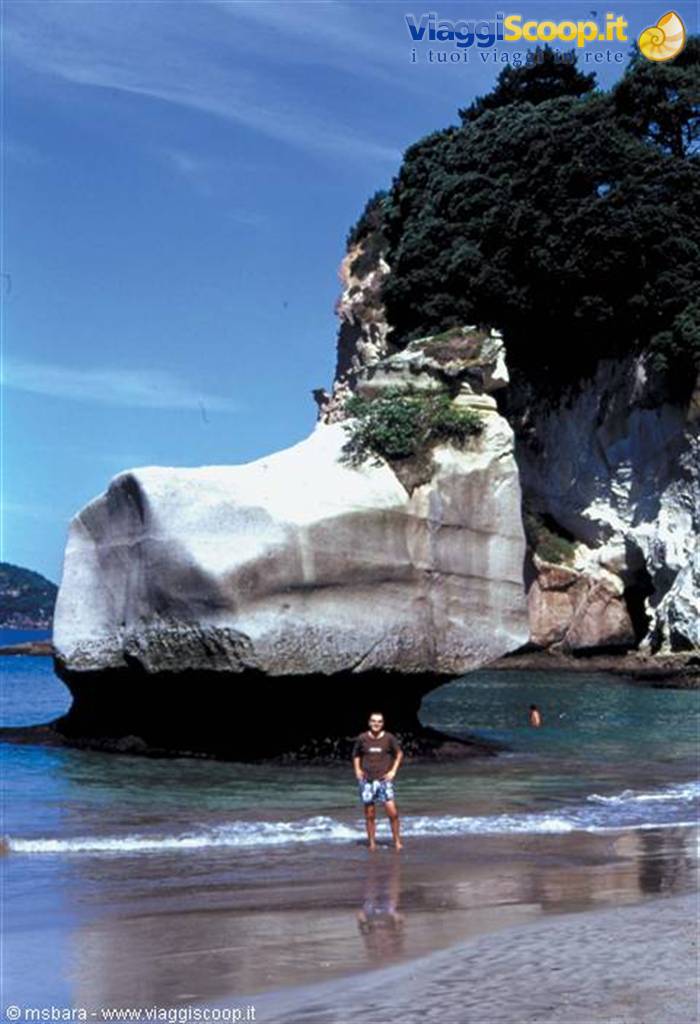
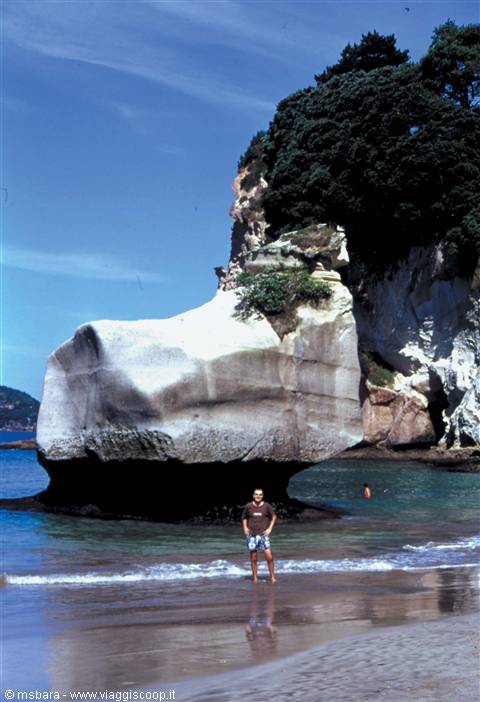
8-9 FEBRUARY: ROTORUA On Saturday morning we say goodbye to our hosts and their fox terrier Jessy (here, if you want to sleep in b&bs you have to love animals, because everyone has at least one) and set off towards the Coromandel Peninsula, which is about a hundred kilometres away. There's lovely sunshine and so we can enjoy our first and only day at the seaside: at Hot Water Beach I even go for a swim, my debut in the Pacific, but the white sand, the sky-blue water and the natural rocky tunnel of Cathedral Cove remain the most vivid memory of a day that also marks our first encounter with the terrible sun of this area.
I don't know whether it's the thinness and cleanliness of the air, or whether it's just the fault of the ozone hole, which has its epicentre up here, but the fact is that the sun is relentless: despite the creams I got burnt on my forehead, nose, hands, arms and neck, and for a week I lost skin in shreds (on my face I peeled down to my cheeks). But even Virna, of fair seafaring stock and used to the sun, wasn't spared. Because of this blasted holiday weekend, to sleep we can only find a place in a bungalow on the beach that offers too many services we don't need: equipped kitchen, garden for dining outside. We, on the other hand, to eat something have to wait for the second sitting at the restaurant: an honest pizza that arrives at around 10 in the evening.
The next morning, car heading south, towards Rotorua, the symbolic city of Maori civilisation (the indigenous people of Polynesian origin, the first inhabitants of these islands), where we arrive at midday. It's raining, but as far as accommodation goes we go for a sure thing (the "Charming" guide, with addresses and photos of hundreds of b&bs, is essential): the Deer Pine Lodge is clean and nice, but too far from the city (15 km) and we'll only stay there one night. We reserve the rest of the day for a visit to the beautiful early-1900s spa complex, the Government Gardens, now turned into a museum: this is in fact an active volcanic area (steam even comes out of the manholes) and therefore thermal, with hot mineral water pools everywhere.
Inside the museum there's also a section dedicated to the 28th Maori Battalion, which during World War II also fought in Romagna: many photos illustrate events and protagonists, including those of the soldiers (I remember one name, Werewere Rakuraku) who died in Faenza. The next day we visit the "Rainbow Spring" park (local flora and fauna) where we see our first and last kiwi, a bird that lives only in New Zealand. It doesn't fly, it's big, slow and clumsy, and when dogs, cats and other predators that didn't exist here arrived with immigration from Europe, it was a massacre. To prevent their extinction they are being moved to the smaller islands, far away from their executioners.
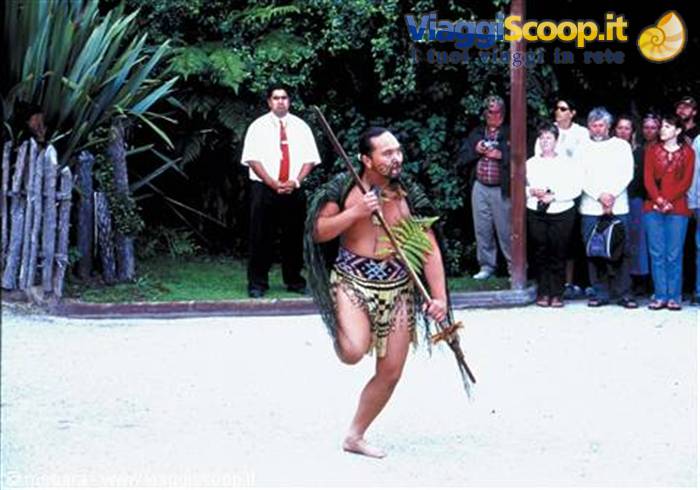
In the early afternoon we go to Hell's Gate, the volcanic area par excellence, where everything is geysers, boiling mud, hot water pools, jets of steam: we try a relaxing bath in the hot (about 40 degrees) muddy water. But between the scorching sun and the boiling water, after 20 minutes we go and take a cool shower. At five in the afternoon we leave by coach for the visit to the Maori village of Tamaki: it's all reconstructed for the use and consumption of tourists, but beautiful and evocative. Just as beautiful and evocative is the whole setting, which expresses a very strong cultural identity, and the show they put on for us, which also includes the Haka, the war dance made famous by the All Blacks. The evening continues with dinner based on Hangi, meat and vegetables boiled in the natural hot springs of the ground.
Then follows the show by the coach drivers, strictly Maori, who after teaching us a few words in their original language (I only remember "kia ora", good luck), perform a personal interpretation of the Haka. A splendid day ends in a horrendous b&b, which even has a caved-in bed: our fault, since we wanted to save money and settled for a room at 35 euros for two.
mine bay
Day 410 Feb 2004
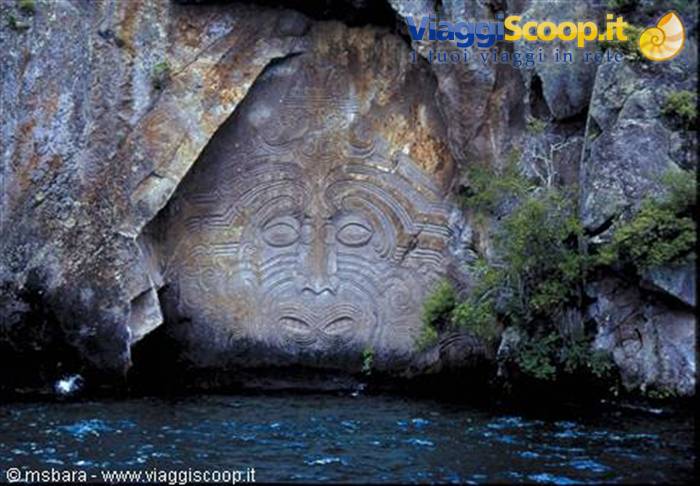
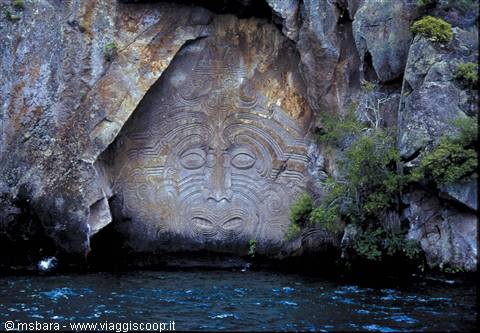
FEBRUARY 10-11: HERE'S LAKE TAUPO AND WELLINGTON The next morning we head south again, toward Lake Taupo. It's only 90 kilometers, and along the way we stop to see the Aratiatia rapids and the waterfalls called Huka Falls. Around noon we're in Taupo, we find a b&b in Acacia Bay (very nice, all in dark wood), and then we go for a two-hour boat ride on the lake. Nothing special except for Mine Bay, where there's an incredible, enormous Maori sculpture carved out of a rock that overhangs the water. An excellent dinner, thanks to the gigantic green mussels found in these seas, then off to bed. When we get up it's raining, but that's no problem, because today the only thing on the agenda is the 400 kilometers that separate us from Wellington, the capital.
We arrive in the early afternoon, with no intermediate stops, and immediately find the b&b: our host is Francesca (actually Frances), a cheerful 70-year-old who doesn't seem afraid of anything, so much so that she always leaves the door of her house open, wide open, even when she goes out. The first afternoon spent in Wellington, a frankly not very beautiful city, is a disaster: it's pouring rain and it's hard to get out of the car, the penguin colony promised by the guidebook is a pipe dream (even Francesca has never seen them in her life): luckily the Fisherman's Wharf cooks good fish. The next day, though, the sun is out, and we can visit the city at our leisure: not that there's all that much to see.
The center is just cute, and we spend the whole day inside two museums: the Museum of Wellington, focused on the history and development of the city, and Te Papa, which takes us over four hours. Spread over six floors, the first ones deal mainly with local animals and plants, while the most interesting sections are those relating to Maori culture and the European colonization of the 1800s. The top floors are nice too, reserved for contemporary kiwi artists (which always means New Zealanders). The fish dinner at the "Tug boat," a tugboat converted into a restaurant, is simply fantastic.
mine bay
Day 513 Feb 2004
FEBRUARY 13: THE STRAIT, THEN ARTHUR, OUR FARAWAY SUBSCRIBER Friday morning we say goodbye to the North Island, leave the Toyota (after 1,330 km and not without regrets), and ferry over to the South Island, crossing the Cook Strait. It takes about three hours to cross the stretch of sea that separates the two main islands of New Zealand. By one o'clock we're on land, and the "AeB" representative is waiting for us (the sign reads "Mr Baravelly") to hand over our car: a seasoned and dented Nissan station wagon that emits strange squeaks. It's cheap, not even 20 euros a day, and you can see why, but in hindsight we have to admit it served us well. Once the luggage is loaded we set off for Nelson. I'm impatient because in that city I have a task to carry out: delivering the latest issue of "sette sere" to Arthur Gladstone, our farthest subscriber.
We arrive at his house around 3:30 in the afternoon: when he comes to open the door, obviously wary, I show him the copy of the newspaper, and the ice is broken. He invites us in, and we stay there for a couple of hours chatting in Italian. Two wonderful hours in the company of a helpful and kind person: he wants to know everything about Faenza, about his Romagnol friends, about Giuliano Bettoli and family. When we mention his wife from Faenza, Antonietta Dalmonte (whom he met during the war) who died last year, his voice breaks with emotion, so we then try to avoid the subject. Around five o'clock Timothy arrives, one of Arthur's ten children: of these only three live in the Nelson area, while the others are scattered around New Zealand and three in Australia.
A bit of chatting with him too, who doesn't understand Italian at all, then after the obligatory photos we take our leave and leave Arthur to read "sette sere": when we arrived he was holding the copy dated January 31, this time the postman, I must admit with some emotion as well, delivered him a "fresher" issue.
a bit of sea in the Coromandel
Day 614 Feb 2004
FEBRUARY 14-17: WEST COAST Our original direction is south, but we allow ourselves a brief detour toward Abel Tasman Park, famous for its golden beaches. It rained all night, but when we get there the sun is out and the panorama, between the gold of the sand, the blue of the sky and the light blue of the water, is breathtaking. We allow ourselves an hour of sun and then set off again. Heading for the West Coast, the coldest and most sparsely populated area of New Zealand. We manage to cover about 400 kilometers of narrow, deserted roads, often carved into the rock of the New Zealand Alps, which practically end in the sea. The bridges are curious and dangerous: always one lane even though there are two directions of traffic, often three. In fact there are also rails, because the train can pass there too...
Around noon it starts to rain, by two it's a downpour, which practically prevents us from seeing the Pancake Rocks, a very famous cliff. You get there on foot after a short walk: but it's coming down so hard that in five minutes we're soaked, while visibility drops to zero. Luckily an hour later we arrive in Greymouth, where a cozy and above all warm b&b awaits us, because we've turned on the electric heating. We're getting close to Antarctica (only Patagonia has a lower latitude) and the temperature has dropped quite a bit. It's the Saturday night of Pantani's death, that is, Valentine's Day: but in our restaurant, more of a diner than anything, nobody cares.
The next morning the West Coast shows us its kind face: the sun is out and the temperature is good, ideal weather for the 520 km we have to tackle to reach Wanaka, gateway to Fiordland, the southernmost nature park on the island, a kind of southern Norway. Along the way we first see the mining town of Shantytown, then the 3,700 meters of Mount Cook, the Fox Glacier and Franz Josef glaciers, the Haast Pass, the very tall Thunder Creek Falls and Lake Hawea, blue as the sky. We arrive in Wanaka around six, tired and hungry. Dinner is decent, the b&b is beautiful, and the owners perfectly embody what seems to be the kiwi spirit. Relaxed, calm, they live a decidedly less stressful life than ours.
They don't seem particularly interested in making money: after welcoming us into their home, despite having other rooms free, they put up the "no vacancy" sign; we'll stay with them two nights, and they won't take it down again. They ask us about Italy, about us, about our jobs. When I tell them we live near Bologna the wife confesses she doesn't know any Italian city: only when I try "and Rome?" do her eyes light up for a moment. The next morning an early wake-up because the Milford Sound tour awaits us, one of the most beautiful and most visited fjords. We'll go by small plane (six seats) in an hour's flight, then a boat trip (two hours) in the fjord and return again by plane. Departure scheduled for 9. But we don't take off: they messed up the booking, obviously, but the employee blames the bad weather.
Which isn't there and has nothing to do with it: in fact at two in the afternoon, the new departure time, it's decidedly nasty out, but we go anyway. To reach the fjord you have to cross rather high mountains: our small plane can't fly over them, so we pass through them. Only it's raining, there's fog and clouds, in short you see little or nothing. The pilot says it's normal, that the weather there is always like this. But nobody believes him: after twenty minutes the merry brigade (the two of us plus three Austrians) has turned into a group of sulkers who can't wait to get off. Somehow at the scheduled time, and amid the pilot's smiles, we arrive at our destination. But it's raining there too, and despite his calm face he announces that we can forget about the boat trip: he grants us a 20-minute walk, then we head back.
So we just have time to snap a few photos, to see Milford Peak, a 1,600-meter mountain that rises from the sea right at the entrance of the fjord, and to understand that this Milford Sound is not a place for humans. People come here, flying over or crossing (there's also a very winding 120 km road) a dense forest so damp it appears black, they visit it, admire it, then leave. There's nothing here, just the landing strip, the wharf for boats and a small Lodge for those who for some reason are forced to spend the night. The rest is mountains, rivers, dozens of waterfalls, forests of ferns (the symbolic plant of New Zealand). The triumph of nature, simply. After our twenty minutes in the air we set off again: dark faces at takeoff, and for the first quarter of an hour.
Then suddenly the clouds lift: it's still raining a little, but we can cross the mountains with ease and our pilot, now elevated to the role of hero, even indulges in a few tricks, like 360° turns to let us admire the scenery better. Once back in Wanaka they refund us the money for the missed cruise. Toward evening the sun comes out, and it will stay with us the next day too, when we leave the West Coast to head toward the east coast. We say goodbye to the Alps, cut the island in two through the Ida Valley (a Lord of the Rings location, in particular the village of Rohan) and arrive in the Otago Peninsula. We stop to see Dunedin, a beautiful city whose buildings don't hide the Scottish origin of its founders; then we enter the peninsula, a true natural paradise, where we see, among others, the yellow-eyed penguins.
In the evening, after a stop at Moeraki Beach (there are enormous perfectly round boulders resting on the sand for a few million years) we sleep in Oamaru, an atypical town with stunning white sandstone buildings. Dinner, however, due to an unworthy sauce, is stomach-churning.
a bit of sea in the Coromandel
Day 714 Feb 2004
FEBRUARY 14-17: WEST COAST Our original direction is south, but we allow ourselves a brief detour toward Abel Tasman Park, famous for its golden beaches. It rained all night, but when we get there the sun is out and the panorama, between the gold of the sand, the blue of the sky and the light blue of the water, is breathtaking. We allow ourselves an hour of sun and then set off again. Heading for the West Coast, the coldest and most sparsely populated area of New Zealand. We manage to cover about 400 kilometers of narrow, deserted roads, often carved into the rock of the New Zealand Alps, which practically end in the sea. The bridges are curious and dangerous: always one lane even though there are two directions of traffic, often three. In fact there are also rails, because the train can pass there too...
Around noon it starts to rain, by two it's a downpour, which practically prevents us from seeing the Pancake Rocks, a very famous cliff. You get there on foot after a short walk: but it's coming down so hard that in five minutes we're soaked, while visibility drops to zero. Luckily an hour later we arrive in Greymouth, where a cozy and above all warm b&b awaits us, because we've turned on the electric heating. We're getting close to Antarctica (only Patagonia has a lower latitude) and the temperature has dropped quite a bit. It's the Saturday night of Pantani's death, that is, Valentine's Day: but in our restaurant, more of a diner than anything, nobody cares.
The next morning the West Coast shows us its kind face: the sun is out and the temperature is good, ideal weather for the 520 km we have to tackle to reach Wanaka, gateway to Fiordland, the southernmost nature park on the island, a kind of southern Norway. Along the way we first see the mining town of Shantytown, then the 3,700 meters of Mount Cook, the Fox Glacier and Franz Josef glaciers, the Haast Pass, the very tall Thunder Creek Falls and Lake Hawea, blue as the sky. We arrive in Wanaka around six, tired and hungry. Dinner is decent, the b&b is beautiful, and the owners perfectly embody what seems to be the kiwi spirit. Relaxed, calm, they live a decidedly less stressful life than ours.
They don't seem particularly interested in making money: after welcoming us into their home, despite having other rooms free, they put up the "no vacancy" sign; we'll stay with them two nights, and they won't take it down again. They ask us about Italy, about us, about our jobs. When I tell them we live near Bologna the wife confesses she doesn't know any Italian city: only when I try "and Rome?" do her eyes light up for a moment. The next morning an early wake-up because the Milford Sound tour awaits us, one of the most beautiful and most visited fjords. We'll go by small plane (six seats) in an hour's flight, then a boat trip (two hours) in the fjord and return again by plane. Departure scheduled for 9. But we don't take off: they messed up the booking, obviously, but the employee blames the bad weather.
Which isn't there and has nothing to do with it: in fact at two in the afternoon, the new departure time, it's decidedly nasty out, but we go anyway. To reach the fjord you have to cross rather high mountains: our small plane can't fly over them, so we pass through them. Only it's raining, there's fog and clouds, in short you see little or nothing. The pilot says it's normal, that the weather there is always like this. But nobody believes him: after twenty minutes the merry brigade (the two of us plus three Austrians) has turned into a group of sulkers who can't wait to get off. Somehow at the scheduled time, and amid the pilot's smiles, we arrive at our destination. But it's raining there too, and despite his calm face he announces that we can forget about the boat trip: he grants us a 20-minute walk, then we head back.
So we just have time to snap a few photos, to see Milford Peak, a 1,600-meter mountain that rises from the sea right at the entrance of the fjord, and to understand that this Milford Sound is not a place for humans. People come here, flying over or crossing (there's also a very winding 120 km road) a dense forest so damp it appears black, they visit it, admire it, then leave. There's nothing here, just the landing strip, the wharf for boats and a small Lodge for those who for some reason are forced to spend the night. The rest is mountains, rivers, dozens of waterfalls, forests of ferns (the symbolic plant of New Zealand). The triumph of nature, simply. After our twenty minutes in the air we set off again: dark faces at takeoff, and for the first quarter of an hour.
Then suddenly the clouds lift: it's still raining a little, but we can cross the mountains with ease and our pilot, now elevated to the role of hero, even indulges in a few tricks, like 360° turns to let us admire the scenery better. Once back in Wanaka they refund us the money for the missed cruise. Toward evening the sun comes out, and it will stay with us the next day too, when we leave the West Coast to head toward the east coast. We say goodbye to the Alps, cut the island in two through the Ida Valley (a Lord of the Rings location, in particular the village of Rohan) and arrive in the Otago Peninsula. We stop to see Dunedin, a beautiful city whose buildings don't hide the Scottish origin of its founders; then we enter the peninsula, a true natural paradise, where we see, among others, the yellow-eyed penguins.
In the evening, after a stop at Moeraki Beach (there are enormous perfectly round boulders resting on the sand for a few million years) we sleep in Oamaru, an atypical town with stunning white sandstone buildings. Dinner, however, due to an unworthy sauce, is stomach-churning.
whales at Kaikoura
Day 818 Feb 2004
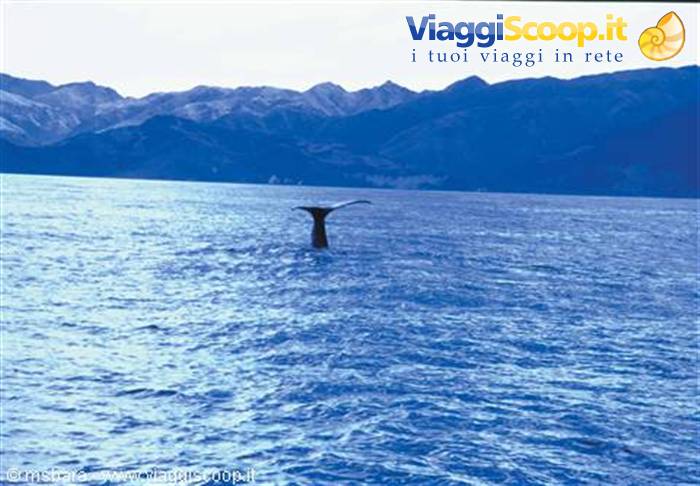
FEBRUARY 18-19: FINALLY THE WHALES OF KAIKOURA Wednesday the 18th the final transfer awaits us: 440 kilometers to Kaikoura, where we hope to see whales. We didn't manage it in South Africa, but on Thursday the 19th, around three in the afternoon, our turn comes. We're on board a boat equipped with sonar: after several minutes of waiting and a few empty laps, a whale surfaces and lets itself be seen. We follow it, at about 50 meters away, for half an hour. Photographs raining down from all the tourists, especially when it dives showing its gigantic tail. During the day we'll see another one too, but as soon as it's spotted it dives down. Between one whale and another we also spot a royal albatross, a bird with a wingspan of about three meters, and above all a pod of "dusky" dolphins.
In coloring more similar to orcas (they're white and gray-black), when they see us they surround the boat and it feels like we've ended up at the circus: jumps, belly flops, jackknife dives, zigzag sprints, passes under the boat. There are about 400 of them, they tell us, and the spectacle is truly thrilling, unforgettable. After such a binge all that's left is to return to port: a success across the board, including the holding up of our stomachs despite the not exactly flat sea.
whales at Kaikoura
Day 920 Feb 2004
FEBRUARY 20-21: THE LAST DAY IN CHRISTCHURCH We've almost reached the end: Friday morning we set off for Christchurch, where on Saturday we'll take the plane to Italy, and we get there in the morning, after about 200 kilometers. We spend a few hours in the center for a quick visit of the city, clearly Anglo-Saxon in style too, then after dinner (bruschetta, fish soup and cherries) we look for a motel. We find a somewhat run-down one, but it's near the airport and the rental company where we'll have to return the car (this one after 2,400 km). The motel owner looks like the wicked witch, all dressed in black and with frizzy gray hair going every which way except the right one. But she's very kind, and she even books us the taxi that the next morning, at 6, will take us to the airport.
Another four planes await us (stops in Auckland, Singapore, Frankfurt and Bologna) for a total of 26 hours. During the interminable and sleepless return journey, while New Zealand is already taking on the features of a fantastic memory, I feel sadness surfacing: a dream realized is a dream finished, gone, lost forever, and in my drawer there's now more room. But while we fly over the Australian desert I find myself thinking, quoting someone I know well, that the wheel turns fast, and we with it. Tomorrow, I'm sure, it will already be time to dream of something else.


0 reader comments