After 11 September, entering the United States may have become safer, but it is certainly much more exhausting. The security checks we have to face before boarding the Frankfurt - San Francisco flight force us into an endless queue, which ends with a meticulous check, personal search included, of the whole ocean-like crowd of travellers. Once past these gauntlets, finally the plane and, 11 hours later, America. On board, naturally, the usual Immigration Office form, which asks you if you're a terrorist, if you deal drugs or transport atomic bombs. Having always answered with great sincerity, they let us in without any trouble. In the checks, it seems, they've become good and punctual, but the organisation is always the same, and so when we set foot on the ground, our luggage isn't there.
"It ended up in New York," they say, "you'll have to wait until tomorrow." No big deal, we're in San Francisco.
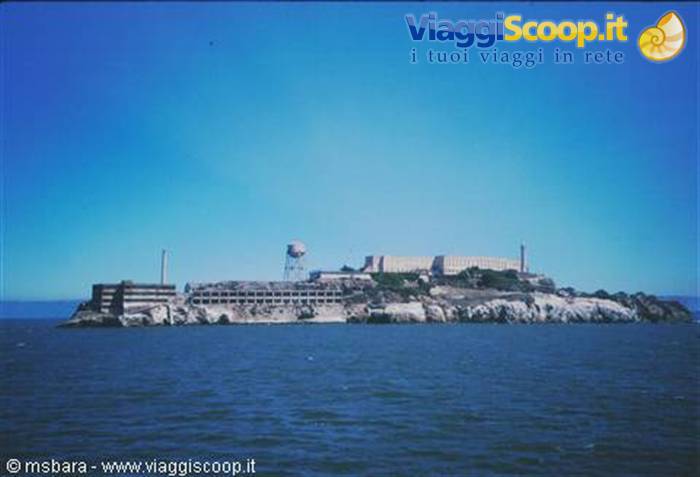
alcatraz
Day 223 Sep 2002
23/9, FOG AT THE GOLDEN GATE After a restless night, necessarily, since in Italy (and for our bodies) it was daytime, we get up early and set off for our first actual day of holiday. There's no trace of the luggage, but we're not worried. A hearty and very hot breakfast because we've already tasted the freezing wind coming from the sea whipping the bay, even though it's only 23 September, and then a visit to Union Square, the central square of a city that immediately appears to us unmistakable and beautiful. This area is full of luxury hotels, shops and restaurants, but the famous little hills we've all seen on TV make the landscape undulating here too, right in the city centre. For this first tour we give up taking the Cable Car, the famous tram you can jump on practically on the fly by hanging onto the outside handrails, and decide to walk down to the sea.
We cross the whole of Chinatown (shops and restaurants, shops and restaurants) while the sun, finally, triumphs and makes the air much more bearable. In fact, after a little while we start sweating, because to get to the port you have to trot quite a bit, up and down the city's hills. Around 11.30 we reach Pier 39, surely the most famous pier in the port, where, as always, shops and restaurants await us, but also a fantastic view: in fact we're in the middle of San Francisco Bay, right in front of Alcatraz Island, once the site of the prison, and to the left of the Golden Gate, perhaps the most famous bridge in the world. Boats, not particularly expensive but not particularly well kept either, offer to take you on a tour of the Bay at decent prices, and so we decide to go.
We sail around Alcatraz, taking quite a few photos of the prison remains (nobody ever escaped, they say, and it's not hard to believe), then we reach the Golden Gate. The area of the bridge, but truly only it, is in the grip of a very thick fog that, when we arrive by boat, envelops us completely. The sun disappears, the wind picks up and turns freezing, while the sinister sound of a mad siren warns us that the bridge, even if you can practically no longer see it, is still there, right above us. Once the trip is over, with frozen hands and noses we return to port, where after a well-deserved fish meal (excellent and not too expensive, 36 dollars for two) we take a few more photos of the sea lions lazing sleepily and squabbling inside the piers.
Before saying goodbye to Pier 39 and heading back to our Hotel, this time using the Cable Car, we stop to buy some fruit: for 4 peaches, 2 pears and a bunch of grapes they ask us for 15 dollars. Deal done, unfortunately. Back at the hotel they warn us that there's no trace of the luggage: luckily in the carry-on we have all the essentials (toothpaste, toothbrushes, combs, etc.), and a first change of clothes, so we can relax for a while. But when even the next day nothing is found, "Sorry, we don't know where it is" is the laconic answer from the Lost and found office, we start to get nervous. A thousand phone calls lead nowhere, so we decide not to let it ruin our holiday and set off again.
Union Square again, a few shops (Niketown, unapproachable Italian designers, Disney and similar, meanwhile the money changes hands), then we choose to pop into Downtown, to discover what the city is like outside the classic tourist itineraries. We take the metro and go south, towards Golden Gate Park. Then we come back up the city on foot, for over an hour and a half. An exhausting route, all up and down the hills, but which offers an unforgettable slice of the city: perfectly straight streets, winding for hundreds of metres between climbs and descents that let you admire kilometres of landscape. The houses are stunning too, some very colourful, others pastel, all low, made of wood, with a small portico and entrance steps.
Many of these homes, indeed entire streets, display the rainbow flag, the flag of gay pride: designed in 1978 by Gilbert Baker, a gay artist born right here, it immediately became a symbol of sexual freedom. Once the tour is over, exhausted, we go to eat a pizza and then return to the hotel.
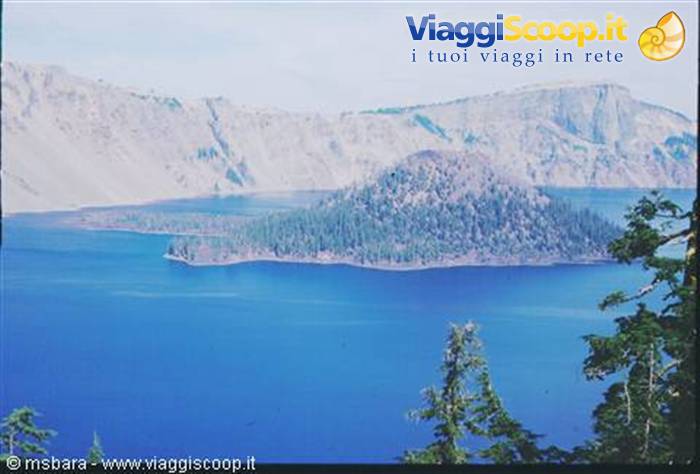
crater lake, oregon
Day 325 Sep 2002
25/9, TOWARDS OREGON The next morning still no news of the luggage: by now it's a slow torture and we decide to give up. "Send it to Italy, if you find it, or keep it in San Francisco until our return": with these words we free ourselves and set off. Having bought some underwear, two sweatshirts, socks and T-shirts, and rented the car (an astonishing Dodge Intrepid with automatic transmission, for about 50 dollars a day) we point the nose north: we cross the city, pass over the Golden Gate (zero emotion, too much traffic and fog), drive alongside Oakland and Berkeley (home of the very famous university) and begin the run towards Northern California and Oregon, our new destination. After half a day of driving and a round 400 miles (about 650 kilometres) we arrive in Medford, where we sleep in a Motel 6 (an inexpensive chain of decent quality).
The next morning, after a couple of hours on a magnificent road, winding through an enormous forest of very tall evergreens, we arrive at Crater Lake: a gigantic extinct volcano, whose crater contains a lake at the centre of which is an island. The lake, of an intense blue never seen before, has an average depth of about 400 and at most is 6 miles wide, about 10 kilometres. Measurements, numbers, that don't explain how imposing, majestic, impressive it is. Having finished the visit in the morning we head east: another 400 miles through the interior of southern Oregon. The most stressful 650 kilometres of our tourist career: the prairie, yellow, flat and always the same, where the perfectly straight roads seem never to end, literally swallows you. You can go as fast as you like, and we did, because nothing and no one got in our way, but you feel as if you're always in the same spot.
Kilometres and kilometres like this, hours spent in this countryside, with nothing to break the monotony of the landscape. Until, shortly before seven in the evening, we arrive at Ontario, right on the border with Idaho. Dinner, and then to bed. Not before, however, having adjusted the clocks: in fact we've left the Pacific Time zone (nine hours behind Italy) to enter the Mountain Time zone (one hour ahead).
crater lake, oregon
Day 428 Sep 2002
28/9, GEYSERS AT YELLOWSTONE The next morning we get up early and, after an awful breakfast, set off: about 350 miles separate us from Yellowstone National Park, and we're eager to arrive. The road is good and the landscape decidedly more varied: rolling, green, then yellow, orange, even fire red: the hues of autumn have set the countryside ablaze and made driving in this area pleasant. Idaho offers an interesting landscape but no place really worth visiting: the only curiosity is Crater Moon, the crater of the moon. An area where the earth is completely black and crumbly, almost sandy, evidently volcanic in nature. In the early afternoon we enter Montana, the temperature and the evergreens testify that we're starting to climb: at 15.30 we're in West Yellowstone, a beautiful little town at the west entrance of the park, at over 2,000 metres of altitude.
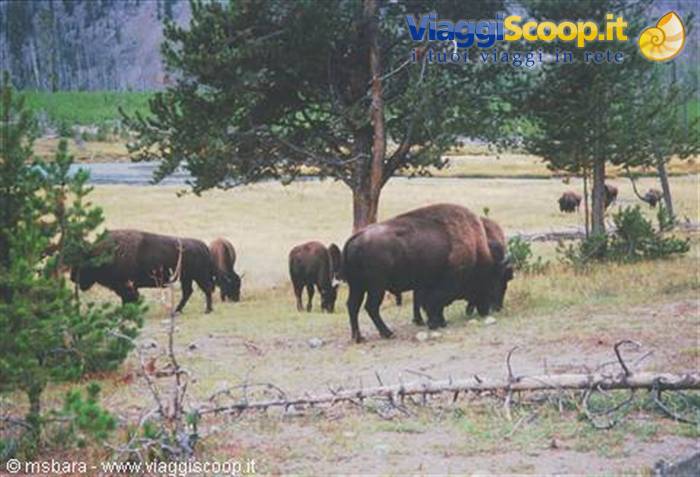
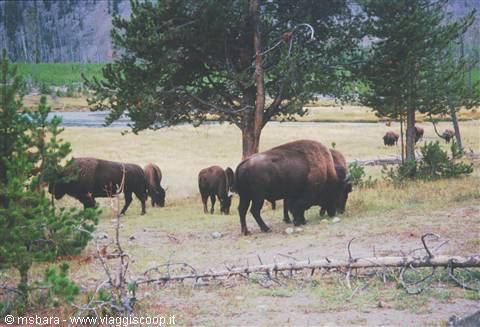
An altitude you feel, even on your skin: the cold stings. After a quick tour of the initial part of the park (20 dollars for entry, but the ticket is valid for a week), enough to see the first enormous American bison ford a river, we go looking for a hotel. We choose the Fairfield Inn: very characteristic, made of wood, intimate, above all warm because in the rooms the air conditioning blasts hot air. Relaxed, we go to eat. They offer us bison meat: it's excellent. The next morning we re-enter the park. Five minutes and we're stuck in a traffic jam: the bison's fault, of course, who instead of merely crossing the road, decide to travel along it in our direction, occupying both lanes. After ten minutes at a... bison's pace, in the middle of these beasts that can reach the height of a man, we finally manage to make our way through and set off again.
It will be a splendid day, during which we'll cover about 300 kilometres, partly through snow, crossing into Wyoming, in a wild and fascinating nature, among woods, waterfalls, lakes, animals of every kind (eagles, deer, elks, we even spot a wolf and a black bear) and geysers. Yes, Yellowstone is famous for its many sulphurous hot springs: there are some almost everywhere, but the most impressive is the one called Old Faithful. Every 94 minutes, roughly, Old Faithful (this is the translation of its name) shoots a jet of boiling water over 30 metres high. A spectacle we share with hundreds of other curious onlookers. Having finished the visit to the park, which still bears the scars of a fire that in 1988 devastated 36% of its total area, we leave. Not before having fought with more bison, who evidently ignore the rules of the highway code, to get a clear path towards the West Gate.
buffaloes at yellowstone
Day 51 Oct 2002
1/10, HERE IS NEVADA The next morning we set aside the idea of going north again, into the heart of Montana, to visit Little Big Horn, where the Indians, hallelujah, gave Custer's bluecoats a beating, killing over 250 of them. Unfortunately the luggage business made us lose time, and we can't go further east. So we head south and set off on what will be the longest drive of the whole trip: 570 miles (about 920 kilometres) on the I-15, a straight, fast and lightly trafficked highway that lets us cross Idaho once again (but from north to south) and the whole of Utah (including Salt Lake City, the state capital). We don't allow ourselves any intermediate stops because the Mormon state, though very beautiful, we've already visited on a previous trip.
We sleep in Cedar City, a small and pretty town in southern Utah, and the next morning, after crossing the border into Nevada, at 10.30 here's Las Vegas. We'd been here before too, but the incredible Las Vegas Boulevard, with its gigantic and extravagant hotels, can't fail to amaze us still. We decide to stay at the Luxor, an Egyptian-style hotel. For 60 dollars a night (a splendid double room with two queen beds) we sleep in the pyramid, on the 26th floor. To reach it you don't use elevators, but inclinators, because, rightly, in a building like this you only go up diagonally.
What's surprising, instead, is the fact that the pyramid is hollow and the rooms are set against the outer walls; when you leave your room you find yourself in a corridor that looks out onto the void: below you a hole of 70-80 metres, and then a reconstructed Egyptian village where you find restaurants, shops and, below that again, the inevitable casino.
Las Vegas is full of hotels like this, enormous and surreal, each with its own characteristic: the Venezia, with the Rialto Bridge, St Mark's and the canals for gondolas (Japanese people queuing to take a ride), the Paris with the Eiffel Tower, the immense Caesar's Palace in Roman empire style (next to which they're even building a Colosseum), the New York with the Statue of Liberty, the Excalibur with its colourful towers (we slept there in 1999), Treasure Island with a lake and the galleons, the new Alladin with the storm that breaks out inside, and many, many others. Every hotel is a kind of city: in ours we estimated there were about 4,000 rooms (confirmed via the Internet, there are 4,200), then five restaurants, a gigantic self-service, about twenty shops.
Even a Wedding Chapel for those who want to get married in Nevada (we counted five weddings in two days), where everything is easier. Getting divorced too, naturally. Every hotel has the inevitable themed pools, and we take advantage of the three (surrounded by colonnades and palm trees) that are available to guests of the Luxor to relax and recharge our batteries in view of the return to base.
buffaloes at yellowstone
Day 63 Oct 2002
3/10, AWAY FROM LAS VEGAS The next morning while we're getting ready to leave, on TV the usual preacher we'd already noticed on the previous days is putting on a show: his name is Benny Hinn (unintentional humour?), he dresses like a dandy, but all in white, and in front of thousands of people he performs every kind of miracle. He makes people sitting in wheelchairs walk, he heals others afflicted with deadly diseases. But above all he enjoys making them faint, by the dozen, simply by brushing their foreheads. A great one, expected in Europe too, say the ads, for the month of November. Having said goodbye to Benny forever, we leave Las Vegas, strangely in the rain. Judging by the arid desert that surrounds the city for hundreds of kilometres, it must be a rare event.
We drive a long stretch of it, skirting a Death Valley, so called also because it was the grave of many Mexican illegal immigrants looking for a safe passage to reach California, shrouded in fog. At midday we're at the edge of the gigantic military zones, where in the past some nuclear experiments were also carried out. Suddenly, very low and parallel to the road, an enormous military aircraft comes towards us carrying a strange device under one wing. But we weren't its target, because it flies lazily over us and goes on its way. In the early afternoon we reach the Sierra Nevada, an imposing mountain range that separates California from the rest of the American continent. The pass we choose is inside Yosemite, another national park. Pretty, but after seeing Yellowstone it pales. Here we meet snow again, though the temperature is acceptable.
And it becomes decidedly pleasant once we've come down from the mountains and arrived on the plain. We sleep in Tracy, in a strangely dirty Motel 6, where a group of Mexicans, disturbing us, party all night long. Our last night, unfortunately, in the United States: the next day we arrive in San Francisco, return the car (after almost 4,500 kilometres) and go to the airport. The luggage is there waiting for us: it will come home with us, useless by now, but safe and sound.

1 reader comments
Spero tu non sia tornato in Usa dopo questa esperienza. Per gli americani intendo!