The story
From London, after amply restocking the van with food, as well as an industrial quantity of beer, we take the northern motorway in the direction of Edinburgh. We don't feel in Scotland yet until we pass the legendary Hadrian's Wall, the dividing wall that marked the northern border of Roman colonisation, beyond which they could not penetrate.
We saw Edinburgh under a blanket of fog with an even more mystical effect. Having landed there on the day of the Queen's birthday, we witnessed a costume parade, complete with kilts and bagpipes and with cannon salvoes fired from the castle. Spectacular!!! Beautiful is the Royal Mile, the main street leading to the castle, full of shops and pubs. St Giles' Cathedral with the statue of John Knox, the reformer of the Scottish church.
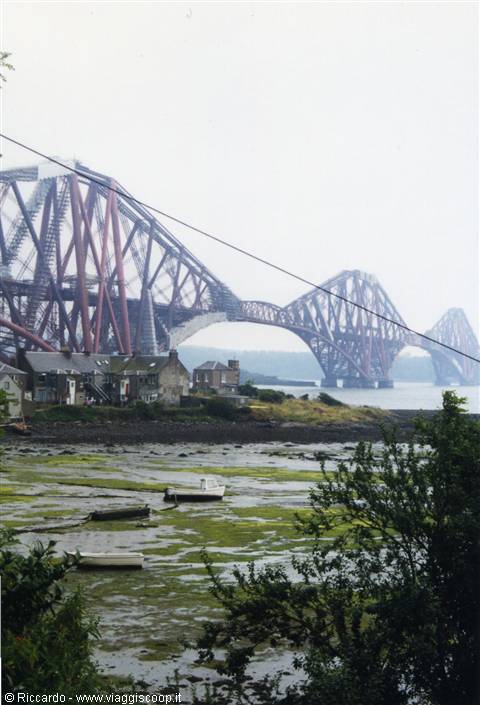
We cross the majestic bridge over the Firth of Forth to head for the valley of the Glen, a region of very famous distilleries. Taking the A822 towards Crieff we visit the Glenturret Distillery. A tour of the distillery and a tasting of single malt whisky among the best on the market (not my favourite, but still excellent whisky). Continuing on the A826 we find a distillery and a mill at Aberfeldy. The area is truly interesting for anyone like me who loves single malt whiskies. But we are not yet in the heart of whisky; we will be only in a few days.
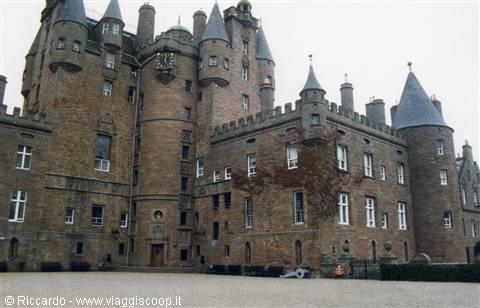
We follow the country lanes in this beautiful area: the A827 to Kenmore, then north to Fortingall (a truly picturesque little village) and Tummel Bridge. We skirt Loch Tummel on the B8019 towards Killiecrankie. Nearby, to the north, we find Blair Castle (it is advisable to get a pass to access a series of castles, to avoid spending exorbitant sums), and then return south towards Pitlochry (dam and artificial salmon pass) and Dunkeld.
We continue north-east on the A92 in the direction of Stonehaven, on the east coast. Along the coast heading north, we reach the ruins of Dunnottar Castle directly on the sea. Extreme peace in an incredible setting. A beer in contemplation is a must.
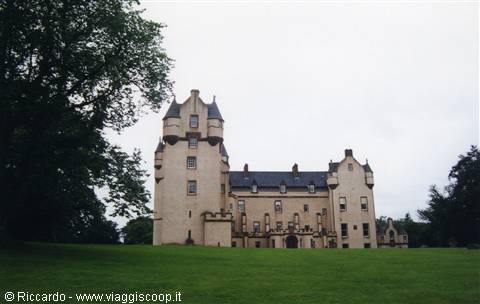
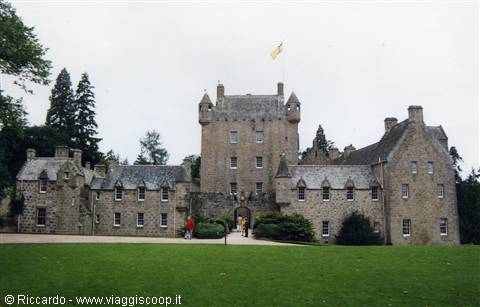
We leave the east coast and take the A957 towards Banchory. Nearby you can visit the castles of Drum, Crathes, Castle Trail, Fyvie Castle up to Aboyne, Ballater (Balmoral Castle) and Braemar on the B976, passing through the Lochnagar Distillery. A little whisky is just what's needed.
We leave the valley of the river Dee and take the A939 north. The route at high altitude takes us to Tomintoul. From here you can do a tour of several whisky distilleries (whisky trail).
We continue north on the B9008 and B9009 towards Dufftown (distillery and castle open to visitors) and on the A920 towards Huntly, on the A97 we visit Kildrummy Castle until we reach the north-east coast of Scotland, precisely at Macduff. From here you can enjoy the landscape with spectacular views of the cliffs. Chips and fish (potatoes and fish) are a classic dish in these parts.
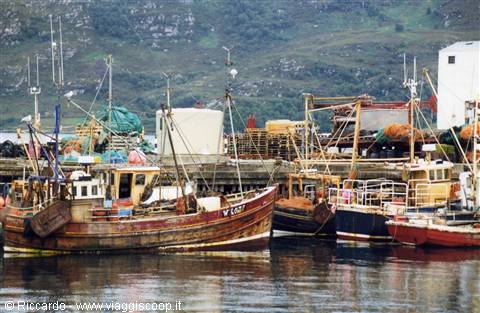
We follow the coastal road to visit the fishing villages with their characteristic little harbours. The drizzly evenings spent in the pubs of Portsoy or Cullen will stay in my memory forever. Also pretty are Portnockie and Findochty.
We arrive at Inverness, but don't stop, preferring to head straight for the Highlands northwards on the A9, enjoying the landscape among the firths.
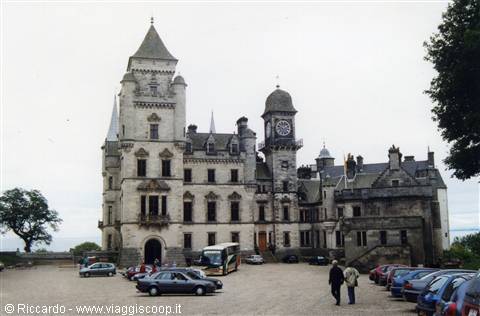
Along the way we stop at Dunrobin Castle of the noble Sutherland family. Towards Brora we find the Carn Liath Broch (an Iron Age fort). Between Dunbeath and Wick you can see some Celtic sites (at Latheron for example there are Achavanich Standing Stones, 40 standing stones), although we prefer to head further north where we will encounter many more.
Having reached Wick we visit Sinclair Castle directly on the sea.
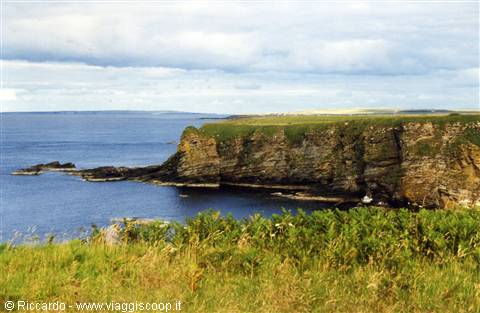
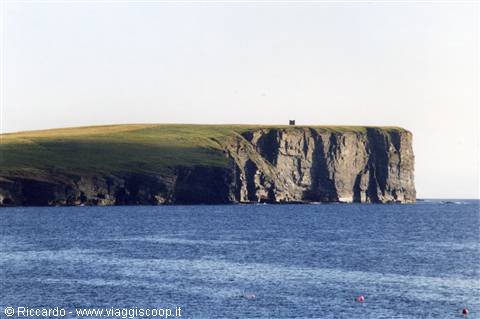
Having reached the far north via the A836 there are no words. Extremely high cliffs on the sea, green and unspoilt landscapes. Virtually no tourism. We find ourselves on these little roads where we don't meet a living soul for kilometres. The locals are most kind. Even running out of petrol (few petrol stations, no doubt about it), our waiting time was barely half an hour: picked up in a car by a kind gentleman to the first petrol station and back.
Dunnet Head, the northernmost point of Great Britain, and the view of the Highlands is incredible. Here the world seems to end, imagining further north only the Arctic Circle. We also spotted a seal playing among the light waves.
At Scrabster we slept in a campsite right by the sea. The dawn seen from there, with the gulls and pelicans near our camper, is something marvellous, with only the thought of having to board the next morning for the Orkney Islands.
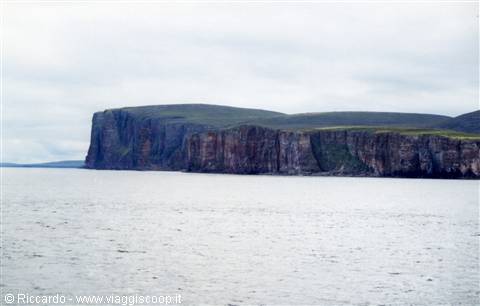
The next morning we boarded with the whole camper. The crossing followed by friendly dolphins almost made me shoot a whole roll of film. The high cliffs with the sun's reflection look painted pink.
We dock at Stromness after almost two hours. The weather is glorious and we arrive at the precise moment of a solar eclipse already announced days before. Will it be a sign?
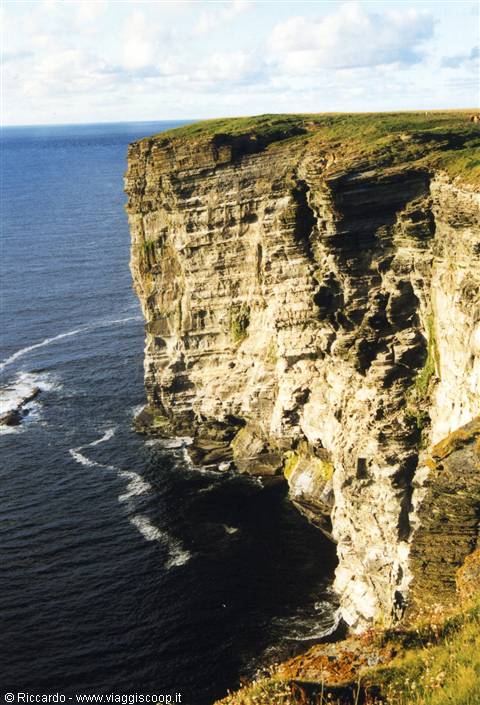
Despite our experience in various campsites we allowed ourselves the luxury of a three-day stay at a beautiful Bed & Breakfast lost in the countryside near the town, almost by a cliff. A hot bath and a reading room with excellent hot teas offered by the landlady make that stay one of the most comfortable of my travels. The days in these parts last an eternity and we often find ourselves, after ten in the evening, still seeing the sun on the horizon. The dinners on the camper atop the cliffs will stay in our memory forever.
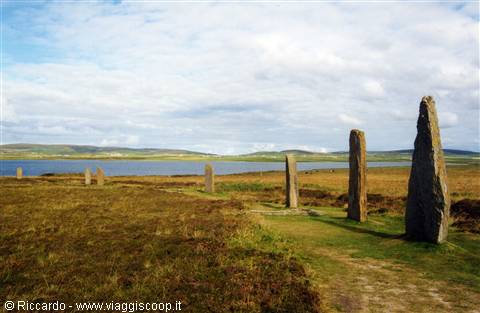
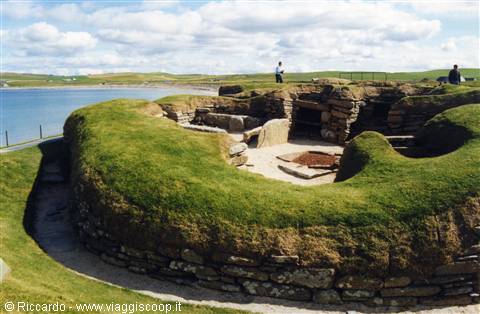
There is a lot to see here. The Orkney Islands offer an immeasurable quantity of archaeological finds from the Neolithic era. The most important, Skara Brae (remains of a village 5000 years old), besides being a site visitable 24 hours a day, despite its beauty is not overrun by tourists; Ring of Brodgar, a group of menhirs arranged in a circle on a bright green expanse; Maeshowe, an ancient tomb from 2500 BC with Viking inscriptions from the 12th century.
Kirkwall is the largest town on this island (Mainland). Here we visited the distillery producing my favourite single malt whisky, Highland Park. Built in 1798, it is the northernmost distillery in Scotland. Traditional processing involves operations such as peat cutting, malting and the use of coal for the distillation phases. There are four stills (two for each distillation) and the water, clear and pure, comes from the Cattive Maggie springs. The ageing warehouses, on a hill like the distillery, are exposed to the constant north wind. The maturation of the whisky is therefore influenced by this natural element. It is a real shame to leave this island, but our journey must continue.
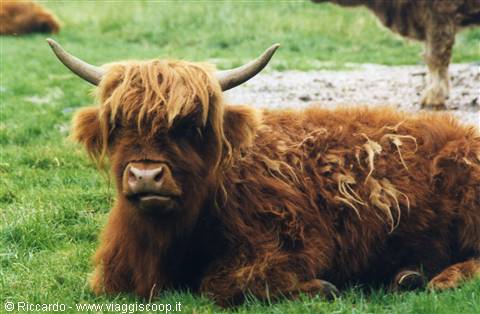
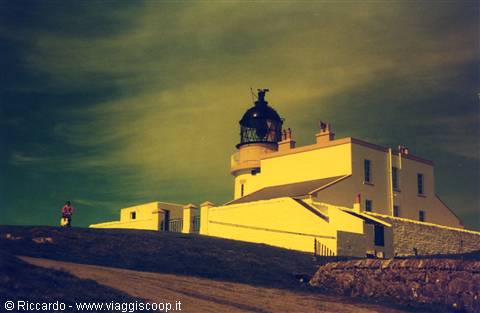
We take the ferry again for Scrabster, continuing along the coast westwards on the A836. The landscape here is truly wild. Strathy Point offers a fantastic view of the Highlands with its lighthouse. At Tongue we find the ruins of Castle Varrich. The moorland, the sand dunes, the typical shaggy-coated cattle, the sheep, everything fills the eyes in this area. It is hard to part from it.
........to be continued
The journey's photographs
24 photographs · click to open them full screen





0 reader comments