The story
We then go to dinner, and since the lunchtime tapas had been tasty but a little heavy, we think of looking for an Italian restaurant; we go to 'Al solito posto', located right behind the church of the Salvador and the square of the same name, much frequented by young people who eat tapas and chips standing up; we dine inside because the evening is cold (besides, it's 22.00); Italian and Spanish menu, we choose Italian dishes; the prices are at Italian levels. We return to the hotel passing along Calle Sierpes, an elegant shopping street. 29 March: Visit to the Cathedral and the Giralda (it opens at 11; first we walk around the monument to get a sense of its size).
The cathedral was built in the 15th century on the site of a mosque, of which only the Giralda (it was the mosque's minaret), the Patio de los Naranjos (courtyard of the orange trees) and partly the Puerta del Perdón remain, along with a few decorative elements.
We go in (I pay 1.5 euros but the price is 7 per person, audio guide 3.5 euros each), we visit it (a shame that some areas are under works), following the audio guide; we admire, enclosed by a magnificent wrought-iron grille, the great carved wooden Retablo of the Capilla Mayor, with scenes from the life of Christ and the Virgin Mary, flanked by the saints of the city; it's hard to get close, with tourists crowding to take photos; we move on to the Capilla Real (in Plateresque style), the Great Sacristy, the cathedral treasury, the side chapels; in particular we visit the Chapel of San Antonio with two masterpieces by Murillo, and the monumental tomb of Christopher Columbus.
We climb the Giralda on foot, taking the easy ramp that starts inside the cathedral; from the Moorish windows, some with little balconies, there is a magnificent view of the city; the climb is gentle (originally even horses went up); we reach the top, naturally very crowded, from which there is a magnificent view of the city. We come down and rest in the shade of the orange trees of the Patio de los Naranjos, one of the few remains of the ancient mosque, used by the Muslims for ablutions (not to be missed); of course, besides the orange trees you'll find the fountains with the little channels that carried water from the fountain throughout the patio. In the afternoon we head to the Casa de Pilatos (8 euros each for the full visit). The name comes from the fact that in the Stations of the Cross held at Easter in this building there was a station dedicated to Pontius Pilate.
You enter the Patio Principal, a magnificent courtyard surrounded by arches resting on columns, with the white marble fountain in the middle; the walls are adorned with splendid azulejos and arabesques, niches with busts and statues of figures from antiquity (Cicero, Hannibal etc.); no less valuable are the various rooms with walls finely decorated with azulejos. Before returning to the hotel, we take a ride on another circular route (C3). Then dinner at 'Al solito posto', not before a short stroll along the modern, pedestrianised Calle Sierpes, the most commercial street, as always very crowded — besides, it's also Saturday. 30 March: Second Leg: Cordoba At 9 we take the train to Cordoba; we arrive at 10.20 right on time; the local train is clean and modern.
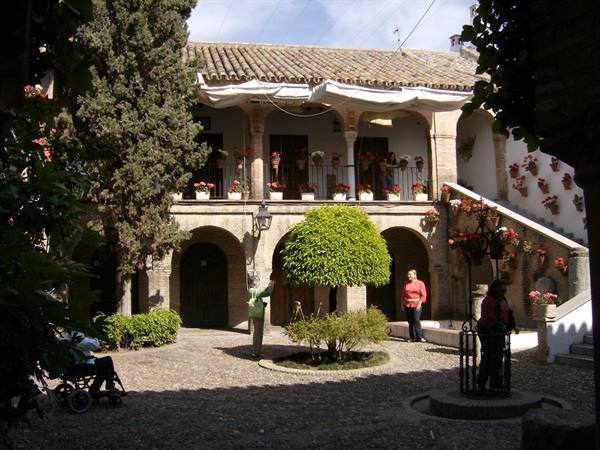
From the station a scheduled coach takes us close to the Mezquita; the monument is near the Guadalquivir (which has a less majestic air than in Seville) and the Roman Bridge (of which only the 12 arches on which it rests remain; some were added by the Arabs after the conquest of the city). We begin the visit from the Jewish quarter (Juderia), which is near the Mezquita; the district is largely pedestrianised; we walk along narrow lanes with little white houses with the typical patios; we visit the Campo Santo de los Mártires, a lovely shaded square in memory of the Christians killed during Muslim rule, then the small synagogue of 1315 (free for EU citizens), with Mudéjar-style decoration; opposite, the Zoco (market, now a craft shop), the remains of the medieval wall (Puerta de Almodóvar). We then go to the Mezquita, the city's most celebrated monument.
Outside, apart from its imposing size, it looks rather bare, like a fortress; the high walls are interrupted by the various doors; the Puerta de San Esteban (year 855) I believe is the oldest and most interesting. The mosque was built on the site of a Visigothic church; moreover the Arabs subjected it over time to many enlargements, and then the Catholic kings built a monumental Baroque-style cathedral inside it. We enter (8 euros each, 4 for me, plus the usual audio guide 3.5 euros), through the Puerta de Santa Catalina; we find ourselves in the Patio de los Naranjos, then enter the church and are amazed by the 'forest of columns'.
That is what the 850 columns that give a sense of infinity are called (in the past there were 1,260); some are of Roman origin, others Visigothic and African; magnificent arches rest on the columns; a shame that when we visited, major restoration work was underway; not to be missed is the mihrab, a masterpiece of Muslim art, a niche oriented towards Mecca; we admire the magnificent gold and blue mosaics, the representation of the tree of life, symbol of eternity. The Christian part, too, is one of the finest achievements of Spanish art; the Capilla Real (1258) has Mudéjar-style decoration, and the building has Gothic and Baroque features. Before leaving, we rest a little in the Patio de los Naranjos, then take the train back to Seville.
It is our last evening in Seville; we must bid it farewell as it deserves, going to a restaurant with local specialities; we decide to return to Casa Manolo. The usual waiter of the drawings welcomes us, broad smiles; when he goes to serve the other tables he shows us the dishes and points to them on the menu, then serves us wine, beer, bread, a few vegetable tastings, then prawns in garlic sauce, guisantes (green beans) with jamón, roast lomo de cerdo, crema catalana, all for 41 euros for two.
31 March: Morning devoted to the working-class district of Triana, on the right bank of the river, once a gypsy quarter; on the walls of the white houses, charming plaques that recall the azulejos; we visit the church of Santa Ana (1280), one of the oldest in Seville, surrounded by many legends; the style is Gothic-Mudéjar, with a fine 16th-century Retablo inside; we then go to the Plaza del Altozano, then Calle de Castilla with its patios, and visit the Capilla del Patrocinio. I then decide to cross the bridge again and stroll along the riverbank; I approach the Torre de Oro, a defensive tower built by the Muslims, and go to see the Plaza de Toros La Maestranza, the theatre of the same name and the Hospital de la Caridad with its typical Baroque façade and the chapel with its typical azulejo panels.
Speaking of the La Maestranza arena, I noticed that bullfights are no longer very important; in fact, if we hadn't passed by the arena, we wouldn't even have known that bullfights were being held during our stay; the posters are no longer in almost every shop window or in the streets as they once were. Lunch with tapas at a restaurant (terrible) outdoors and in the sun in the Plaza del Salvador, crowded as always; luckily a worker had let me into the church of the Salvador (under restoration) for a few minutes, allowing a hurried visit. Then departure by train for the last leg, Granada.
The journey's photographs
2 photographs · click to open them full screen

0 reader comments