The story
Ferrara and the Po Delta
by Ferny Forner
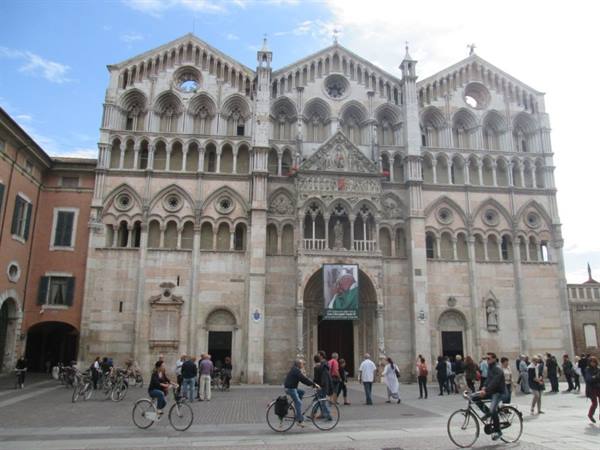
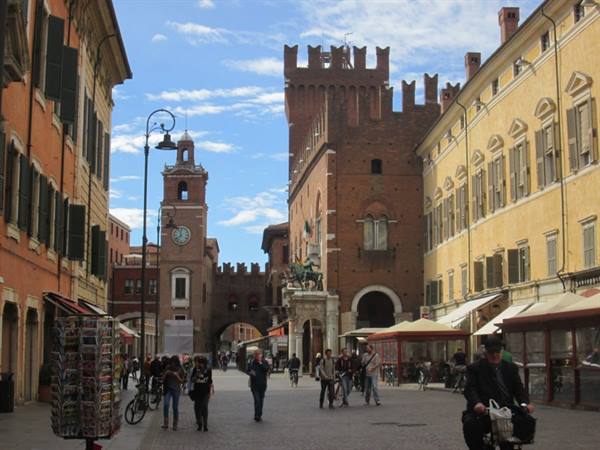
Rita and I arrive in Ferrara at 9.30 on 8/10/2015; having left our luggage at the hotel S. Stefano, on a street that forms part of the city's medieval route, we begin our first walk, reaching the historic centre where we visit the Cathedral of San Giorgio, a twelfth-century building, extensively altered over time (partly Romanesque, partly Baroque). The facade is in white marble, decorated with sculptures showing scenes from the Testaments and a Last Judgment. On the right-hand side are shops (the Loggia dei mercanti), and then the stone bell tower in splendid colours. The interior has three naves with side chapels, with paintings by well-known Baroque artists such as Guercino and Garofalo; in the apse there is an extraordinary fresco, "The Last Judgment" by Bastianino.
The church is rather dark, only the apse is lit, the vault, covered by a transparent net, is under renovation, and there are few signs in the chapels - a constant in the churches we visited. We then move into the nearby Town Hall (twelfth-nineteenth century), once the residence of the Este family, climbing the Scalone d'onore (sixteenth century), an artistic covered staircase. The palazzo is used as municipal offices, and the visit takes place with employees at work; they are all kind and willing to point out the rooms to visit. Some are decorated with rather recent frescoes showing stories of San Giorgio, references to classical art and to Orlando Furioso.
We found two sixteenth-century Flemish tapestries in the Sala della Giunta particularly interesting, as well as two modern-art paintings by Mario Sironi; the Stanzino delle Duchesse (sixteenth century) is original too - a tiny room with richly decorated wooden panels and paintings with classical subjects on gold backgrounds and mirrors, where painters such as Bastianino worked. We continue through a covered passage and reach the Castle, of which we visit only the garden. In the afternoon, a tour around the Castle/fortress, very well preserved; the area is pedestrianised and you can walk about in complete calm, apart from the occasional bicycle whizzing by with great confidence.
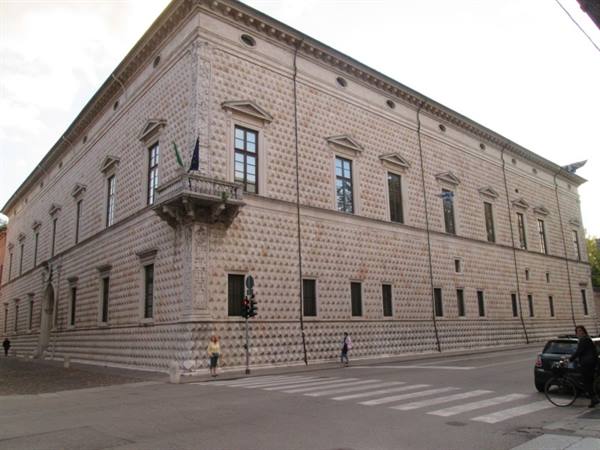
We then take Corso d'Este, a cobbled street with some period noble palazzi, and reach Palazzo dei Diamanti (sixteenth century), a magnificent construction with a facade made of small pyramid-shaped blocks of white marble (about 8-9,000 of them), whose points are oriented so as to produce special light effects; the other decorations are remarkable too. Inside it houses the National Picture Gallery, which offers a complete overview of Ferrarese art, with famous painters such as Cosmè Tura, Garofalo, Mantegna and many others; some rooms are being refurbished. We go out, pass in front of the Certosa, which is closed, and see only the interesting facade; we finally reach the walls (Porta degli Angeli) that surround almost the whole city, with many young people, green areas for children and adults with exercise equipment and a busy cycle path.
Friday 9 October
We head for Palazzo Schifanoia, crossing practically the whole of the oldest historic centre, including Via Voltapaletto and Via Savonarola; we see the church of S. Francesco (fifteenth century), with a fine but rather plain terracotta facade; the church is closed. Finally, Palazzo Schifanoia: the building is not very noticeable, blending in with the others on the street. Inside there are richly decorated rooms, in particular the Salone dei Mesi, which has a cycle of frescoes arranged in three horizontal bands; a pity that of the twelve months only seven are visible, with only a few traces of the others. Naturally the scenes are secular, since the palazzo was a place of recreation: one band is devoted to the zodiac sign of the month in question, the other two to pagan deities and country life. We then visit the other rooms, which display mainly sculptures, ceramics and coins.
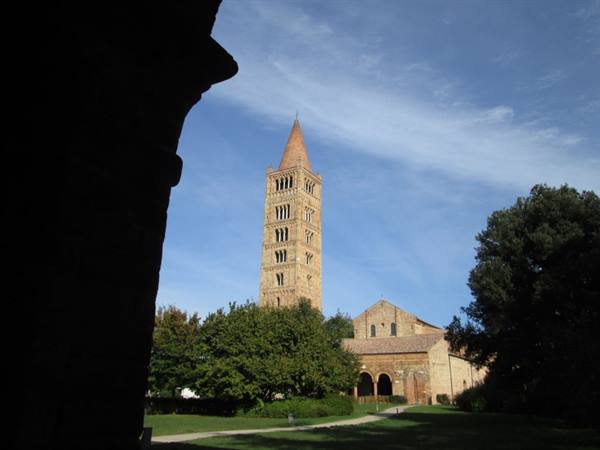
In the early afternoon, by train to Codigoro and then by car as far as Pomposa to visit the famous Abbey. The Abbey, in Romanesque style, is part of a complex that also includes the monastery and the Palazzo della Ragione. Set in a large park, its origins date back to the sixth century, while the bell tower is from the eleventh century. Admission is charged (5 euro); we begin the visit with the Museum, which contains finds including capitals, marble panels, some fragments of fresco and many other decorative pieces from the ancient abbey, and then visit the other parts of the complex, where we admire more frescoes. We then enter the church dedicated to S.
Maria: a magnificence, with three naves and Byzantine columns; note that it was built with materials from Ravenna, and on all the walls there are cycles of frescoes arranged in horizontal bands (thirteenth century), with stories from the Testaments and the Apocalypse; the floor, with figures of flowers, animals and other decorative motifs, is breathtaking. The monastery's frescoes, and in particular those of the Refectory, are of equal value. On the way out we linger over the bell tower (eleventh century), with unusual windows whose openings increase as you go up. It's a real shame that this monument is not much visited, because of the lack of public transport.
Monday: around Ferrara
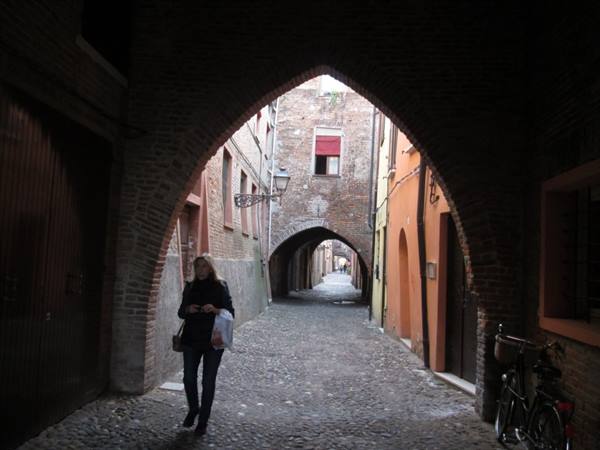
We head for Casa Romei, near Palazzo Schifanoia; the building has a rather plain facade. We immediately notice the Cortile d'onore, overlooked by large balconies, with friezes and remains of frescoes on the walls. Inside there is a museum with collections of paintings, friezes, sculptures and more, all from religious buildings. Of particular interest are the unusual Sala delle Sibille and Sala dei Profeti, with painted walls; I especially liked the first, whose walls bear paintings of twelve Sibyls waving long scrolls on which prophecies are written. In the house you can also see parts of frescoes from deconsecrated churches. We then visit nearby Via delle Volte, one of the oldest streets of medieval origin, cobbled, whose name recalls the passages and arches linking the buildings on the two sides of the street; in some stretches these passages form veritable galleries, very evocative.
Useful information: in general prices in Ferrara are on average lower than in other historic cities; it's easy to get around, with many pedestrian areas, and on foot you can reach almost everywhere; you can cycle anywhere as it's all flat; the museums and attractions are inexpensive. Unfortunately the connections with other places are very poor, and in the province, without a car, it's hard to reach the many attractions.
Hotel S. Stefano: double room with private facilities and breakfast, 70 euro Restaurants: we frequented mid-range and cheap restaurants in the centre: Bar Settimo: set menu 13 euro (+1.2 cover charge), including drinks and coffee, good value for money, we went back Il Ciclone: pizza 4 euro, grouper fillet 8, beer 2.5, we didn't go back Leon D'oro: nice place, average prices around 20 euro Il Postiglione: low prices, but we didn't go back
The journey's photographs
5 photographs · click to open them full screen
0 reader comments