The story
Self-service trip, low-cost flights with Vueling and Ryanair, budget 700 euros, excellent Hotel Carlos V in Granada Return to Andalusia (Seville-Cordoba-Granada) (27 March-5 April 2008) by Ferny Forner
I had wanted to return to Andalusia for 30 years; finally Rita and I decided to make the trip. Since January we had booked flights and hotels online (after reading travel accounts and hotel reviews on Tripadvisor and other sites), and entry to the Alhambra (important). FIRST LEG: SEVILLE 27 March: at 9 we leave Turin by coach for Malpensa (18 euros each), where the Vueling flight awaits us (107 euros for two), departing at 12.30 and arriving in Seville at 14 (early). Once we have collected our luggage, we take the bus (packed) towards the city (3 euros each); we arrive near the Parque Maria Luisa — I had calculated it was about 800 metres from the hotel; despite the mobile phone with the navigator we manage to take the wrong road and find ourselves in the middle of the great Parque Maria Luisa.
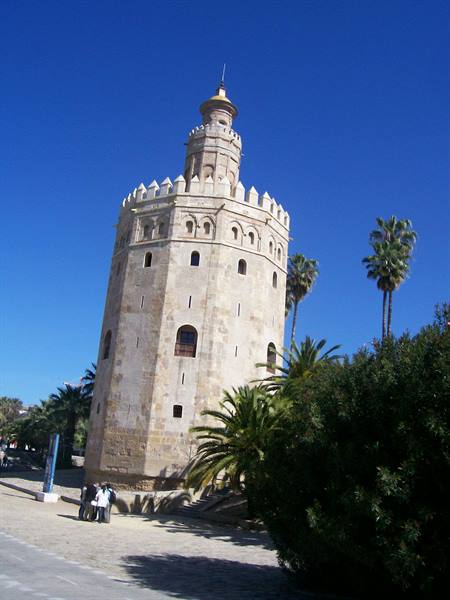
But every cloud has a silver lining, in fact we start our visit early (with our trolleys and unfortunately our thick jackets..... it was 25°) and see the Plaza de España, a lovely semicircular square, so we cover a kilometre and a half of road, the route running alongside the Guadalquivir riverbank along the Paseo de las Delicias and Paseo de Colón; we stop anyway at a friendly student bar near the gardens of S. Telmo, then resume our walk, passing the Torre de Oro, the Maestranza theatre, where the city's opera and symphony season is held, and the Plaza de Toros; from the other bank of the river you can see the white houses of the Triana district. At last we reach Calle Reyes Católicos, where our Hotel Becquer is located. The hotel is rated 4 stars (128 euros a night); it is right in the centre, close to the most important monuments and shopping streets.
Our room is on the sixth floor, medium-sized, with a large but windowless bathroom, a small wardrobe for 2 people, a sitting corner, satellite television (you can get Rai 1); we phone to ask for another towel, they assure us of immediate delivery, but we never see it; we discover there is no toilet brush in the bathroom, the usual phone call, but this time they tell us it is not provided in the hotel (but.....), no wifi; we will later discover there is a terminal in the hotel at astronomical prices (3 euros for 15 minutes); the staff advise us to use an internet point 30 metres away, which we do (1.5 euros/hour).
Around 20.30, after a healthy shower, we set off for a first exploratory walk; we go along Calle Reyes Católicos and Calle San Pablo and immediately notice the Iglesia de la Magdalena (open until late), 17th century, a very simple but imposing exterior, a classic baroque interior with the characteristic Madonnas; I notice a chapel in Mudéjar art (the Capilla de la Quinta Angustia). In this regard I recall that Mudéjar art is the art of Arab artists, who after the Christian reconquest were allowed to stay and work; it is a style of Muslim art that is seen only in Spain. Around 22 we go to dinner at the restaurant Casa Manolo, which some friends had recommended, but which is also listed in some tourist guides among the inexpensive restaurants.
The place is very simple, frequented by local clientele; the menu offers only Spanish dishes; the waiter speaks only Spanish, but he helps us choose by drawing the menu dishes on paper; we order soups, espárragos con jamón, tortilla de patatas, natillas de la casa, macedonia; all well done, 26 euros for two including wine, coffee and bread (you have to order it as if it were a course). Friday 28 March: after breakfast in a bar, we look for a newsstand and notice that, unlike Granada, it is hard to find Italian and foreign newspapers; the newsstands deal exclusively in local papers; we will find them, by chance, near the Barrio de Santa Cruz. We head towards the Real Alcázar, going along Calle Zaragoza and the narrow lanes (public minibuses also run there); we reach the Plaza Nueva, a lovely large rectangular square, surrounded by palms, with the monument to S.
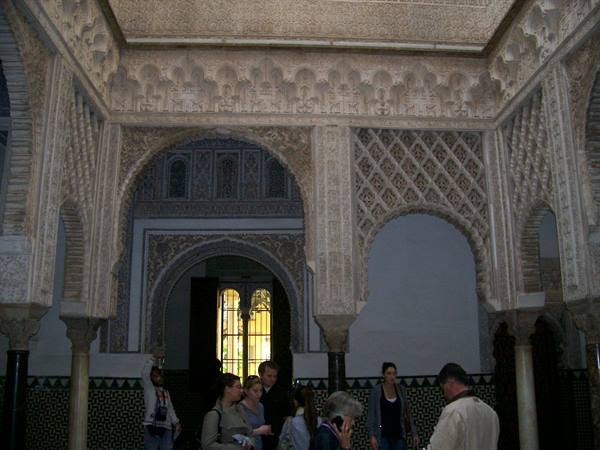
Fernando; from this square begins the Avenida de la Constitución, where the Ayuntamiento stands, an imposing 16th-century building with a fine façade in the Plateresque style, an architectural and decorative style born in Spain in the 15th century, used for façades and windows; the building has a splendid façade with historical and legendary figures including Julius Caesar and Hercules. We then reach the Los Reales Alcázares (entry 5 euros, free for students and the elderly), the oldest royal residence; in fact it is still partly used as a residence by the kings of Spain; the complex consists of several palaces, built in different architectural styles, ranging from Arab art to the Renaissance, passing through the Gothic.
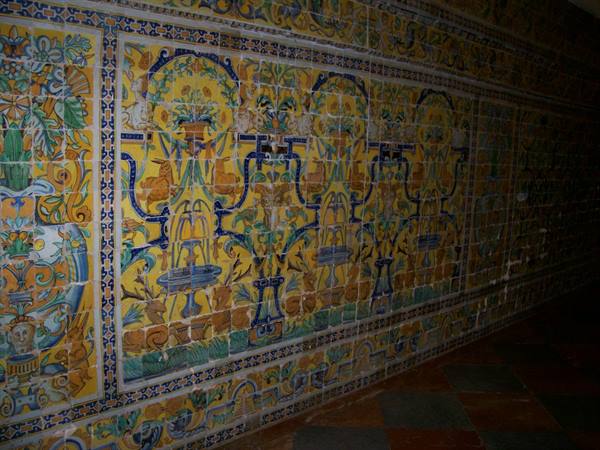
The first palace was built in the 10th century by the Arabs as the governor's palace; after the reconquest the Christian kings enlarged the building with the help of Arab artists, and it therefore displays different styles; the exterior looks like the wall of a fortress, also because of the presence of crenellated towers. We enter through the Puerta del León and, accompanied by the audio guide (essential, 3.5 euros), we visit the palaces, admiring the magnificent patios with elegant arches and sculptures, and we linger in particular at the Patio de las Doncellas (the one I liked most), also for the fantastic azulejos (mosaics), the Patio de las Muñecas, the Salón de Doña María de Padilla and the Salón de los Embajadores, with columns coming from ancient Arab palaces; I must say the visit was a real feast for our eyes.
In the Gothic Palace we linger in particular in the hall of tapestries, then we visit the magnificent gardens, which are not the original ones — in fact they were, so to speak, restored into their current form between the 16th and 20th centuries; here too a sequence of patios and gardens, very pleasant. Around 14 we go out and eat some tapas. In the afternoon we visit the Barrio de Santa Cruz, which I think is one of the best-known districts in all of Spain; once an Arab quarter and then a Jewish one, today without any particular character. We wander among narrow streets with small low houses containing a little courtyard (patio), surrounded by arches with azulejos on the walls, and the typical fountains in the centre.
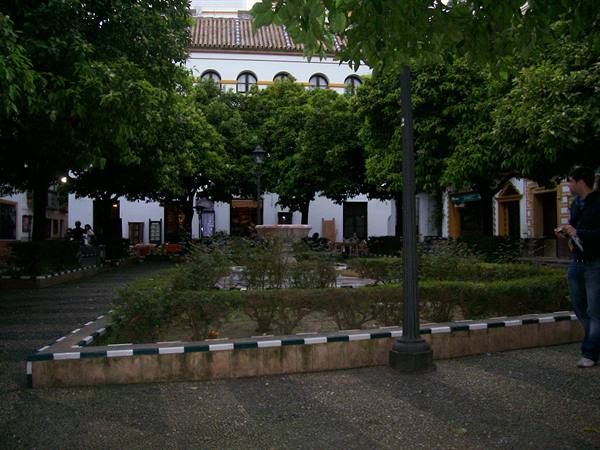
We linger in the elegant Plaza de Doña Elvira, with the typical azulejos on the walls, a garden with orange trees and a fountain in the centre, restaurant tables around the edges; we then pass the Hospital de los Venerables, an old home for elderly priests, the Plaza de Santa Cruz with the Cruz de la Cerrajería (emblem of the district) in the centre, the church of medieval origin of Santa María la Blanca; but the best thing was to stroll, without haste, among these streets and see these and other magnificent squares and enchanting corners appear. As is our habit, we buy a transport card, to allow us to visit places and districts that would otherwise be ignored. We return to Calle Reyes Católicos and take the little C5 bus (C stands for circular; there are 5 circular routes); these are minibuses that tour the tourist sites and even run along very narrow streets; we do the entire loop.
The journey's photographs
6 photographs · click to open them full screen


0 reader comments