A tour through what was once the immense empire of the Soviet Socialist Republics. A journey through countries in transition, where leaving the past behind takes great courage and a huge commitment...
Day 120 Aug 2003
Kiev - part one
Departure from Rovello, punctually at 5:00, heading to Malpensa airport, departure for Frankfurt scheduled for 7:00, and at 7:15 we take off; not even time to wander around the duty free!!! After 1 hour and 45 minutes of flight we land in the immense Frankfurt airport. The plane stops far from the mechanical gates; a bus is needed to reach the airport structure; we walk across a large part of the structure to head toward the exit for Kiev. The departure scheduled for 9:35 is postponed to 10:10; we have time to see the airport, not very clean (especially the restrooms) and chaotic; the efficiency of the Germans immediately suffers a big blow!!!! Finally we board for Kiev; the plane is decidedly larger than the one that took us to Germany; we take off with 1 hour delay; the flight is almost calm; some turbulence makes us jolt and after crossing a blanket of clouds we see Ukrainian soil.
We land; customs formalities are slowed by misunderstandings created by the language; the forms to fill out, written in Cyrillic, are not easy to understand; the number in the group (31 people), who pass through passport control at different times, contributes to slowing things down. After retrieving our luggage and passing, not without difficulty, one last check, we head toward the exit; we meet our guide with a sign in Cyrillic, a sign we initially ignore; only when we hear her speak Italian do we realize it is her. Once the group is regrouped and the luggage loaded onto the bus, we set off for the first part of the tour awaiting us: the tour of Kiev.
I don't have the Ukraine guidebook; I struggle to follow; I take notes and shoot slides; three grueling days are announced if I want to remember everything; on returning to Italy I will have to buy the TCI guide!!!! Kiev, 3 million inhabitants, of very ancient origin, the mother of Russia, was the first city from which Vladimir set out to build the empire, where in 988 he had himself baptized in the river that crosses the city and gave an international push to recognition of Russia at that time. From the airport, to reach the city one travels 30 km along a road that crosses an immense wooded area. Once the expanse of trees ends, the first dwellings are visible, some modern (these are the rich building houses outside the city), but most are dilapidated, giving the impression of being half-abandoned, yet they are inhabited.
The salary of an employee with prestigious positions does not reach €200/month. As we make our way into the city, neighborhoods built of prefabricated concrete appear before our eyes; it is public housing, but still a home for people. Seen from the outside they do not appear well kept; who knows about the interiors..... Continuing toward the center, we pass through the industrial zone; the state of abandonment and neglect, seen from the height of the road, is great; it feels like being in an Italian film from the early 1950s. By bus we go deeper into the city; the guide is named Dalia; she praises her nation, highlighting the positive aspects, with a few digs at the management during the communist years. The bus stops; the city tour begins.
We stop at the Church of Saint Elijah, built in the 9th century, redone in the 1700s; the icons present are from the 1600s-1800s. The iconostasis has been redone. It is the first church of Kiev. The impact with Orthodox culture is strong; the richness and decoration of these churches is truly remarkable; each of them is a little masterpiece; if only we knew how to value our Italian masterpieces the same way... Coming out of the Church of Saint Elijah, immediately to the right we find the Church of Saint Nicholas along the river; the facade is in Ukrainian Baroque style; it is a church that was reopened for worship after the repression of the communist regime. The guide ventures into the past???
We continue toward the center; we pass near the universities; we arrive at a square where there is the fountain with a statue of Samson struggling with a lion (the original statue is kept in the national art gallery); we stop to visit the Church of the Dormition of the Holy Virgin, a church famous for its ancient icons; inside there is only one of the 3 originals; the others are in the Russian museums of Moscow and Saint Petersburg. We set off again, passing through the artists' quarter and near the Church of Saint Andrew, where we will return in the following days; the appearance of the quarter is fascinating; it resembles Montmartre in Paris; stalls, artists, and painters line the sidewalks and little squares of the steep, cobbled street that climbs the hill where the Church of Saint Andrew stands. We continue a little farther and arrive at Saint Sophia.
The bus stops; I get off; my eye ranges from the imposing entrance of the church, a blue and white bell tower in Ukrainian Baroque style, to a broad and spacious avenue all the way to its end, where another building with golden domes stands, the Church of Saint Michael, the guide informs us. We enter Saint Sophia; the courtyard allows a clear and unobstructed view of the church from the surrounding walls; its beauty leaves you breathless: the white facade, the green roof, the green columns; the contrast is strong, wonderful, instilling an air of royalty. The church was built in 1037 (TCI p. 16). In 1240 Kiev was invaded by the Mongols; the upper part of the city, where the church stands, was destroyed, but the church was spared; the interior was redone in the Baroque period.
Today the interior of the church appears in its original form; only the floor has been replaced with cast-iron tiles, which gives it a truly original appearance. The apse and the dome are covered with 11th-century mosaics; originally there were 1600 sqm of mosaics; today 200 sqm remain. Mosaics are very rare in Ukraine and are of truly astonishing beauty; the primary color, besides gold, is red/green. The iconostasis is gilded wood in Baroque style. Inside the church, one room is dedicated to Saint Michael, a 13th-century church. Destroyed during Soviet domination to make room for a building with a political function. Some 13th-century mosaics are preserved. Moved before the destruction, their colors are green/blue; part of them were transported to the museums of Moscow and Saint Petersburg.
It starts to rain; the outing is modified; we go to see the Church of Saint Vladimir, the one who in 988, by converting, introduced Catholicism to Russia; the church, built in 1870 in Neoclassical and Neo-Byzantine style, contains frescoes by local painters; the most famous is the Baptism of Vladimir. Finally we reach the hotel, Hotel President; it is majestic, 10 floors; we enter and it is half-empty; only part of the bar and the casino below will prove to be used; I don't know if it's just a slow period, but having heard what the guide told us about monthly salaries, I deduce that we are great lords to them. We check the prices of drinks in the kiosks, truly low, less than a third of what they are back home.... A classic Ukrainian dinner: vegetables, meat, dessert, all served quickly. We have time for an evening outing; we head toward the city center.
The contrast is strong: from solid brick houses without cladding to 18th- and 19th-century buildings rich in ornamental details, to the gloomy gray buildings of the Soviet era, up to modern constructions with imposing glass facades. The shops highlight the difference even more markedly: from cigarette sellers (even single ones), to tables selling drinks placed on the sidewalks, to ultra-modern shops with the latest-generation mobile phones.
.... to be continued....
Blue façade with gilded domes and crosses of St Michael's Cathedral in Kyiv
Day 220 Aug 2003
Kiev - part two
Here too the Western proportion is confirmed: 5% of the population owns 95% of the wealth, but here the contrast is extreme; the middle class is in fact nonexistent; one sees only rich and poor. Walking through the city streets, one notices how well-kept buildings are illuminated, a great example for enhancing Italian beauties; the streets are wide and clean; people are calm; some are a little tipsy from the beer flowing in rivers, but nothing worrying. It is pleasant to stroll; we go into a market open 24 hours; there are only flowers, fish, and caviar. We return; from the hotel the view ranges over the city; cars can be seen speeding along one of the city's grand avenues.
.... to be continued....
The steel Friendship Arch in Kyiv with the statue in front
Day 321 Aug 2003
Kiev
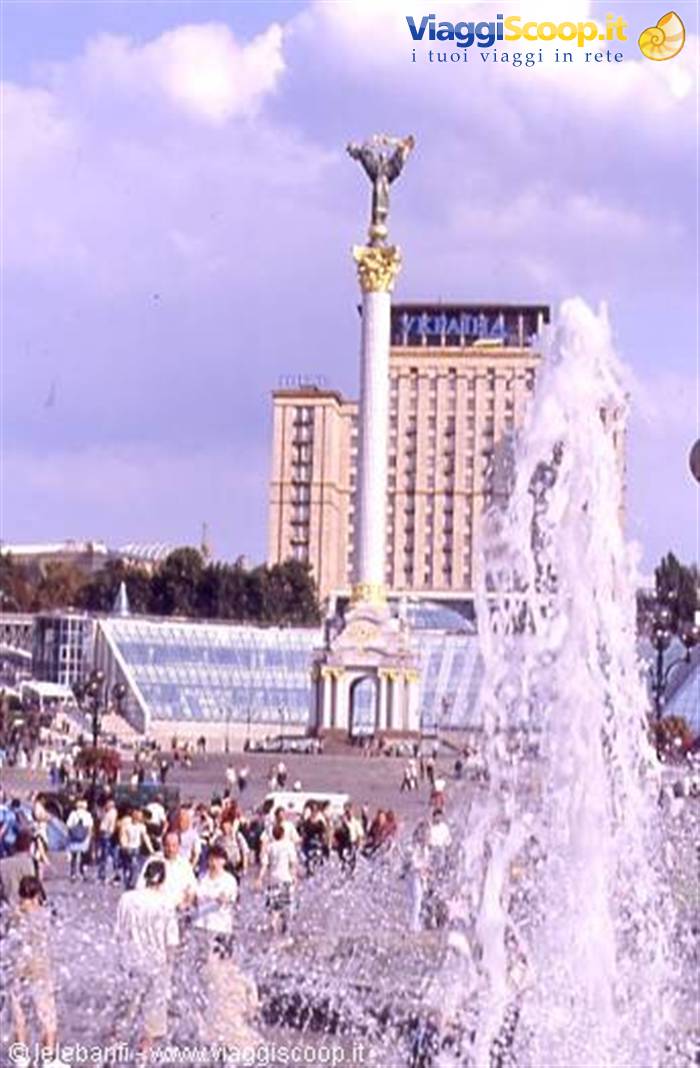
We continue the city tour; the houses increasingly show the contrast seen yesterday; solid bricks always make an impression placed next to colorful buildings with soft colors, never strong; white is always present, but paired with light blue, pale green, pink, yellow, giving the city a gentle look. The first stop is at the Church of Saint Alexander; it is the first functioning Catholic church; Saint Nicholas is the second; to get there we pass by the ancient synagogue, proof that Kiev has always been a cosmopolitan city of international fame; we pass through the vast Independence Square, where preparations are underway for the Independence Day celebration to be held on August 24. Shortly before the church we pass by the Kiev exhibition center.
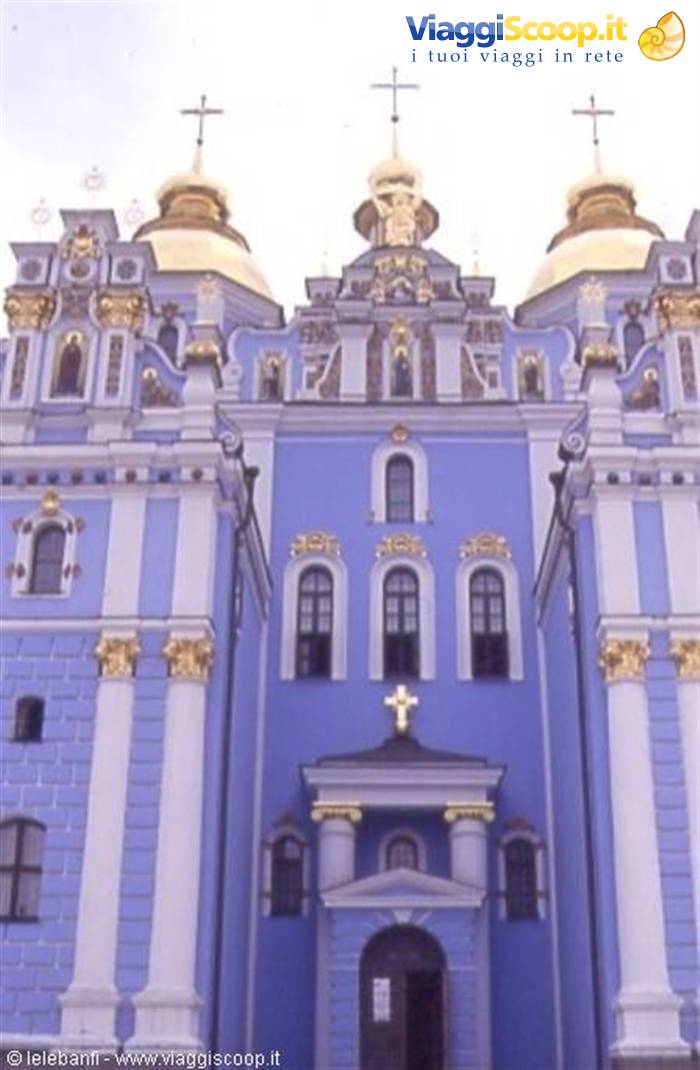
The Church of Saint Alexander has a Neoclassical structure; the interior is completely bare and white; there are decorative elements on the capitals; frescoes of the 4 evangelists dating from the 1900s are at the sides of the dome; there are a few paintings and few statues. After the richness of the Orthodox churches, entering a bare church is truly jarring. A short distance away we stop at the Monastery of Saint Michael, built in the 17th century, located opposite Saint Sophia; the color is white and blue; inside the church there are 17th-century mosaics and frescoes; some frescoes were redone in recent periods (1700s and 1800s); the iconostasis is from the 1800s. Outside there is a refectory with a roof of wooden scales; the structure is ancient and retains its charm; inside a religious service is underway accompanied by a choir; we stop to listen.
Continuing inside the monastery, we visit the Chapel of Saint Michael, which preserves Ukrainian embroideries of local tradition; each embroidery distinguished by a particular color accompanies a particular episode in each person's life. We visit the museum-shop full of icons dated from the 1800s; a doubt arises: are they real or fakes for tourists? No one buys anything and we immediately clear up the doubt.... We continue to the Ukrainian Art Gallery, where we discover that the term icon means window; the guide is sharp and allows us to learn many things. The evolution of icons is historical: it starts in the 16th century, when they were carved, then in the 17th century they became paintings without background, and in the 18th century they became three-dimensional. Moving through the rooms we see the evolution of Ukrainian art up to the 20th century.
The pride of the young state (12 years old) appears in the enthusiasm of the guide, who openly condemns the crimes perpetrated by the communist regime. The day continues with lunch in a typical restaurant where the garlic in the creams claims its victims (the subsequent search for candy and chewing gum is remarkable..). We resume the city tour; the guide takes us through neighborhoods that were destroyed by a fire in the 1800s. Then she tells us about the extermination carried out by the Nazis between
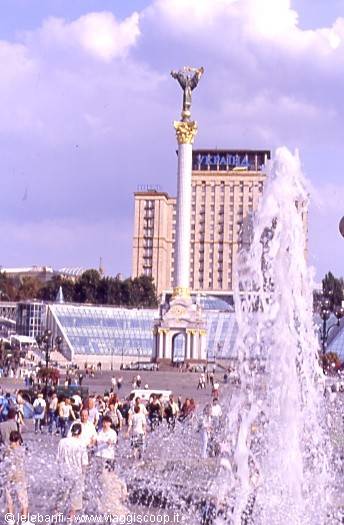
Fountain in foreground, golden statue column on Maidan Nezalezhnosti square, Kyiv
Day 422 Aug 2003
Kiev - part one
Is it the time zone making itself felt? No, it's the tiredness from the previous day showing in the sleepy eyes seen before breakfast; fortunately the food and coffee kick in and we recover quickly. On the way to the Monastery of the Caves we pass by Kiev's important buildings, the National Bank a neo-Russian building, a little further on we stop to see the garden of the presidential palace and the palace itself. The palace from 1750 built by the Italian Bartolomeo Rastrelli (a Florentine architect, who built the major buildings of the tsars in the 18th century) was the residence palace of the tsars when they came to Kiev, after the 1918 revolution the garden wall was destroyed and the palace was looted of its contents, today after restoration it is used for official receptions.
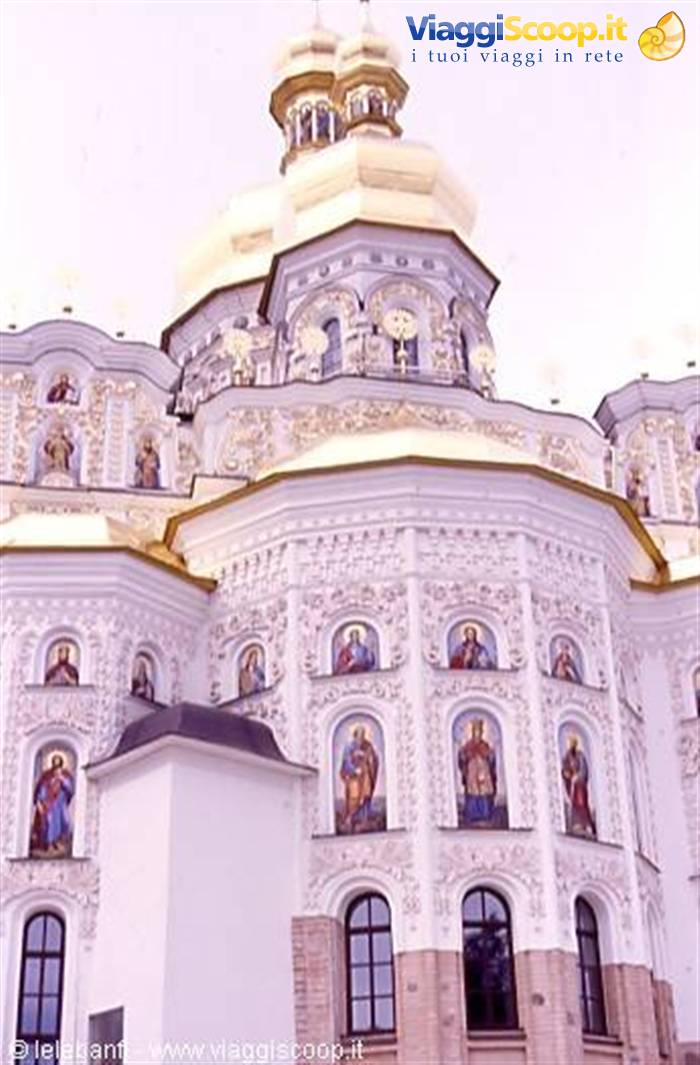
During the movements both by coach and on foot it is pleasant to notice the Slavic population, the physiognomy of the people, the beauty of the men and women. We arrive at the Monastery of the Caves, a complex of buildings set on a terrain with an extension of 22 hectares that occupies various hills with various arrangements of the buildings, all fortified with a double wall (in ancient Russia the monasteries had a religious and defensive function). The entrance is imposing, as soon as you pass through the gate the view takes your breath away, a series of buildings with roofs with golden onion domes and richly frescoed emerge from a series of low white-painted houses with green roofs and with very well-kept gardens in front, it feels like being in an enchanted place, in a fairy tale.
Above the entrance gate is the church of the Trinity, inside there are very detailed frescoes, on the walls wooden chairs for the monks recall the Western monasteries. Leaving the church a short distance away is a white and green building that houses a hospital, continuing on you meet a white building with a green roof which is the seat of the economy office and nearby its gate, a construction in Ukrainian baroque style, inside which on the first floor is the church of the Holy Trinity with 17th-century frescoes. In Ukrainian style, the colors are dark, enlivened only by the halos of the saints, the wooden iconostasis of red color has an unknown historicity (red, I will discover later, is the real color, the most important color for Russian culture), most of the icons were removed during the communist period.
Continuing the tour of the immense monastery you arrive at the cathedral of the Resurrection of the Mother of God, placed at the center of the upper part of the Monastery, it is imposing, all white with golden decorations and frescoes on the outside, the golden onion domes reflect the morning sun, the origin of the church is from the 16th century, destroyed in the Second World War it is in the phase of restoration and renovation. 18th-century iconostasis in gilded wood, the most majestic seen so far, it is a true masterpiece. Leaving, you take a few steps in the courtyard and enter the church of Saint Theodosius, an 19th-century structure, it was the winter refectory of the monks, the dark frescoes recall the church of the Holy Trinity, next to the church a room with frescoes on the walls depicting important episodes in the life of the Monastery.
These buildings during the communist period had been used as a museum of atheism and the frescoes covered with plaster, today they have been returned to their original splendor. A symbol of the revival of the Ukrainian people, of safeguarding and enhancing the enormous local artistic heritage. We are still inside the Monastery, we are on the upper lavra (city with streets), all the internal streets are paved or cobbled and this gives the right to call itself a "city with streets". We stop in the internal square of the Monastery to admire the landscape from above, the view is evocative, the hills decline gently toward the river, from the plants emerge the golden onion domes of the buildings of the lower part of the Monastery. In the square there are many sellers of honey and derived products, the production and processing of honey is a long local tradition.
Some bees fly around the products almost as if to signify the goodness of the product, some insects come a little too close to us, perhaps it is better not to linger too long nearby. We go down to the lower part following the slope of the hill, after skirting a piece of land planted with fruit trees and grapes we reach a small square, the women had been told to dress so as to be well covered and to bring a scarf to cover their heads, we enter a building, equipped with candles we go deep into what were caves (hence the name of the Monastery), narrow tunnels where the deceased monks rest, some are mummified, in some cases a small hole appears in the wall, behind it there was a room (a cave) where some monks performed extreme eremitism until death. Next to each urn an icon reproduces the monk (a replacement for today's photos).
The route is very evocative, one notices a great faith and devotion in the Ukrainians, the difference between them and the tourists is notable, they are there to pray, we to pry, at times I feel like an intruder, violating their rites. At the end of the feasible route, other galleries are reserved only for monks or for those who want to go and pray at some urn enclosing monks to whom people are particularly devoted, we exit outside, the air is clean and fresh, we retrace the climb and also exit the defensive wall of the Monastery. It's lunchtime, the characteristic restaurant reproduces a farm, it's fun and pleasant, the waiters are dressed in traditional clothes, the food is simple but tasty (salad, soup, main course, dessert).
We set off again, we tour Kiev, the parks are numerous and all adorned with cast-iron lampposts, very beautiful to see, we arrive at the church of Saint Andrew, in the artists' quarter where we passed on the first day, the church is placed on a hill, it was built by Rastrelli in 1750 at the specific will of the imperial family, the interior maintains the characteristic of the imperial style of the era, Ukrainian baroque, few frescoes, there is the unusual presence of the pulpit, the interior is white and soft blue, the capitals are decorated with floral motifs and the decorations at the windows are gilded. The iconostasis is in red color (imperial color) gilded at the columns and frames.
Having left the church of Saint Andrew we walk toward another hill where we find a square with the foundations of the first church of the city, dating back to the 11th century, there is a park and under a linden tree there is a Bandura player, the Ukrainian musical instrument, similar to a flat mandolin. Dalia tells us the tragic story of the Bandura players massacred during the Soviet period. Originally they were blind people or warriors who had become blind and performed the activity of storytellers to survive. The stories they sang were accompanied with this instrument. Among themselves they used a code that served both for teaching and for communicating with each other.
During the Soviet domination, the regime realized that these people had their own communication code, a conference was organized in Kiev, all the storytellers who attended it in the evening were loaded onto a train and deported to Siberia where they died from the cold. The ancient oral tradition was thus destroyed, today there is a state institute where some young people study the instrument and the songs that have come down to us. In all of Ukraine there are only 30 Bandura players who use this historic instrument.
.... to be continued....
Fountain in foreground, golden statue column on Maidan Nezalezhnosti square, Kyiv
Day 522 Aug 2003
Kiev - part two
A short distance away is the palace in socialist Russian style that contains the museum of Ukrainian history, dedicated to national history. We find rooms that starting from the Stone Age, the Bronze Age, the Romans, the nomadic tribes have made the ancient history of Ukraine. Then the Tatars, the Cossacks until reaching the 1918 revolution and our days. Very beautiful are the rooms that contain artistic artifacts, gold glass, ceramics, bookends, various objects. It is mid-afternoon when we reach the river port of the city, we board a boat for a panoramic tour of the city.
You see lower Kiev, the golden roof of the spires of Saint Andrew, the imposingness and extension of the buildings of the Monastery of the Caves, the imposing statue of the Motherland (in stainless steel and 102 m high), from the trees of a hill emerge the domes of Saint Cyril, the working-class neighborhoods with their prefabricated concrete block houses rise on the other side of the river, in the middle of the river a long island with fine sand serves as a beach for the city's inhabitants, along the river you see a succession of bridges from the pedestrian one to the metro one to the car one. Fishermen are present both on the banks and in the river aboard tiny boats or dinghies, only a few motorboats move on the water, even on this side the social divide is noticeable.
Once the dwellings of the working-class neighborhoods end, the industrial zone begins, rich in factories for naval activity and the production of building materials. Returned to the coach, on the way back we pass through Independence Square and the main street appears completely transformed compared to the previous days, preparations are underway for the national Independence holiday that will begin tomorrow.
.... to be continued....
White facade of Kyiv Pechersk Lavra cathedral, golden domes and mosaics
Day 623 Aug 2003
Moscow
Wake-up call at 4:00, the schedule calls for a quick breakfast, so much for a quick breakfast, the bar counter is overflowing with food, eggs, canapés, croissants, fruit juices, I eat two eggs to recover from the decidedly light dinner of the previous evening. We set off for the airport, at night the city takes on a different face compared to the evening, the buildings are no longer lit up, from the top of the hill you only notice the street lighting, it seems a more familiar sight to me, only the streets lit up. At the airport, boarding is made easier by the presence of Sandro who, with excellent English, speeds up the boarding procedures, we leave on an Aerosvit flight aboard a Boeing, the flight on Tupolevs is postponed to future trips.
Kiev airport appears not up to international flights, but after all it has only been intended for international flights for a few years and it's unthinkable that they would modify the structure: they have adapted it as best they could. Before, under the Soviet regime, the organization was different, only domestic flights departed from Kiev. I get confirmation of this when we arrive in Moscow, the airport appears little bigger and better organized than the semi-run-down one in Luxor, Egypt. We meet our Moscow guide, Alina, who explains that this airport was intended only for domestic flights and Kiev was considered part of Russia.
Moscow's international airports are quite different and of other dimensions (we won't have the chance to verify this since we'll leave Moscow aboard a train), I accept the clarification but right away from the airport I notice that Russia's poverty is much greater than Ukraine's. Approaching Moscow I noticed some wooden houses, almost a village of little houses with gardens, the state of neglect is remarkable, although inhabited they are neglected in the paint, the window frames, the roof gutters and the garden. Here too you notice the prefabricated concrete houses, all identical and all semi-neglected.
The hotel is located 17 km from the center, it is surrounded by buildings inhabited by families, they seem better finished than the houses built in the '60s by Khrushchev, the aforementioned houses, and given as gifts to the people who until then lived with multiple families in each apartment. The hotel is recently built, its luxury seems to clash with the adjacent buildings, but we have Euros and they have rubles...... We have lunch, the usual salad, soup, main course and dessert, the menu in Russia is not very varied; after lunch the tour of the Russian capital begins. The first stop is the Convent of the Virgins, along the way the guide explains some terms to better understand Russian civilization. Monasteries were buildings with a religious purpose but also for protecting the population from Mongol raids. Kremlin means fortress, and every city in Russia has its own kremlin.
Red is the most important color of all and means power (e.g. Red Square, red flag...) Crossing the city we reach the Convent of the Virgins (TCI p. 106), inside the church of Our Lady of Smolensk contains the most beautiful iconostasis in Moscow, an icon dedicated to the Virgin of Tenderness from the 16th century, it is stunning, golden frame, with 16 surrounding figures depicting the life of Jesus, the refined art of icons finds here one of its highest expressions. In the cloister of the church we have the chance to listen to a choir, the acoustics are excellent, and the performance wonderful and highly evocative, the CDs they offer have prices equivalent to Italian CDs, truly an excessive cost for being in Russia.
The whole ground inside the Monastery is characterized by tombs, important figures from Russian history are buried there and tradition holds that to be buried here one must be without sin. I realize that in Moscow being a tourist is equivalent to being a chicken to be plucked, they offer everything at Italian prices, when a Muscovite's salary is €300/month. Next to the Monastery is the second most important cemetery in Moscow. We get back on the bus and head to Sparrow Hills (TCI p. 115) from where we can admire the Moscow landscape from above. The square is full of brides, the guide explains another Russian custom, brides who arrive in ordinary cars belong to the poor class, those who arrive in limousines to the middle class, and the rich instead rent an entire boat.
From the square you admire the cityscape, it is truly immense as far as the eye can see, from the city only the buildings and the golden domes of the various churches emerge, in between the Moskva River flows calmly. Right next to the square you can see the ski jump, built for the 1980 Moscow Olympics, and the university building (TCI p. 116), one of the 7 tallest buildings in Moscow commissioned by Stalin. At the end of the square we find the Church of the Holy Trinity, inside it icons covered in gold, the church dates back to the early 1800s, it is one of the few churches remaining after the communist period. Moscow had 400 churches and was called the city of golden domes. Having observed from above those few churches that remain, imagining seeing 400 churches, each with 5 golden domes, the spectacle must have been truly fascinating.
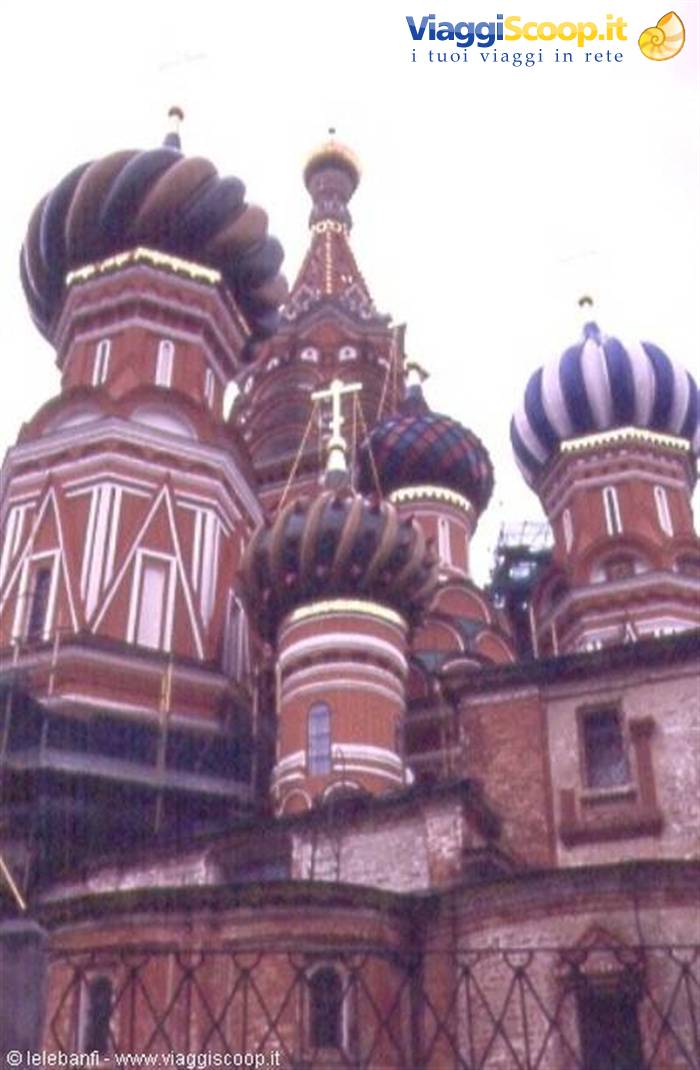
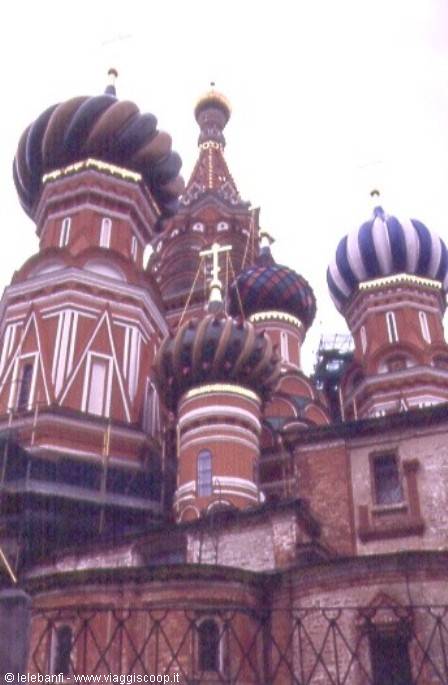
We continue the tour observing the Ministry of Foreign Affairs building (another of the 7 tallest buildings in Moscow), the TASS headquarters, the Bolshoi Theatre (TCI p. 84), we get off the bus and walk toward Red Square (TCI p. 58), the imposing square is partially closed due to possible attacks, but it shows its imposingness, in the center you see Lenin's Mausoleum, in front of it the GUM department store (TCI p. 58) with the figure of Christ the Savior placed right in front of Lenin's Mausoleum (a big joke on Lenin??), and finally, at the end of the square, on the open corner, the stunning St. Basil's Church (TCI p. 61). We visit the interior of the historic church and can admire the frescoes brought to light only recently, part of the domes are still under restoration and we can see the state of decay the entire building was in.
After the first day the differences between Ukraine and Russia appear, differences not only historical, but cultural, social, structural. They are two different states and even the overall mentality appears different, we will see in the coming days.
.... to be continued....
The colorful domes of St Basil's Cathedral in Moscow
Day 724 Aug 2003
Moscow
We set off at 9:00 sharp, the day looks interesting, the first stop is at the Cathedral of Christ the Savior on Spilled Blood (TCI p. 88). It is a church rebuilt with private money and was completed in 2000. Entirely in local white marble, it has an imposing appearance, interiors completely frescoed and gilded. Iconostasis in white marble, finely inlaid and gilded wooden door, the inner arches of the doors are in worked brown marble. In one hall all the names of the soldiers who fought the 1812 war against Napoleon are present. The domes covered with 40 kg of gold can be seen from afar. We pass near a market where Muscovites can buy non-brand clothing, the contrast with the large and rich shops in the center is remarkable, an endless series of small "shops" where you can find everything for a few rubles. We continue the city tour going to the Tretyakov Gallery (TCI p.
117), inside we see the mosaics from Kiev, a wide range of icons (TCI p. 30). They explain that in an icon the light comes from within. In the gallery there are only works by Russian artists. It is truly interesting to see and understand the culture of this great state. Lunch, always salad, soup, main course, dessert, quick, packed like sardines in a Russian/Chinese restaurant, who knows what food recycling they did.. The room is crammed only with Italians, being a tourist sometimes brings real surprises. We set off again for the Andronikov Monastery (TCI p. 103), the Monastery was an icon school, as well as the seat of the spiritual father of Ivan the Terrible. Today it houses a museum of icons, where you can admire works displayed chronologically. A short distance away another group of fortifications is the Novospassky Monastery (TCI p. 104).
The women, in order to access the church, being a place of worship, had to wear a scarf and those who had trousers and skirts not long to the ankles had to wear an apron. We visit the Church of the Savior, the frescoes are original and not restored, the church has an appearance of real lived-in life and not museum-like as many seen previously, we limit ourselves to observing it from the inner cloister since the church is off-limits to tourists. Some buildings of the Monastery are under restoration. We go out and a short distance away, on the suggestion of Father Maurizio, we go to see Kiutiokoe podvore, an ancient residence for ecclesiastics (TCI p. 105), the building although present in our Touring guide is unknown to Alina, our guide, who, curious and amazed, comes to see it too.
The structure is in a remarkable state of abandonment, on the church there is scaffolding for work but it seems to have been there for a long time, the building consists of a church, a building in Russian style and a covered and raised loggia that connects the building to the church. The building is in Russian style with exposed brick. In the evening after dinner we set off by bus for a tour by night of Moscow, it is truly evocative to go around the city at night and be able to admire many details that during the day would surely escape you due to the quantity of works to see. We start with the Hill of Farewell (TCI p.
115), where a bronze obelisk 141.80 mt high stands, dedicated to the days of World War II, 1418 days), we continue to Sparrow Hills, the view over the illuminated city is stunning, we stop at the Convent of the Virgins, where the wives of nobles who intended to remarry were locked up, adjacent to the monastery there is a small lake, the reflection of the building in the lake is truly evocative. We continue with St. Basil's and the Kremlin, which unfortunately is not illuminated, and finally a quick visit to Red Square which to our surprise is completely fenced off so not passable as the day before. We return at 11:30 pm, time for a restorative rest and tomorrow.......
.... to be continued....
The colorful domes of St Basil's Cathedral in Moscow
Day 825 Aug 2003
Moscow
After an abundant breakfast we set off at 9:15, we head out of the city, the traffic in the opposite direction is remarkable, immense queues remind me of the traffic in our metropolises, it may be an illusion but here too the traffic is congested. Going out you see birch and pine woods, the plain is boundless, you see the izbas, the peasants' houses with an adjacent piece of land to cultivate, and the dachas, the second homes of Muscovites, most of them are made of wood, some (for the wealthier) are made of brick (a wooden dacha of 80 sqm per floor, arranged on 2 floors costs 26,000 rubles, just under €900). You see old wooden houses, perhaps izbas, they are colorful, have inlaid windows painted white, with a piece of land around them, they show stateliness and constructive refinement.
The day is gloomy, it is drizzling, at times even heavily, it is funny to notice that all the water from the roofs, through channels connected to the gutters, is discharged directly onto the sidewalks and the streets serve as collection. We arrive after 70 km at the city of San Sergio, where the monastery of the same name Sergiev Posad stands (TCI p. 132), it is imposing, a true fortress, the mighty white defensive walls well protect the inner buildings, only the golden domes emerge. We enter after paying the ticket and the supplement to be able to photograph (a custom widespread in all tourist places in Russia, for photos you pay 100 rubles, €3, we really are chickens to be plucked....). The complex is truly large and stunning, the blue of the walls, the white and gold of the domes stand out, in the center a series of small buildings all finely decorated and the fountain of Holy water.
We start the visit with the Cathedral of the Trinity (TCI p. 134), the appearance is gloomy, a strong smell of burnt wax (they use pure wax candles, therefore with a high percentage of honey), there is no electric lighting in the building, the icons are lit only by votive lamps, the evocation is great, you have the chance to admire the actual state of the churches without the artificial lighting of light bulbs, gloomy frescoes entirely cover the church, the silver urn of St. Sergius finely chiseled is also lit only by candles, it seems bleak, you see the great devotion that the faithful have to the Saint. The next building is the refectory (TCI p. 134), the interior is entirely frescoed and adorned with golden and silver stuccoes. In the center of the Monastery is placed the Cathedral of the Assumption (TCI p.
135) which we visit, inside there are important frescoes and an exhibition of icons for devotional purposes, some are of valuable workmanship dating back to the 18th century in which the three-dimensional dimension appears. Having left the cathedral we hurry to fill the plastic bottles we had brought with the water that flows from a fountain that is considered Miraculous Water. Lunch takes place in a classic restaurant where the wooden furnishings praise the birch. We return toward Moscow leaving a glance at the splendid monumental complex. Once in the city we visit the Metro (TCI p.
109), we stop to see some stations, all different from one another, a true underground work of art, the trains come every 90 seconds, very fast, well-sprung, it is around 4 pm and the convoys are half-full, I wonder what crush crowds the carriages and the entire network at rush hour since the metro is the main means of transport for Muscovites especially in cold periods. Access and outflow is practicable with steep and very fast escalators. To be admired is the civic education of the Russians, those going up or down the escalators position themselves on the right of them leaving the passage free for those who want to run. Having left the metro, the bus accompanies us to take a tour of a street dedicated to shops, it is raining, it is cool, someone enters the shops, more to warm up than to buy, the prices are sometimes above average.
We set off again by bus for the hotel, a group decides to go to the circus, I return, I want to continue the diary. On the way back we find unbelievable traffic, the six lanes of travel per direction are all full, we proceed slowly, I don't know the pollution rate, but I presume it is high. From the bus stopped in the long and endless queues there is the chance to observe scenes of daily life, the height of the vehicle offers a privileged view. A curious detail, the windows (double for the cold) do not have the central two-panel opening, they are closed, they open only in the right part (from the inside) for about 1/5 of the width, this detail is also present in modern double-glazed windows, will it be to allow ventilation during the cold winter months???
.... to be continued....
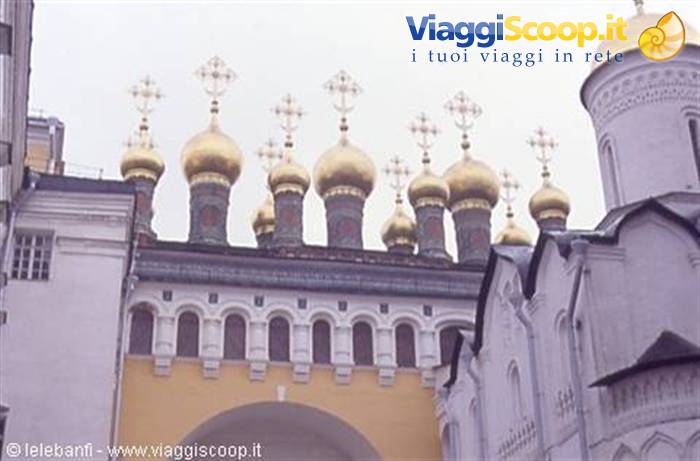
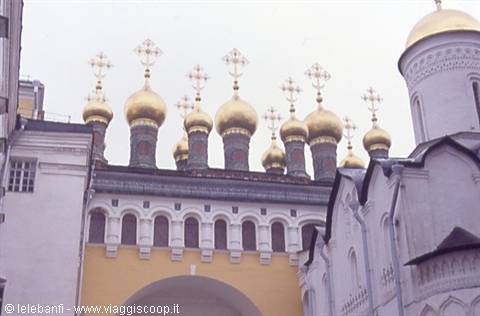
The golden domes of the Terem Churches in the Moscow Kremlin
Day 926 Aug 2003
Moscow
We set off at 8:50 toward the Kremlin, we are immediately stuck in traffic, it is raining, we proceed slowly, you see people on the street without an umbrella, will they be hoping for good weather or do they not have an umbrella?? Traveling slowly you can observe the habits of Muscovites, the physiognomy is different from Ukrainians, the features are more marked, the faces less handsome, as people age they tend to get sturdier, will it be the effect of beer and food?? Finally we arrive at the Kremlin (TCI p. 65), under the rain we queue up to pass the checks by the KGB agents. We enter, the impression is of being in a vast territory protected by the outer walls, we do a quick tour, there are queues at every building and at every photographically interesting point. Imposing are the Tsar Cannon and the bell of Elizabeth I, the largest in the world and both unusable.
We visit the Church of the Annunciation (TCI p. 71) there are golden frescoes of the life of the Madonna, the iconostasis is carved and gilded, the sensation is that of being in a golden room, breathtaking. Once access was reserved only for nobles, exquisitely finished is the wooden throne reserved for the regent of Moscow. We go out and under the rain we head toward the Church of the Annunciation, the church is preceded by a portico entirely frescoed, the portals are blue with floral decorations in copper and gold. We continue the tour with the Church of St. Michael (TCI p. 74), the frescoes are less heavy than the previous ones, the iconostasis is more recent with a red and gilded background. We continue the tour seeing the treasure of Russia (TCI p. 75), a true masterpiece of high goldsmithing, breathtaking, infinite and unique emotion, the value of the jewels is inestimable.
Certainly not inferior in artistic beauty is the treasure of the tsars (TCI p. 74), an inestimable collection of clothes, carriages, thrones, crowns, scepters, finely chiseled weapons, furnishings, sacred vestments and regalia of Imperial Russia. Having gone out it has stopped raining, you see the blue sky, we stop for lunch on a boat moored on the Moskva River, from the boat you see the city and a factory on the riverbank. In the afternoon, having some free time, I decide to join those who will visit the Pushkin Museum (TCI p. 121), stunning is the Egyptian room, the Scythian one with cuneiform writing and seals, the Italian paintings from the Renaissance, the paintings by the Impressionists, it is the first time that I admire them in their beauty with tranquility and I am happy to have taken advantage of this opportunity.
Superb is the Treasure of Priam, for this alone it was worth coming to Moscow. The return to the hotel is practically a long 6-lane queue, we cover the 17 km in 2 hours, if we had gone on foot we would have taken less time, we certainly cannot complain about Milan's traffic.
.... to be continued....
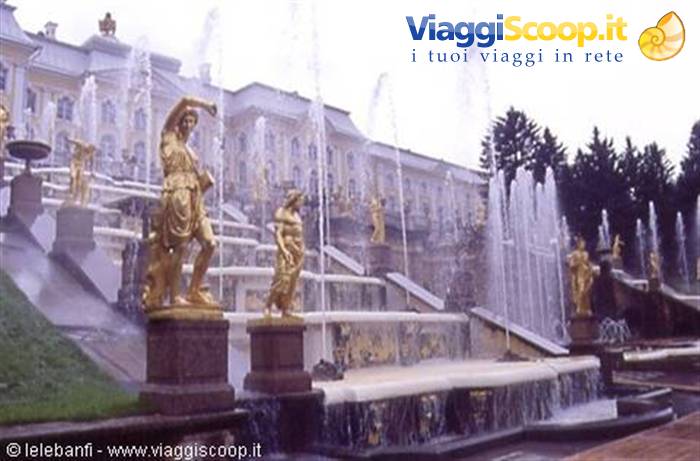
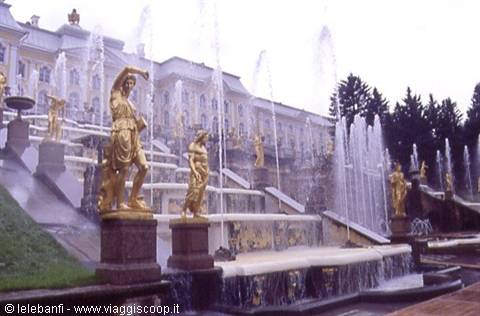
The Grand Cascade at Peterhof with gilded statues and fountains before the palace
Day 1027 Aug 2003
Moscow
Before leaving the hotel I take one last stroll around the neighborhood, the weather is gloomy, I look up above the buildings and see some wires that catch my attention, they are telephone wires, unlike us, the poles are not placed on the street but on the roofs of the buildings, a strange habit, I think it is linked to the harshness of the winters and the abundant snowfall. We leave the hotel and take the ring road (total length 109 km) heading to Kolomenskoye (TCI p.
125), we enter the park and a thick rain greets us, we head toward the Church of Our Lady of Kazan but a religious service is in progress, so entry is forbidden, we continue toward some wooden houses, we visit Peter the Great's, built in wood without the use of nails, between the logs hemp was placed to prevent the passage of air, inside there is 18th-century furniture, beautiful are the majolica stoves, the canopy bed and its little table. They have reconstructed a study of the time, a bookcase, and a dining room. We continue the visit to the local museum where wooden and ceramic models of the royal wooden building inhabited in the early 1800s when the capital was St. Petersburg are kept. There are windows with mica panes, tools, locks, clothing, icons and decorations carved in wood.
Having left the museum, we visit the Church of Our Lady of Kazan, it contains icons of the Madonna, they are much venerated and are considered protectors of the family, outside the church women ask for charity. Inside the church a religious service is in progress, it is a chant, the acoustics are excellent, the chant heart-wrenching, it is a funeral. We return toward the city for lunch, I notice that despite the rain the Russians continue undeterred to work, they must make the most of the few summer months, in a few weeks the cold will make itself felt and outdoor work will be suspended. We stop in front of St.
Basil's Church, I take the opportunity for a visit to the Hotel Russia which with its 3,000 rooms is the largest hotel in the world, inside I meet the members of the Frecce Tricolori, I stop to talk with them, then under the rain I go to see the first house of the tsars in Moscow, a modest building located near the Kremlin. By bus, having set off again, we pass near the Duma, the national parliament, we arrive at the station square, there are three stations, one with departures for southern Russia, the other for Siberia, where the famous Trans-Siberian train departs, and the last station ours with direction St. Petersburg.
As we approach our carriage I can observe in a nearby train the sleeping cars of the Soviet trains, a board covered with a small padded thickness on which a mattress and blankets are placed, a decadent appearance, some compartments are occupied by people sleeping, who knows where the train is headed? From the platform to get on the train you have to be very careful, the distance requires a good step and the void below is remarkable, over 1.5 mt, if someone should slip I think they could seriously hurt themselves, strange customs the Russian railways.... We say goodbye to Alina, our Moscow guide, and at 4:30 pm we set off, with absolute punctuality it seems to be in Switzerland. While traveling I look at the distance separating Moscow from St. Petersburg, 730 km, the train should arrive at 9:53 pm, we'll see.
The carriage we travel in is a single compartment, 64 seats, carpet on the floor. The train travels fast, crosses northward the enormous Russian territory, the countryside is truly boundless, as are the birch and conifer woods, you see some villages of izbas, toward St. Petersburg gentle hills begin, the ground is sometimes marshy, the rivers are many like the small lakes we see. In the villages I see from the train, the paved roads are only the main ones, the side and inner ones are dirt roads that with the rain turn into mud, the sunset appears endless, finally some blue sky after gloomy days. We arrive in St.
Petersburg on time, 730 km and not even a minute late, I am speechless, so much for our railways!!!! We find the guide who will accompany us around the city, Nikita, a man, who studied medicine in Milan at the Statale, leads us to the hotel, located on a street 13 km long, the hotel is grand, immense, I read in the guide that it has 1,000 rooms, it is crowded and seems to offer many services, I almost almost miss the "intimacy" of the Kiev hotel where practically we were the only ones staying. The European culture of St. Petersburg was visible as soon as we set foot outside the station, the lights, the people, the clothes are different from the cold, gray and backward Moscow. As if to say, we got on the train in one dimension and get off the same in another. More than a train journey it seems a journey through time and space.
We will see if this evening impression tomorrow will find confirmation.
.... to be continued....
The Grand Cascade at Peterhof with gilded statues and fountains before the palace
Day 1128 Aug 2003
Moscow
The evening impression that St. Petersburg is a cosmopolitan city different from Moscow is amply confirmed by the breakfast presented at the hotel, an infinity of food, rich and assorted, breakfast takes place in a room that in the evening seems intended for shows and is a kind of beer factory. The day presents itself rainy, looking at the schedule I think a nice soaking awaits me!!! During the trip, Nikita informs us about life in St. Petersburg, different from Moscow and not only for the weather and light, in winter only 5 hours of light a day, while in summer it reaches 21 hours of light, we are above the 60th parallel and the height can be seen in the evening with the sunset arriving around 10:00 pm. In St. Petersburg the average salary is €130/month, the pension €50, which is why in museums the guards are all retirees, to supplement their pension. We arrive at Peterhof (TCI p.
268), along the road we have a view of the Italian gardens and the back of the Palace (called the Versailles of the north). We arrive at the entrance, we queue up under the rain, here museums open at 10:30, it is 10:00, I take the opportunity to take some photos, you never know with this extremely variable weather..... People start entering, some groups pass us, the guide tells us that it is enough to give the person in charge a tip (€50) to enter earlier, bribes are universal I think. The person in charge is a middle-aged person with a not very happy expression.... After 1:30 hours of queueing under a nice drizzle we manage to enter, in the Grand Palace, we stop to leave the wet raincoats and umbrellas in the cloakroom, then we put on the overshoes so as not to ruin the parquet floor that characterizes the palace.
You enter the interior from the Gala staircase, completely frescoed with golden stuccoes and parquet floor, it is Russian Baroque, the style characterizes the whole palace and makes it decidedly fascinating, more than our palaces that have marble floors. We go through immense and decorated halls, a true splendor of beauty, curious is the audience hall, small compared to the others and to increase its perspective mirrors have been placed on the walls that reflect up to seven times, a nice optical effect, the Italian imagination of the architect Rastrelli is noticeable. In the dining room the English service for 30 people is composed of 196 pieces of very precious porcelain and crystal. Stunning are the chandeliers in Bohemian crystal and amethyst.
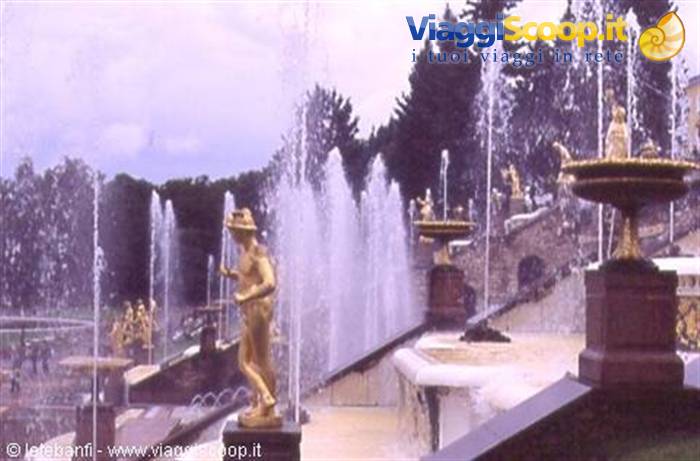
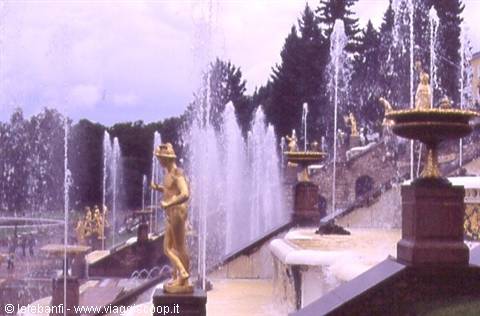
Immediately different in style appears the room of paintings, where on the walls they are hung uniformly creating continuity without interruption: a full 368 paintings. When at the end of the tour you arrive at the oak study that belonged to Peter the Great, the atmosphere, the warmth, the energy present brings the mind back to Urbino to the studiolo of Duke Federico da Montefeltro. Having left the palace we take a tour of the gardens to admire the countless fountains present, near the Monplaisir building (Peter the Great's summer residence), we can take a look at the Gulf of Finland, a wide view without boundaries over the sea, I understand why Peter the Great wanted his summer residence in this magnificent position, a lover of navigation and the sea like him could not have chosen a better view.
Near the building there is a fountain that at the passage of people suddenly and in an articulate way gushes, pranks were in fashion in the 18th century.. We have lunch in the wing of the palace in the part built by Rastrelli that connects the Grand Palace with the pavilion of the Imperial Eagle. We set off again toward St. Petersburg, during the trip I can better observe the marshy area, not entirely reclaimed, we pass alongside lakes covered with reeds or water lilies, we see a palace of the tsars, today restored and summer residence of the President of Russia, we pass in front of an immense naval military school, today abandoned for lack of funds. Nikita illustrates other curiosities of Russia, food shops are open 24 hours, the outskirts of St.
Petersburg are formed by dormitory neighborhoods with buildings of at least 9 floors, in the city the maximum height is 5 floors (excluding the KGB building), in apartments cohabitation of families with shared bathroom and kitchen is widespread. In recent years prices have been subject to an inflation of 6200%. Currently the prices of homes and goods considered luxury (cars, motorcycles, imported clothes....) are expressed in American dollars. While Nikita illustrates these aspects of life we approach the city center, we stop, there is a queue, the traffic seems crazy, the three lanes of travel per direction become six one-way lanes, cars in the opposite direction to ours drive on the sidewalk, someone tries a U-turn further blocking traffic, it is the entropy of traffic!!!! It is fun to observe it all from the bus.
A tram is stopped, blocked too, people get off, head toward the metro, it is incredible to observe the calm and resignation of these people, as if anything could happen, as if problems were a normal thing. Someone takes advantage of the block to fix the car and improvises as a mechanic in the middle of the street, a custom very widespread in St. Petersburg. In the end we discover that this chaos is caused by a jam at an intersection... We manage to resume driving, we pass near the port, we travel through St. Petersburg along its canals up to St. Isaac's Square and St. Isaac's Cathedral (TCI p. 192), on the square there is the equestrian monument dedicated to Tsar Nicholas I, we continue the tour to return to the hotel, the feeling is that St.
Petersburg is an ideal mix between Venice and its canals and Vienna with its 18th and 19th-century buildings, a nice mix of culture, art, tradition, history. In the evening at the hotel I stop to continue the diary while someone has gone out to see the city in the evening. Tomorrow the schedule includes the visit to the Hermitage, it is better that I read something about the palace and the museum, I don't want to be unprepared for such an important appointment.
.... to be continued....
Golden statues and fountains in the gardens of Peterhof
Day 1229 Aug 2003
Saint Petersburg - part one
Punctually at 9:00 we set off for the city center, we arrive in a short time, always accounting for the immense traffic, near the Hermitage building (TCI p. 249), the entrance is located along the river at the Winter Palace. We are among the first to enter, we start the visit with the imposing Staircase of the Ambassadors, in Russian Baroque style, the stairs are in Carrara marble, the monolithic pillars of gray marble, the frescoed ceiling. We enter the halls of the tsars, you see some porcelain and the wooden coronation carriage, it is in gilded wood and colored red (the imperial colors). We continue into the Small Hermitage (TCI p. 255) with the small throne room, semicircular apse niche for the throne, parquet, golden stuccoes and tapestries. The Hall of Arms called so for the heraldic coats of arms placed on the chandeliers, it is an immense hall of 800 sqm.
With golden columns and rock crystal chandeliers. Another hall contains artifacts that are masterpieces, among all stands out a wooden table inlaid with mother-of-pearl, tortoiseshell and gold. We continue into a hall with 332 paintings by the same painter, they represent the high officers who fought in the 1812 war against Napoleon, there are empty frames with only the name written, they are the officers who died in battle. We continue with St. George's Hall, an ancient throne room in Russian Baroque style, the fresco present on the ceiling is faithfully reproduced in the parquet, the columns are in Carrara marble. Another hall where there are enormous vases in lapis lazuli and malachite. We arrive at the Pavilion Hall, inhabited by Catherine II (TCI p.
257) in Russian Baroque style, there are tables worked in very fine mosaic, in addition to the stunning Peacock Clock, from a door you leave the Small Hermitage and enter the Large Hermitage where the Painting Gallery of the Museum begins, the first part is dedicated to Italian art (TCI p. 257), you see a copy of Raphael's loggia, of stupefying beauty are the paintings by Leonardo da Vinci, by Caravaggio and the sculpture by Michelangelo. In the Russian art part we see masterpieces of furnishings, a lapis lazuli table whose top in a single block measures 2.5 mt x 80 cm x 4 cm, supported by inlaid and gilded wood, a true spectacle to observe it. Tables and vases in malachite, some vases have a height of 2 mt and 1 in diameter.
We then continue with Spanish painting, the Dutch one where we find the paintings by Rembrandt, including the painting "The Prodigal Son" which was taken as a symbol for the Jubilee year 2000. We continue with the French part of the Impressionists, we end with the paintings by Picasso from his Red period and of futurism. We continue the tour of the palace visiting the apartments of the tsars, the golden room in Russian Baroque style, the crimson and green lesene rooms (transparent glass pillars with red-colored tinfoil underneath) always in Russian Baroque but with golden tapestries on the walls, the salon is also in Russian Baroque, the bedroom with blue curtains and marble pillars that divide it into three parts, we see a gilded wooden sleigh, a corridor of tapestries.
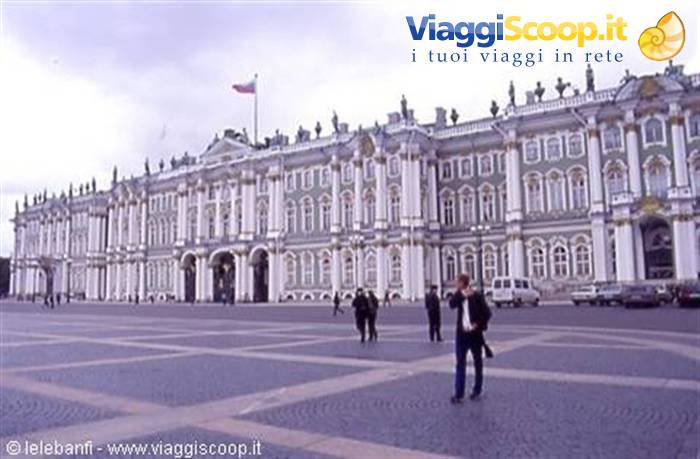
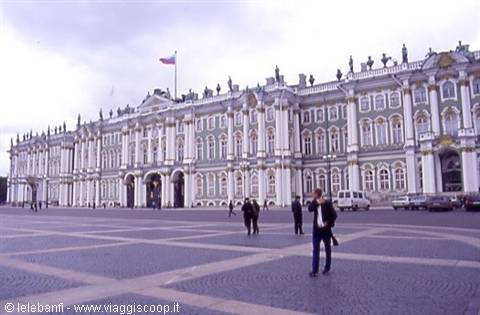
Before leaving we visit the malachite room (2 tons of mineral are present), the pillars, the fireplace cladding, vases, furnishings, all strictly of malachite. We leave the museum palace, the impression is of bewilderment from how much beauty we have seen, truly a concentration of works of art, the most beautiful museum I have seen so far. We must acknowledge the foresight of Catherine II who started the great collection that then continued over the decades. We leave the Winter Palace (one of the five palaces that form the Hermitage complex) and walk along the left perimeter until we reach Palace Square, Carlo Rossi's building (TCI p. 190), the square is vast, one of the largest in the world, historical memory of so many events of which many extremely tragic ones that marked the history of Russia, we cross it and going into canals that bring back Venice to mind, we reach the restaurant.
Located on the mezzanine floor it is an 18th-century hall. The ceiling painted in oil, on the walls inlaid wood panels, the windows are in mosaic, the fireplace is in carved marble and the sides are decorated with rectangular ceramic tiles depicting figures, the tiles are interspersed vertically by squares also in ceramic with a floral motif, the hood is adorned with a finely inlaid wooden covering, in the room there are carved marble pillars with floral motifs. Lunch reflects the Russian tradition, salad, soup, main course, dessert. At the end of lunch we set off for Pushkin, the drive soon stops, a car broken down in the middle of the road does not allow us to advance, after a few minutes the car is moved by hand and we can resume driving observing the driver of the car who as is the custom in St.
Petersburg, equipped with a rag opens the hood and tries to fix the engine, most people understand nothing about mechanics, but here the custom is this. Along the way we stop to see from the outside the Church of the Savior on Spilled Blood, Church of the Resurrection (TCI p. 214), it has a larger surface of mosaics than that of St. Mark's in Venice. We resume the journey and Nikita has the opportunity, at our urging, to speak about hospital treatments in Russia. Nikita is a pulmonologist, he did the sixth year of medicine in Italy (Milan, Statale university), he works as a guide and is the coordinator of a modern art center.
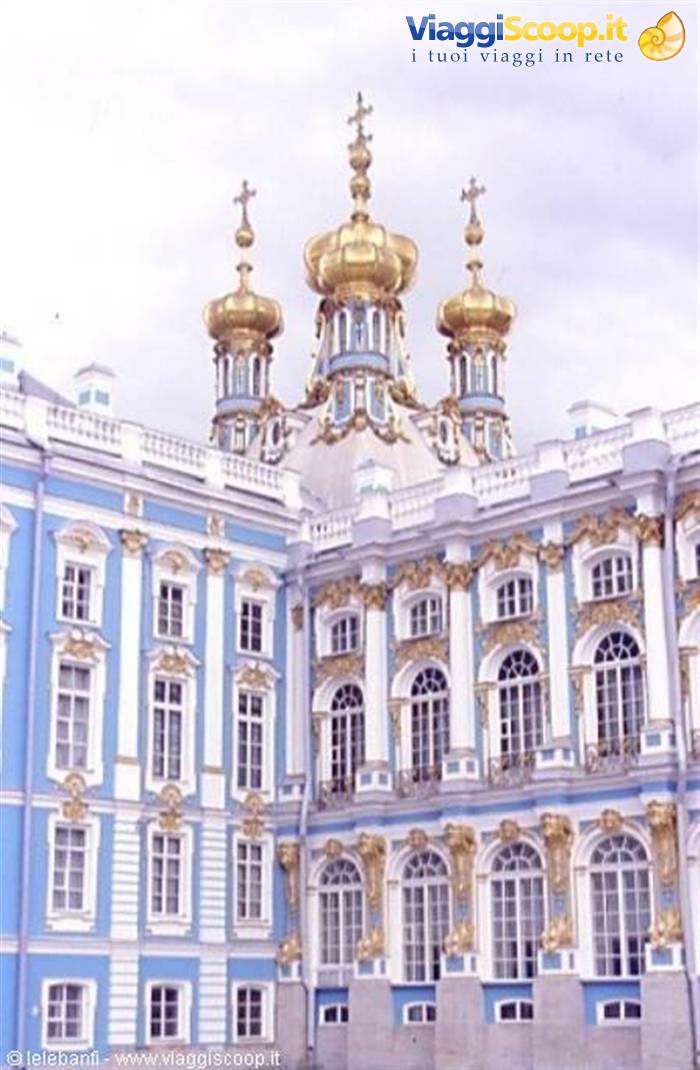
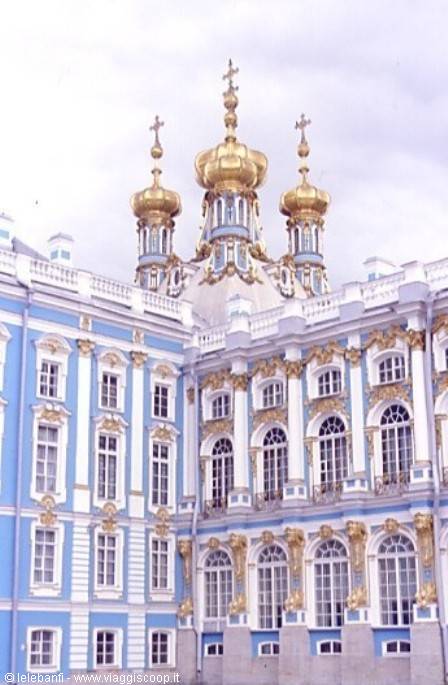
He tells us about hospital treatment, where patients must bring from home medicines, cutlery, pillows, bandages, syringes and food, or everything they need for their treatment, assistance is limited only to the administration of care and some visits, nothing that concerns the person, I get the shivers just thinking about getting sick in this country..... We reach Pushkin (TCI p. 276), it is a village located about 30 km from St. Petersburg, the palace is imposing, in size it recalls the building of the Villa Reale of Monza, the style is Russian Baroque but it is the color that fascinates, light blue and white with the golden domes of the church, a breathtaking spectacle, and it is!!! Light blue, white, gold a tricolor that fascinates.
The palace was redone after the destruction of World War II, the restoration in some rooms is still in progress but what is visitable is truly of stupefying beauty. The Great Hall has on the ceiling a painting on canvas of 860 sqm, in Russian Baroque style it is illuminated by many mirrors that amplify its size. Leaving the Great Hall you have the enchanting vision of the Golden Enfilade, a series of apartments connected to each other by doors that left open give the impression of a single, very long and isolated corridor all in Russian Baroque style where the golden stuccoes stand out from the white of the wall and ceiling. The Amber Room, small at only 52 sqm, has walls completely covered in worked amber that infuse infinite shades, for its restoration 57 quintals of mineral were used.
The crimson and green lesene rooms stand out compared to the previous ones, both for the originality of Rastrelli and for the white damask that is placed on the walls at intervals of the lesenes. Having left the palace we visit the gardens, other magnificent palaces are under restoration, the small lakes are many and make the residence of the tsars a truly enchanting place. Having finished the visit to Pushkin we return to St. Petersburg, the outbound traffic is heavy, long columns of cars carry the inhabitants of the city to their dachas, the custom is that on Saturdays and Sundays Russians cultivate their vegetable gardens at their second homes.
.... to be continued....
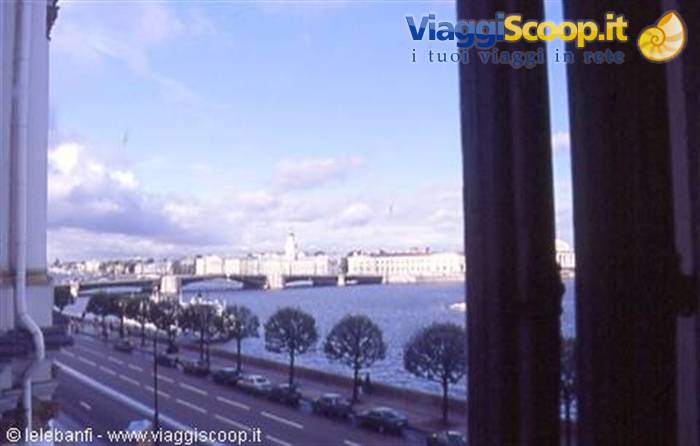
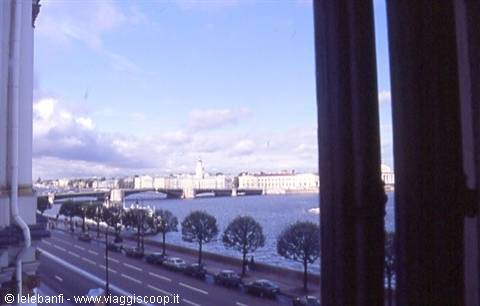
Neva River with bridge and cars seen from a window in Saint Petersburg
Day 1329 Aug 2003
Saint Petersburg - part two
We return to the hotel, time to change and an evening at a characteristic restaurant awaits us. We set off by bus toward the center, along the way I notice men and women who while walking calmly sip beer from the bottles they hold in their hands, we encounter a few minor collisions, most are resolved with an argument, sometimes it turns into a fight. The sun is heading toward sunset, it colors canals and buildings with pastel colors, evocative is the
Neva River with bridge and cars seen from a window in Saint Petersburg
Day 1430 Aug 2003
Saint Petersburg - part one
Final day of the tour, I'm sorry that we have to pack our suitcases, traveling around Russia is fascinating and it would take much more time to see what remains, this is just a small taste of the beauties to see, perhaps an entire lifetime is not enough to properly study this magnificent city, even if it is only 300 years old, with its history, its palaces and its museums. We load the suitcases onto the coach and begin this panoramic tour of the city, we head toward the center, the first stop we make is at the church of Smolny (TCI p.
223), it is an imposing complex in full restoration phase, it is impossible to access it, the church is in restoration phase, but one has the possibility of observing the buildings before and after restoration, in fact a little in front but still part of the complex there are two buildings and the building on the right can be seen restored, the one on our left lies in a state of decay, after all how the buildings were before restoration and how many buildings still are in the internal streets of the city, although in fairness it must be said that the Russians have managed to recover and restore very many important buildings belonging to the city. Both those left to decay by political mismanagement, and those semi-destroyed or destroyed during the Second World War, a fine example of national historical memory to be preserved for posterity. We continue and see the Summer Garden (TCI p.
196), commissioned by Peter the Great with 59 Italian statues from the 18th century. Further on we find the brick house built to protect Peter the Great's wooden house (TCI p. 235) dating back to the early 18th century when the emperor personally followed the construction of the first building of Saint Petersburg, the Fortress of Saints Peter and Paul. A short distance away we find the cruiser Aurora (TCI p. 236) moored. We head toward the church of the Annunciation, crossing the industrial zone of Saint Petersburg, the state is one of semi-abandonment, next to some still functioning factories there are many abandoned and semi-collapsed buildings. We arrive at the church of the Annunciation (TCI p. 232), with an important city cemetery attached. We travel along Ulica Rossi (Carlo Rossi Street) (TCI p.
203) one of the streets with classical-style palaces, one of the most beautiful in the city. We stop at the church of Saint Nicholas (TCI p. 216), Rastrelli's originality is noticeable, the interior and the view from the adjacent canal are stunning. We travel along the Neva, the river of Saint Petersburg, until we reach the ancient port (TCI p. 227) where two rostral columns rise that were ancient lighthouses for river navigation. We arrive at Hare Island, where the Fortress of Saints Peter and Paul (TCI p. 180) rises, we enter the imposing construction and visit the church of Saints Peter and Paul (TCI p. 181), it is completely frescoed, including the fake marble pillars, the tombs of all the tsars are present.
The presence of the pulpit is unusual, it is the second church in the whole tour where I see the pulpit (not even in the Catholic one that we will see later is it present), it is in gilded wood. There is the red and gold canopy from where the tsar followed the ceremony, the iconostasis in gilded wood is being restored, we look at the tombs of the tsars in white Carrara marble except the tombs of the two tsars killed in attacks whose color is green and red. We continue the visit of the fortress giving a look at the Neva, on the other bank you see the palaces that with their height of five floors give the city a truly fascinating urban appearance, above the palaces only the golden onion spires of the churches and the tall spire of the Admiralty emerge.
Having left Hare Island, right in front we find the military museum of artillery where, in the courtyard, a sample of the pieces used in the Second World War is visible. We continue the tour until the Square of the Museums (TCI p. 251), called so because of the presence of several museums, in the center of the beautiful square, placed in a small garden, there is the statue of Pushkin. We continue and see the accordion building with the bronze statue of Catherine II in front (TCI p. 202). During the tour it has been possible to see many houses in restoration phase, the city in a few years will truly have a very beautiful appearance. We see one of the ancient remaining drawbridges. Touring the city you see how all the main streets are radial with the Admiralty Palace and its visible golden spire as the epicenter.
We accompany part of the group to the airport that returns with a flight before ours, we say goodbye to them and since we have 5 hours of time, with the help and advice of Nikita we take the opportunity to visit, in the center of Saint Petersburg, the Yusupov Palace (TCI p. 210). The palace belonged to the richest family of pre-revolutionary Russia, it presents itself with a classical facade overlooking a canal, looking at it like this I don't see this great beauty compared to villas and other noble palaces of the city. We begin the visit from the mezzanine floor, we enter a semicircular mirrored antechamber, the effect is evocative, from here through a short corridor you access the room where the conspiracy for the killing of Rasputin was plotted (TCI p. 210).
Entering this room I perceive a sensation of negativity, the room is gloomy, dark, muffled, the air is heavy as if a strong negativity hovered over it, few times have I perceived such an unpleasant sensation of negative energy concentrated in a single point. Going down the stairs, exactly below the conspirators' room is the room where the murder took place. On the walls are hung photos and writings of Rasputin, personal advisor to the tsarina and to Tsar Nicholas II, loved by the rulers and hated by the nobles. In the two rooms, furnished with original furnishings, the scene of the conspiracy and of the poisoning of Rasputin has been reconstructed, wax statues are placed depicting the conspirators and Rasputin, very faithful in the reconstruction and in the details, even the poisoned sweets have been meticulously reconstructed.
We return to the entrance and visit the dwelling of these nobles of Mongolian origin, the mezzanine floor, we begin with the piano room, it is decorated with golden stucco from the late 18th and early 19th century. French room, with the marble fireplace, doors and furnishings in pear wood (a wood extremely difficult to work), the table is in wood with cabinetmaking workmanship, the fronts are worked in relief. Library, frescoed ceiling, walls in finely carved wood panels, the room contained 40,000 volumes, most were lost during the revolution. Ceremony room, where guests were received, the windows are in mosaic in Russian style, there is a semi-dome niche where the acoustics are truly excellent.
Moorish room, the fireplace is in onyx, the coffered wooden ceiling is inlaid, colored like a mosaic with gold decorations, on the walls inlaid wood panels, colored with Arabic inscriptions, the marble pillars, the windows in gilded wood, the floor in mosaic marble, the doors are in oriental shape. We continue and enter the apartment of these nobles, the division is not random as if to signify that that was a reserved area where guests could not access, this family had built an empire within the empire, they had 53,000 servants, 8 estates scattered throughout Russia and were always supporters of the reigning tsar, whoever he was, as if to say, the practical application of Machiavelli's The Prince.
The private apartments are not in their original form, they were partially readapted after the looting of the revolution, the bedroom was in wood, on the upper floor there was the wife's bedroom accessible via an internal wooden staircase whose supports were in crystal, the windows in French mosaic.
.... to be continued....
Tourists walk in front of the Winter Palace on Palace Square
Day 1530 Aug 2003
Saint Petersburg - part two
Dining room, with walls in painted leather, inlaid wooden ceiling from the 18th century, fireplace in yellow Siena marble, the furniture is from the late 19th century. We return to the atrium and go up the staircase that leads to the upper floor, the beauty is amplified by the presence of mirrors that widen the perspective, the staircase is made of white Carrara marble, the chandelier in rock crystal, the ceiling with stupendous stuccoes, the columns also in stucco with capitals decorated with floral motifs. The visit of the second floor of this stupendous dwelling begins with the green room, the fireplace is in malachite, the furniture in birch wood, the decorated and gilded ceiling, the chandelier in gilded bronze.
Red room, the chandelier in gilded bronze, the parquet made with 8 types of fine wood, walls in red silk, the ceiling is flat but the painting gives it a vaulted perspective, it is frescoed and gilded. Blue room, the barrel vault is frescoed, the cobalt chandelier, the walls are covered in blue silk, 19th-century mirrors. Round room, the room is square but takes its name from the dome that is in the ceiling, the decorations are from the 19th century. Ballroom, rock crystal chandelier, decorated ceiling, white columns with gilded capitals, the orchestra's place is carved into the dividing wall with the next room, placed high up it is hidden by a grille.
Apollo room, adjacent to the previous one, if necessary by opening the three doors, the two rooms became a single ballroom, there are 24 marble columns, the ceiling is barrel-vaulted and frescoed, the chandeliers are in papier-mâché, a fashion of the 19th century. Dining room, it is adjacent to the entrance staircase, all in finely carved oak wood, coffered wooden ceiling, wooden columns, wooden panels with gray silk on the walls, Italian table in the center of the room. Dining room (there are many dining rooms and the family's custom was to always dine in different rooms), ceiling and columns in plaster with capitals with floral motifs, parquet.
Corridor, decorated barrel vault, red walls, leads to a wing of the palace dedicated to art, the first room encountered was the private picture gallery (today the precious works contained are exhibited at the Hermitage), a few paintings hanging on the walls but at the time it must have truly been an exclusive, refined and precious gallery (a survivor of the family who fled to Paris during the revolution survived by selling two Rembrandt paintings). Round room where the owners collected sculptures. Roman room is the antechamber of the private theater with 150 seats, original 19th-century furnishings, all in inlaid and gilded wood, the stage and the dimensions of the theater reflect the ideal volume for perfect acoustics. The theater is still today a place where concerts are given.
I exit the palace dazed by so much beauty, it's strange, seeing the location of the palace placed on a small street on the bank of a canal it gives the impression of an ordinary palace, only by entering and wandering through the rooms can you admire the splendor, the opulence, the wealth and the refinement of this family, as if it were the manifestation of absolute wealth between the power of the tsars and that of the church, but a wealth not visible to all, a wealth not ostentatious like so many other palaces, that discretion and that preciousness reserved only for those who lived in the palace and visible only to the guests who were invited, in fact the differentiation of the structure of the floors suggests this. On the ground floor some rooms sparsely furnished on one side, on the other others more furnished, on the upper floor the greatest splendor where only a few could access.
We continue the tour visiting the church of Our Lady of Kazan (TCI p. 201), then the Catholic church of Saint Catherine, a short distance away is the church of the Resurrection (TCI p. 214) seen quickly the day before, we take the opportunity to see it again, next to the church an imposing Art Nouveau railing delimits a park. It starts to rain, perhaps the weather wants to greet us this way, no matter, I take the photos anyway. To head to the airport we pass in front of the church of the Madonna of Vladimir (TCI p.
221), current seat of the Patriarch of the city (in the Orthodox tradition each Patriarch can choose the church as a religious reference point), continuing the route we see the Armenian church, half-hidden as if the Armenian people (largest concentration in southern Russia) wanted to hide their religion, it is a white and blue construction, illuminated inside, perhaps this fringe of the Catholic religion, a minority in Saint Petersburg, will be able to find its space after so many persecutions. We head toward the airport which we reach after crossing the city for the umpteenth time, we pass in front of the Victory monument, the square south of the city where we had the hotel, a quick glance at the imposing monument (TCI p.
239) and we quickly reach the airport, after a queue the boarding gates open, we say goodbye to Nikita our guide, who thoughtfully in Soviet style, made sure that we were boarding for Frankfurt. The return to Italy was calm, some turbulence during the flight did not allow me to write the diary, but nothing worrying. Arriving home is always pleasant. One's own home is always a warm and welcoming place. The time has come to make some considerations about the trip, but where to start?? I begin with the hotels, the President Hotel in Kiev is a beautiful hotel, very luxurious built in the times of the Soviet regime, the service discreet, comfortable rooms, located near the center it allowed you to stroll around the city.
The Katerina Iris Hotel in Moscow is located outside the city center, but relatively close to the imposing metro network, if you want to move around (aside from the widespread petty crime) it is fairly easy, although tourists were advised to go out in groups and without money. The Pulkoskoya Hotel in Saint Petersburg is a commercial and tourist hotel, although it is listed as 4 stars it is an average three stars, the service discreet. We continue the analysis speaking of the food, in the whole area the imagination in cooking is scarce, little gastronomic tradition, people eat salads (cucumber is omnipresent). Many soups (the ones in Kiev are very good), the main courses are meat or fish accompanied by vegetables or pasta or rice, desserts are always present, the ice creams are very good and creamy. The cities.
Kiev and Ukraine appear different from the other cities seen, it maintains its own autonomy, geographically it is closer to Europe and this influence is noticeable, it is a historically cosmopolitan city and maintains this attention, the strength of the rebirth appears remarkable. Moscow, is a gloomy city, dark, sad, people don't smile, dress badly, even those who have a lot of money available and buy designer clothes dress badly, poverty is rampant, alcoholism is noticeable. Saint Petersburg, a large city with a European soul, a mix between Venice and Vienna, only the main palaces have been restored, wandering inside you notice the state of abandonment in which the city finds itself.
The plague of poverty and alcoholism is fully visible in the evening and at certain hours of the day, a Russian society that suffers from the void left by communism and socialism, will have much to work on to reach our living standards.
.... to be continued....
Catherine Palace at Tsarskoye Selo, blue facade with gilded domes under gray sky
Day 1630 Aug 2003
Saint Petersburg - part three
Cars, you could see many Mercedes on the road, the Limousines, are used by brides, but most of the population uses Ladas, the Russian Fiat, you see 124s and 125s driving around, which have other names there, the models don't have a name but have numbers, to date they have reached model 9. On average a car changes owner every 50,000 km. There are cars on the road that are more than 20 years old, since the car is a luxury people try to keep it as long as possible, as long as it runs it's fine. The external condition doesn't matter, what matters is that it runs. When it stops, sometimes it is abandoned along the road without a license plate. Few recent models of European brands are present. The rich show off expensive Japanese and American SUVs. In the countryside it is impossible to move without an SUV since the roads in the villages are not paved. The restorations.
The states visited have invested a lot in the restoration of the works of art that had been destroyed both during the war and during the period of Soviet domination. Great skill of the Russian and Ukrainian craftsmen in bringing everything back to its ancient splendor. The publications. Although they are cities very frequented by tourists, finding medium/medium-high level publications in Italian turns out to be fairly difficult. Those in French, English and German are very widespread. The best are printed in French and are available inside museums or in specialized bookstores (almost always adjacent to museums or Monasteries). The tour was a great opportunity not only from the cultural and artistic point of view, it was the possibility of seeing Ukrainian and Russian society in full rebirth or perhaps in full cultural and artistic redemption, with Europe so far and so close.
It will be up to us Europeans to be able to bring this nation so ancient, so great closer, and not create further divisions that in the last century characterized history. Now all that remains is to transcribe this travel diary, and integrate it with the books I bought on site that will keep this stupendous trip alive.....
Catherine Palace at Tsarskoye Selo, blue facade with gilded domes under gray sky



1 reader comments
Ottimo viaggio, bella e completa descrizione