The story
Friday 8: Sintra – Cabo da Roca - Oriente From Rossio station we take the train to Sintra (about 30 minutes); the heavy rain prevents us from visiting the town, we take the local bus to go to the Palacio Nacional; between rain and fog we manage to see the characteristic tall conical chimneys, we visit the various rooms, all of them, decorated and richly furnished, with ancient azulejos on the walls, some even from Spain, which allow you to see their evolution over time; indeed, some are from the 14th century, others from later centuries; some rooms are even visited with your nose in the air to see the richly decorated coffered ceilings, in particular the Swan Room and the Magpie Room. By bus we continue the tour of the other sites; we notice the Palacio da Pena, which we see only from the outside.
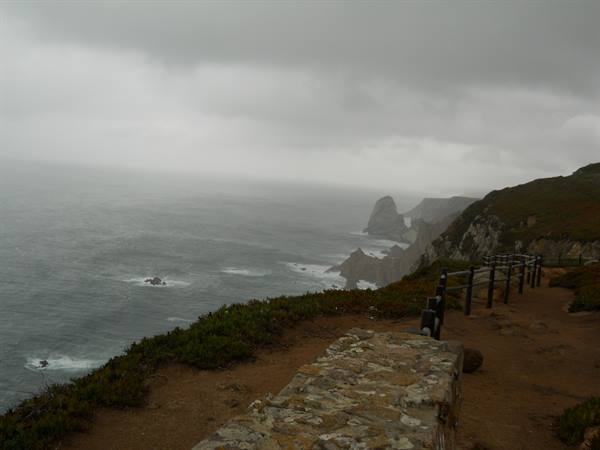
We return to the station and take the bus to Cabo da Roca, the westernmost point of the European continent. We arrive when it is not raining, there is almost no one, the panorama is magnificent, cinematic, tall and violent waves crash against the cliff of the Cape, 150 metres of rock sheer above the sea, wrapped in a light fog, it makes quite an impression; there are also a lighthouse and a small tourist office with a comfortable lounge for guests inside; we walk along the edge of the precipice protected by a low wall, then we approach the lighthouse, it starts pouring with rain, the wind keeps increasing, we can barely stand upright; at a certain point I thought it was hailing, but it is the water drops being driven violently onto our faces; we head back towards the low wall of the cape, which we see wrapped in fog and waves, we reach the tourist office, it has become almost dark, my gla
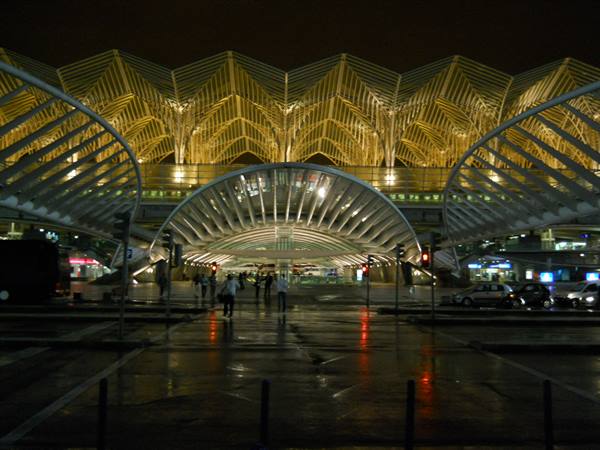
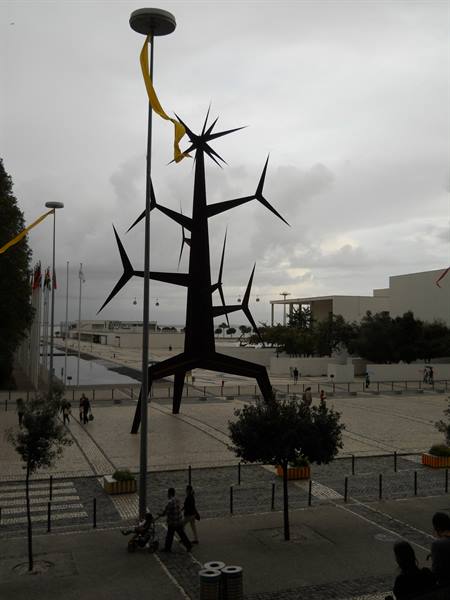
sses fly off, which will be picked up near the low wall by a tourist some tens of metres away. In the tourist office, a policeman explains to us that today's wind is 'average' and that it reaches its maximum in June. An interesting experience; I have been to other capes, and I can say that when in places like these there is sun and a calm sea you end up disappointed. We get on the coach to Cascais, then a train to Lisbon. I then go to visit the Estaçao Oriente; the station is considered a masterpiece by the famous architect Calatrava, in an ultramodern style with a structure of glass and concrete, the entrance looks like a sail, opposite it, in almost the same style, the Vasco da Gama shopping centre, then a brief visit to the Parque das Nações with its modern metal sculptures.
Saturday 9: Castelo de São Jorge, Graça Visit to the Castelo de São Jorge, located on the highest point of Lisbon; it is a citadel surrounded by several rings of walls, with very ancient origins precisely because of its dominant position over the city and the Tagus; over time it has been a fortress and a royal palace. Access is paid; as soon as you pass through the entrance you find yourself in a beautiful tree-lined square with open-air sculptures, from which you enjoy a magnificent panorama of the city and the Tagus, The castle, over time, has been the subject of many reconstruction works, even recent ones; very little of the original remains; we take a walk along the wall walkways, you see interesting panoramas; on the whole the visit is interesting, and I share the view of those who believe it must now be considered a great miradouro.
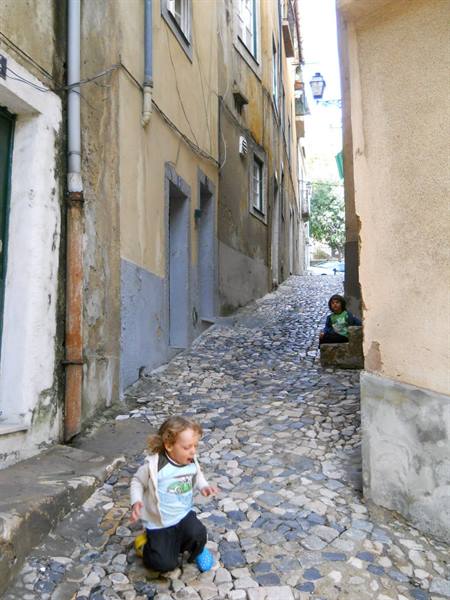
The narrow, picturesque streets outside the castle are very characteristic; walking we arrive in the Graça district and at the imposing church of São Vicente de Fora (closed); first, though, we take a look at the Feira da Ladra, an ordinary flea market; the church, of white marble, is visible from almost all the city's viewpoints; luckily the Mosteiro de São Vicente is open, known for the azulejos that can be seen in the sacristy and the cloister, which illustrate episodes of the reconquest and stories taken from La Fontaine's fables; we were not overly enthusiastic. We continue our wandering through Graça, visiting some churches built after the 1755 earthquake; they all have Baroque interiors.
In the afternoon from Cais do Sodré we take the regular ferry to the other bank of the Tagus; we make the crossing under the sun (about 15 minutes), we see the panorama with the famous bridges that span it; having arrived at our destination we head back almost immediately, since we find only a coach station and residential buildings. Sunday 10: Costa de Estoril It's a beautiful sunny day (we'll reach 26°); we take the chance to go to the sea to see the Costa de Estoril; we set off from Cais do Sodré at the modest price of €1.8 for two. We arrive in Cascais on a comfortable and clean train. Cascais is a holiday town; we walk around, not many people, shops almost all closed despite it being Sunday; we walk along the pedestrianised main street, and so we reach the beach.
Towards midday we go to Estoril; there is a fine seaside promenade, a pier, and along the promenade bars and restaurants, much livelier than Cascais. It's very hot; on the pier the waves force us to move away, while on the wide beach many are in swimsuits; Rita goes into the water; afterwards we go to lunch in a restaurant on the seafront, then beach. Then back to Lisbon, in the evening Monday 11: Fatima - see the account on the site
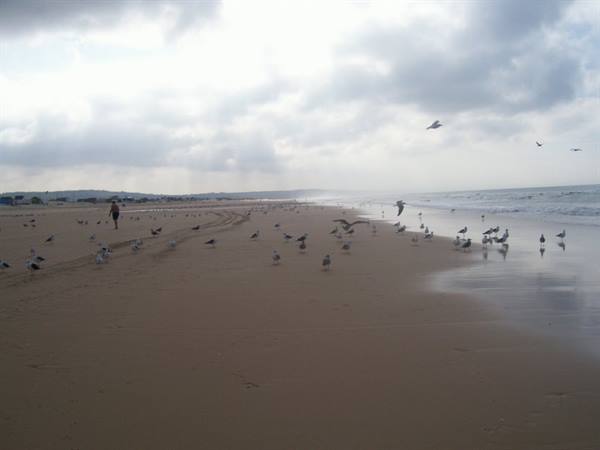
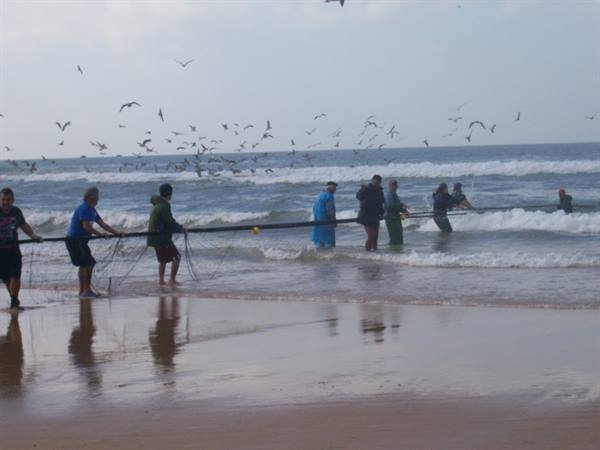
Tuesday 12: Queluz – Costa de Caparica Rita and I split up: I go to Queluz while Rita heads towards the Costa de Caparica. Costa de Caparica: from Praça de Espanha you take the 161; I arrive at Caparica, a charming holiday spot, with immense and very long beaches; you see groups of fishermen pulling in nets full of fish, a few surfers in the sea, low vegetation with yellow and blue flowers inland, a fine promenade with benches and wooden refreshment kiosks; the ocean is beautiful and immense. Queluz: I set off from Rossio station, then from Queluz I take a local bus to the famous Rococo-style palace; a pointless trip because the palace is closed, though I can see the beautiful pink outer façade. I return to Lisbon and, given the sunny day (26°), go back to Estoril where I rest on the beach.
Towards evening, with Rita, we wander around Bairro Alto and Chiado looking for azulejos to give as gifts; we visit some shops and stop to admire the magnificent sunset panorama of Lisbon and the Tagus, seen from the Miradouro de Santa Catarina, perhaps the most beautiful I have seen Wednesday 13: the trip is over; a light lunch in the famous Café Nicola, then a wander around to buy a few souvenirs. I also remember not to miss the themed azulejos in the metro
The journey's photographs
13 photographs · click to open them full screen



0 reader comments