The story
August 28: a visit to Pistoia (about an hour by train)
We immediately realise we picked the wrong day (Wednesday): there was the market, an ordinary neighbourhood market, fruit and vegetables included, filling most of the streets of the old town — not just with the stalls, but also with vans pressed against the walls, so the centre and its narrow streets lose all their charm. If you go to visit Pistoia, avoid Wednesday and Saturday; a local told us that attempts to move the market elsewhere have been in vain.
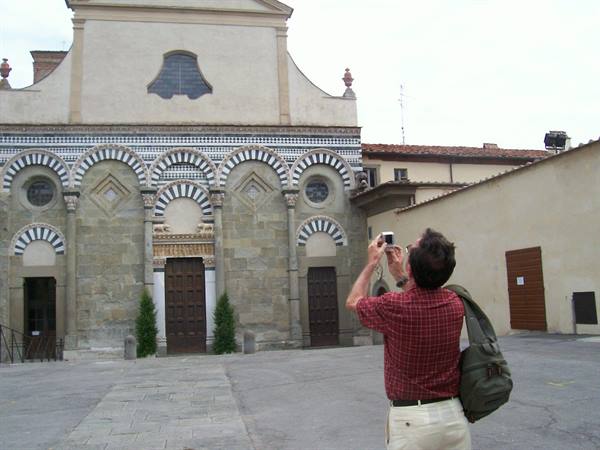
As we walk from the station to the Duomo we notice the splendid walls, visit the Church of S. Domenico and the Church of San Paolo, both from the 1200s-1300s with 14th-century frescoes, interesting even though by painters unknown to us; we then enter the old town with its narrow streets and reach Piazza Duomo, where we visit the Cathedral of S. Zeno, whose origins date back to the 6th century. The interior is majestic, with three naves; we especially liked the chapel of the Last Judgement with an interesting fragment of fresco, and the chapel of the Blessed Sacrament, attributed to Verrocchio. We were thrilled by the Dossale argenteo di S. Jacopo, a silver altar made up of 628 small carved figures, the work of various artists and goldsmiths from the 13th to the 15th century (including Brunelleschi), also mentioned by Dante in the Divine Comedy (canto XXIV).
The altar can be visited for a fee of 2 euro and with the sacristan present to switch on the lights (not to be missed).
We only saw the Baptistery in part, since it is under restoration both outside and inside; you can go in but you only see scaffolding.
We have lunch in a bar, then continue with a visit to the church of S. Francesco (frescoes by Pietro Gerini), the facade of the Spedale del Ceppo, the churches of S. Francesco and Sant'Andrea (the beautiful Pulpit by Pisano) and San Giovanni Fuoricivitas (Pulpit by Guglielmo da Pisa and a holy water stoup attributable to the school of Pisano).
Back on the usual train.
August 29: Lake Massaciuccoli and Torre del Lago
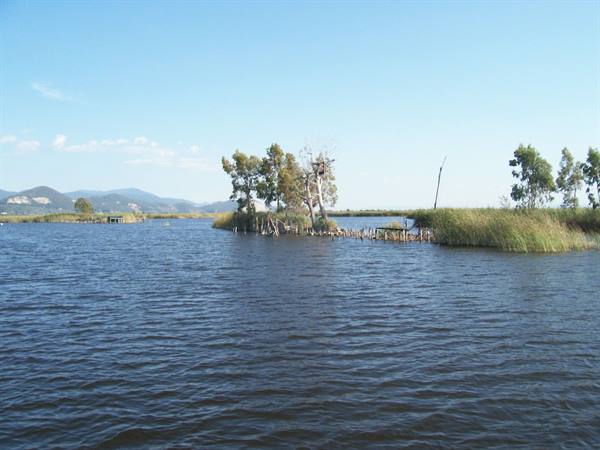
In the morning, beach life; then in the early afternoon, while my husband goes for a nap — and never skips a quick check of the internet — I don't give up my ecological calling and take the bus to Lake Massaciuccoli and Puccini's villa, where I had long wanted to go. Public buses are frequent and very punctual; for Torre del Lago and its lake one leaves every half hour (cost 0.90). The ride is quick and very pleasant, because just outside the city you're immersed in splendid, lush nature, flowers and plants, with the wonderful pinewood of the west coast running parallel. Once at Torre del Lago, the bus turns into a long avenue and you immediately glimpse the expanse of the lake amid the greenery. At the little harbour a boat is ready to set off towards the marsh, which lies inside a nature park.
The boat moves slowly through a dense network of natural canals, rich in marsh vegetation and reeds. As the boat goes along, we're told about the natural environment and the life of the great musician Giacomo Puccini. We cross the lake, get off and head for Puccini's house-museum; the audioguided visits run every hour. In the villa there are personal belongings of the musician, both to do with hunting and with meetings with friends, his correspondence, texts of musical compositions, his pianos and his tomb in the family chapel inside.
August 30: the Apuan Alps
In the morning, beach life. In the afternoon, while my husband takes a trip to Viareggio, obviously including the internet café, I took the bus to Pietrasanta and there caught the connection to Seravezza, a little village at the foot of the wonderful Apuan Alps, a well-known marble-working centre. After walking along the stream and visiting the small churches along the way, I climbed up to the Medici palace (16th century), once a holiday residence of the Grand Dukes of Tuscany and now a museum, in a green park right beside the stream. Along the way I could see the marked blocks of marble, waiting to be sorted and worked. Looking at the blocks, I thought of Michelangelo's search, choosing them by already glimpsing the shapes of his creations. I visit the exhibition "L'oro delle Apuane", which continues until 7 October.
There are about a hundred works on the landscape and the work that for centuries has allowed marble to be extracted and transported; works by Carrà, Rosai and Viani are also on display. Back to Viareggio.
August 31: Forte dei Marmi.
Morning and afternoon, beach life. In the evening, taking advantage of the fact that in July and August a bus service has been set up that runs all night (3 euro ticket with unlimited travel all night), we head to Forte dei Marmi, considered the "coolest" seaside resort in all of Versilia. Many films have been set here, hundreds of scooters are parked, and of course there are the squares with the pine trees; the streets are lit up like day, and the designer shops are countless. The bus is used mainly by young people heading to the clubs along the coast; we pass the famous Capannina, with its endless queues at the entrance (…those were the days). We do a full circuit, then late at night return to Viareggio.
On 2 September, back to Turin.
The journey's photographs
4 photographs · click to open them full screen


0 reader comments