The story
A short itinerary in Versilia (Siena, Viareggio and surroundings, Pistoia), from 23 August to 2 September by Ferny Forner and Rita.
In July, my wife Rita and I had taken a week of seaside holiday in Alassio, with the usual beach life, and we wanted to do something more, so we decide to go to Versilia with Viareggio as our base, to have a few swims and visit Siena and a few other places we hadn't seen yet.
We start organising the trip online (modest budget), searching for hotels, restaurants, events etc., and we find a 3-star hotel in Viareggio and a 2-star one in Siena.
On 23 August at 6.30 we leave Turin for Siena on the Eurostar, with a change at Firenze Rifredi (total cost 41 euros each). We arrive in Siena around midday and, considering that it was raining and that the station is about 2.5 kilometres from the historic centre where the hotel is located, we treat ourselves to a taxi (8 euros). We arrive at the Cannon d'oro hotel (2 stars, 75 euros a night); the hotel is in the very heart of the historic centre, a stone's throw from piazza del Campo, in a 13th-century building (one of the owners was mentioned by Dante in the Divine Comedy), run as a hotel for about two centuries, back then called Locanda delle Armi d'Inghilterra; the rooms are spacious and comfortable (full bathroom, satellite television etc.), a pity about the lack of a lift and the rather steep staircase, since we were on the second floor.
We decide to go for lunch; we find a buffet restaurant (Nannini), fixed price 12 euros, all-you-can-eat (satisfying). At last the rain stops, the warm sun returns; we go to Piazza del Campo, passing through Via Montanini and Via Banchi di Sotto, all pedestrian, narrow, very lively, full of historic buildings but also of shops. We see the Palazzo Salimbeni, seat of Monte dei Paschi and Chigi Saracini, home of the well-known music academy (a rich programme of concerts both in the afternoon and in the evening); we also pass along Via di Città, where we admire the Loggia della Mercanzia, and arrive at piazza del Campo.
The square, built between 1293 and 1349, is the heart of the city, the site of the Palio and, in the Middle Ages, of capital executions; the most important streets converge on it, the square is very lively, shell-shaped, and at its highest point stands the famous Fonte Gaia, created by Jacopo della Quercia; bear in mind that the panels depicting the Virgin and the Virtues are reproductions, the originals can be seen in the Spedale di Santa Maria della Scala. On the outer south side, opposite the Fountain, we find the Palazzo Pubblico, the Torre del Mangia and the Cappella di Piazza (1376). Inside the Palazzo Pubblico is the Museo civico (5 euros), which is worth a visit to admire works by Simone Martini and Ambrogio Lorenzetti; on the outer side of the square you'll find bars and restaurants with outdoor tables, always very busy.
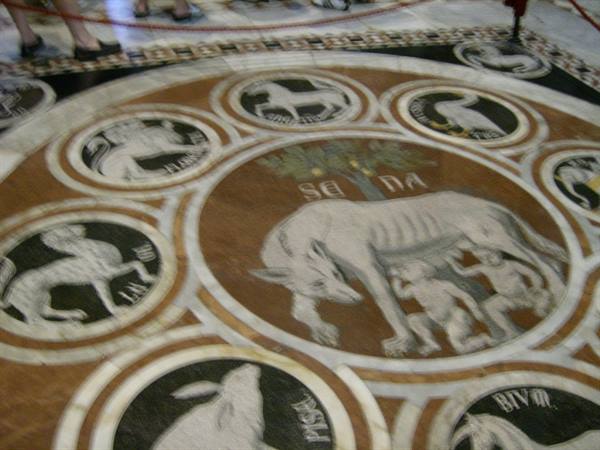
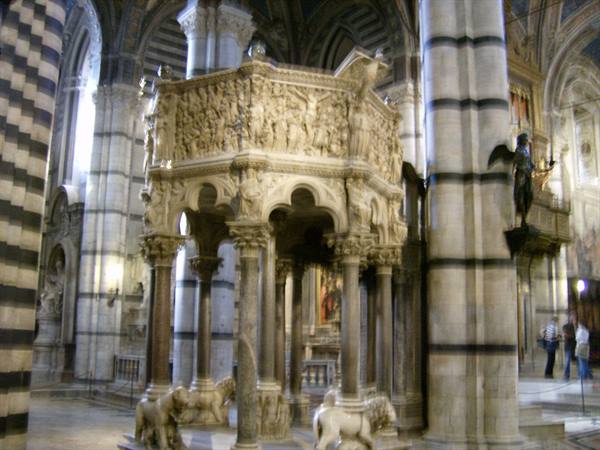
We head to piazza Duomo, where we admire the grandiose Cathedral of the Assumption, in white marble, in Romanesque-Gothic style. We queue to go in; entrance is 6 euros, but it's worth getting the combined ticket for 10 euros that includes the baptistery and the museum. The interior is truly evocative, the works of art are countless, the pulpit carved by Nicola Pisano is splendid, the marble floor is fantastic, divided into 56 panels that represent scenes of salvation and revelation, in the making of which the greatest artists of the time worked (Donatello too); even a moderately attentive visit takes no less than two hours. Note that it is visible only in August and September, in the other months it is covered.
We then move on to the Baptistery of San Giovanni, again in white marble, with the beautiful hexagonal baptismal font by Jacopo della Quercia inside and the walls frescoed by one of the greatest painters of the time, il Vecchietta. Around 20.30 we dine at the restaurant Grotta Santa Caterina da Bagoga, which is in an old and charming little alley in Siena; the interior too is furnished in a characteristic way, the atmosphere is warm and welcoming. We order dishes with the flavours of old Sienese cuisine: crostini with chicken livers, Pici with Aglioni (fresh handmade pasta, with tomato, oil and cooked garlic), Ribollita, Turkey made with a 1700s recipe (turkey with a mix of spices and red wine), a taste of Peposo (chianina stew with pepper and red wine), Torta di riso with berries, and another taste of dessert, all for about 40 euros for two with 2 glasses of wine.
We take another little stroll and stop in the ever-lively piazza del Campo, then at last we go to sleep.
August 24: We return to Piazza Duomo to visit the Spedale di S. Maria della Scala (4 euros), opposite the cathedral, where we admire the splendid frescoes on the walls, dating from the 1400s, by Domenico Di Bartolo and Lorenzo Vecchietta and other painters of the Sienese school, depicting scenes of the hospital's activity (not to be missed). Then we set off on a complete tour of the city: we visit the church of Gothic origin of S. Agostino (1260), the church of San Girolamo and Santa Maria dei Servi, with the remains of 1200s frescoes and the fresco attributed to Pietro Lorenzetti, as well as the church of S.
Spirito, which dates back to the Renaissance; naturally we always pass through the narrow pedestrian streets with their splendid palaces, a brief visit to the shrine of St Catherine with its fine portal, then the church of San Domenico, with masterpieces by Sodoma, and finally a visit to the Pinacoteca Nazionale, an essential visit to get a historical overview of Sienese painting of the time; we manage to see it all, even though towards the end the custodians hurried us along. Around 21.00 we go to another restaurant, the Hosteria il Carroccio; we were a bit tired, we limited ourselves to Pici al sugo, Ribollita, Etruscan-style duck, dessert, all very nicely prepared, with a bill of 36 euros for two. We end the evening sitting on the pavement of piazza del Campo.
August 25-27: stay in Viareggio, a lovely seaside resort town, with a vast sandy beach, a gently sloping sea, a long (and well-known) promenade running parallel to the sea, with Art Nouveau buildings, full of shops open until midnight; there are 7 cinemas, series of talks at the caffè Principino (we attended the last one with Franco Ferrarotti), the chance to go on bike trips, with a convenient cycle path alongside the seafront (many hire shops), both in the two vast pine woods, levante and ponente, an open library, with a newspaper and magazine reading room and an internet point (mornings only), a museum and a picture gallery, good public transport too, the chance to reach Pisa and Lucca in about 30 minutes by train (by bus it takes longer), and for opera lovers excellent connections to Torre del Lago for the Puccini festival, and to the seaside resorts of the whole of Versilia.
The Dolly hotel is a 3-star, well-kept, just a few metres from the sea and in the centre, with an internet point available, but you can only use it standing up; the cuisine is well prepared, the only drawback being that in the evening the owner waits up for the guests, and since we stay out a bit late it made us feel rather guilty.
The journey's photographs
3 photographs · click to open them full screen

0 reader comments