from the address
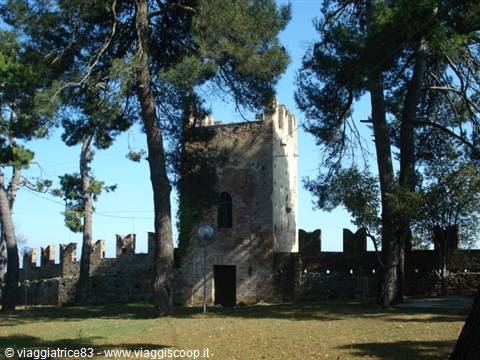
Having reached the historic center, at the entrance of Via Leopardi, on the right, you come across the Monument to the Madonna, in Carrara marble, commemorating the Marian year 1954, while on the left there is the Torrione with the Porta di Monte Antico (15th-16th century), the historic access to the city.
Continuing along Via Leopardi you arrive at Largo G. Speranza, where you can admire a wide panorama of the whole valley and the surrounding mountains.
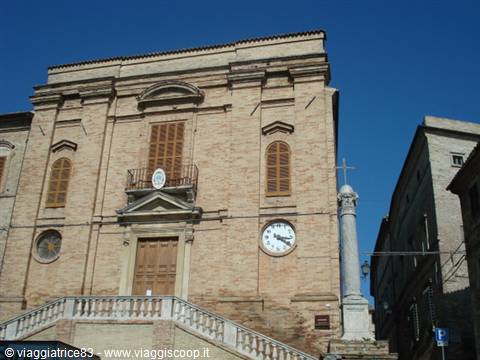
The churches and the public and private buildings of greatest value are located for the most part along Corso Vittorio Emanuele II, which crosses the entire center in a South-North direction. At its entrance, on the right, is the Palazzo dei Marchesi Bruti Liberati (17th century) and, immediately after on the left, the Church of Santa Maria della Valle, renovated at the beginning of the 20th century when the facade was also redone and the interior renewed.
After the Church follows Piazza Guglielmo Marconi with houses from the 16th century, in one of which Adolfo Cellini (man of letters, theologian, exegete) was born, and Casa Mancini, with a coat of arms on the rusticated portal.
At the end, on the right, Via Attone Bonaparte begins, with the former little church of SS. Filippo and Giacomo (15th century) on the left, transformed in 1988 into an art and technical studio.
Turning right you then arrive at the Colle-Belvedere S. Nicolò (508 m), partly bounded by the City Walls (15th and 16th century) to which the Torrione with Ghibelline merlons belongs. On the highest point stands the Church of S. Nicolò, one of the oldest in the city, with a 9th-century apse, a 15th-century portal, renovated inside in the 16th century.
Returning to Corso Vittorio Emanuele II, we find on the right: Casa Tozzi Condivi (18th century); Palazzo Cellini, in neo-Gothic style (mid-19th century) with a doorway by B. Vecchiarelli; Casa Fedeli (late 17th century).
Having reached Piazza Matteotti, on the left there is Palazzo Massi Mauri (18th century), shaped like a ship's hull with a balcony fitted with an elaborate wrought-iron railing, a work by F. Tartufoli. On the right are Casa Teodori, with an ogival portico of two bays and 15th-century terracottas, a 15th-century house with a portico on brick columns and a wooden entablature in Venetian style, and a house with an ogival portico on low pillars and Romanesque columns with a Renaissance upper storey.
Having entered Piazza Ascanio Condivi, on the left stands the facade of the Cathedral Basilica, consisting of three churches, and dedicated to Saints Gregory and Margaret.
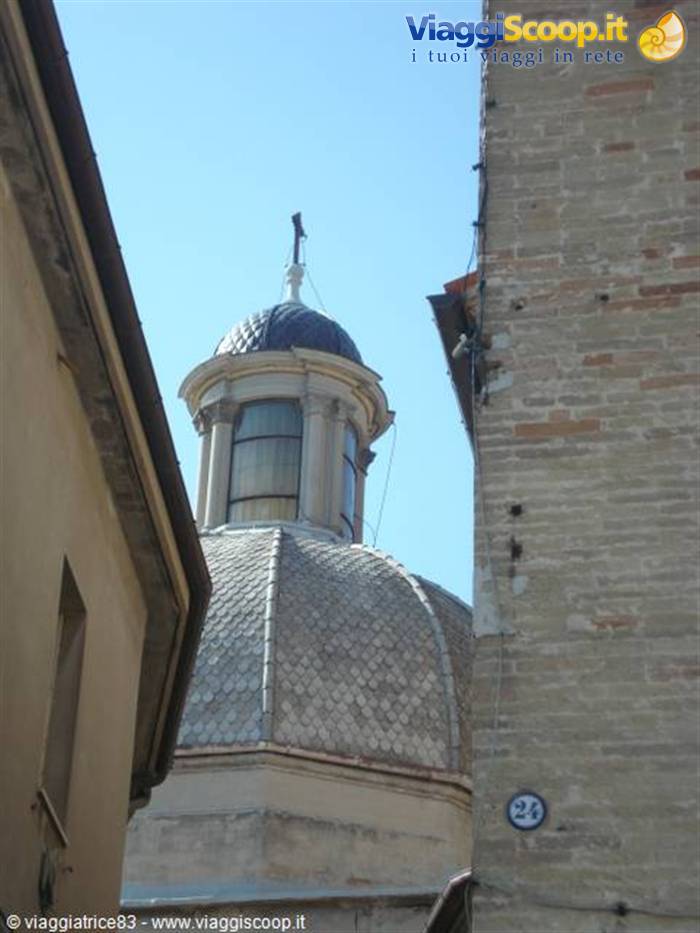
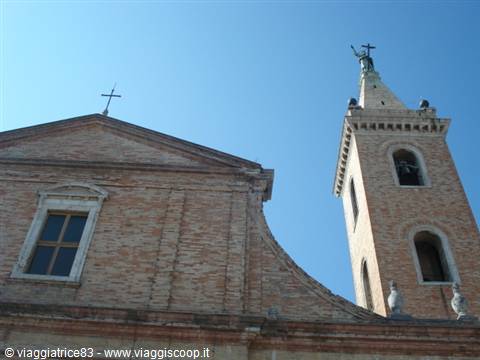
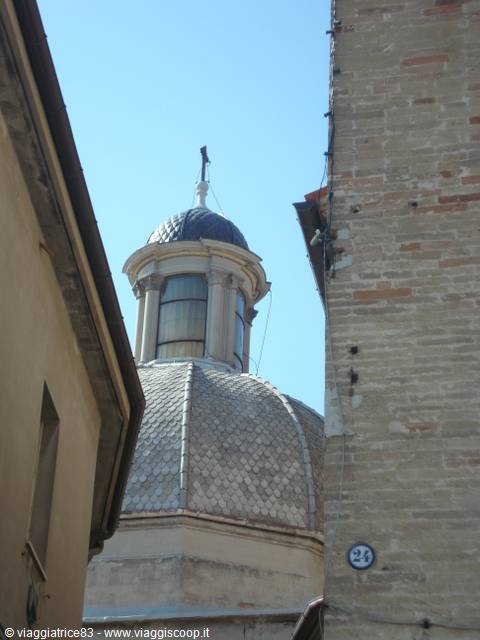
The Cathedral, built to a design by G. Guerra of Modena between 1597 and 1623, today presents the octagonal tiburio of 1786, the facade dating from 1842 and the bell tower, raised between 1884 and 1902 to a design by the pontifical architect F. Vespignani, characterized at its summit by the copper statue of the Redeemer made in 1901 by the Luigi Del Bo foundry of Milan. The interior, with three naves and a Latin cross, is characterized by the pictorial decorations of the brothers Michelangelo and Marcantonio Bedini dating from the late 1950s. During the visit you can admire: the 17th-century wooden pulpit, a work by D. Bonfini of Patrignone, in which the dominant motif consists of the elements of the coat of arms of Ripatransone, alternating with panels depicting the 5 glorious mysteries.
The decoration of the tiburio is also very rich; at the corners are painted the 4 evangelists while in the upper part, on a golden background, the 4 cardinal virtues are represented. The presbytery has a marble altar by Poscetti of Rome, while on the right wall there is a painting representing St. Gregory the Great (17th century) and, on the left, the Nativity (18th century). The bishop's chair is also a work by Bonfini. In the apse you can admire a wooden choir made by Agostilio Evangelisti (1620), the imposing statue of St. Gregory the Great and the pictorial complex by Bedini. The liturgical organ is a work by the famous Venetian organ builder Gaetano Callido (1783); it was originally built for the Church of the Maddalena dei Frati Minori Osservanti, from where it was then moved along with the choir loft in 1812.
Among the numerous works kept in the cathedral should also be counted: the polychrome wooden Crucifix donated, according to tradition, by Pope Pius V in 1571, probably a work by Giovan Battista Casignola of Como, the wooden Altar, a work by M. Angelo Ripano (17th century), the Altarpiece, a work by Orazio Gentileschi (16th-17th century), three canvases, among them the one depicting the Madonna and Child, St. Peter, St. Roch, St. Anthony of Padua and St. John the Baptist, a work by Simone de Magistris of Caldarola (1579), the Altarpiece canvas representing Charles Borromeo attributed to Turchi known as l'Orbetto (1623) and the Altarpiece, a work by S. Ciannavei of Ascoli Piceno (18th-19th century).
From the Cathedral you enter the diocesan Sanctuary of the Madonna known as of St. John, patroness of the city since 1893. The entrance door was made in copper by C. Capponi in 1950. The Sanctuary was erected in the years 1846-58 to a design by G. Carducci of Fermo, and preserves inside 4 statues by Luigi Fontana, 5 Murano chandeliers and a wooden choir with two tiers by S. Morelli of Montegiorgio.
The shrine that houses the miraculous Effigy, a work by S. Sebastiani of 1620, was designed by the architect Francesco Vespignani in 1881. Having left the Sanctuary, on the right, in Via Ghislieri, is the Crypt of the Cathedral, with the Tomb of the bishops, built starting from 1597, in the place where, as the inscription on the architrave testifies, the Confraternity of Mercy and Death had built the Oratory. Inside is the tomb of the four bishops of Ripatransone, on whose stele is a polychrome Crucifixion by the Ascoli ceramicist Giuseppe Marinucci. At the entrance of Via Angela di Zingaro you can admire the ancient Casa Gallo, with a portal in dressed stone, on whose architrave an inscription of 1503 can be read.
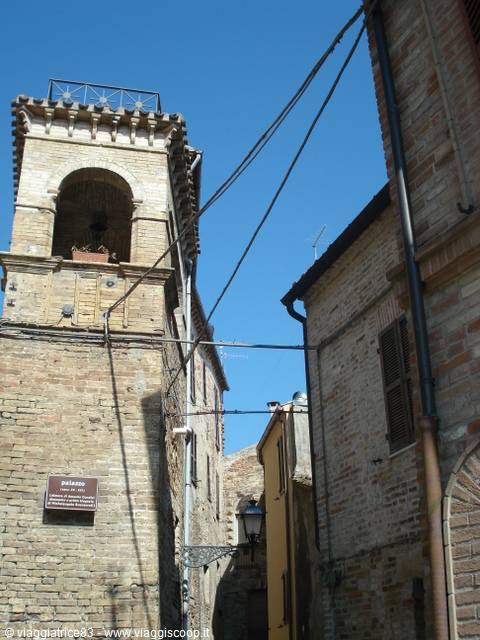
Returning to Corso Vittorio Emanuele, on the left there is a Corinthian column of 1658 and, on the right, Casa Bruni (15th-16th century), home of Ascanio Condivi, first biographer of Michelangelo, with an elegant little loggia and Guelph-cross windows. Opposite stands the Church of S. Agostino (15th-18th century), now deconsecrated and transformed first into a Conference Hall and then into a Cinema Hall. The Bell Tower has Gothic elements. Since 1992 the adjoining convent has been the seat of the Historical Archive with documents starting from 1572.
Continuing, you come across Palazzo Lupidi-Boccabianca (17th-18th century) and Palazzo Tassoni-Gera, restored in the 19th century, the birthplace of the sculptor Uno Gera. Having reached Piazza XX Settembre, with a travertine balustrade, you find yourself in front of the Municipal Palace (13th century), which preserves almost nothing of its original structure.
On the facade, with a double staircase, you can see a rusticated portal surmounted by the municipal coat of arms distinguished by a lion on five hills, two closed arches of the Loggia of the elders, and a wall sundial. On the ground floor it houses the Archaeological Museum and the Municipal Library.

0 reader comments