The story
A short stop in Brindisi to find some relatives. Brindisi (87,935 inhabitants) is a city in Puglia, the capital of its province and the third city of the Salento by number of inhabitants. It stands on a natural harbour on the Adriatic Sea. A very important port from a commercial point of view and for transport to Greece, it has an airport. The two Roman columns have always been the symbol of the city of Brindisi. Although it is wrongly believed that they marked the exact point where the Via Appia ended, in reality they served as a harbour landmark for ancient sailors. They were built in the 2nd century with marble from Turkey; only one is intact today and is made up of eight drums, with a total height of 18.74 metres. The Corinthian capital is decorated with acanthus leaves, heads of divinities and eight tritons.
The other column collapsed in 1528; today only the base and one of the drums remain. The remaining part is in Piazza Santo Oronzo in Lecce. In Piazza del Duomo you can admire the Portico of the Knights Templar, built in the 14th century, remains of a far more majestic building. Today it forms the entrance of the Ribezzo Museum, which preserves everything found in the province; it also houses the precious cast of the section of Trajan's Column depicting the port of Brindisi, and there are also numerous vases, ceramics and statues. Other sections of the museum illustrate finds that testify to the port's trade since prehistoric times. Still in the historic centre is the church of Santa Maria degli Angeli, built in 1600 by the dukes of Lorraine.
Today's Piazza della Vittoria comprises two squares that in the 17th century were called piazza dei nobili and piazza della plebe, where the market was. In the summers of 1617 and 1618 Brindisi suffered epidemics due to the scarcity of water, which drove the population to drink unsafe water. The city's governor at the time, Captain Pedro Aloysio de Torres, a Spaniard of great ability, in order to bring water to the citizens, decided to build three fountains within the built-up area, charging the cost to the citizens in proportion to each one's means. The fountain of Piazza Vittoria, made up of a large marble basin into which the water gushing from a beautiful smaller upper basin, also of marble, was collected, very similar to an older baptismal font, bears an inscription in memory of governor de Torres.
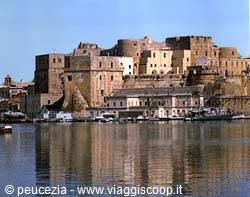
The great fountain, also known as the Tancredi fountain, stands near the end of the ancient Via Appia; despite its name, it was built by the Romans. Tancredi, count of Lecce and last Norman king, only had it restored in 1192, to commemorate the marriage celebrated that year in the Cathedral between his son Roger and Irene of Greece, daughter of the emperor of Constantinople Isaac. In Piazza Cairoli is the Fontana delle Ancore, which dates from 1937. Its original design, made up of a central little column consisting of four fasces holding an elegant bowl and creating striking light effects, was completely reworked with a project by the Ente Autonomo Acquedotto Pugliese. Another monument worthy of note is the Swabian Castle, also called the "great castle" or "land castle", commissioned by Frederick II; its plan is trapezoidal and it has sturdy square towers.
Materials from the old walls and from other ruined monuments were used for its construction. Abandoned by the Spanish, it was turned into a prison by Joachim Murat in 1813, and since 1909 it has been used by the Navy. The Castle was a naval base during both world wars; moreover, in 1943 King Vittorio Emanuele III was hosted here and made Brindisi the capital of Italy (10/9/43 - 11/2/44). Arriving at Brindisi from the sea you admire the Aragonese Castle, better known as Forte a mare. It is a construction built in 1491 on the island facing the port by Ferdinand I of Aragon to defend the city from attacks from the sea. The Aragonese Castle consists of two sections: the Red Castle, named after the colour of its bricks made from the island's stone, and the Fort, more recent, used to house the garrisons.
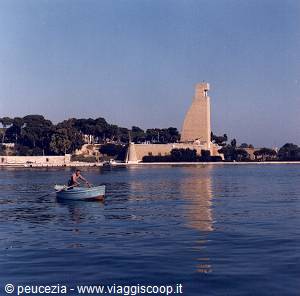
Entering the port from the sea or walking along the quay you cannot fail to notice the Monument to the Italian Sailor, built in 1933 in the typical shape of a rudder 54 metres high. At its base is a votive chapel commemorating the fallen of the world wars and preserving the bell of the battleship "Benedetto Brin", which sank in the port of Brindisi in 1915.
The journey's photographs
5 photographs · click to open them full screen


0 reader comments