The story
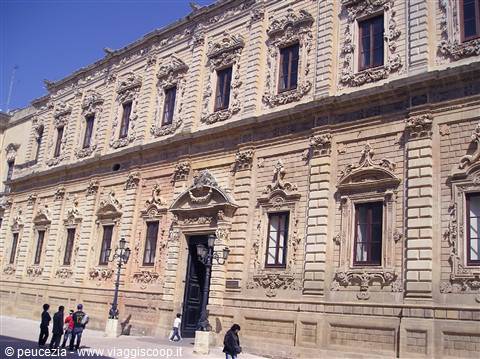
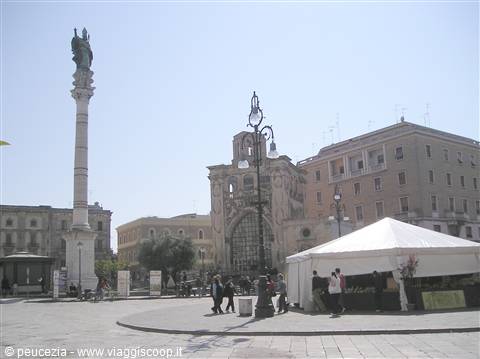
Lecce (93,395 inhabitants) is a city in southern Italy located in Puglia, in the flattest part of the Salento, and the capital of its province. It is the city where the development of Baroque art in Lecce stone, a malleable limestone very suited to working with the chisel, was most elaborate. For this reason one speaks of Lecce Baroque. For the beauty of its monuments the city is called the Florence of the South. The Salento capital is also famous for its many churches, which embellish its historic centre. Located in the very central Piazza Sant'Oronzo, all that remains of it are the arena, the lower tiers and part of the outer walls. Built in the 2nd century AD, the amphitheatre measured about 102 m x 83 m and could hold more than 25,000 spectators; in later periods it was buried and built over by other buildings.
In 1901, however, during the excavations for the construction of the local branch of the Bank of Italy, it was brought to light thanks to the determination of Cosimo De Giorgi, who regarded the discovery as: "a noble coat of arms found by chance while rummaging through the family papers and whose existence we did not know". The building, made of Lecce stone, was largely covered with marbles that were not always white but also artistically worked, and was enriched with decorations now kept at the Museum of Lecce. Inside, the height of the seat steps increases as you go up towards the higher tiers, to make the arena clearly visible from any point of the cavea. Depending on their importance, the external structures were covered with more or less noble materials: marble cladding or plaster.
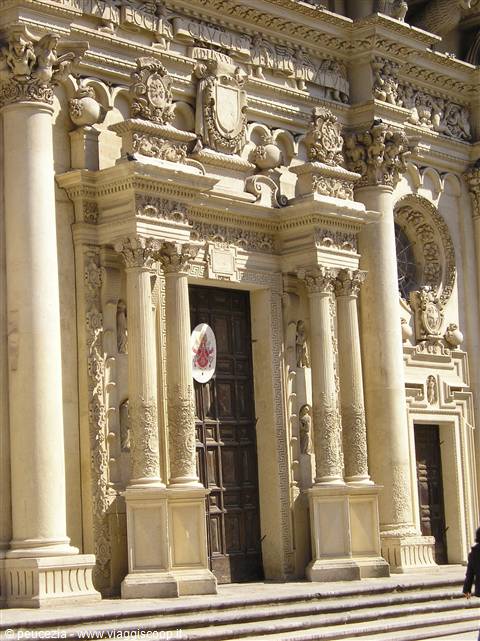
Unfortunately, it is not known precisely either who had the Amphitheatre built or the exact era to which it dates. Almost all the scholars who have studied it attribute its construction to Hadrian in the Augustan age. In 1938, however, during work on the Amphitheatre, an inscription mentioning Trajan came to light, but it has since disappeared. Of the Amphitheatre only a portion could be brought to light, because of its size, which includes Piazza Sant'Oronzo, the church of Santa Maria delle Grazie and some surrounding buildings. Thanks to a decree of the King of Italy, Vittorio Emanuele III, on a proposal by the honourable Bernabei, the Amphitheatre was declared a National Monument. The symbol monument of Lecce Baroque is the Church of Santa Croce, built across two centuries from 1549 to 1695 to designs by G. Riccardi.
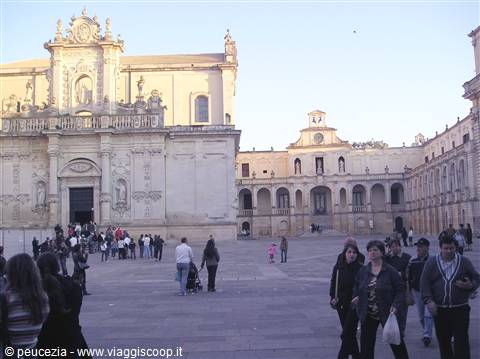
The façade is structured according to a complex iconological programme; in the central panel stands out the splendid rose window with a succession of cherubs, foliage and pomegranates. The interior has three naves, with a fine coffered wooden ceiling both in the central nave and in the transept. Despite the frequency and elegance of the ornaments, the interior is nonetheless sober and preserves its Renaissance stamp. Particular attention is due to the altar of Saint Francis of Paola (1614), the work of F. A. Zimbalo. Also to be admired is the cathedral, among the most beautiful in Italy, first built in 1144, then in 1230.
At the request of the archbishop of Lecce, Luigi Pappacoda, the cathedral was completely renovated between 1659 and 1670 by Giuseppe Zimbalo, who also built the adjoining bell tower about 70 metres high, divided into 5 levels with very slender windows; it ends with an octagonal loggia. Before these renovations the cathedral area was "closed", in fact there was a closed entrance where today the entrance into Piazza del Duomo is, made accessible after those works.
The journey's photographs
12 photographs · click to open them full screen



0 reader comments