The story
The Basilica of St Nicholas, located in the old part of the city of Bari, keeps the remains of St Nicholas, a miracle-worker but also known as "Santa Claus", that is Father Christmas, so a visit to his home is called for in the Christmas period. A few notes on the history of the Basilica: The Basilica was built within the Court of the Catepan, the residence of the Byzantine (Greek) governor at the time when Bari was the capital of southern Italy (970-1071). Its good defensive position and the choice made by the representatives of the Byzantine emperor would suggest that since Roman times this was the area of civil authority. It is likely, therefore, that the Roman praeses lived here first, then the Lombard gastald, then the Saracen emir and, finally, the Byzantine catepan.
The people of Bari, in their desire to keep the prestige of the city high (which had lost its role as capital) and to stir up new commercial life, stole the relics of St Nicholas from Myra (Turkey) (1087). The presence of these relics would indeed have stirred up a considerable flow of pilgrims, Nicholas being the most venerated saint at that time.
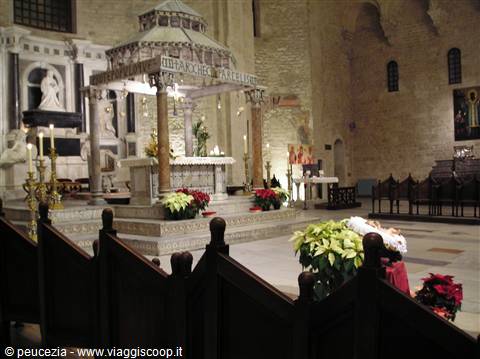
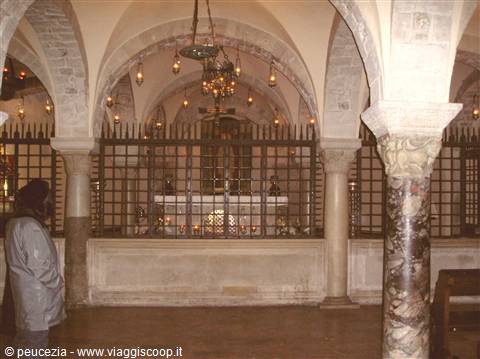
The great undertaking, carried out by some seventy sailors (62 of them with Bari citizenship), was narrated the following year by two writers, Nicephorus and John the Archdeacon. They recount that the arrival of the relics in Bari aroused strong tension between Archbishop Ursus and the town's "bourgeoisie", and that it was the Benedictine abbot Elias who calmed the spirits. To him, therefore, was entrusted the construction of the imposing Basilica, which required the demolition of four small churches that stood within the catepanal enclosure, only S. Gregorio remaining intact to this day. On 1 October 1089, at the end of a council held in Melfi to settle the tensions between Bohemond and Roger Borsa (sons of Guiscard), Pope Urban II came to Bari and placed the relics under the central altar of the crypt, an ancient catepanal hall with Byzantine columns and capitals.
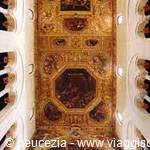
The passage of the crusaders in 1096 and the council of 1098 increased its already great fame. In the 17th century, perhaps on the occasion of the grand ceiling, the roof was also redone, as well as the silver altar of Urosh II Milutin. Various restorations were begun towards the middle of the 18th century and resumed in the 19th, but only those of 1928/30 brought the Basilica to its present form, tending to give the building back its original lines. On that occasion the alterations made after the 16th century were removed (including the Baroque chapels and the frescoes of the central apse) and, were it not for the loss of most of the frescoes, today one could have enjoyed what the people of Bari admired nine centuries ago. The crypt, that is to say the underground church corresponding to the transept, was certainly the first part of the church to be completed.
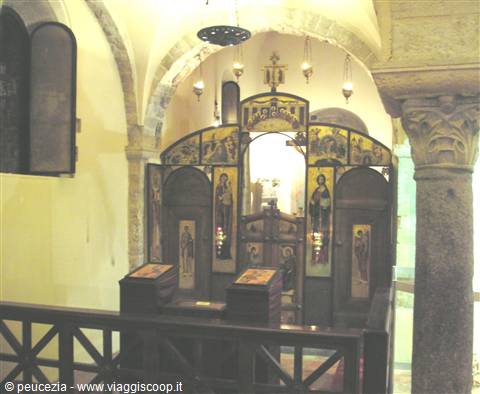
There is reason to believe, in fact, that Abbot Elias used a pre-existing hall of the catepanal palace, perhaps placing in it some liturgical capital from one of the demolished Byzantine churches. On the wave of the Second Vatican Council and of the improved relations between Catholics and Orthodox, the Holy See deemed it appropriate to grant the wishes of the Dominican fathers and of the archbishop of Bari, Enrico Nicodemo, to host in the Basilica an eastern chapel where the Orthodox too could celebrate their liturgy.
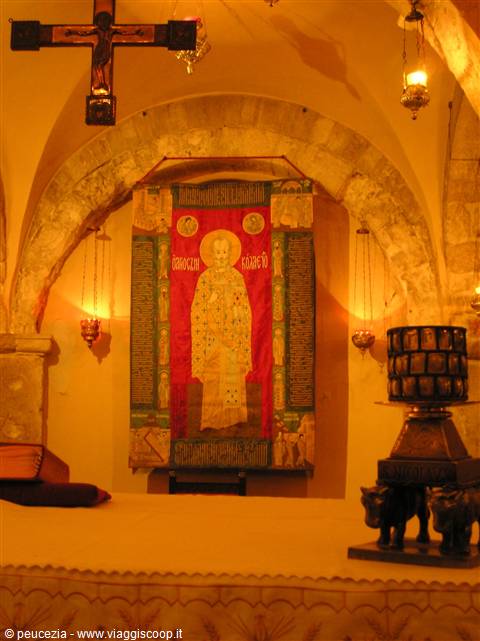
Cardinal Paolo Giobbe, who together with the then archimandrite Gennadios Zervos blessed the chapel, said: It is the first time that in a Latin church a chapel is erected for the celebration of the eastern liturgy. This achievement is one of the many fruits of the Ecumenical Council. Two years later Archbishop Nicodemo and the Dominican Fathers also founded an Institute of Ecumenical Theology where professors and students, both Catholic and Orthodox, could teach and study in a spirit of fraternal friendship. The iconostasis was made for the occasion by the Croatian artist Zlatko Latkovic, also the author of the iconostasis of the eastern chapel in Berlin. It attracts the curiosity of visitors, that INB1, instead of INRI (Jesus Nazarenus Rex Iudeorum). The explanation is simple: in Greek Rex is Basileus.
The journey's photographs
8 photographs · click to open them full screen



0 reader comments