For all the photos and further information, visit my website:
Day 125 Apr 2001
Boarding and departure on the Tirrenia ferry
The travel group consists of me, Stefania, my brother Davide and a friend of his named Ignazio. We board our white Fiat Punto in Cagliari, on the Tirrenia ferry to Civitavecchia, at 5:30 pm. The ship departs punctually at 6:30 pm, leaving the port of the regional capital and passing along the eastern coast near Villasimius where we witness a splendid sunset over the sea. It's always a particular and intense emotion to leave your own land watching it slowly move away! The night on the ferry is a bit boring but the sea is calm. Ste and I take a chance on a cinema ticket to see "Vertical Limit" (which I had already seen a year ago in a cinema worthy of being called such).
I knew that the cinemas on these old Tirrenia ferries are certainly not the best, but I would never have thought in such pitiful conditions! The screen is cut in 4:3 format (so like the TV at home and not the classic stretched cinema image), not very big, the images are pitiful and the audio is awful, you can barely hear the voices. All of this nevertheless turns out to be a fun experience, but we can't say we really went to the cinema...
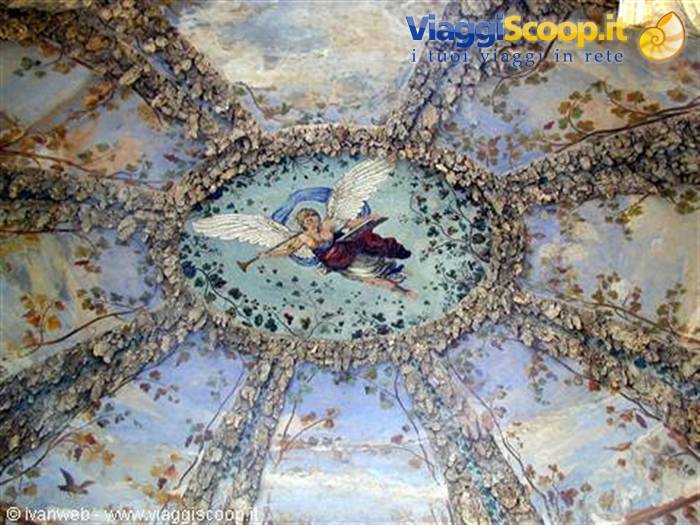
Fresco in the Boboli Gardens
Day 226 Apr 2001
Arrival in Civitavecchia; journey to Florence; hostel check-in; Church of S.Maria Novella
The ferry arrives punctually in Civitavecchia, where we disembark and take the road to Grosseto, avoiding the motorway. We stop for a break and breakfast halfway, already in Tuscany, where we can admire the beautiful countryside of green hills with spring colours. Once in Florence, we follow the signs to reach the Youth Hostel on via Raffaele Sanzio, a hostel found on the internet and booked by fax. We are assigned a clean and comfortable room, inside a structure where they are carrying out completion works at the entrance. The room is more than decent for an accommodation of this type, the bathrooms are outside but shared only with one other room and are clean and brand new. We leave our bags and Stefania and I get a ride from Davide and Ignazio who have to go to the I.L.P.
(Italian Lan Party), that is a mega event where hardened PC gamers meet, who bring their own computer and connect it to the others, creating a gigantic network to play the latest generation games. Davide in particular has specialized in Counter Strike, Quake 3 Arena and Unreal Tournament. We get off near the church of Santa Maria Novella, which we reach after a ten-minute walk. The Gothic church was built between 1279 and 1357 by the Dominican friars, and the facade was redone by Alberti, in front of a small green meeting place with a splendid fountain. We don't go inside, even though it's a real shame since there are very important works there such as the Strozzi Chapel, with the frescoes by Nardo Di Cione, the Tornabuoni Chapel with the famous fresco cycle by Ghirlandaio, the Chapel of Filippo Strozzi with the frescoes by Filippino Lippi and the Spanish Chapel.
We linger a while in the square taking a few photos near the beautiful fountain, and continue the pleasant walk through the streets of Florence, until we return to meet up with Davide and Ignazio
We go out for breakfast, since it isn't included in the hostel, and head towards the nearby bank of the Arno, which we walk along for about half an hour. We watch some people sunbathing on the paving stones near the river, given the beautiful and even too hot spring day. We cross one of the main bridges leading towards the centre, and at a leisurely pace we reach Piazza Duomo. The city is full of tourists from everywhere and the impact is really strong, seeing all these monuments and this architectural beauty concentrated in just a few hundred metres! We start visiting Giotto's Bell Tower, designed by Giotto himself in 1334 and completed in 1359, twenty-two years after his death.
We climb its 410 endless steps made even more tiring by today's heat, and from its summit 85 metres high you can admire a splendid panorama of almost all of Florence: beautiful is the view of the Duomo and of the mammoth dome by Brunelleschi (just six metres taller), although unfortunately the bars give a sense of imprisonment and don't allow you to take good photos. Once down, we join the long queue to visit the Duomo, next to the bell tower, where we enter after about half an hour of waiting. Before the Florence Duomo (or Cathedral of Santa Maria del Fiore), the area was occupied by the church of Santa Reparata, demolished in 1296 precisely to make room for this masterpiece. The construction is very imposing and reflects the Florentine desire to excel over everything.
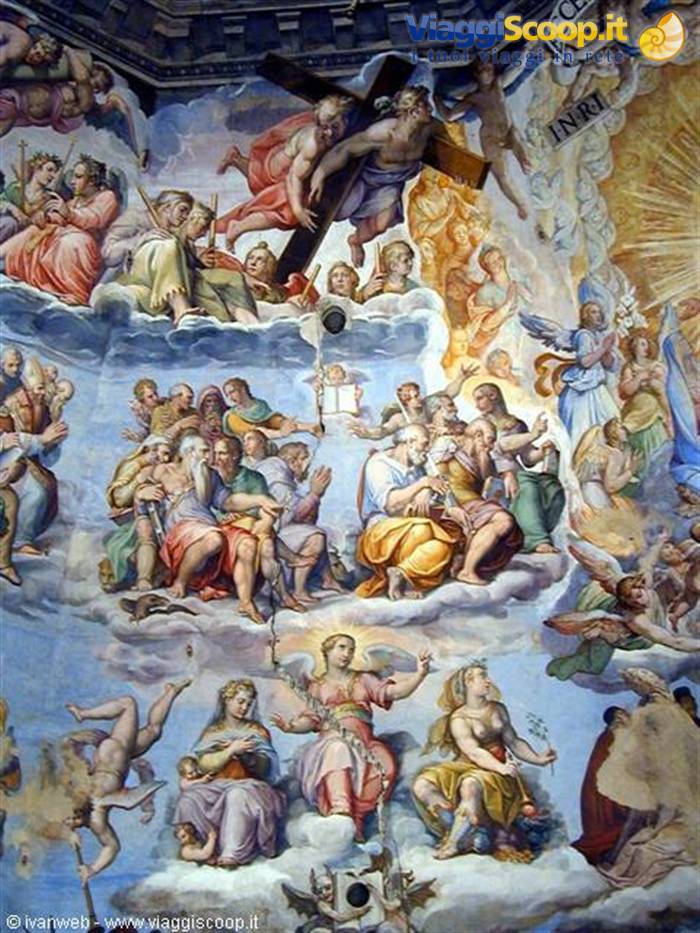
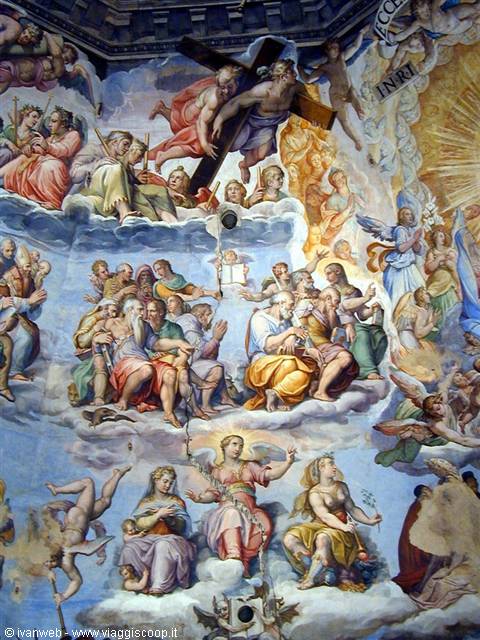
The works began on behalf of Arnolfo di Cambio, and were completed in 1436; its current facade, however, was only completed in 1887. The exterior leaves those who observe it ecstatic and breathless, while the interior is a little less evocative. Particularly striking is the immense dome by Brunelleschi with its paintings and decorations. Here too we climb an endless staircase of no less than 463 steps that spiral around the dome, from where you can first admire the frescoes of the Last Judgement by Vasari, and then reach the top with a spectacular view of the city, finally without iron railings. From here you can see all the main landmarks that make magnificent Florence famous: from Giotto's bell tower, to the Baptistery, to Piazza Signoria and Palazzo Vecchio, to the Boboli gardens and Palazzo Pitti, to the churches of Santa Croce and Santa Maria Novella.
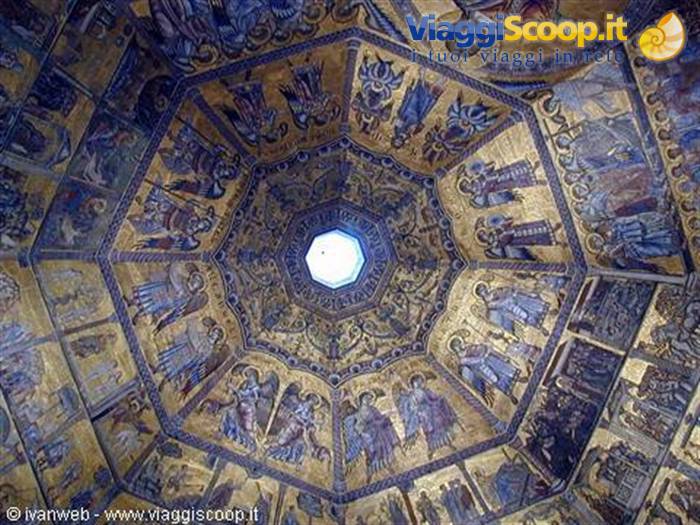
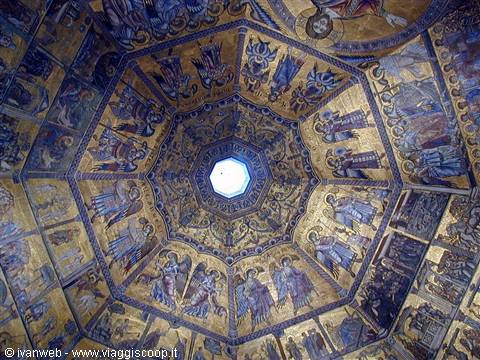
Once down from the Duomo we finish visiting the square with the Baptistery, dating back to the 4th-5th century, one of the oldest buildings in the city. Famous are its doors, in particular the eastern one called the Gates of Paradise, made by Ghiberti to celebrate the end of the plague in Florence in 1401 and which was chosen after a competition in which great artists took part including Brunelleschi and Donatello. Inside we admire the mosaics of the magnificent vault of the Baptistery, which overlook the octagonal font where Dante Alighieri was also baptized. We stop for lunch in a fast food place on the side of the square, where they sell sandwiches and slices of pizza. We take a few at random, seasoned in a way very different from our Sardinian pizzas, and go down to the floor below sitting at a table that luckily was free despite the influx of people.
We then continue towards Ponte Vecchio, one of the symbols of the city, characteristic in its ancient buildings that have now become precious and important jewellery shops. We cross it entirely together with a tide of tourists, coming from the most disparate parts of the planet, and take the road that leads to Palazzo Pitti and the Boboli Gardens. We enter the gardens from the entrance of Palazzo Pitti. The gardens were created for the Medici family, after they bought Palazzo Pitti, and were opened to the public in 1766. A splendid Renaissance example, you get completely lost in it while walking freely and every place gives a different sensation, including that of taking a deep dive into the past. First we come across the Amphitheatre, stage of the first opera performances, then we go up to the Fountain of Neptune by Lorenzi, built between 1565 and 1568.
We continue along the splendid and long Avenue of cypresses, dating back to 1638, flanked by statues. Having reached the Isolotto, we admire the spectacle of the birds and ducks that populate the small lake, the statues of peasants that surround the garden encircled by a moat, as well as some cunning cats that seem to pose expressly for photos. At the centre we finally find the Fountain of the Ocean (1576) by Giambologna. Going back up along the tree-lined avenue we first reach a park, then the Porcelain Museum, by now closed given the late hour. Forte Belvedere is closed for works, so we go down to the Kaffeehaus, a Rococo-style pavilion built in 1776 by Zanobbi del Rosso; in front of it is the Fountain of Ganymede.
Finally we reach the Grotta del Buontalenti of 1583, where we find the cast of Michelangelo's Prisoners, Paris with Helen of Troy by Vincenzo de Rossi, and a fountain with Venus by Giambologna. Towards the exit of the gardens we come across the Fountain of Bacchus of 1560, a copy of the original by Valerio Cioli, which portrays Pietro Barbino, the court dwarf of Cosimo I, in the likeness of Bacchus god of wine riding a turtle. We leave the gardens and return to the hostel on foot walking for another hour, admiring the beautiful greenery that characterizes and colours this city so much, very tired after the very long tour, the staircases of the monuments and the ups and downs of the park.
Dome of the Duomo
Day 428 Apr 2001
Visit to Palazzo Pitti; Piazza Signoria: visit to the Uffizi
Having skipped yesterday's visit to Palazzo Pitti, at the entrance of the Boboli Gardens, due to time constraints, this morning's first thought is precisely to go back there again and not miss this marvel. The palace was built for the banker Luca Pitti, probably on a design by Brunelleschi, and was begun around 1458. After the banker's bankruptcy, the works were suspended and resumed a century later: from then on it became the residence of the Medici and of all the governors. In the 17th century the Palatine Gallery was added, with frescoed walls, Baroque and Renaissance works arranged by the will of the Medici themselves for the sensations they aroused.
Tantalizing, fascinating are the rooms of Saturn, Jupiter, Mars, Apollo and Venus where the magnificent "Venus Italica by Canova" is found, commissioned by Napoleon to replace the Medici Venus of the Uffizi which was to be taken to Paris. Also notable are some paintings by Viziano such as La Bella and La Maddalena, and by Raphael for La Velata. During the visit one notices the pomp, luxury and wealth in which this family lived. Every room is a different colour: red, green, yellow, white, etc. Very beautiful is the room of the parrots with walls covered in red wallpaper and decorated with birds. Having finished the visit we take the road towards Piazza Signoria, where we arrive at lunchtime. We stop to have a quick lunch and around 3:00 pm we try to approach the Uffizi hoping not to find a very long queue.
In fact from outside it doesn't seem too long, but soon we realize that in reality the longest part continues inside! So it takes us more than an hour before officially starting the visit to the Gallery, certainly one of the most sought-after and frequented destinations by tourists who come here to admire the extraordinary works of art, built on a design by Vasari for the "Uffizi" of the magistratures of the new administrations of Cosimo I. From 1581 the heirs of Cosimo I, in particular Francesco I, used the space to display paintings from the family collection. His descendants continued to add works until, in 1737, Anna Maria Luisa, the last of the Medici, donated it to the Florentine people.
Visiting the Uffizi is a real journey into art and the past mixed between fantasy and reality; the paintings are there and speak for themselves as you observe them, each has a different story and its own meaning in which it is pleasant to lose yourself in imagination. It is in the immense room 10-14 that Botticelli shoots his arrow and Stefania remains in love and struck by his frescoes. One after another you meet the greatest painters of all time: Piero della Francesca, Michelangelo, Titian, Giotto, Filippo Lippi, Leonardo da Vinci. Evocative is then the octagonal tribune with mother-of-pearl ceiling, designed by Buontalenti to allow Francesco I to display the works of the collection. Beautiful and beyond words is the Venus of Urbino by Titian from 1538. The rooms of Rubens, Rembrandt and Caravaggio unfortunately these days are closed to the public.
We stay several hours visiting the gallery, then finally give up and are able to return, by now late in the evening, to our hostel to rest. We go out around 9:00 pm with Davide and Ignazio, who practically are always at the I.L.P. all day, to go and have dinner in a trattoria. We choose one among the many in a small square that we come across going up the main street of Raffaele Sanzio, and I must say it turns out to be very characteristic and with an excellent quality-price ratio. I choose an enormous portion of penne alla boscaiola, covered with a delicious sauce so complex that I couldn't even name all the ingredients!
Dome of the Duomo
Day 529 Apr 2001
Visit to Dante's House; Church of Santa Croce; Fiesole
We arrive in the centre on foot, and during our walk we are intrigued by the House of Dante. We go up some stairs and begin the visit, which allows us to retrace all the fundamental stages of the great poet's life. In the various rooms there are interesting reconstructions that give an idea of what Florence was like at the time of the artist (1265-1321): it was in those little streets that he met Beatrice Portinari, the love of his life and inspiration for his poetry, in the church of Santa Margherita de' Cerchi dating back to the 11th century. Having finished the visit we continue towards the square of the Church of Santa Croce (1294), a Gothic basilica where the tombs of the most illustrious men of past centuries are found. The visit inside closes at lunchtime and reopens at 3:00 pm, so we stop in a bar in the square (with very high prices!) to have lunch.
Around 3:00 pm a large group of tourists begins to gather on the steps of the church, but luckily we manage to enter immediately when the doors open. The interior is rich in frescoes painted in the various chapels, such as those by Giotto in the Bardi Chapel depicting scenes from the life of Saint Francis, the crucifix by Donatello and the fresco by Gaddi in the Baroncelli Chapel. There are also the tomb of Michelangelo (designed by Vasari), the cenotaph dedicated to Dante (who died in Ravenna in 1321), the tomb of Machiavelli buried in 1527, that of Leonardo Bruni and Galileo Galilei. We continue with the visit to the Cloister and the Pazzi Chapel by Brunelleschi from 1430, which represents the first Italian Renaissance example, simple but very beautiful, to conclude with the museum where the Crucifix by Cimabue is found.
Santa Croce is a pleasant place of peace where you breathe an air of tranquillity that benefits the soul, a veritable music of serenity that urges you to stay all day. We return to the hostel quite early and so decide to take advantage of these last hours of daylight by taking the car and heading to the surroundings towards Fiesole, a very touristic town a few kilometres from Florence. The tree-lined road that reaches it is very beautiful and climbs up a hill where the town stands. We park the car and walk on foot, reaching a large panoramic viewpoint from where you can admire a spectacular view of Florence that takes your breath away. You can make out the Duomo and some main monument, but above all what strikes you is the green of the wonderful and relaxing Tuscan countryside.
We continue climbing even higher until we reach a little church immersed in a beautiful park, then go down taking a walk in the park and return to the centre. Unfortunately the Duomo and the amphitheatre are already closed due to the time. It starts to get dark and so, before nightfall, we return to our hostel. The last night here in Florence we go to dinner at a place practically next to the hostel, which turns out to be truly particular and nice. It's a sort of restaurant-pizzeria, with a suggestive interior environment that evokes the forest, complete with simulated waterfalls and animals; and you eat really well, as indeed everywhere in this city!
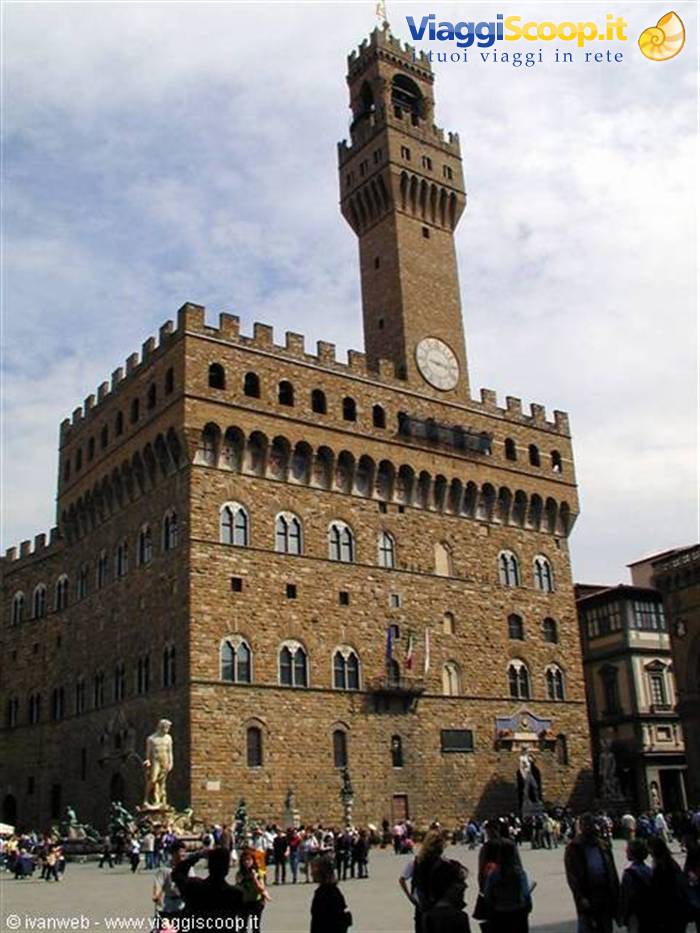
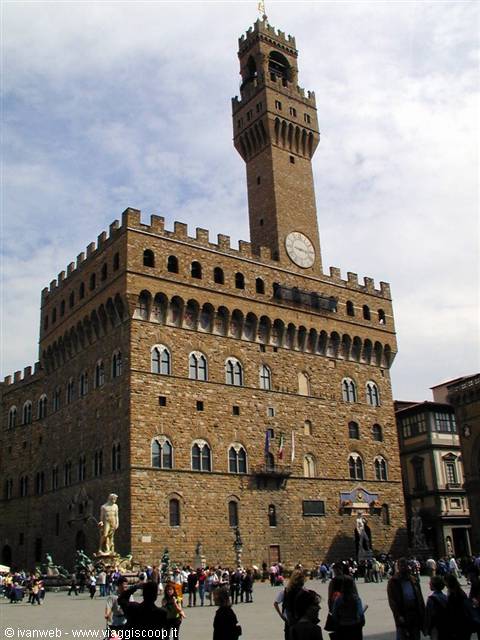
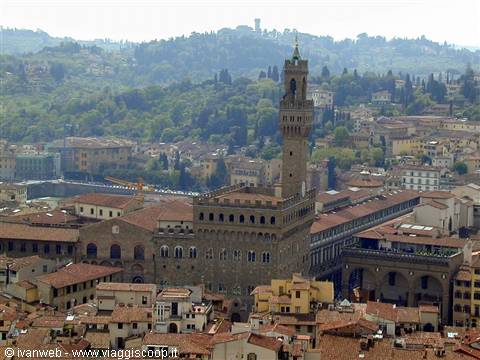
Palazzo Vecchio
Day 630 Apr 2001
Visit to the Bargello; visit to Palazzo Vecchio; journey Florence - Livorno
Having finished the I.L.P. and its legendary tournaments, Davide today is with us and can spend the morning with me and Stefania coming to visit the centre of Florence. We start with the Bargello, the oldest seat of government of the city, dating back to 1255 as the city town hall, later becoming the seat of the chief of police until 1786 and the site of capital executions. In 1878 Bernardo Baroncelli went to the gallows, accused of having participated in the Pazzi conspiracy in which Giuliano, brother of Lorenzo de' Medici, died. The body was then hung from a window as a warning against other attacks; this was also one of the horrid scenes of the film "Hannibal", sequel to the quicker and certainly better-made "The Silence of the Lambs", where Hopkins kills a poor wretch by throwing him from the balcony precisely inspired by this story.
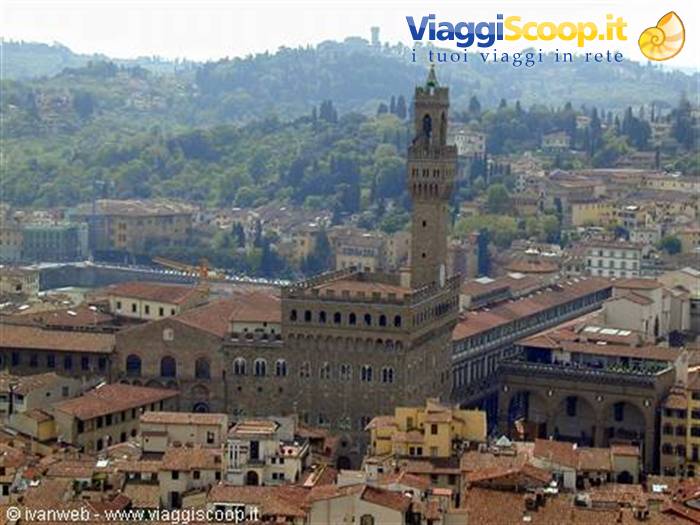
The Bargello became the seat of the national museum in 1865 and here are found works such as the Bacchus by Michelangelo, by Giambologna, the David by Donatello in bronze. The visit begins in the open courtyard, where executions were carried out, then moves inside up to the interesting collection of weapons and armour on the top floor. After the Bargello we move to the nearby Piazza della Signoria, to enter another of the symbolic monuments of Florence: the Palazzo Vecchio. Statues of Grand Duke Cosimo I by Giambologna celebrating the man who unified Tuscany under military rule, and the Fountain of Neptune, celebrating the maritime ambitions of the Grand Duchy. David by Michelangelo from 1501. It was designed by Arnolfo di Cambio and completed in 1322, when the bell was raised on top of the tower.
In 1540 Cosimo I moved here with his family and much of the interior was renovated by Vasari, who also designed the courtyard. It was also the seat of the Italian Parliament from 1865 to 1871. On the right a wide staircase leads to the great hall of the 1500s, decorated with statues and gigantic frescoes: here the heads of the Florentine Republic met. Continuing, there are other rooms, such as that of Eleonora of Toledo, of Pope Leo X, the quarter of the elements with allegories of earth, water, fire, air by Vasari; then still the Hall of the Lilies, which are the emblem of Florence. Finally we go up to the top floor, in the open air, where it is possible to admire the splendid Piazza della Signoria in its entirety. Before leaving we take one last stroll in Piazza Duomo and are captured by two artists who convince me and Davide to have a nice portrait made.
We sit in a chair and in a few minutes we are immortalized in a curious and funny caricature: an interesting souvenir to take home! In the afternoon we close our suitcases and leave the city heading towards Livorno, where we wait for boarding at the port for the Moby Lines ferry to Olbia. The departure is punctual and the first thing you notice on the ship is the abysmal difference in the cabins compared to those of the old Tirrenia ships: the quadruple is large and spacious, with carpet on the floor, the radio on the table, the bathrooms clean inside the cabin, with comfortable beds and nice finishes. And the price difference isn't even that much!
Panoramic view
Day 71 May 2001
Arrival in Olbia; return to Cagliari
Having spent the night crossing the Tyrrhenian Sea, we disembark in Olbia on time. Another three hours by car await us to get to Cagliari, but after all we had no choice since today, May 1st, there was no free place on the Tirrenia ferries for Civitavecchia-Cagliari. Thus ends our journey dedicated to beautiful Florence, a city that speaks for itself, so rich in culture and art that they push those who observe it to want to know and want to discover more and more about its history marked by great poets, painters and sculptors: geniuses of art who here were able to express their best, and donate their most precious art to the Florentine and Italian people.

0 reader comments