The story
27 August. The destination is Baselice, a little village in the Benevento area. I'm a bit hesitant because of decidedly unencouraging weather forecasts, but the Bari sun seems to contradict the bad omens. At Foggia, however, first mishap: because of the driver-navigator's inexperience and the poor precision of the road signs, instead of skirting Foggia on the ring road, we drive into it and go about a quarter of an hour through the streets of the city's working-class districts. In the end we almost by chance take Via Lucera, a road of decidedly dilapidated tenements, and realise we've hit the right road for Lucera, precisely the next objective of the route. We skirt the town and come close to reaching Alberona. Now things start to get complicated, because the flat route is replaced by a more winding one.
We climb the steep ascent, which is also used by scheduled buses on weekdays, and finally reach Alberona (732 m a.s.l.), a village that boasts the orange flag.. We descend from the village to continue our journey. The roads become more and more complex; luckily the weather is kind and the road traffic extremely light. Between climbs and descents we reach San Bartolomeo in Galdo, the first village of the Sannio. Reaching this pleasant little nativity-scene village was a real test of courage; much of the road is little more than a drovers' track, with gravel, no street lighting and big cracks in the middle. From San Bartolomeo we finally reach Baselice, a classic small provincial village with idlers hanging around the bars and people who, at the first request for information, are seized by curiosity.
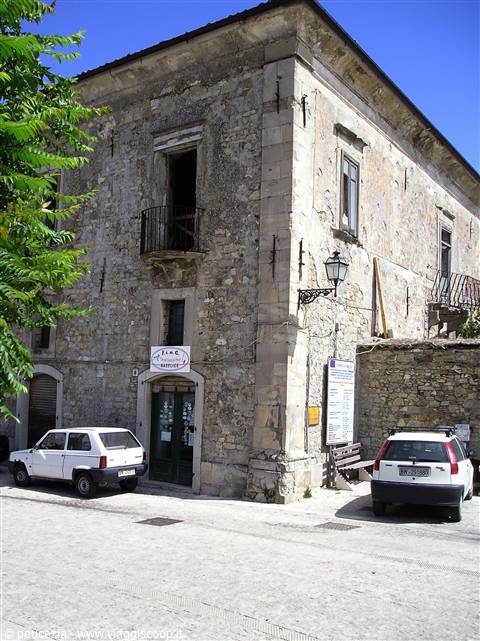
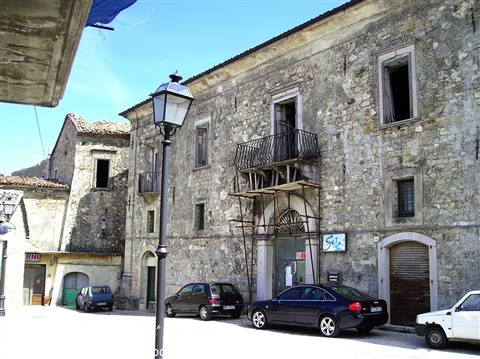
After a phone call, the appointment with the radio listeners is at Palazzo Lembo, a half-destroyed palazzo, probably the residence of the local bigwig. We have lunch at AGRITURISMO IL CONTADINO, Contrada De Fenza 82020 - Baselice (BN) Tel. 08249685590. It's a little peasant cottage but inside three tables are occupied: a family group, a man perhaps from show business with some young aspiring 'starlets', a semi-obese priest with a static mother. On the right a television is tuned to the Istanbul Formula 1 Grand Prix. Another adventure awaits us. We decide on a different road from the previous, already very complex one. The first stop is Montefalcone in Val Fortore.
The road is called a 'provincial' road but that's a very big word: potholes, curves and dangerous hairpin bends, crossings of flocks...When we begin to convince ourselves we've taken the wrong road (and the doubt of having taken a secondary road remains), an elderly, rubicund shepherd tells us we've reached the first little village! Jubilant, we set off again for the new, less tragic stop than the first but still heart-stopping!:-0 At Castelfranco in Miscano a man who turns out to be a lorry driver tells us that the SS90, the road marked on the map to go towards Foggia, is blocked by a landslide and forces us to enter Savignano Irpino!!! We take the state road called 90 bis and then towards Savignano for a stretch we join the SS91.
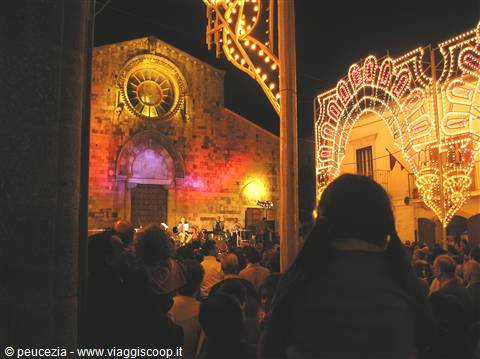
The villages crossed so far are all more or less the same, all equally depressed and deprived; we miss the Monginevro road, demanding but certainly with a greater and better impact! Into the village come campers and other cars diverted because of the landslide, a real crime by the administration towards road users! Finally our sufferings seem to come to an end: we take the 90 towards Foggia and immediately find the turn-off for Bovino. After so many difficulties, the hairpin bends that separate us from this little village don't seem prohibitive. We pass the sanctuary of Valleverde with a roof of such a colour and climb up to the small village swarming with locals and holidaymakers waiting for the patron saint's festival: the main street is lit up and full of market stalls. We go into a pizzeria La Taverna del Duca: P.za XX Settembre, 5:: Tel: 0881.966326 28 August. New stop: Troia.
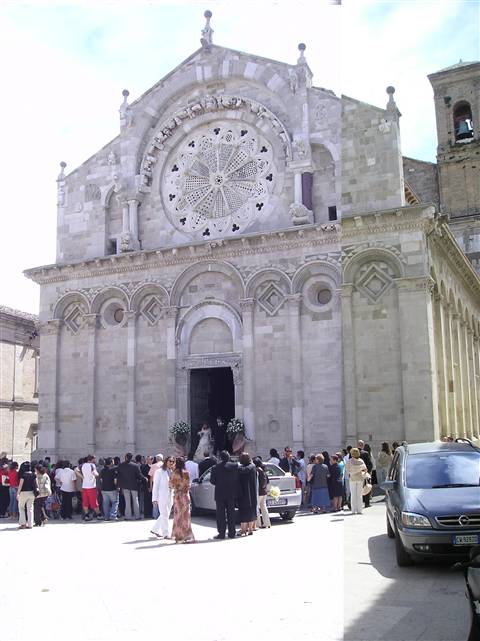
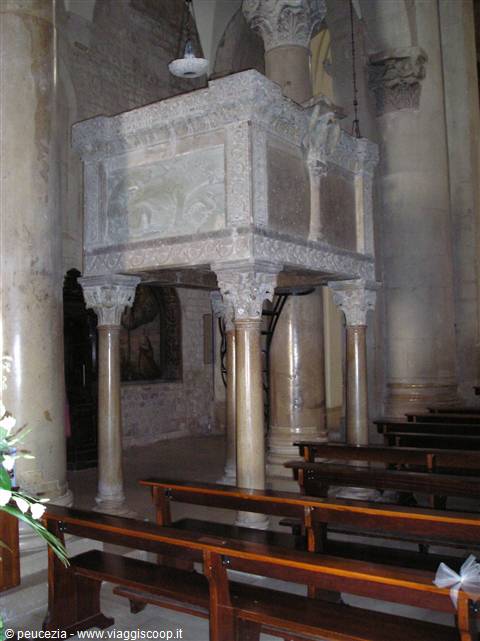
For a certain stretch the road is winding, as usual by now. In Troia too it's rather hot, and after all it's late: midday has long passed. After some nerve-racking laps looking for parking, we stop and head for the elegant, well-kept historic centre, of medieval type, so much so that it recalls that of Siena. The famous cathedral with its magnificent rose window appears in all its imposingness. Outside, well-dressed guests, including a girl in clothes decidedly unsuited to a religious ceremony, wait for the newlyweds to come out of the church. It duly happens amid applause and showers of rice. We go in: the church is decorated with flowers, we admire among other things the cathedral's pulpit. Coming out of an adjoining bar I take the chance to have a look at the Gazzetta del Mezzogiorno: the news is riddled with episodes of violence.
At 12.50 near the Pro Loco office, the man in charge is about to close, but kindly offers us tourist material and candidly describes some of the main events that take place in the village. We move off towards Lucera, taking the SP 160; by now the route can be called straight and easy after the earlier ordeals! We arrive in the village at the lunch hour and so decide to go to a restaurant to refresh ourselves. The chosen restaurant is 'IL GROTTINO', with a rather narrow staircase going down. The restaurant is open by chance, there are few diners but the menu is cheap and the food is good. We order two plates of grilled sausage, a portion of grilled vegetables, fruit and sorbet for 20 euros for two. After a break we begin the visit of the town.. The church is old, of late Renaissance period with side altars and wooden statues and frescoes only recently brought to light.
We notice a traffic of Roma women who somewhat impudently beg, accosting passers-by with excessive self-assurance. We move on to the Cathedral, more sumptuous but which nonetheless keeps the basic lines of Puglian Romanesque. It's quite hot and the sun brightens the day. Along the little stone-paved streets of the historic centre we see the outside of the civic museum, still closed after the earthquake of October 2002. In the square in front of a Catholic club a lean man offers to guide us to the municipal park near the Hohenstaufen castle; we walk along the promenade street with elegant ice-cream parlours and shops. The park is elegant and busy with many people; in the distance a child's mini-moto buzzes. From the belvedere you can see the ridge of the sub-Apennines. Protective railings are missing though, and indeed behind the benches there's a very deep ditch.
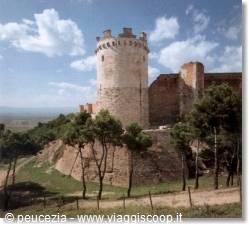
We head towards the castle. The fortress outside is very large and imposing; it is one of Frederick II's major residences, built imitating the defensive fortresses in Palestine. The two towers stand out, one of which, the Queen's tower, is now open to the public and hosts an exhibition of contemporary artists. Indeed there are many people in the courtyard. The interior of the castle is nonexistent; it is an archaeological site with important finds from different periods. The little staircase leading up to the tower is full of people. It's almost half past seven, the sun is about to set. We try to reach the Roman amphitheatre. We make several laps in vain and then end up on a broken, potholed road, the Via dell'Anfiteatro. We discover to our regret that the site is closed for restoration. By now it's late.
Many cars have left and the traffic shows that the holidays are over for almost everyone. We take the provincial road to Foggia, very busy and dark. The bypass around Foggia is long
The journey's photographs
14 photographs · click to open them full screen





0 reader comments