The story
Gubbio
we reach this small medieval town by bus from Perugia; we will soon realise that the public buildings cannot be visited because in… 3 days… the festival of the ceri is scheduled and preparations are under way; in practice only the churches are open to visitors.
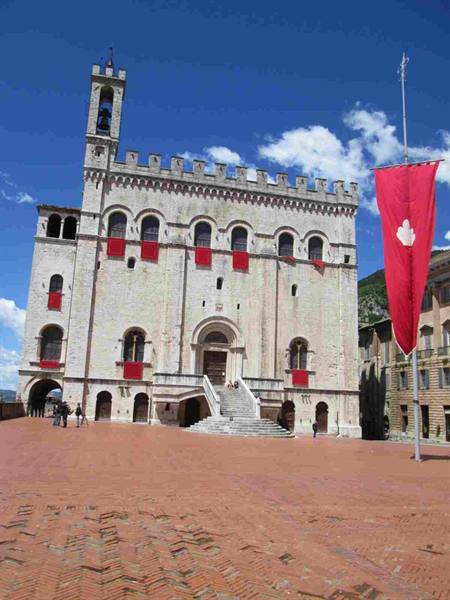
We start with the church of S. Giovanni (12th century); it is very large, the facade in Gothic style is rather simple, the Romanesque bell tower is remarkable, the interior has a single nave, we appreciated the remains of some frescoes; then with a convenient lift we reach Piazza Grande, a belvedere over the landscape and the town, on the two sides the Palazzo dei Consoli (14th century), with a portal and lunette, in front a semicircular staircase, the bell tower is incorporated into the building; less interesting is the Palazzo del Podestà (15th century).
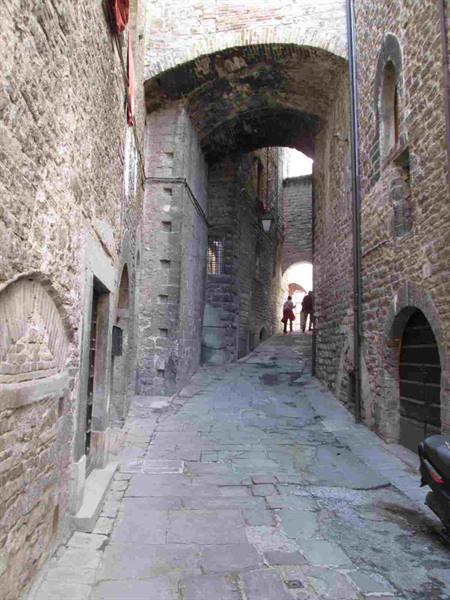
We head towards the Duomo, using a convenient lift and following an uphill road among medieval buildings; the facade is in stone (12th-13th century), without particular decorations, in the centre a large circular window, a very tall interior, vault supported by arches, a single nave, on the sides works by Umbrian painters and remains of frescoes.
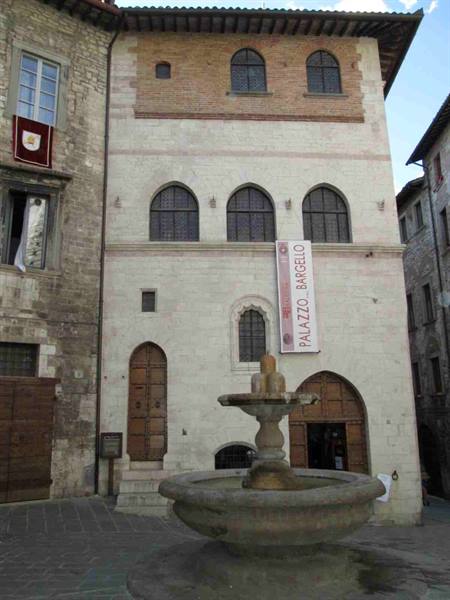
Then, walking along the medieval streets of the town, we reach the small piazza del Bargello, a 14th-century building, and the Fontana dei Matti (16th century), finally the Church of San Francesco, one of the first churches built in honour of the saint; the interior has 3 naves, the frescoes by the painter Ottaviano Nelli are remarkable. Opposite is the Loggia dei Tiratori, a 14th-century building used at the time for wool processing.
Assisi
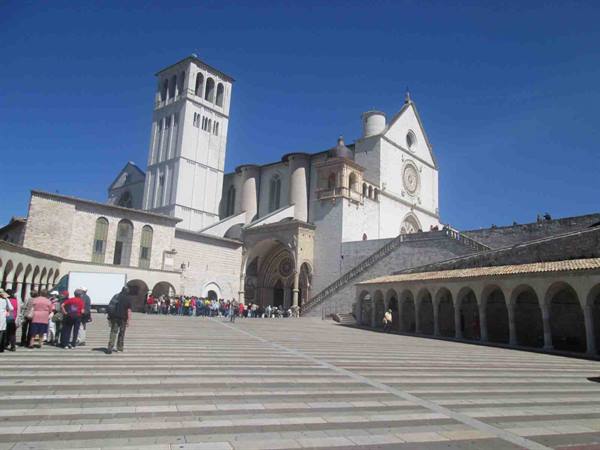
having set off early with the scheduled bus for the town, which has always been one of the most important pilgrimage destinations of Catholicism, to which art lovers must be added, we got off at the foot of the hill on which the Basilica of San Francesco stands; we walk a short uphill road and find ourselves in the large square in front of the church.
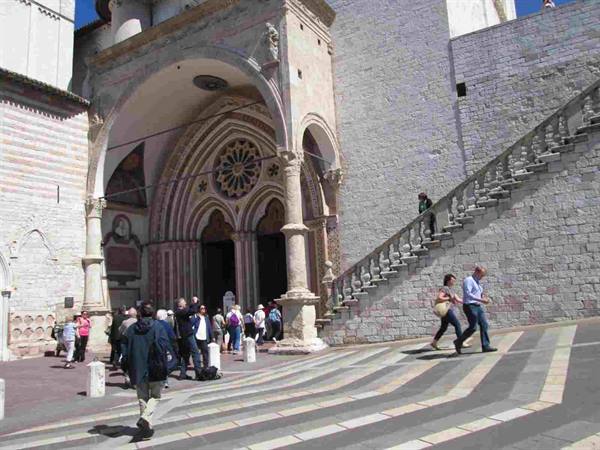
Imposing, it is articulated on two levels; on the first is the Lower Basilica, a construction closer in style to the Romanesque than the Gothic; the portal is magnificent, the interior with low vaults, in fact, it had to be a reliquary church, supported by artistic arches, poorly lit, windows not very large; the impression is grandiose, the whole church is decorated with frescoes with stories of Saint Francis and the Passion of Christ; on the sides are the Chapels, and among them all we liked the Chapel of San Martino frescoed by Simone Martini and the Chapel of the Maddalena; the frescoes have recently been restored; great painters of the time worked on the decoration of the church, including Cimabue, Giotto, Simone Martini, Pietro Lorenzetti and others – it is difficult to tell them apart.
Some areas are dedicated to prayer; throughout the church continuous messages inviting silence are displayed. The basilica is crowded, with very many groups.
I also note that almost all the damage from the earthquake has been repaired.
We then go down to the Crypt to visit the tomb of the saint.
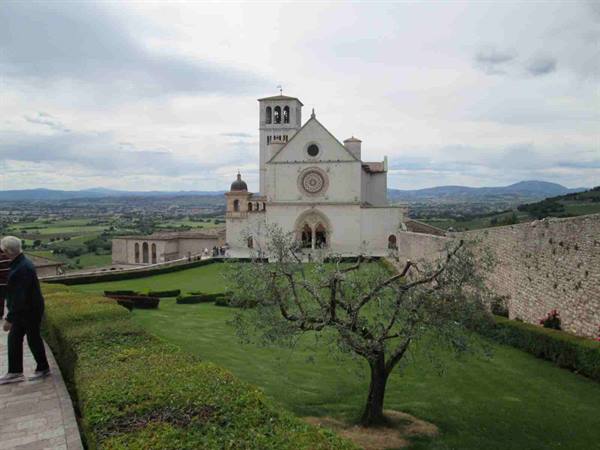
We then pass to the Upper Basilica (built above the lower church); the facade is rather simple, in the upper part a rose window, on one side a loggia and the bell tower. The interior has a single wide nave, without side chapels; some maintain that it is more like an art gallery than a church; note that inside there is also an information box.
The large windows are remarkable, in the form of mullioned windows, with stained glass depicting stories from the Gospel; the vault is supported by Gothic arches; the whole church is decorated with frescoes with stories from the New Testament and of Saint Francis; naturally Giotto and Cimabue and their assistants are always present; also not to be missed is a visit to the Treasury and the Perkins collection.
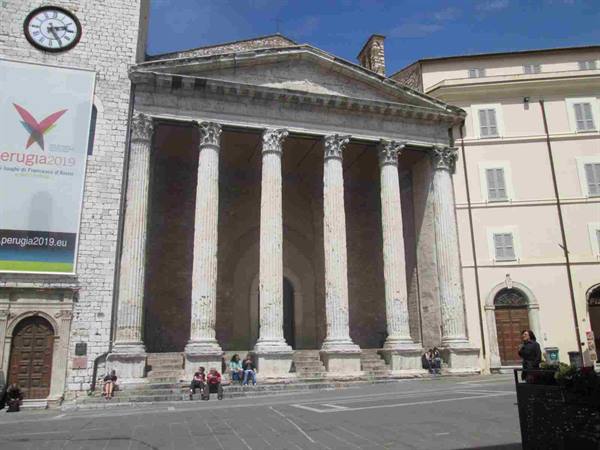
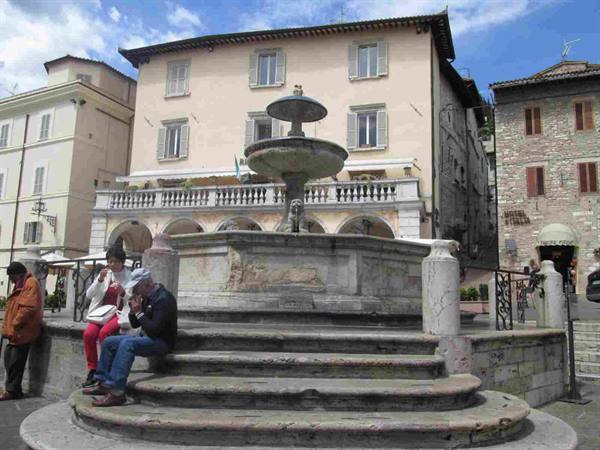
We go out and follow the Via San Francesco, perhaps the main street; we reach the Piazza del Comune, built on a Roman site as shown by the presence of the majestic Temple of Minerva (1st century BC), with its original and perfect Corinthian columns, while the interior is a church in Baroque style; beside the square are the Palazzo and the Torre del Capitano del Popolo (13th century); it is the centre of the town, very crowded, with bars and restaurants, while the Via San Francesco was rather deserted. Continuing the route we reach the Duomo dedicated to San Rufino; the Romanesque facade is very beautiful, with three portals with lunette, each portal has a rose window, in front two lions; the interior is from the 16th century and preserves the baptismal font where St Francis was baptised.
We then reach the Basilica of Santa Chiara, a hut-shaped construction, a rather simple facade with a rose window, a single portal, on one side robust supporting buttresses lean; the interior has a single nave, on the walls and in the chapels frescoes by Umbrian painters; in the crypt are kept the urn and the relics of Saint Clare; in a chapel is displayed the Crucifix that spoke to St Francis, coming from the church of San Damiano.
We continue the visit with the Church of S. Maria degli Angeli; it is in a more peripheral position, not very far from the station, built in the 16th century to house inside it the small chapel of the Porziuncola and the Transito cell, which are shaped like tiny little houses. The Porziuncola has frescoes on the outside, while that of the Transito (where the Saint died), which is even tinier, is practically devoid of decorations.
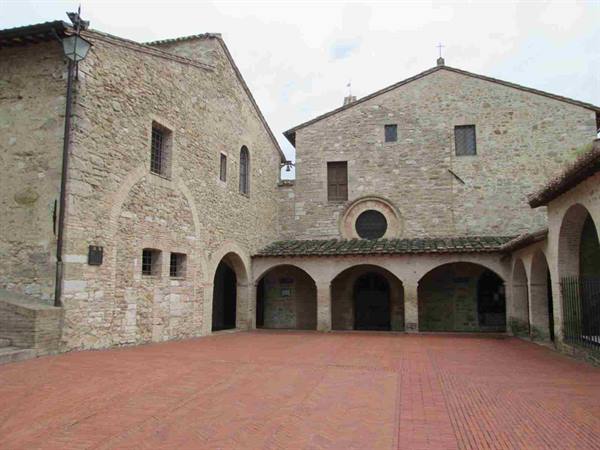
We take a bus that leaves us on a road outside Assisi, and, after covering about 1 km through meadows, we reach the Church of San Damiano, a Romanesque brick church, not very large, which we visit only from the outside because it is closed; it is the church where the crucified Christ spoke to the Saint, and where the Canticle of the Creatures was written; it is an oasis of peace among meadows and olive trees, one of the places where peace and silence reign; there are many signs inviting silence and meditation.
Ferny Forner - Rita Risoli
The journey's photographs
10 photographs · click to open them full screen
0 reader comments