The story
We had learned that in Assisi the restoration of the frescoes damaged by the earthquake had been completed, and we decided to treat ourselves to a short trip to Perugia, Gubbio and Assisi, using exclusively public transport – train to Perugia then scheduled bus for the other destinations – with overnight stays and restaurants keeping an eye on our modest purse.
We arrive in Perugia by train, then reach the centre with the Minimetrò, an automatic metro line with a small carriage (8 seats) whose route runs partly above ground and partly in a tunnel, overcoming considerable gradients; the interior is similar to a cable car.
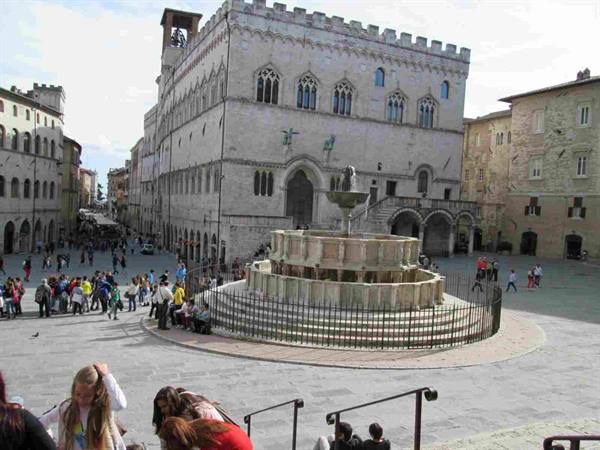
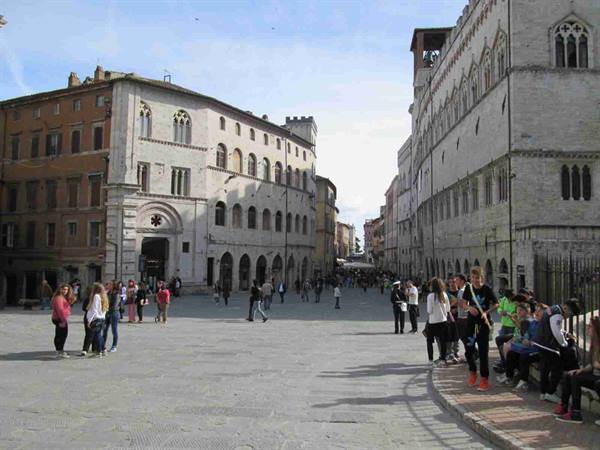
Then from our B&B we reach Piazza IV Novembre, a medieval square and the hub of the town since Etruscan times. In the centre of the square is the Fontana Maggiore, symbol of the town, a masterpiece by Nicola and Giovanni Pisano; it is made up of two concentric marble basins, each decorated with 24 bas-reliefs whose theme is the Bible and various allegories; the griffins at the top are copies; the fountain is protected by a fence which partly compromises the complete appreciation of this work of art.
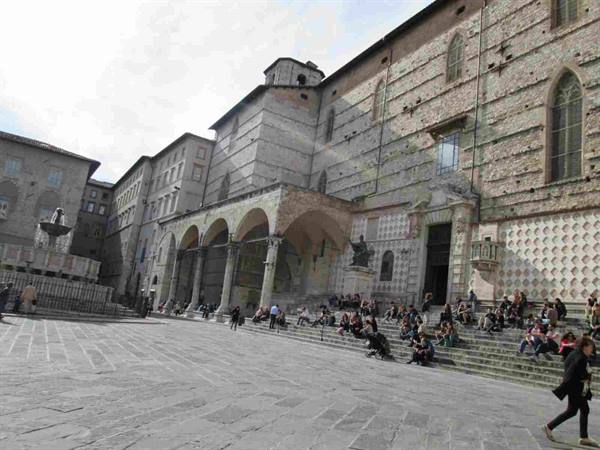
On the right, the Duomo (Cathedral of S. Lorenzo), in Gothic style from the 14th century, without the large stained-glass windows and decorated portals that characterise French Gothic; the facade (spartan) is in the small side square; the interior is Baroque; one enters via a staircase where tourists and young people sit – it is a bit like the Trinità dei Monti of Perugia. In front of the church is the bronze statue of Pope Julius III.
Opposite, the Palazzo dei Priori (13th century) in light marble, partly used as public offices; it is rather large.
The square is rich in historic settings, which were the seats of the guilds; we visited: the Collegio del Cambio, a Renaissance hall with rich frescoes by Perugino on religious and classical themes. the Sala dei Notari, one of the oldest halls, with large ogival arches and frescoes with religious and mythological themes; note that part of the frescoes was redone in the 19th century. Collegio della Mercanzia, a hall with an artistic inlaid wooden panelling.
We continue with the Galleria Nazionale d'Arte Umbra, which contains a complete overview of Umbrian art, but also features Beato Angelico, Duccio di Buoninsegna, Pinturicchio and naturally Perugino; the works are arranged in 40 rooms over two floors.
From the square begins the Corso Vannucci, the main street of the town, where the luxury shops and restaurants are located. It is the busiest street, the place for strolling; it ends at the Giardini Carducci, a belvedere over the Umbrian landscape. Beside the gardens is the Rocca Paolina, in whose underground spaces the escalators pass, leading to the lower part of the town; the passage is very evocative, it feels like crossing a cave, even though there are commercial activities.
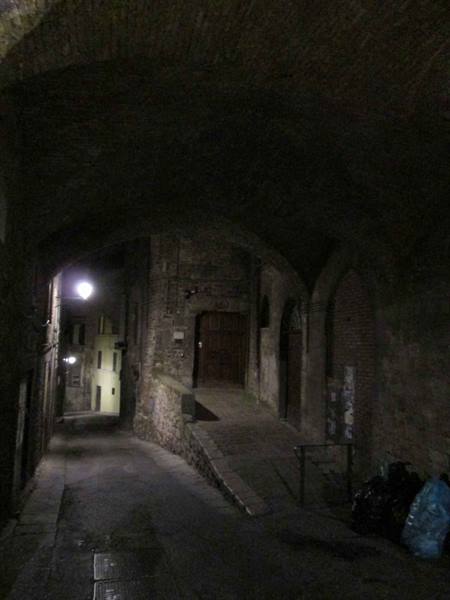
Not to be missed is a walk in the narrow medieval streets with steep gradients; some, on the side, have small brick stairways to ease the route. A return to the past.
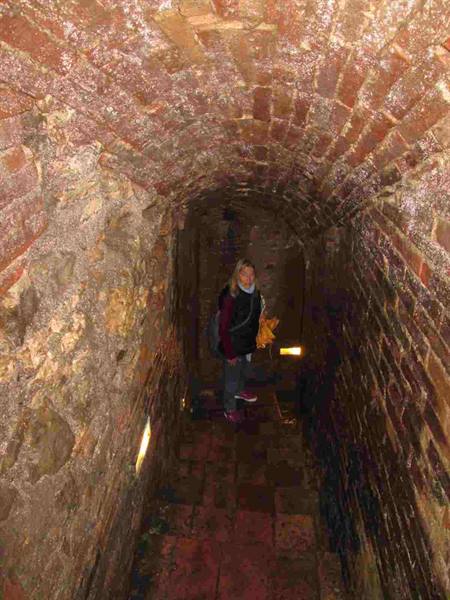
We visited the Etruscan Well (3rd century BC); it is inside a building and was a large water reservoir; it has a depth of about 35 m and is more than 5 m wide; the visit is very spectacular; we descended via a brick staircase to a certain depth.
Still following these streets we reach the Chapel of San Severo, where inside we see the fresco "The Trinity" by Raphael.
Then the Etruscan Arch, but it is all wrapped up for works.
The churches that most attracted our attention are: The Basilica of S. Pietro is located in the lower part of the town, very large, 10th century; the interior has three naves with Romanesque columns; on the walls remarkable works of art and frescoes. The wooden choir is beautiful; the portal I believe is from the 16th century. The Basilica of San Domenico, an enormous church from the 14th-17th century, with a rather bare interior, with a magnificent stained-glass window, and some traces of 14th-century frescoes, very Baroque due to the 17th-century interventions; the cloister with the well is also beautiful; the archaeological museum is attached to the church.
Information that may be useful: Period: 12 – 17 May 2014 Train: Turin – Perugia return Scheduled bus Perugia – Gubbio and Perugia – Assisi Bed and Breakfast Nubes Alba – booked directly on the Web Restaurants for cheap dinners frequented: Della Bianca and Al Mangiar bene
Ferny Forner and Rita Risoli
The journey's photographs
5 photographs · click to open them full screen
0 reader comments