The story
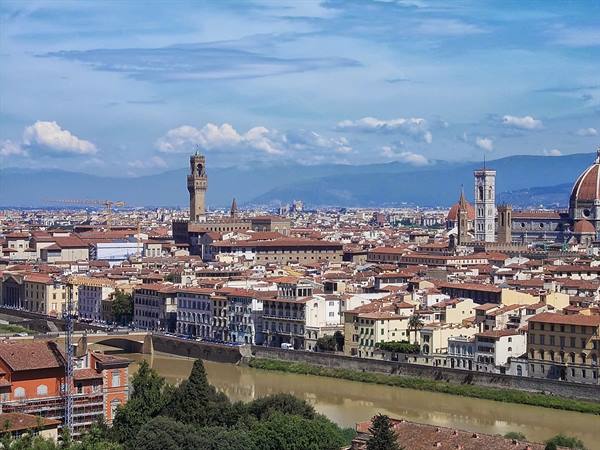
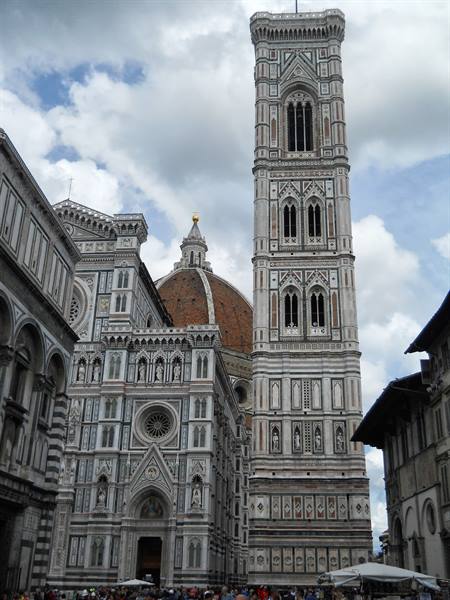
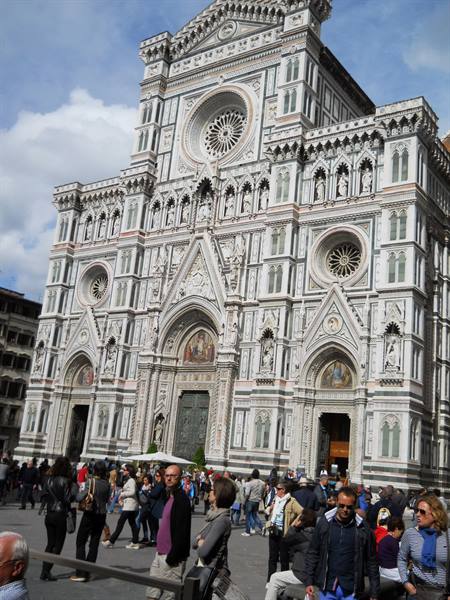
Rita and I were in Florence from 31 May to 6 June; it had been a long time since I had been away from Florence, but palaces, monuments and museums are constantly reproduced in magazines, DVDs and advertising, so it almost feels as if we had seen them recently. We arrive by train around 11, settle in, then begin our visit in the city that is the cradle of the Renaissance with Piazza del Duomo, which together with Piazza della Signoria forms the heart of the city; from afar we see Brunelleschi's Dome dominating the city, but the most admired buildings are the Baptistery and Giotto's Bell Tower.
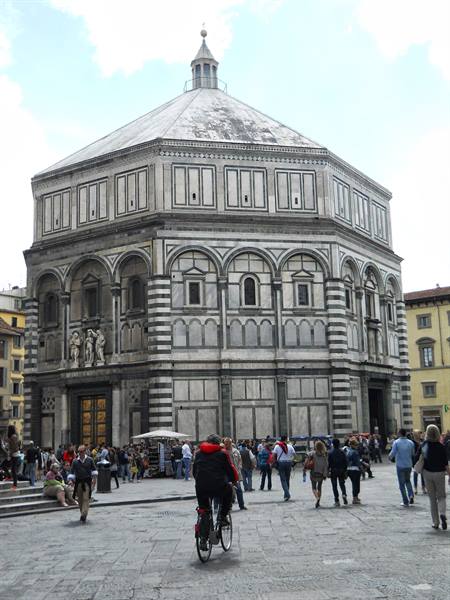
The Baptistery is one of the oldest buildings; its octagonal shape symbolises the resurrection (the eighth day), it is covered in white and green marbles, and the interior is decorated with marbles too, but black has replaced green; the flooring is remarkable, and in particular the zodiac part (we will see a similar one in the Church of S. Miniato); breathtaking are the Byzantine-style mosaics of the dome (12th-13th century), and the frescoes on the walls, with stories of Genesis and the Testaments as well as an enormous Last Judgement that can be seen by looking at the dome from the centre of the baptistery.
On one side, leaning against the wall, is the sarcophagus of the antipope John XXIII, a work on which Donatello also laboured; going out we pause at the bronze door by Andrea Pisano, with panelled scenes, while we overlook the other two more famous ones by Ghiberti, including the famous Gates of Paradise, which are copies. The Cathedral, begun in the 13th century, its current facade dating from the 19th century, is one of the largest churches in the world; the interior appears rather bare, but it is rich in works of art by great artists such as Paolo Uccello, Andrea del Castagno, Vasari and others; not to be missed are the stained-glass windows (13th century) and the fresco of the Last Judgement. Giotto's Bell Tower beside the church, rich in decorations and sculptures (copies) with biblical subjects, placed in niches; the originals are by Luca della Robbia, Donatello and Pisano.
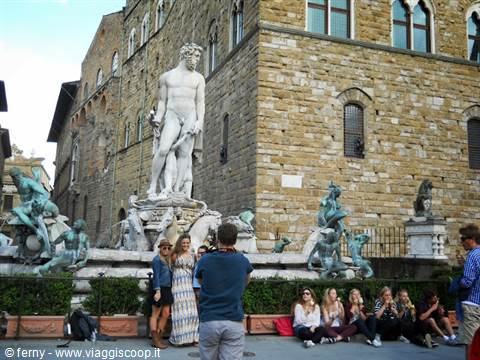
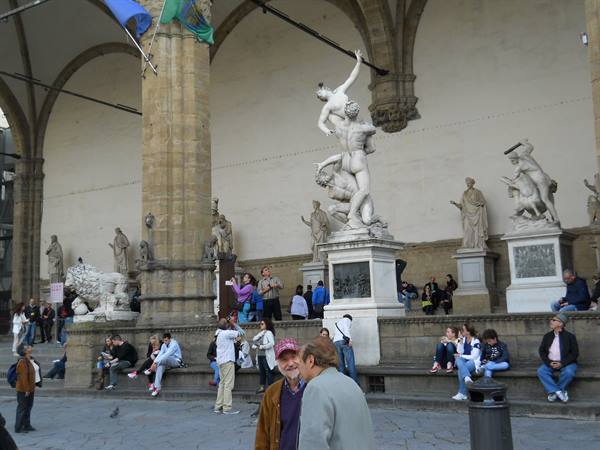
Worth noting how the square is surrounded by relatively recent buildings of no particular artistic merit, and while by day it is always lively, in the evening it is almost deserted, only the facade of the Cathedral being lit up. We head for Piazza della Signoria; it is wider than Piazza Duomo, the main building is Palazzo Vecchio, a 14th-century building that looks like a fortress; we visit it only from the outside; on one side is the Fountain of Neptune, a gigantic nude surrounded by sculptures of nymphs; in front of the palace entrance stands a copy of Michelangelo's David, and to the side the Loggia dei Lanzi, practically a small open-air museum, where you can see, among others, Cellini's bronze Perseus and Giambologna's Rape of the Sabine Women. Then the U-shaped palace of Vasari's Uffizi Gallery, which ends in front of the Arno.
Worth noting that the square is often the site of events that enliven it; when there is nothing on, it is not very busy; the streets around it are somewhat livelier; in the evening many shops are closed, with the odd street-performer show. In the following days, besides taking long walks through the city streets among the Renaissance palaces, we did not deny ourselves a visit to Fiesole; in particular we visit: the Church of the Carmine with the Brancacci Chapel, a true jewel with spectacular stories frescoed by Masaccio, Masolino and Filippino Lippi. the Church of S. Spirito, a work begun by Brunelleschi, with an unfinished, bare facade; inside, a wooden crucifix by Michelangelo, and works by Ghirlandaio and Filippino Lippi; a pity that the large square in front is used as a car park.
The journey's photographs
7 photographs · click to open them full screen
0 reader comments