The story
Rome in 2011, from 11 to 13 October by Ferny Forner Let me start with a few practical notes: Train travel: Turin-Rome on the Freccia Rossa high-speed train, round trip, mini fare 49 euros each way per person; bed and breakfast Angolo Romano at 70 euros for a double room, breakfast included (free wifi), near Cipro metro station. Rita and I begin by heading to the Trevi Fountain, one of Rome's symbolic places, not before admiring Palazzo Barberini and the Fountain of the Triton. In Piazza di Trevi, as always crowded, the fountain is a great monument that forms a single body with the facade of a palace, 20 metres wide and 26 m high; to grasp its scale, just think that 3 floors of a building are 10 metres tall.
It is an evocative work of art (18th century) with gigantic statues, bas-reliefs, white marble sculptures and monumental niches representing figures of ancient Rome such as Augustus, Agrippa and others; at the centre is an enormous shell-shaped chariot driven by Neptune, drawn by horses. Around the basin, tourists toss their lucky coins into the water. We manage to sit on the steps in front of the fountain; it is close to sunset and the view is even more evocative. We leave the fountain (but we will return several times) to feast our eyes on another symbolic place, the Spanish Steps — Piazza di Spagna (17th century) — one of the most evocative and elegant spots with its magnificent staircase, which ends at the church of SS. Trinità dei Monti; also converging on the square are the famous designer shopping streets such as Via Condotti.
This is the Rome celebrated by many films, a place for meetings and for resting on the steps, with many tourists too in front of the Barcaccia fountain, a work by the Berninis, father and son. The square is often chosen for social events and as a backdrop for fashion shows. October 12: St Peter's: it is the day of the Pope's public audience, the square is fenced off and full of chairs; we give up our reservation and take the chance to visit the interior of St Peter's Basilica. The basilica is enormous in scale; they say it can hold 60,000 people. The greatest architects and artists of the age worked on its construction.
The interior is adorned with hundreds of sculptures, among them Michelangelo's Pietà, the only one protected by glass; Bernini's Baldachin is magnificent too, along with dozens of funerary monuments carved or frescoed by famous artists, among them Canova, Bernini and Domenichino. A small note: you can take photos everywhere. Then there is Michelangelo's Dome; to enjoy it fully, given its height, we brought binoculars. On the way out we savour the magnificent square in front and the facade of the basilica; the square has a semicircular colonnade (Bernini) that symbolically represents the Church's embrace of all people. We continue to Santa Maria Maggiore, but first we visit the church of St Peter in Chains, where the chains that bound Saint Peter are kept.
The church is rather hidden away, with a 16th-century facade and a 15th-century portal; the interior is Baroque, with Greek marble columns dividing the central nave from the side chapels, wooden ceilings, and the chains enclosed in a golden reliquary. There is an apse with Byzantine mosaics and also works by Guercino and Pomarancio, but the church's fame is mainly due to the imposing and extraordinary sculpture of Michelangelo's Moses, in white marble. The masterpiece can be enjoyed fully, not protected by glass or anything else — a rather rare situation nowadays — and the sculpture is of striking beauty. Then Santa Maria Maggiore, in the square of the same name with a Roman obelisk. The basilica (4th century) has undergone many interventions and today appears Baroque in style; among the largest in Rome, with a 17th-century portico (its bell tower is among the tallest in the city).
The interior is divided into three naves, with marvellous mosaics both on the walls of the central nave (5th century) and in the apse (13th century), containing scenes from the Testaments, from the life of Jesus and of Mary. The ceilings are coffered and gilded, from the 16th century; the elegant Cosmatesque floor is in marble. One has an impression of great spaciousness and elegance, and there is no lack of works by great artists including Guido Reni. In the square in front stands an obelisk from the remains of the Basilica of Maxentius. After a quick snack at The Old Marconi (nothing special), we go to the Church of St Praxedes, on the street of the same name, a very ancient church (9th century), rich in Byzantine-style mosaics, with a precious relic: the column to which Christ was bound for the flagellation. The mosaics of the chapel of St Zeno are breathtaking.
Not far away is the church of Santa Pudenziana (Praxedes's sister), smaller and less rich than St Praxedes; like all of them, it has seen many changes over time — for instance the access staircase is 19th century and the bell tower is 12th century. The 4th-century apse mosaic is remarkable; I should note that it is poorly lit. We then leave this area and reach the lovely Piazza della Rotonda, not very large, very crowded, with bars and restaurants around it. The Pantheon is an imposing Roman building, practically unchanged over time, with a facade and a portico of marble columns; originally a pagan temple, its interior has a single, cylindrical nave, very large and tall, with a dome shaped like an open bowl at the top. At the sides are funerary chapels with the tombs of the first kings of Italy, of Raphael and other famous Italians.
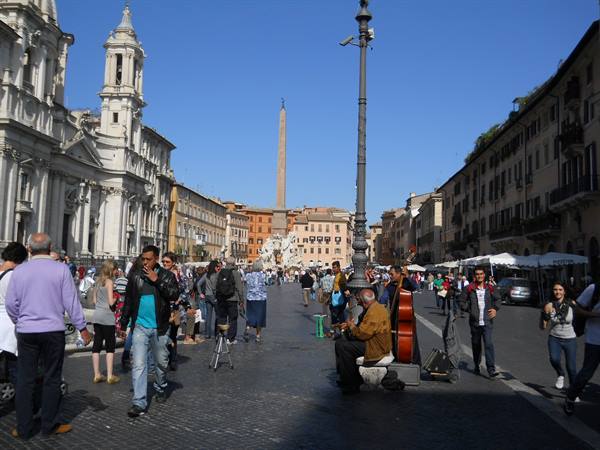
Nearby we visit the church of Santa Maria sopra Minerva, a 13th-century Dominican church in Gothic style, once the seat of the Roman Inquisition; in the building beside it, Galileo's trial took place. Inside is the sarcophagus with the body of St Catherine of Siena, but it is visited above all for the sculpture of Christ carrying the cross, partly carved by Michelangelo; in the side chapels are works by Fra Angelico and Filippino Lippi. In front of the church the Egyptian obelisk is only partly visible due to roadworks. The last stop of the day is the famous Piazza Navona, another symbol of Rome: an elongated oval square with, at its centre, the celebrated Fountain of the Four Rivers by Bernini, whose white marble statues personify the Nile, the Danube, the Ganges and the Río de la Plata, built around an Egyptian obelisk.
The other two fountains (more recent) on the square's central line are very beautiful too, though the sculptures are often copies. The square is lively both by day and by night; at night it looks better because there are fewer stalls, and on the perpendicular streets there are countless restaurants for every budget. Then dinner at the Navona Notte restaurant, average level.
The journey's photographs
6 photographs · click to open them full screen


0 reader comments