The story
October 13: it's the day of the Vatican Museums, booked online at a cost of 19 euros each; at 9 we enter without queuing, we head for the Sistine Chapel walking along the long corridors, called Galleries, all magnificently decorated, both on the walls and the ceilings; we pass through the gallery where ancient geographical maps and breathtaking tapestries are displayed; we arrive at Raphael's Rooms (Logge di Raffaello), and note that not all of them were painted by Raphael, since he died prematurely; simply marvellous is the Room of Heliodorus, then the Sistine Chapel, which is not only Michelangelo, but also Perugino, Botticelli, Pinturicchio and other great artists of the time, but the most admired part is the vault with the grandiose fresco of the Last Judgement; it is the most crowded place in the Vatican Museums (no photos); we have been there several times over the years, but it is
always a discovery; I notice that it is ever more crowded; if you don't get in among the first you risk seeing only the vault. We then resume the tour of the museums, returning to the geographical maps and the tapestries, then visit the collection of modern art; it is fairly recent, large, with many works by Impressionists and later schools; you will find works by many great names such as: Gauguin, Picasso, Rodin, Van Gogh, Klee etc.; I must say I didn't even know that Van Gogh had painted a religious subject; his work "the entombment" struck me a lot; it is a gallery not to be missed. Then a stop at the self-service for a snack, and after that a visit to the ancient part of the museums with Roman, Greek and Egyptian art.
In the evening, in Trastevere, one of the nightlife quarters, old little streets, some call it the Montmartre of Rome; a lovely evening, lots of people, bars, restaurants, venues full; we visit S. Maria di Trastevere, an ancient church (3rd century), but rebuilt in the Middle Ages (13th century), with an 18th-century portico, inside magnificent mosaics by Cavallini (13th century); in the square of the same name a fountain by Bernini. Then dinner, outdoors at the restaurant Hostaria dal Moro (I would go back). October 14: visit to the Colosseum area, one of the symbols of Rome, and of the Roman remains; on the large square, beside the Colosseum, the great Arch of Constantine, then the church of S.
Clemente, a very ancient church; it stands on the site of a Roman house of the first century; it consists substantially of two churches one above the other; the present arrangement is from the 12th century, but the excavations have made it possible to find a third, lower level, the patrician house on which the church was built (excavations visitable for a fee). Numerous are the mosaics and frescoes: in the upper basilica of the 12th century and in the lower basilica there are frescoes even from the 6th century; remarkable too, in the central nave, a 9th-century fresco depicting the Ascension; it is a monument not to be missed.
We return to the vicinity of Piazza Navona, to visit the church of San Luigi dei Francesi, a beautiful Baroque church by Della Porta and Fontana from the 16th-18th century; the interior decorated with sculptures and stuccoes, but you can also admire works by Domenichino and Bassano; the church is above all frequented for the presence, in the Contarelli chapel, of two masterpieces by Caravaggio on the subject of Saint Matthew..... magnificent. Afternoon at the Galleria Borghese; it is housed in an elegant seventeenth-century palace, inside the gardens of Villa Borghese.
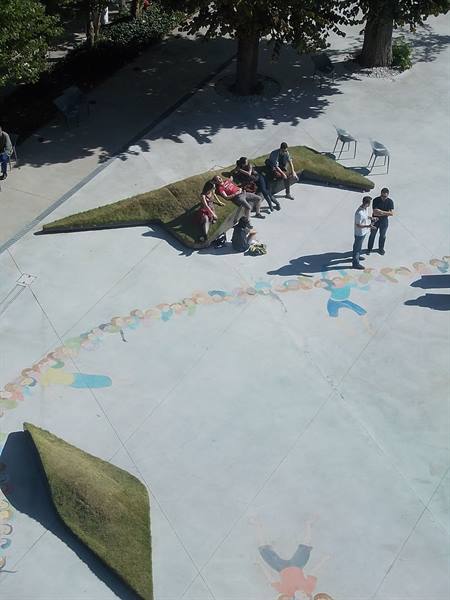
The works are distributed in elegantly decorated rooms; large are the masterpieces of sculpture and painting; among the best known, Paolina Borghese by Canova, Pluto and Proserpina by Bernini, Aeneas and Anchises also by Bernini; among the paintings, two great works by Caravaggio, then Raphael, Pinturicchio, Carracci and others. dinner at Campo dei Fiori. Saturday 15 In the morning, visit to the Maxxi, a museum of contemporary art; the building is very modern in design; in front there is a garden with an original layout; inside I visit a temporary exhibition on the most recent Chinese architecture; they are photos, models and projects; then I see the rest, but it didn't make a great impression on me.
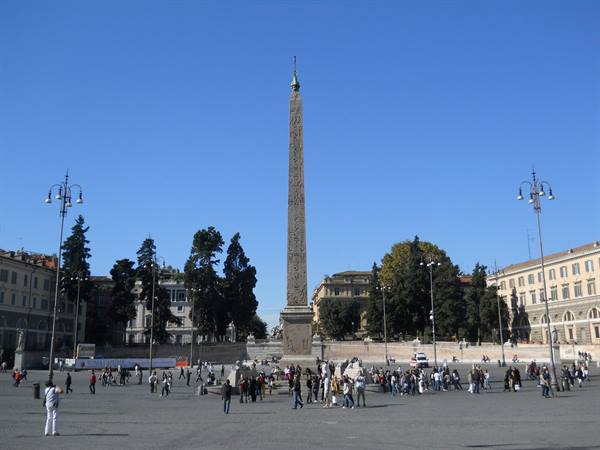
In the afternoon, because transport was halted, I return to the Vatican Museums, going to visit the Pinacoteca; great masterpieces of art are exhibited, from the Middle Ages onwards; among the great painters, Giotto, Filippo Lippi, Perugino, Raphael, Titian, Caravaggio, to name but a few. Sunday 16: Piazza del Popolo, a large square with an ancient Egyptian obelisk in the centre (1200 BC), moved from the Circus Maximus; the square was laid out by Fontana in the 16th century. On one side the church of S. Maria del Popolo, an 11th-century church, but the one you see now is the result of the transformation it underwent in the 16th century; Baroque interior; many are the works of art in the various chapels inside, Pinturicchio, Sansovino and two masterpieces by Caravaggio, the crucifixion of Peter and the conversion of Saint Paul; the dome is attributed to Bernini.
We then head for St Peter's to attend at 12 the Pope's message. Monday 17 San Giovanni in Laterano, perhaps the oldest church in the world (early 4th century), already the seat of the papacy; like almost all ancient churches rebuilt several times; the one you see now is from the 17th century; a part is from the 16th century to a design by Fontana; interior with 5 naves (Borromini), like the arches of the portico; gilded wooden ceiling; magnificent Cosmatesque floor; many are the works of art, some from the old basilica, among them a fresco by Giotto; in the centre a great fourteenth-century tabernacle, adorned with frescoes; high up are kept relics of Peter and Paul, contained in silver caskets; on the altar only the pope can celebrate functions; then both on the apse and on the side walls of the central nave rich mosaics, remarkable that of the Redeemer (4th century); the naves are separ
ated by enormous pillars with niches inside which are placed statues of the apostles; outside, in the portico on the left, you can admire a statue of Constantine brought from the Imperial Baths. In the square we visit the Scala Santa, a building erected by Fontana, which contains the staircase of the palace of Pontius Pilate that was climbed by Christ; the faithful can climb it only on their knees; at the sides the staircase is decorated with frescoes; note that the staircase is covered in wood; at the top of the staircase, closed by a railing, the chapel of the popes; we sit on the steps opposite, from where we admire the ancient obelisk in the centre of the square, and further off the Colosseum and the Arch of Constantine. Then departure. Ferny forner
The journey's photographs
6 photographs · click to open them full screen


0 reader comments