The story
From the Archaeological Park of the Roccelletta di Borgia to Capo Colonna, a journey through history, crossing the tourist resorts and the enchanting coasts of the Ionian Sea, in the Gulf of Squillace
The archaeological park of the Roccelletta di Borgia (CZ) is the place where, according to scholars, the Greek colony of Skylletion arose. Excavations have so far revealed structures from the Roman era such as the theatre and the forum, and a basilica of Norman origin dating back to 1060 AD. From the ancient Greek Skylletion, no wall structures have yet emerged, due to the overlapping of the Roman city, but there are numerous ceramic finds from the 6th, 5th and 4th centuries BC. The archaeological evidence from the Roman era is better documented: a route with explanatory panels guides the visitor along a path that from the entrance leads first to the imposing ruins of the Norman basilica of Santa Maria della Roccella (11th century AD). Inside the Park is the Antiquarium which houses the finds from the site.
The Roman forum consists of a rectangular area paved with square bricks surrounded by porticoes; a caesareum, the Curia and a thermal hall have already been excavated, and a small temple, a monumental fountain and a tribunal are also visible. From this area also comes a splendid series of statues and portraits from the imperial period (1st century BC - 3rd century AD) kept in the adjoining antiquarium. Besides the forum, leaning against a hill, stands the Roman theatre (1st and 2nd century AD) which must have held about 3000 people. Above the hill of the theatre, an amphitheatre, the only one in Calabria, dated to the 2nd century AD, three thermal complexes, a Roman necropolis and the aqueduct, also of Roman construction, have been identified.
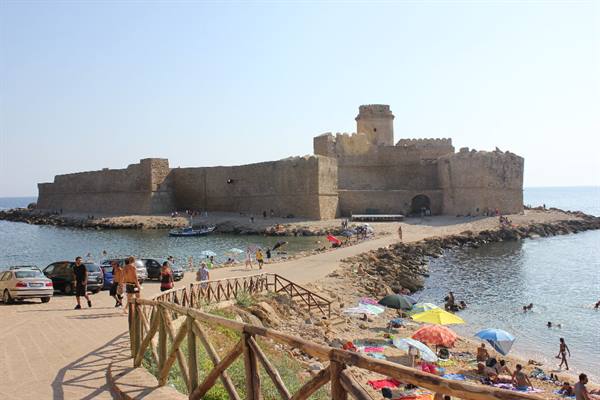
Continuing along the road that runs beside the Ionian Sea, in the direction of Crotone, and crossing splendid tourist resorts, you reach the Castella di Isola Capo Rizzuto. Located along the Ionian coast, this castle was built in 204 BC, when the leader Hannibal stayed in this area, and was inhabited by Arabs and Aragonese.
The special feature of Le Castella is its position: built on an islet, it is connected to the coast by a thin strip of land. In ancient times Le Castella was not the only castle in the area, and the name in the plural indicates precisely that there was more than one fortification.
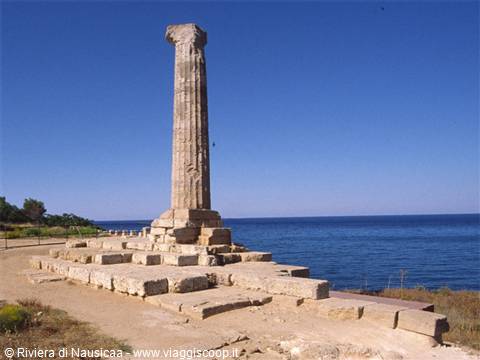
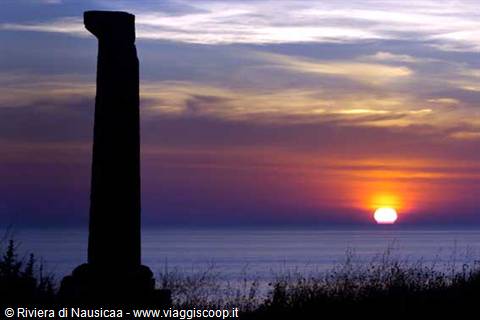
Ten kilometres further south of Crotone, on the promontory overlooking the Ionian coast of Capo Colonna, which the ancient Greeks called Heraion Lakinion, stands the Archaeological Park of Capo Colonna.
The Park covers 30 hectares. The area of the Lakinion Akron, certainly one of the best-known sacred areas of the whole of Magna Graecia, revolved around the Sanctuary of Hera Lacinia. The temple itself had the classic shape of Greek temples: an imposing complex of 48 Doric-style columns over 8 metres high and made of 8 fluted drums. The roof was of marble slabs and Parian marble tiles.
Watch the video on youtube More details:
The journey's photographs
5 photographs · click to open them full screen


0 reader comments