The story
I return to Budapest after 10 years, and I almost don't recognise the city I had encountered in 1989, a few months before the fall of the wall, numb and tired. Now Budapest is one of the most beautiful European capitals, with an exceptional architectural restyling. Five days are barely enough to visit it: home to two sites belonging to the UNESCO world heritage, it is the only capital in the world where hundreds of thermal water springs and 12 thermal baths are found. Budapest was essentially built in the last third of the nineteenth century and the beginning of the twentieth at an American pace. The dominant style in the architecture of this era of peace until 1914 was the Art Nouveau style. This style, which came from abroad, then had a great Hungarian master recognised also in Europe in the person of Ödön Lechner (1845-1914), „the Hungarian Gaudí”.
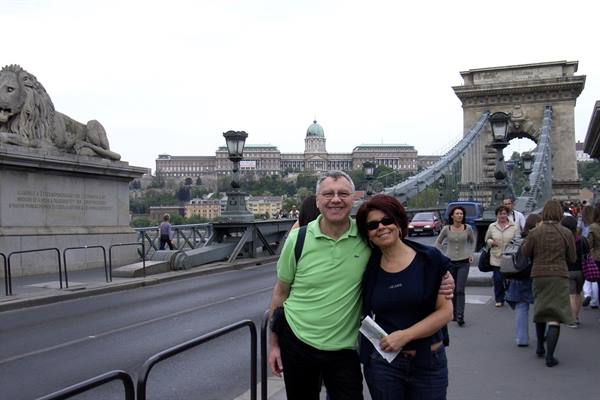
Budapest can boast two world heritage sites that uniquely form a connected itinerary: on the Buda side, from the Chain Bridge (from Adam Clark Square) the Engineering University Palace, the Gellért Thermal Bath, Gellért Hill with the Liberty Statue, the Citadella and the buildings of Buda Castle including the picturesque Fishermen's Bastion with an exceptional view over the city. On the Pest side, under protection are the Parliament (a masterpiece of exceptional beauty), in front of the Chain Bridge Roosevelt Square, as well as the Redoute palace and the 4 bridges of this side (Margaret Bridge, the Chain Bridge, Elizabeth Bridge, the Liberty Bridge)....and then the baths. We treated ourselves to a day at the Gellert baths, the most beautiful bath in Budapest, where the original Art Nouveau furnishings have remained with coloured mosaics, marble columns, stained glass and statues.
But the choice can range toward the Szechenyl, Rudas, Luckacs, or Kiraly thermal baths, to name the best known. From Budapest a flight took us to Krakow, another splendid capital city of Poland until the 16th century, when it was moved to Warsaw. Cultural capital of the country, it boasts a very famous university and is in fact full of young people.
The old town is a true jewel, so much so that it is recognised as a World Heritage Site: splendid is the Market Square, the largest medieval square in Europe, a square of 200 metres per side (Rynek Glowny), around which stand beautiful buildings of the 17th and 18th centuries, some of them with a Venetian imprint, the civic tower of the Town Hall, the great Cloth Hall (Sukiennice) and above all the church of Santa Maria with the wooden altar by Veit Stoss (a marvellous work of art) and the tall tower from which the famous “call to arms” is played every hour. Another historic core to visit is the one on Wawel Hill with the Castle, the Cathedral and further down the Baroque Church of St. Peter and Paul. Disappointing for us, however, was the Jewish Quarter Kazimierz. Last gem: the Czartoryski Museum, which we visited above all to see Leonardo da Vinci's painting Lady with an Ermine.
Krakow too impressed us very positively. Less beautiful but not for that to be thrown away, Warsaw. We expected it, after all the city was almost completely razed to the ground by the Germans in 1944 and its current historic centre is the result of an accurate reconstruction faithful to its original state...but still fake. However, the ancient forms have been lovingly reassembled in Castle Square (Plac Zamkowy) and in the rectangular Market Square (Rynek), now surrounded by colourful houses housing restaurants, bookshops, pastry shops, museums, cafés, enlivened especially in summer by vendors, painters and tourists.
A visit to the city cannot overlook the Citadel, a fortress-prison erected by Tsar Nicholas in 1832, with a route that winds along the Vistula, the Muranow district, with the monument to the ghetto heroes (the Jews exterminated in Warsaw were 350 thousand) and the royal itinerary, from the Castle to Lazienki Park, among palaces, churches and monuments. Lazienki Park is the largest in the city (greenery reigns in Warsaw): inside it is the Palace on the Water (Palac na Wodzie) in neoclassical style and the theatre built on an islet. The park is very extensive and among woods, lakes and streams there are many colourful birds, squirrels and the inevitable tribute to Chopin, a distinguished citizen. A truly well-articulated journey that allowed us to see different cross-sections of our Eastern Europe.
The journey's photographs
8 photographs · click to open them full screen



0 reader comments