The story
SARAJEVO, ONCE AGAIN (The tunnel) On my last day in Sarajevo, after yesterday's intense experience of Srebrenica, I decide to take a taxi as far as Butmir, near the airport, to see the tunnel dug during the siege. My taxi driver is talkative and, since the road is long, I reciprocate with my limping English. I thus discover that he knows Trieste and that his father used to come there to buy jeans and 14-carat gold around the train station, jeans and gold that sometimes, after a long journey, could end up in Prague or Budapest, and even in the boutiques of Moscow. Towards Butmir the driver points out Mount Igman, where the 1984 Winter Olympics were held.
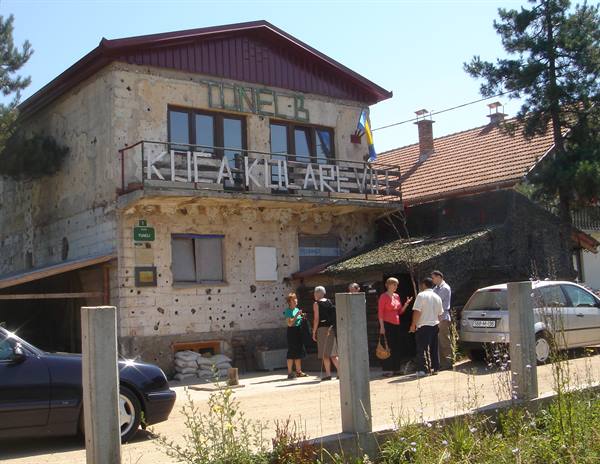
When I tell him I remember the mascot "VUCKO" very well, a little wolf cub, he bursts into a boisterous laugh: "Ja, ja vucko, emblema!" Shortly before turning off for the museum, he tells me that the neighbourhood where we are now is called Dobrinja and that this is where the hard fighting took place, building by building, house by house, and the neighbourhood's population suffered greatly during the siege because the Serb militias had managed to conquer half of this neighbourhood of social housing, settling less than 15 kilometres from the centre of Sarajevo. In Dobrinja there had been kidnappings, rapes and killings; here, all non-Serbs had been driven from their homes and the men had ended up in prison camps. Finally we arrive at the house-museum, whose façade still bears the marks of the mortars. They show me a DVD on the construction of the tunnel and on life in besieged Sarajevo.
I'm with a small group of English people whose guide, a Bosnian woman, can't hold back her tears. With a gentle movement of her hand she wipes them from her cheeks, as if she felt ashamed to let them slide freely down her face. I found that gesture heart-wrenching and her of a grand dignity. She jokes about it and laughs to exorcise, I imagine, the fear that all that horror might one day return. The first attempt to build an underground tunnel involved the use of a drainage pipe for groundwater, but in the chaos of besieged Sarajevo it wasn't possible to find the sewage plans and the project was soon abandoned. But at the end of 1992 it was necessary to act decisively, since the population was at breaking point. General Rasid Zorlak managed to find two engineers capable of drawing up the project. The works began in great secrecy.
The project involved a tunnel passing under the airport runway, for which it was necessary to have the authorisation of the UN, to which the control was entrusted, and to make sure the calculations were extremely precise so as not to cause damage to the runway and its stability. The entrance and exit holes were established so as to halve the execution times by digging simultaneously from both sides. The digging works began in January '93. Three or four hours of work a day, no more, because the works were slowed by the continuous bombardments and also because only picks and shovels could be used. For lighting they used bowls filled with cooking oil with a small fuse. With April, to speed up the works three shifts of eight hours each were organised so as to cover the whole day.
The water that filled the gallery was sucked out by a hydraulic pump but, more often, because of the continuous power cuts, buckets and jerrycans were used. Meanwhile the besiegers, having noticed the works, began to systematically bombard the area involved in the digging to discourage its continuation and slow the works. On 30 July 1993 at 9 pm, after seven months of almost uninterrupted works, the two sections were joined and the men who at that moment were digging shook hands. Now Sarajevo had an underground link through which to channel weapons and soldiers and food supplies, and to evacuate the wounded into areas controlled by the Bosnian Armija. The tunnel measured 800 metres in length by 1.5 in width and height and connected Sarajevo with the free territories of Bosnia-Herzegovina. Essentially the tunnel was a military-strategic instrument of extreme importance.
Twice the Serb shells massacred civilians waiting to cross the tunnel. Dug under the house of the Kolaric family, it has now become a museum. The two elderly owners, grandpa Alija and grandma Sida, became famous during the war: there was always a piece of bread and a glass of water for the tired soldiers returning from the front, who warmed up chatting in the little room heated by a wood stove. The following morning, early, I leave Sarajevo and, after travelling the busy, chaotic "sniper avenue", I take the turning for Zenica.
The journey's photographs
4 photographs · click to open them full screen

0 reader comments