The story
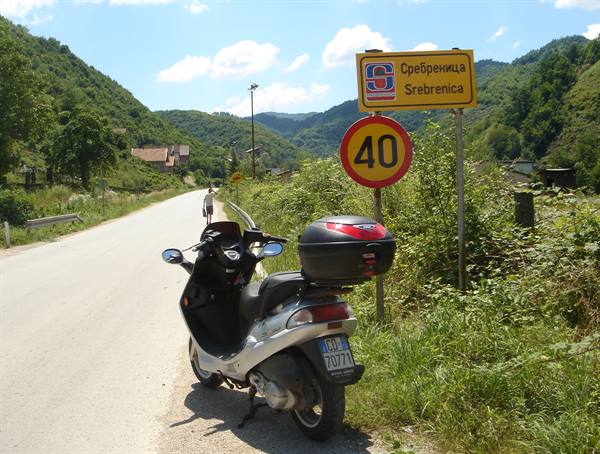
THE SORROWFUL WAY In the morning I decide to go to Srebrenica. I slept little during the night and I feel tense as a violin string. The idea of going there, knowing what happened, unsettles me. I have a very frugal breakfast, my stomach is in turmoil. On top of that I have to cover over 150 kilometres and as many again on the way back. I don't know why, but I decided not to tell anyone that I'm going to Srebrenica. I'm afraid they'll talk me out of it or that it will stir hostility. On a piece of paper I write down the names of the towns I'll come across along the road as far as Milici, where there's the last turning that will take me to Srebrenica. I stop every 30 kilometres or so to drink a coffee and ask for information, because here the signs are back in Cyrillic and I don't want to take the wrong road, given that the kilometres to cover are already so many.
When I arrive at Vasglanica, a little town a bit bigger than the others I've met so far and an important junction for Srebrenica, I find myself in front of a yellow sign with more than six directions in Cyrillic. Luckily two lads are working inside the courtyard of a house, and I ask them for clarification. I don't mention Srebrenica even to them, still convinced that it would cause annoyance. Instead the lads look at my plate and once again I discover that Trieste is known in Bosnia, if only for the jeans and gold trade that made the merchants of Borgo Teresiano enormously rich in the '70s and '80s. They give me very thorough directions on how to reach Milici and they write the name in Cyrillic on a piece of paper and then, convinced that I'm heading on to Belgrade, they urge me to take a kiss to all the Belgrade girls.
With my poor English I even manage to crack a few witty jokes and make them laugh (or maybe they laugh at my English?). I say goodbye and after about thirty kilometres I find Milici and the turning that leads to Srebrenica. I stop at the corner to catch my breath and sit down in a trattoria for a coffee. While the lad serves me, a good smell of cevapcici being grilled comes from the kitchen. From him I can't hide my destination: when he asks me where I'm going I tell him, but he doesn't bat an eyelid and points me the way. He wants to chat and asks me where I come from and how far I've travelled. "All that with that?" he says, pointing at the little Dink. "Very long drive!" he comments. It's already one o'clock and I've been in the saddle for 4 hours, between one stop and another. It's time I went and made up my mind to do the last stretch that separates me from Srebrenica.
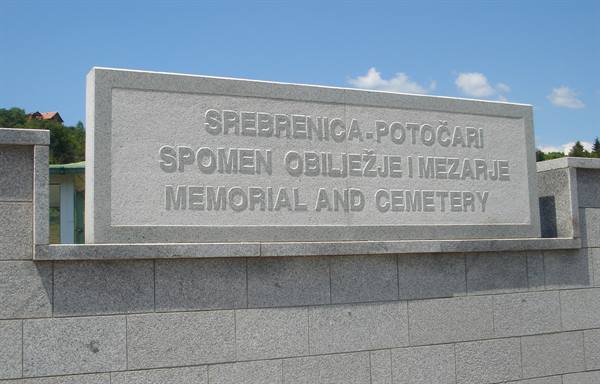
I ask him what there is to eat and, after hearing the menu, I decide to stop on the way back for lunch. We say goodbye and I get back on. The houses along the road still clearly show the marks of the war. Some are half-destroyed, others being renovated, and then the usual stumps blackened by fire and abandoned by their owners. The shell marks form abstract squares with their holes… they remind me of Fontana's "holes". My stomach knots up thinking of all the horror that happened here. When in the distance the outline appears of the shed of the former Potocari factory, where the Dutch Blue Helmets had their command and where the refugees fleeing from Srebrenica, which was about to fall, had taken refuge, I get the shivers. There's a roadblock right in front of the Memorial to the victims of the genocide and of course I'm stopped for a check.
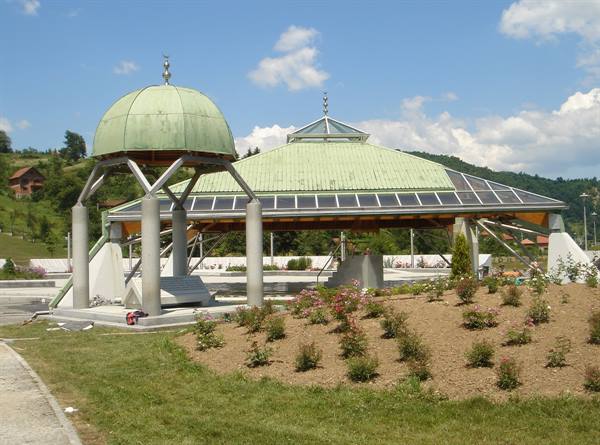
The policeman doesn't speak English and, gauging him, I hand over, like a ritual, licence, registration and green card. He's a bit gruff, he insists on speaking to me in Serbian even though he well knows I don't understand it. I stay calm and smile. He looks at my licence and exclaims "Ah, italijanski!" "Any problem?" I ask him. "Nema problema!" He points me to the Memorial car park and repeats: "Nema problema". A marble semicircle holds the names of the victims carved in alphabetical order. A man runs his eyes over the inscriptions, probably looking for a relative or a friend, one hand pressed to his mouth. I feel as ashamed as a thief when I take the only photo inside the Memorial. Outside everything seems indifferent; the policemen chat and laugh among themselves in the shade of the roof of the casemate set against the fence that separates the road from the factory.
The shed looks like a sinister place of memory and of Europe's shame. I go out and put the scooter back on the road to cover these 7 kilometres that remain to Srebrenica. In a few minutes I'm in the town, today half-empty and lacking any superstructure; the water comes only at set hours and so does the electricity. Here there used to be the spa baths, but they were destroyed by the shells in an attempt, a successful one, to cut off the water supply during the siege. Once this was a thriving and rich town of silver mines (srebro). The Sasa one in particular was equipped in a technologically modern way and before the war employed 1,800 people, of whom 400 were miners. From '93 to '95, the year of the capitulation, Srebrenica was declared a UN-protected area and besieged by Serb-Bosnian militias.
Inexplicably, at least from a human point of view, on 30 May 1995 the UN declared that the Blue Helmet interposition forces in Bosnia should step aside, a decision that would prove fatal for the town. A couple of months later, on 9 July, the Serb-Bosnian army commanded by General Ratko Mladic began to bombard the town without respite. The Blue Helmets, obliged not to intervene, tried to persuade the population to surrender, promising them NATO air intervention, which was never to arrive. Not only that, but meanwhile, threatened with death, the Dutch Blue Helmets handed over to Mladic their uniforms, their weapons and their means of transport. Mladic's men thus entered the town undisturbed aboard UN armoured vehicles, welcomed by the population as liberators. The next two weeks for the inhabitants would be an authentic nightmare.
About 8,000 men between the ages of 12 and 77 – but the "Women of Srebrenica" association has long insisted that the figure be updated to 10,072 – were taken prisoner, separated from the women and summarily executed. 1,800 of them who had taken refuge in the former engine factory where the Dutch Blue Helmet command was located were mown down by machine guns in the reed bed opposite, where the Memorial now stands. The few survivors testified before the judges that, being wounded, they managed to escape by night by pretending to be dead, taking advantage of the tiredness of the soldiers who had been shooting at their companions all day.
What remains to be known and understood in this tragedy, one of the most shameful pages of History written after the Second World War, is the political truth: it remains a mystery why the international forces present did nothing to prevent the bloodbath, why NATO did not support them with air strikes, and how it is that the officers of the Bosnian Army (Armija) present in the area were suddenly moved a few days before the town's surrender. Among the various things that had outraged public opinion was the discovery of a film in which Father Gavrilo Maric blessed weapons and massacrers immediately before the slaughter. When I set off again I feel relieved, as if I had lifted a weight off myself. I'm convinced, however, that anyone thinking of travelling to Bosnia today cannot exclude Srebrenica from their itinerary.
The massacre that took place here will remain one of the most shameful events that happened in Europe in the century
The journey's photographs
4 photographs · click to open them full screen

0 reader comments