"Life is a journey, to travel is to live twice" Omar Khayyam, 12th-century Persian poet…… Perhaps never, as on this trip to Mexico, have I realised how true this phrase is; how time, when travelling, alters its inexorable flow and expands across the faces, landscapes, noises and smells that fill the minutes of an otherwise ordinary day. And perhaps it is for this reason that the memories of emotions, of landscapes and of looks merely crossed remain indelibly imprinted in the memory
Day 118 Nov 2007
Arrival in Playa
After two years of waiting we finally touch Mexican soil, but for the moment it's still hard to realise that I'm fulfilling a dream I'd been cherishing for a long time. In Cancun we're greeted by a heavy, humid and annoying air that for a while makes us miss the pressurised air that enveloped us for the twelve hours of the Atlantic crossing. But enough chit-chat, we head straight off to pick up our sky-blue Hyundai Dodge that will take us around this beautiful country. We head straight for Playa del Carmen and, as soon as we leave the airport, we realise what Mexican topes and vibradores are. Forget kerbs! … if taken at high speed they could send us soaring straight back to Italy..
not to mention the vibradores, which aren't erotic objects but rather half-spheres of metal firmly set into the ground and the size of a good palm, whose function is first of all to make you slow down and secondly, to support the mechanic profession. Even the speed limit signs deserve a mention … they go from 90 km/h to 40 and then back to 60, all within the space of 4/5 km and with no apparent logic ….. at least for us ……so you may as well keep to a fairly relaxed pace. In about an hour, anyway, we reach Playa del Carmen and, without much difficulty, we even find the pousada we'd booked for this first night. Maria Bonita really is a lovely pousada, painted yellow, blue, red, orange and green, overlooking a small pool in the middle of the garden.
After a quick shower we start looking for the village that will host us at the end of our tour and where we want to leave our big suitcases, but tiredness is probably starting to set in and we don't find it. We wander a bit along V Avenida, which is really very pretty, and decide it's time for dinner. Our choice falls on a little place right in front of a very colourful souvenir shop from Chiapas – our next destination – and we begin our "Mexican diet" with two delicious enchiladas. By now, though, sleep is taking over, so after buying a few provisions for the next day, we go back to our very colourful pousada and fall blissfully into the arms of Morpheus.
Palenque
Day 219 Nov 2007
Laguna Bacalar
We wake up at dawn – as expected – and it's already time to reorganise the suitcases ….. The sky doesn't promise anything good: thick black clouds announce rain. A little disappointed, we wait for the pousada bar to open for breakfast while we chat with a local guy. Of course Mexican half an hour isn't really half an hour …… it's a bit more but nobody knows how much, so we head off to V Avenida for breakfast, drop our suitcases at the village – which this time we find without any problems – and...off we go!! Time to set off and discover Mexico. Between topes and vibradores – always present and in massive quantities – in about an hour we reach Tulum, but given the dreadful weather we decide not to stop and to continue straight on to Bacalar. I'm a bit disappointed by this Mexico ….. I mean….
I've been dreaming of coming here for years and this is how it greets me …… mouse-grey clouds and rain!! Pouring, on top of that!!! This weather makes me doubt a bit the feasibility of the itinerary we've planned to undertake and I seriously fear I'll have to change it. The carretera leading to Bacalar is a strip of asphalt cutting through an impenetrable forest, whose intensely green walls stand out on both sides of the road, …… we drive along it a bit listlessly, passing through a few run-down little towns … but little by little the rain eases and on the horizon small patches of blue begin to appear. By the time we arrive in Bacalar (300 km in about 4 h) the sun will even manage to peek out from among the clouds!!! We immediately spot the hotel Laguna Bacalar where I'd planned to stay.
The hotel is clearly visible from the carretera, helped also by its slightly kitsch structure painted green and white with pink roofs. They immediately give us a simple room (690 pesos) overlooking the famous seven-colour lagoon and, after relaxing a bit, we set off exploring right away. We head straight for Cenote Azul and from a small hill we can admire the Laguna from above. It's described as a Maldives-like landscape, maybe that's a bit of an exaggeration, but it really is stunning!!! We take a few photos and then continue on to the cenote. Cenote Azul is really very large and its dark waters, 90 m deep, contrast with the lighter tones of the lagoon, from which it's separated only by a thin strip of land. We have lunch and then go to visit the town of Bacalar and the fort of San Felipe.
It was built in the 17th century as a defence against pirates and is still well preserved, we wander around it a bit and then, having nothing else to do, we go to dip our feet a little in this crystal-clear water. The sky is clouding over again, but all in all we've been lucky! By 6 pm I'm already in a comatose state and struggle to stay awake until dinner time, so to pass the time we wander among the various stairways of the hotel, which has direct access to the lagoon and even a little chapel. Absolute peace reigns and, after dinner, we go to bed …. Even if we wanted to, anyway, there wouldn't be much else to do.
Agua Azul
Day 320 Nov 2007
Transfer to Palenque
05:15 and we're already up. My husband has never seen me so awake at this hour (but the time difference is my accomplice) and, incredibly, I don't even feel like snapping at anyone who speaks to me. Today we have a long leg ahead of us and, if we're lucky, also the ruins of Palenque!!! We close the suitcases and, before the sun is up, we're already in the car. While we have breakfast on crisps, chocolate biscuits and Coca-Cola, we come across our first checkpoint. We stop and the policeman, with a grim look, asks us to open the boot. He seems anything but friendly but, as soon as he hears us speaking Italian, his attitude changes completely. He's no longer interested in the boot at all, a smile spreads across his face, and after exchanging a couple of words he wishes us a good trip! After a good couple of hours it's my turn at the wheel.
The impenetrable forest has gradually given way first to woodland and then to cultivated fields and haciendas. The road is not very busy and, all in all, easy to drive. Honestly I was expecting much worse roads. Near a village we're stopped again by a lone, cheerful officer who, probably, just wants to ward off boredom. He asks us where we're heading – not that there are many alternatives – whether we're married, etc. When I ask whether the road to Palenque is in good condition after the flood the previous month, he answers with a gallant "Seria mentiroso si le decia que no" (more or less that's what he said … but my Spanish has a few gaps). Well … we don't pay much attention to the fact that the road might not be in good condition and we arrive at Escarcega where we make a brief stop. It's only 09:30 and Palenque isn't that far off now.
Actually he was a bit of a "mentiroso" indeed, because the road to Palenque turns out to be in good condition, apart from numerous stretches of roadworks. This section of road is definitely much busier. Huge American-style trucks speed past at high speed, so my husband takes over the driving again. Shortly after midday we're in Palenque (490 km, 6.5 h). Unfortunately, due to a misjudgement on my part, we go looking for our hotel heading towards the city centre …if only we hadn't done that …..this mistake costs us over three quarters of an hour … There's a festival and many roads are closed to traffic. We find ourselves behind a huge tourist bus that practically gets wedged between the cars in a rather narrow street. With needlework-like manoeuvres, the driver manages to extricate himself without damaging any of the parked cars. How he did it I still can't explain.
As soon as we get back on the main road … a few hundred metres further on we find our hotel (Maya Tulipanes – 690 pesos per room). We check in in a great hurry, unload the suitcases and set off again for Palenque. The ruins close at 16:30 and we still have enough time to visit them.
Santo Domingo Church San Cristobal de las Casas
Day 420 Nov 2007
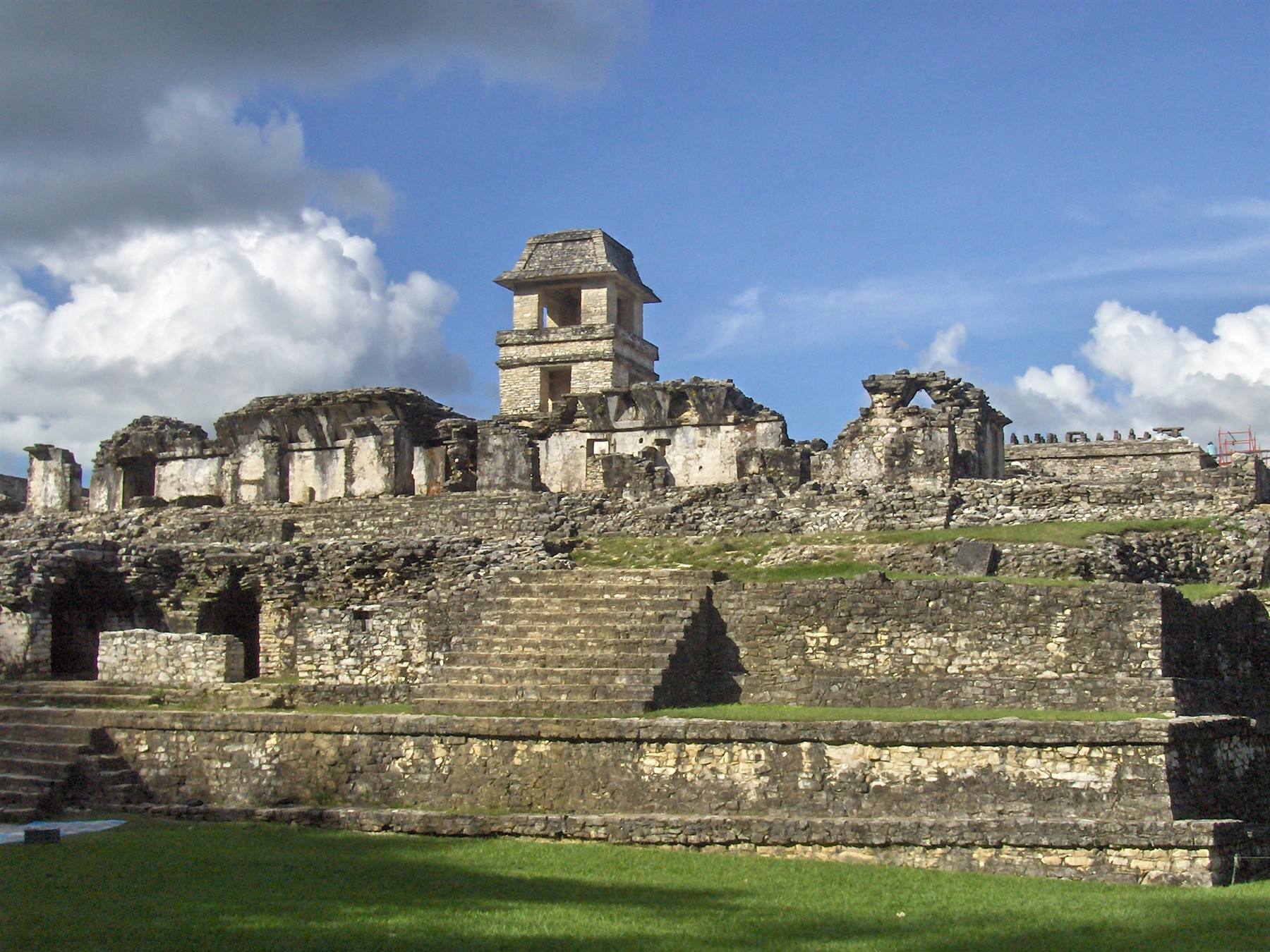
The site of Palenque
We arrive at the entrance to the site and decide to take a guide to accompany us. He does ask a very high price (50 euros), but we don't haggle much, first of all because we're in a hurry to get into the site and secondly because it's obvious from a mile away that I want the guide. The choice will indeed prove to be a good one and Nilo's explanations will be useful to us even at the sites we'll see later armed only with the LP. Palenque is surrounded by the tropical forest, from which it was torn with great effort and to which it seems to want to return at the slightest lapse of human attention. They say the best time to visit it is in the morning, when the early mist envelops it creating a particular effect.
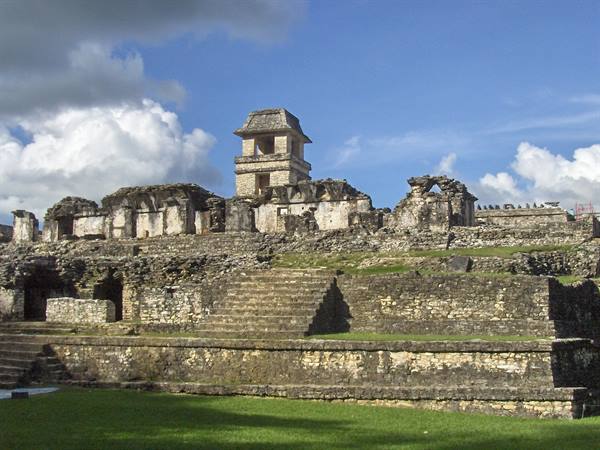
We, on the other hand, see it in the afternoon, but it's still shrouded in a special aura: the sun, setting very early (around 17:00), bathes the temples and palaces in warm, luminous tones. It won't be the magic of the morning, but it's an enchantment. For my husband it's a return, in fact he had already been to Mexico 10 years ago, but at the same time it's a new discovery since, the previous visit was very rushed. We go deeper into the site and Nilo tells us the story of Pacal, the lord of Palenque: crowned King by his mother at only 12 years old, he governed his city for several decades. We smile at the physical description of this king who was so important, cross-eyed, limping and with the typical flattened head, and we're astonished by his architectural and cosmological knowledge as well as by his intelligence.
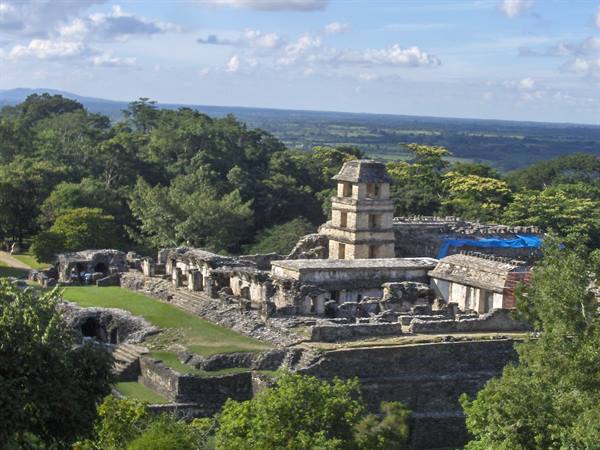
After a short break Nilo shows us the "mimosa pudica", a little plant that closes its leaves at the slightest touch, and the ceiba tree – sacred to the Maya – which stands in front of Pakal's palace. At this point we begin the real discovery of the site. Palenque is one of the few sites where it's still possible to climb on the palaces and temples. We visit the Temple of the Inscriptions, where the coffin of the red queen was found (a queen strangely tall for the average of the time and of the Maya race) and right after that we head to the Palace. An architectural detail that doesn't go unnoticed is the Mayan arch, and only at Palenque are there even double-row ones. It's incredible how some parts of these "arches" are still standing, defying all the laws of gravity.
We find coats of arms of the kings of the time eroded by time and destroyed by subsequent conquests, and even the toilets, male and female, connected directly to the sewer system, part of which can be seen uncovered. A detail not to be underestimated is that all the buildings and sculptures were made without knowing metal, using simply stone tools. Another particularity Nilo explains to us is that Pacal is often depicted sitting in the lotus position, a posture typical of Buddhist meditation. It really makes you think that there's an invisible thread linking cultures so far apart in time and space. While we wander around the Palace, Nilo explains that in Maya culture it was the kings and nobles who underwent sacrificial practices involving the shedding of blood to the gods and the sun, while the mass killings, the better known ones, were carried out in later periods during Aztec rule.
Once the visit to the palace is over we climb the Temple of the Cross, from where it's possible to admire the whole Palenque complex, the expanse of forest surrounding it, protecting and hiding the mythical quetzal bird with its brightly coloured feathers. The Cross and the Foliated Cross (a stylisation of the corn cob) are two other elements of Maya spiritual symbolism that we will often come across at the sites and in Chiapas. Once the tour is over we stop to buy one of the many Maya calendars painted on leather that they sell inside the site, but Nilo is restless …. Before the site closes he absolutely wants to take us for a while into the surrounding forest. Humidity and mosquitoes reign supreme but it's interesting all the same.
Covered by vegetation there are still numerous half-destroyed buildings that perhaps will never see the light, but which serve to give an idea of how extensive the Palenque complex was. During this walk I have the chance to ask for information about a particular plant I had noticed earlier, which has a trunk polished to a shine and bronze-coloured. It's jokingly called the "tourist plant", since it has precisely the characteristic of being red and peeling in the sun. But now it's time to go, more than satisfied we take a last look at the palace and head to the exit, where once again I'm spellbound admiring splendid flame-coloured crotons. Now that we've left the magic of Palenque we realise we're also ravenous, since to save time we didn't actually have lunch. So we treat ourselves to a snack of tacos at the restaurant outside the site.
We go back to the hotel and do a quick reconnaissance. It's a very nice hotel, the room is spacious and cosy, but right now we need a shower and a bit of relaxation before dinner. In the evening, in the garden, a group is celebrating, we don't know what. Typical Mexican music and themed decorations, all white, red and green, the colours of the country… it's a shame to think that in Italy the tricolour – except on official occasions – flies almost exclusively during the World Cup, while here – as in other Latin American countries – you find it practically always and everywhere. A quick stroll and then off to bed, the day has been long and intense … tomorrow San Cristobal!
San Cristobal de las Casas
Day 521 Nov 2007
San Cristobal de las Casas
Today we allow ourselves a bit more sleep, even though the road to San Cristobal is all bends, it's "only" 200 km! We set off right after breakfast and soon reach the Misol-Ha waterfalls. It's early and there are very few people. The waterfalls are nice, but nothing special, were it not for the fact that the sun is still rising and gives us very beautiful images of its rays emerging from the top of the waterfall and slipping in among the trees. We stop just long enough for a few photos and then set off again for Agua Azul. This morning I'm at the wheel and, amid my husband's mockery, I manage to be overtaken by no fewer than two buses. It might not seem surprising, but the road to San Cristobal consists of an endless series of bends and is just wide enough for two cars, so it's hardly normal to be overtaken by a tourist bus.
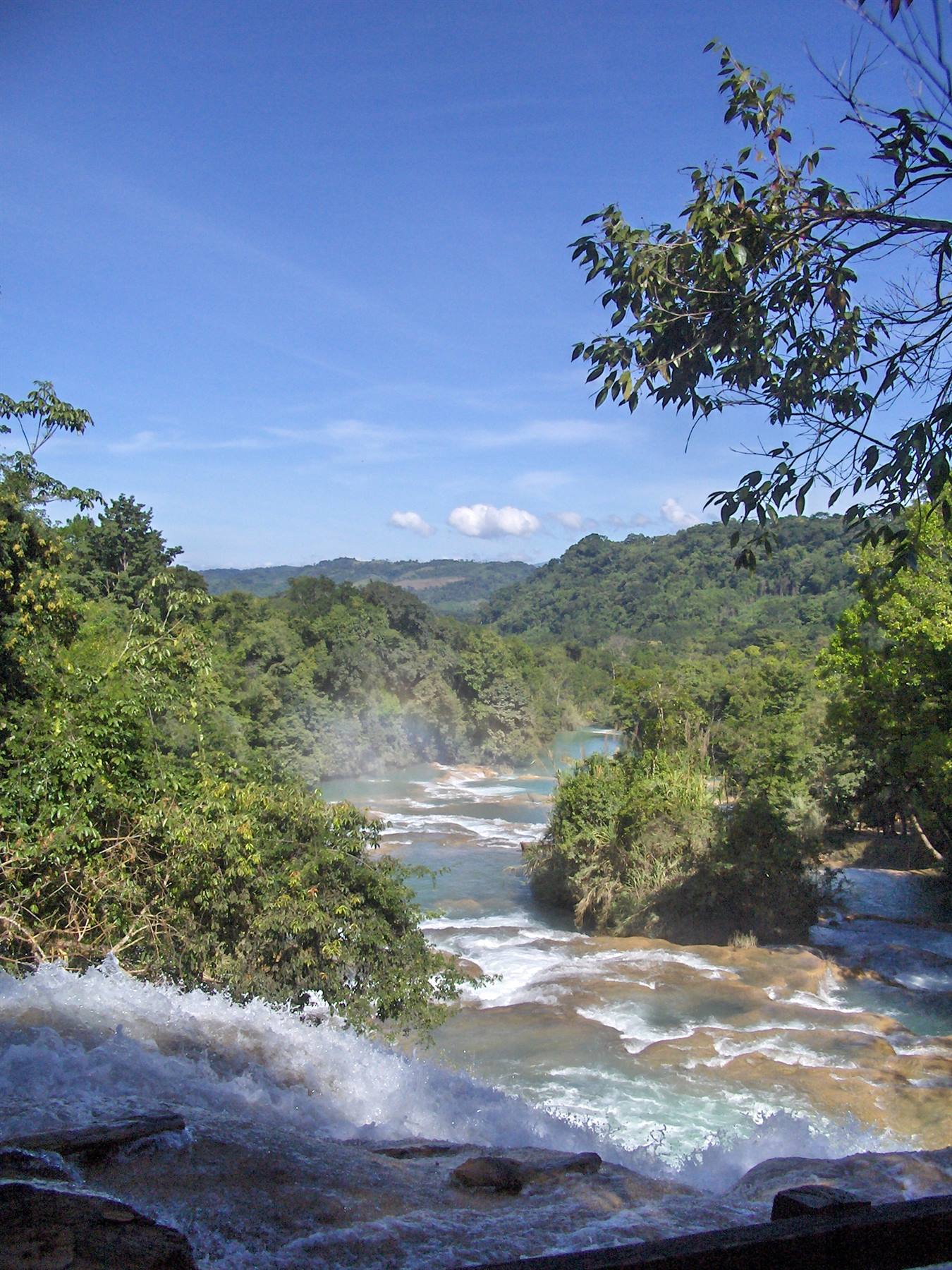
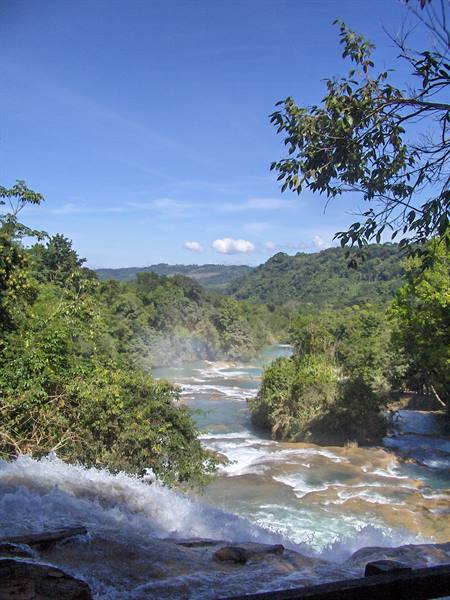
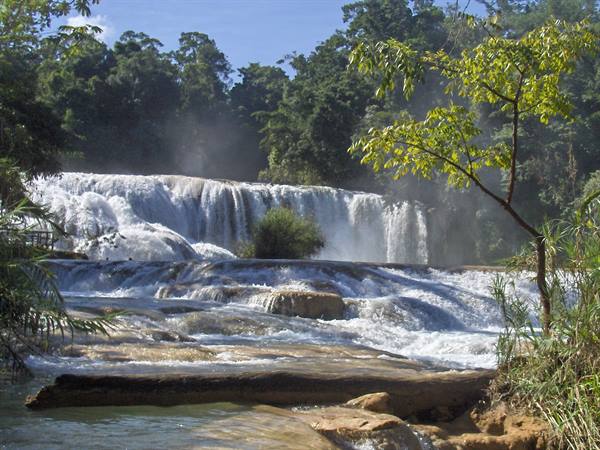
I try for a while to keep up with these madmen who know every tope, pothole and bend by heart, but I very quickly give up. They're crazy!! Finally we arrive at Agua Azul. Here too there are very few people because it's quite early and again today it's a splendid day. Agua Azul is truly enchanting with its turquoise waters, and we stop for almost an hour to take photos and relax. We buy two bananas from a very nice little boy and get back on the road to San Cristobal. We pass through Ocosingo, a small town known for being the base of the Zapatista rebels, and my husband takes the driver's seat. I can relax a bit, because between bends and topes, the road is quite demanding and requires constant attention. Meanwhile the vegetation around us has changed, as has the women's clothing.
From the white "huipiles" blouses with very colourful embroidery and dark skirts with equally colourful belts, we move on to the clothing typical of the mountain indigenous people. The weather is changing and turning bad, but never mind. The last stretch of road is really tough. We find ourselves behind big carnival trucks going to San Cristobal – some saint is being celebrated – and it's really impossible to overtake them. The cruising speed is obviously very low and we wonder how long it will take us to reach our destination. Fortunately the boys perched on top of these big trailers, as soon as the opportunity arises, improvise as traffic officers and let us know that it's possible to overtake. After about 4.5 h (stops excluded) and under heavy rain, we arrive in San Cristobal.
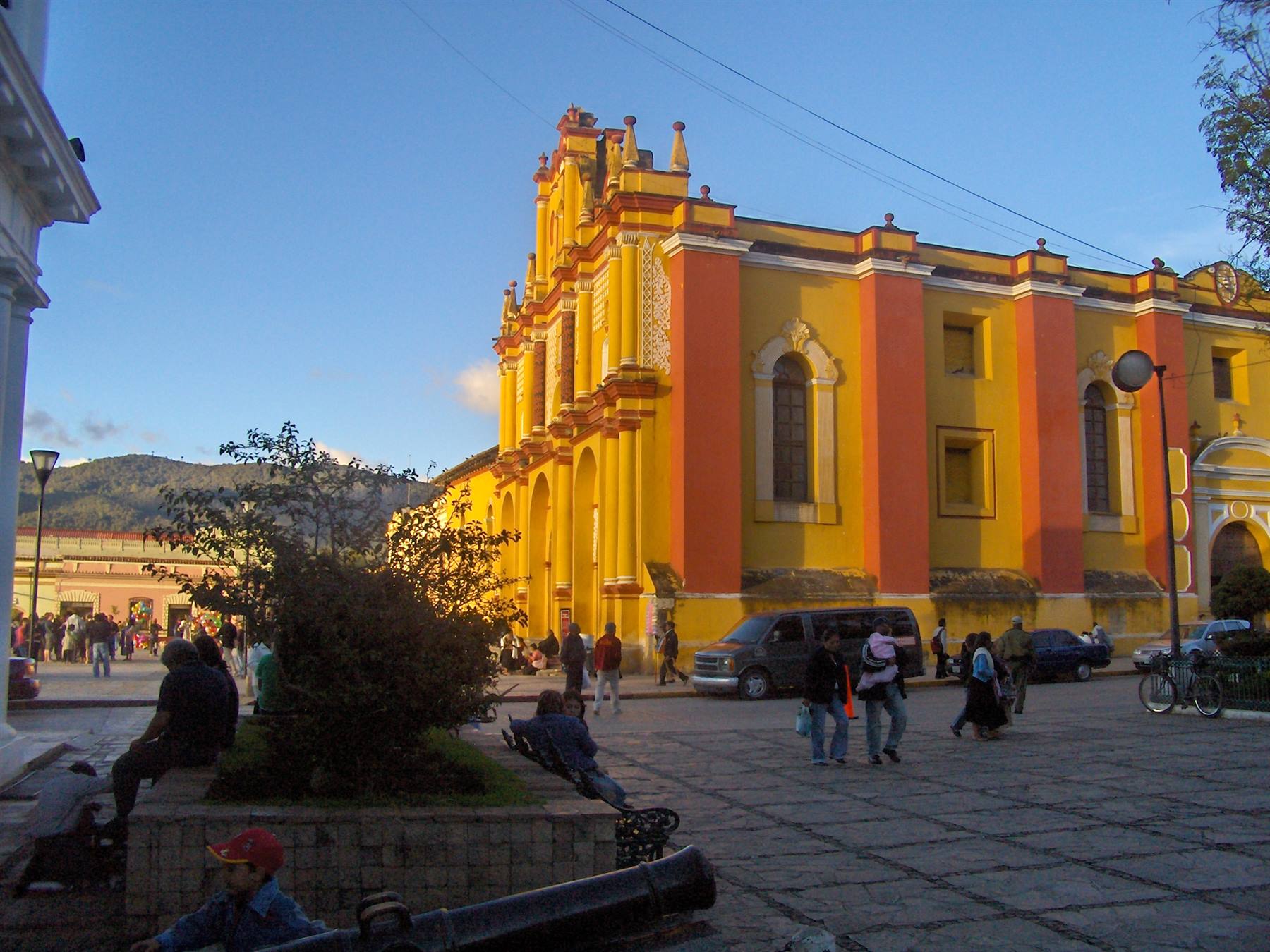
The tropical forest has given way to coniferous woods and the air is decidedly crisp, on the other hand we're at 2100 m altitude! The outskirts of this famous city disappoint me. Petrol pumps and car dealers ….this isn't how I'd expected it!! As soon as we enter the city, though, I discover that it really is the little jewel everyone raves about … a shame about the rain. We immediately start looking for the hotel where my husband had stayed 10 years ago. In his memory it's an unmissable stop, also because, after sleeping badly and eating worse for several days, this hotel, for him and his friends, had meant physical and moral rebirth. The Hotel Catedral is, needless to say, just a few minutes from the cathedral, has a guarded, covered car park and although it's a 5*, they offer us the choice between a double room and, for a negligible difference, the presidential suite.
I look at my husband and it's like seeing a child in front of a jar of Nutella, and without even asking him I know what his choice will be (in fact two nights in the suite with breakfast included costs us less than € 90.00, a shame to pass up). Our Chamula suite is really very nice! Huge, with three windows overlooking the main street, obviously the bathroom is in keeping with the rest. Despite that … just time to take something a bit warmer out of the suitcase and we're already out on the street. Meanwhile it's stopped raining and, although there are still black clouds, we can walk around comfortably. We reach the cathedral and, as our first move … we look for Calle Adelina Flores. My interest in this street is entirely due to a book by the writer Marcela Serrano – "What Is in My Heart" – which I've read several times.
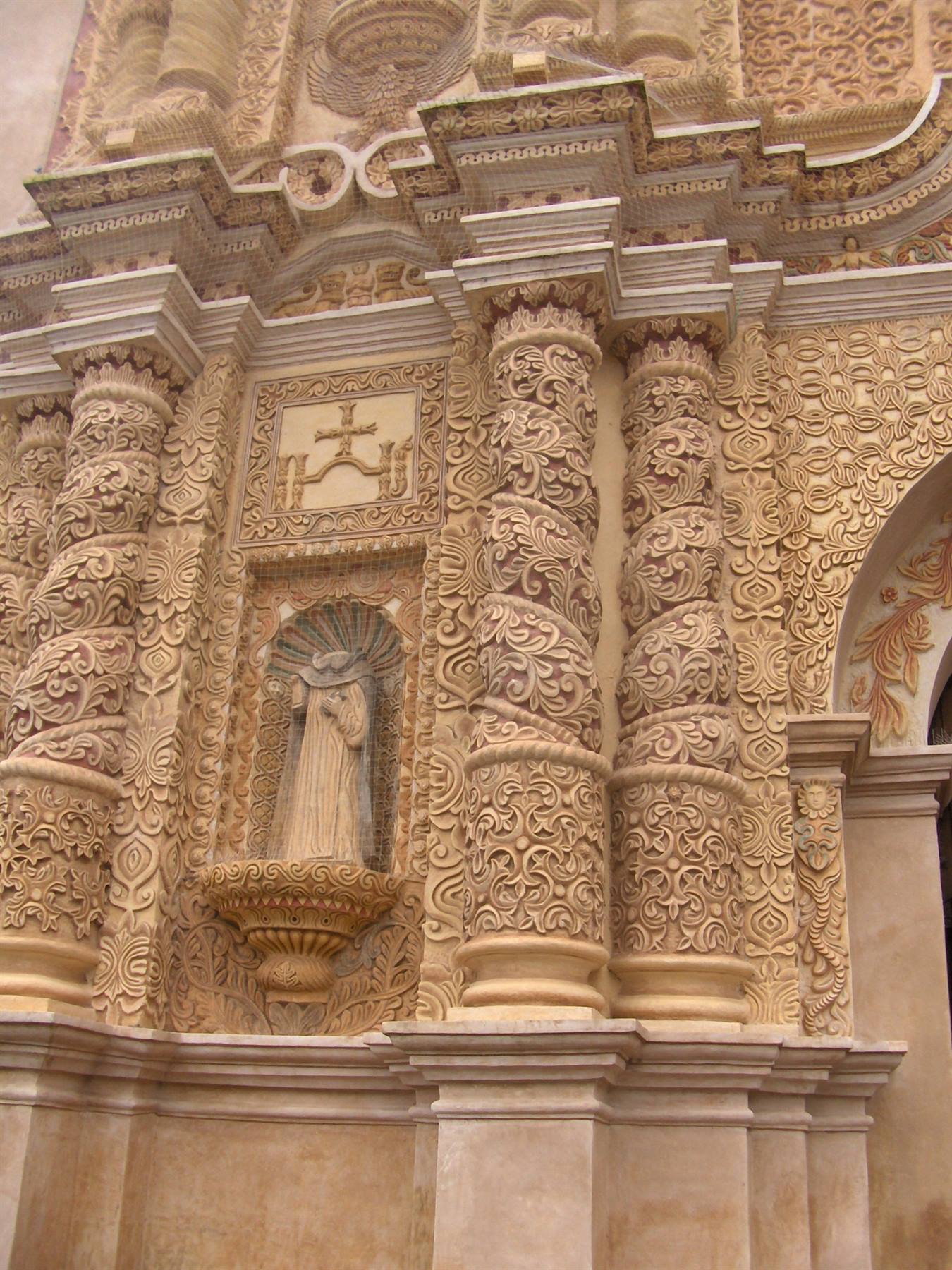
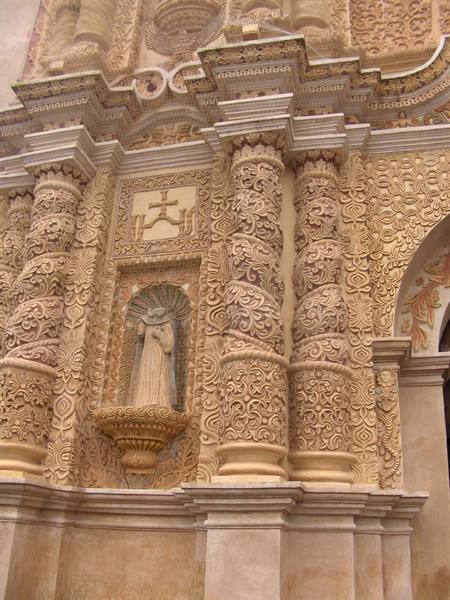
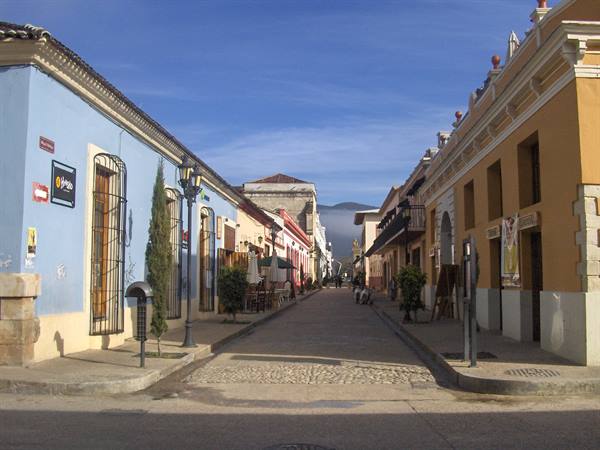
It's set in San Cristobal and it's in this street that Reina lives, the woman around whom the whole story revolves. Once we find it – it's a street parallel to the main one – we take a stroll along it – and peek into the various courtyards that hide in large numbers behind the façades of the colourful houses. I don't know what I hope to find, whether it's Reina's house or goodness knows what.. what's certain is that we discover hotels with splendid courtyards and I almost regret having gone straight to the Catedral. Walking on we reach the splendid church of Santo Domingo, where the Chamula indigenous market is held every day. One thing is certain, I know that tomorrow I'll be shopping …. and quite a lot too. The market is a riot of colours: huipiles, serapes, wool sweaters, pochos, embroidered placemats, leather belts and otherwise … in short, it's impossible not to buy.
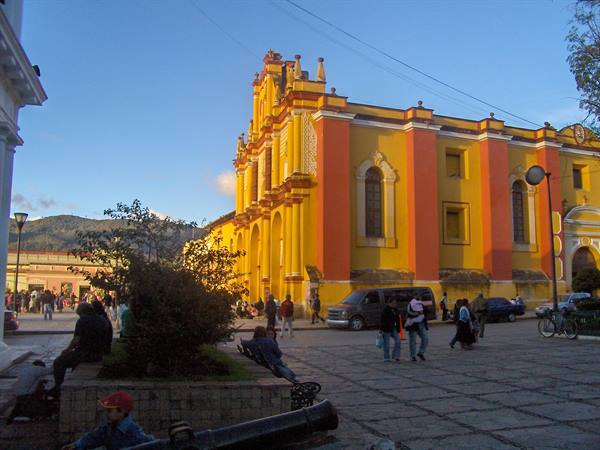
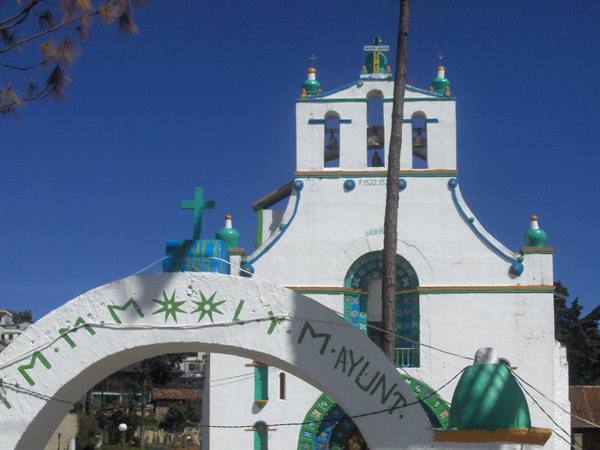
Anyone who thinks of San Cristobal immediately imagines the famous yellow and maroon Cathedral that at sunset, when the sun hits it directly, lights up in golden yellow. In reality the Church of Santo Domingo is perhaps even more beautiful with its pinkish façade entirely "embroidered" in carving. The nearby church is decked out for a celebration, pine needles cover the entrance steps and a floral arch stands over the doorway. The "Virgen de la Caridad" is being celebrated, so it's party time! We wander for a while among the stalls and the various little shops. San Cristobal offers excellent prices almost everywhere and the best exchange rate we found in our whole trip. On the way back to our hotel we discover a rather odd custom that makes us burst out laughing. We go into a little place to get a Coke and they ask us whether we're staying to drink it there or taking it away.
When I say we intend to take it away, out comes a transparent bag – the kind you use for freezing – and the Coca-Cola goes straight from the little bottle into the bag, which is closed with a knot into which the girl sticks a straw. My astonishment is such that I start giggling, trying not to burst out laughing openly … but I can't help it. Trying to hold back the tears I pay and when I go out with my little bag of Coca-Cola the tears are running down my cheeks. It takes my husband a few seconds to realise why I'm laughing … and when he sees the bag he struggles to connect it to the fact that the Coca-Cola is inside it… glass is for display.. mystery solved. Tonight we won't go out for dinner, I'm shattered, so we decide to take advantage of the hotel restaurant. The choice turns out to be anything but right, but never mind.
We take a short walk to the cathedral and along the streets a procession files past, preceded by mariachis in full dress, dedicated to Saint Cecilia … could the saying be true that in Mexico there's always something being celebrated? In the evening, the illuminated cathedral square is very evocative, as are the arcades beside it, but our walk doesn't last long and, after a brief stop at one of the countless internet points of San Cristobal, finally bedtime!!
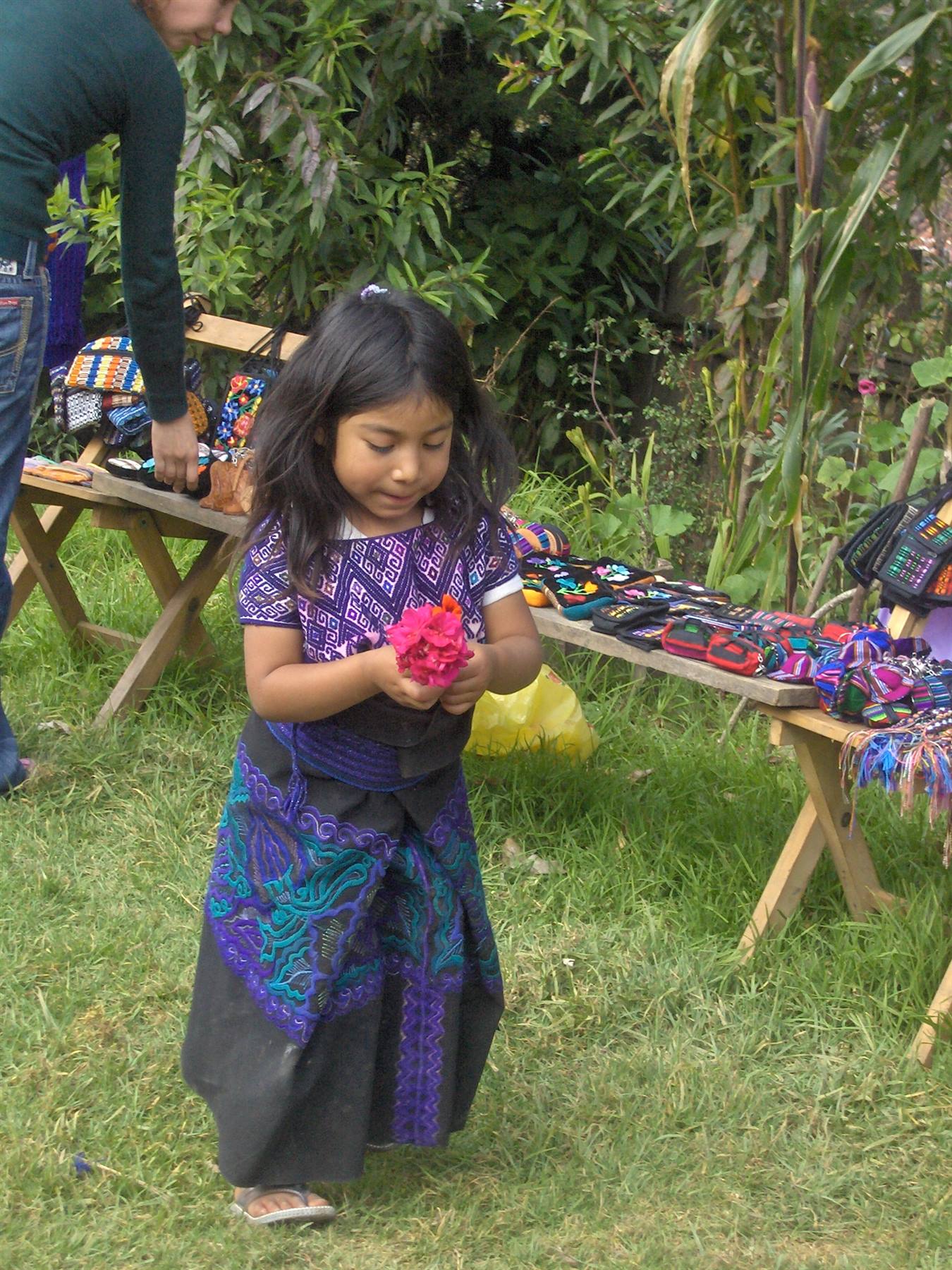
Girl from Zinacantan
Day 622 Nov 2007
San Juan Chamula and Zinancatan
We wake up early and, before showing up for our appointment with Senora Mercedes, we have time to stroll around this splendid little town. It really seems incredible to me to be right here in San Cristobal and I'm happy. There's a special feel in the air this sunny morning. The brightly painted houses stand out in the still, clear, crisp air; the traffic is still limited and in the distance you can make out a light mist that seems to rest somewhere like a forgotten hat. Marcos and the EZLN were here too and, surely, they're not even that far away even now….. I could keep walking for hours through the colourful alleys but at 09:00 we have an appointment at the zocalo with Senora Mercedes. We don't take long to spot her, because, as indicated in the LP guide, she has the inevitable colourful little umbrella with her.
We buy the half-day excursion and wait for the minibus to arrive (180 pesos each) that will take us to the villages of San Juan Chamula and Zinancantan. Unfortunately Senora Mercedes doesn't come with us and entrusts us to another guide. I'm sorry because I'd heard very good things about her and by now she seems to be an institution in San Cristobal, but never mind. The village of San Juan Chamula …. Well, it's not exactly a village but a small town that lives following archaic rites and rhythms. In San Juan the people are dressed in typical indigenous costumes: the men wear a kind of poncho over ordinary trousers, while the women wear blouses and a black sheep's wool skirt, both in summer and winter. The Chamula don't like being photographed, so if you want to do so you have to ask permission, but it's rarely granted.
We take a little walk around the village and in front of a green cross adorned with pine branches, our guide explains the symbolism of the cross / foliated cross in the Christian/Maya religion. Indeed here, the two religions have merged in such a way as to create a harmonious blend of ancient culture and new religion. This somewhat complex concept we'll understand better later when we visit the church of San Juan. I can't wait to visit this church that everyone says is very particular. Externally the church of San Juan is extremely simple: three green arches with floral motifs adorn the entrance doorway, the rest is painted in pure white that stands out under the warm rays of the sun that illuminate it today. Going into the church, though, transports you to another dimension, another world.
Entering the church you have, in a sense, the sensation of entering a coniferous forest on a sunny day. The church is, in fact, quite dim and at the entrance you're assailed by the smell of the pine needles scattered on the ground in memory of the pre-Columbian prayers made in the woods, mixed with that of the smoke of hundreds and hundreds of lit candles in front of the various saints. Although it's a Christian church it's absolutely different from the common idea one has of a church and it's imbued with a spirituality that is perhaps different, but deeply felt and concrete. There are no pews, no kneelers, no confessionals, but people pray sitting on the ground on the pine needles. There are some families, numerous women, in little groups, with children or alone, and as they pray they stick more long, thin candles to the floor by means of the dripping wax.
Gathered in front of one of the many saints, there's a whole family that, with the help of a kind of officiant who acts as intermediary with that particular saint, asks for a favour for one of its members who is ill. These rituals, our guide explains, are particularly expensive for the Chamula, who have to pay not only the officiant but also the little bottles of Coca-Cola and the chicken that will be sacrificed to the saint invoked. The use of Coca-Cola as an offering to the saints has replaced the use of posh, a dark alcoholic drink that costs much more. More than one chicken is to be sacrificed today, but if you don't pay attention, you almost don't notice. The whole ritual is performed very quietly and the feeling is that of being intruders, admitted by grace or necessity, to witness what intimately concerns the lives of these people.
Another particularity is that on the altar, the central position is occupied by Saint John the Baptist, while the crucified Christ is to his left, as a background figure. Even the Baby Jesus is seen in a somewhat different way, in fact he isn't worshipped as the child who was Christ, but as a figure in his own right. It's hard to leave this place of worship that's a bit atypical, a bit magical and so deeply charged with spirituality, but I think I've already taken enough advantage of the opportunity to access this place, so I join my husband outside. I get a bit annoyed when he confesses that he secretly filmed a few minutes inside the Church. It's expressly forbidden and I'd begged him several times not to be sneaky … yet I can't help feeling a surge of joy, some images of this place I'll be able to carry with me not only in my memory.
In the outside square another cross adorned with pine needles stands, at the base of which is an inscription commemorating the visit of Pope John Paul II. Indeed, during his apostolate he came here too!
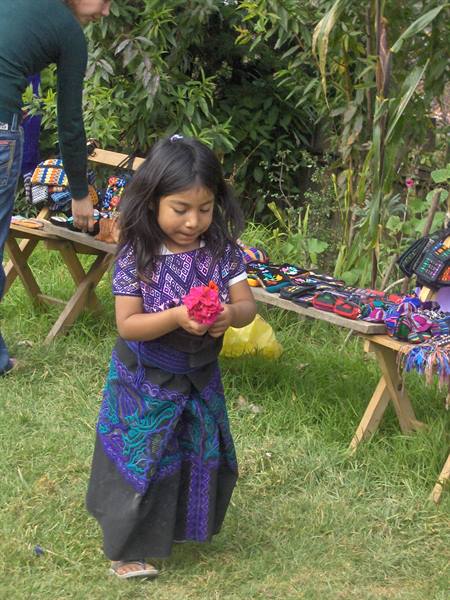
After doing some shopping at the San Juan market – which is more expensive than the one in San Cristobal – we set off again for the village of Zinancantan. We stop for a short break at the cemetery of San Juan Chamula, which stands near a church that burned down.. and here we discover the reason why some saints in the main church didn't have lit candles. They were the Saints who should have protected the "old" church, but having failed to do so adequately, they are in a sort of punishment, so no little lamps or prayers …. that's Mexico too. The village of Zinancantan is about 7 km from San Juan Chamula, but the indigenous people's clothing changes completely. The women in fact wear garments finely embroidered in shades of light blue, blue and turquoise. We're accompanied by a family that is willing to show its house to tourists.
The women in traditional dress are weaving one of the many tablecloths sold everywhere and another offers us freshly made tacos and a taste of posh.On the way back, still in Zinacantan, we come across yet another procession for some saint.In the afternoon, once back in San Cristobal, we devote ourselves to shopping. I buy quite a few things for myself and friends, from a wooden Crucifix painted with floral motifs to a bedspread woven with the typical colours of Guatemala to a Christmas tree woven on a loom … in short … thank goodness the suitcases weren't too heavy when we arrived … What I don't buy I photograph, because even the stalls are a riot of colours that deserves to be captured. This evening we manage to admire the Cathedral in all the splendour the sunset rays give it.
We wander a bit more around the centre and after a stop at the hotel, which allows us to take a shower, with the LP in hand we go out for dinner. We head to Emiliano's Mustache, it's recommended by the guide which never lets us down, in fact we eat wonderfully, meat and tacos, spending about 16 euros for two. We take our leave of this beautiful little town with one last walk to the cathedral and the arcades, tomorrow unfortunately it's already time to set off again.
Campeche
Day 723 Nov 2007
Transfer to Campeche
We leave San Cristobal at dawn, I try to memorise as much as possible of this place, from the pine woods to the valley still wrapped in morning mist … it's always hard for me to detach myself from places that strike me deeply. My husband, on the other hand, is already projected towards the next stop: Campeche … but it will take us quite a few hours to get there.At Ocosingo I take the wheel of the car again and, shortly after, we stop at a little souvenir shop on the road that also has toilets. On this occasion too we have the chance to chat with the owner, from whom we ask for a coffee, associating our idea of toilet + souvenirs = "service station". Actually the lady doesn't offer this kind of "refreshment", but she goes and makes us a coffee directly at her home.
Since she doesn't want to be paid, I buy a couple of little bags to thank her for her kindness.After the usual 4 and a half hours of travel we arrive in Palenque where we make a brief stop to eat something. For about 6 euros we stuff ourselves more than decently with half a spit-roasted chicken, Coca-Cola and bean purée and two bananas. We set off again for Campeche and my husband takes the wheel. Mexico and clouds, never was a song more apt …Indeed the clouds, all in all, accompany us on every transfer. But they're not the high, closed, gloomy clouds we're used to seeing back home. Low, light clouds resting here and there or rather …. suspended in mid-air. It's a phenomenon I've never happened to see so clearly and it's really pleasant to watch them as we rack up the kilometres towards our new stop. At Escarcega we stop for a short break and I take over the driving again.
Between Palenque and Campeche we come across a great many American-style trucks, often with two trailers, and we can't help photographing some of them. The drivers zoom along at decidedly high speeds, fine, the roads are completely straight for long stretches …… but still they're really crazy. On the other hand they seem to have special protection from Good Jesus, given the numerous holy cards and stickers – "God loves me" or "God protects me" – that we often see on cars and trucks. He'll surely have His work cut out protecting this bunch of would-be Schumachers…!! The state of Campeche is visibly richer than those crossed so far, such as Quintana Roo or Chiapas. You notice it right away from the condition of the road surface and from the towns you pass through, much tidier and better kept. We reach Champoton and, for the first time, we catch sight of the Gulf of Mexico.
Champoton is a small town we drive through quickly, by now it's really not far to Campeche. We refuel and I hand over the wheel … I'm exhausted by now. We arrive in Campeche and quite quickly find one of the various hotels I'd researched. It's the Francis Drake, a very nice hotel in colonial style, with covered parking, but expensive compared to the Mexican standard (about 900 pesos for a double), anyway it's fine like this, I'm really exhausted and couldn't face looking for another place to stay, we left at dawn and have covered about 570 km in about 9.5 h … I'd say that's enough for today!! My husband, though, is restless … he wants to see Campeche … so after about an hour of relaxation we're back on the street. When planning the trip I had considered Campeche only as a stop to break up the journey, in reality it will give me a lovely surprise.
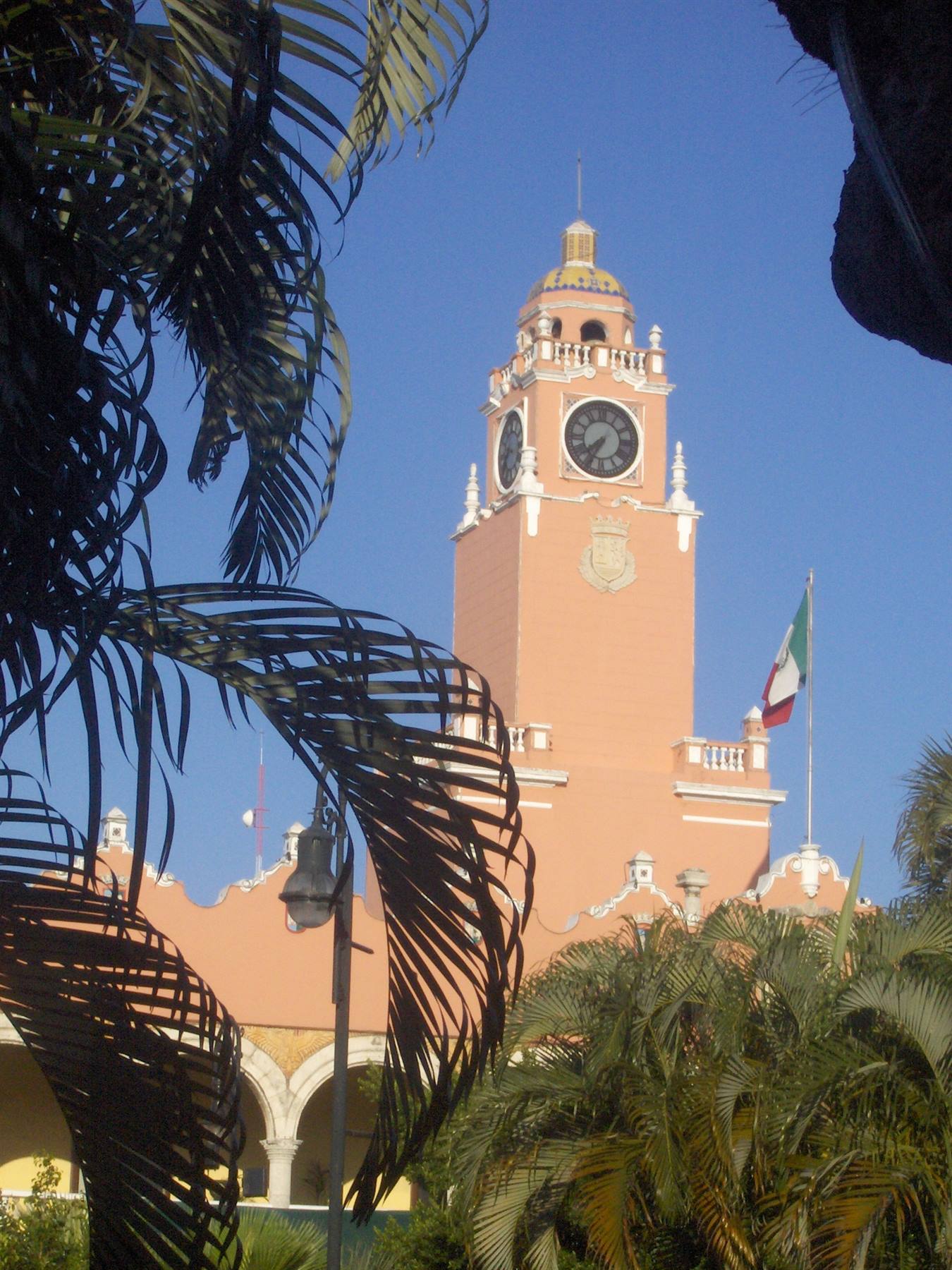
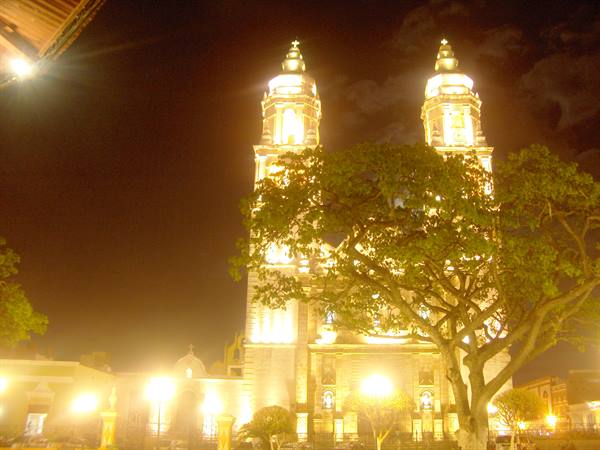
We leave the hotel and night has already fallen and we discover that we're really just a stone's throw from the zocalo, in fact after a few minutes we turn a corner and find ourselves in front of the splendidly illuminated cathedral. I wasn't expecting it and I must say I'm delighted by it. We wander a little but it starts to drizzle, so we take shelter in the patio in the middle of the square and wait for it to pass while leafing through the guide. We read that right there in front is a small museum where a typical colonial house of the period is reproduced, so we go and take a look. This museum is tiny, but it's worth a quick visit, to take a trip into the past of this lovely little town. We go to dinner at the Parroquia, a family-run restaurant recommended by the LP, a stone's throw from the zocalo where I
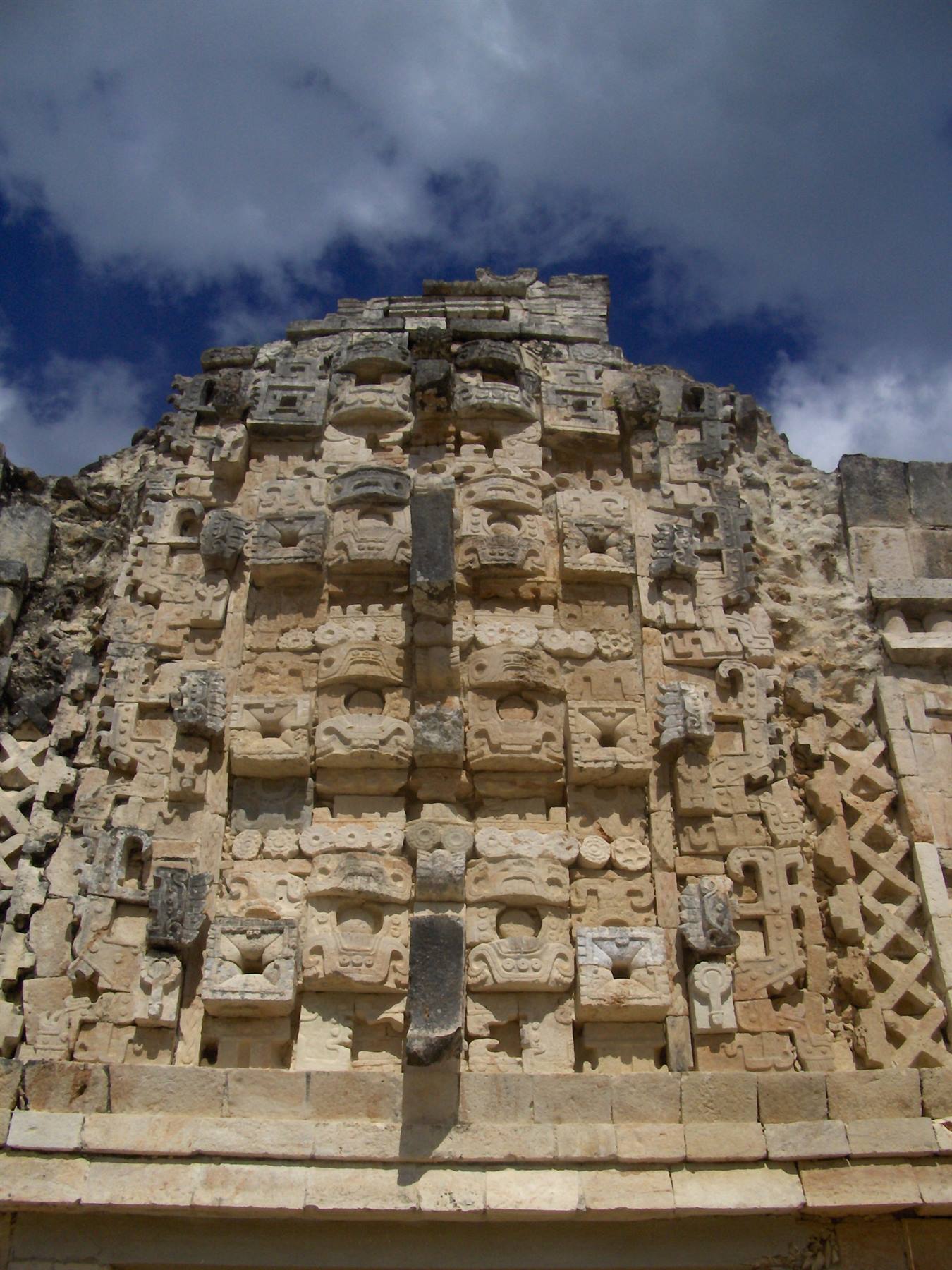
Uxmal - Nunnery Quadrangle
Day 824 Nov 2007
Uxmal and Merida
As usual by now, we wake up quite early and head to the Marganzo restaurant for a typical Mexican breakfast (Come on... the Pan de Cazon wasn't enough for me).. based on omelette, tortillas, beans, onions and tomatoes. This time, though, I'm more than satisfied with the choice,... just think that at home I drink just a little tea with a few biscuits! The restaurant is really very nice and we spend 130 pesos for two. Today's day includes a visit to Uxmal and then transfer to Merida, so we have time to take a stroll around the city. The cathedral seen by day is... really quite ugly! Nothing compared to the effect in the evening. We take a few photos of the zocalo and then head towards the sea.
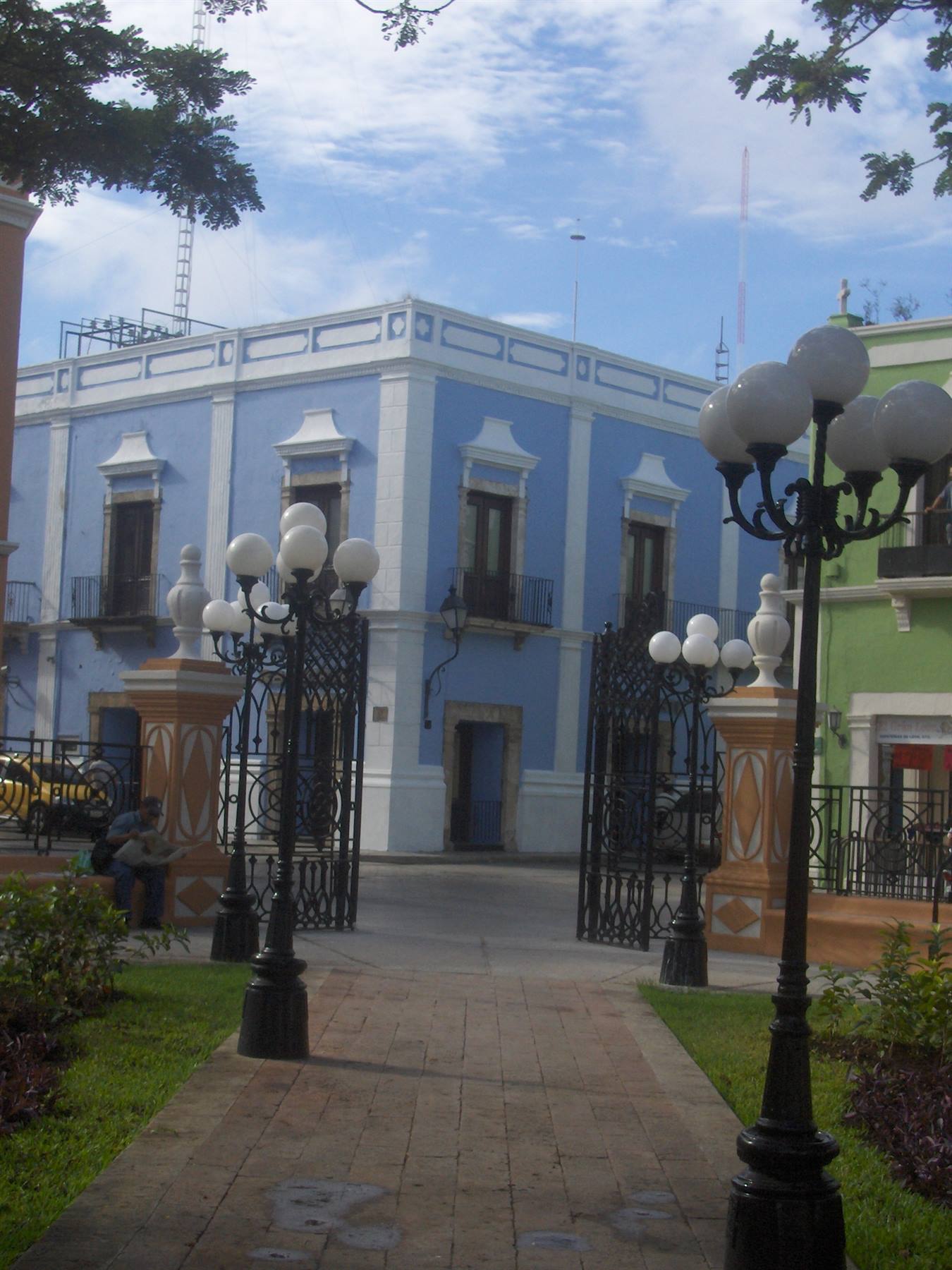
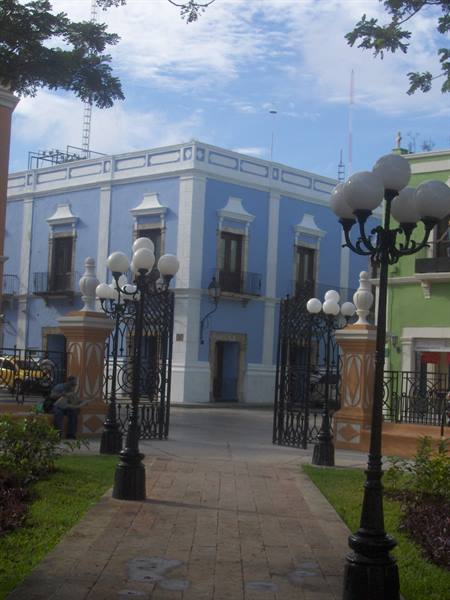
Frequently visited by pirates - not by chance are we staying at the Francis Drake - it had been surrounded by protective ramparts and even the houses retain the habit of bars on the windows, a bit like the town of Trinidad in Cuba. We stroll a bit and I would never tire of doing it, I really love these towns with low, brightly colored houses. For the record, I cannot omit a note on the typical women's clothing of this area. Due to the hot and humid climate, the sheep's wool skirts of the indigenous women of Chiapas have given way to huipiles reaching below the knee, cool and airy (almost nightgowns, in short), but what links these huipiles to those of Chiapas... are the colorful embroideries, which are never missing. In Campeche I treat myself to a very small souvenir that well represents this city. A small straw fan, with a print of the cathedral...
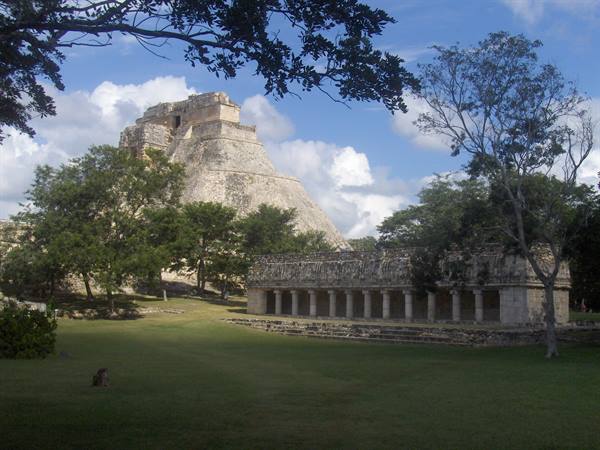
Perhaps because of the small museum visited, the pirate tradition, the bars on the windows, for me Campeche is the city where, once upon a time, spoiled young girls, daughters of wealthy merchants, idled in the garden lazily fanning themselves while waiting for the cool evening breeze... that's why a fan! In about a couple of hours we arrive at Uxmal...... the famous site of the Pyramid of the Soothsayer. The Pyramid is truly an imposing construction, it is impossible not to be fascinated and struck by the skill of the ancient Maya, and the whole site proves to be extremely interesting. Here, along with the feathered serpent, the mythological figure of the rain god Chaac Mol predominates, characterized by a kind of trunk.
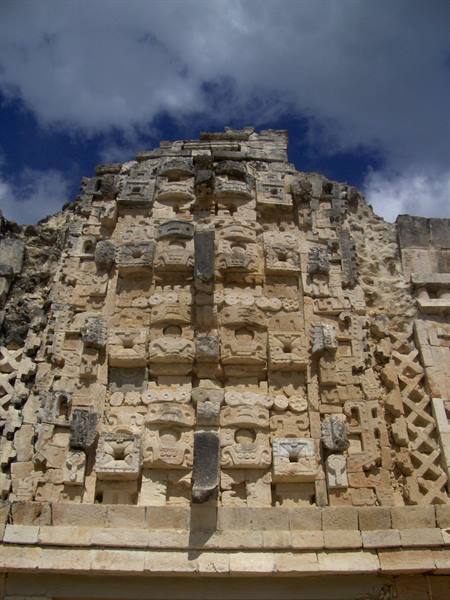
The "Quadrangle of the Nuns" proves to be a truly very beautiful and refined construction; built in pinkish stone, it is richly decorated with countless masks of the god and rhomboidal motifs recalling the scales of the serpent; it is hard to believe that, in this case too, these skilled artists and architects did not know the use of metals! The sun is shining and it is very hot but, fortunately, there is always some cloud that every now and then keeps us from getting completely roasted. The site of Uxmal is truly enchanting, there are many trees, quite a few iguanas lazily sunbathing and there are not many tourists; you breathe a peace and a silence hard to imagine at other sites. Photos, of course, are taken in abundance.
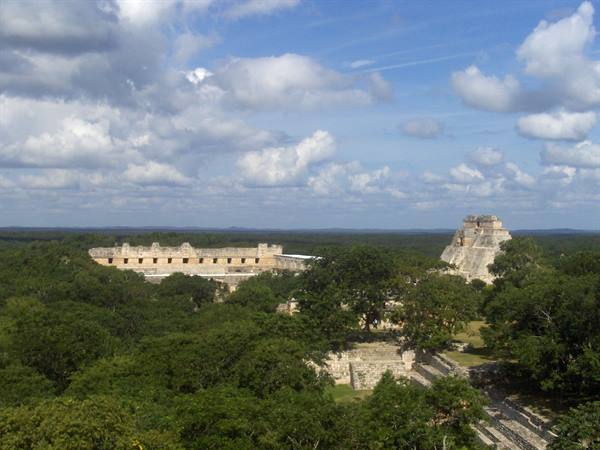
From the Quadrangle of the Nuns we move on to our first ball court - how on earth did they manage to play on it, God only knows! - and from there we climb up to the Governor's Palace, also imposing and richly decorated. From the back of the Governor's Palace it is possible to climb the only visible facade of the "Great Pyramid". I am not very convinced about this ascent... but above all, I am not convinced about how I will get down!! What convinces me is seeing a Japanese woman of a certain age... if she made it... I can go too! As soon as I reach the top I regret my "audacity", even though the spectacle of the site immersed in the forest and seen from above in all its completeness repays the thought of having to go down. Here we are... and now what? Looking down from the pyramid you get the impression that the steps are practically placed vertically like a ladder.
In reality it is not quite like that and if you don't suffer from vertigo, the descent is more than doable. However, I don't trust it too much and adopt the method of descending on all fours with my face turned towards the pyramid. This way it is much easier... my husband laughs and films me... I a little less, I am focused and, naturally, I grumble. We wander around this splendid site a bit more and then head to the exit, where we stop to eat. We then set off again for Merida, which we reach in a little more than half an hour (total Km 235 time 3.5 h). The hotel we have chosen is the Dolores Alba, quite famous among those who travel do-it-yourself. It is fairly close to the city center and seen from the outside it is rather run-down. The inside, however, is completely different.
It has a large covered patio with a tree in the middle, it is furnished in a vaguely colonial style and is even equipped with a pool. For 459 pesos we have a double room with air conditioning, very simple but more than decent. Merida is a chaotic city that doesn't particularly appeal to us, so we decide to treat ourselves to a bit of relaxation in the hotel's upper patio, quiet and isolated from outside noise. We then go out to explore the city a bit, which, being Saturday night, is preparing for a night of celebration, with singing and dancing in the street. In Merida there is only an embarrassment of choice of restaurants, so for dinner we opt for a patio with soft lighting... the ideal setting for a romantic dinner... even if our clothing is more in keeping with Indiana Jones than with the romance of the place.
We go to visit one of the various "Casas de Artesanias" - in Merida anyone who stops you has a casa de artesanias to recommend - where we buy a ceramic dish, a typical souvenir of this city, and after wandering a bit in the chaos of the Zocalo, we retire to the quiet of our hotel.
Merida
Day 925 Nov 2007
Chichen Itza
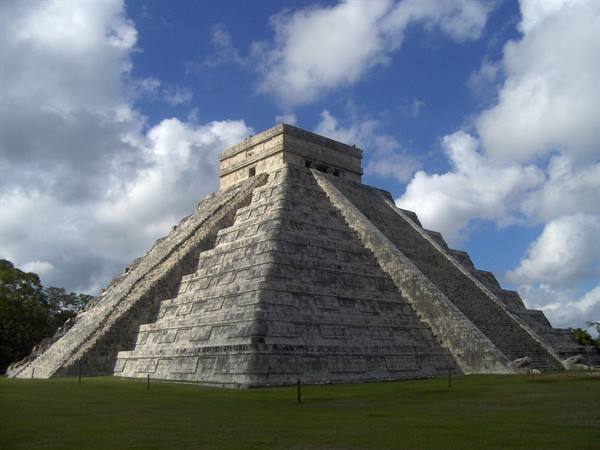
In the morning we take a look at the city, which is much quieter, and then we set off quite early to visit the famous Chichen Itza (130 km, 1.5 h), before the arrival of the hordes of tourists coming from the Riviera Maya. It's still early and we can enjoy the site in complete peace. The Pyramid of Kukulcan strikes us with its perfection and imposing size, although I find I prefer the buildings of Uxmal, but it's still too early to judge. We can photograph it to our heart's content, and with the clouds racing across the sky, each photo is a little different and a little similar to the many you see around. Imitating some children who are there, we discover that if you clap your hands in front of it, you hear an echo like the sound of a taut string being made to vibrate; too bad it's no longer possible to visit the throne room inside the pyramid.
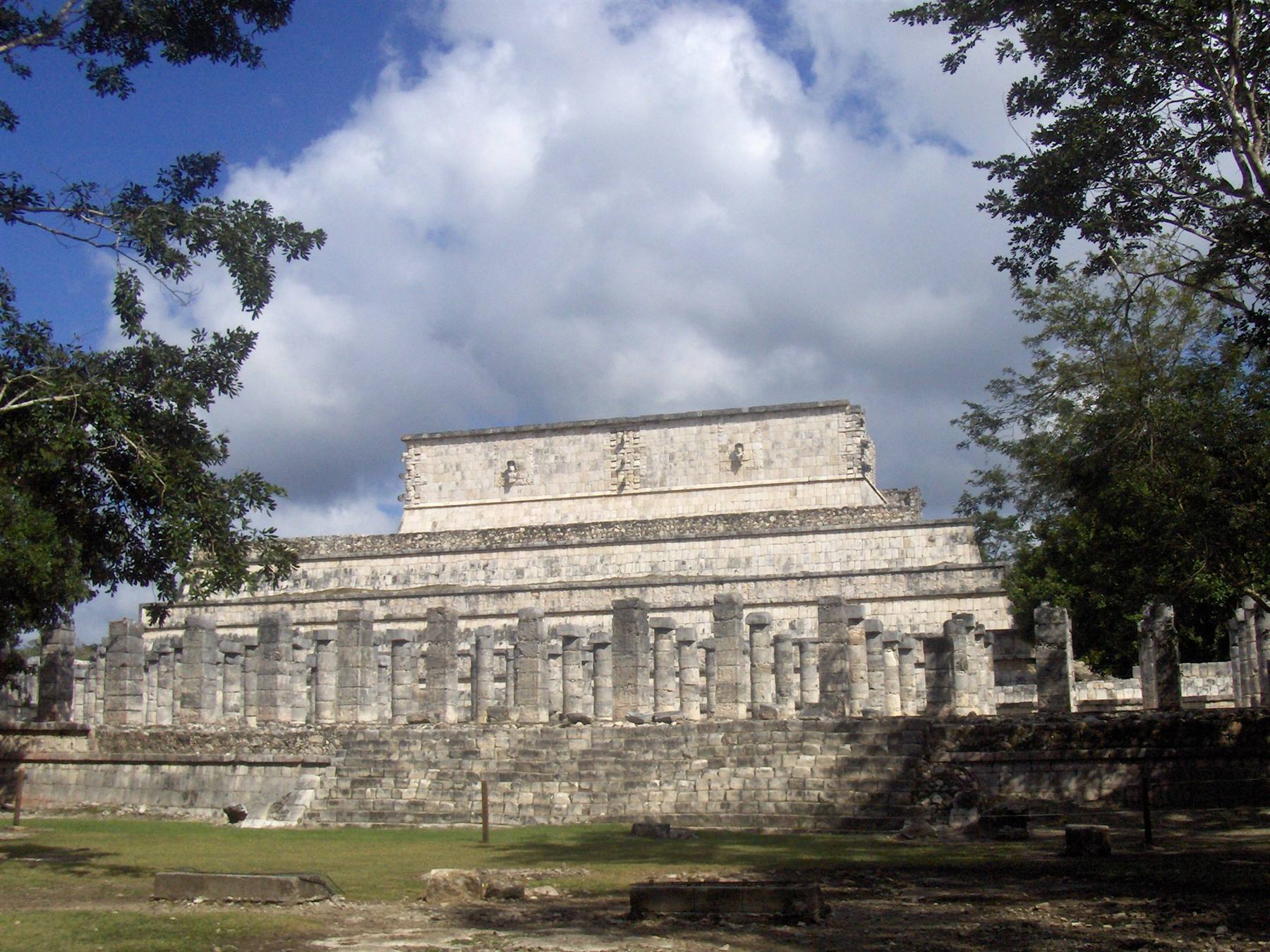
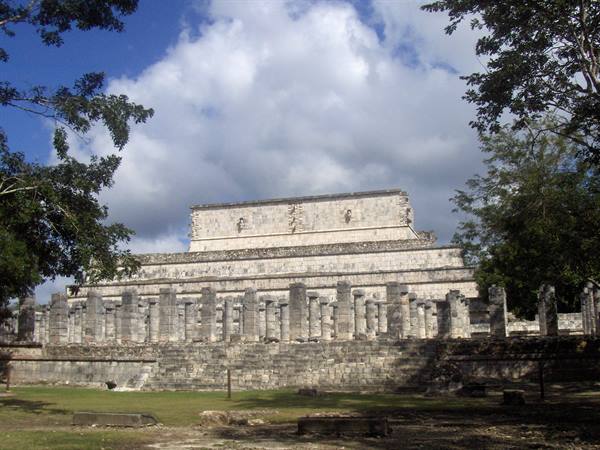
The Temple of the Warriors with its adjoining Hall of a Thousand Columns particularly catches my attention; I wonder what it might have been like in Maya times… The Pelota ball court is truly imposing, and while at Uxmal I wondered how they could ever manage to score, here it seems to me particularly impossible. The ring is in fact placed at such a height that it seems quite unlikely you could get it through without the use of your hands, and especially if you consider the height—not exactly basketball-player height—of the Maya of the time. But maybe it was better that way, since the player who managed the feat was rewarded with the honor of being beheaded as a sacrifice to the gods, as the scenes carved on the sides of the court indicate. As in front of the Pyramid of Kukulcan, here too it's enough to clap your hands to produce a loud echo.
It's starting to get really very hot, and the ball court is the least suitable place to linger. There's absolutely no shade, so we head toward the Sacred Cenote along a shaded path through the forest. In the Sacred Cenote, it's said, numerous remains of human bones were found, evidence of the remarkable number of sacrifices to the gods that took place in Aztec times. Meanwhile, along the path to the cenote, numerous stalls of local handicrafts have been set up at prices only slightly higher than those we found in Chiapas. They're so beautiful to look at and so colorful that, even if I don't buy, I photograph them: the most beautiful is the one selling ceramic plates. We make our last purchases, including an orange serape that I don't even know where I'll put it, but it's too beautiful to leave there…. I hope I don't have to charter a cargo ship to get back to Italy….
It's almost noon and it's really very hot; we head toward the exit and pass incredibly long lines at the entrance. The tour buses from the riviera have arrived; I really don't envy them—seeing Chichen Itza under the noon sun is absolutely inadvisable. The first impression we had turned out to be true: I prefer the site of Uxmal to that of Chichen. Surely the fame of the Pyramid of Kukulcan worked against it compared with the absolute surprise of the Uxmal site. A surprise for my husband too, who on his previous visit hadn't seen it … or at least that's what he believed! Back home, in fact, we discover from a much more attentive travel companion of his that they had visited this site too. Where my husband's head is sometimes, I really don't know! Having left Chichen, we head to the hotel, which is only about 3 km away.
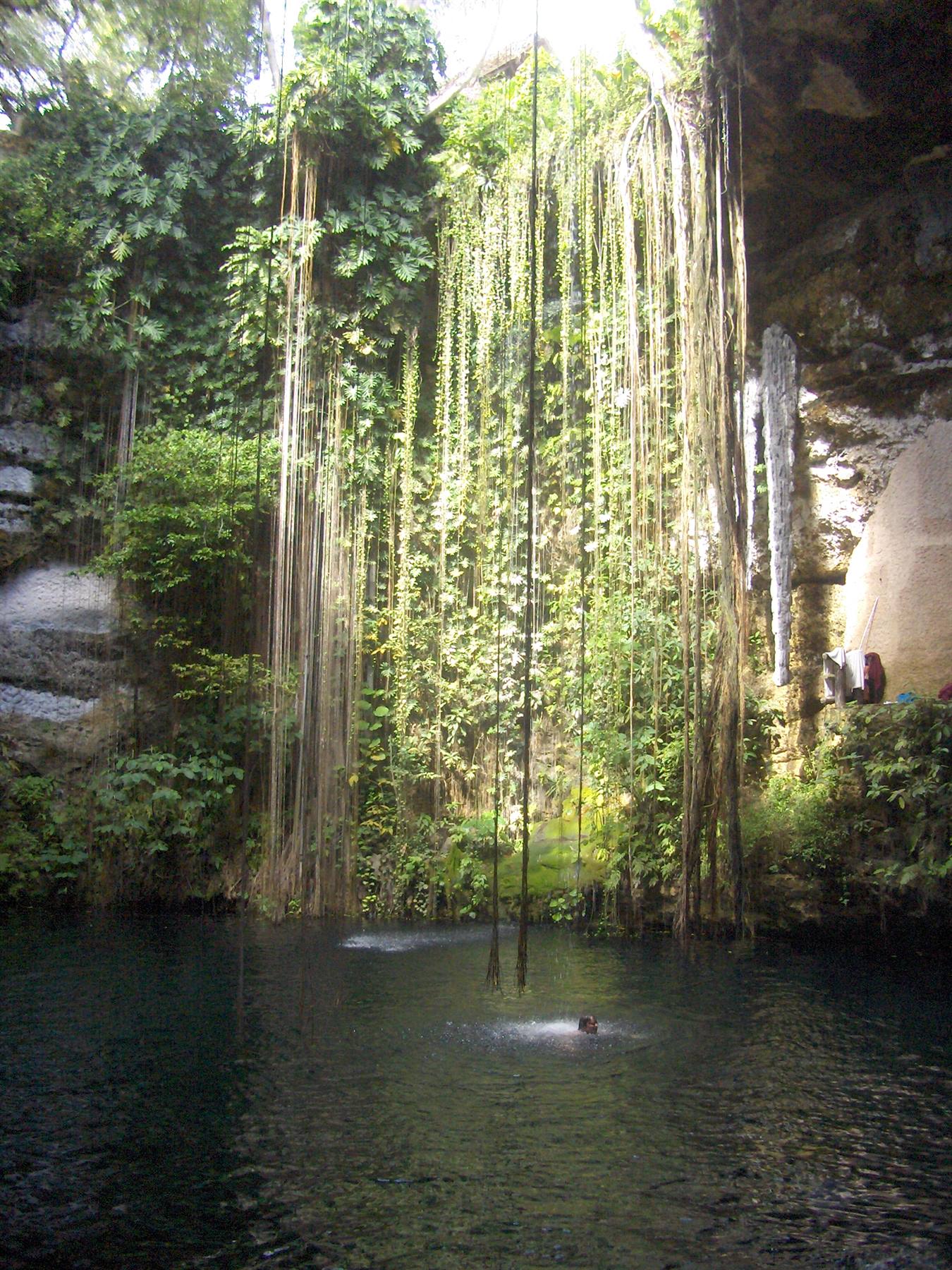
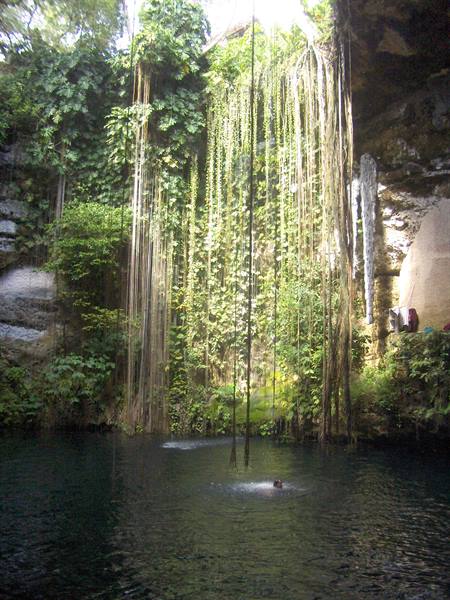
It's Dolores Alba again, and we booked it directly from Merida (595 pesos for the room). This simple, nice hotel consists of a series of pink bungalows arranged around two pools and is located exactly opposite the Cenote Ik-Ill. Once we've set down our bags, we immediately go to explore the Cenote. After a short stretch of road through a beautiful tropical garden we reach the entrance and start to go down. The Cenote of Ik-Ill is very beautiful and is very popular with tourists because you can also swim in it. It's open to the sky, and the roots of the surrounding ficus trees reach down to touch the water. We stay for a while in this cool place, but we don't swim—for my husband the water is too deep, and I … don't have my swimsuit!!! Poor me! We climb back up to the surface and, after lunch, relax a bit in the pool while waiting to return to Chichen for the evening light show.
Before entering, we don't fail to let ourselves be tempted once again into a purchase: we certainly couldn't pass up the hammock, could we? … for about 10 euros we get our nice synthetic hammock, obviously, even though the climate where we live will let us use it maybe four months a year. In front of the Pyramid of Kukulcan a series of chairs has been set up to watch the show, and apart from that spot, everything else is wrapped in darkness. While we wait for the show to begin, you can hear the sounds of the forest in the distance, and as the moon rises on the horizon, my husband fiddles with his camera and tripod.
When the camera is properly set up, a slightly mischievous dog comes along who, even though there's room around for a herd of elephants, lies down right in front of him!! We manage to get him to move, and shortly afterward the show begins, during which part of Maya history is told; meanwhile, garish and somber colors alternate on the pyramid, artificially reproducing even what happens during the equinoxes when, through a play of light, the feathered serpent seems to descend from one side of the building. My husband isn't in the least interested in the story, first of all because it's told in Spanish and secondly because he's busy taking artistic photos of the pyramid and the night. After about half an hour the show ends and we head back to the hotel.
We're at the tail end of our vuelta; the next day we'll make our way to Playa del Carmen, where we'll stay a few days for a bit of relaxation.
Temple of a Thousand Columns Chichen Itza
Day 1026 Nov 2007
Cenote Dzinup - Samulà - Valladolid - Tulum up to Playa
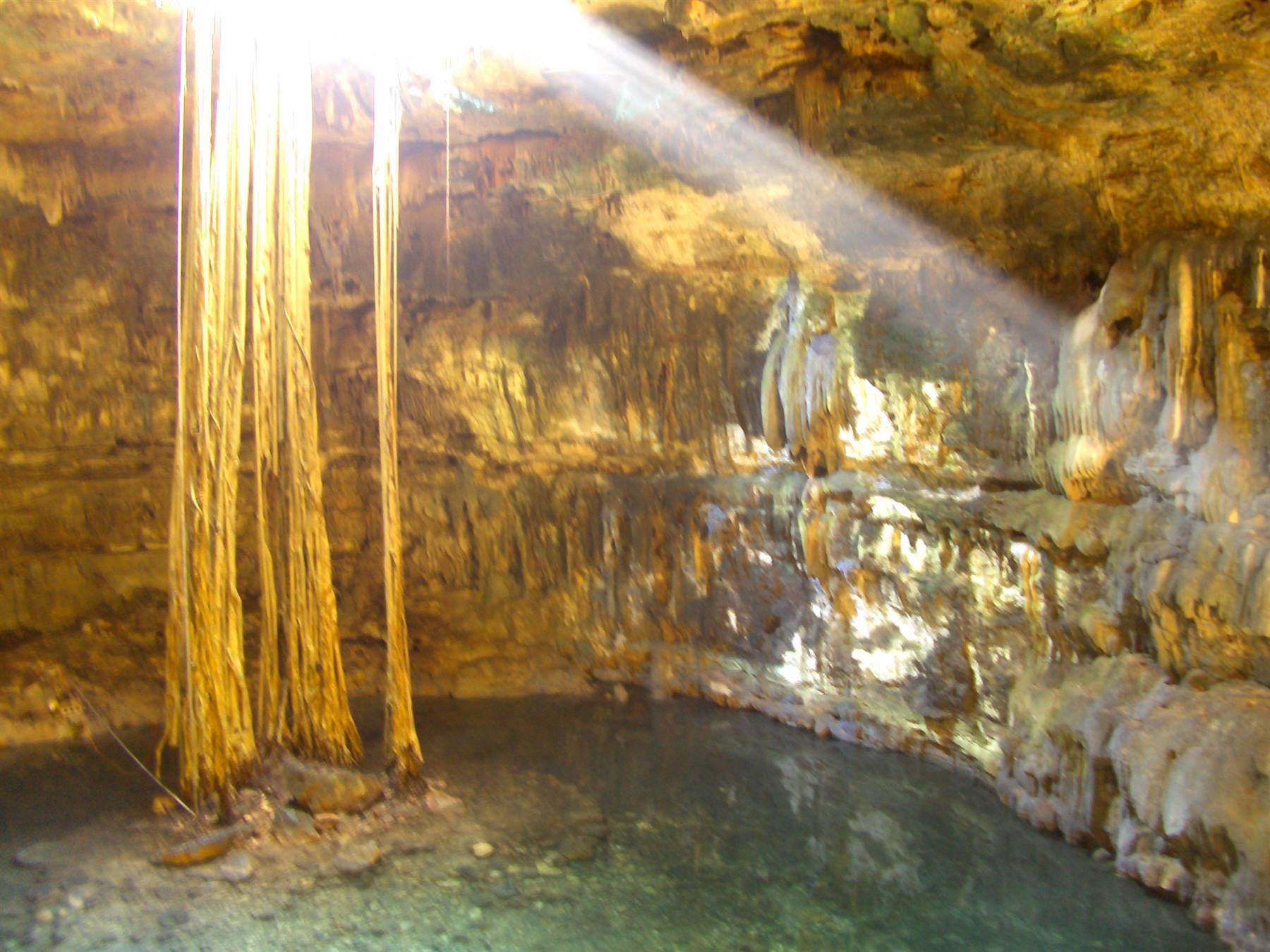
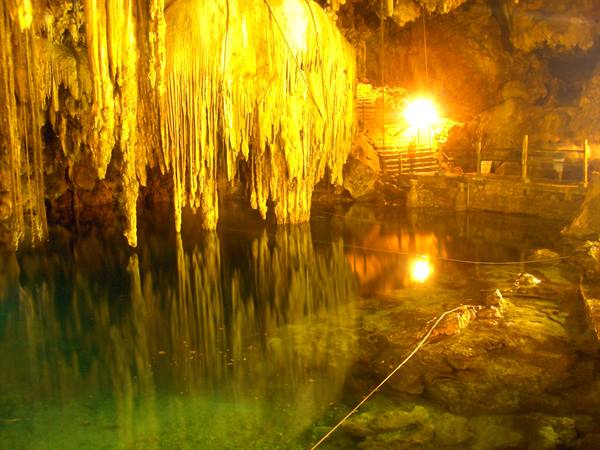
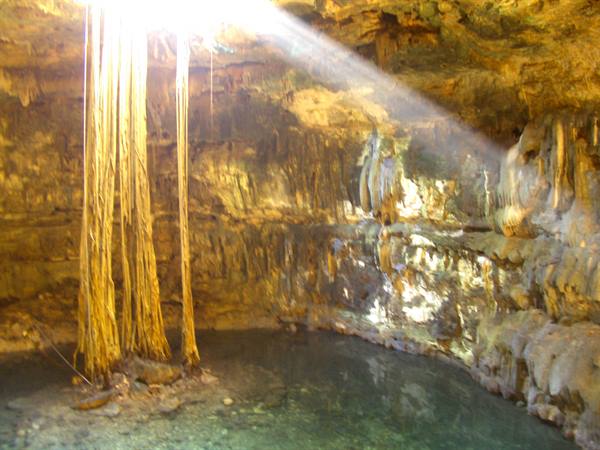
We set off for Valladolid, and along the way we stop to visit the Cenote Dzinup. The Cenote Dzinup is completely different from the one at Ik-Ill; it resembles in every way a cave richly decorated with limestone concretions and with a small lake. The group that entered with us leaves within a few moments, and so we're left alone to admire this place. We return to the surface via a slippery little staircase—these cenotes aren't as well equipped as the other one—and we realize that less than 200 m away there's the Cenote Samulà. We go to visit this one too, and it turns out to be very special. Here as well there's absolutely no one, and we can enjoy it in peace. The Cenote Samulà is very similar to the previous one, but it has a small opening in the roof, through which a cascade of roots from the plant above enters, and it's used as a doorway by small flocks of birds or bats.
I can't identify them, and maybe that's just as well! On the way out we notice we have a flat tire: the first and only unexpected event of our trip. So while my husband improvises as a mechanic, I dig into the supply of crackers to feed a very skinny dog and her lively little puppy, the size of a mouse. In Mexico, dogs really are poor wretches—mangy, thin and sad, the exact opposite of my three spoiled little creatures. In Valladolid, even though there are now only about 200 km to go, we get the tire repaired in a shack, just in case, and here I see the first well-kept dog, but equally unpleasant and snarling. We devote very little time to this town. A few photos on the ever-beautiful benches of the zocalo, we change some money at an excellent rate and set off again.
To get to Tulum we pass by the entrance to the ruins of Cobà; I'm very tempted, but unfortunately we don't have time for both, so it's Tulum, which has the special feature of overlooking the sea. The entrance to Tulum looks a lot like the entrance to an amusement park: restaurant, souvenir shops galore, and everything at prices decidedly higher than what we'd gotten used to. Coming from sites with the majesty of Uxmal or Chichen or the magic of Palenque, Tulum is a big disappointment. The only building that stirs a bit of interest in us is the Castillo, but without the splendid turquoise sea it would lose much of its charm. It's still interesting to read its history and the purpose for which it was built and had importance.
Whether because of tiredness or because we've seen much more important sites, we wander around without much enthusiasm, except for the color of the sea, which is truly splendid. After a quick lunch we set off … the last stretch with our legendary blue Dodge to Playa (total 210 km, 3.5 h), where we hand it back without any problems after unloading bags and souvenirs—just a few, really—at the village where we'll stay for a few days of rest. The village is quite nice, although it doesn't overlook the beach directly. In any case it's not a big problem, since in the days to come we won't have much to do, except eat, sleep, take a dip, lounge in a deckchair and take a few strolls… After a short walk along V Avenida … off to bed!
Cenote Ik Ill
Day 1127 Nov 2007
Playa and Isla Mujeres
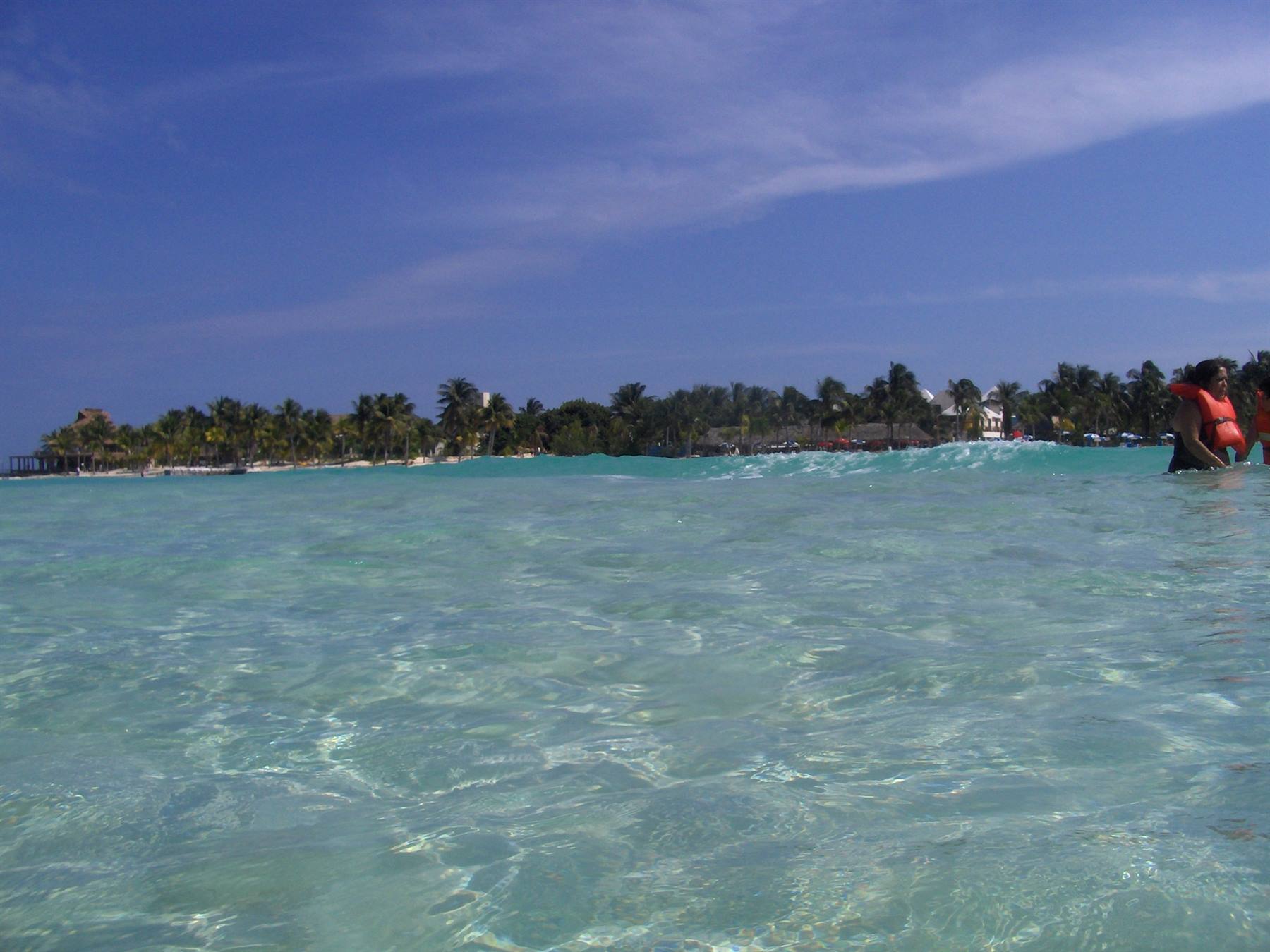
The next day we get to enjoy our first swim in a sea of a splendid emerald color…… It's rather rough, but the color is priceless… and as we walk along the beach we decide that tomorrow, a trip to Isla de Las Mujeres wouldn't be such a bad idea after all. No sooner said than done: notes in hand, after breakfast we head to the collectivos "terminal" for Cancun. We need to get to Puerto Juarez by nine.. we have time, but the collectivos only leave when they're full; luckily we don't have to wait long and in about an hour we arrive at our destination. We get off at the terminal in Cancun, and right afterward the colectivo passes by and in a few minutes takes us to Puerto Juarez.
As soon as we get off we're practically taken hostage by a jovial Mexican from a local agency who offers us a day by boat to Isla del Las Mujeres for a truly very reasonable price (about 300 pesos each with lunch included). On the little boat there are only 9 of us: us and a Mexican family made up of grandparents, children and a little granddaughter. Off we go! …the crossing should last about half an hour …. Yes, should …when we're halfway between Cancun—which from a distance is visible covered by a little rain cloud, Fantozzi-style—and the Island, the little boat stops … we've nearly run out of fuel and the engine is picking up residual debris that has made it stop …. Oh great, now what? Oh well …. The route is very busy, surely somehow it'll work out.
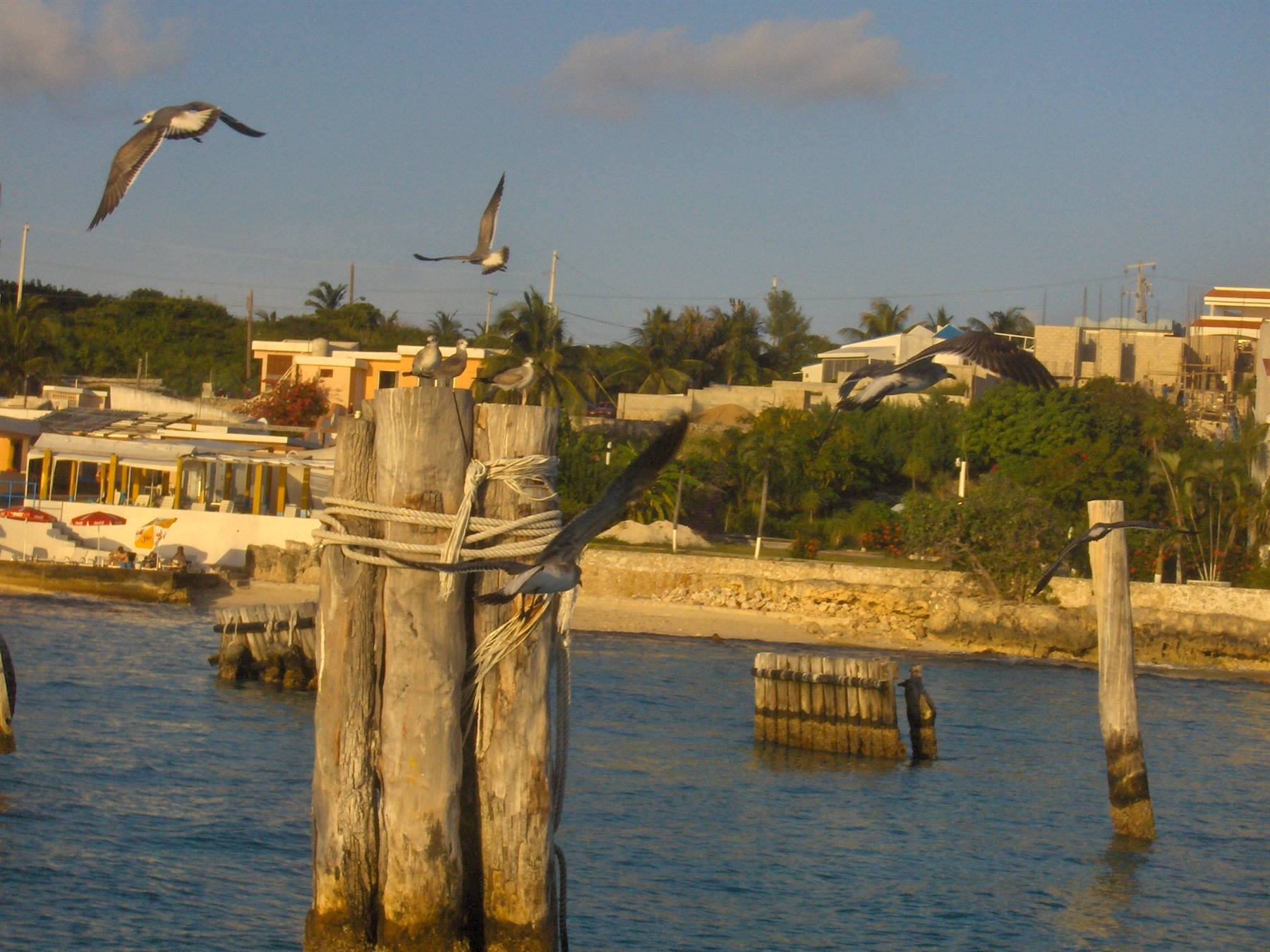
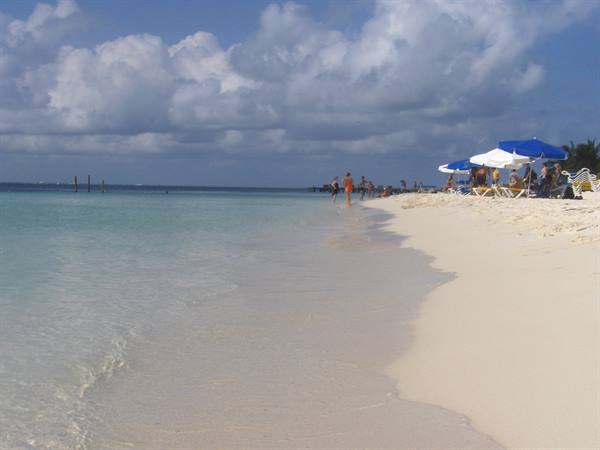
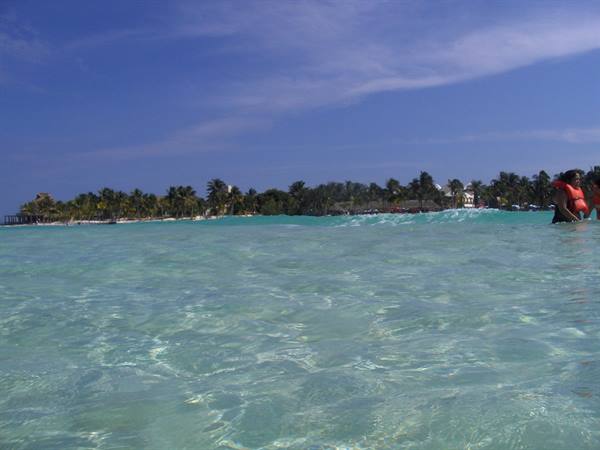
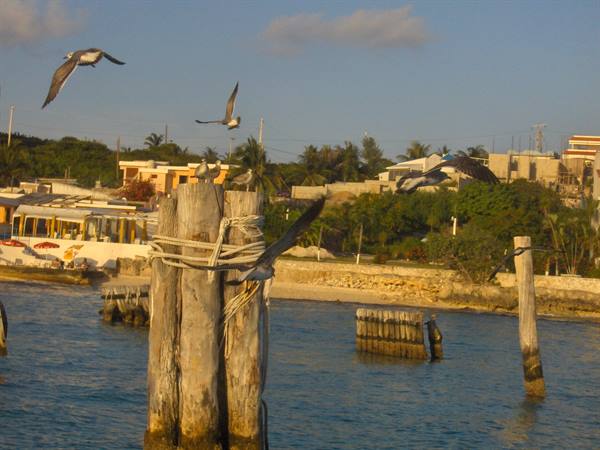
Our pilot doesn't lose heart, fiddles with the two engines and, with the utmost calm, after a good quarter of an hour and a good dose of luck, one of the two engines starts up again. So we reach Isla de Las Mujeres, where we make our first stop in town….. while our "captain" fills up with fuel! While it's raining in Cancun, the weather accompanying us is instead splendid: crystal-clear sky and sun that splits the stones. Isla de las Mujeres is the classic Caribbean island: white, fine sand, crystal-clear water, palm trees and tranquil relaxation. After a short walk around "town!" we set off again toward the hotel zone, where we stop for a refreshing swim.
Today it's really very hot!! We throw ourselves directly from the boat into a lovely sea and enjoy these moments of pure relaxation! From there we head toward Playa Tiburon, where in a simple little restaurant we'll be served a lunch of rice, pasta and grilled fish that is decidedly excellent. At Playa Tiburon you can have your picture taken with a little shark kept in captivity in an enclosure so cramped that it makes me feel sorry for it. It's so fed up with being touched and photographed that whenever it can it hides at the bottom. A few minutes' walk away, on the other hand, you can visit a center where injured turtles are collected and cared for, as well as the eggs, to protect their hatching and help more of the newborns survive once they reach the open sea. The day passes pleasantly and peacefully, and as soon as the nice Mexican family finishes lunch….
an operation that despite the single course requires a couple of hours… we set off for the Garrafon Natural Park. Here the water takes on intense blue colors and then shifts to patches of deep green. There's time for another swim among the colorful fish … but by now the day is drawing to a close. The colors become warmer and more golden as we set off—with a full tank—for Puerto Juarez. We take the colectivo back to the Cancun terminal and from there the one to Playa. On this last one, two musicians get on, heading to one of the big hotels in Playa for an evening concert, and they have with them a charango and an Andean flute. We chat a bit about Andean music and they i m p r o v i s e A l t u r a s d e g l i I n t i I l l i m a n i, o n e of m y f a v o r i t e s o n g s ( t o t a l c o s t f o r t h e d a y a b o u t ¬ 5 0. 0 0 f o r t w o ).
T h i s d a y t o o d r a w s t o a c l o s e; t h e n e x t o n e s w i l l b e d e v o t e d t o r e l a x i n g a n d t h e b e a c h, w i t h t h e o n l y v a r i a t i o n b e i n g a h a l f - d a y trip to the Cenote Giardino dell'Eden, an excursion offered by the tour operator at the time of booking. It's an open-air cenote and the water is decidedly chilly, but we enjoy the swim and the view of the depths of these pools of semi-fresh water. The day of departure arrives …… packing turns out to be a balancing act. They tell us, in fact, that at the airport they're very strict about the weight of suitcases, and we, with all the purchases we've made, will certainly be over the limit.
I buy a beach bag with the sole purpose of filling it with the fragile and heavy souvenirs (they don't weigh it anyway) and we try to distribute the purchases as best we can between the two suitcases and the trolleys. In fact we're brilliant: the suitcases are each only one kg over (which we'll have to pay for anyway) and this allows us not to draw too much attention with the trolleys, which are actually quite heavy… With the awareness of having only just tasted a little of this land of colors, music, ancient history and spirituality, we board for the return to Italy with a bit of nostalgia for everything we've seen and above all for what we've yet to see……
……back home in Italy: the suitcases are opened and the living room becomes a little native market: spread out in neat order on our sofa are all our purchases and, in the camera, a few hundred photographs as a memento of a wonderful trip in a country that fills your eyes with colors and beauty and your heart with emotions… que VIVA MEXICO!
Cenote Samulà - Valladolid
Day 1227 Nov 2007
Playa and Isla Mujeres
The next day we get to enjoy our first swim in a sea of a splendid emerald color…… It's rather rough, but the color is priceless… and as we walk along the beach we decide that tomorrow, a trip to Isla de Las Mujeres wouldn't be such a bad idea after all. No sooner said than done: notes in hand, after breakfast we head to the collectivos "terminal" for Cancun. We need to get to Puerto Juarez by nine.. we have time, but the collectivos only leave when they're full; luckily we don't have to wait long and in about an hour we arrive at our destination. We get off at the terminal in Cancun, and right afterward the colectivo passes by and in a few minutes takes us to Puerto Juarez.
As soon as we get off we're practically taken hostage by a jovial Mexican from a local agency who offers us a day by boat to Isla del Las Mujeres for a truly very reasonable price (about 300 pesos each with lunch included). On the little boat there are only 9 of us: us and a Mexican family made up of grandparents, children and a little granddaughter. Off we go! …the crossing should last about half an hour …. Yes, should …when we're halfway between Cancun—which from a distance is visible covered by a little rain cloud, Fantozzi-style—and the Island, the little boat stops … we've nearly run out of fuel and the engine is picking up residual debris that has made it stop …. Oh great, now what? Oh well …. The route is very busy, surely somehow it'll work out.
Our pilot doesn't lose heart, fiddles with the two engines and, with the utmost calm, after a good quarter of an hour and a good dose of luck, one of the two engines starts up again. So we reach Isla de Las Mujeres, where we make our first stop in town….. while our "captain" fills up with fuel! While it's raining in Cancun, the weather accompanying us is instead splendid: crystal-clear sky and sun that splits the stones. Isla de las Mujeres is the classic Caribbean island: white, fine sand, crystal-clear water, palm trees and tranquil relaxation. After a short walk around "town!" we set off again toward the hotel zone, where we stop for a refreshing swim.
Today it's really very hot!! We throw ourselves directly from the boat into a lovely sea and enjoy these moments of pure relaxation! From there we head toward Playa Tiburon, where in a simple little restaurant we'll be served a lunch of rice, pasta and grilled fish that is decidedly excellent. At Playa Tiburon you can have your picture taken with a little shark kept in captivity in an enclosure so cramped that it makes me feel sorry for it. It's so fed up with being touched and photographed that whenever it can it hides at the bottom. A few minutes' walk away, on the other hand, you can visit a center where injured turtles are collected and cared for, as well as the eggs, to protect their hatching and help more of the newborns survive once they reach the open sea. The day passes pleasantly and peacefully, and as soon as the nice Mexican family finishes lunch….
an operation that despite the single course requires a couple of hours… we set off for the Garrafon Natural Park. Here the water takes on intense blue colors and then shifts to patches of deep green. There's time for another swim among the colorful fish … but by now the day is drawing to a close. The colors become warmer and more golden as we set off—with a full tank—for Puerto Juarez. We take the colectivo back to the Cancun terminal and from there the one to Playa. On this last one, two musicians get on, heading to one of the big hotels in Playa for an evening concert, and they have with them a charango and an Andean flute. We chat a bit about Andean music and they i m p r o v i s e A l t u r a s d e g l i I n t i I l l i m a n i, o n e of m y f a v o r i t e s o n g s ( t o t a l c o s t f o r t h e d a y a b o u t ¬ 5 0. 0 0 f o r t w o ).
T h i s d a y t o o d r a w s t o a c l o s e; t h e n e x t o n e s w i l l b e d e v o t e d t o r e l a x i n g a n d t h e b e a c h, w i t h t h e o n l y v a r i a t i o n b e i n g a h a l f - d a y trip to the Cenote Giardino dell'Eden, an excursion offered by the tour operator at the time of booking. It's an open-air cenote and the water is decidedly chilly, but we enjoy the swim and the view of the depths of these pools of semi-fresh water. The day of departure arrives …… packing turns out to be a balancing act. They tell us, in fact, that at the airport they're very strict about the weight of suitcases, and we, with all the purchases we've made, will certainly be over the limit.
I buy a beach bag with the sole purpose of filling it with the fragile and heavy souvenirs (they don't weigh it anyway) and we try to distribute the purchases as best we can between the two suitcases and the trolleys. In fact we're brilliant: the suitcases are each only one kg over (which we'll have to pay for anyway) and this allows us not to draw too much attention with the trolleys, which are actually quite heavy… With the awareness of having only just tasted a little of this land of colors, music, ancient history and spirituality, we board for the return to Italy with a bit of nostalgia for everything we've seen and above all for what we've yet to see……
……back home in Italy: the suitcases are opened and the living room becomes a little native market: spread out in neat order on our sofa are all our purchases and, in the camera, a few hundred photographs as a memento of a wonderful trip in a country that fills your eyes with colors and beauty and your heart with emotions… que VIVA MEXICO!
Isla de las mujeres
Day 1327 Nov 2007
Playa and Isla Mujeres
The next day we get to enjoy our first swim in a sea of a splendid emerald color…… It's rather rough, but the color is priceless… and as we walk along the beach we decide that tomorrow, a trip to Isla de Las Mujeres wouldn't be such a bad idea after all. No sooner said than done: notes in hand, after breakfast we head to the collectivos "terminal" for Cancun. We need to get to Puerto Juarez by nine.. we have time, but the collectivos only leave when they're full; luckily we don't have to wait long and in about an hour we arrive at our destination. We get off at the terminal in Cancun, and right afterward the colectivo passes by and in a few minutes takes us to Puerto Juarez.
As soon as we get off we're practically taken hostage by a jovial Mexican from a local agency who offers us a day by boat to Isla del Las Mujeres for a truly very reasonable price (about 300 pesos each with lunch included). On the little boat there are only 9 of us: us and a Mexican family made up of grandparents, children and a little granddaughter. Off we go! …the crossing should last about half an hour …. Yes, should …when we're halfway between Cancun—which from a distance is visible covered by a little rain cloud, Fantozzi-style—and the Island, the little boat stops … we've nearly run out of fuel and the engine is picking up residual debris that has made it stop …. Oh great, now what? Oh well …. The route is very busy, surely somehow it'll work out.
Our pilot doesn't lose heart, fiddles with the two engines and, with the utmost calm, after a good quarter of an hour and a good dose of luck, one of the two engines starts up again. So we reach Isla de Las Mujeres, where we make our first stop in town….. while our "captain" fills up with fuel! While it's raining in Cancun, the weather accompanying us is instead splendid: crystal-clear sky and sun that splits the stones. Isla de las Mujeres is the classic Caribbean island: white, fine sand, crystal-clear water, palm trees and tranquil relaxation. After a short walk around "town!" we set off again toward the hotel zone, where we stop for a refreshing swim.
Today it's really very hot!! We throw ourselves directly from the boat into a lovely sea and enjoy these moments of pure relaxation! From there we head toward Playa Tiburon, where in a simple little restaurant we'll be served a lunch of rice, pasta and grilled fish that is decidedly excellent. At Playa Tiburon you can have your picture taken with a little shark kept in captivity in an enclosure so cramped that it makes me feel sorry for it. It's so fed up with being touched and photographed that whenever it can it hides at the bottom. A few minutes' walk away, on the other hand, you can visit a center where injured turtles are collected and cared for, as well as the eggs, to protect their hatching and help more of the newborns survive once they reach the open sea. The day passes pleasantly and peacefully, and as soon as the nice Mexican family finishes lunch….
an operation that despite the single course requires a couple of hours… we set off for the Garrafon Natural Park. Here the water takes on intense blue colors and then shifts to patches of deep green. There's time for another swim among the colorful fish … but by now the day is drawing to a close. The colors become warmer and more golden as we set off—with a full tank—for Puerto Juarez. We take the colectivo back to the Cancun terminal and from there the one to Playa. On this last one, two musicians get on, heading to one of the big hotels in Playa for an evening concert, and they have with them a charango and an Andean flute. We chat a bit about Andean music and they i m p r o v i s e A l t u r a s d e g l i I n t i I l l i m a n i, o n e of m y f a v o r i t e s o n g s ( t o t a l c o s t f o r t h e d a y a b o u t ¬ 5 0. 0 0 f o r t w o ).
T h i s d a y t o o d r a w s t o a c l o s e; t h e n e x t o n e s w i l l b e d e v o t e d t o r e l a x i n g a n d t h e b e a c h, w i t h t h e o n l y v a r i a t i o n b e i n g a h a l f - d a y trip to the Cenote Giardino dell'Eden, an excursion offered by the tour operator at the time of booking. It's an open-air cenote and the water is decidedly chilly, but we enjoy the swim and the view of the depths of these pools of semi-fresh water. The day of departure arrives …… packing turns out to be a balancing act. They tell us, in fact, that at the airport they're very strict about the weight of suitcases, and we, with all the purchases we've made, will certainly be over the limit.
I buy a beach bag with the sole purpose of filling it with the fragile and heavy souvenirs (they don't weigh it anyway) and we try to distribute the purchases as best we can between the two suitcases and the trolleys. In fact we're brilliant: the suitcases are each only one kg over (which we'll have to pay for anyway) and this allows us not to draw too much attention with the trolleys, which are actually quite heavy… With the awareness of having only just tasted a little of this land of colors, music, ancient history and spirituality, we board for the return to Italy with a bit of nostalgia for everything we've seen and above all for what we've yet to see……
……back home in Italy: the suitcases are opened and the living room becomes a little native market: spread out in neat order on our sofa are all our purchases and, in the camera, a few hundred photographs as a memento of a wonderful trip in a country that fills your eyes with colors and beauty and your heart with emotions… que VIVA MEXICO!


0 reader comments