With about twenty days available it is not difficult to plan a visit to all of Cuba. The island is long and narrow and lends itself well to a circular tour. That is what we wanted: to see the east and the west, the south and the north, the sea and the mountains, the countryside and the cities. After visiting Havana we set off for the west, towards Viñales and Maria La Gorda. We choose an off-the-beaten-track route and therefore a very genuine and unspoiled one. It is the Circuito Norte that passes through villages full of life: people queuing for purchases, schoolchildren in uniform (white shirt, trousers or skirt, red or ochre depending on the year) going to or coming from school, stalls with carnival decorations made of paper, kiosks with porchetta sandwiches and soft little pizzas, rare tractors, many horses and bicycles, a few trucks loaded with people, very rare cars.
The road at first wanders among sugar-cane fields, then, following the lie of the land, rises and falls through a hilly area covered with vegetation and cultivated fields, scattered houses and small villages. Everywhere stand out the tall, grey trunks of royal palms with their jagged, swaying green plume. The earth is blood-red and generous. When the road climbs the ridges the view is rewarded: hills follow other hills, and sometimes one can even glimpse the sea or some rare distant chimney. The countryside houses, bohios, are all alike: roof of palm leaves and wooden walls, single-storey with a porch, but here in the west they have a particularity: all of them, but really all of them, outside, under the little porch, have two rocking chairs.
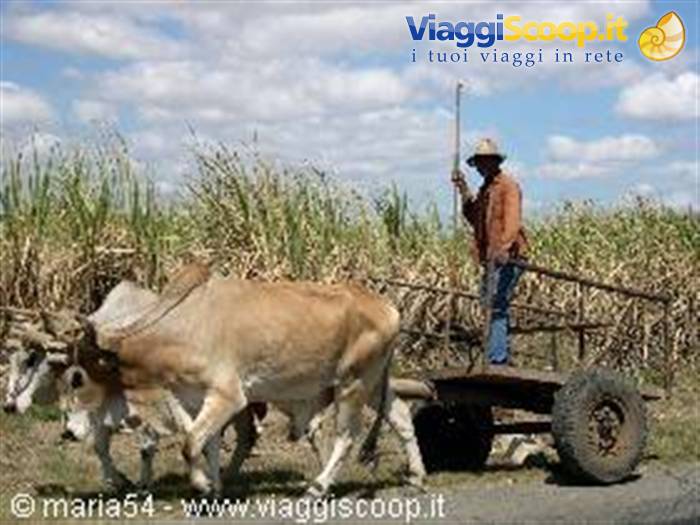
Even in the villages the houses are generally single-storey, but of masonry with tiled roofs, arranged in long rows along the sides of the streets; the entrance door leads into the living room, behind it the kitchen and the patio or a courtyard onto which the bedrooms open. The houses, like the churches, are blue or pink, turquoise or yellow, pale green or wisteria. Gradually the landscape changes: banana plants, chickens, dark pigs, dogs, goats, oxen pulling carts or rudimentary sledges made of two logs pass by. Many cattle egrets and the “usual” vultures circling in the sky. The mogotes begin to take shape, a kind of rocky hillocks covered with vegetation that rise straight and steep from the plain. I expected many more flowers, but the winter season is dry and the vegetation is still at rest.
Only a few trees have blossomed, their extraordinary red canopy standing out against the rest of the still leafless branches. And we arrive at Viñales, a village in a splendid position where life flows slowly and regularly, marked by the rhythms of the seasons. The climate is ideal for producing the most prized tobacco. Fields and fields of tobacco, dotted with drying sheds, divided by wild hedges, interspersed also with other crops. Here there is abundance of everything; our dinners, in the casas particulares, will be among the richest and most varied of the whole trip: very fresh vegetables and fruit: lettuce, tomatoes, peppers, grapefruit and oranges, guava with red, fleshy, slightly peppery pulp, bananas and pineapples - delicious especially the mignon ones - to accompany excellent free-range chicken or pork.
Many crops, but there is also an abundance of wilderness areas, parks and reserves where one can go hiking, generally guided. Having a guide, more or less official, is preferable, both for the necessary information on flora and fauna and because the paths are unmarked and it would be easy to get lost. During one of these hikes we visit a heavily fissured limestone area covered with vegetation; we saw the rare cork palm, tree ferns, termite mounds embracing tall trunks and strange trees with thorny trunks, others hosting orchids and dozens of epiphytic plants resting on the branches awaiting a little dew, and still lianas and palms and the first Tocororo, the national bird, with the colours of the flag. On the route we are accompanied by Lazaro, met by chance, 30-40 years old, who looks more like an Irishman than a Cuban: small and thin, red hair, fair skin with freckles.
His appearance is truly wretched, broken shoes and patched clothes. After the visit he takes us to his house, shows us songbirds and three unfortunate young jutia (similar to a nutria) that he keeps in a cage, caught to be eaten later. Lazaro, poor but generous, before saying goodbye gives us about twenty grapefruits just shaken from the tree. We move further west; along the road there are various piles of charcoal and plumes of smoke coming from the many lit charcoal kilns. At Maria la Gorda, which was supposed to be a paradise (palms by the sea, flourishing vegetation and some of the most beautiful seabeds in Cuba), we arrive in the late afternoon.
As we had been told, last year's Hurricane Ivan had badly damaged this area: inside, nature trails closed, branches and trees ravaged with 80% fewer leaves - which on the other hand allowed us to spot many birds including the tiny hummingbird - and along the shore, bedraggled palms, shells, corals and sea fans washed up. Nevertheless, the excursion to the “Cave of Pearls” and the pleasant swim with a sighting of the coral seabed full of colourful fish were very beautiful. But, given the late afternoon hour and the absence of wind, waiting for us as we come out of the water we find a myriad of tiny famished midges that put wings on our feet, and in a flash we left the battered “paradise” to launch into a long transfer run towards Trinidad. A beautiful and unique city, quiet, full of music, charm, tourists and iron grilles.
More than in any other place we visited, the balconies, all of them, are adorned and protected by grilles; the oldest, dating back to the 1700s, are wooden, while the iron ones are from the 1800s. Gigantic balconies that display the interior of beautiful colonial houses; especially at sunset or in shady areas the shutters are opened and people, in this place a bit home a bit street, sit to take the fresh air. Here too the day is never long enough.
In the morning, hiking among the green mountains of Topes del Collantes, rich in icy streams and waterfalls, then to the sea for a few hours of sun and various swims to peer into the rich seabed; but there are also interesting museums to see, the architecture one and the civic one, the art gallery, the markets overflowing with beautiful embroidery and crochet work, seed necklaces, papier-mâché little cars and other objects we will no longer find. And it is also beautiful to get lost in the silent cobbled lanes, where horses are more frequent than cars, and finally, in the evening, at the Casa de la Trova to listen to music while sipping a cool mojito (cane sugar, lime juice, white rum, hierba buena (it resembles mint), soda, ice). On our move eastwards, after Trinidad everything becomes flat again.
The plain is dotted with lakes and marshes, where the crocodile also lives, but otherwise everything seems a great expanse of sugar cane, which at the end of winter and the beginning of spring is harvested; indeed along the road one notices a certain coming and going of workers and trucks for transport to the processing plants. These collection centres can be seen even from a distance by the smoke coming from the plants and by the sweetish smell of the air.
Day 120 Feb 2005
A night in Camaguey, right in the middle of the plain and of the island's most important road. The city is less distinctive than Trinidad, but lively, full of activity and shops with a good range of goods - if you want, you can even find Coca Cola. Famous for its tinajones, large terracotta jars where rainwater was collected, but to me it remains in mind rather as the city of bicycles, which swarm in flocks on all the streets, protagonists of the traffic, on equal terms with pedestrians and in slight competition only with the bike taxis. With another long stage we arrive at Santiago de Cuba, on the mountainous and rugged east coast. The city, particularly significant for the island's history - it was the colonial capital before Havana and the Revolution set off from here - faces the Caribbean Sea, but inside a vast and protective inlet.
The historical importance shines through in the wealth of its architecture, in the mighty defensive fortifications at the entrance to the bay, in the artefacts and in the passionate and tragic account given by the guide at the Moncada Barracks, now the Museum of the Revolution. We pass Guantanamo, of the American base you can't perceive the slightest presence, and travelling along La Farola, a winding mountain road, we arrive at Baracoa. After the harsh and at times desert-like east coast it is a plunge into greenery, the vegetation becomes lush, truly tropical, with a climate particularly suited to coffee and cocoa, but here, they say, everything grows. Until a few decades ago you could only reach Baracoa by sea, but even now it is decidedly out of the way, with a demanding mountain road on one side and an unpaved, potholed one on the other.
Baracoa is a small town, minimal I'd say, with simple buildings but, as always, tidy and clean. The only church is half-ruined and awaiting funds for restoration. Yet in the early 1900s it had a flourishing period thanks to banana production, but then the banana plants fell ill and the crisis came. It was Christopher Columbus's first landfall in the Americas; of him there remains a cross, a monument and the name given to the strange mountain resembling an anvil, "El Yunque", behind Baracoa, an unmistakable landmark for sailors coming from Europe.
Interesting was the meeting with the director of the Municipal Museum who told us: "I believe that neither America nor Cuba were discovered by Columbus, given that populations already lived here, but in contrast to the frequent opinion that sees in the arrival of Christopher Columbus a negative moment for America, I am convinced instead that he brought cultural wealth and opened new perspectives". Generous of him to privilege these positive aspects; the Indian chief Hatuey, who was burned alive for having opposed Spanish domination and the annihilation of his people, would certainly have thought otherwise. We liked Baracoa for having found some traces of the native Cubans, and it is particularly dear to us for the lovely relationship we had with the people of the nearby Rio Yumuri, where we went on an excursion accompanied and pampered by half the village.
Finally, a memory from my taste buds for its cuisine, different from the rest of the island, in the name of coconut: excellent the fish in coconut milk, the coconut chocolate and the cucuruchos, a sweet made of grated coconut cooked with honey, papaya or guayaba, grapefruit or orange and packaged in characteristic banana-leaf cones.
Notes The trip was made in February with a minibus with driver - convenient if you are at least 5 people - a choice that proved excellent both for the good relationship with "our" driver (Pancho), and for his knowledge of roads and places. For overnight stays, dinner and breakfast we chose accommodation in Casas Particulares (private houses) to have more contact with the people and where we always found an excellent welcome and good treatment.
For information and/or contacts in Cuba Maria Grazia Brusegan mariagrazia@arcam-mirano.it to see some photos

0 reader comments