Desert: a call, a necessity, a dream? "God created lands rich in water so that men may live there, deserts so that there they may find their soul again" (Tuareg proverb) But what can there be in a desert?: silence, solitude, space, synthesis and, sun, stars, sand, stones, thirst, but also animals, water, dawns, art. Desert is being enchanted before a rocky landscape, it is longing for the coolness of the oasis, it is..., but let's go in order. The desert in Libya is not a rarity. Excluding the coastal strip about 200 kilometres wide and a few oases, 93% of the country is arid, and, since Libya is one of the largest African countries, there is desert for all tastes and itineraries can be equally varied.
For us the choice was easy, it was the first trip and so we chose the most beautiful route, the most classic, in the Fezzan, the south-western region, but crossing the Jebel Nafusa (the Western Mountains). We travel the 750 km, from Tripoli to Ghadames, on a smooth asphalt road. Every sign, including road signs, is strictly in Arabic, undecipherable. At first we pass through populous districts, people in the street, quiet traffic. For a couple of hours along the roadside there pass uninterruptedly workshops, garages, shops, restaurants, crops and rubbish, as long as there are houses. Then everything becomes arid and stony, first flat then mountainous. Beside the road, imposing power lines. We overtake a flock, a few stalls with fruit and ceramics. Villages are rare, inhabited by Berbers.
On the road only men, many completely wrapped in the warm gard, a traditional white woollen cloth that serves as a coat. Grazing dromedaries. A couple of brief stops to stretch our legs, but wind and sand immediately drive us back into the car. A few snowflakes, who would have said it? In the desert! A couple of checkpoints, we stop, documents are shown, a bundle of photocopies and certificates. By now it's night, the two Libyans accompanying us chat busily, a fluid, harmonious, hushed speech that makes you drowsy. And here we are in Ghadames, in my view a symbol city of today's Libya with strong traces of the past. A past that manifests itself in the black skin colour of many inhabitants and in the medina (declared a UNESCO world heritage site), now completely deserted. Gaddafi, in his desire for modernisation, completely uprooted the population from the traditional houses.
In 1984 more than 6000 people lived in the old city; four years later a single unyielding family. Now they live in new, anonymous and unfinished districts. In summer the heat is unbearable and some return to the old dwellings, cooler and more liveable. But modernisation processes are unstoppable and legitimate, as we know, and often the leap is too glaring and lacerating. The medina of Ghadames is like a dead body, no blood flows in its veins, no more voices and glances, movement and thought. But even if deserted the old city is evocative. Surrounded by walls with 2 watchtowers, 7 entrances, which used to be closed at sunset, one for each district. In the alleys there is shade, sometimes total darkness. The dominant colour is white, often in the plaster there is the imprint of a hand, it's the mason's "signature".
The wooden doors are stubby and massive, some bear the marks of those who have been on pilgrimage to Mecca. In the little squares, where the social life of the districts took place (meetings, weddings, parties, the prophet's birthday) interesting craft objects are displayed. The sellers don't pester, they let you look and the bargaining is quick. Taher, our guide, tells us how life was organised: during the day the women lived mainly at home, indeed on the rooftops, going out only early in the morning and at sunset. No restrictions for the men, who however grouped by age: young people, children, the elderly near the mosque. Even for marriages the categories apply, a tradition still in use, they are made between likes: natives, immigrants, former slaves. The tour passes by the Pasha's palace, the well, then the public baths with running water.
And we come to the vegetable gardens shaded by palms, here you can hear the flowing water, we are right above one of the channels that carry it into the medina. Water, extremely precious, was rationed. An official controlled the well and kept account of consumption. In May there was the meeting of the family elders to organise its use: sale, rent and payment for what was used. Ghadames, an important oasis and trading centre, was for centuries a fundamental stop for the caravans that carried goods but also news, slaves and precious materials. From central Africa towards Europe: gold, precious stones, horses, ostrich feathers, while from the Old Continent came pearls and linen. The last caravan left in 1940, then came the war and many caravan families settled in Niger or Mali and the trade was interrupted.
The caravans camped outside the city near the spring which now, apparently due to an earthquake, is reduced to a desolate hole, with only a little greenish water at the bottom. The visit ends with a typical lunch in an equally typical dwelling. Some inhabitants, seizing the opportunities tourism offers, are restoring and opening their old houses for interesting visits. After the entrance, there is a short corridor, a steep and narrow door into the large living room. Shoes off, on the floor a soft carpet and dozens of cushions to sit on. Along the walls a wide and high masonry step serves as a bench and shelf. The white walls are decorated (by the women) with stylised designs in fiery red, a little yellow and green. Many copper bowls and mirrors are hung on the wall, to decorate and to reflect the light that enters only from a door and from the skylight at the top of the high ceiling.
Around the living room, raised by a few steps, are the bedrooms, almost niches - the marital one, with a canopy, was used on the wedding night or in the event of the husband's death to receive any visitors. An opening leads to the external "room": the roof terrace, where, apart from a small room for cooking, the rest is open. A space to hang out washing, dry things, work, sleep in summer, move about. Even today, despite Gaddafi's openness, excluding Tripoli, it is very rare to see a woman in public, social and religious rules are deeply rooted and women are generally segregated at home. So the rooftops of the medina, with the houses leaning against one another, became their street. I imagine them flitting like tightrope walkers in a swirl of long coloured robes.
At least the view from up there is special, totally different from the narrow spaces of the "lower" city, the horizon is free, the breeze dries your sweat, you can see the doves flying. And after this plunge into the sky we go back inside where an excellent lunch is ready, prepared by invisible women and served by the men: olives, harissa, shorba, meat and vegetable couscous, soft drinks or non-alcoholic beer (alcohol is not permitted in Libya), fruit and to finish green mint tea. Restored and refreshed, it's time to set off for the desert. We abandon comforts, for 10 days our roads will be tracks, our home the jeep, our roof the tent.
Day 127 Dec 2003
In two days we cross the Hamada al-Hamra, the Red Rocky Desert, a cold zone, a flat plateau where the wind runs without meeting obstacles, a cold zone. The first days are hard because of the freezing temperatures, both day and night. You eat with gloves and a beanie and in the morning you wake up with frozen frost inside the tent, before getting up you wait for the sun to warm the air a little. In these two days we covered a rarely frequented area - usually tours, to save time, go further east on paved road - but we preferred not to linger and set off for the Akakus following a track parallel to the border with Algeria. On our right, a few kilometers away, the Libyan and Algerian oil wells. During the day you barely noticed them and at night you could glimpse a faint glow. It's almost evening, the pace of the two Toyotas slows, our guide is looking for a spot for the camp, the first one.
A small tree will be our shelter. A slight depression, some bushes, a few dry branches, that's all we need. The vehicles are parked close together, in an L, to block the wind. In no time the tents are up, the mat and cushions are already laid out, dinner is almost ready, the fire is lit too and the first very sweet tea is ready to warm us up. The clothes are still clean and for a little while longer still smell of laundry, but the smoke, which swirls everywhere, will take care of giving us the typical smell of nomads. There's no escape and despite moving around it always blows your way, so you might as well stay still and let the smoke get into your eyes, it will purify them. Then I close them waiting for tomorrow.
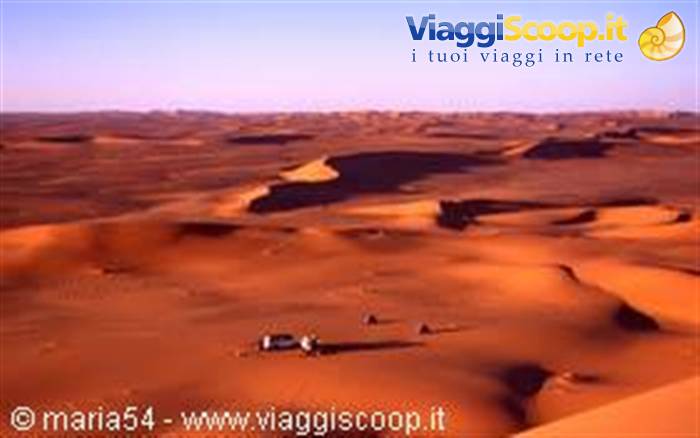
4x4 jeep amid orange sand dunes of the Sahara desert
Day 228 Dec 2003
Eight in the morning, waking up is hard, not because of sleep, the night is long and you sleep a lot, but because of the cold. The light is still that of dawn, but breakfast is ready and there's no more delaying. The others are already all sitting on the mat. Outside. One by one we warm our hands over the providential little fire. Toasted bread, jam, honey, nutella, eggs, cheese spreads, tea, coffee. A Mula Mula even shows up, a lucky little bird. The day starts off really well. Meanwhile the sun comes up. A bit more chatting then tents, blankets and luggage are packed up, everything is loaded onto the vehicles and we set off towards the many landscapes of the desert: stretches of red sand or black stony ground, pointed rocks or chunky little cones, endless plains or narrow valleys.
Whenever possible, in certain spots that the guides know, we stop to gather dry wood, as much as is needed for a few days. Today the area is initially flat, then the plateau cracks, a valley opens up, we descend to the bottom among rocky walls and scattered pinnacles. The track in certain places is marked by little piles of stones, you can spot them even up high, on the edges of the canyon. To mark the road, a bit like we do back home in the lagoon, they use whatever they find: old tires, sticks, car wrecks, rusty drums. We arrive at Gar-Mellen where there's a well, a cistern, 2 shacks for two families. As soon as we get out we wander around carelessly, but Ahmed, our guide, warns us not to go further, there are the families, there are the women who must not be seen. We have to learn discretion, to look, but without intruding. Around us scrap, pigeons, goats, the desert.
Three bottomless drums protect the only plants, two small fig trees, some tender arugula and a few millet plants. We won't come across wells like this again, usually they're isolated, there's a small building with the pumps, a pipe, a tank. The well is also a meeting point, while you're loading water it's useful to exchange some information with other crews: about the condition of the track, about where they've been or where they're going. The hamada (rocky desert plateau) we're crossing is covered with black gravel over a red layer, which surfaces only where the vehicles pass. The flatland is in fact a tangle of parallel lines that fade into the horizon. On the left, a group of camels grazes on the little there is. Every now and then in the distance a lake or an island with palm trees appears, a mirage, which doesn't last long.
Very concrete instead is the dust cloud of the vehicle ahead of us that, through the whims of the wind, occasionally engulfs us and for a few minutes completely cuts visibility. Noon arrives quickly and the stop is quite long also to allow the drivers to rest a bit from the driving, which resembles a rodeo. It takes experience, skill and a lot of energy to keep a vehicle going at good speed to avoid getting stuck in the sand, but dodging the bigger stones, or at full power to get over a steep dune, stop almost teetering on the crest line, and then down without rolling over. And this for a whole day, maybe even having to fix a flat tire or some other not-rare engine breakdown.
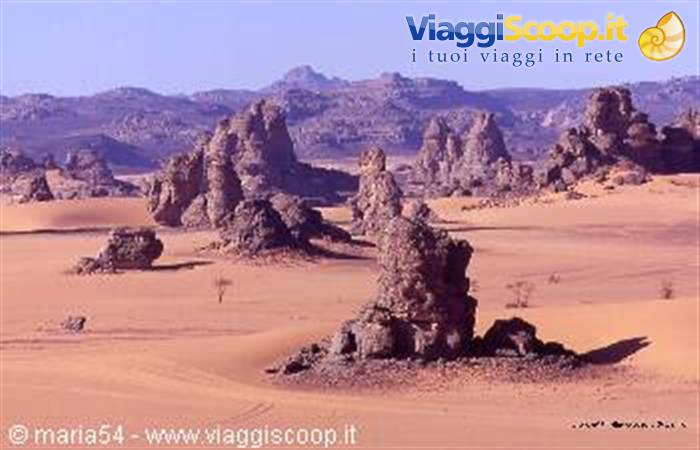
In the evening, after pitching the tent and sorting the luggage, while waiting for dinner, we take the opportunity to get some exercise and if there's any kind of rise nearby, better if a mountain, it's natural to climb up it. To touch that rock, with the fantastic shapes of a prehistoric animal, scaly rock, black, indestructible. But it's only appearance and what seemed like a hard, volcanic material is actually soft sandstone, black on the surface due to oxidation, but with a red and ochre heart. The wind knows this well, which grain by grain erodes, digs and scatters this docile material, flattening it or piling it up as it pleases. From the top the panorama doubles, triples, the amazement and disbelief nail you in front of stupendous landscapes heightened by the flames of the sunset that lights up the reds and then turns everything to gold.
Unfortunately the light plummets suddenly and you have to go back down as soon as possible.
Akakus
Day 330 Dec 2003
Day by day we draw closer to the spectacular rocks of the Awiss and then to the Akakus, famous for its rock paintings. Here too the mountains have strange appearances, and it doesn't take much imagination to see the profiles of turtles and of Indians, the faces of a baboon or two people kissing, the eyes of an iguana, the skin of a rhinoceros. But also towers, boulders poised in mid-air, mushrooms, pinnacles, teeth, needles. At times, colour aside, it feels more familiar, as if we were on the snowfields of Fanes or the Pordoi. Incredible - even the walls look alike. And it is in this labyrinth of valleys and little vales that in 1955 an Italian archaeologist, Fabrizio Mori, began to study what is considered one of the most interesting and richest galleries of prehistoric art in the world. 1,300 sites catalogued, thousands of rock paintings, the oldest dating back 12,000 years.
Various epochs are depicted: "the great fauna", "the round heads", "pastoral", "equine" "camelid". The most interesting cycle is from the "pastoral" period, 6000 - 2000 BC, almost the saga of two tribes: battles, hunts, dances, rites, even a wedding. Six days in the desert and then we arrive at Ghat to take part in a folk festival. The town is inhabited mainly by Tuareg. For them too a change in lifestyle is beginning, and although for a Tuareg "the house is the tomb of the living", many of them are turning from nomads into settled people. This is certainly due to the introduction of rules and borders by the states, which complicate life for populations that for centuries moved freely within their territory. Rules that are hard for a nomad to respect, but which, added to commercial and social changes, are quickly transforming their culture. Ghat, 16,000 inhabitants.
The oasis is buzzing with life; for the occasion even the women come out, but veiled. The old town, just for these three days at the end of the year, comes alive again with sounds, activity and trade. Various folk groups perform songs and dances. In the tangle of alleys you are caught by a piece of music, you follow it, and once past narrow passages you enter the inner courtyards where groups of beautiful women, unveiled, show intense faces, mostly black, dressed in brightly coloured clothes, traditional jewellery and particular hairstyles, playing and singing with great skill and naturalness. In the evening the concert in the stadium. Huge turnout, a real crowd. Men and women clearly separated.
On our part a certain disorientation: with another 5 or 6 tourists we were the only whites, but our embarrassment was due above all to the fact that we too, as women, were in the section reserved for men. But we noticed no gesture, no look of disapproval towards us. The beautiful thing about the evening, the real show, was being in the midst of all those people so different and colourful, taking part in the game of the empty chairs that every now and then passed overhead, moved by dozens of raised arms, to recover a seat a little further forward; perceiving the tone of reproach from the elders towards the young people who were too rowdy; sensing how much anticipation there was in the boy in front of us who, wearing only a shirt, shivering with cold, patiently awaited the start of the show. Eyes that shone like stars, in certain faces black as the night. A real immersion in humanity.
New Year's Eve here is a day like any other, midnight arrived without arousing any interest and we were the only ones to exchange a handshake and a subdued "best wishes". We leave Ghat and the carousel of panoramas begins again. In front of us, a strange mountain, it looks like a castle, it is the inaccessible Kaf el Djenoun, where powerful and fearsome spirits live, better not to go near. After a few hours, an "ocean of black stones" and the pace slows to walking speed, then a series of two-coloured dunes and a plain that looks like an Asian steppe; we arrive at Mathendush, another gallery of art. Twelve kilometres of rock engravings, or rather the whole range of wild animals that lived here 12,000 years ago but in environmental conditions very different from now: elephants, zebras, crocodiles, ostriches, monkeys, of large dimensions, executed with a very refined technique and artistry.
Incredibly, perhaps because of the distance, in such a beautiful place we met no one; we, on the other hand, walked all 12 kilometres, always with our eyes raised in search of the engravings scattered over the more solid and smooth walls, stopping to admire the most beautiful ones, until we reached the famous and enigmatic "cats of the mammoni". We set off for Germa, a stop at the petrol station which, like the wells, is a crossroads of encounters. Many Italian jeeps, their crews still spick and span and well pressed; we, on the other hand, have clothes tried by many days of wandering, but soon we'll have a bath.
By now our journey is drawing to a close and after visiting the ruins of the city of the Garamantes, the dominant population at the arrival of the Romans; the singular lakes of Ubari, in the middle of the desert, surrounded by palms and by a crown of spectacular gigantic dunes; we take the asphalt road again and in an 8-hour ";dash" we will arrive at Tripoli. We pass small villages. From the low houses emerge the green roofs of the mosques and the minarets, towering slender like gigantic pencils with green tips. Green, the colour of Islam, the colour favoured by Muhammad. Around the settlements small cultivations. Children coming home from school. Only men. It is also time to say goodbye to Ahmed, Mohamed and Ibrahim; in Tripoli they will not be needed. After leaving them, for a few hours the emotion and sadness of beautiful things coming to an end keeps us all in silence.
The visit to Tripoli will be quick and therefore a bit superficial, but enough to grasp some strong contrasts, between the compact core of the old city and the gigantism of the new part, between the deeply rooted traditions of the outskirts and the advanced globalisation of the capital. We leave the beautiful Libyan sun for a return heavy with clouds and Po Valley greyness, but with our eyes completely full of landscapes and beautiful memories.
For information and/or contacts Maria Grazia Brusegan mariagrazia@arcam-mirano.it to see some photos column "viaggi Popoli Culture"


0 reader comments