At first glance getting to Vietnam would seem to require no titanic effort: eleven hours of flight to Bangkok, in Thailand, then another hour of plane and you land in Hanoi, the country's capital. That is according to the script set by the travel agency, a script that however could do nothing against the ruthless efficiency of a murderous strike and the brute force of the snowstorms that whipped Italy at the end of February. Snow and strikes that prolonged the wait beyond all logic, forcing us to postpone our arrival in Southeast Asia by about 30 hours. Hanoi airport, where from the uniforms that greet you for visa checks you won't get a shred of a smile, offers a severe, spartan, in some ways desolate spectacle. Outside a dark night awaits us, wrapped in a blanket of humidity and fog. To really get into the city, though, there are still thirty minutes to go, at least if you go by taxi.
Once in the centre, the night immediately stops being dark: Hanoi in fact is a city that doesn't sleep, that swarms with lights and life, where the motorbikes, and above all the motorbike horns, never, never, never stop blaring, arrogant and annoying. We don't have a hotel booked from Italy, since according to the plans we were supposed to arrive in the morning and believed we could look for accommodation calmly. But in Vietnam no one stays in the middle of the street: the taxi driver takes care of it, who on the second try finds the place for us, the Hoi Linh hotel. Nothing special, indeed a bit run-down, but the room is clean, the bathroom too, the breakfast edible: all for 15 dollars for two.
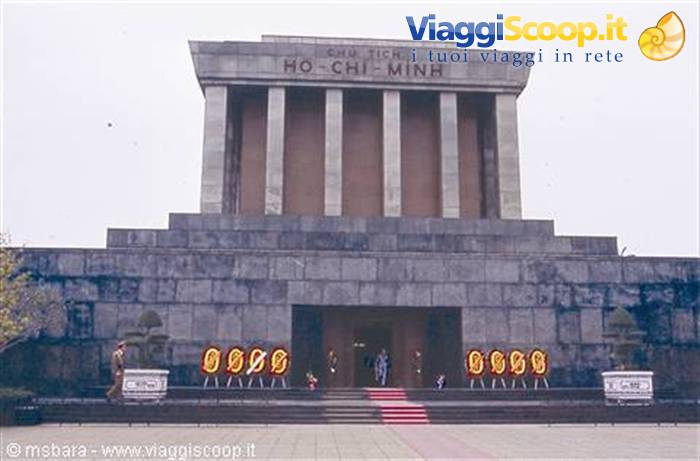
The first evening in Hanoi ends quickly: a shower and to bed, even though the time difference, six hours ahead, messes up your sensations and the buzzing of the motorbikes makes it impossible to fall asleep quickly. The next morning Hanoi reveals its face to us: it's cloudy and humid, and so it will stay for three days. It couldn't be otherwise, seeing that this city no longer knows, literally, where to put the water it has. There are puddles, little lakes and enormous lakes everywhere, that at certain moments it feels like being at the sea and yet the coast is almost 200 kilometres away. The jet lag has played a nasty trick on us and we woke up very late, that is at 10: by local habits, we discover immediately, it's a capital sin. We rush anyway, without even having breakfast, to the Ho Chi Minh mausoleum, but it closes at 11, and we can't get in.
Our first day in Hanoi starts badly, but it's not a problem. Near the mausoleum we're assailed by hordes of guys who want to take us to visit the city. At random we choose to entrust ourselves to Banj, and his cyclò: he pedals, we sit and let ourselves be carted around. For about six hours he takes us to see everything worth seeing: the war museum, the most interesting pagodas (he takes the opportunity to pray a little), and then palaces, prisons, other museums, even the wreckage of a shot-down American B52 emerging from a lake, and finally the water puppet show. Nice, unusual, just a little too long. Banj, while pedalling, tells us that his mother was killed, in 1971, when he was three months old, under the American bombings.
Towards five he takes us back to the hotel, and we learn a new lesson: in Vietnam, even if you agree a figure for a service, then almost always there will be an argument. We had agreed straight away, 15 dollars for the whole day, but once the tour was over he wanted 50. He didn't get them, and we settled with 25, but this raising of voices, this insisting, this shameless breaking of one's word had made me nervous. Then I thought back on it, I thought back on his holey T-shirt, his rickety cyclò, his barely-there English, the gestures he made when he explained to us how his mother had died. I thought back on how Banj too, like me, was born in 1971, but surely he has seen a few more things. And now I think I shouldn't have got nervous, that those 10 extra dollars for him make a difference, while for us they mean nothing. And now I think of you with a smile, Banj.
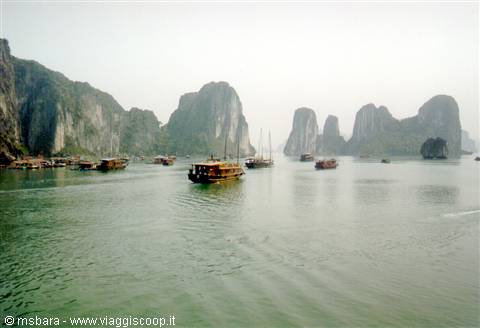
In the evening, dinner at the Cyclò Bar restaurant: so good, for 12 dollars, that we decide we'll come back to eat there. The next day we dedicate to Halong Bay, where thousands of rocky formations, narrow but very tall, emerge from the surface of the sea. It takes more than three hours by bus to get there, but it's absolutely worth it. There's even sun, waiting for us, and a sea smooth as oil. On the boat that takes us out to sea there are the two of us, four friendly Greeks, two Japanese, two Koreans, an Australian girl travelling alone and lots and lots of fish to eat. Halong Bay is a magical, romantic, fascinating place, considered by Unesco a world heritage site: it's not hard to understand why. Once back in Hanoi, cooked to a turn, we buy something in the street: to have dinner 30,000 dong are enough, a little less than two dollars.
The following morning we get up early because we don't want to miss entry to the Ho Chi Minh mausoleum. We arrive in time, this time, and after leaving everything in custody, because inside you can't bring anything, we get in line. Half an hour and it's our turn: Uncle Ho's body is very well preserved, and it will be the lights, that beautiful and magnetic face, the stiff soldiers keeping vigil over it, the religious silence of the visitors or I don't know what else, but you come out of the rapid passage in front of the coffin with the impression of having lived a different, unprecedented, almost mystical experience. Our time in Hanoi is about to end: a last lunch at the Cyclò Bar, many photos of the varied humanity that has a home but loves to live on the pavements, then in the afternoon we have ourselves taken to the airport, because we're leaving for Hue.
The hotel doorman, one who seems capable of doing anything, bought us the Vietnam Airlines tickets (60 dollars each) and even procured the visas for Cambodia, which will be needed later on.
the mausoleum of Ho Chi Minh
Day 228 Feb 2005
HUE, I FEEL LIKE I'VE ALREADY SEEN IT An hour of flight and we land, right in the middle of a kind of tropical storm. According to the guidebook, it rains all year round in Hue, and indeed it's raining. What the guidebook doesn't say is that you can't see a thing, and it seems impossible that the plane has to land in the middle of that nothing made of dense clouds and rain. But the pilot knows his stuff, and once he touches the wheels down on the runway he even gets applause from the whole audience, a custom I thought had fallen into disuse years ago. Not in Hue, where it always rains. It's raining the next morning too, when at eight o'clock sharp we leave our hotel (9 dollars, nice, I can't remember its name anymore. When I think back now the hotel names all seem the same to me) to go visit the imperial tombs along the Perfume River.
As always everyone seems to want to take us to see something: for around ten dollars we make a deal with a guy (his name has evaporated too) who has a long and spacious boat. So spacious that he lives on it, with his wife and four of his six children, while two are grown up and have already flown the nest. The tour lasts about four hours; we start from the Thien Mu pagoda: it's a holiday, and the sight of thousands of Buddhists praying is impressive. Then it's the turn of Minh Mang's tomb, and then Khai Dinh's. While we're heading back towards Hue, I start watching the daughters of this man whose name I've forgotten. Three petite, polite little girls, who offer us green tea, but otherwise carefully avoid us.
The eldest, who must be twelve, at a certain point grabs her little brother and carries him two metres away from me: she lays out a mat and starts playing with that wonderful creature with slit-like eyes and hair sticking straight up. She hugs him, kisses him and cuddles him for half an hour, and I can't help taking a few photos. But she pretends not to notice, ignores me, turns the other way. And she never smiles at me, never, making me feel like a complete stranger, a stranger as I had never felt before. Sure, I've bought the right to be there, but that is her home, and in her home she must have already seen too many strangers, enough to no longer see a single one. Not even me. In the afternoon it's no longer raining, and we visit the city.
Symbols of Hue, a city full of beautiful tree-lined boulevards, are the Citadel, and the memory, only the memory now, of the Forbidden City, swept away by the American bombings of 1968, after the Tet offensive. While I look at Hue, while I look at these ruins, left there because there's no money to restore a blessed thing, and because it's better to remember what happened, I can't help thinking of the many books I've read, and the many films I've seen. And I can't help thinking of Stanley Kubrick, of a masterpiece called «Full Metal Jacket», of how, in that film, a young Vietnamese woman manages to do for many young Americans, and of what the young Americans then do to that young Vietnamese woman. In Hue, the war, that war, seemed closer to me, almost something I could touch, even though more than thirty years have passed.
NEXT STOP, HOI AN The following morning we make our acquaintance with the Sinh Café buses, the means by which we will travel for all the rest of Vietnam and reach all the way to Cambodia. They're not bad at all, these buses, but they have one flaw: they go slowly, very slowly. Then again it's not their fault, or the drivers'. It's that going fast, in Vietnam, where the roads are a disaster and the highway code is a mystery, would be suicide. And so you go very slowly, so that to get to Hoi An from Hue it's barely 200 km, but we take more than six hours. It's worth it, though, because this city is really lovely. There's even a pedestrian island, and escaping the grip of motorbikes for a few hours seems like a dream. In Hoi An there are lots of shops, lots of tourists and there's the river.
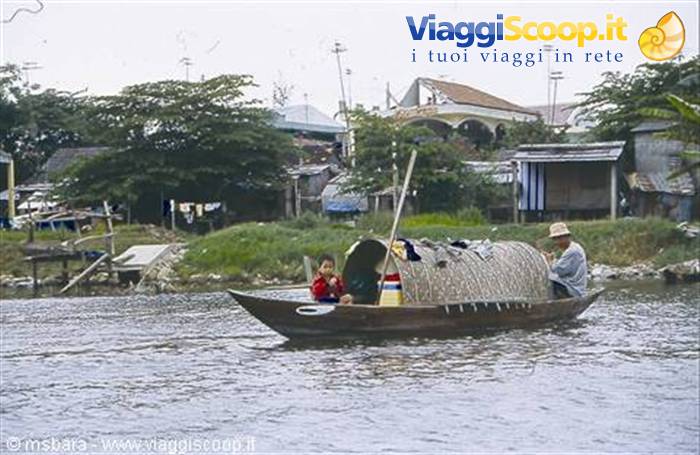
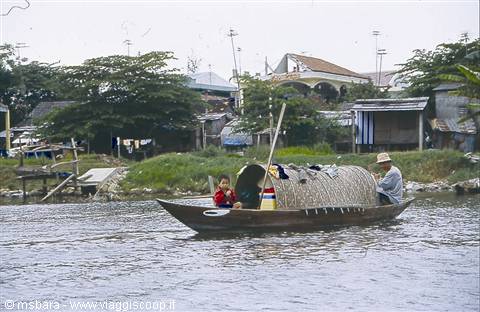
We have ourselves taken by a 23-year-old girl, who owns a kind of junk boat, a conical hat and a kind face, to see how the people of the sanpan live, the typical Vietnamese boats. Badly, I'd say. The next day, another Sinh Café bus: we set off for Nha Trang. An endless journey, 530 km to cover in about 13 hours, from six in the morning to seven in the evening. Slow, but punctual, our bus makes it. And right at seven we arrive in what is described as the Rimini of Vietnam. Exactly as we would have done with the original one, we carefully avoid visiting it, and the following morning, despite all the hours on the bus the previous day having left their mark, we take another one that will take us to Dalat, in the mountains. We arrive in the early afternoon, not before having visited a wonderful Cham tower. We're now in the south of the country, and it's getting decidedly hot.
But Dalat is at altitude, it's the place where the French occupiers used to go on holiday, and indeed there's even a huge reproduction, about a third of the original, of the Eiffel Tower. Dalat is nice, but it's not Vietnam, quite simply.
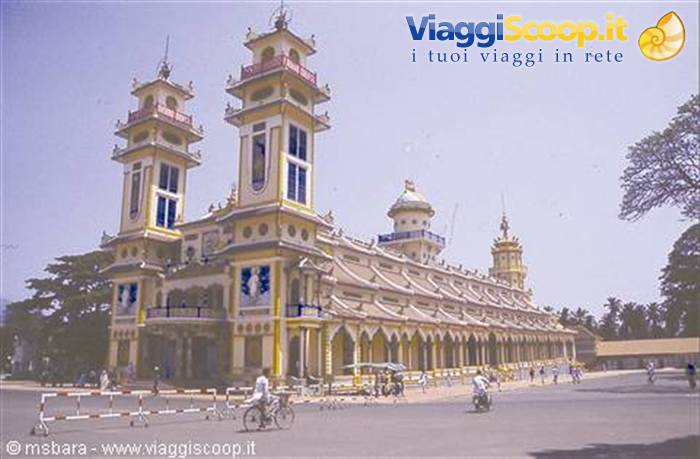
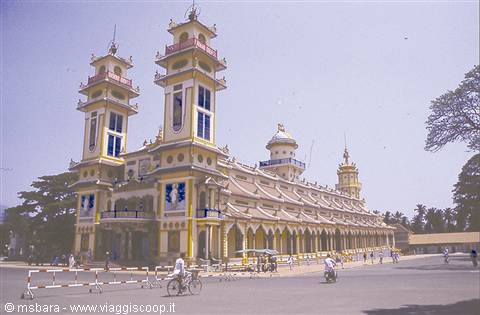
Pastel twin-towered cathedral, cyclists on the road, bright light
Day 33 Mar 2005
SAIGON, LAST RUN When we get up we're ready for another feast of buses: next stop Saigon, or rather Ho Chi Minh City, as the communist regime that rules down there would like it. Only it, though, calls this huge, disproportionate city of 8 million inhabitants that way, where we stay for three days, hating it more every minute. Not that it doesn't have a certain charm, or interesting things to offer (one above all, the museum of the horrors of war, where you can't help but be moved), but Saigon embodies the worst of any Eastern city (absolute chaos, smog, mad traffic, dirt, overly strong smells) and the worst of any Western city (powerful cars, mobile phones, adverts for powerful cars and mobile phones, the need, indeed the immoderate craving for money, for doing business, for selling, for ripping you off). It's a mess, Saigon, and it becomes unliveable, after a while.
Luckily the second day we go off to the Cao Dai temple of Tay Ninh, where a curious sect, in a temple so bizarre and kitsch that it feels like being in Las Vegas, simultaneously worships Buddha, Christ, Mohammed, Confucius, Joan of Arc and, incredible but true, even Lenin. The faithful are all dressed in white, the monks with coloured tunics ranging from red to blue by way of yellow. On the way back towards Saigon we stop to see the Cu Chi tunnels, the complicated system of underground galleries devised by the Vietcong to escape the Americans. In certain holes, cramped and suffocating beyond reason, of the whole group of tourists, the only one who had the physique to fit was me. And I went in, only to come out a few seconds later: a little anxious, a little photographed. Once we emerged from the tunnels we went back to Saigon.
We were about to say goodbye to Vietnam: the next morning another bus awaited us: destination Cambodia.
Wooden boat with straw canopy on river, man rowing and child aboard

0 reader comments