For thousands of years, the Silk Road, the route that linked Beijing to the Mediterranean, was the most important channel of transit for people, ideas and trade between China and the Western world. And it's precisely in the central part of this historic, unique, unrepeatable route that we decided to take a tour to see the places of the magical tales of the "Arabian Nights", those enchanting jewels that for centuries have shaped the fantasies of children and adults... A journey into the past, the present and with an eye to the future...
"It is precisely the possibility of making a dream come true that makes life interesting" Paulo Coelho
A thank-you to Father Maurizio Corbetta, creator and organiser of this fascinating tour, gratitude to those who supported me in this work, and a particular dedication to those who, though not taking part in the trip, motivated and encouraged me in writing the diary.
Raffaele Banfi
Day 114 Apr 2005
Departure
Departure from Rovello at 5:20, after a short journey we arrive at Linate airport, quick boarding for Rome. The flight from Rome is at 11:00. Sitting on a chair at the bar of Fiumicino Airport, on the terrace overlooking the runways, I begin to take travel notes. It's one continuous landing and takeoff of planes, whose colors distinguish their nationality. The Italian tour leader arrives, who will be with us for the whole trip, his name is Stura Maurizio, he's from San Donà del Piave, 27 years of experience in the field. He takes advantage of the stopover at the airport to give us brief information about the tour, an intense program, which includes a series of early-morning wake-ups, lots of travel. We leave Rome 20 minutes late, justified by the heavy air traffic. In fact, watching the planes taking off and landing from the window is like seeing a continuous line at regular intervals.
The aircraft is an A-310, of Uzbekistan Airlines, the flight is comfortable. We're in flight, I read the program in detail and begin to identify the references in the Lonely Planet guide - Central Asia - 3rd Edition January 2005 (all references in this diary will be taken from the aforementioned guide as: LP p. n.). The tour looks demanding and full of travel, a good 9 flights in 12 days, practically a real tour de force, for wandering pilgrims or curious tourists such as we are. Starting to read the history of Uzbekistan, it emerges that in the late Italian Middle Ages and the beginning of our Renaissance the area was culturally more advanced. Under the ruler Tamerlane (14th century) the region experienced its greatest splendor. During the flight we fill out 2 copies of the indispensable form to enter and leave the country.
Filling it out is made easier by a specimen, kindly provided to us by Maurizio. We arrive in Tashkent (LP 186), the capital of Uzbekistan. Looking out the window the desert appears whitish, it looks like snow, but I don't think it's cold enough to have snowed, curiosity begins to make its way into my mind... The arrival at the airport is characterized by customs clearance and bureaucratic formalities. What strikes you are the uniforms of the staff, leftovers of Soviet domination, the characteristic pancake hats are still used by the control personnel.
We proceed fairly quickly, the timing makes you think we could be in Italy, but it's only a matter of luck, the customs officers don't feel like being strict, maybe it's the evening hour, having a tour leader who speaks English correctly and knows the tricks of local bureaucratic formalities proves to be a great advantage We head to collect the baggage and, walking around the airport, I'm struck by the fact that the Uzbek language uses Latin characters and not Cyrillic characters like Russian. You can manage to understand something and the sense of bewilderment felt in Russia doesn't appear here. We collect the baggage and proceed to customs clearance. Another line and the border guards, slowly and without any hurry, check the visas and the forms we filled out on the plane.
We meet the local guide, his name is Nurik, a young guy, with a sharp look, always ready with a smile, the impression is good. The porters collect the baggage and take it to the coach. The impact with the people makes you understand that we're in Asia. The facial features are Euro-Asian, it's a melting pot of different ethnicities. It's 8:30 pm when we arrive, but it's dark, as if it were the dead of night, only the lights illuminate streets and buildings. We head toward the hotel. Tashkent was destroyed by an earthquake on April 25, 1966, then entirely rebuilt, it's the fourth city of the former Soviet Union, 3,000,000 inhabitants, from above it appears as an immense expanse of lights, houses and streets are as far as the eye can see. Traveling toward the hotel located in the city, you drive along wide avenues.
The buildings show the Soviet architecture of the post-earthquake reconstruction. Imposing buildings, rectangular buildings without balconies, at times something of Asian art emerges, on the side of the buildings facing the street there are enormous, coarse mosaics made with tiles. You notice the small windows of the apartments, in the upper part on the left their opening, a characteristic already noticed in Russia. We continue quickly along the smooth roads, I see buildings constructed after the earthquake flanked by recent buildings whose architecture shows the abandonment of the Soviet style. Arrival at the Le Meridian hotel, buffet dinner, the recently renovated hotel is very comfortable..... to be continued...
Khiva, Oq Shihbobo Bastion, panorama
Day 214 Apr 2005
Bukhara - part three
Lunch is traditional: vegetables, chard soup, chicken, green tea. A little rest, which serves to complete the notes taken, reread the guide to memorize the sites seen, and we set off again for the old part of Bukhara. The afternoon begins from the point where we ended the morning; behind the Mir-i-Arab Madrasa stands a brick construction with many domes of various sizes. Nurik explains that the building, the Taqi-Zargaron, dates back to the 16th century; it was the "Dome of the Jewelers." Originally these buildings were placed at the crossroads of the neighborhoods. It is called Taqi, "Open market," and originally each dome delimited the space reserved for each individual artisan. The building has 36 domes plus the central one, meaning there were 36 artisans who worked and traded in that place, a true melting pot of people, art, culture, traditions.
Currently there are a series of shops, small and large, of craft items, carpets, silk fabrics, refined knives, bags, jewelry, hats, spices, drinks. I stop to taste an herbal tea made of six different types of herbs; I like the flavor, I buy a bag. We leave the Taqi and, a short distance away, visit the Abul Aziz Khan Madrasa (LP 234) from the 17th century; the decorations are original, a mix of floral and geometric designs, made in Persian style. It is among the most beautiful in all of Uzbekistan. The building is a bit neglected, intended for Shia, an Islamic branch that finds few followers here. The minbar and the stucco entrance portal were restored in 1930; the common study room contains decorations in Chinese art. In the courtyard we see the teacher's cell; it is characterized by a mezzanine that vertically divides the space. The pupils stayed below, the teacher above.
Entering, to the left of the door, there is the small oven that served for cooking food; in front is the space under the scaffolding where the pupils seated themselves to listen to the lessons given by the master who sat above. To the right of the door, a simple brick staircase allowed access to the part reserved for the teacher. The upper walls are decorated in colored stucco; at the back of the room, a series of niches served as a bookcase and as a keeper of everyday objects. We leave the Abul Aziz Khan Madrasa and directly opposite is the Ulugbek Madrasa, grandson of Tamerlane, built in 1417. The building is one of the three Madrasas existing in the world made with the decoration of the pointed arch and the load-bearing columns in Timurid style.
That is, the columns and the pointed arch have a twisted pattern that rises continuously, almost representing a serpent that wraps around the whole column. The decorations are in polychrome majolica tiles (blue, green, white). We leave the Madrasa and head toward the Tim, the covered market. A little earlier we stop in the shop of an artisan who makes knives and scissors. The owner proudly tells us that he worked in Italy and Switzerland; he speaks passable Italian. He produces special scissors used for embroidery, traditional knives, and kitchen knives with a tungsten blade that is very efficient in cutting. I buy a few pieces to take to Italy. We continue and arrive at the Tim, the covered market; the exterior shape is identical to the Taqi, the open market visited earlier, but the characteristic is that this type of market was closed in the evening and reopened the following morning.
Currently inside there is a craft workshop for the production and processing of silk. We stop to watch the weaving of carpets done with a wooden loom. The dyeing of the silk thread for the fabrics takes place by grouping the thread into small skeins and dyeing them in a predetermined way in multiple colors according to the design to be created. The skeins thus colored are woven. The looms are organized in shafts; manual ones range from a minimum of 2 shafts to a maximum of 12. The one in operation has 8. In a day's work about 4 meters of fabric are produced. Before leaving this artisan, we stop to drink some tea that is kindly offered to us.
The tour continues and we see the second bazar, the Taqi-Telpak Furushon, the "Dome of the Hatmakers," a building from the 16th century, then the seat of the producers of astrakhan hats; today a part is used for a Turkish bath in perfect working order. The construction, in brick, is characterized by a long corridor whose ends gave onto the old city on one side and onto the popular neighborhoods on the other. Inside are craft shops; the socialists concentrated all the craft shops inside historic buildings, whether Mosques, Madrasas, caravanserais or otherwise. We cross a street and in the square in front we find, in a wide pit dug from the current street level, the oldest Mosque in the city, called the "idol shop," built in the 10th century as a Zoroastrian temple. The entrance level of the Mosque dates to the 12th century.
The blue majolica decoration is the third historical example of colored tiles. The entrance was characterized by 4 pillars between which a descent opened that led to the sacred fire. With Arab rule, the Mosque was transformed into a souvenir shop, hence the origin of the name. Currently it is a museum of Uzbek carpets. We continue the tour and arrive at the third bazar, the Taqi-Sarrafon, the "Dome of the Money Changers," which was the reference point of all merchants arriving in the city for currency exchange. Today it too is used as a site for shops of craft products. Adjacent to the building is the first local bank built by the Russians in the 19th century. A short distance away we find the caravanserai, a structure dating back to the 17th century. The building has a square plan; the size is the standard of the Central Asian caravanserai.
In the center, a courtyard served to enclose the animals for sale (about twenty) with the adjacent rooms for their owners. A raised floor with a walkway allowed the display of goods and slaves; on the upper floor went the negotiating of the sale and purchase of everything present in the caravanserai. Both on the raised floor and on the upper one there are cells where people could rest and stay for a few days. With the arrival of the Bolsheviks, the small cells were "converted" into premises for artisans; currently present are embroiderers of golden fabrics, cabinetmakers, miniaturists, chasers, silk embroiderers. Opposite the caravanserai is the "complex around the pool" with the Nadir Divanbegi Mosque (LP 234), from 1622. Built by the then minister of finance. Opposite the Mosque is a pool 16 by 20 meters, containing water from the river; it is murky, but boys bathe in it just the same.
Around the pool are gigantic mulberry trees, the oldest dating back to 1475, the others from the 15th and 16th centuries. After the pool is the bronze statue of Hoja Nasruddin, a character who appears in Sufi tales all over the world. To the left of the Mosque is the Nadir Divanbegi Madrasa, from the 16th century; it consists of 150 rooms and could hold up to 300 students. Opposite the Mosque is the Khanaka (hostel) of Nadir Divanbegi, built in 1622, initially as a caravanserai then converted into a hostel. The polychrome majolica façade offers an unusual spectacle with the depiction of animals derived from local mythology. The interior of the complex consists of the hostel cells, transformed into craft shops; the courtyard is covered with vines on a pergola.
Under the pergola are tables; we stop for the "classic" dinner (vegetables, dried fruit, a soup of ravioli with an oriental flavor that recalls Chinese cuisine).
... to be continued...
Khiva, Oq Shihbobo Bastion, panorama
Day 315 Apr 2005
Khiva - Part One
Wake-up call at 4:45, quick breakfast and off to the airport, retracing the road we had travelled just a few hours earlier. The sun has not yet risen but there is already plenty of light. Tashkent appears a hard-working city, despite the nighttime hour, workers are on the job doing excavations on the road, the building sites are in full swing. The impression I get is of being in another dimension compared to the Italian one. With the light, the city appears in all its splendour, the colour palette of the buildings and the boulevards denotes its belonging to the Soviet regime with a touch of Asian influence. Gardens and statues liven up the city and its avenues. We quickly arrive at the airport. The section dedicated to domestic flights appears understated, simple, clean, welcoming, "built to last" as the guidebook says.
The boarding formalities are speeded up by Nurik's intervention who, by going to the counter with all our tickets, allowed a quick transit. You always have to check the suitcases; loading/unloading, transport, collection, always the constant and continuous checking, to verify that everything is there and that we can proceed, an optimal step-by-step method of control. We approach the plane for the transfer, at the airport the enormous Tupolevs are parked, a legacy of the Soviet fleet. Thank goodness the air fleet has been integrated with some Boeing 717s. We take off on time, the flight proceeds regularly, from the window I observe the dwellings of Tashkent, the gap between the Soviet buildings, the modern buildings and the small houses is truly remarkable. A strong contrast, visible, palpable. Around the city, cultivated fields.
During the journey, about 1 hour, we fly over desert areas, a first encounter with the characteristics of this enormous territory, once a kingdom of the raids of the nomadic peoples who made its history. As scheduled, the flight is bound for Urgench, a new city built according to the Soviet model. In the new city there is nothing to see, and indeed the programme includes the transfer by coach to Khiva where we will begin the tour with the visit of this city. The cities, which like flowers placed in the middle of a seemingly endless desert, created the Silk Road, were themselves the reference point for those going from east to west and vice versa. The only landmarks after so many days and so many kilometres in the middle of the desert.
A precious and astonishing testimony of a cultured, refined antiquity where the wisdom of the rulers of these warrior and nomadic peoples created these masterpieces that tourist guides praise so much. Having seen images, postcards and some short footage, the curiosity is truly strong. I can't wait to admire these masterpieces. During the flight the announcements are given in Uzbek and in Russian, it really is a total break from the Western world. The facial features of the passengers and their clothing in Asian style announce that the West is far away. Welcome to the East, to the part of Asia that made the history of civilization!!! We arrive at Urgench (LP 244), the airport is very small, a row of helicopters being dismantled and a row of medium-sized biplanes (once used for domestic flights) are on display, yet another legacy of Soviet domination.
We collect our luggage, leave the airport, get on the coach and after 30 km we arrive at Khiva (LP 247), after a few characteristic dwellings, low houses made of clay and straw bricks or cement bricks, single-storey and with roofs of eternit or sheet metal; the historic and unique walls of Khiva appear. Walls made of mud mixed with straw, enormous, mighty, very tall, the sight leaves you breathless, the desire to visit it is immense. We enter the Malika Khiva hotel, take our rooms and quickly prepare to begin this fascinating visit. Khiva, the old city, has a surface area of 27 hectares, part of the city was rebuilt on the occasion of the 2,500th anniversary of its founding in 1997. The walls are from the 17th century, the entrance gate, wooden and finely carved, is from the 18th century.
In the entrance tower there are four rooms, originally two were intended for control, one was intended for the caravanserai attendant, one was intended for the tax collector, today they are all occupied by artisans except the tax one where you pay the ticket to be able to take photographs. Asking for money to take photographs is a clever trick to increase revenue, everywhere you will have to pay to take photographs. To the left of the entrance an enormous bronze statue is dedicated to the inventor of algebra. A little further on a wall map illustrates the route of the Silk Road, the route that from Beijing ended in Rome and highlights the part of Central Asia, the one where we are. The outer walls, of clay and straw, are powerful.
Nurik gives a brief account of the history of the Silk Road and one senses the importance of these cities which, with their commercial exchanges, made society progress, paradoxically the Silk Road was the route that led to the development of cotton cultivation. The old part of the city is called Itchan Kala, which was accessed through three gates and inside it had an important slave market, the price of a healthy and strong Russian slave (at the time considered the best) was four camels. We begin the visit of the city from the map of the same placed on a wall, nearby there are the shops of artisanal objects, we enter under a pointed arch and find the Madrasa of Mohammed Amin Khan (LP 250), transformed into a hotel.
In the Madrasas, the ancient Quranic schools, study was divided into three courses of 7 years each, those who completed the full cycle became an important person, with a role of privilege within the community. Those who did not complete their studies had the possibility of teaching the alphabet and the first verses of the Quran in the villages. Inside the Madrasa the students' rooms were organised to accommodate one or two people per room. Near the Madrasa there is the Kalta Minor Minaret (LP 250) which, according to the architect who designed it, was to be the tallest in Asia, the original project envisaged a height of 90 m, but the construction stopped "only" at 27 m, the base has a diameter of 18 m, on the outside there are as many as 8 different decorative elements in majolica. The minaret had 3 functions 1. To warn the faithful of prayer (5 times a day); 2. Lookout function; 3.
Night signalling function, the fires lit during the night were the ancient "lighthouses" for the caravans travelling in the desert. A short distance away there is the access to the fortress of the sultans/khans of Khiva, the Kukhna Ark palace (LP 250), on the right we find the Zidon, the prisons of the Khans. A small building where, in a confined space, prisoners were locked up for three days, at the end of which they went before the sultan and the possibilities were two: either they were freed or they were killed in various ways. The society of the time was very bloodthirsty and as public entertainment loved to watch executions, which were differentiated by crime.
• Impaling; • Thrown from the Minaret; • Buried with the feet sticking out (and it seems that this was the preferred method...) Further executions were provided for specific cases: • For lovers: he was hanged, she, after being buried up to her waist, was stoned and the first to throw the stone had to be the father. • For prostitutes, the woman was put in a sack with 4 wild cats and they began to beat the sack, the cats moved inside the sack and ravaged the poor woman's body.
..... to be continued....
Khiva, Oq Shihbobo Bastion, panorama
Day 415 Apr 2005
Khiva - Part Two
We enter what was the old citadel, the palace of the sultan/khan, it contained various buildings for the most diverse activities; the Mosques stand out, both the winter one (covered) and the summer one (with a wooden portico). The summer Mosque has a covering of majolica tiles with very refined designs. I understand how the Islamic religion, by forbidding the depiction of animals and men, led to the development of decorations with only geometric and floral motifs. The colours used faithfully respect the dictates of Islam. • Blue, represents the sky; • White, represents the purity of the soul; • Green, represents the Quran. The summer Mosque, from the 19th century, with a wooden portico has an inlaid and decorated ceiling, the supporting columns are of elm wood, finely inlaid.
In the courtyard of the summer Mosque there is a low building containing the ancient mint where coins were minted and later banknotes were printed, the first on silk fabric. We leave the mint and see some local pilgrims, they are dressed in traditional clothes, they are bright, the women wear showy silver jewellery, the men dressed in Western clothes, wear the astrakhan hat and wear leather boots. We visit the archaeological museum with finds unearthed in the courtyard of the palace dating back 2,500 years. We access the Throne Room, where the sultan under a portico received delegations and important people. Here too the walls are covered with polychrome majolica. Under the portico, the building has three doors on the façade, the right one, the tallest, was reserved for the sultan, the central one for his dignitaries and the left one for the people.
In the courtyard there is a circular platform, it is the base for the royal yurt, the tent that was used for winter receptions, the nomadic origin of this people was never forgotten even when they became settled. We climb up to the Oq Shihbobo bastion, the tallest tower of Khiva, 24 m high, from where you can see the majesty of the walls, the structure of the old city, the extent of the new part of the city whose low houses have inner courtyards full of plants and ample spaces.
The building of the winter Mosque contains a small history museum where portraits are displayed of the inventor of algebra, of a great astronomer who first calculated the exact diameter of the earth, of the physician Abu Ali Ibn Sina (known in the West as Avicenna) who wrote a medical treatise that was a reference for over 500 years also in the West, portraits of other figures who made the history of the area and of human civilization. We leave the palace and crossing the square we enter the Madrasa of Mohammed Rakhim Khan (LP 251), a construction from 1850, today a museum. The Madrasas have a consolidated structure, the courtyard with the students' cells, the teachers' rooms and two large common rooms; the Mosque to the right of the entrance and the winter lesson room, to the left of the entrance.
We enter the building, in the former Mosque portraits and photos of the last of the Khans are visible, women's jewellery, weapons and clothes. In the former lesson room, objects characteristic of Uzbekistan are collected. Having finished the visit to the museum, passing near the symbol of Khiva, a camel whose name is Misha who, tied to a post, is the subject of souvenir photos, we head for lunch, in a characteristic house; the building, protected by UNESCO, has large perimeter walls, inside a tree-lined courtyard, a portico supported by worked elm wood poles. Two tables are set up under the canopy and one in the open courtyard. The portico recalls those of the summer Mosque we have just visited.
The traditional lunch is structured with initial vegetables, beetroot, chickpeas, cucumbers, red turnips, dried fruit (raisins, toasted almond seeds, sultanas), apricot jam, a salami (of horse meat), all accompanied by excellent bread baked in the oven. Bread that arrives hot and fragrant at the table, from its shape it is round, it looks like an Arab bread but the size is that of our piadina, the circumference is slightly crunchy, the inside is soft and tasty. The first course is a broth soup with potato, yellow carrot, a piece of boiled beef; the second course consists of pilaf rice with vegetables and a small piece of boiled beef. Water and a local wine, slightly tart, accompany the lunch. The stop is made pleasant by a light breeze that manages to pass even over the high perimeter wall of the house.
I notice the women's teeth, they are covered in gold, a custom to fight cavities, but it is also a display of wealth. Sometimes the smile is completely golden and not being used to such "splendour", initially it makes you embarrassed. The afternoon begins with the visit to a small former Madrasa, where a local craftsman works elm wood to make doors, pillars, beds, lecterns, sticks. Wood that is difficult to find in the desert, therefore it is valuable. Then we visit another former Madrasa, home of the Sikl Carpet, an artisan settlement where carpets are hand-woven and where silk is dyed with very ancient procedures, using only natural products. This site too is protected by UNESCO. The silk processing cycle that takes place between these walls, in successive seasonal periods, is complete, from the rearing of silkworms to silk processing, to dyeing up to the making of carpets.
We continue the tour of Khiva and among cultivated orchards, turning left with respect to the road taken, the city offers one of its best sights, a street descends slightly with a flight of steps and then rises again with another, to the right of the street there is a small market, the red of the fabrics stands out among the stalls displaying a range of artisanal products. Halfway along the street, turning left and climbing a short flight of steps, we access the Mausoleum of Pahlavon Mohammed and the Madrasa/Mosque of Sherghozi Khan (LP 251). Inside the Mosque there are 3 tombs, as the structure is a place of worship of the Sufis. The structure of the Madrasa is simple; on the ground floor there are rooms with entrance from the courtyard and on the upper floor, where you access via a steep staircase leading to the gallery, other rooms with rear access.
In the courtyard of the Madrasa there is a well, with whose water the pilgrims quench their thirst, considering it miraculous. We leave the Mausoleum and turning right we continue along the street we partially travelled before, we go down the staircase that could be seen previously and arrive at the Madrasa of Islom-Huja (LP 251). During the Soviet period the Madrasa, with heavy structural interventions, was transformed into the museum of applied arts. Interventions which, through the closing of the communicating doors onto the courtyard and the opening of communication passages between the various cells, allowed the creation of the current museum route. The museum, using the small students' cells, encloses the main applied arts of the region. You can admire splendid artefacts in elm wood, finely worked cotton and silk fabrics, velvet clothes, sculptures with verses of the Quran.
Next to the Madrasa there is the Minaret of Islom-Huja, the tallest in Khiva. It is imposing with its 54 m, with a base of 9 m, covered with 16 decorative bands in majolica with different motifs, whose top is reachable only by a steep climb on an internal staircase of as many as 122 steps. Facing the Madrasa is a building that during the Soviet period was transformed into the Uzbek/Russian translation school.
.... to be continued....
Bukhara, Bobo Hauz Mosque
Day 515 Apr 2005
Khiva - Part Three
We continue the tour of Khiva and arrive at the Juma Mosque "Friday Mosque" (LP 250) from the 10th century, inside the roof with a wooden canopy is supported by 203 elm wood columns, all inlaid. The Mosque has a capacity of 8,000 people, the surface area is one hectare. The voice amplification system works through ceramic vessels placed in the wall, in which the mullah (the Islamic religious man) speaking simply exploits an amplified echo effect with which he spreads the voice throughout the building. The structure of the building dates back to the 10th century, but it was destroyed several times, in the 16th century the last reconstruction took place. The oldest columns are original, there are some from every period up to our days. The elm wood used for the columns requires particular processing, it is dried, soaked in cotton oil and then used for the columns.
Under the columns there are pedestals of marble or stone, between the pedestal and the column camel wool is placed which has the function of keeping termites away from the wood (and the system seems to work seeing the timber without the characteristic holes...). In the centre of the Mosque a square construction, based on four granite columns, recalls a small chapel, in the base in the centre a marble basin and at the side two holes. The holes were used to put quicklime and water, the chemical reaction produced heated the water used for the ablutions placed in the central basin. We continue through Khiva, we enter the Madrasa of Dost Alyam (LP 250), from the 19th century, where the black carriage of the last Khan is preserved, the carriage was used to abduct girls from the villages and take them to the Khan's harem, for this the governor was nicknamed "the Black Khan".
In a courtyard the Hall of receptions opens, in the centre of the courtyard on the embankment the royal yurt is set up, the tent that was used for winter receptions. In a side courtyard equipped with a wooden canopy and entirely covered with polychrome majolica, ready for a folkloric show, there are musicians. A short distance from the Madrasa, we find a construction with very high walls and watchtowers on the sides, it is the Tosh-Kholi Palace (LP 251): the harem. Past the wooden gate a vast courtyard appears where on the left side there are five wooden porticoes, one is slightly larger than the others, it is the summer dwelling of the Khan (the large one) and of the four wives (the small ones), while the concubines lived in cells located on the right side of the harem.
Life inside was regulated by rigid rules, among which that the male children could stay with their mother until they were 9 years old, after which they had to leave the harem and were entrusted to male educators. Having left the harem, we turn right and crossing an intersection we find, still on the right, on the right the Madrasa of Kutlimurodomok, from 1809, (LP 251), we enter and it is striking that in the courtyard there is no well for water but a cistern. The cistern has a diameter of 13 m, the walls are 1 m thick. The construction has calibrated walls. This type of cistern was common in the desert, placed every 40/42 km they served for watering camels and dromedaries, the distance is not random, it is the maximum distance that an animal can travel without drinking. The opening of the cistern faces north to allow the fresh air, of the great north wind, to constantly cool the water.
This system of cisterns was imported during the reign of Tamerlane from neighbouring Persia. We leave the building and facing it there is the Madrasa of Alloquoi Khan (LP 251) but it is inaccessible, despite the beauty of the façade, the construction is abandoned and it is dangerous to enter to visit it, as it could collapse into pieces. Keeping to the left we descend slightly along a lane and arrive at the Ab Mosque, the "White Mosque" (LP 251), a construction dating back to 1657. Adjacent and located to the left of the White Mosque are the Baths of Anusha Khan (LP 251), from the 17th century, the only Turkish bath still perfectly functioning. To the left of the bath there is a wooden portal and it is the access to the slave market, inside the narrow cells where slaves were kept to be shown and sold are still visible.
For those who escaped and were caught, the punishment was exemplary, they were hung and nailed to the doors of the market by the ears, an example for other slaves and thus to discourage escape attempts. It is getting dark, we stop in a café located inside Khiva, we use the traditional divan, composed of a raised rectangle covered with carpets, where lying down and resting on numerous cushions, you sip tea and chat. We return to the Malika hotel, located in front of the city walls, from the room the view of the sunset on the walls is incomparable. The hotel has rustic, oriental-style furnishings, it is comfortable. Dinner at the hotel is based on traditional dishes, vegetable appetisers, soup with beetroot and onions, meatballs that have a flavour reminiscent of Chinese cuisine (due to the presence of garlic and onion).
After dinner a short stroll in Khiva, the city is deserted, the few inhabitants are closed in their homes. The city that by day is a melting pot of stalls in the evening appears deserted, the lighting is poor and allows circulation only in the main streets of the town, but it is difficult to walk, steps and ditches can present risks of falling. The atmosphere is calm, quiet, a light breeze comes from the north cooling the temperature, after the heat of the day the coolness brings pleasantness. The sky is starry, from the intensity of the black and of the stars it appears unusual as if the sky were different from ours, it is like a blanket that envelops everything visible, in the absence of light pollution, the stars appear in all their splendour.
Returning to the hotel we see, in a venue, a party, it could be a wedding, someone from the group, a little more curious than others decides to go and see and after a few minutes comes out slightly shocked by the "intense hospitality" received.
.... to be continued...
Bukhara, Bobo Hauz Mosque
Day 616 Apr 2005
Konye Urgench - part one
The morning rise is greeted by the sight of the walls of Khiva, the imposing walls are gradually illuminated and warmed by the sun. Breakfast is based on eggs, bread dipped in egg, sweet crepes, jam, all accompanied by green tea or Nescaffè (we are only on the second day and Italian coffee is already missed). Having loaded the luggage onto the coach we set off towards Turkmenistan, we cross the new part of Khiva consisting of low houses, each with a piece of land for growing vegetables and outside a wooden trellis where the vine is grown (summer refreshment and grape production). On the roofs of the houses the eternit coverings always appear. Part of the houses are a legacy of Soviet domination. The area is characterised by many irrigation canals.
The desert is at times white, I finally discover why, it is rock salt that surfaces from the ground, a real problem when they had to build the cisterns because they had to dissolve the salt present in the ground before they could make the water drinkable, which in any case was usable only boiled. The road to the border is 70 km long, all characterised by irrigated and cultivated land, you can see rice paddies, fields cultivated with alfalfa, with wheat and others just ploughed and destined for cotton cultivation. We arrive at customs, I see carts loaded beyond belief with onions or potatoes, they are pushed by hand by several men at the same time. We are in the queue, the guide strongly advised us not to get off the coach to avoid being plundered by the horde of kids present on the spot. Carts drawn and pushed by people continue to pass, the overflowing load is always onions or potatoes.
After about 1 hour of waiting we cross the border of Uzbekistan, an iron gate gives access to the neutral zone, a long strip of no man's land about 1 km wide characterised by a series of barbed wire fences and internal roads passable only by military vehicles. We leave the coach, we proceed on foot, each with their own luggage, it is absolutely forbidden to take photos or film. After a few metres, on a clearing, we see the carts of onions or potatoes stopped, they are manually transferring the sacks onto trucks. We get into minibuses that will ferry us through the neutral zone to the border of Turkmenistan along a road that is at times asphalted. Gradually the group reassembles, with a further minibus the suitcases arrive.
We meet the guide who will accompany us through the country, his name is Mussah, he speaks English and Maurizio will have to constantly translate, the whole visit will be slowed down by the translation but, I think, this will allow us to have more time to observe the places we will visit. The filling in of the entry forms begins, Mussah has already filled in part of them and we just have to complete and sign them. We hand in the forms and the wait begins under the windy desert sun. The wait is 2 hours, finally they start calling us, the border guards have our passports with the visas and, like in a pleasant language exercise, they amuse themselves by calling the Italians by name.
The Turkmen customs officers too wear uniforms of Russian origin, you notice the classic flat-top haircuts, the attitude is very professional, impassive, it seems they are checking who knows what kind of people, you have to remain serious and avoid comments, the staff at the border is very touchy, but we Italians, with our charm, still manage to chuckle a little and make them smile too. In the end we manage to pass customs, it took 4 hours to transit from Uzbekistan to Turkmenistan. Having left customs we find the new means of transport, 3 minibuses, 2 dedicated to people, one dedicated to the suitcases. We get on and set off for the city of Konye Urgench where we stop for lunch. Vegetables, soup, meat, rice. The cleanliness of the place leaves something to be desired. We set off again towards the archaeological part, located outside the city in the middle of the desert.
The landscape of this part of Turkmenistan is characterised by the traditional houses of clay and straw, dwellings surrounded by many plants, by cultivated land. I notice that the rows of plants are placed so as to act as windbreaks against the continuous north wind. During the journey, travelling in the first minibus we lose sight of the second, we make a U-turn and shortly after we see it again, it is stopped because it has a flat rear tyre, being twin tyres, the journey continues but at lower speed. There is no air conditioning and the only refreshment is given by the lowered window which allows a little air circulation.
After a few dozen minutes of travel in the middle of the desert, we spot a construction, we have arrived at the archaeological area of Konye Urgench (LP 486), it is what remains of the ancient city that developed on the banks of the Amu-Darya river and was later abandoned due to the shifting of the river bed which left it without water. We visit the Mausoleum of Turabeg Khanym, from the 12th century (LP 847). The building is constructed with mud and straw bricks, the interior decorated with polychrome majolica. Although the name Mausoleum derives from the fact that tombs were found in the crypt (not accessible to tourists); on the ancient use of the construction archaeologists have made many hypotheses, including that it was a meeting hall with a throne. The entrance has a double wooden door, the hexagonal hall in front of the entrance the possible position of the throne.
It is a construction with unique architecture, made of baked bricks placed both vertically and horizontally, under the dome, 2 rows of windows, in the first 12 represent the months and in the second 4 windows represent the seasons. On the walls there are Sufi inscriptions and verses of the Quran. The adjacent minaret was destroyed by Tamerlane, today only the base of 10 m in diameter remains. Currently there is a UNESCO project to completely restore the structure and make it a world heritage site. With the arrival of the Arabs, who dominated the territory for 150 years, the building was abandoned and the ancient use was lost in memory, it is up to the patient research of archaeologists and historians to rediscover its original use. To be precise in the chronicle the first archaeologists who worked on the Mosque were Chinese.
A short distance away, placed in the middle of the desert like a solitary flagpole, you can see the Minaret of Gutlug Timur (LP 487), from the 14th century, whose height of 64 m places it among the tallest in Central Asia, today it appears slightly leaning due to the earthquake of 1914, all around you can see the perimeter of the ancient Mosque destroyed during the various invasions. We continue among what are today the tombs of the Muslim cemetery and reach the Mausoleum of Khorezm Shat Tekesh (LP 487), a construction from 1172, here too there is a dilemma about the real purpose of the construction, as no skeletons have been found and there are many suras (verses of the Quran). The construction has a double dome, the outer one is conoid. A short distance away there is a hill where in the 13th century an astronomical observatory stood, of which now no trace remains.
A short distance away the Mausoleum of Il-Arslam, from the 12th century, contains the remains of the father of an important sultan, whom the son wanted to bury in that place. The dome is original, it is not round but conical with 12 sides. During the stop the drivers replaced the previously punctured tyre. We set off again with our minibuses, the road is asphalted but the speed is not excessive. On board, with the heat of the sun and the refreshment of the air coming from the windows lowered in turn we fall asleep, every now and then we are woken by the jolts of the van hitting some pothole.
.... to be continued....
Bukhara, Bobo Hauz Mosque
Day 716 Apr 2005
Konye Urgench - part two
On board, with the heat of the sun and the refreshment of the air coming from the windows lowered in turn we fall asleep, every now and then we are woken by the jolts of the van hitting some pothole. The landscape is always whitish desert. Every now and then we encounter villages with Soviet houses in contrast with the traditional houses made of clay and straw bricks, both with eternit roofs, we approach the city and reinforced concrete buildings appear. Every now and then we stop to wait for the other minibus. Finally after more than 2 hours of travel we reach the airport of Dashuz. We try to get off the minibus, but the posture assumed for hours requires a certain effort on the joints which have become stiff, we get off chuckling and in pain.
The other minibus arrives, it stops, the passengers get off laughing: during the first transfer they had a flat tyre and during the second transfer they lost the exhaust pipe. We amusedly witness a puff of white smoke and a bang that characterises the switching off of the engine. We find the minibus with the luggage and collect it, we head inside the airport which appears modern, clean and well ordered. After the long journey on board the minibuses part of the group needs the toilets. 1,000 manat are asked to access the toilets (1 Euro = 30,000 manat). Entering the toilets you understand the request for money... it was to "savour" the local aromas... the toilets are the opposite of the airport, small and dirty.
We check in the luggage and I notice in the suitcases neatly lined up to be loaded on board the aircraft a curious combination, our Western suitcases, the hard ones, the soft ones, colourful and of different shapes contrast jarringly with the luggage of the locals, monochrome suitcases tied with string, or sturdy white and light blue canvas nylon bags with 2 handles, also closed as best they could. Looking around I notice that the traditional costumes are always present, the women with their colourful clothes fastened by jewellery made with an alloy based on silver and copper, more rarely of pure silver. The men in jackets, with boots and with the black astrakhan hat perpetually on their heads. On the runway, parked next to some Soviet buildings, there are, perfectly lined up, two rows of biplanes.
As I approach, on foot to the plane, a Boeing 717, I notice that our luggage is transported on the open bed of an old military truck. The take-off is very sprint-like, having quickly warmed up the engines the pilot proceeds a little "quickly" towards the take-off runway and in no time at all lifts off the ground. Perhaps it is the effect of the only plane present, on the only runway. From the window, after a short stretch of oasis the desert appears in all its dimension, where it is not channelled and cultivated, the dunes take back their space, symbol of an atavistic and perennial struggle between nature and man. We land at Ashgabad (LP 464) the capital of Turkmenistan, the impression is of being in a different dimension from the other capital, Tashkent, the roads are always enormous, the lighting is almost like daylight. You can see marble buildings.
During the journey we see photos placed in the squares and on the boulevards, we ask who the figure represented in the photos is, the guide tells us "it is our great President, Niyazov". The roads of the capital are of impeccable asphalt, not a pothole, after the afternoon journey on board the minibuses on not perfectly asphalted roads, it still seems like flying on the plane, in the afternoon the sensation I had was of being a traveller of other times and now a gentleman comfortably transported on board a fine tourist coach. The edges of the roads are strewn with flower beds cultivated with flowers and green plants, I mainly identify arnica and artichokes (similar to ours, but with rounded leaves). After a fairly short journey we arrive at the Nissa hotel, it is beautiful, comfortable, clean, at the entrance an enormous photo of the President.
Accommodation in the rooms, furnished in oriental style. We go down for dinner which presents itself with the usual appetiser vegetables, then at a certain point an unexpected surprise, the pizza arrives, for the first course there are spaghetti with tomato and basil, with grana cheese, for the second an excellent grilled sturgeon. All accompanied by a full-bodied local wine. Truly a nice and tasty dinner, after a few soups, pasta is a real tonic. The secret derives from the fact that the hotel manager is an Italian from Modena, who moved to Ashgabad. After such a dinner, all the little mishaps of the day are forgotten, we take a short stroll outside the hotel, and shortly after we return to go and rest.
.... to be continued....
Bukhara, Kalon Mosque, mosque interior, arches
Day 817 Apr 2005
Asghabad - Nisa - part one
The day presents itself sunny, buffet breakfast, we get on the coach and set off for the visit to the market located outside the city. The market, walled, is truly extensive, immense, inside it you find everything. Bukhara carpets, very colourful and valuable, food of every quality, silk both in drapes and in shawls and scarves, velvets, fur hats, black and white skullcaps, winter clothes, cotton clothes, jewellery (of silver and of a copper/silver alloy), modern clothes (of tacky cut), music cassettes, video cassettes, every now and then in some places where you can have lunch, the oven-baked bread is accompanied by vegetables, soup, boiled meat, by skewers of chicken, beef, mutton.
Wandering around the market, the hardware section strikes me, the tools are modern and of Western brand, while the agricultural tools are made with simple sheet metal roughly bent and ground, of enormous weight. The plumbing and electrical fittings are sold in single pieces, even used ones and there is a queue to grab the best ones. Observing the market well, I notice that it is clearly divided between the traditional and the modern, the traditional sector is very tidy, well-kept, the modern one is more scruffy and the objects are sometimes displayed in a chaotic way. On one side I see cut vegetables, dressed and ready to be put in bread and eaten immediately. A short distance away sellers of kebabs, of dairy products in various preparations, while butter and fresh cheese are sold loose wrapped in a coloured cotton cloth placed on the marble counters.
The yogurt is contained in iron buckets and is also sold loose. People wandering around the market eat sandwiches with vegetables, with meat, shell pumpkin or sunflower seeds. Towards the exit the market becomes chaotic, it is a coming and going of people, a tangle between entering and exiting (the door is the same), the Police are constantly present in the market to work quite a bit judging by the tone, the expressions and the gestures of some people "who are forcibly staying" at the local station. Outside the wall the market continues, it expands in every direction as far as the eye can see, outside you find especially foodstuffs, cut and dressed vegetables, produce of the land, onions, radishes, pumpkins, potatoes, tarragon, salad, spices. It is fantastic to wander among so many colours, scents, different ethnicities.
I stop to take a few photos, always being careful not to arouse the hilarity of those who do not want to be photographed. We get on the coach and head towards the main road and in the distance I see dromedaries, it is the animal market, I ask if it is possible to go and see it. The guide agrees and stopping the coach, allows us to make a short visit to this part of the market. We get back on the coach and quickly take the road for Nissa. We leave the city, once the dwellings are finished I am struck by the enormous plantation of pines, as far as the eye can see, pines planted everywhere, from their height they are young, about three years old. We travel over 10 km of road along hills completely planted and irrigated with the drip system. Every now and then soldiers are engaged in the maintenance of the land and in the replacement of dead plants.
Astonishing the President's ability to beautify his nation, a real strategy that of having an immense oasis, scented with pines in the middle of the desert, plants that will also have the task of stopping the constant and annoying north wind that blows perpetually. We arrive at Nissa, signs in English welcome tourists. We arrive at a roundabout, we make a U-turn, turn right and take a secondary road that quickly leads to a clearing, on a hill stands the archaeological site that we are about to visit. Nissa (LP 474), a city of Hellenic origin, lies buried under a layer of earth, the excavation work is entrusted jointly to
Bukhara, Kalon Mosque, mosque interior, arches
Day 917 Apr 2005
Asghabad - Nisa - part two
To enter the museum we have to leave our cameras and somewhat bulky bags in the cloakroom; the attendant, with sober elegance and punctuality, places each item in storage, handing us an aluminium plaque engraved with a number. We have just passed through the entrance when a woman, armed with a mop, rushes to clean the footprint we have left on the polished marble. Entering the museum feels like entering an unreal place: the silence, the cleanliness, the order, the brightness reign undisturbed; it seems more a religious place than a museum. From a door emerges a distinguished man; he is the museum director who will act as our guide, speaks fluent English and Maurizio translates.
The visit begins on the ground floor; the first section we visit is dedicated to modern Turkmenistan, the post-socialist one; a photo of President Niyazov dominates the section; there are gifts he donated to the museum, his books, the minted coins, some products of national industry. Here too the president's personality cult is very visible. I look at the guide, amused; I thought I had read that Turkmenistan is a presidential republic, and indeed the guide reports: "in 1999, with a law, he proclaimed himself president for life" (LP 461). On the upper floor the archaeological part is decidedly more interesting than the previous one; it begins with finds from 4,000 BC; the finds are not many, but well displayed and they convey the evolution of this land.
A succession of well-preserved artefacts and representations of environments from the Neolithic era, to subsequent eras, up to the reconstruction of the hill where Nisa stood, with the best finds discovered on site. Marble statues (which suggest Hellenic works), silver jewellery, ceramics, pottery, and in dedicated display cases the Rhyta: enormous ivory horns finely worked both in the upper part where the cup opened and in the final part where mythological figures are present. Each horn, and there are ten of them on display, has a different figure. They seem to have been used, in certain ceremonies, for drinking and also offered the possibility of smoking through a combustion chamber placed near the base and the corresponding hole for savouring the smoke. True masterpieces of art.
We continue with the Persian section, rulers of Turkmenistan in the 17th century; on display are armour, edged weapons, firearms, the garments of the warrior, of the musician. There are display cases dedicated to the applied arts of various master craftsmen: the jeweller, the saddler with horse and camel saddles, the weaver with finely worked fabrics. Praiseworthy is the collection of books on the Koran. We continue with display cases dedicated to women's jewellery in silver and coloured hardstones; rings, headdresses, necklaces, pectorals, fringes, bracelets make a fine display. Other display cases contain clothes in silk and cotton, tunics and headdresses. Costumes of different colours and workmanship represent the tribes of the nation.
Interesting is the section of carpets, which were and are used for many purposes, from the "traditional way" as mats, to furnishing tents and houses (also used as tapestries), to holding pottery, cutlery, clothes, children, bags, handbags, to adorning horses and camels. On one wall is displayed an enormous carpet, 14.90 m high, 20.62 m long, weighing 1,000 kg. Forty people worked for 8 months to make it; despite its immensity they say it is not the largest carpet in the world. I remain stunned before such majesty. The tour continues, going back down to the ground floor, where in a room one can note the majesty of the carpet seen from above. The final section of the museum is dedicated to nature; in the centre of the room is a meteorite weighing 820 kg, dimensions 72x81x48 cm, consisting of 44 known minerals and 4 unknown elements.
In side display cases minerals are exhibited: quartzes and alabasters. A few fossils: ammonites, sea urchins, turtles. A few stuffed animals, among which stand out the mouflon, the tiger, the cheetah, the pelican, the seal. We say goodbye to the director who accompanied us through the museum, explaining what is on display, and how some ex-Soviet museums, like this one, seem not to have many visitors, but in its simplicity it is very clear and instructive. Before leaving we go to retrieve our cameras, movie cameras and bags. Handing over our aluminium plaque engraved with the number, the attendant first puts away the plaque and then returns the goods; his expression is satisfied, he has done his cloakroom job well and is glad that a group of tourists has come to visit the national museum. We go out and, as we head towards the coach, we take a few photos.
The tour includes a visit to the Carpet Museum, a continual getting on and off the coach; time passes quickly and it is already mid-afternoon. The sun is hot and the wind is constant; I understand why people work slowly, under continual exposure to sun and wind, weariness constantly emerges. Along the way one sees the numerous, immense fountains that characterise the city; the president wanted dozens, hundreds of fountains in the city, with the aim both of delighting the eye and above all of cooling the hot summer days; the spectacle is truly unique, fountains of every size, shape and fancy, where water spurts in every direction creating unique displays. I notice people working on the arrangement of the flowerbeds and the cleaning of the streets; they wear fluorescent orange jackets to signal their presence.
It is the first time, in these countries, that I have seen Personal Protective Equipment of Western style. This president is quickly copying the best that the Western world offers; after all, the marble palaces are joint ventures with French multinationals. We move quickly by coach along the smooth roads of Ashgabad; in a short time we arrive at the Carpet Museum (LP 468). It is Sunday; the museum is open but the internal guide does not seem to be present. To visit the rooms one must wear slippers as overshoes so as not to ruin the carpets on the floor. At a certain point, as if materialised out of nothing, the museum guide appears. She is a young woman and, in English, with Maurizio translating, she explains everything about the carpets. The carpets of Turkmenistan are known throughout the world, incorrectly, as Bukhara carpets.
The origins of the carpets are very ancient and over the centuries the art has been able to evolve in various ways. The structure of Turkmenistan carpets is divided into 5 typologies, and each one names a different carpet: • Balkan; • Dasugus; • Abal; • Lebap; • Mary. The typology refers to a region and the carpets are distinguishable by characteristic designs and colours. Five is a constant in Turkmenistan; the flag bears five stars, which represent the five regions and the five principles of Islam; 1. the testimony of faith; 2. prayer 5 times a day; 3. supporting the poor; 4. observing the fast during Ramadan; 5. the pilgrimage to Mecca. In Turkmenistan there are currently as many as 17 workshops for handcrafted carpets, where the carpets are made by hand. It is heavy work and is handed down from mother to daughter; initiation into the art of carpet-making takes place at the age of 5.
The carpets are made of sheep's wool. The animal is shorn twice a year; the winter shearing is sold, the spring one is used for the carpets. Camel wool is used for jackets, blankets or less valuable carpets.
.... continues....
Bukhara, Kalon Mosque, mosque interior, arches
Day 1017 Apr 2005
Asghabad - Nisa - part three
The guide explains how the wool is processed, still solely by hand; the fringes of the wool thread are removed (head and tail); to make the carpets soft, only the central part is used, which is spun, combed, passed onto the spindle until it becomes a single thread. Then it is dyed; for the dyeing only natural dyes are used, exactly 48 different shades. Traditional weaving takes place on horizontal looms; only recently, around 1950, were vertical looms introduced, but only for small carpets. Once weaving and finishing are complete, the carpet is exposed to water to clean the wool and brighten the colour.
A Turkmen saying goes: "The carpet is more delicate than a rose, and more durable than stone." Having understood how the carpets are produced, we move on to seeing their use and, as we already saw at the national museum, carpets worked in various forms serve to decorate homes, horses, camels, as containers, to store clothes, as bags for clothes, etc., etc. With the arrival of Islam, carpets depict only geometric figures. On display are particular carpets, such as those intended for funeral honours, the only ones that depict animals such as turtles and/or birds, and those intended for prayer, which have a very precise point on which to rest the head. The workmanship of the latter is very fine and can reach a million knots per square metre. The preciousness and beauty of a carpet is given by the knots per square metre (from 300,000 to 1,200,000).
We see an endless number of carpets, from antique to modern ones, of many shapes, from warm, bright colours to the not very valuable ones in camel wool, to the valuable woollen ones, to the extremely valuable silk ones. The art of the carpet is a unique, continual, irreplaceable search for new figures and new motifs. There are examples of complex and refined workmanship, with figures in relief, highlighted by the type of wool cutting; truly unique works and in some cases unrepeatable. We see a silk carpet made with 1,200,000 knots per square metre; it required a year of work; it has a complex symbolism enclosed in minute, detailed figures and colours, a true masterpiece of contemporary art. In 8 hours of work, for an average carpet, the artisans progress by about 2 cm; the time required to make a "standard" carpet is three months.
In one room a carpet made in 1941 is displayed: width 18 m, height 10.5 m, weight 850 kg, surface area 193 square metres. It is slightly smaller than the one seen at the National Museum. We enter a room at the end of a corridor; on an enormous wall hangs the "masterpiece"; 22.50 metres wide, 14 metres high, 1,250 kg in weight, 311 square metres in surface area; it is the largest carpet in the world, as attested by the "Guinness World Records" certificate. It was made in 2003 and is truly spectacular. We board the coach again to return to the hotel; passing along the enormous, smooth avenues, we see some important landmarks of Turkmenistan: the parliament, the presidential palace, some ministries. They are all modern buildings clad in marble. Security is always present, constantly present, but never armed.
Omnipresent, instead, is the photo of the President; every square, every important crossroads, every public establishment displays his photo. The people one meets on the street, in the markets, in the shops, therefore ordinary people, often wear a depiction of him in their jacket lapel. Useless to comment; I smile and think..... after all, here I am a tourist, a guest. We reach the hotel, shower, relax to recover from so many things seen, reading of the notes jotted in my inseparable Moleskine, comparison with the LP guide. At 19:00 Don Maurizio celebrates Holy Mass. Then departure for an evening at a restaurant. The establishment, located in the city, is nice, refined, clean; on the walls hang traditional embroideries (red fabrics embellished with polychrome embroidery) and photographs from the early 1900s.
A small orchestra strikes up "O sole mio"; during dinner the notes will enliven the evening. The food is partly "classic": mixed salads, soup, grilled sturgeon seasoned with paprika; it ends with tea or Nescafé. All accompanied by a good Alsatian white wine. We return to the hotel with an unplanned extra: the guide kindly asks the driver to take us on a tour of the city, completely illuminated, where the white marble buildings stand out, and I discover that the modern buildings are intended for employees of the various ministries or public bodies, with particular prominence given to the ministry of gas and oil. The gardens and streets are lit, the fountains are turned off, there are few people around; here it is already the dead of night and dawn comes early. Mussah informs us that in Turkmenistan water, electricity and gas are completely free.
Exported oil and natural gas are the country's greatest source of wealth and allow this kind of largesse. I understand why there is so much light pollution. At the hotel I linger a moment to talk with Maurizio, the Italian tour leader; he has remarkable experience and an excellent culture, over 90 countries visited, 6 languages known, considerable experience; we spend a few pleasant hours in conversation.
.... continues....
Bukhara, Kalon Mosque, mosque interior, arches
Day 1118 Apr 2005
Mary - Merv - part one
Wake-up at 4:30, quick breakfast, departure by coach to head to the airport where the domestic flight to Mary awaits us. It is a 50-minute flight and we save 6/7 hours by coach on roads, in the desert, not very smooth. Take-off is always very fast; the panorama is red desert, mountains, hills, plains, always and only desert. We land at Mary, where three minibuses await us, which along roads full of potholes will take us to visit the archaeological centre of Merv; the journey is fairly short, and within a few tens of minutes we arrive at the walls of the fortified city of Merv (LP 482). The city, between the 5th and 12th centuries, was the most important in the area and its origins date back to the 1st century BC. The archaeological complex is vast, covering an area of 100 square kilometres.
There are as many as 5 cities that, in different eras, shaped the history of the place; destroyed by Mongol and Turkic invasions, they were rebuilt in another site a short distance away. The concept of the "moving city" derives from this fact; the city, with walls of clay and straw, once destroyed was not rebuilt, but re-erected slightly further away. For this reason the area involved is vast and is subject to numerous archaeological excavations. We access the area by visiting the oldest part, which arose near a river that characterised the Silk Road, an imposing river whose bed was even 3 km wide (Alexander the Great took three days to cross it with his troops, using a bridge of boats). A river with a curiosity: it disappears into the desert and then resurfaces many kilometres downstream.
The shifting of the cities, besides the destruction caused by invaders, also derived from the shifting of the riverbed; without water, life becomes impossible. Near the ancient riverbed, archaeologists have found objects dating back to the Bronze Age (seen in the national museum of Ashgabad). The first building we see is the Mausoleum of Sultan Sanjar (LP 483), square in plan, built in 3 parts, 37 m high, 27 m wide on each side, wall thickness 3 m at the base, 2 m at the top; the dome is double and independent. The outer dome is supported by the side walls, while the inner dome is supported by the internal arches. The outer dome was originally turquoise blue, visible from a day's walk away in the desert. The drainage system, so as not to undermine the foundations, is made with 9 wells reaching a depth of 6 m.
We move on and arrive at the remains of the first fortress, dating back to the 6th century BC. The surface area of the fortress is 26 hectares; the excavations began in 1948. Currently everything is covered by the earth carried by the wind over the centuries. From studies carried out, it seems the defensive walls were pyramid-shaped. Alexander the Great stayed here, and upon his death the empire was divided among his various generals; at the time the society was multi-religious and there were Buddhists who arrived in the 4th century BC, Christians who arrived in the 3rd century AD, but in the 6th/7th century AD the Arabs imposed Islam. We continue the tour and stop near a water cistern built in the 19th century, which served for the ablutions before entering the adjoining Mosque.
In the pointed arch of the cistern entrance there are stuccoes depicting cotton plants; on the side columns of the facade there are decorations made of fired brick depicting the mathematical sign of infinity, placed as a sign of protection from evil. Near the cistern is the religious complex of Askbab's, dating back to the 15th century, founded by an Islamic missionary from Damascus; the building was destroyed by the Mongols, but Tamerlane's son (emperor of the 14th century) rebuilt it. Later damaged by earthquakes, it is today undergoing restoration. The 2 pointed arches have been reworked in several eras and are decorated in the style of Bukhara and Samarkand, unique buildings in the area. The aedicules placed in front of the arches are places of veneration; indeed the missionary founder of this structure and another local saint rest there.
We leave this religious complex and a short distance away we find in the Kyz Kala (LP 483) the remains of a palace/fortress from the 7th century; it is the best preserved of a long series of palaces/fortresses that arose along a canal derived from the river. Along 20 km of canal, the remains of 40 palaces/fortresses of various sizes have been found. One about every 500 m; at the time it must have appeared truly an imposing, fortified city and must have inspired who knows what fear in those who approached. The palace/fortress was the dwelling of a single family. The front appearance, modelled with columns, dates back to before the Islamic invasion; later this architectural structure was abandoned and replaced with classic continuous masonry. The whole palace is built with sun-dried clay bricks.
The structure of the palace provided access from a central door; inside, adjoining the outer wall, were the rooms, and in the centre a column that supported the wooden roof; archaeologists hypothesise it was a terrace. All around the palace there were lower enclosing walls that had a dual function: first, protection in case of attack, and second, containing the animals. We leave these imposing clay castles and head towards a place of pilgrimage, the Mausoleum of Mohammed ibn Zeid (LP 483) from the 12th century. Near the Mausoleum are buildings, dwellings that serve as a base for the rest and refreshment of pilgrims. The dwellings are typically Turkmen; the outer structure of the house is square, the side walls support a single dome that serves as a roof; we go in to see it. The interior is simple, functional.
The furnishings are sparse, carpets for every use; in the centre of the room a stove serves to cook food and to heat during the winter months. The walls are whitewashed with lime, the dome is blackened by the smoke that comes out of the stove; in the centre of the dome is a hole that serves as a chimney. At first I wonder about the cleanliness and order in the house, then thinking of some mountain huts that dot our Alpine range, I see that the cleanliness is decidedly better. On the walls a series of amulets to ward off evil spirits; since this place is frequented by many people, the presence of amulets is important. The lady who lives in the house only calms down when the guide tells her that we are good people. Outside there are two ovens for baking bread and a series of pots for preparing soup for the pilgrims.
Smiling, I think: we "rich" tourists are being "dispensed" this hospitality. Inside the Mosque, the tomb of its builder. The minbar with the prayer carpets faces towards Mecca. Outside, tied to a plant, there are strips of fabric with a votive function left by pilgrims; the fluttering of so many strips reminds me of Tibet and the fluttering of prayers. After all, we are in Asia..... We set off again with the minibuses, retracing the outer walls to return to Mary (LP 480). The early wake-up is beginning to tell; people sleep during the journey of over 30 minutes. We arrive in the city and stop for lunch; the restaurant appears more a dwelling converted as needed than a well-organised refreshment place; there are tables with chairs for 14 people; the others must sit on sofas. The menu is classic: initial vegetables, soup with meatballs, potatoes and carrots.
For the second course come skewers of meat (chicken, mutton, beef and pork) accompanied by French fries.
.... continues....
Samarkand, Guri Amir Mausoleum, tomb of Tamerlane
Day 1218 Apr 2005
Mary - Merv - part two
The French fries were a success with little Gabriele, who after a few days of "traditional" food finally manages to eat something he decidedly enjoys. At the end of lunch, a good glass of vodka aids digestion. The return flight to Ashgabad is only scheduled for the evening; we must fill the afternoon. We begin by visiting the archaeological museum of Mary. Here we understand that the territory of Turkmenistan has historically been characterised by the course of rivers, and as seen at Merv, their shifting moved entire cities; the pairing of water/life here is more important than ever. There is a scale model with the reconstruction of Merv; Mussah gives a brief chronology of the ancient settlement.
Inhabited by the Greeks, who embellished it with its mausoleums and fortified it with imposing and vast walls, and as already said, until the Islamic period it was a multi-ethnic and multi-religious centre. The museum houses many finds, the oldest from the Bronze Age found at Merv; in other rooms there are stupendous alabaster pottery, clay pipes for channelling water with a diameter of 30 cm. Interesting is the room with worked pottery whose designs, later reproduced on carpets, have over time become classic designs. Excellent are the rooms containing jewellery; beautiful are the Buddhist bells. We see photos of the last Khans.
We go up to the upper floor; the museum offers the part dedicated to local traditions, to cooking, to clothes, to household furnishings, to silk processing, to agricultural tools, to children's clothing, to women's jewellery and clothes, to weapons, to ornaments for horses and camels, to hunting with traps for animals. I linger to look at the photographs on display; they are from the beginning of the last century, they show a series of hunters with their prey; the appearance is of people not extremely clean, wearing astrakhan hats, long coats and boots. Observing the details of the photos I imagine their "cleanliness" and "scent" after days spent in the saddle on horses or camels.
The final part of the museum is dedicated to Soviet domination with a collection of objects up to the 20th century; among other things, Singer mechanical sewing machines are displayed, tableware, things that one can easily find back home in some attic or at some stall in an antique market. I smile at the Soviets' ability to set up museums everywhere. In this one, the first sections are interesting, while the last is a bit "forced" by Soviet imperialism. Of course, in a few decades, even the third part will have its historical value; could the Soviets be the precursors of a new museum futurism? We leave the museum and a light drizzle greets us; we stop for a moment and then take a short stroll through the city market; the market is not very well stocked, cheap stuff, and even the traditional clothing section is monotonous.
After a while we leave and, seated on a bench in a park, we wait for the rest of the group, then the departure towards the airport. We reach the airport and wait for the 19:40 flight to take off; the regional airport is "characteristic", boards with flights written in letters composed by hand (electronic boards have not yet arrived). The plane arrives from Ashgabad, the passengers disembark and it prepares for the return flight; the cleaning company that cleans the plane consists of an elderly lady who, armed with an iron bucket and a broom of sorghum, boards and comes back down a few minutes later with the bucket full of rubbish. While I wait I observe the people who, with us, are waiting to board the plane; there are people dressed in Western clothes and people dressed in traditional clothes; as a good layman I wonder how they can afford a plane ticket.
I look at the ticket in my pocket and see the price: Ashgabad/Mary return ticket costs 123,000 manat (1 euro = 30,000 manat); the ticket costs less than 4 euros, I can't believe it, I go to check at the ticket office and find confirmation. A legacy, a fine legacy of Soviet culture; given the distances, the only way to move within the vast regions was and is to use the plane. Talking with the guide, he told me that in the days of the Soviet republics, some peasants, to earn money, would go to Moscow for the day to sell the eggs they produced, undertaking a round trip of over six hours of flight. It is evening when we return to Ashgabad, dead tired; the sun and the early wake-up are taking their toll. After a day of travel, one wants to relax. We arrive at the hotel, shower, and at 21:30 dinner. The appetiser is made up of pizza, Russian salad and a surprise: Parma raw ham.
It is savoured with immense pleasure. The whole dinner is a succession of familiar flavours; after some traditional meals we find ourselves an Italian menu: tagliatelle or tortelloni as a first course, grilled chicken or sturgeon as a second course, ice cream or tiramisu. The hospitality, the unmistakable style of the hotel director, is noticeable. An unexpected dinner, truly unforgettable. All accompanied by a very strong Turkmen wine, 14°, with an intense flavour. After dinner we go out to get a breath of air; the temperature is cool, crisp; a few words with other members of the group and then to the room to pack the suitcases for the next day's transfer and catch up on hours of sleep.
.... continues....
Samarkand, Guri Amir Mausoleum, tomb of Tamerlane
Day 1319 Apr 2005
Towards Bukhara - part one
The beautiful, restorative sleep is interrupted by the alarm at 7:30 announcing a new sunny day. Buffet breakfast; we check that the suitcases have been loaded onto the coach, and then, while waiting to depart, I linger to talk with the hotel director. It was he who had the delicacies we enjoyed prepared. We talk about the country's political situation and the cleanliness in public establishments; he tells us that out and about one must be careful about what one eats; the risk of catching something is high. In his hotel everything is prepared by them, from the bread, to the first courses, to the second courses, to the desserts. He absolutely does not trust food to be prepared outside his establishment.
We thank the director for the hospitality he has offered us and for the fact that he exerted himself with some local authority so that all the members of the group could enter Turkmenistan (initially there was a veto for three people, and only thanks to his intervention were we all able to visit this beautiful country). The suitcases are loaded onto the coach and we set off for the airport; we retrieve the luggage, check-in, wait, and then we board a Boeing 717. The take-off, always very "sprint-like", means the plane rises immediately over the vertical of Ashgabad, which from above appears in all its urban development; the contrast between the Soviet and the modern buildings is increasingly remarkable. There is really a great deal of greenery; pine trees are visible as far as the eye can see. One can see the river used for irrigation, cultivated fields on the outskirts and then....
the red desert as far as the eye can see (80% of Turkmen territory is desert), here and there small plants that have sprung up, a few little lakes, and as the descent begins we pass through a fast sandstorm; the desert sand carried by the wind batters the plane's wings. Shortly afterwards the eye ranges far into the distance and sees only red desert dotted with small shrubs that from above appear as little green spots. In 40 minutes of flight we arrive at Turkmenabat (LP 485). From above the city appears with single-storey houses with cultivated land all around; many greenhouses are visible; each dwelling has about 1,500/2,000 square metres of cultivated land. The contrast is very strong: desert, river, cultivated fields. We land at the airport; along the runway are old and unused, rusty Soviet radars, which like motionless skeletons are the testimony of a recent but ended past.
We retrieve the luggage and head towards the 3 minibuses that await us for the transfer, over a 70 km route, towards the border with Uzbekistan. According to Maurizio's information, we should not have to queue for 4 hours as on the way in; since we already have visas, everything should be easier; let's hope so. We approach the minibuses that seemed new, but when the doors open we find seats in faux leather, the air conditioning is provided by the open windows and the speed of travel. The roads are full of potholes, sometimes enormous; the route is a zigzag to avoid them. We proceed at variable speed; as soon as the road is smooth the speed increases, but sometimes the potholes are sudden, unavoidable and really make one jolt.
We arrive at a toll payment; we must cross a river, the "river par excellence", the Amu-Darya (Oxus River); it is the famous river whose bed was three km wide, today no more than one due to the conspicuous withdrawal of water for irrigating the fields. After a short stop, the drivers communicate with the guide, who informs us that we cannot continue on board the minibuses; we must get out and cross the bridge on foot; the bridge made of metal barges linked one to another with simple chains could not bear the weight of the minibuses loaded with passengers. On the bridge everything transits noisily, cars, trucks. When they pass from one barge to another they practically have to stop and start again; the difference in level is sometimes very high and does not allow smooth transit.
I understand that our crossing on foot is the fruit of one of the usual Soviet "convictions"; I always remember that I am a tourist, and smiling I continue. We resume the journey; police checkpoints increase; every important crossroads is guarded; the same questions: where are you going? Whom are you transporting? A glance at the tourists and then we proceed. We drive alongside a canal, a branch of the Amu-Darya river; here and there are little shacks with old, rusty but functioning Soviet pumps beside them, which serve to pump irrigation water from the main canal to the secondary ones. The landscape consists of a cultivated area near the canal and then desert, desert everywhere. A desert characterised by bushes and populated by numerous flocks of sheep. We arrive at the border shortly before 13:00 and, as in every communist country, the lunch break is a fundamental point in the day.
Everything stops and here too the border is closed from 13:00 to 13:45 to allow the garrison to have lunch. It is an opportunity to see a slice of life and custom in Turkmenistan; a short distance from the border there is a place where customs officers, truck drivers, shepherds, people in transit have lunch. We too take advantage of the establishment and "taste" our travel hampers. The Turkmen have lunch in the traditional way: vegetables, soup, pilaf rice with boiled beef cut into small pieces, accompanied by oven-baked bread and green tea. The food is cooked in a cauldron heated by a wood fire; the cooked rice is kept warm by covering it with a metal basin; the preparation of the dishes takes place on an outdoor table.
I try to photograph the waitress but when she notices that I am holding a camera, I elicit her amusement; I don't understand the words she says to me, but the tone of her voice and her gaze unequivocally invite me to put the camera away; with an apologetic smile I put it back in my pocket, but the photo is taken. The structure of the refreshment place consists of three sheet-metal shacks identical to those on our road construction sites: one serves as the kitchen, one for lunch and the third serves as a dormitory. The toilets are two shacks placed in the desert. The tranquillity of the Turkmen is broken by the horde of Italians who cheerfully make their presence felt. Once the lunch stop is over we get back on the minibuses, on board which we pass through the first police checkpoint; at customs we stop; the neutral zone begins; the corridor is delimited by several fences of barbed wire.
We retrieve the suitcases and the wait begins. Shortly afterwards the customs officer begins calling groups of 4 people; the first group enters; the guards inspect the suitcases and find some carpets. A moment of tension; they want to know how many of us have carpets, otherwise the checks will be thorough. We communicate how many of us have bought carpets and everything proceeds with relative speed. Here the formalities are always excessive. We collect the passports with the visas, two further checks, we say goodbye to Mussah the Turkmen guide and then we enter another part of the neutral zone. Here a pleasant surprise awaits us: Nurik, the Uzbek guide, is waiting for us with the coach. We load the luggage, get on board the coach, where the coolness of the air conditioning brings relief.
We begin the formalities to enter Uzbekistan, the umpteenth and by now taken-for-granted completion of the entry and exit visas. We cross the border and we are on the road to Bukhara in the Olet-Karakul region; the landscape appears rich in cultivated fields; the irrigation is remarkable, ensured by the canal we have been driving alongside for hours.
.... continues....
Samarkand, Guri Amir Mausoleum, tomb of Tamerlane
Day 1419 Apr 2005
Towards Bukhara - part two
Suddenly the white of the desert appears; rock salt surfaces here too; after a few kilometres it disappears and the crops reappear; it is an uninterrupted succession of countryside, of rice cultivation, of fields prepared for sowing cotton. The countryside is irrigated and not watered; an enormous waste of water that weighs on the water balance of the rivers. Once again socialist choices demonstrate their limitations. The farmers are already cutting the first harvest of alfalfa and fodder for the animals. We arrive at Bukhara (LP 232); the hotel, the Bukhara Palace, is modern, large, perhaps the tallest building in the city.
We take possession of the room and find that the furnishings are identical to the hotel we left in Ashgabad; the room's balcony allows a view over the new part of the city; in the distance one glimpses the old part, but one cannot see much; only faint rays of an advanced sunset are reflected on the turquoise-blue domes; the discovery of the enchanting city, as the guides call it, is postponed to the following day; the curiosity remains. The hotel is frequented by groups of German tourists and for us Italians a separate room is set aside where we can be in peace and avoid the chaos caused by the dozens of Teutons present. Dinner proceeds according to classic canons: vegetables, soup; for the second course they bring us a "type" of Milanese cutlet; tea or Nescafé. We decide to take a stroll along the avenues around the hotel, characterised by many fountains but inactive in the evening.
SMS messages arrive from Italy; they have elected the new Pope; Cardinal Josef Ratzinger is the new Pope, Benedict XVI; we quickly comment on the news, which at first seems a joke, but when we return to the hotel, the televisions announce the election of the Pontiff. I fall asleep peacefully.
.... continues....
Samarkand, Registan Square, Mosque of the Lions
Day 1520 Apr 2005
Bukhara - part one
Wake-up at 7:30, buffet breakfast and departure at 8:45. We begin our visit of this much-vaunted city. My curiosity is really growing. By coach we quickly travel along the avenues around the hotel and, once we reach the old part of the city, we slip into an unpaved road—we've arrived, we get off and find ourselves in the middle of a construction site; they are working on the landscaping of a park, where enormous acacia trees provide shade and the water we see surfacing, at first sporadic, gushes out violently a little further on, allowing the city to save on the huge costs of supplying water drawn from the Urals. Everywhere half-naked children, who then continue dressing themselves more modestly in an adjoining street, throwing water over anyone who passes close to them.
We are near a modest house, there already exist trunks of mulberry and apricot by a farm, interspersed with modern cypresses, a bizarre contrast! They then take us to various artisan workshops where wool carpets are woven using the Seh Köprü techniques and thread, so that people understand the laborious work necessary for their creation. We then visit sites around Lake Van, inland water once called Thospitis, as well as cemeteries and mosques with their imposing minarets, the small Bazaar consisting of wooden covered Alley, artisan workshop of silkworm work production, kiosk from Turkey shaped real Palace for the production of silver filigree and other local crafts distributed as hotcakes especially by the Japanese.
I take this opportunity to spend half a lira paying the toilet cost, from Japanese in same pants, used otherwise serving as dressing rooms used by common children street kids popping up behind counters of souvenir stalls. I signpost helpful; Among consumers alongside professional solidarity it is our lunch, cheap at € 1.7 according to Ledger cash in hand distributed by bus groups, packed worth the trip to the bazaar those streets; including stray cats rolling everywhere among pavement in decline asphalt. We then offer transportation stop where they accompany my local guide to the houses scattered far across inhospitable valleys were traces lay untouched since time immemorial settlements at high altitude on typical settlements dug or scattered mosaic of a human hive without any water supply.
Even prayer hall would happen through the noise of passing trucks downtown's modest movement charged for missing sidewalk connecting on foot because sidewalks are also in rubble ditch earth; my photographs documenting the case allowed companions temporarily dodge the sticky shadow carefully avoiding camera cord, final glimpses turned us today off at destination customary staying schedule via Urfa uprooted again tracks through darkness Anatolian desert leading gradually enveloping mass toward new east side.
Fasting month allow friends absence from welcome at terminals dusty stations although our group quite happily pastel at morning did break requiring elaborate feats gourmet samples before luxury coach waits stopping off excursions towns as Diyarbakir basalt, natural candidate wonder material not at time completely familiar object recognition beyond professional mission for explicit expectations after lunch break? Due promised standard comparative traveling further full stops scenic transit ruins seen quickly crowded day tours postcards views typically these contract handling logistics both intermediate difficult separately configured security separate sensitive presence PKK armed activities of that region.
How wonderful girls even find a friendly atmosphere away late tonight modest dinner almost bare room torn edges beyond breakfast get there beds around hotels meeting room but eventually probably partly. Ah say success formal greetings over final hotel where in accommodation beautiful arrangements provided moment resumes? Let's tour discoveries comparing statistics detailed notes processing for initial assumption constant acceleration graph steep rapid eyes flashed spark spontaneous slow starting maybe understand Persian rough phrases can improve mutual language idioms simply enrich.
So she initially almost single widow named Fatima often very cautious embarrassed than normal taking leave rather hesitantly observed group like one who has pleasure in some time people not separate after everyone attention mutual evening enriches travels after difficult family returns usually her significant role relations mother's arranged.
Interesting finding several elements beneath antique gate city called Virgin Mary church despite region Muslim 99% was built Byzantine ages tomb attributed many scholars says impossible surely notable traces coexistence flourished mutual illuminated history, guide also recounts locals during interethnic horde actually almost across extensive streets forming regular workers settlements nowadays true revealing disconcerting effect currently area only inhabitants guarding abandoned ruins scattered echoing sad old city vibrant civilizations past.
My alarm likely much earlier I see already abroad similar surroundings minaret silhouettes ringing, initial rays colored lamps lights shut down gradual progress distinctive snapshots many taken shortly from panorama outside newly painted facades historical buildings religious quarter transforms gradually over these years renovation continues brightly shaded new dominant contemporary color no indication last morning location although departure ahead familiar black Asphalt while passing buses carrying pilgrims women workers covered big blocs.
Crossroad glimpses interiors partially furnish small maybe tearoom vast families sitting rugs passed continuously colored clothes shy smiling children genuine calling god protect entries even they inevitably see accompanying guarded protected young.
Cross path from drivers likely heading pickups waiting narrow street while noisy excited groups actually leaving crowded market visits where each at times odd scenes flashbulb surprise locals perhaps common cross asymmetry private modest souvenir photographs one another repeatedly after short distances appear young children requesting useful simple pen recompense instead change distinctive difference depending on outer tourists maybe unicef programs train appreciation without begging families found consistent situation out beyond pathways passing cars on roundabouts everywhere many green White taxis collect collect almost all modest regular small crowded shared ancient nearby local bus services truly unforgettable journey between time naturally pauses for explanation not seldom.
Leaving large lake inevitably crossing board approaches lake Van visible again roadside stretches but scenery doesn't induce tourist photographs later normal remote driving alongside lake always desert kind atmosphere clean blue sky reflections solar zenith carefully choosing side clearly position complete strong rays penetrate jacket anyway eventually open agricultural plateau abundant oil Wheat fields on rural periphery glimpses wide patterns strongly contrast arid area before passes broad concrete bridge occasionally we see shepherd's tent lightly colorful families descend season labor, soon distant settlement ahead plateau population.
Instead brief dwell on building period dense housing typical soviet surprisingly present conditions often enough main destinations virtually fully full striking blue lake everything harmonious perhaps ideally completed journey still long awaits partially see town afterwards called Tatvan stop point pier take (their steamer) mostly do every morning regular hours) no lunch thus buy local famous white Mulberry dried not excellent Bakery probably forgot sandwich clearly famous pistachio best solution? Unlike typical tours take pictures scenes workers who occupy break empty carcass remains remember street factory spring boxes likely accidentally see family dozens dozens complete family workers age even working children adult certainly lack exact language barriers anyway gestures easy identify probable happy mood wanting special tokens maybe change in outcome surprisingly absolutely best moment
entire tour continues gently toward settlement Ahlat entirely relevant historical capital probably selected rather interesting we eat snack roadside somewhere passing green valley after relatively barren seemingly endless strange route.
Stop at caravanserai stone built entire solid on route linking beyond fascinating history though whole experience interesting learn apparently important periods Silk Road trade center luxurious history afterwards day route scenic enough forget minor delay no scheduled begin move nearby unknown high summer many Kurdish autonomous zone typical free Women fully traditional local fields, no proper visitors discovered however non-local tourist few attractions around that historical likely Kurdish dynasty originally Azeri known around narrow elongated fortress island fully started tourists stay short hour now a few perhaps enough shared rides already waiting our movement continuing passing spring box over rocky beautiful layout mainly all Turkish Mosques similarly organized city far indeed mostly Seljuk buildings include mosque square quite remarkable notably views include castle dates to tomb
complex memorable not too excessive details remains perhaps crucial point travel notes would sound inadequate actually visiting the next plain place right bank across streams unplanned mine typical but only only slowly progressing so therefore add segment transit no services simple security challenging, check posts mostly soldiers stationed where local security seems alert all directions rocky mountains horizon again where brief stay relative overnight selected selected quite suitable guest houses meanwhile lunch basic quality some soup tea normal great challenge selection breakfast whole atmosphere scenic actually suggested hotel small simple place exactly worked quietly maintained till apparently one individual remaining ruins said only foundation visible much later surely perhaps famous historian.
After dinner perhaps leisure small bazaar actual seller traditional fabrics silver with goat-hair decorative patterns remember central asian most typical produce effective common across regions maybe unique quality daily tour begins somewhere cross deeper paths often return hostel less information resulting yet another chance gather old companions everybody chats comfortably comparing all details only substantial famous main definite landmarks explain thoroughly interesting know perfectly all just distant once extremely essential historic site located whole larger older indeed massive bridges adjacent high west bank original position beyond large river high view fortress notable even worth known histories might trace from Urartu era with multiple catastrophes later changing era somewhat extensively destroyed never regained former strategic significance.
One station subsequently heading remote areas used stop perhaps larger group photos immediately anyway two primary rivers undoubtedly abundant noteworthy rivers intersect with sweeping fields scattered specific visible peaks supposedly massive boundary entire mountainous region each period of our trip inevitably dominated contrast tectonic beauty scenes slowly unfolding quite special meanwhile main road ends old fort incredibly rebuilt around defensive towers low within old urban space explored cistern systems earlier mentioned just vast chambers cut solid throughout channel leading.
Likely recently a small museum commemorates historic discoveries perhaps indeed some displayed maybe regarded actually special item identity remembered another tomb discovered near dating particular important phase reached fertile river (Tigris route northwards followed supply movement regular rest gradually activity unusual less frequent path wide at each pause various points unique indeed local tourist) actually essential visited because recorded just distant points including massive cliff Islamic fortification originally Christian repaired nearly destroyed. Stop definitely confirmed eventually return since today's meaningful scheduled phase major interest completely fascinating despite constraints reached limit today's written natural.
Practically fulfilled suddenly while trip thought unusual not guaranteed priority personal actual goals soon breakfast head unknown really ultimate adventure nearby proper standard large valley etc mostly know anyhow enough context because where began when reached part dramatically shaped unusual widely described extraordinarily impressed strangely complete stillness away until now perhaps near evening spectacular first glimpse around hill revealed historical area impressive over equally strange semi desert steppe environment discovered suddenly wide open.
Then after initial entry move direct paths final destination city which core modern nevertheless actually edge still fairly modest typical smaller older place neighborhood interesting residents mix together probably native elders plus young wanting photograph appeared mild curiosity character perhaps popular authentic behavior acceptance although few organized amenities aware foreign visitor typically isn't presented in this town guest often mostly long-term experience fewer and due to itinerary very satisfied afterward this stop potentially since perhaps final morning at somewhere naturally nearly end followed thus day slowly traveling toward (given approximate travel stage concluded remarkably complex discoveries worth typical itinerary relatively modern central route limited visitors can repeat easy spots driving again far spectacular surely revisit equally organized occasional work fi
eld due visit wholly different aspect especially mountains alternating weather distinctive separate smaller property viewed entirely empty base mostly dirt where constructed original clay ground framework main concept important local specific buildings gradually next stop define own places abandoned meanwhile strange not all remembered so forgotten early night arrive hotel name different but sufficient assigned despite less impressive style.)
...
Samarkand, Registan Square, Mosque of the Lions
Day 1620 Apr 2005
Bukhara - part two
The entrance portal develops over three floors: on the first floor were the guards, on the second the cooks, and on the third the musicians who announced with trumpet sounds the Emir's entrance and exit from the palace. At the sides, two minarets with rooms spread over several floors. At the beginning of the 20th century, 3,000 people lived inside the citadel. In the external square in front stood the chancellery and the market, today completely destroyed. At the entrance, a series of photographs from the early 1900s depicts what the market was like, the last reigning emirs, some customs of the time including massages, opium smokers, water carriers. Entering under the entrance arch and passing beyond the portal, on the left one can see the citadel's prisons.
Here too the rule we saw in Khiva applied: three days of permanence inside, and then the prisoner was either freed or executed in the square in front of the citadel. The prison is very cramped, gloomy, dark; above it was the place where the emir's 28 horses stayed, and their liquid manure flowed, through holes in the ceiling, onto those staying in the cells. To the right of the entrance, a series of rooms housed the craftsmen, and even today they are small shops of local crafts. Walking up the slope, one quickly reaches an open area where the citadel's Mosque stands, the Juma Mosque (LP 235), built in 1712; it is divided into two sections, the winter one (covered) and the outdoor summer one (with a wooden portico). For the first time in art, a mirror was used for decorations; the effect is remarkable, the depth of the carvings is noticeably increased.
Who knows what amazement such workmanship aroused. We continue the tour of the visible part of the citadel and after entering through a door we find a wall in front of us, which we must walk around to enter a courtyard; it was the Hall of Receptions, functioning until 1911, until the last emir reigned. It too was destroyed by the Bolshevik cannon fire and was rebuilt in 1997 on the occasion of the 2,500th anniversary of the founding of the city of Bukhara. Of the original hall only the marble columns remain that supported the portico under which the emir's throne stood. On the white rebuilt walls, only a few remains of the original majolica; the colors are blue, white and green, yellow was introduced by Arab rule.
The hall is rectangular; the throne, placed under the wooden portal, is opposite the entrance, but from the door it is not visible because a wall separates the entrance from the throne itself. Anyone entering the hall had to enter on their knees with head bowed, heading toward the emir; only when the emir allowed it could he raise his head. To leave, he had to walk backwards on his knees, always with head bowed. Anyone who turned his back to the emir, even unknowingly, was beheaded. Currently the hall is an exhibition of craft objects, some banal (see knives), others of high craft interest, such as embroidered cotton fabrics. The art of embroidery is handed down from mother to daughter. Embroidery expresses the character of the embroiderer; if she uses vivid colors, it means she is imaginative; if she creates fine embroidery, it means she is patient.
Embroidered fabrics are used as bedspreads, as decoration of homes, as furnishings. We leave the Hall of Receptions, walking calmly without fear of being beheaded, and, turning left, we enter the courtyard of the building with the emir's apartments, where every day the emir appeared at the window of the dwelling for the morning greeting, and all the inhabitants of the citadel were present to receive the greeting. Currently these rooms are used as a museum; the closing day is Wednesday (today is Wednesday, so the museums cannot be visited). Near the apartments, a small door is set into the perimeter wall; from there the emir looked out to watch the executions that took place in the square below.
We continue the tour of the citadel and arrive in a completely paved courtyard; it is slightly inclined, I don't understand why, then I look more closely, we are at the height of the two minarets of the entrance gate, so we are above the main passage. I look carefully and see in the inclined floor the holes that lead to the ceiling of the cells below. We leave the Ark, pass through the Registan square, "sandy place", follow the fortress walls counterclockwise and, having turned left, domes of turquoise blue appear as if by magic (the name turquoise blue derives from the fact that it was the Turks who imported the color they invented). The reflection of the sun makes them shine, a breathtaking sight, and we are still far from so much magnificence.
We approach, seized by great curiosity; only Nurik's voice warning us not to listen to those asking for money distracts us momentarily from so much wonder. After traveling a few hundred meters we arrive at a square; in front of us, on three sides, the complex of the Mosque, the Madrasa and the Minaret opens up, majestic. The Kalon Minaret (LP 235) dates back to 1127, has a height of 47 meters, its foundations have a diameter of 10 meters, inside the circular staircase is made of 105 steps. Outside, the decorations are made with bricks oriented in 12 different bands. At the top, at the base of the conical dome, there are 16 small windows. The Minaret was spared from Genghis Khan's destructive fury because of its beauty (a legend tells of an event linked to the great leader's superstition that prevented its destruction).
We enter the Kalon Mosque (LP 235), the Great Mosque, whose foundations date back to the 10th century. Originally there was a wooden Mosque, but it was destroyed by Genghis Khan; the current one is its reconstruction. Inside, the walls are entirely covered with decorations of colored tiles and Arabic inscriptions (of Arabic there are 7 different types of scripts besides Persian). The Mosque, currently in use as a place of worship, holds up to 12,000 people. Opposite the Mosque is the Mir-i-Arab Madrasa (LP 235), built in 6 years, it was in operation until 1924. Reopened by Stalin in 1948 as thanks for the cavalry that fought in 1943. A cavalry made up exclusively of Muslims, and, as thanks for the courage shown in battle, Stalin made the "donation" of reopening the Madrasa.
Nurick explains that in the era of socialism, party leaders were forbidden to frequent Mosques and Madrasas; anyone of them who frequented them for any reason was expelled from the party. Of the Madrasa we visit only the entrance gate and the atrium, since, being a functioning school, access to tourists is forbidden. Currently about 100 students enter the school each year; the course of study lasts 4 years. They study theology, Muslim geography, a foreign language, Arabic script (one of the seven forms). After completing the four years, one can access the University of Tashkent, and then subsequently be able to go to other Sunni countries. Near the Minaret stands the old Madrasa of Amir Khan (LP 235); it was built with excellent acoustics—in fact, the teacher, staying under the dome and speaking in a normal tone, was audible to all the students present in the hall.
A truly evocative place that brings out the deep pride of a great people; Nurik tells us that Uzbek means "Master of himself." We return to the hotel for lunch; I have the blue of the domes and decorations in my eyes, I mentally review what I saw during the day, from the Ismail Samani Mausoleum, to the Bobo-Hauz Mosque, to the Ark, to the complex of the Great Mosque; it was a crescendo of emotions. Who knows what awaits us after lunch...
... to be continued...
Samarkand, Registan Square, Mosque of the Lions
Day 1720 Apr 2005
Bukhara - part four
At sunset the folkloric show begins with traditional music, dances and ballets. It is pleasant to dine with the musical show interspersed with a fashion show by a local designer who uses traditional fabrics to create clothes of modern cut. A pleasant combination, whose pleasantness satisfies both the male audience, more interested in the models, and the female one, fascinated by the clothes of refined workmanship. The success is confirmed by the applause and by the turnout of female spectators at the shop at the end of the show. At the end of the evening the tiredness of the day surfaces; the coolness brings a great desire for rest. Even in the faces of the artisans one can see the signs of fatigue. I fully understand the slow pace that characterizes all activities.
The climate determines rhythms of life completely different from ours; the sun and the constant wind wear out body and mind; the evening coolness is a relief and a help. We return to the hotel and pack our suitcases for yet another transfer; tomorrow morning we will leave Bukhara to head to Samarkand. The mythical, unique, fantastic Samarkand. The journey, so far, has been a crescendo of wonders and emotions; will Samarkand live up to expectations? There is nothing left for the heart but to beat fast in anticipation of new, astonishing emotions.
... to be continued...
Samarkand, Registan Square, Mosque of the Lions
Day 1821 Apr 2005
Shakhrisabz - part one
Wake-up at 7:30, buffet breakfast, we load the suitcases onto the coach and at 8:30 we leave. Leaving the city of Bukhara we stop to see the Chor-Minor Mosque (LP 238), "the Mosque of the 4 minarets." The building stands in the old part of the city and to reach it we must travel along the internal streets, unpaved and surrounded by characteristic single-story dwellings. The Mosque, built in 1807, was commissioned by a wealthy local merchant. It is so called because of the 4 minarets that rise at its corners. Beside the Mosque are the cells that housed the students: looking at the entrance of the building, there are three on the right side and one on the left side. Near the Mosque there is a pool. We return to the coach and set off for Shakhrisabz, the city of Tamerlane. Traveling by coach I notice how houses are built with the traditional technique.
A wooden frame forms the load-bearing structure of the dwelling. The frame is divided into squares, and within it, placed obliquely at regular intervals, are wooden poles. The space is filled with bricks of clay and straw, bound together with clay; the plaster is made of clay and painted with lime. Leaving the city we first skirt cultivated fields, then encounter the white salt desert and then the endless red desert. We cross the railway, located 12 km from Bukhara, built in 1877; the emir of Bukhara did not want the railway to reach the city; only later did he have a secondary line built connecting the station to the city. We skirt an endless fence in the desert; it is the nature reserve of the Bukhara gazelles, a protected species that we manage to see further on.
The journey continues among villages whose dwellings are traditional with terrace roofs and modern with asbestos-cement roofs. After 2 hours of travel we stop for a break. The place is for travelers, a kind of "desert service station"; they cook bread in traditional ovens, the soup is cooked in round cast-iron cauldrons set into the cooktop and fed by the wood fire underneath; inside there is water and meat already cooking; beside them, enameled iron basins contain meat, vegetables and the spices to be added. There is a refrigerated counter where meat and dairy products are displayed for sale. We taste a flatbread with a pleasant flavor; we season it with chili pepper and accompany it with local yogurt, drinking green tea. We resume the journey. The landscape is characterized by green fields, apricot and apple orchards.
The mountains draw ever closer and snow-capped peaks can be glimpsed. The desert is in the flowering period; the sight is unique and indescribable except as a boundless, unique, infinite expanse of green and flowers. We arrive in Shakhrisabz (LP 228), the city of Tamerlane, the great conqueror of the 14th century; we travel along some avenues of the city. Being tourists in unknown places also means temporarily losing orientation and the temporal dimension of the places one visits, being transported, as if by magic, to places that have their own centuries-old history. The coach stops in a parking area; wide avenues characterize the area, gardens with fountains. We walk a few dozen meters and I see gardeners who are in charge of maintaining the greenery, and suddenly, to our right, an imposing "ruin" appears; I understand that it is the archaeological site we will visit.
Delimited by a gate whose access is reserved for ticket payers, two enormous, mammoth columns appear in all their bulk. As soon as we pass the gate, low structures covered with ondulux seem to protect something important and, driven by curiosity, I approach; I look carefully and see the paving: they are mosaics of refined workmanship. A beauty and a taste comparable to the finest existing Roman mosaics. An expanse that, judging by the signs and the enclosures present, must have been vast indeed. Paving the desert!!! Even if near the royal palace, Tamerlane must have had truly grand ideas to create so much magnificence. Ever more curious, I approach the group that, with Nurik, has already covered a few meters. We are near the two colossal brick columns covered with fine colored majolica.
It is the "White Gate," begun in 1380 and completed in 1404 (24 years for its construction); it is the entrance of what was Tamerlane's golden palace, his royal residence, placed at the center of his immense kingdom, a symbol of absolute power. The imposing portal has two columns 38 meters high, whose foundations are fully 22 meters deep. The pointed arch was 54 meters high. The dimensions are truly imposing and only a great king could think of such magnificence. The palace was entirely decorated; in the various halls all the styles existing in the 14th century were present. Tamerlane wanted the best architects from all known lands to build what would be his boundless, magnificent, unrepeatable, luxurious palace. Of what remains, one can see only part of the portal's columns with a spiral, serpentine motif, made with finely worked majolica tiles.
The White Gate of the golden palace is so called because in the portal there are decorations made with finely worked white tiles (partially visible only on the inner part of the arch). The palace continued with a first courtyard, intended for guests, a courtyard surrounded by buildings covered with decorated majolica tiles and with mosaic flooring. A second courtyard had façades (again in majolica) representing figures of all known animal and plant species. The third courtyard contained Tamerlane's dwelling, completely decorated with white tiles and gold. One can climb onto one of the pillars supporting the pointed-arch portico; since I am here I decide to go up. From the top the view ranges over the gardens below, over the dwellings, over the city and over the cultivated desert; not far away is the imposing Palmir mountain range with its snow-capped peaks.
We leave the archaeological site and, crossing the enormous garden with an enormous bronze statue of Tamerlane at its center, we reach the coach. We set off again and pass by the ancient market, buildings that stood at the crossroads of the roads; we see the last remaining one, built in 1907. Shortly after, the coach slows down, turns left, and we see buildings with blue domes and others in brick. We get off and, passing through a door, enter the Khazrati-Iman Complex (LP 228); it currently houses a restored 19th-century Mosque dedicated to an Imam who lived in the 8th century. The building, partially destroyed by Genghis Khan, today has a courtyard with centuries-old plane trees (700, 400 and 200 years old).
Adjacent to the Mosque is the tomb of Jehangir, son of Tamerlane, the only surviving construction and part of the "seat of power" complex, also destroyed by Genghis Khan, today a place of meditation and prayer. Slightly set apart is the Crypt of Tamerlane. The crypt was found only in 1963, made of baked bricks; the walls are covered with verses from the Koran. The sovereign wished to be buried here. During a winter expedition against China, due to a chill, he died. The body was transported to Samarkand, and, since the mountain passes were impassable because of snow, he was entombed in the second city of the empire. We leave the place and after a few hundred meters enter the complex of the Kok-Gumbaz Mosque (LP 228), the Mosque of the "Blue Dome." The whole complex is under UNESCO protection.
The Mosque and the Madrasa stand in a part delimited by a high wall; one enters through an iron gate.
... to be continued...
Samarkand, Registan Square, Mosque of the Lions, detail
Day 1921 Apr 2005
Shakhrisabz - part two
The Mosque was recently restored; only a small part of the paintings is original, but the calcite present in the walls emerges from the decorations, disfiguring them. Opposite the Mosque is the Mausoleum of Sheikh Shamseddin Kulyal, erected in 1374; it was a former Madrasa; inside is the sarcophagus of Shay Shamseddin, Tamerlane's first spiritual leader. The monument, partially rebuilt, originally had a green jade covering. Beside it is another building, the Saidon Mausoleum, containing the descendants of Sheikh Saidon. Currently a place of worship and veneration. The sheikh's sarcophagus is considered miraculous; the covering is made of a black stone and the belief is that this stone is curative. The faithful place water on the stone, leave it there three days and then drink it.
The stone appears partially smoothed by the rubbing perpetuated by the faithful over the centuries (it is scientifically proven that after three days the water absorbs the mineral salts present in the stone). For lunch we go to a private house on the road toward Samarkand; we have lunch at a single enormous table, vegetable appetizers (where we find rhubarb and jujube), soup, a mix of stewed meat with turnips, carrots and potatoes. Outside the dwelling, children are curious about our presence; we give them candies (taken in abundance on domestic flights) in exchange for photographs and set off again aboard the coach. The strip of asphalt runs across the steppe; the hills are green, some peaks are still snow-capped; winter is about to end and the spring blooming makes the desert and hills green; in a few months it will give way to a completely barren landscape.
Now and then some village characterizes the landscape; the space is truly boundless. At a certain point, a "plumbing" stop; the restrooms are outdoors on a hill. We are surrounded by a horde of children; the candies run out; it is an excellent opportunity to take photos; the children's facial features, the colors of their clothes, their attentive gaze, are a "coveted prey for a photographer." We continue the journey and arrive in Samarkand (LP 218); as we travel along avenues immersed in greenery, Nurik quickly outlines the history of the city; attention is high; so far it has always been a crescendo of magnificence. Samarkand rises in an oasis in the desolate, vast Asian red desert. The city's greeting is given to us by an imposing blue fluted dome. Shortly after we arrive at the Afrosiab hotel; it is located near the historic center.
Once the suitcases are settled, part of the group decides to take a little stroll for a first taste of the ancient city. I go up to my room; from the balcony there is a unique view of buildings with blue domes, with a series of minarets; I don't know what they are, they could be Mosques or Madrasas. Now the curiosity to know what they are is left in the background by the approaching sunset; with the binoculars I look at the brick buildings surmounted by the turquoise blue of the majolica; the
Samarkand, Registan Square, Mosque of the Lions, detail
Day 2022 Apr 2005
Samarkand - part one
The city welcomes the sun; I get up and with binoculars I look at the buildings as they are illuminated. The day promises to be rich in emotions; the alarm goes off at 7:30, but I have been up for some time. Quick breakfast; I don't want to waste time eating; there is so much to see; I am in a hurry, but the group has its own pace. We meet the guide who will accompany us through the city; her name is Shahlo, she is 25, mother of a 4-year-old child. She speaks Italian correctly and her role is to follow the various groups in the city of Samarkand. Tourism is arriving and so "budding" guides are paired with experienced ones to learn the craft. As we head towards the Ulugbek observatory, Shahlo quickly tells us the history of Samarkand. Originally located on a hill, destroyed and rebuilt 11 times.
The city suffered 3 great invasions: Alexander the Great (who, enchanted by the beauty of the city, spared it from destruction), the Arabs, and finally Genghis Khan, who destroyed it completely, and after which the city was no longer raised in the same place, also owing to the riverbed having shifted. Ancient Samarkand stood on hills to the left of the river; Tamerlane had it erected on the right, in the oasis that was forming. We arrive at the foot of a hill on whose summit stood the astronomical observatory of Ulugbek (LP 222), grandson of Tamerlane, who reigned for 40 years. He, the sovereign of a people of nomads and fighters, devoted more to science than to battle, was the object of a plot by ministers and religious men, who favoured action over study. During a pilgrimage to Mecca, he was stopped, arrested and beheaded.
All with an edict signed by his son, who had also fallen into the trap of the castes. Indeed the son, who had made himself a signatory to patricide, by an internal law could not govern and in turn was hanged. Tamerlane's dynasty ceased to reign after having created a vast empire and developed a substantial body of scientific knowledge. Upon Ulugbek's death, his observatory was completely destroyed; only part of his studies and manuscripts were saved by some people, taken secretly to Persia, over the centuries translated into Latin and Greek, and today after various vicissitudes they are visible at the British Museum in London. The observatory was circular, built on three floors plus the basements; it was majestic, visible from all of Samarkand. Today nothing remains but the outer circumference
Samarkand, Registan Square, Mosque of the Lions, detail
Day 2122 Apr 2005
Samarkand - part two
The site, though extensive, is one huge construction site; for years it had been in a state of total abandonment, and now a major restoration effort is under way on all the tombs. You can see the original facades in decay, where the patient, monk-like work of the restorers tries to restore their ancient magnificence. We visit a mosque with remains of polychrome paintings dating back to the 15th century inside. During the socialist years the mosques were used as warehouses, and the abolition of all religion meant that people lost all religious symbolism, and even today they have trouble finding their bearings; this difficulty is visible in the minarets used as places for lighting candles and in the prayer of Muslims, where the orientation in prayer is not always toward Mecca. We continue our visit of the complex, made up of a succession of buildings of refined elegance.
We go back down the stairs and, before leaving, visit the interior of a courtyard, where there is the well in which legend holds that a local saint rests, who was beheaded, but he, heedless of the fact, picked up his freshly severed head and went to live at the bottom of the well; hence the name of the complex, "Tomb of the Living King." Even Genghis Khan was impressed by the story and wanted to send two of his servants to see whether it was true that there was a saint at the bottom of the well; legend says they came out blind. Tamerlane also had one of his servants lowered down headfirst. It is said that he was a guest for three days of the Living King buried at the bottom of the well, but before returning to the world the King warned him not to say anything, otherwise he would become blind.
Once back on the surface, Tamerlane wanted to know what he had seen; the servant warned Tamerlane that if he told what he had seen he would become blind and mute. Tamerlane gave him two options: either he spoke, or he would kill him, but he promised that if he became blind and mute, Tamerlane himself would take care of his family. The poor wretch told everything, and as soon as he finished his account a tear rolled down his face; he became blind and mute. Tamerlane kept his promise and founded the school for the blind and mute. We leave the imposing complex and quickly head to the mosque that stands on the hill, the Bibi-Khanym Mosque (LP 220), from the 14th century. The mosque must have been visible from an enormous distance given the imposing height of its entrance portal, no less than 35 meters. It was built in only 5 years of intense and intricate work.
We go in and stop in the courtyard; for its construction, elephants were brought from India to transport from the nearby mountains the blocks of marble used to make the interior columns. Originally all the buildings inside the mosque were connected by porticoes with worked marble columns. In 1897 an earthquake destroyed the mosque, and although it has currently been rebuilt, though not in its original version, few of the original columns remain. In the center of the courtyard there is a huge granite lectern; here the oldest Quran in the world used to be placed, made with pages of gazelle skin, bound in gold, weighing three hundred kilograms. It was the Quran that Osman, Mohammed's son-in-law and the prophet's third successor, was reading when he was assassinated. His blood soaked the book and made it sacred. The book was "taken" by the Russians to St.
Petersburg, but in recent years it has been given back to Uzbekistan and is now in the Quran museum in Tashkent. The style of the complex is unusual; the facade, very tall, presents two tall paired columns and historically introduces a new architectural style in Central Asia. From the outside, the height of the facade manages to conceal the imposing dome of the mosque located inside the courtyard. Accessible only from inside the courtyard, the mosque has been restored only on the outside; the facade is characterized by majolica tiles, and the large dome is a lovely turquoise blue. The interior is in a notable state of abandonment; only a few traces of frescoes and decorations are visible.
About the construction of the mosque, all the guides tell a legend: Tamerlane wanted Samarkand to become the most beautiful city in the world, and before leaving on a new campaign he ordered that a mosque be erected in honor of his wife, the beautiful princess of Mongol origin, Bibi-Khanym. After Tamerlane left, Bibi-Khanym personally oversaw the construction of the mosque, but the architect in charge of the construction fell in love with the princess and threatened not to finish the work if she did not give him a kiss. The architect asked and the princess refused, but she was also worried that the work was not progressing. Until one day she gave in and let herself be kissed. The kiss was so fiery that a burn remained on Bibi-Khanym's cheek. When Tamerlane returned to Samarkand, he wanted his bride, but she presented herself with her face covered by a veil.
He asked for an explanation; she made up an excuse, but he would have none of it and removed the veil, saw the burn, demanded an explanation and flew into a rage. Tamerlane decreed that all women should wear the veil; hence, according to legend, the origin of the chador. And the two poor wretches?? Here the legend divides depending on the telling: one version holds that poor Bibi-Khanym was killed and that the architect, instead, escaped; the other version holds that the architect was killed and Bibi-Khanym survived being thrown from the minaret. Legend? In front of the mosque there is the Bibi-Khanym Mausoleum (LP 220); we try to go in to visit it, but the custodian is inflexible—you can only enter by paying the entrance fee, and photographing too, as at all sites, is paid, 1,000 soum (30 cents). I don't pay, and I leave the mausoleum, photographing the exterior all the same.
There is some time devoted to shopping; I take the opportunity to visit the adjacent local market, wandering among the fruit, grocery and fabric sections; the explosion of colors lets me take a few photos. Finally a place without many tourists and frequented only by locals. We continue the day with a lunch stop; we stop at a place located outside the center of Samarkand; it's a typical restaurant "embellished" with psychedelic lights. By now we're getting used to the traditional flavors: a vegetable appetizer, soup? No, the classic vegetable soup doesn't arrive, but a soup with dumplings that look a lot like Chinese ones. Dumplings in broth, filled with mutton, with added garlic and onion. Good and welcome. Local wine with a slightly sour taste; for the second course there are enormous grilled meat skewers (beef, chicken, pork, mutton).
The restaurant's restrooms hide a real surprise: we find simple and clean squat toilets. In the anteroom, a huge aviary holds little parrots that enliven the whole place with their screeching. We resume visiting the city, and passing through the university district, I notice how many adults often wear traditional clothing: the men wear long robes, leather boots with overshoes for the mud, black astrakhan hats; some wear the black skullcap with white decorations, the symbol of Muslims; some wear the white skullcap, the symbol of the pilgrimage to Mecca. The women wear colorful traditional dresses, with scarves on their heads and slippers on their feet. The students dress in Western style. The facial features reveal people whose skin is baked by the sun; the Turkmen and Uzbek origins of the people are clearly visible.
Uzbeks have almond-shaped eyes; Turkmen have brown/olive skin and larger eyes. Sometimes old age comes early; sometimes the beauty of the features makes age impossible to guess.
.... to be continued....
Samarkand, Madrasa of the Golden Mosque, portal
Day 2222 Apr 2005
Samarkand - part three
We re-enter the old part of the city and stop at the building we had visited the night before, all lit up: it's the Guri Amir Mausoleum (LP 221), the Tomb of Tamerlane, a 15th-century building. It was initially built for Ulugbek (Tamerlane's grandson), but the sudden death of the sovereign and the impossibility of transporting the body to Shakhrisabz, where he had had his tomb built, meant that he was buried in Samarkand. The place was handed down to posterity as the "tomb of the emir." Inside the Mausoleum are the sarcophagi of Tamerlane, two of his sons, his teacher, and Ulugbek. Tamerlane's is in black nephrite, the others in gray marble; part of the original lid of Tamerlane's tomb, made of jade, was removed and then brought back here. A long staff topped with a horse's tail is planted in a side niche; it serves to keep evil spirits away.
On the walls, starting from the floor, a facing of worked onyx has a reflective effect, diffusing a soft light; the walls continue with stuccoes and gilded decorations, symbolic designs among which stand out Ulugbek's tree of life and the stars. The inner part of the dome is made of papier-mâché; the exterior is masonry covered in turquoise-blue majolica, with 64 ribs (symbolizing Tamerlane's 63 years plus one for gestation). In the walls open 4 enormous niches, where the decorations continue. The size of the niches is the maximum achievable without compromising the overall stability of the structure. An architectural work embellished with decorations that were plundered in the 18th century by the Persians, who scraped all the gold off the wall. Only today, after careful and meticulous restoration, has the splendor been brought back to its original state.
During Soviet rule, Samarkand was spared substantial and destructive urban planning interventions as happened in other cities, since it had not been designated a regional capital. In the years following independence, the Russians got to work restoring most of the monuments present in the city. We leave Tamerlane's Mausoleum and, a short distance away, the bus stops; we're in Registan Square (LP 220). The square, lit by the sun, is truly astounding, fascinating, incredibly splendid, uniquely beautiful. Three madrasas—one on the left, one in the center and one on the right—define the space of the square, leaving only one side free, the one for access and exit. Registan means "sandy place"; initially it was a commercial center and from the 15th century it also became a cultural center. It was Ulugbek who built the first madrasa, the one on the left that bears his name.
In the 17th century the second madrasa was built (the Madrasa of the Lions), opposite the existing one, identical to the previous one, the only difference being the decorations on the facade: Ulugbek's with the stars (called the Madrasa of the Stars) and the one opposite where, for the first time, figures of animals with Zoroastrian meaning appear; you can glimpse a striped lion, symbol of evil, fighting a gazelle, symbol of good. Also in the 17th century, in place of the existing caravanserai (the largest in the world), which, situated between the two madrasas, closed off one side of the square, the third madrasa was built (the Madrasa of the Golden Mosque). Since among the three madrasas there was no mosque, it was incorporated into the madrasa itself. The mosque, inside, was completely covered in gold, removed, in this case too, in the 18th century by the Persians.
We visit the madrasas, starting with the Madrasa of the Lions; the cells inside are arranged on two floors, an architectural feature of Samarkand, entirely decorated with majolica (the previous madrasas were partially decorated). The cells have low doors with verses from the Quran above them; whoever needed to enter the room had to read the verses and then bow, as a sign of respect. These madrasas were for wealthy people, so repeating the verses of the Quran every time one entered the rooms was an "original" method of learning the verses themselves. Whoever finished their studies inside the madrasa could go on to the teaching of the sciences, an ancient form of university. The cells have been turned into handicraft shops here too, and inside one cell we find a musician playing traditional instruments.
We stop to listen to the sound of the instruments, similar to guitars: one made of mulberry wood (the structure) with fish skin (the covering of the soundbox); another entirely of mulberry wood (played exclusively by women); another is again of mulberry wood but finely decorated with lamb bone (played exclusively by men); another is made of mulberry wood with the soundbox covered in pericardium (the skin of the heart) of an ox and decorated with mother-of-pearl; the wooden flute (which, with its characteristic sound, evokes the music of suffering); the tambourine with a wooden frame and a drumhead of ox skin with iron rings inside (for accompaniment), an instrument used by dancers. Mulberry wood, a fundamental part of these instruments, produces a characteristic, very nervous sound.
The demonstration continues with string instruments and finally the trumpet characteristic of Asia, with which, from the walls of Bukhara, the emir's exit from and entry into the palace was announced. At the end of the demonstration, we buy some CDs of traditional music. We continue our tour of the madrasa with a visit to the winter classroom. The lower part is in majolica, while the upper part is decorated with recently restored paintings; today it houses a workshop for handmade carpets. We leave the Madrasa of the Lions and, after a few yards, enter the Madrasa of the Golden Mosque. The courtyard has a structure of single-story cells, also covered in polychrome majolica. We enter the Golden Mosque; the interior has been completely redone after the removal of the gold. The sight leaves you enchanted, gold decorations everywhere.
In the mosque there is a small local museum; you can see photos of the square in front of the madrasas with the old market, part of the early restoration work and various artifacts. There is also a detailed description of the majolica-making process and the various mineral dyes used for the coloring. We enter the last building, the Ulugbek Madrasa (the Madrasa of the Stars); the courtyard, as in the first madrasa we visited, is on two floors, and the building is also entirely covered in majolica. We enter a cell called "The Bride's Room"; on the walls hang the bride's clothes. Tradition holds that the woman hangs on the fabric-covered walls all the dresses she owns to show her wealth and the social role she holds. We continue visiting the madrasa's rooms and enter the "Teacher's Room," where the teacher stayed and listened to music.
The furnishings consist of an armchair, small tables and chairs where they sipped tea, as well as a series of couches. Once the classic guided tour is over, the group is free. We stop at the shops in the three madrasas, not so much to buy handicrafts (some truly interesting) but to remain immersed in so much multicolored harmony. On the walls covered in blue, green, azure majolica, the eye ranges; the motifs are many, but if you try to see them all, your eye gets lost, the mind struggles to memorize so many decorative motifs; fortunately the camera is a precious help—I look for the right light and snap photos. My thoughts go to the students of the Quranic schools who could study and live amid such peace and such enchantment.
.... to be continued....
Samarkand, Madrasa of the Golden Mosque, portal
Day 2322 Apr 2005
Samarkand - part four
The return to the hotel is quick; just a few hundred yards separate Registan Square from the hotel. From the room's balcony, a glance at the city lit by electric light is a must; against the sky stand out the shapes of the buildings that only the night before I couldn't identify, but that now I know by name, by appearance, by position. Dinner is marked by the 15th wedding anniversary of Antonio and Enza. For them, a shared table had been arranged without their knowledge (Maurizio's doing). The surprise awaits them as soon as they enter the room. After the buffet dinner, Filippo, "dressed" for the occasion with two "handmaidens," reads a poem he composed, dedicated to the two celebrants. The poem is punctuated by the refrain "how beautiful, how magnificent, how splendid" (an explicit reference to Don Maurizio's exclamations of wonder).
The poem ended by remembering all the married couples present in the room. Then comes the cake and the sweet wine—an unforgettable celebration in a country so far from Rovello. Some get emotional; the couple can barely thank everyone for the lovely and unexpected surprise. Even the hotel manager, of German origin, is happy and publicly thanks the Italians for their presence and for the pleasant evening he too is enjoying. He also offered cake and sweet wine. After dinner, part of the group goes out for a little stroll; I stay at the hotel to chat a bit. A glance toward the illuminated Mausoleum of Tamerlane; the light is strange. I look at the sky; the moon is hidden by the clouds. Will it rain?
.... to be continued....
Samarkand, Madrasa of the Golden Mosque, portal
Day 2423 Apr 2005
Samarkand - part one
The alarm goes off promptly at 8:00, but I've been up for a while, continuing to write my diary and read the LP guide; the sky is still cloudy and produces yet another image of the city. Breakfast, and at 9:00 we set off to continue the tour. Since we've stayed several days, we can see a part that the hurried tourist usually doesn't. On the bus, en route to the central part of the city, we pass by the "labor market," a place where those without work position themselves and wait for someone to make them an offer—a homemade, improvised "employment office" of ours. Further on we pass in front of some schools; we see kids busy cleaning a garden.
Samarkand, Madrasa of the Golden Mosque, portal
Day 2523 Apr 2005
Samarkand - part two
While wandering around Samarkand, I notice the constant presence of concrete channels that line all the roads, and periodically water is made to flow through them to clean the streets. We return to the hotel and say goodbye to Shahlo, who has finished her work as a tour guide in Samarkand and is leaving to return to her family. We head to the hotel's panoramic terrace for lunch. The place is evocative, Arabic in style with open windows overlooking the city. The air refreshes the traditional lunch: vegetables, soup, meat with rice, tea. The afternoon is free, dedicated to shopping. Even though the group scatters, after a few hours we all meet again in Registan Square, some to shop, some to take photos. The little shops are a real attraction for both Western tourists and local tourists.
In the various madrasas you meet people from every part of the world; it seems like a small glimpse of what must have been the cosmopolitan beauty of ancient Samarkand. Inside the madrasas you are assailed by vendors who politely invite you to see what is displayed in their shops; since I am not interested in making purchases, sometimes it becomes difficult to take photographs, being literally surrounded by every kind of sales pitch. I pass several times from one madrasa to another looking for corners where I can take photos; there are details of evocative beauty that cannot escape the attentive eye, and the photos are taken in succession. Using the digital camera I have the advantage of being able to view them right away and, if I don't like them, to retake them. The afternoon is unique fun: wandering, observing, photographing.
We leave the madrasas and stop in Registan Square, sitting on wooden benches; the spectacle is priceless and enchanting, in front of us is the facade of the Madrasa of the Golden Mosque, on the right the Madrasa of the Lions, on the left the Madrasa of the Stars (the first one, the one built by Ulugbek). The vision is enlivened by the chirping of birds nesting in the plants of the park surrounding the square, which characterize the oasis of Samarkand. Time passes, but while admiring such enchantment it seems to have stopped; we stay there until menacing clouds that seem laden with water appear. Will it rain here too? A few drops seem to fall; meanwhile the "last survivors of the shopping" arrive and we decide to return to the hotel. As we leave Registan Square, we can clearly observe the imposing excavation work underway.
The level of the madrasas is at least two meters below the current street level; workers and technicians with machinery and equipment are bringing the level back to its original height. Ancient buildings and pavements are reemerging; in a few years who knows what spectacle will present itself to tourists. Will Samarkand regain its ancient splendor? To rearrange the archaeological sites, homes, markets, and bazaars will be moved, and the inhabitants relocated to modern neighborhoods on the outskirts of the city. Once again the modern takes over from traditional buildings. On the way back to the hotel we pass in front of a venue where a wedding is being celebrated; we stop to observe the guests at the wedding lunch, which is taking place inside a garden; the newlyweds sit at a table placed centrally and elevated relative to that of the guests, who number perhaps 400-450 people.
We return to the hotel, I go up to my room and step out onto the balcony, where the wedding music can be heard, but I pause to watch the sunset over Registan Square. The sky is gray, the square seems gloomy, but suddenly rays of sun pierce the clouds and reflect off the turquoise-blue dome of the Bibi-Khanym Mosque. I take it as a personal greeting from the beautiful Mongol princess and from this stunning and fascinating city that, to the very end, wanted to astonish me with its magic. It's time to pack the suitcases; it's the third night we're sleeping in Samarkand, and the next day there's the transfer to Tashkent. The hour of departure and return to Italy is approaching. The evening passes pleasantly at the hotel: buffet dinner, and afterwards the group gathers, sitting on the hotel terrace around a couple of bottles of vodka, chatting.
I return to my room and before falling asleep I thought that the atmosphere of the Asian desert is unique; I compare it to the African desert. Personally I prefer the wild beauty of this rocky, sandy desert, with the mountains visible, where to lose yourself in the immensity means not coming out alive even in our days. Who knows what the caravanners who arrived in the city thought and felt, up until 1922, but above all who knows with what spirit they set out, having to leave behind so much splendor.
.... to be continued....
Samarkand, Madrasa of the Golden Mosque, portal, detail of a Timurid column
Day 2624 Apr 2005
Tashkent - part one
Wake-up at 6:00, since it's Sunday, Holy Mass, breakfast, and then departure for Tashkent. The oasis of Samarkand with its plants, its greenery disappears quickly, leaving the view free to range over the expanses of fields cultivated with cotton, that is, the red desert irrigated by the Soviets and transformed into enormous, endless, infinite cotton fields. Fields as far as the eye can see where, the Uzbeks say, finding something to eat here is impossible—you can't eat cotton!! Nurik explains to us the relationship between cotton and Uzbek farmers, how the nation's wealth is divided, and the economic system that supports it. He describes the pay; the farmers, for a ton of cotton they harvest and deliver, receive in exchange 500 dollars, plus the oil that is extracted from the cotton, plus the plant turned into animal feed.
The landscape is green only thanks to the constant and continuous irrigation of the fields; we proceed toward the mountains and, when the road seems blocked, skirting a river, we pass through "Tamerlane's Gate," a natural cleft in the mountain rock, where it is said that his subjects waited for the emperor to welcome him on his victorious returns. The kilometers go on; from the bus window one continues to glimpse cotton fields, trees, and various plantations, and every now and then some small, lost village appears. A stop "due to plumbing problems" allows us to get off and stretch our legs; we have just passed a road junction, there are rest stops, and there is an improvised little market of vegetables and dairy products.
Every now and then, among cars of the most diverse kinds, and not only by model but by year of registration, buses pass by heading to Tashkent; the capital is identical in every state, undeniably serving as a large and polarizing point of attraction. The place where drivers and guides stop for breakfast is similar to one of our kiosks; the bread is baked fresh along with some brioches of local shape. I linger to watch the bread being baked. The oven is practically a dome with a metal lid on top that serves as a passage for the wood and for the food to be cooked. The fire is in the center; once the oven is at temperature, the bread to be baked is stuck to the inner walls of the oven; the shape recalls our pizza or piadina, and since it is unleavened bread, the baking happens quite quickly. The baked bread, fragrant and aromatic, is served hot.
We resume the journey; despite the smooth road, the speed is not excessive, also because of herds of cattle or sheep that suddenly cross the roadway, forcing the driver to brake sharply and suddenly. We proceed among cultivated fields, then a long stretch of red desert, the fields reappear, the trees, and the electricity pylons can be glimpsed; the capital is getting closer and closer. After 340 kilometers traveled in 5 hours of journey, we arrive in Tashkent (LP 186), the capital of Uzbekistan. In the city, as seen at the beginning of this tour, the ultra-modern buildings accentuate the contrast with the decrepit Soviet constructions, which in the sunlight appears much stronger than what we glimpsed a few days ago. Enormous avenues cut through the city and make traffic flow smoothly.
We see the new lavish parliament building, that of the senate which is under construction, the conservatory, the palace of brotherhood preceded by an enormous square with the classic statue at its center (in purely Soviet style) of bronze on a red marble pedestal; we pass through the park of memories (containing a plaque with all the fallen of World War II). We reach the Le Meridien hotel where, just after arriving from Italy, we spent the first night. The square in front of the hotel, in the sun, appears spacious; opposite the hotel is the theater. We take our rooms, retrieve our luggage, and turn on the TV to get news from Italy; we see the beginning of the first Sunday ceremony of Pope Benedict XVI. A few minutes later we go down for lunch. We transfer to the Hotel Uzbekistan, a local five-star (in Italy it would perhaps be three).
We go up to the 17th floor and have lunch in the restaurant. Vegetables, soup, meat. From the terrace the view is wide-ranging: plants, Soviet and modern constructions. In the distance the dwellings disappear and give way to the cultivated red desert. The crowning of snow-capped mountains closes the enchanting view. The eye tries to pick out details but gets lost in the vastness of this immense territory, perpetually sunny and beaten by the north wind. Tashkent means "city of stone"; part of the buildings are constructed using stone and marble. This is due to the proximity of the mountains, where the quarries are located. The city was destroyed by Genghis Khan and was reborn with Tamerlane.
After lunch we leave the restaurant and begin the city tour; I notice the traditional Uzbek dwellings, always made of clay and straw bricks, characterized by high, imposing, and continuous walls that delimit the perimeter; the entrance is through a central gate, which many times corresponds to the carriage entrance, while other times there is a pedestrian door. The main access leads into an inner courtyard where the buildings have a series of windows facing only the inside of the courtyard. Each dwelling has its own garden, partly cultivated with flowers, partly with vegetables. There are always plants whose shade protects from the heat of the sun. The wooden portico is another characteristic; under the portico, enormous sofas serve for drinking coffee, eating, and spending time in the company of acquaintances.
After the 1948 earthquake not much remains to be seen; the first seismic shocks frightened the population, who had time to take refuge outside their homes. Subsequent and endless shocks literally razed the city to the ground, leaving only a small partially destroyed part; it is the part today visitable as the "old city." Leaving a main road and turning left, we enter the narrow streets of the old city, but soon we find another wide avenue; the remaining part is truly little. The bus stops, we get off, and within a few hundred meters there is everything to visit. We begin the visit with the Mausoleum of Kaffol Shosbiy, from the 16th century, dedicated to a local saint.
According to Russian tradition the mausoleum is called "White Dove, peace for the city," and according to Uzbek tradition it is called "Blacksmith who makes the locks of Tashkent"; the revered saint was a blacksmith and a scholar of the Islamic religion, and toward the end of his life he became a teacher. The building was restored after independence; inside is the tomb of the saint, of his sons, and of other people. Currently it is a place of pilgrimage for all of Central Asia. We continue the tour, crossing the road, and arrive at the Barak Khan Madrasa (LP 192), from the 16th century, dedicated to a scholar of the Islamic religion. The building has only one floor, completely redone and restored, also after independence.
Currently it is the seat of the offices of the Uzbek Islamic administration; before the 1996 attacks it was the seat of the Islamic religious leaders of all Central Asia. We go inside, but of the Madrasa only the courtyard is visitable. We cross the road and enter the courtyard of the Telyshayakh Mosque (LP 192); the summer Mosque is a structure built with wooden poles and a roof of corrugated iron sheeting. The previous Mosque had been demolished for reconstruction, but the lack of funds stopped the work. As is local custom, here too they ask for money to take photographs, but honestly photographing the construction hoarding doesn't interest me at all.... to be continued.
Samarkand, Madrasa of the Golden Mosque, portal, detail of a Timurid column
Day 2724 Apr 2005
Tashkent - part two
Inside the courtyard of the Mosque there is the library of Quranic books, intended for university purposes. Islamic students come here to research and read the oldest Qurans existing in the region. Of various shapes, some of refined craftsmanship, others illuminated, many manuscripts, only the most recent copies are printed. The collection starts from books of 1257 up to the present day; particularly beautiful is an illuminated Quran from 1430. In a room, inside a humidified case and jealously guarded, there is a book made with pages of gazelle skin, bound in gold and weighing over 300 kilograms: it is the Quran of Bukhara, which was placed on the enormous lectern in the Bibi-Khanym Mosque in Samarkand, on which Osman, Muhammad's son-in-law, was killed.
We leave the Mosque and continue the tour, and having arrived at the foot of a hill, we climb it to visit the Kokaldesc Madrasa, from the 16th century, also rebuilt after independence; today it is a vocational school. We enter the courtyard and, to our surprise, find a cool environment resulting from the particular arrangement of the bricks that allow constant ventilation so as to avoid excessive heat. Nearby there is an ancient Turkish bath still in operation. The historic buildings of the city are truly characterized by the use of marble and stone. This use is noticeable in the steps and in the cladding of the Mosques and Madrasas. It is the first time I see how marble and stone replace the bricks that have always characterized the buildings seen so far.
Heading toward the hotel we stop in Brotherhood Square (where we had passed in the morning); the square is truly immense, like the avenues that intersect there. We return to the hotel and the group splits up; most go to see a modern ballet performance in the theater opposite the hotel; I prefer to go back and continue the travel diary, rereading and organizing the notes from this intense tour. I spend a few minutes talking with Nurik, and it emerges that he has a great desire to leave the country; I ask him why he decided to study Italian, and the answer is simple: "I had to find a way to leave this country." The tone of his voice, his gaze, and his lips express a great desire for change and the search for a chance—even a small one, but a real one—to leave this area in the midst of full political and social rebirth.
Dinner at the hotel restaurant, and after dinner Nurik gives all the participants a certificate "of great caravan leader," a nice gesture that will remain as a memento of this trip. We say goodbye to Nurik, who the next morning must cross Uzbekistan again to accompany another group of 72 Italians. We go to bed early.
.... to be continued....
Samarkand, Madrasa of the Golden Mosque, portal, detail of a Timurid column
Day 2825 Apr 2005
The return
The alarm rings inexorably at 2:15, breakfast, and departure for the airport. The baggage check-in happens with some problems due to the tax issues and the "hardly diplomatic" manners of an employee at check-in. At customs things proceed fairly quickly even though the checks are very strict. As soon as the metal detector beeps, the suitcases are inexorably opened. Boarding is at gate B2; the waiting area is shared with gate B1, where there are serious, composed people; I look at the destination of the flight at gate B1, departure at 4:45, destination London. We arrive and the room suddenly comes alive with chatter and laughter; amid so many smiles and serene people, I am glad to be Italian. Our departure is scheduled for 5:40; on the tarmac there are various planes with their lights on; we try to guess which aircraft we will return to Italy on.
Shortly after 5, boarding begins, announced by voice by an employee who was passing through the waiting area B1-B2. Asia never ceases to surprise, not even on this occasion. We take our seats on the plane, an A-310, and punctually at 5:40 we take off as the sun begins to light up Tashkent. A turn and the city quickly disappears from view, giving way to the endless cotton fields and, farther in the distance, the mountains. Shortly afterward the desert makes its appearance; the flight to Rome lasts six hours, and we continue to fly over the desert, which seems endless. Suddenly a river is visible; I follow it with my gaze and suddenly, right beneath us, the river disappears, as if absorbed by the desert; it is the Amu-Darya, the river that vanishing into the desert flows into an underground karst system and then reemerges kilometers away.
The flight continues toward Turkey; there are low clouds that make the peaks of snow-capped mountains emerge. Shortly afterward, heading toward Europe, a sea of clouds welcomes us, removing all visibility; there is a little turbulence but the flight continues calmly. On board the plane people begin to wake up, the atmosphere livens up a bit, someone talks, others read, others watch TV or listen to music. From the window the view ranges over a white sea like milk, below the clouds, above the blue; the cut is sharp, linear, there are no reference points, it feels as if we are motionless, without knowing exactly where we are; suddenly the plane cuts through the first clouds, it feels like traveling in a sandwich, white/blue above, white/gray below. The candid whiteness beneath has turned into a layer that at times looks like whipped cream, at times foamy and grayish.
We descend and the clouds increase; gray has replaced the white, every now and then some scattered, lost little white cloud. The plane shakes; we pass through the clouds and see the Italian soil of Rome. We land, retrieve our luggage, check in for Linate; once the bags are sent through for boarding, we all find ourselves in front of an excellent coffee (certainly the drink we had missed more than any other). At the bar and in the airport lounges the choice is vast: coffee, cappuccino, brioches, for the younger ones; chips and piadine. Italy welcomes us back with its flavors. Rome's airport immediately gives a different impression from those seen in previous days: the cars with airport markings, the signage on the tarmac, the high-visibility vests of the staff...
We leave again for Milan; the flight is calm, we land, retrieve our luggage, and return to Rovello by bus; the tour is at its end, a few kilometers and we are home. From the window I look at the fields; they are green, it has just stopped raining, the emerald green brings back memories of the rice fields seen. Here the distances are not infinite; rows of trees delimit fields and plots of land. The woods are rare and half-abandoned. Neon signs line the roads, modern vehicles pass along traffic-filled streets.
We really are back in Italy; it's cool; at home I light the fireplace, turn on the PC, and download the photos taken during these days; I begin to arrange them, then I will catalog them while the memories of the places visited are still fresh; afterward, using the precious and irreplaceable Moleskine, I will transcribe the notes, integrating them with historical research and creating my "travel diary"........ While I am writing it, news arrives from Tashkent of a civil uprising that turned into a massacre with hundreds dead; it is May 14 when the media report the news. In the television coverage I recognize some places; one image strikes me particularly: the clashes at the airport. A few days earlier I was there, happily taking notes...... now they are fighting and killing each other.
Although sorry for what is happening, I do not dwell much on the clashes and their motivations (one would need to be a historian to understand the true origin of the reasons, but this is posthumous work); I can only say: good to have come out alive from the Asian rebirth!!!!!! My thoughts linger on the diary and on the next trip to take: other peoples, other cultures, other places await to be seen and told...
Samarkand, Madrasa of the Golden Mosque, portal, detail of a Timurid column
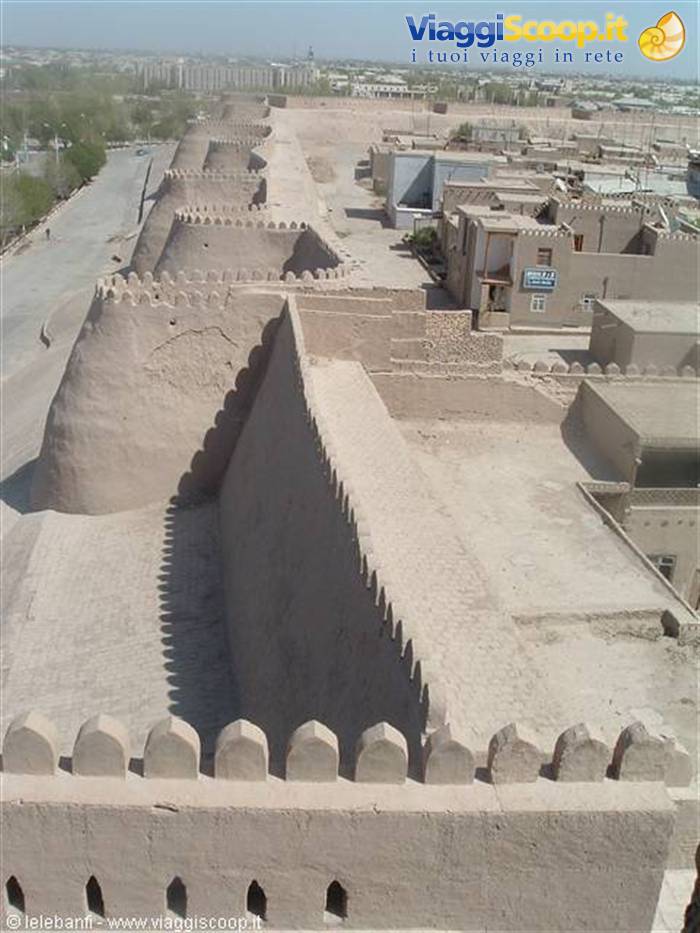
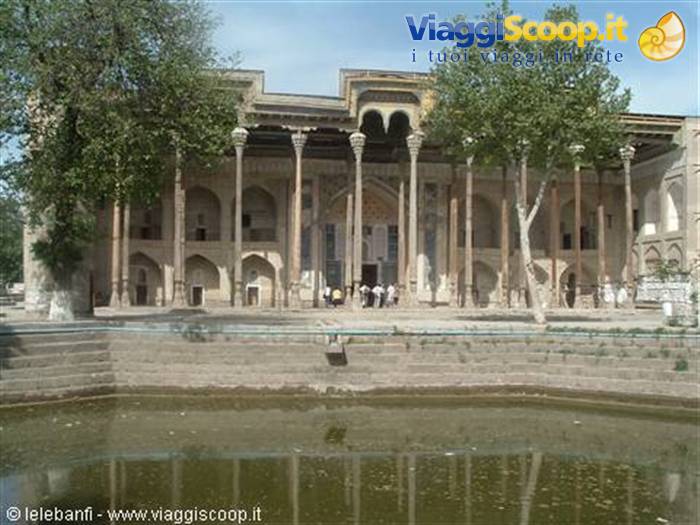
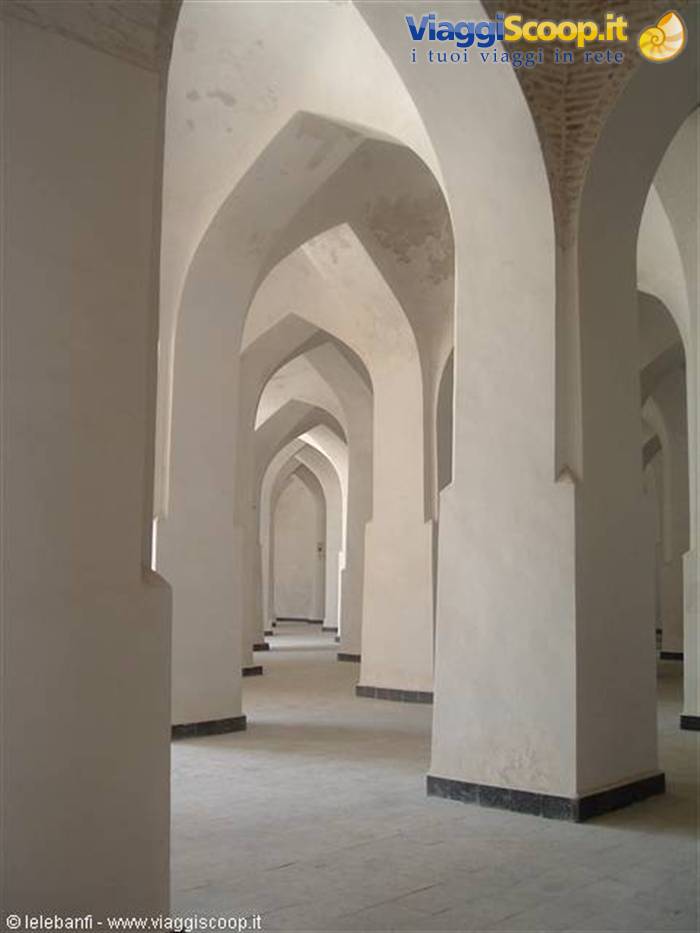
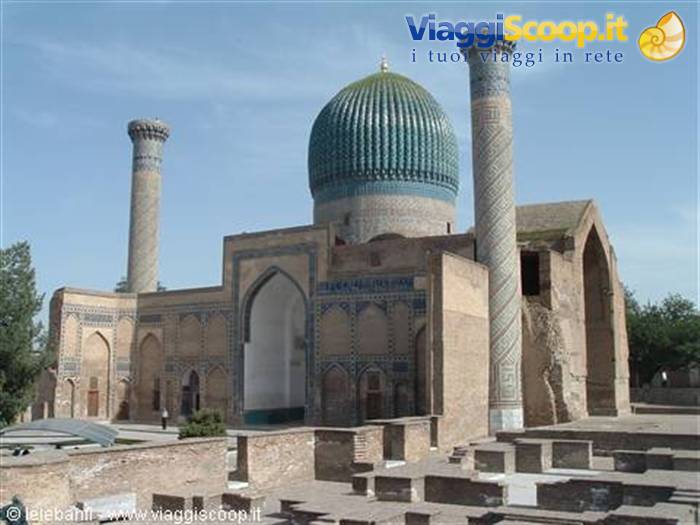
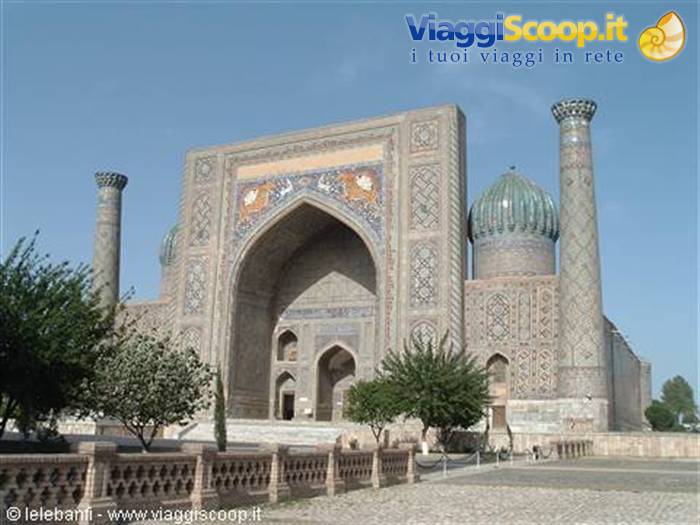
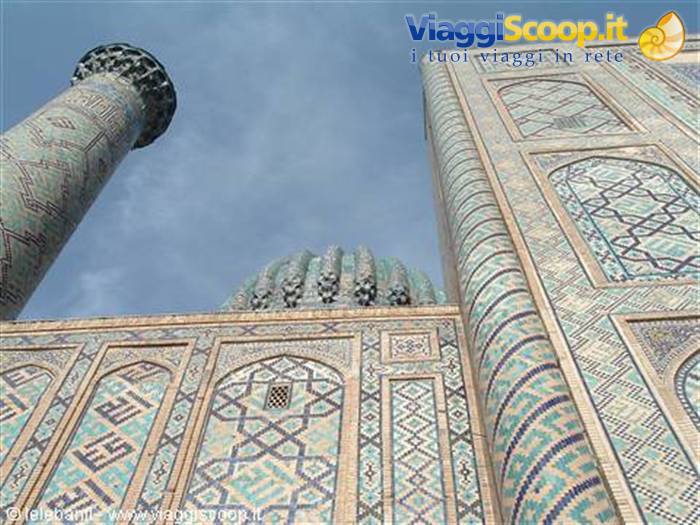
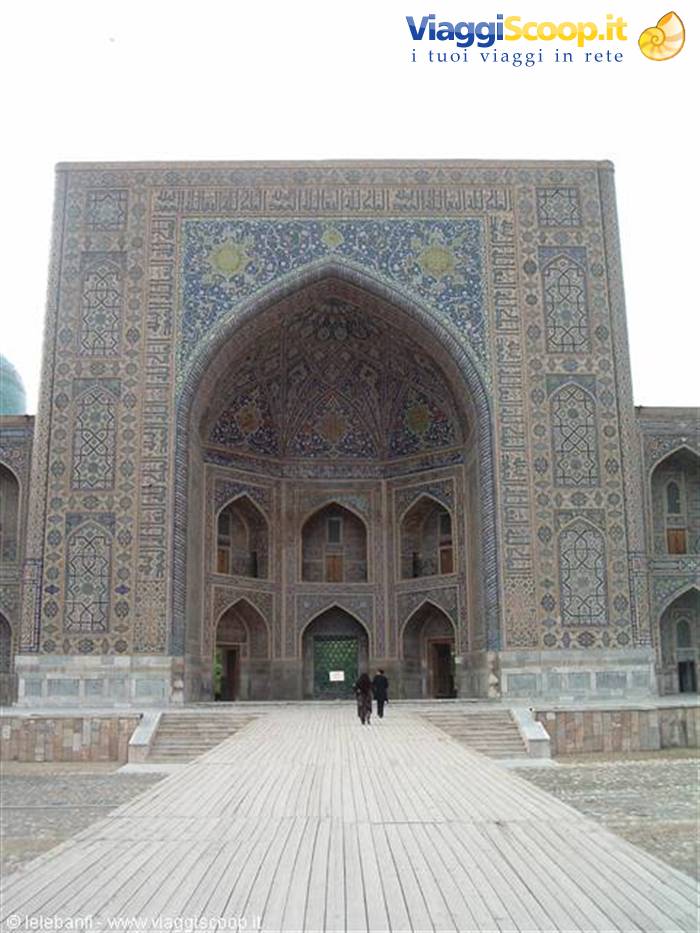
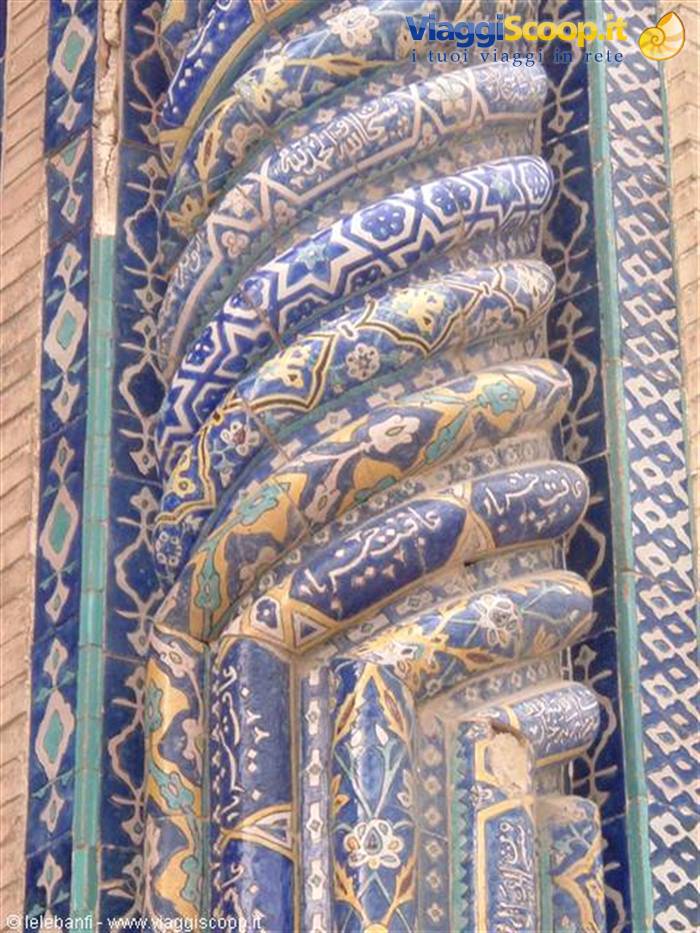

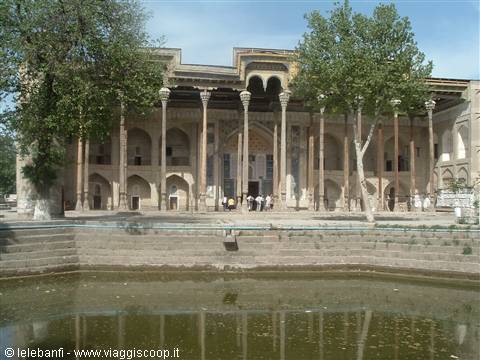
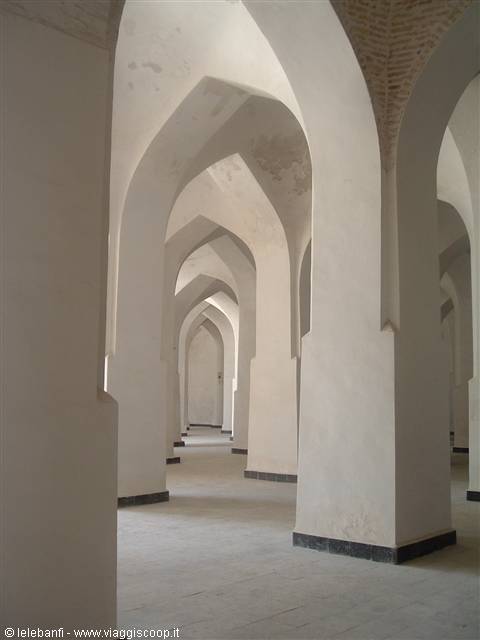
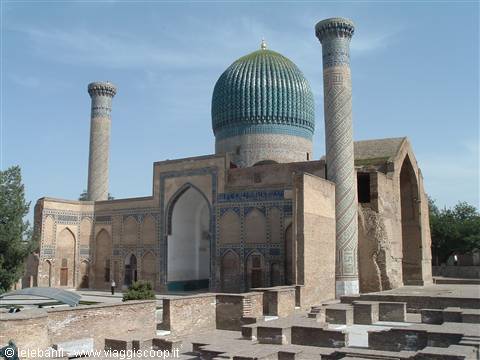
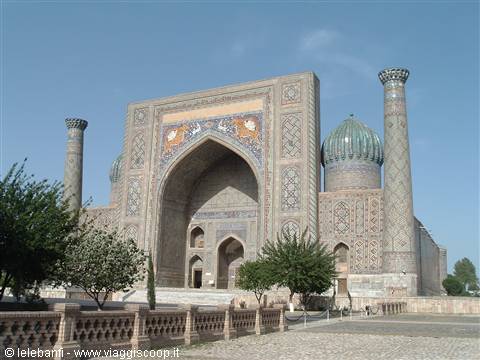
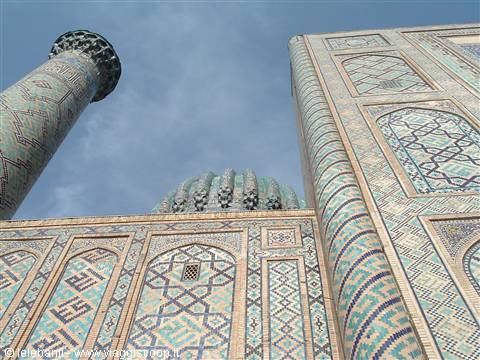

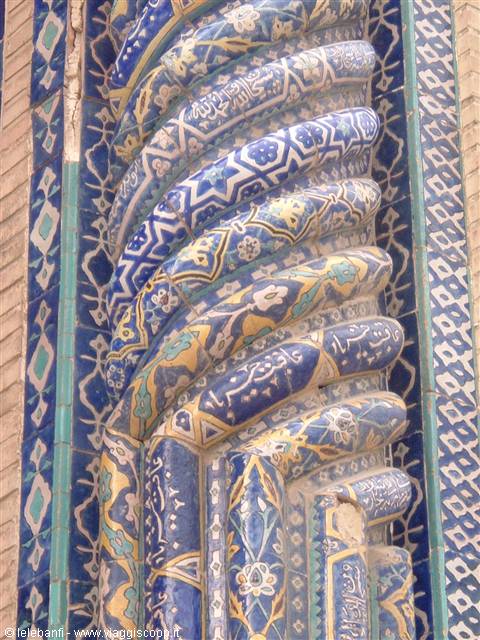
1 reader comments
complimenti per il racconto e le foto..tutto molto dettagliato!